


 Скачать презентацию Zoning and mapping as agrometeorological services in developing
b5062a9fa72370cfc74d84ec2b7cbe0f.ppt
- Количество слайдов: 33
 Zoning and mapping as agrometeorological services in developing countries: preconditions and requirements in a checklist for action C. J. Stigter, Agromet Vision, Bruchem, Netherlands Nawal K. N. Al-amin, Sudan University of Science and Technology, Khartoum, Sudan 1
 We consider belonging to agrometeorological services: 2
 All agrometeorological & agroclimatological knowledge and information that can be directly applied to try to improve and/or protect the livelihood of farmers So yield quantity & quality and income, while safeguarding income the agricultural resource base from degradation. 3 3
 From the beginning we considered as good example of such agrometeorological services: the products of agroclimatological characterization, obtained with whatever methodologies. 4 4
 Agroclimatic zoning (characterization) is most simply seen as the division of an area according to the favourablity for agriculture. The separation of taxonomic agroclimatic units (belts, zones, districts, regions) which differ in climatic resources. 5
 Characterization methods (in seven areas, following Bishnoi) general agricultural suitability n choice of crops, varieties, growing seasons n soil-climatic zones for cropping (systems) n flexible crop planning, covering risks n improvement in crop productivity n assessment of potential productivity n exploitation of agroclimatic resources for specific purposes n 6
 GISs successfully focus primarily on capturing, storing, displaying “natural capital” but much more recently also depict socio-economic indexes and variables Scales and details of the datasets are generally not adequate at farm level. They can support advisory services and contribute to setting the agricultural research agenda 7
 Mapping activities with increasing complexities Basic research support for mapping n Mapping to support basic policy and design decisions for applied research and development n More complex mapping to support decision preparations of government institutions and/or well to do farmers n More complex mapping to serve poorer farmers and/or related NGOs n 8
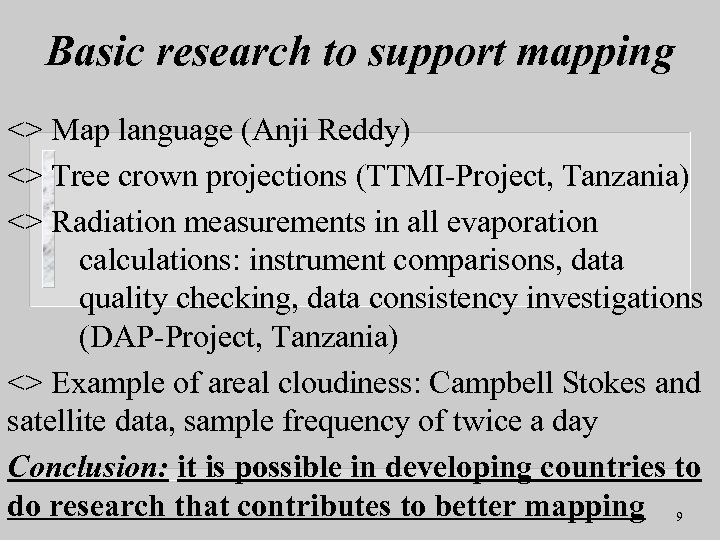 Basic research to support mapping <> Map language (Anji Reddy) <> Tree crown projections (TTMI-Project, Tanzania) <> Radiation measurements in all evaporation calculations: instrument comparisons, data quality checking, data consistency investigations (DAP-Project, Tanzania) <> Example of areal cloudiness: Campbell Stokes and satellite data, sample frequency of twice a day Conclusion: it is possible in developing countries to do research that contributes to better mapping 9
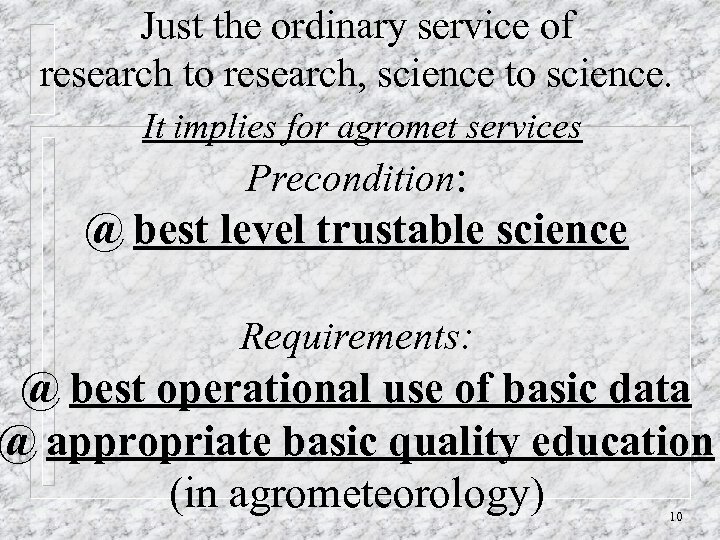 Just the ordinary service of research to research, science to science. It implies for agromet services Precondition: @ best level trustable science Requirements: @ best operational use of basic data @ appropriate basic quality education (in agrometeorology) 10
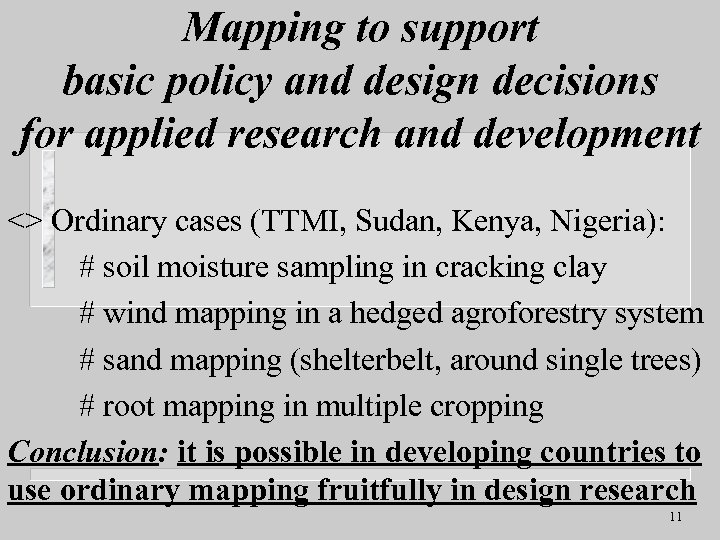 Mapping to support basic policy and design decisions for applied research and development <> Ordinary cases (TTMI, Sudan, Kenya, Nigeria): # soil moisture sampling in cracking clay # wind mapping in a hedged agroforestry system # sand mapping (shelterbelt, around single trees) # root mapping in multiple cropping Conclusion: it is possible in developing countries to use ordinary mapping fruitfully in design research 11
 12
12
 Just the service of mapping to applied research and design studies. It implies for agromet services Precondition (additional): @ knowing regional details of the research questions encountered Requirements (additional): @ best use of relevant basic operational research results obtained elsewhere @ relevant basic policy decisions underlying the research requests 13
 More complex mapping to support decision preparations of government institutions and/or well to do farmers <> general examples but their use as such in the gray literature (example of Baradas in Malaysia) <> China as exception of using disaster mapping in books (CAMS Annual Report); UN <> 20 volumes Agricultural & Forest Meteorology (5 examples, 1. 5 %, only 2 from developing countries) <> 6 volumes (24 issues) WMO Bulletin (1999, 2000, 2001: basically nothing; 2002: little increase, 2003: 14 real change in the making; 2004: very much).
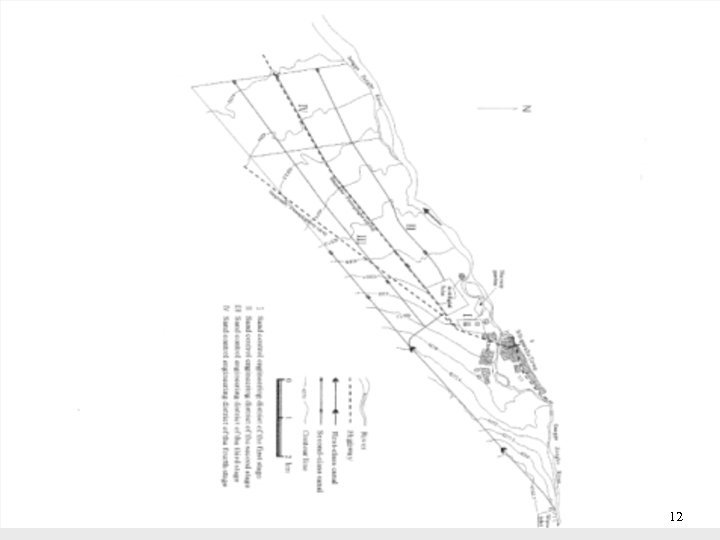
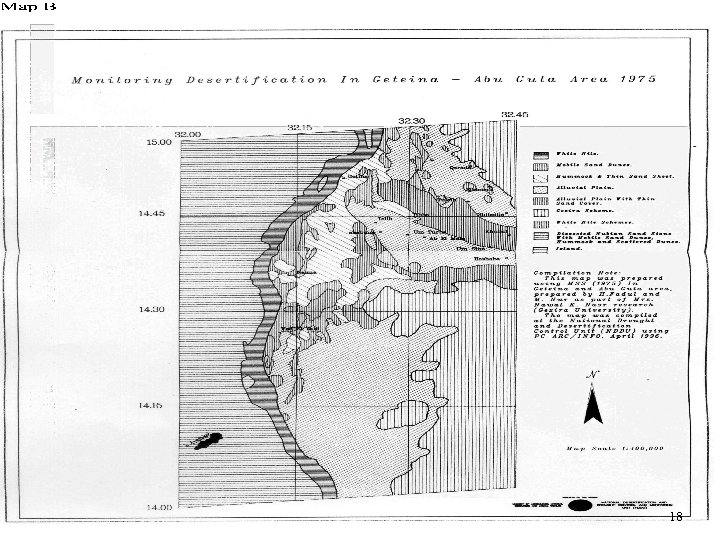
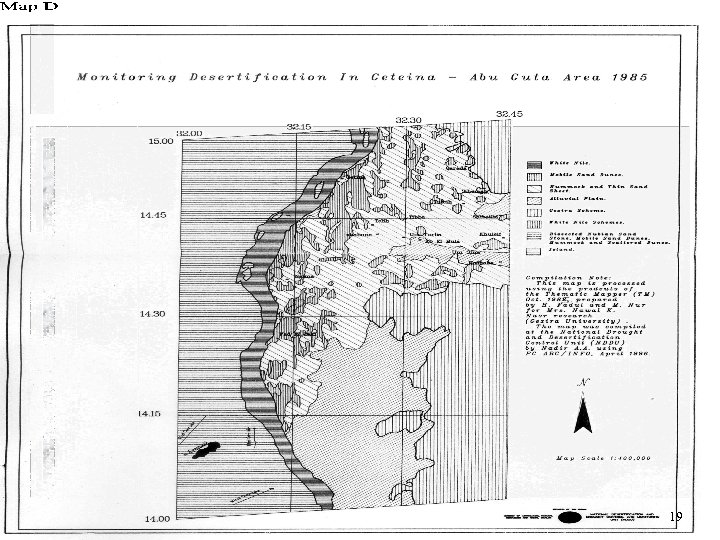
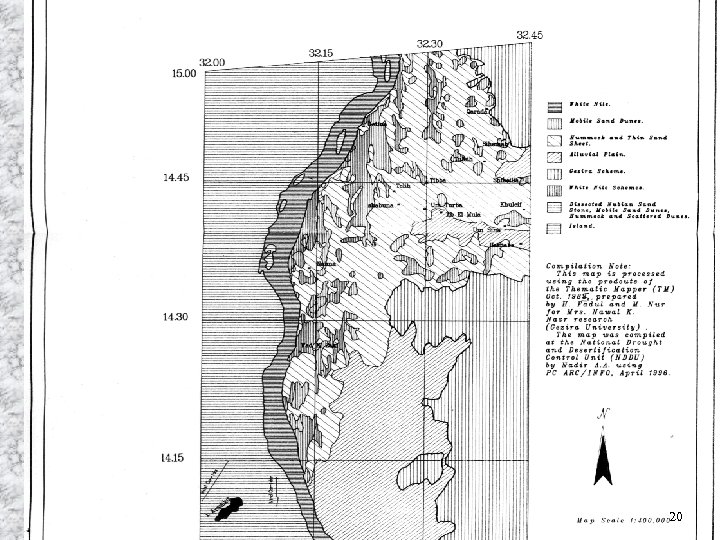
 Conclusion: supportive mapping is in applications, but generally not supporting decisions <> specific examples (Israel: Lomas et al. ; Portugal: Stigter jr. ; Sudan: this paper) <> decision makers can conclude from the interpretation of pictures, in the case of Sudan supported by groundtruth, where and how protective measures should be designed. The above means that already earlier derived tough preconditions demand additional prioritization and additional scientific choices for the applied research 15 necessary to develop priority services.
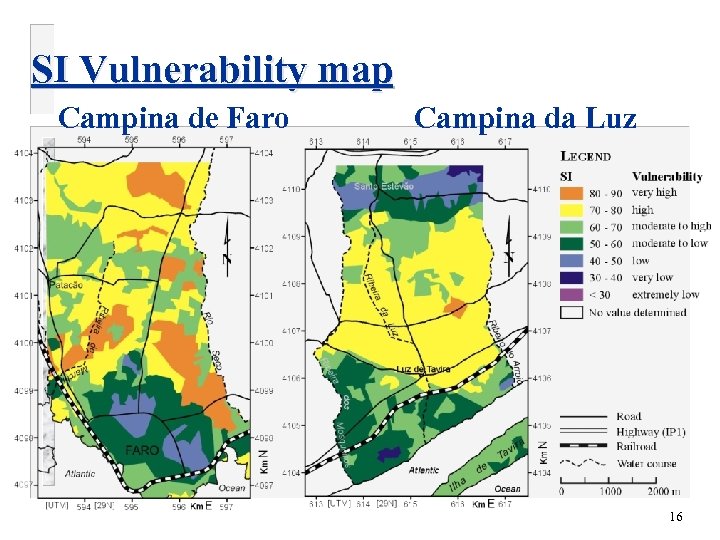 SI Vulnerability map Campina de Faro Campina da Luz 16
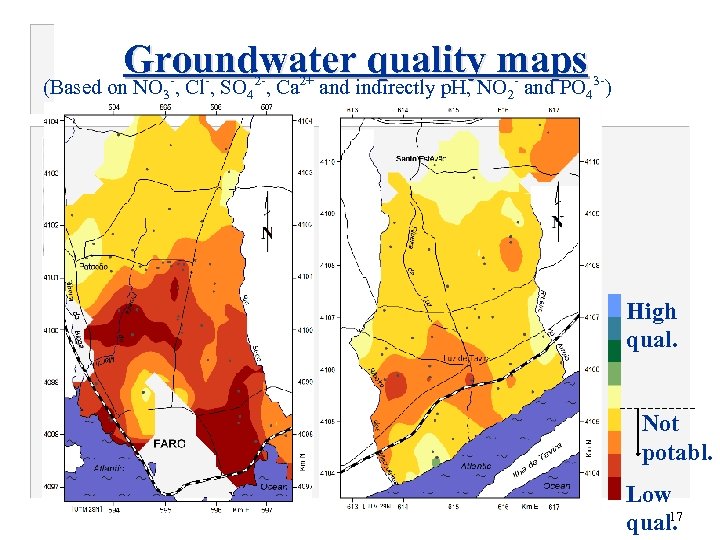 Groundwater quality maps (Based on NO 3 -, Cl-, SO 42 -, Ca 2+ and indirectly p. H, NO 2 - and PO 43 -) High qual. Not potabl. Low 17 qual.
 18
18
 19
19
 20
20
 It implies for agromet services Preconditions (additional): @ appropriate problem selection, together with decision makers for whom agrometeorological services have to be developed @ appropriate knowledge selection, to develop the required applied research focused on services 21
 Requirement (additional): @ to determine appropriate policy environments for action on agrometeorological services, what can be done within the present policy environment (preparedness), and what policies may be necessary in the future for the agrometeorological services to be applied 22
 More complex mapping to serve poorer farmers and/or related NGOs <> CGIAR decision on connecting their GISs on agricultural environments in developing countries: agroecological studies excluding socio-economic data; ten years later: “sustainability” concept at UNCED <> no old literature examples <> CAg. M report on communication of agromet info (Isabirye, in line with Murthy and Stigter; internet ? ? ) <> Carvajal, private communication to Rossi <> INSAM contest on best examples of agrometeorological services 23
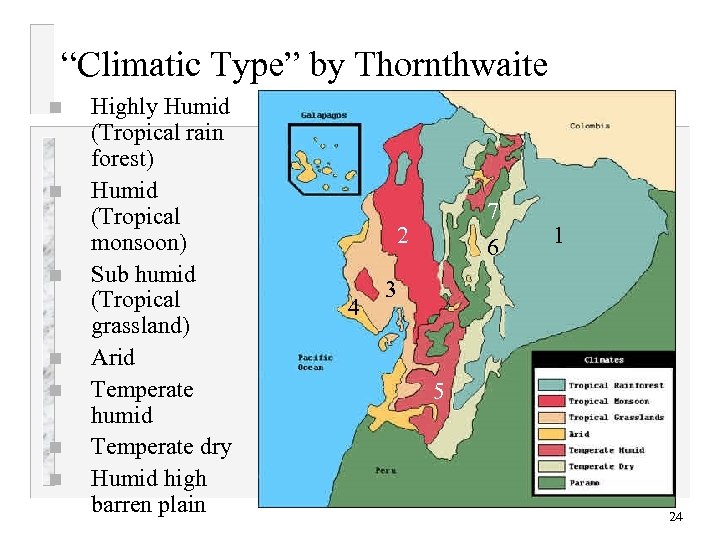 “Climatic Type” by Thornthwaite n n n n Highly Humid (Tropical rain forest) Humid (Tropical monsoon) Sub humid (Tropical grassland) Arid Temperate humid Temperate dry Humid high barren plain 7 6 2 4 1 3 5 24
 It implies for agromet services Precondition (additional): @ knowing poor farmers’ needs the way they see them 25
 Requirement (additional): @ liaisons with farmers, related NGOs and other related decision makers on what they did (traditional preparedness, coping and adaptation strategies), what they can do and what they want to do within the policy environment for agrometeorological services (disaster preparedness and mitigation; land use improvement) 26
 It can be confirmed from these lastly added precondition and requirement that with respect to the livelihood of poorer farmers, bridging the gap between agrometeorological advisory products and such farmers remains the main task of agrometeorologists for the nearest possible future 27
 This confirms conclusions from a CAg. M Management Group meeting in Brazil. We felt that applied researchers need help in bridging the gap. Therefore I also pleaded for training of agrometeorological intermediaries in extension for and training of farmers as decision makers. 28
 The same preconditions and requirements apply to other agrometeorological services for poorer and formally less educated farmers The sequence in each list is now that of a checklist for action 29
 It is these days recognized that sustainable land management is predominantly a conflict resolution issue among the major stakeholders 30
 Summary of preconditions n knowing poor farmers’ needs the way they see them n appropriate problem selection, together with decision makers for whom agrometeorological services have to be developed n knowing regional details of the research questions encountered n appropriate knowledge selection, to develop the required applied research focused on services n best level trustable science 31
 Summary of requirements n liaisons with farmers, related NGOs and other related decision makers on what they did (traditional preparedness, coping and adaptation strategies), what they can do and what they want to do within the policy environ-ment for agrometeorological services (disaster preparedness and mitigation; land use improvement) n to determine appropriate policy environments for action on agrometeorological services, what can be done within the present policy environment (preparedness), and what policies may be necessary in the future for the agrometeorological services to be applied 32
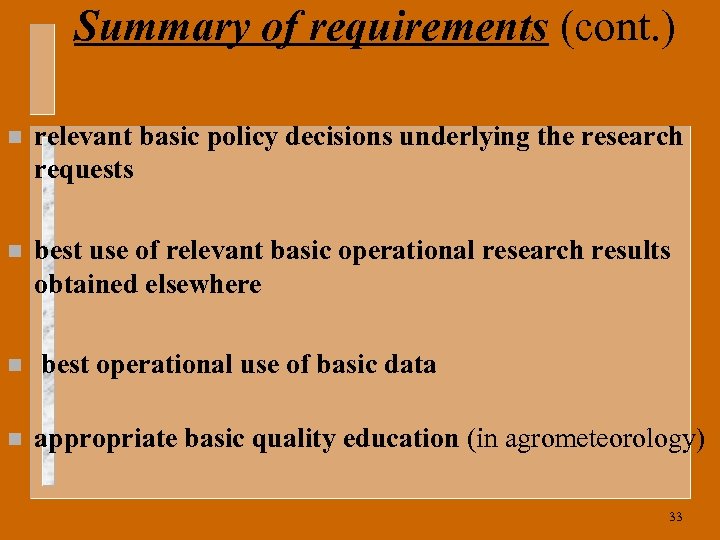 Summary of requirements (cont. ) n relevant basic policy decisions underlying the research requests n best use of relevant basic operational research results obtained elsewhere n n best operational use of basic data appropriate basic quality education (in agrometeorology) 33