


 Скачать презентацию Zoning and Housing Fiscal zoning Thus
823bfa11c9b4a04df137f9dd5b19d2cc.ppt
- Количество слайдов: 18
 Zoning and Housing
 Fiscal zoning • Thus far, we’ve talked about “nuisance” zoning -- keeping out bad stuff. • May be some fiscal aspects. • Most public service (fundamentally education) is financed through property taxes. People in small houses, apartments use services, but pay small amounts of taxes, because they are buying small amounts of housing.
 Some elementary math • Rule of thumb -- Mkt. Value of land 1020% of house value. Suppose that property tax rate is 1%. • Let’s break the land into 1/2 acre plots, and produce $125, 000 houses. This provides $1, 250 per house in tax revenues, which by assumption is break-even.
 Some elementary math • Now, suppose that undeveloped land costs $20, 000/acre. We have 120 acres and it’s divided equally between HI density and SF (single family) developers. • Problem -- If we allow high density development, the units will be small, and worth less than $125, 000, and won’t pay for services that they use.
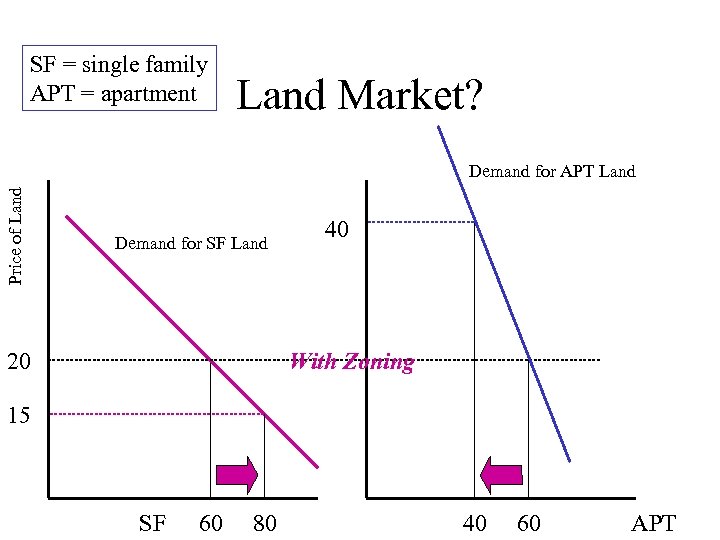 SF = single family APT = apartment Land Market? Price of Land Demand for APT Land Demand for SF Land 20 40 With Zoning 15 SF 60 80 40 60 APT
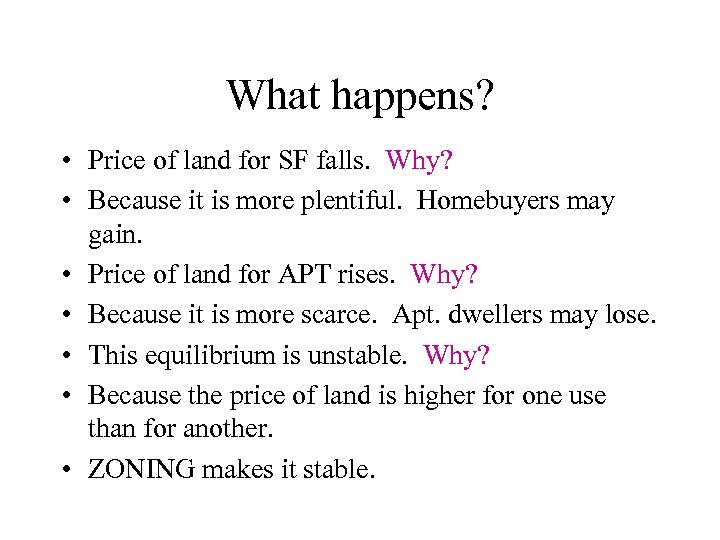 What happens? • Price of land for SF falls. Why? • Because it is more plentiful. Homebuyers may gain. • Price of land for APT rises. Why? • Because it is more scarce. Apt. dwellers may lose. • This equilibrium is unstable. Why? • Because the price of land is higher for one use than for another. • ZONING makes it stable.
 What if we didn’t have zoning? • City of Houston doesn’t. – Industry is dispersed like other cities – Same patterns of retailing – Somewhat more strip development – Plenty of low income housing • So: – Without zoning, there is an incentive to negotiate some restrictions anyhow. – Market forces seem to hold
 Housing -- Why is it Different? • Why? – Housing is heterogeneous – Housing is immobile – Housing is durable – Housing is expensive – Moving costs are high – Neighborhood comes with housing … and it matters!
 Heterogeneous? • Dwellings differ in: – house size (sq. feet) – lot size (sq. feet) – configuration – quality • People seem to value these qualities differently.
 Immobile? • It is where it is. Where you buy it, you get: – Accessibility (to good and bad things) – Package of local public services – Environmental quality • Further – You can’t (really) “move” houses – You can’t rebundle them (use half of two different houses at the same time).
 Price: The Hedonic Approach • Hedonic approach looks at house as a bundle of components. • Analogy: Suppose that when you went to the grocery store, all you could buy were “filled” shopping carts (food, soaps, etc. ), and each one had a price. • You know what’s in them, but you can’t take things out or put things in.
 Price: The Hedonic Approach • How do you figure out what the individual components are worth? • A> If you had a large sample of carts, and each had different amounts of goods in them, then you could come up with the value of the individual components.
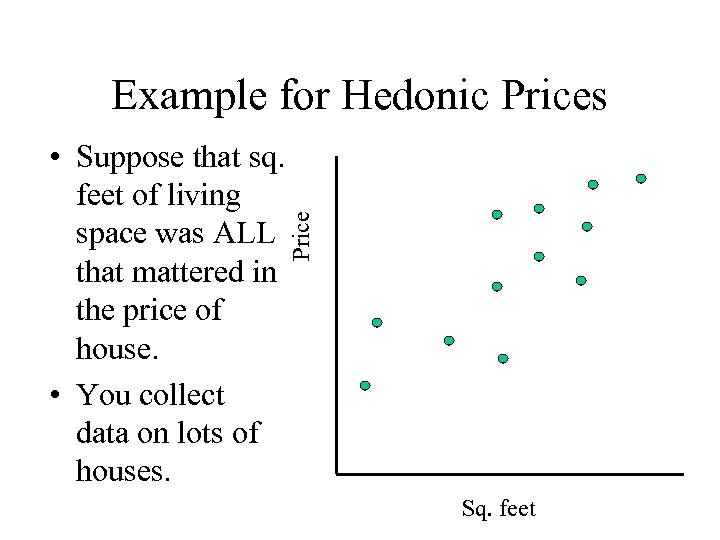 • Suppose that sq. feet of living space was ALL that mattered in the price of house. • You collect data on lots of houses. Price Example for Hedonic Prices Sq. feet
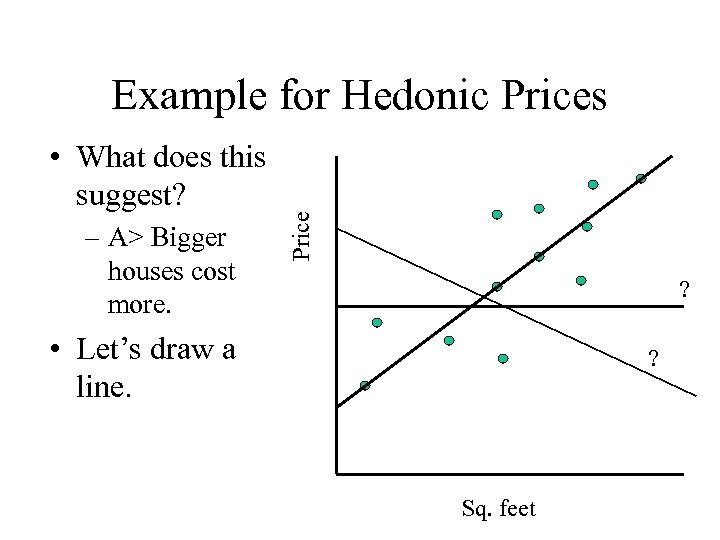 • What does this suggest? – A> Bigger houses cost more. Price Example for Hedonic Prices ? • Let’s draw a line. ? Sq. feet
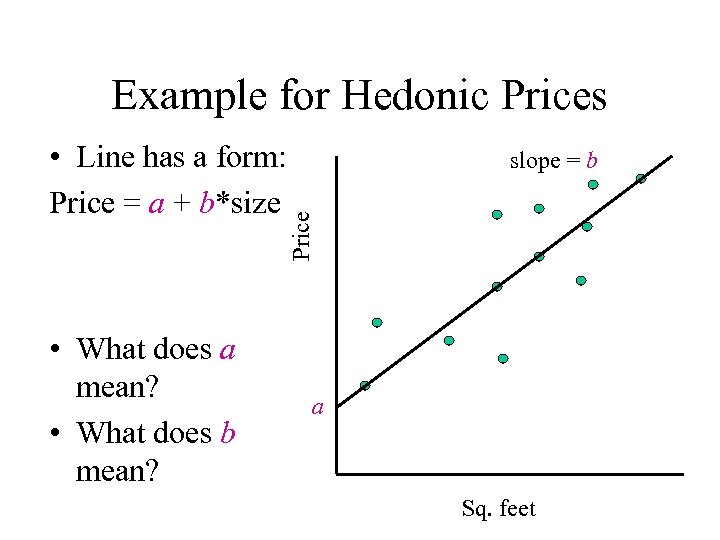 Example for Hedonic Prices • What does a mean? • What does b mean? slope = b Price • Line has a form: Price = a + b*size a Sq. feet
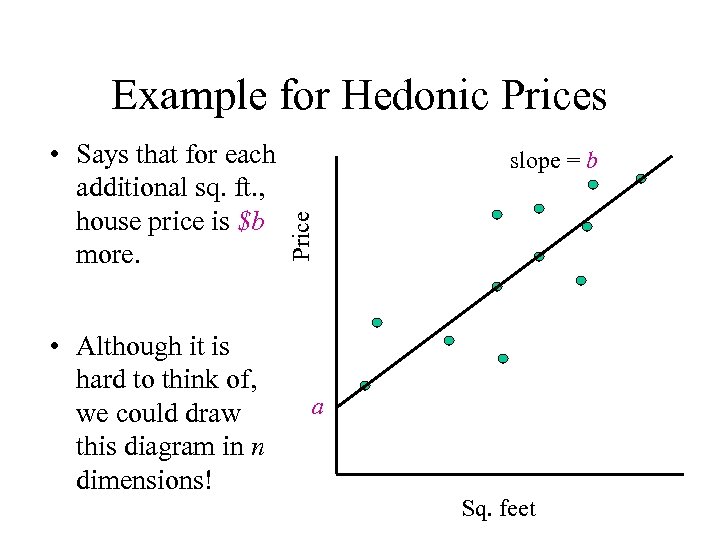 Example for Hedonic Prices • Although it is hard to think of, we could draw this diagram in n dimensions! slope = b Price • Says that for each additional sq. ft. , house price is $b more. a Sq. feet
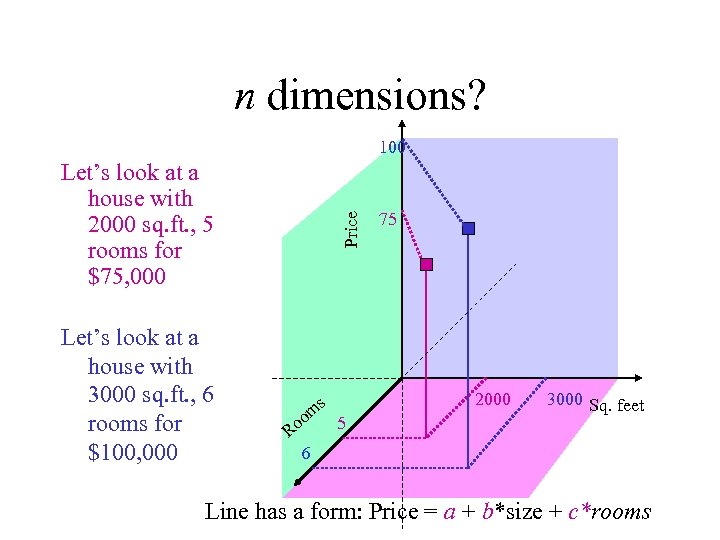 n dimensions? 100 Let’s look at a house with 3000 sq. ft. , 6 rooms for $100, 000 Price Let’s look at a house with 2000 sq. ft. , 5 rooms for $75, 000 s om Ro 6 75 2000 5 3000 Sq. feet Line has a form: Price = a + b*size + c*rooms
 Wrap up! • This allows us to impute the valuations of all kinds of components of the bundle. The incremental valuation is called the “hedonic price. ” Was invented in Detroit! • For more exposure to statistics, see FGS-3 reading in package. • We will be doing some!