 Скачать презентацию Zimbabwe Agenda for Sustainable Socio Economic Transformation Zim
cb8703de8313086246fae394e5a7ebe5.ppt
- Количество слайдов: 15



Zimbabwe Agenda for Sustainable Socio. Economic Transformation (Zim Asset) “ Towards an Empowered Society and a Growing Economy” TECHNOLOGY AS A KEY DRIVER FOR Zim Asset Dr S. Chindaro (Ph. D, MSc, B. Eng, CEng, MIET ) 1 London 07/12/13
OUTLINE Zim Asset Motivation Clusters Key Drivers Why Focus on Technology Zim Asset – Technology Driven Peace, Security and Defence Biometrics ICT Results Matrix Remarks and Conclusion 2
Zim Asset – The Motivation Accelerated economic growth and wealth creation Sustainable development and social equity Indigenisation, empowerment and employment creation Exploitation of country’s abundant human and natural resources Results Based Agenda for Results Based Government and Results Based Management of Ministries 3
Zim Asset –The Clusters 4 Clusters -To enable the government to prioritise programmes and projects: Food Security and Nutrition Social Services and Poverty Eradication Infrastructure and Utilities Value Addition and Beneficiation 4
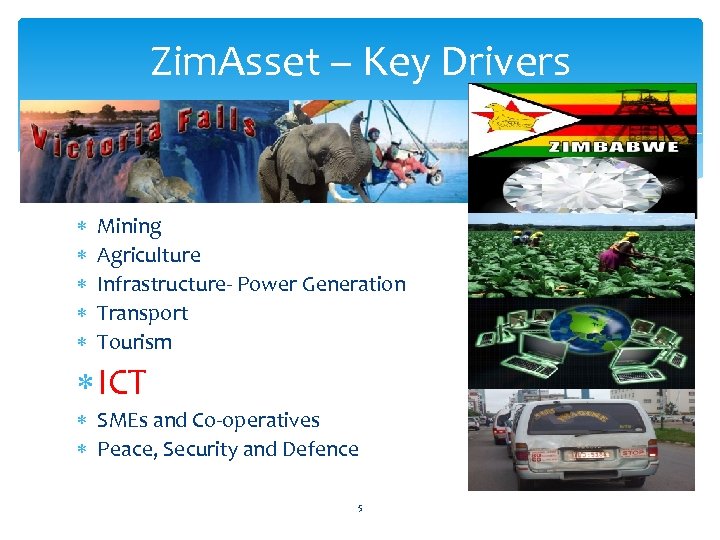
Zim. Asset – Key Drivers Mining Agriculture Infrastructure- Power Generation Transport Tourism ICT SMEs and Co-operatives Peace, Security and Defence 5
Why Focus on Technology? “ICTs is a critical pillar and driver for knowledge-based economic transition” “Unless the developing countries adopt policies to stimulate technological catch-up with the rest of the world, they will continue to fall behind other countries technologically and face deepening marginalization in the global economy” Universal recognition that science, technology and innovation (STI) play a significant role in a country’s economic development and are key contributors to poverty reduction, health care, environmental conservation and development of the knowledge society, through their ability to solve problems and initiate and sustain economic growth. Human capital development that is conducive towards developing a society characterized by skilled, flexible and innovative individuals nurtured through quality education and training. -``UNCTAD (2007): Knowledge, Technological Learning and Innovation for Development - UN Economic Commission for Africa (UNECA) (2010 b 6
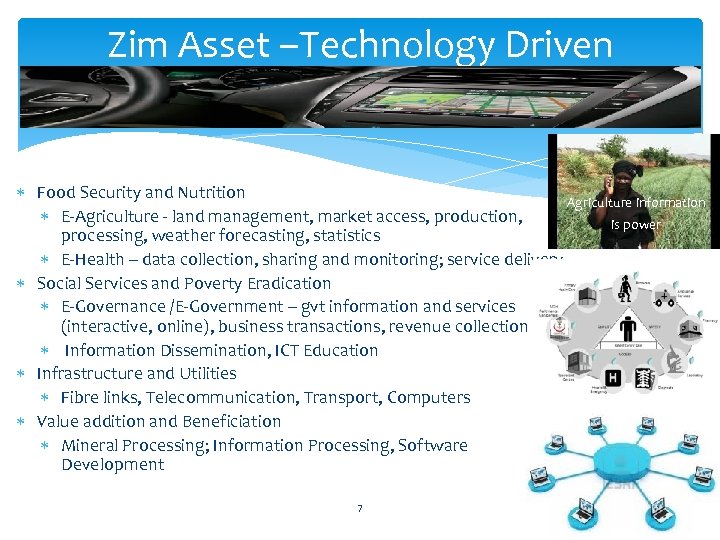
Zim Asset –Technology Driven Food Security and Nutrition Agriculture information E-Agriculture - land management, market access, production, is power processing, weather forecasting, statistics E-Health – data collection, sharing and monitoring; service delivery Social Services and Poverty Eradication E-Governance /E-Government – gvt information and services (interactive, online), business transactions, revenue collection Information Dissemination, ICT Education Infrastructure and Utilities Fibre links, Telecommunication, Transport, Computers Value addition and Beneficiation Mineral Processing; Information Processing, Software Development 7
Peace, Security and Defence Technology for ensuring national security Pace of scientific and ICT innovation -> new technologies appearing faster than Zimbabwe can integrate them Zimbabwe facing an increasingly capable and diverse range of threats Cyberspace is complex rapidly changing/interconnections – cyber threats Extract information from sensors, multiple data sources and media streams; identify and assess risks and threats Research/analysis which will enable national security decisionmakers to understand emerging impacts of technology and integrate them effectively into policies. 8
BIOMETRICS “Passport, national identity cards, birth certificates etc application queues at the RG’s Offices eliminated; Waiting period for passport reduced to 10 working days. ” (Zim. Asset on e-gvt) Biometrics should be the driver in passports and IDs automation Biometrics Passports Biometric IDs The question of credibility of elections has been centred on the voters roll Zimbabwe has always captured fingerprints and faces for IDs – nothing new Examples: DRC, Burkina Faso, Tanzania, Zambia, Mozambique, Malawi, Rwanda, Senegal, Cameroon, Somaliland, Kenya and Uganda. Vital to eliminate this “controversy” by considering use of Biometrics for voter registration and verification Defence, Peace and Security – biometrics will assist crime and terrorism fighting S. Chindaro, ‘Biometrics tech for Zim polls’, Zimbabwe Independent, 22 February 2013. 9 S. Chindaro, ‘The Feasibility of Using Biometrics Technology for Zimbabwe Elections’, SWRadio; July 2013
History of ICT Policies National Information and Communication Technology Policy Framework in 2005 MICT – Strategic Plan 2010 -2014 Draft Information and Communication Technology (ICT) Policy (2012) – Plagiarised ^ Draft Information and Communication Technology (ICT) Policy (2012)- No. 2 – After Exposure Zim. Asset - ICT as a Driver (propose another Policy!) ^S. Chindaro ‘Chamisa’s recycled Draft ICT Policy (2012)’ Sunday Mail: 13 January 2013. 10
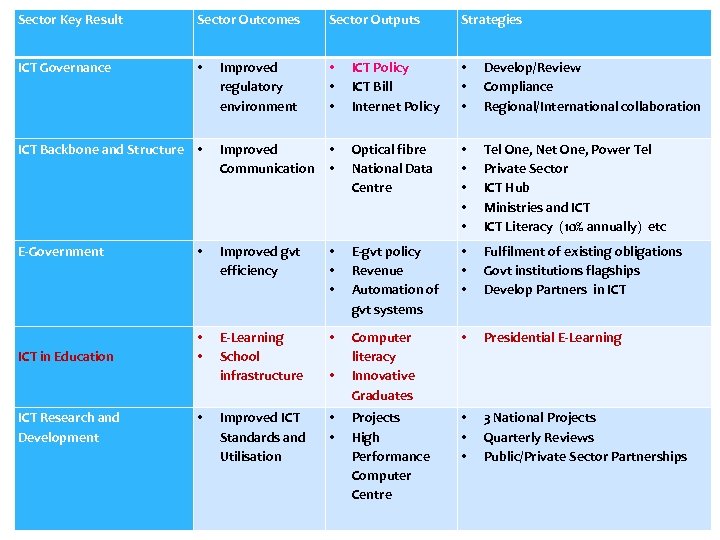
Sector Key Result Sector Outcomes ICT Governance • Sector Outputs Strategies Improved regulatory environment • • • ICT Policy ICT Bill Internet Policy • • • Develop/Review Compliance Regional/International collaboration ICT Backbone and Structure • Improved Communication • • Optical fibre National Data Centre • • • Tel One, Net One, Power Tel Private Sector ICT Hub Ministries and ICT Literacy (10% annually) etc E-Government • Improved gvt efficiency • • • E-gvt policy Revenue Automation of gvt systems • • • Fulfilment of existing obligations Govt institutions flagships Develop Partners in ICT in Education • • E-Learning School infrastructure • Computer literacy Innovative Graduates • Presidential E-Learning ICT Research and Development • Improved ICT Standards and Utilisation • • Projects High Performance Computer Centre • • • 3 National Projects Quarterly Reviews Public/Private Sector Partnerships • 11
POLICY COHERENCE No Specific “ICT in Education Policy” MICT, Ministry of Science and Technology and Ministry of Education – different policies Competition/Grand-standing – divergent policies Create a common vision of the Knowledge Society across all government departments to secure support from the highest levels of government as well as academia, research communities, industry and with the public. Set up an Inter-Ministerial committee to spearhead KS initiatives. S. Chindaro, ‘ICT in education — The way to go’ Newsday ; 14 September 2013 S. Chindaro, ‘Call for dedicated Policy on ICT in Education for Zimbabwe’ Tech. Zim, 25 September 2013 12
REMARKS Knowledge as a resource + technological infrastructure (ICT) for access = knowledge for development. Enhance efficient use of knowledge and technological infrastructure in agriculture, mining, industry and services to enhance economic and social development of Zimbabwe. Education and Innovation should be viewed as interrelated drivers for socioeconomic development of Zimbabwe, in a context where ICT is the enabler for both Innovation and Education. Expanded Education, Research and Development should be positioned for creating awareness regarding the significance of Science and Technology for building capacity for the development and strengthening of Innovation systems. A comprehensive approach to Science, Technology and Innovation should be developed which goes beyond activities and institutions that lie within the responsible ministries and seeks the involvement of all line ministries and agencies, and mobilizes the private sector, academia and donors. 13
Conclusion Commend Zim gvt for coming up with a RESULT oriented policy document Participation of all citizens vital – inclusion should also be gvt driven (diaspora initiatives? ) Technology (and innovation/home grown solutions) should be the cornerstone (my view) Build a solid National Telecommunications Infrastructure Strive to ensure access for all Provide a proper cyber-legal environment Integrate e-governance across all citizen services Promote ICT literacy to all citizens Ensure policy coherence (I acknowledge the inter-dependence of this and a lot of other development issues – in particular general infrastructure and energy availability) 14
THANK YOU Unity is strength. . . when there is teamwork and collaboration, wonderful things can be achieved 15
Скачать презентацию Zimbabwe Agenda for Sustainable Socio Economic Transformation Zim
cb8703de8313086246fae394e5a7ebe5.ppt