 Скачать презентацию Zigbee IEEE 802 15 4 Σαράντης Πασκαλής paskalis di
cf986ef01f3ae8618e62dd7d33d0b64c.ppt
- Количество слайдов: 42



Zigbee, IEEE 802. 15. 4 Σαράντης Πασκαλής <paskalis@di. uoa. gr> Εθνικό και Καποδιστριακό Πανεπιστήμιο Αθηνών 1
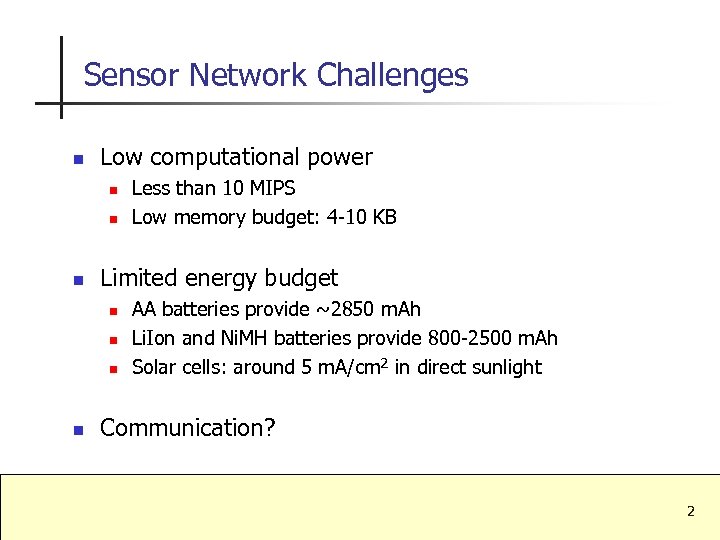
Sensor Network Challenges n Low computational power n n n Limited energy budget n n Less than 10 MIPS Low memory budget: 4 -10 KB AA batteries provide ~2850 m. Ah Li. Ion and Ni. MH batteries provide 800 -2500 m. Ah Solar cells: around 5 m. A/cm 2 in direct sunlight Communication? 2
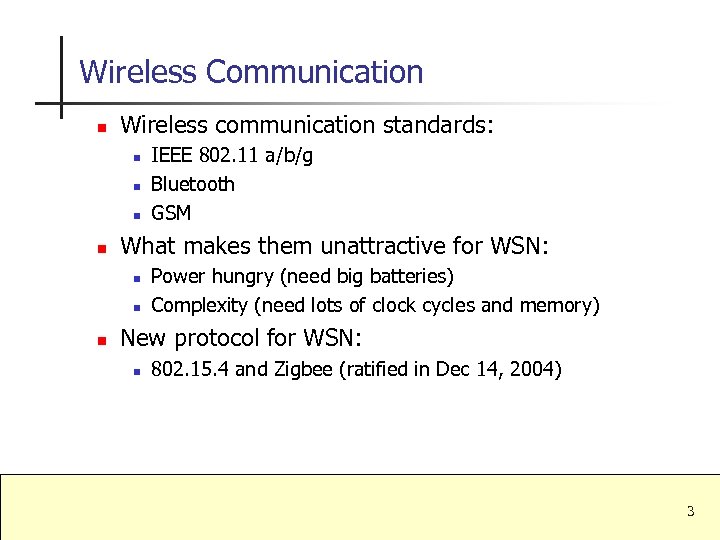
Wireless Communication n Wireless communication standards: n n What makes them unattractive for WSN: n n n IEEE 802. 11 a/b/g Bluetooth GSM Power hungry (need big batteries) Complexity (need lots of clock cycles and memory) New protocol for WSN: n 802. 15. 4 and Zigbee (ratified in Dec 14, 2004) 3
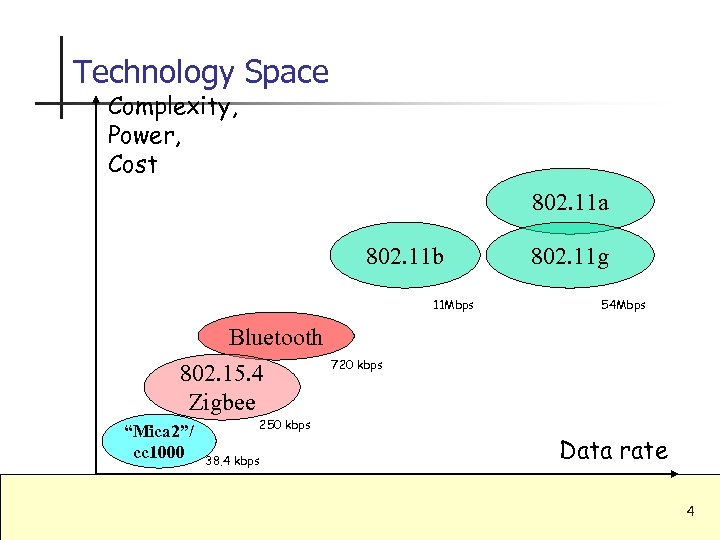
Technology Space Complexity, Power, Cost 802. 11 a 802. 11 b 11 Mbps 802. 11 g 54 Mbps Bluetooth 802. 15. 4 Zigbee “Mica 2”/ cc 1000 250 kbps 38. 4 kbps 720 kbps Data rate 4
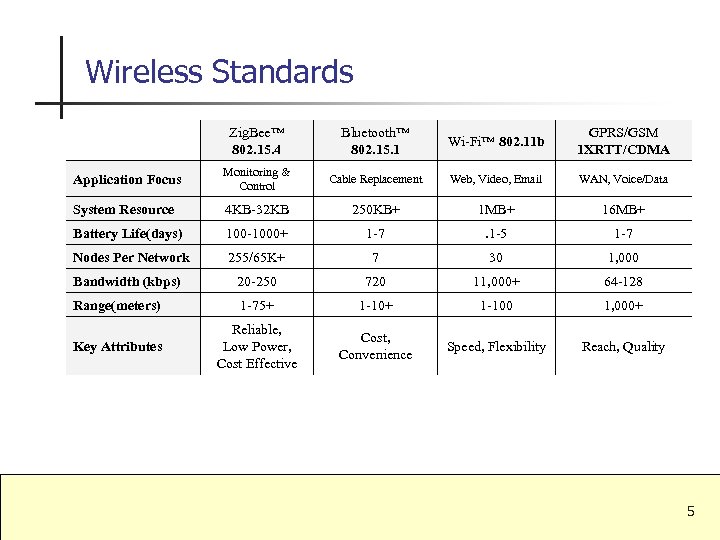
Wireless Standards Zig. Bee™ 802. 15. 4 Bluetooth™ 802. 15. 1 Wi-Fi™ 802. 11 b GPRS/GSM 1 XRTT/CDMA Application Focus Monitoring & Control Cable Replacement Web, Video, Email WAN, Voice/Data System Resource 4 KB-32 KB 250 KB+ 1 MB+ 16 MB+ Battery Life(days) 100 -1000+ 1 -7 . 1 -5 1 -7 Nodes Per Network 255/65 K+ 7 30 1, 000 Bandwidth (kbps) 20 -250 720 11, 000+ 64 -128 Range(meters) 1 -75+ 1 -100 1, 000+ Key Attributes Reliable, Low Power, Cost Effective Cost, Convenience Speed, Flexibility Reach, Quality 5
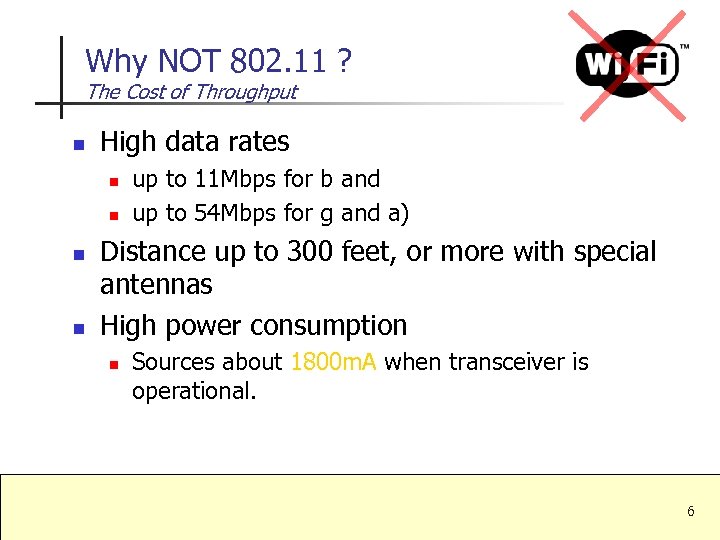
Why NOT 802. 11 ? The Cost of Throughput n High data rates n n up to 11 Mbps for b and up to 54 Mbps for g and a) Distance up to 300 feet, or more with special antennas High power consumption n Sources about 1800 m. A when transceiver is operational. 6
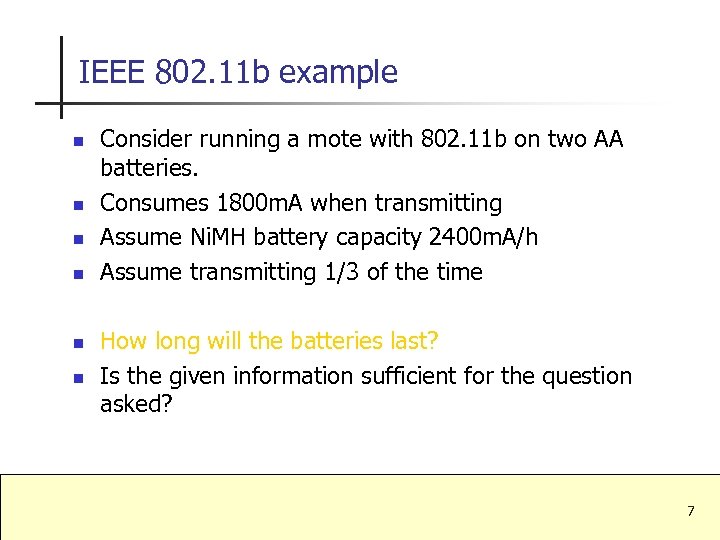
IEEE 802. 11 b example n n n Consider running a mote with 802. 11 b on two AA batteries. Consumes 1800 m. A when transmitting Assume Ni. MH battery capacity 2400 m. A/h Assume transmitting 1/3 of the time How long will the batteries last? Is the given information sufficient for the question asked? 7
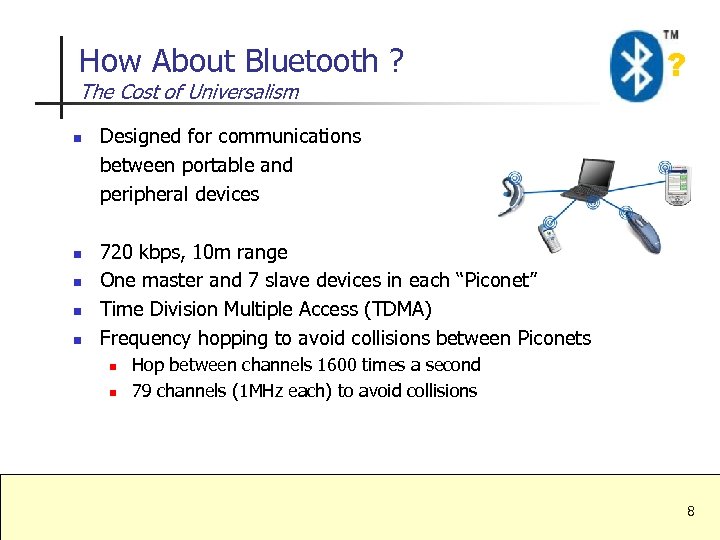
How About Bluetooth ? The Cost of Universalism n n n ? Designed for communications between portable and peripheral devices 720 kbps, 10 m range One master and 7 slave devices in each “Piconet” Time Division Multiple Access (TDMA) Frequency hopping to avoid collisions between Piconets n n Hop between channels 1600 times a second 79 channels (1 MHz each) to avoid collisions 8
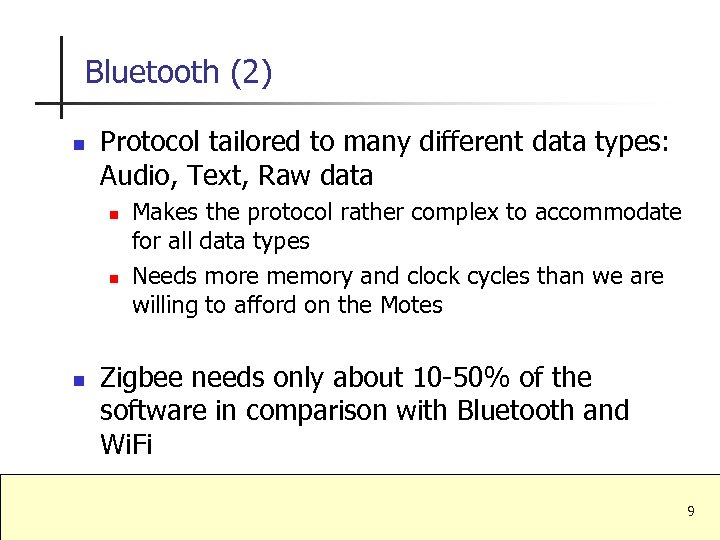
Bluetooth (2) n Protocol tailored to many different data types: Audio, Text, Raw data n n n Makes the protocol rather complex to accommodate for all data types Needs more memory and clock cycles than we are willing to afford on the Motes Zigbee needs only about 10 -50% of the software in comparison with Bluetooth and Wi. Fi 9
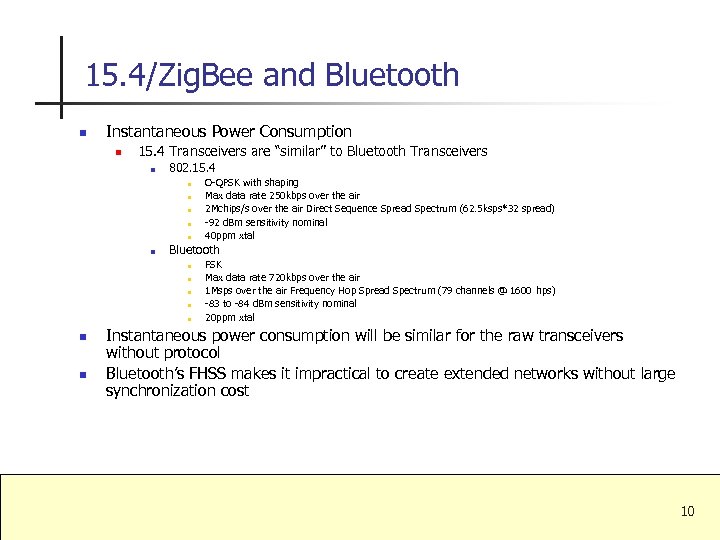
15. 4/Zig. Bee and Bluetooth n Instantaneous Power Consumption n 15. 4 Transceivers are “similar” to Bluetooth Transceivers n 802. 15. 4 n n n Bluetooth n n n n O-QPSK with shaping Max data rate 250 kbps over the air 2 Mchips/s over the air Direct Sequence Spread Spectrum (62. 5 ksps*32 spread) -92 d. Bm sensitivity nominal 40 ppm xtal FSK Max data rate 720 kbps over the air 1 Msps over the air Frequency Hop Spread Spectrum (79 channels @ 1600 hps) -83 to -84 d. Bm sensitivity nominal 20 ppm xtal Instantaneous power consumption will be similar for the raw transceivers without protocol Bluetooth’s FHSS makes it impractical to create extended networks without large synchronization cost 10
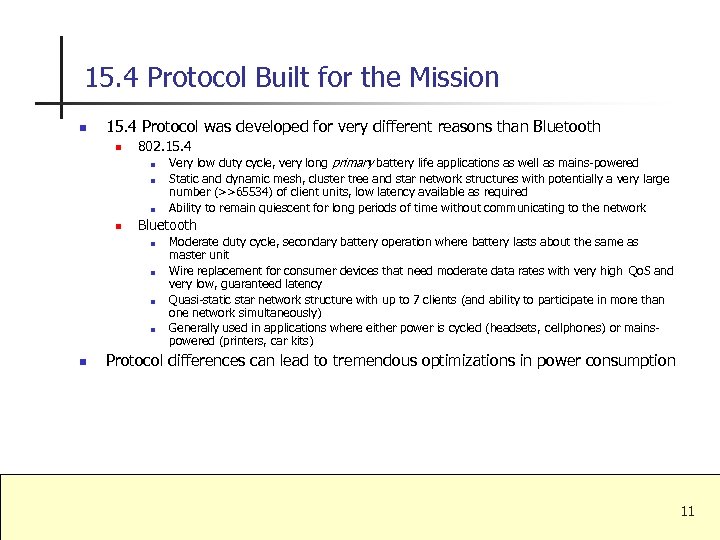
15. 4 Protocol Built for the Mission n 15. 4 Protocol was developed for very different reasons than Bluetooth n 802. 15. 4 n n Bluetooth n n n Very low duty cycle, very long primary battery life applications as well as mains-powered Static and dynamic mesh, cluster tree and star network structures with potentially a very large number (>>65534) of client units, low latency available as required Ability to remain quiescent for long periods of time without communicating to the network Moderate duty cycle, secondary battery operation where battery lasts about the same as master unit Wire replacement for consumer devices that need moderate data rates with very high Qo. S and very low, guaranteed latency Quasi-static star network structure with up to 7 clients (and ability to participate in more than one network simultaneously) Generally used in applications where either power is cycled (headsets, cellphones) or mainspowered (printers, car kits) Protocol differences can lead to tremendous optimizations in power consumption 11
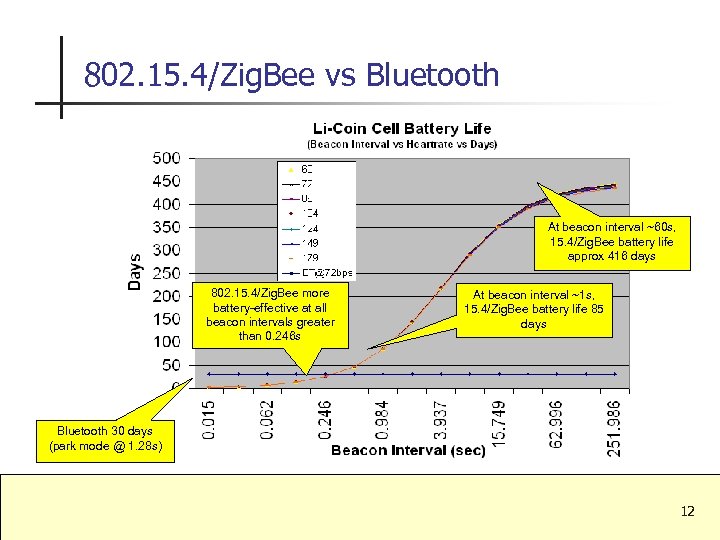
802. 15. 4/Zig. Bee vs Bluetooth At beacon interval ~60 s, 15. 4/Zig. Bee battery life approx 416 days 802. 15. 4/Zig. Bee more battery-effective at all beacon intervals greater than 0. 246 s At beacon interval ~1 s, 15. 4/Zig. Bee battery life 85 days Bluetooth 30 days (park mode @ 1. 28 s) 12
How About X-10? n n ? Targeted for home automation Originally used power lines as transmission media. Later RF communication was added. Mainly used to transmit a few codes to turn on or off other devices, aka. Remote control. Very simple protocol n n n 4 -bit house code (group address) 4 -bit unit code (device address) 1 -bit on/off command (data) 13
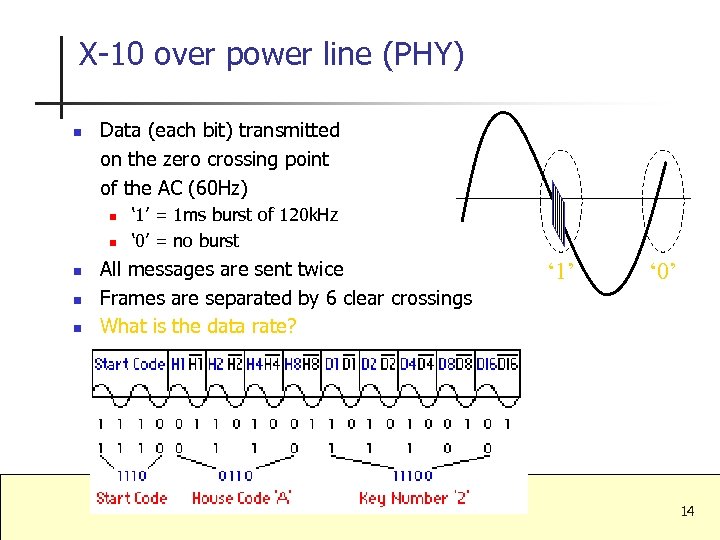
X-10 over power line (PHY) n Data (each bit) transmitted on the zero crossing point of the AC (60 Hz) n n n ‘ 1’ = 1 ms burst of 120 k. Hz ‘ 0’ = no burst All messages are sent twice Frames are separated by 6 clear crossings What is the data rate? ‘ 1’ ‘ 0’ 14
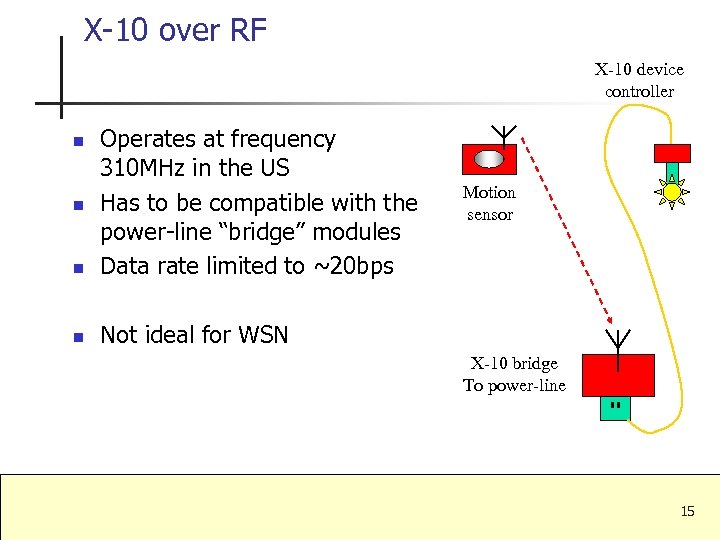
X-10 over RF X-10 device controller n Operates at frequency 310 MHz in the US Has to be compatible with the power-line “bridge” modules Data rate limited to ~20 bps n Not ideal for WSN n n Motion sensor X-10 bridge To power-line 15
X-10 video over RF n X 10 has a high data rate extension allowing to transmit video over RF at 2. 4 GHz n Channel A: 2. 411 GHz Channel B: 2. 434 GHz Channel C: 2. 453 GHz n Channel D: 2. 473 GHz n n Proprietary protocol for NTSC video signal transmission NOT secure! 16
What is Zigbee n Zig. Bee is a published specification set of high level communication protocols for: n n Formely known as n n Low data rate, low power, low cost wireless systems operating in unlicensed RF domain PURLnet, RF-Lite, Firefly, and Home. RF Lite Based on IEEE 802. 15. 4 17
Zig. Bee Applications n n n n Wireless home security Remote thermostats for air conditioner Remote lighting, drape controller Call button for elderly and disabled Universal remote controller to TV and radio Wireless keyboard, mouse and game pads Wireless smoke, CO detectors Industrial and building automation and control (lighting, etc. ) 18
Zigbee General n Low power n n Multiple topologies n n n star, peer-to-peer, mesh Addressing space: 64 bits n n battery life multi-month to years Question: how many nodes? Fully hand-shake protocol (reliability) Range: 50 m typical n 5 -500 m based on environment 19
Zigbee Intended Traffic n n n Periodic data Intermittent data Application defined rate (e. g. , sensors) External stimulus defined rate (e. g. , light switch) Low latency data 20
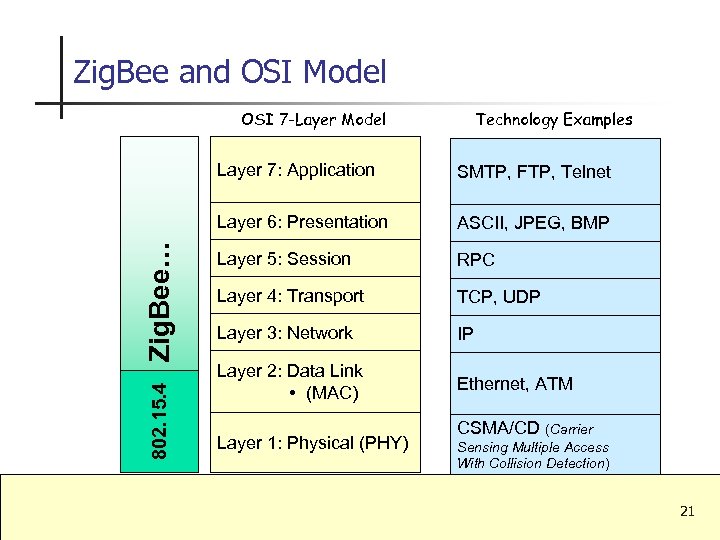
Zig. Bee and OSI Model OSI 7 -Layer Model Technology Examples 802. 15. 4 SMTP, FTP, Telnet Layer 6: Presentation Zig. Bee… Layer 7: Application ASCII, JPEG, BMP Layer 5: Session RPC Layer 4: Transport TCP, UDP Layer 3: Network IP Layer 2: Data Link • (MAC) Ethernet, ATM Layer 1: Physical (PHY) CSMA/CD (Carrier Sensing Multiple Access With Collision Detection) 21
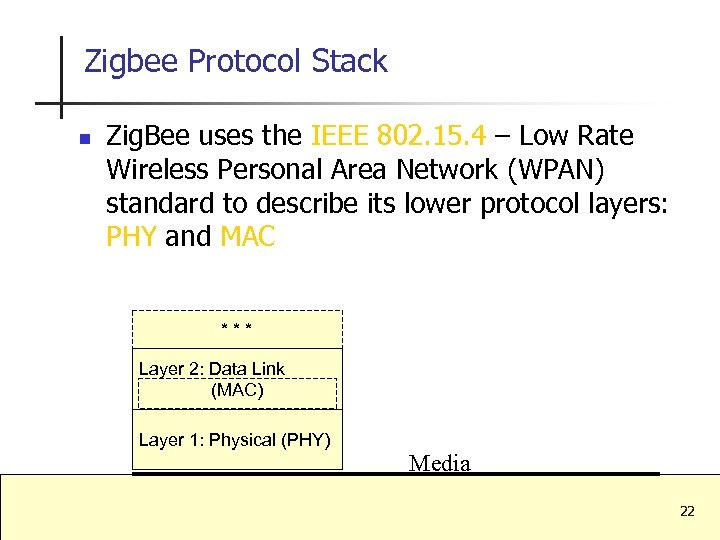
Zigbee Protocol Stack n Zig. Bee uses the IEEE 802. 15. 4 – Low Rate Wireless Personal Area Network (WPAN) standard to describe its lower protocol layers: PHY and MAC *** Layer 2: Data Link (MAC) Layer 1: Physical (PHY) Media 22
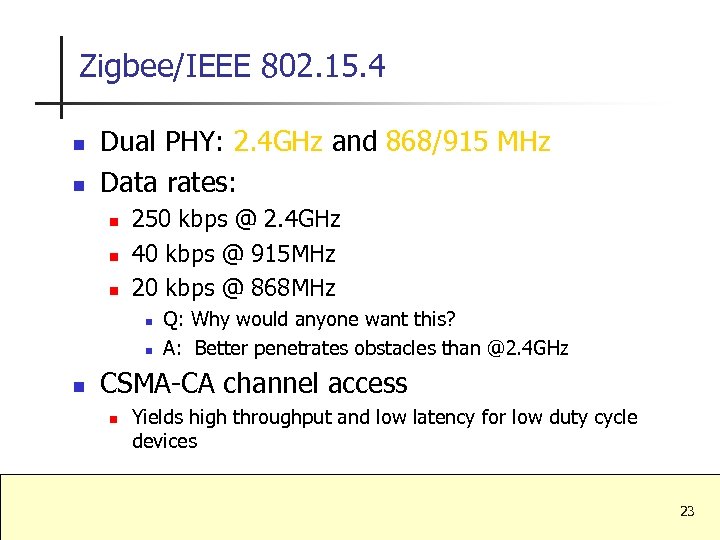
Zigbee/IEEE 802. 15. 4 n n Dual PHY: 2. 4 GHz and 868/915 MHz Data rates: n n n 250 kbps @ 2. 4 GHz 40 kbps @ 915 MHz 20 kbps @ 868 MHz n n n Q: Why would anyone want this? A: Better penetrates obstacles than @2. 4 GHz CSMA-CA channel access n Yields high throughput and low latency for low duty cycle devices 23
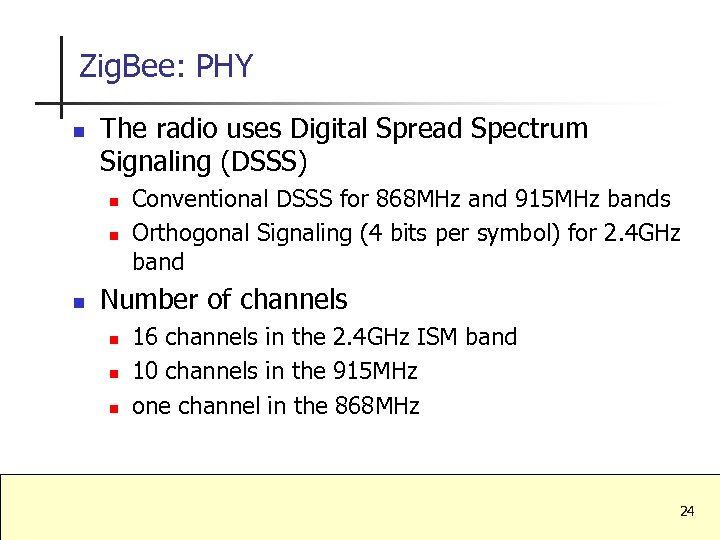
Zig. Bee: PHY n The radio uses Digital Spread Spectrum Signaling (DSSS) n n n Conventional DSSS for 868 MHz and 915 MHz bands Orthogonal Signaling (4 bits per symbol) for 2. 4 GHz band Number of channels n n n 16 channels in the 2. 4 GHz ISM band 10 channels in the 915 MHz one channel in the 868 MHz 24
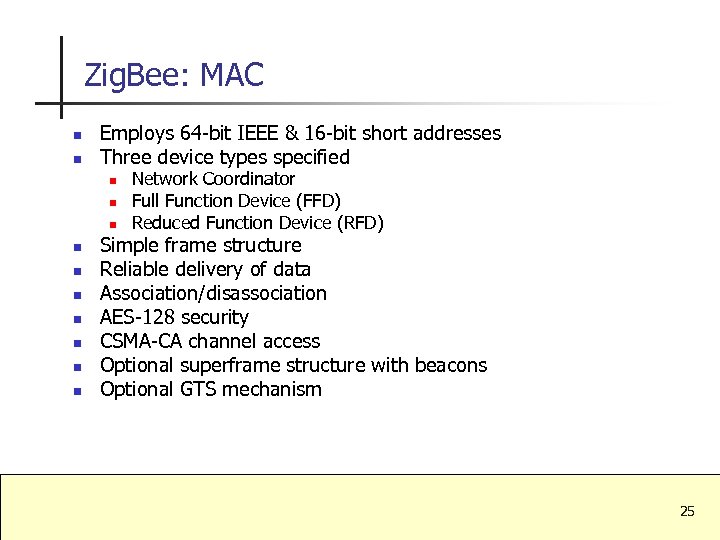
Zig. Bee: MAC n n Employs 64 -bit IEEE & 16 -bit short addresses Three device types specified n n n n n Network Coordinator Full Function Device (FFD) Reduced Function Device (RFD) Simple frame structure Reliable delivery of data Association/disassociation AES-128 security CSMA-CA channel access Optional superframe structure with beacons Optional GTS mechanism 25
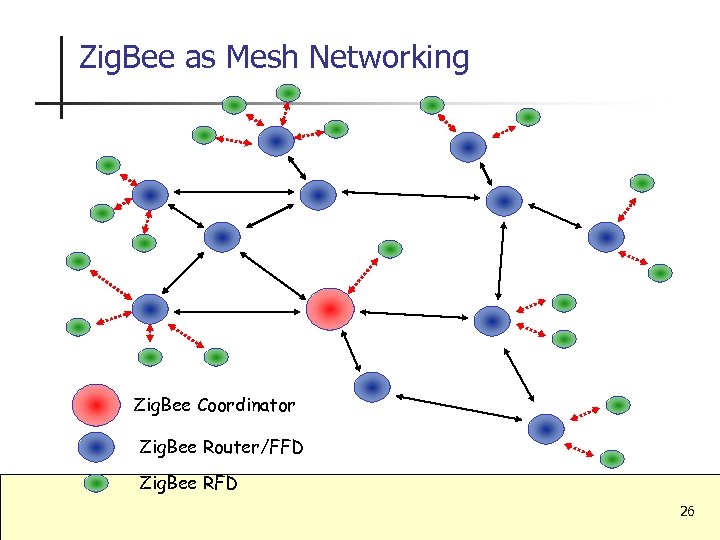
Zig. Bee as Mesh Networking Zig. Bee Coordinator Zig. Bee Router/FFD Zig. Bee RFD 26
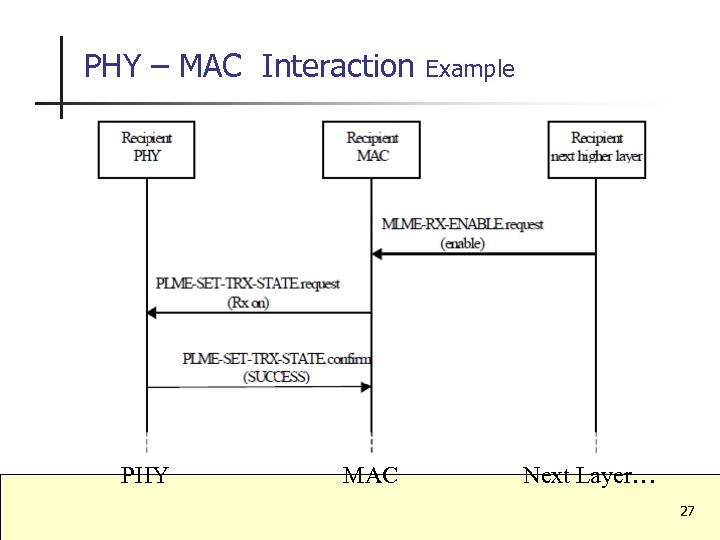
PHY – MAC Interaction PHY MAC Example Next Layer… 27
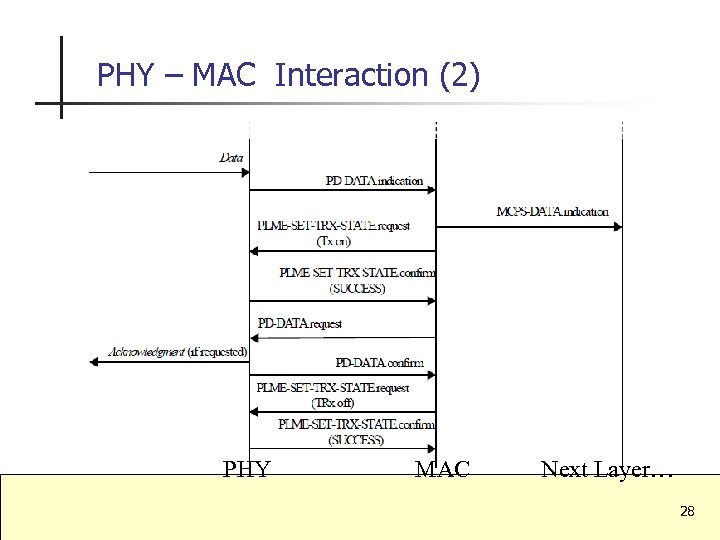
PHY – MAC Interaction (2) PHY MAC Next Layer… 28
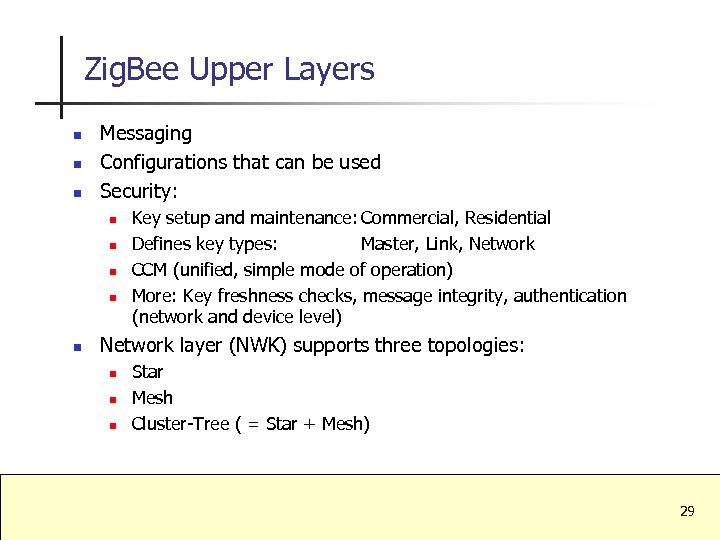
Zig. Bee Upper Layers n n n Messaging Configurations that can be used Security: n n n Key setup and maintenance: Commercial, Residential Defines key types: Master, Link, Network CCM (unified, simple mode of operation) More: Key freshness checks, message integrity, authentication (network and device level) Network layer (NWK) supports three topologies: n n n Star Mesh Cluster-Tree ( = Star + Mesh) 29
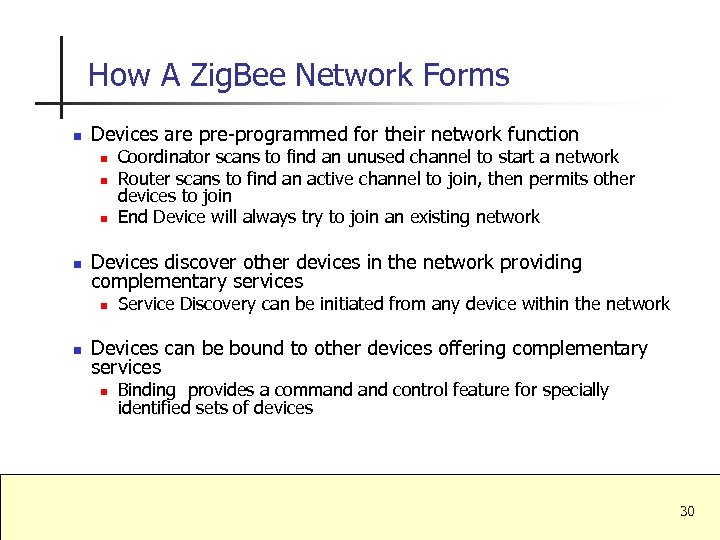
How A Zig. Bee Network Forms n Devices are pre-programmed for their network function n n Devices discover other devices in the network providing complementary services n n Coordinator scans to find an unused channel to start a network Router scans to find an active channel to join, then permits other devices to join End Device will always try to join an existing network Service Discovery can be initiated from any device within the network Devices can be bound to other devices offering complementary services n Binding provides a command control feature for specially identified sets of devices 30
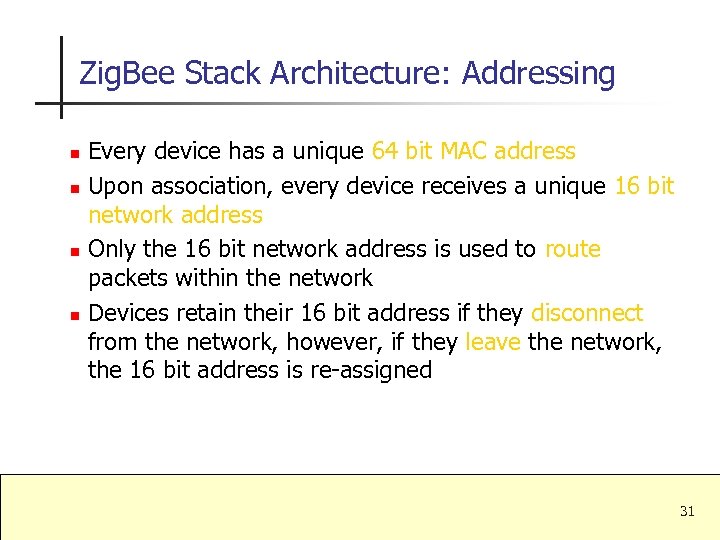
Zig. Bee Stack Architecture: Addressing n n Every device has a unique 64 bit MAC address Upon association, every device receives a unique 16 bit network address Only the 16 bit network address is used to route packets within the network Devices retain their 16 bit address if they disconnect from the network, however, if they leave the network, the 16 bit address is re-assigned 31
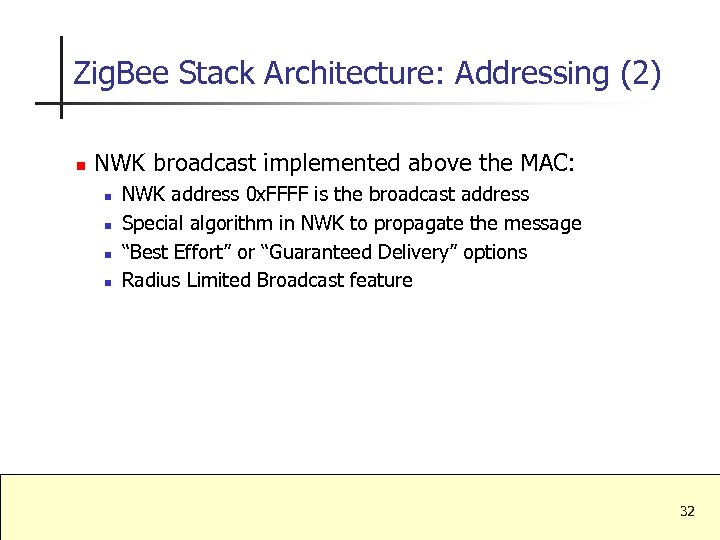
Zig. Bee Stack Architecture: Addressing (2) n NWK broadcast implemented above the MAC: n n NWK address 0 x. FFFF is the broadcast address Special algorithm in NWK to propagate the message “Best Effort” or “Guaranteed Delivery” options Radius Limited Broadcast feature 32
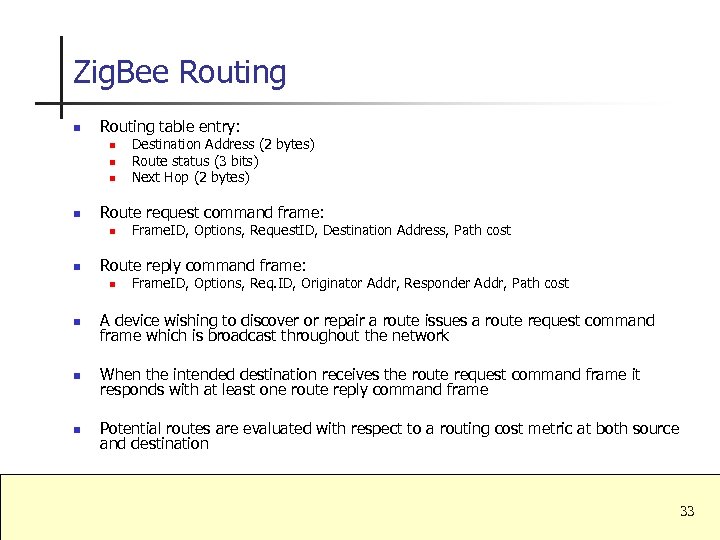
Zig. Bee Routing n Routing table entry: n n Route request command frame: n n Destination Address (2 bytes) Route status (3 bits) Next Hop (2 bytes) Frame. ID, Options, Request. ID, Destination Address, Path cost Route reply command frame: n Frame. ID, Options, Req. ID, Originator Addr, Responder Addr, Path cost n A device wishing to discover or repair a route issues a route request command frame which is broadcast throughout the network n When the intended destination receives the route request command frame it responds with at least one route reply command frame n Potential routes are evaluated with respect to a routing cost metric at both source and destination 33
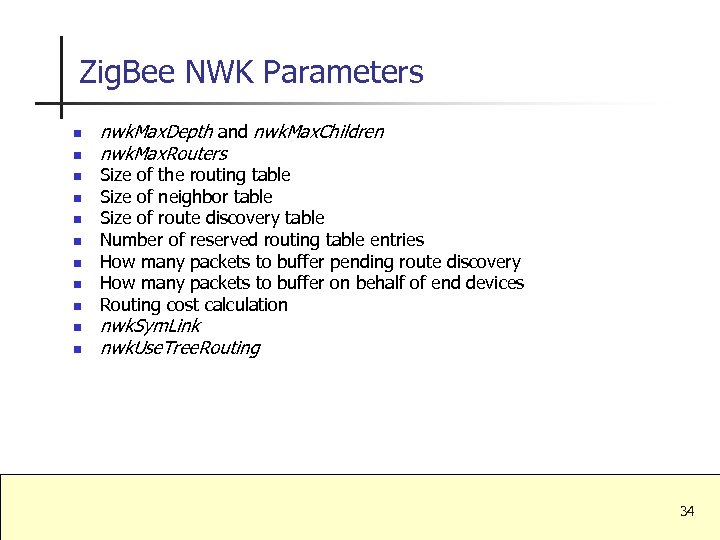
Zig. Bee NWK Parameters n n nwk. Max. Depth and nwk. Max. Children nwk. Max. Routers Size of the routing table Size of neighbor table Size of route discovery table Number of reserved routing table entries How many packets to buffer pending route discovery How many packets to buffer on behalf of end devices Routing cost calculation nwk. Sym. Link nwk. Use. Tree. Routing 34
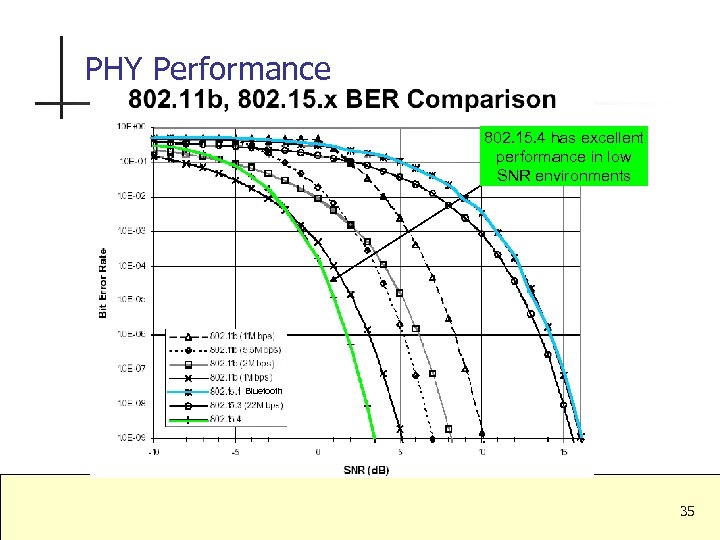
PHY Performance 802. 15. 4 has excellent performance in low SNR environments Bluetooth 35
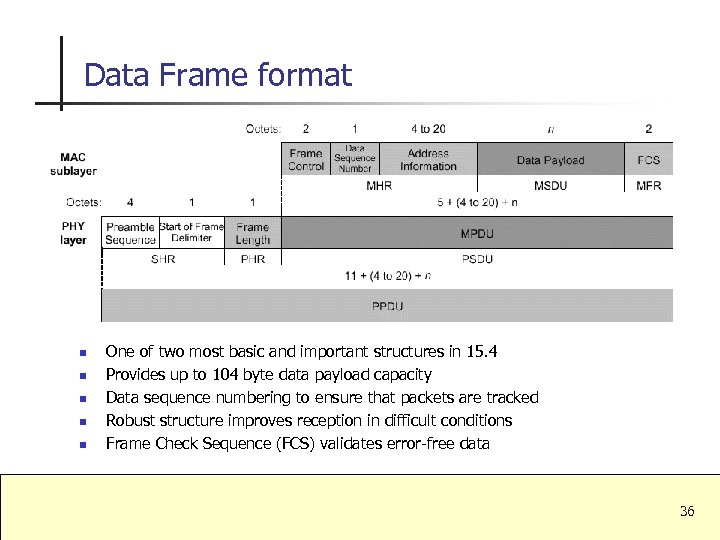
Data Frame format n n n One of two most basic and important structures in 15. 4 Provides up to 104 byte data payload capacity Data sequence numbering to ensure that packets are tracked Robust structure improves reception in difficult conditions Frame Check Sequence (FCS) validates error-free data 36
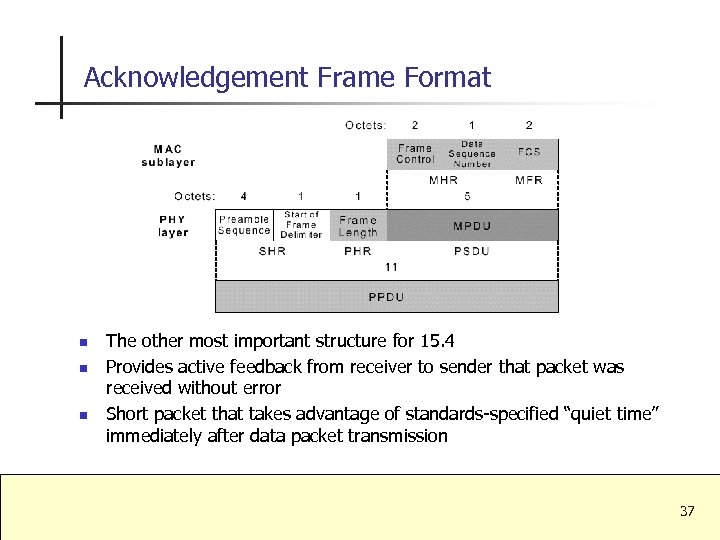
Acknowledgement Frame Format n n n The other most important structure for 15. 4 Provides active feedback from receiver to sender that packet was received without error Short packet that takes advantage of standards-specified “quiet time” immediately after data packet transmission 37
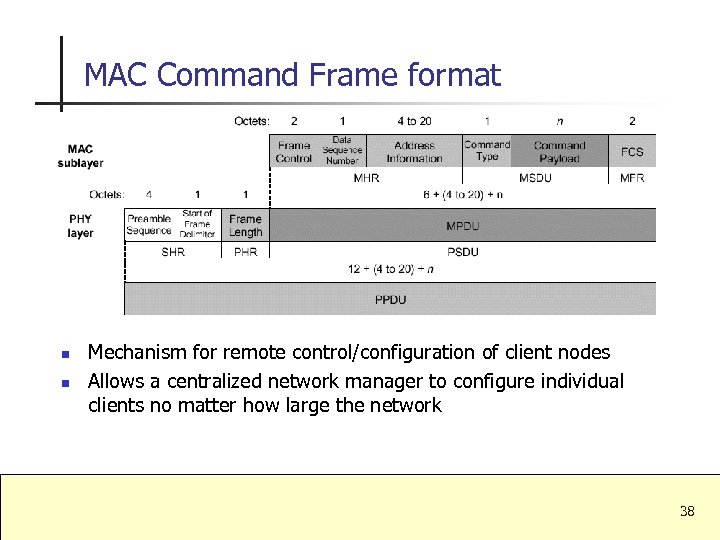
MAC Command Frame format n n Mechanism for remote control/configuration of client nodes Allows a centralized network manager to configure individual clients no matter how large the network 38
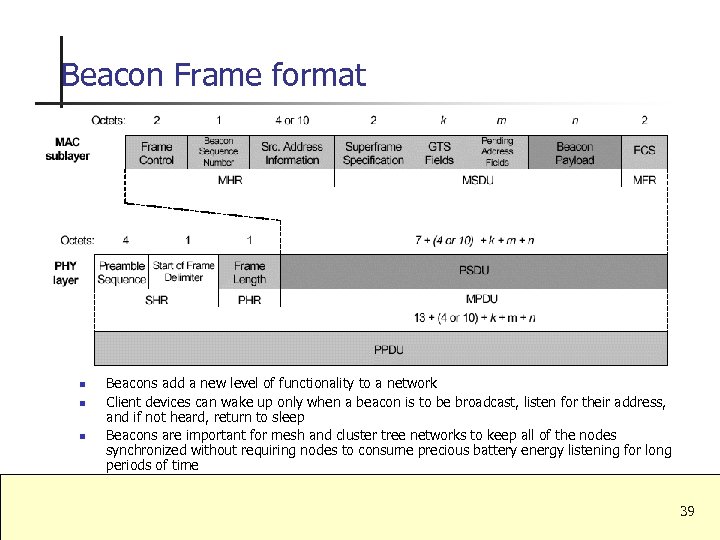
Beacon Frame format n n n Beacons add a new level of functionality to a network Client devices can wake up only when a beacon is to be broadcast, listen for their address, and if not heard, return to sleep Beacons are important for mesh and cluster tree networks to keep all of the nodes synchronized without requiring nodes to consume precious battery energy listening for long periods of time 39
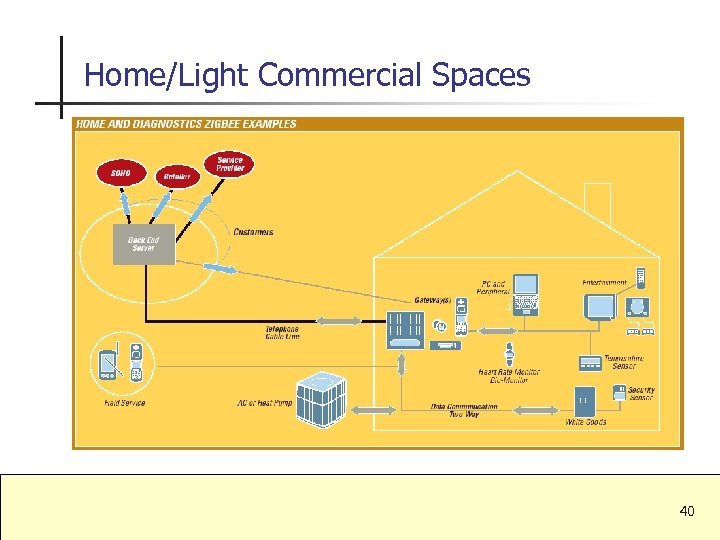
Home/Light Commercial Spaces 40
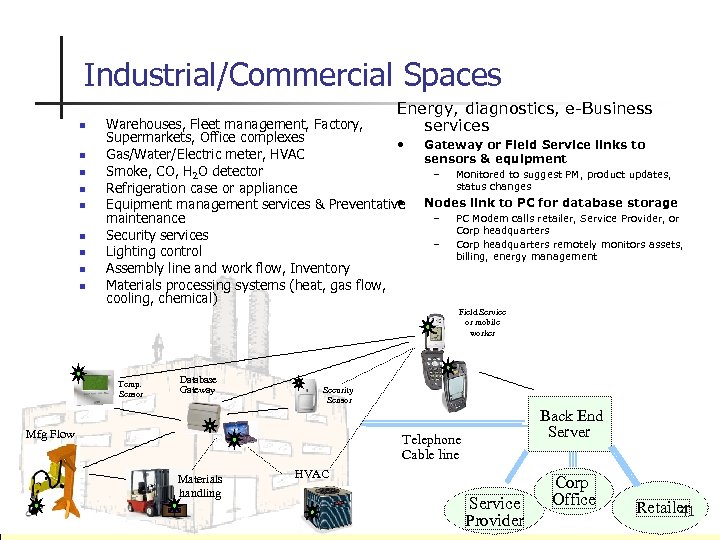
Industrial/Commercial Spaces n n n n n Energy, diagnostics, e-Business services Warehouses, Fleet management, Factory, Supermarkets, Office complexes • Gas/Water/Electric meter, HVAC Smoke, CO, H 2 O detector Refrigeration case or appliance • Equipment management services & Preventative maintenance Security services Lighting control Assembly line and work flow, Inventory Materials processing systems (heat, gas flow, cooling, chemical) Gateway or Field Service links to sensors & equipment – Monitored to suggest PM, product updates, status changes Nodes link to PC for database storage – – PC Modem calls retailer, Service Provider, or Corp headquarters remotely monitors assets, billing, energy management Field Service or mobile worker Temp. Sensor Database Gateway Security Sensor Mfg Flow Back End Server Telephone Cable line Materials handling HVAC Service Provider Corp Office Retailer 41

42
Скачать презентацию Zigbee IEEE 802 15 4 Σαράντης Πασκαλής paskalis di
cf986ef01f3ae8618e62dd7d33d0b64c.ppt