 Скачать презентацию Zig Bee IEEE 802 15 4 Zig
b187a212d04fb2daa50278b6b7e4e924.ppt
- Количество слайдов: 81



Zig. Bee / IEEE 802. 15. 4 Zig. Bee Alliance: http: //www. Zig. Bee. org IEEE 802. 15. 4: http: //www. ieee 802. org/15/pub/TG 4. html
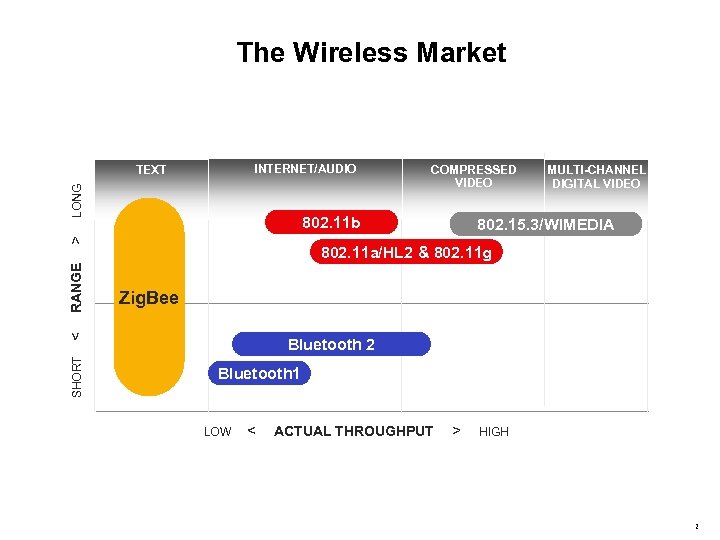
The Wireless Market INTERNET/AUDIO LONG TEXT RANGE > 802. 11 b MULTI-CHANNEL DIGITAL VIDEO 802. 15. 3/WIMEDIA 802. 11 a/HL 2 & 802. 11 g Zig. Bee < SHORT COMPRESSED VIDEO Bluetooth 2 Bluetooth 1 LOW < ACTUAL THROUGHPUT > HIGH 2
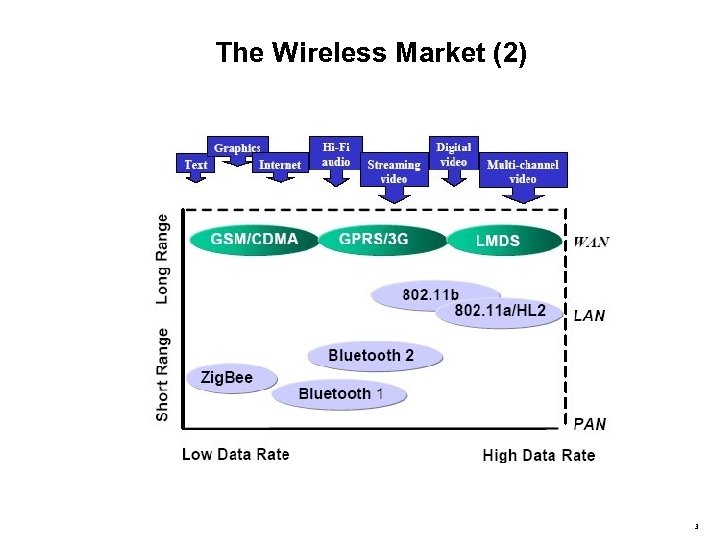
The Wireless Market (2) 3
What Is the Zig. Bee Alliance? ■ An organization with a mission to define reliable, cost-effective, low-power, wirelessly networked, monitoring and control products based on an open global standard ■ Alliance provides ► ► ► Upper layer stack and application profiles Compliance and certification testing Branding ■ Result is a set of interoperable solutions recognizable in the market ■ Eight promoter companies ► Ember, Freescale, Honeywell, Invensys, Mitsubishi, Motorola, Philips and Samsung ■ A rapidly growing list (Over 120 participants) of industry leaders worldwide committed to providing Zig. Bee-compliant products and solutions ► Companies include semiconductor manufacturers, wireless IP providers, OEMs, and end-users 4
Why Do We Need Zig. Bee Technology? ■ No standard approach today that addresses the unique needs of most remote monitoring and control applications ► Enables the broad-based deployment of reliable wireless networks with low-complexity, low-cost solutions ► Provides the ability to run for years on inexpensive primary batteries for a typical monitoring application ► Capable of inexpensively supporting robust mesh networking technologies 5
How Is Zig. Bee Related to IEEE 802. 15. 4? ■ Zig. Bee takes full advantage of a physical radio and MAC layers specified by IEEE 802. 15. 4 (lower layers) ■ Zig. Bee adds logical network, security and application software (higher layers) ■ Zig. Bee continues to work closely with the IEEE to ensure an integrated and complete solution for the market 6
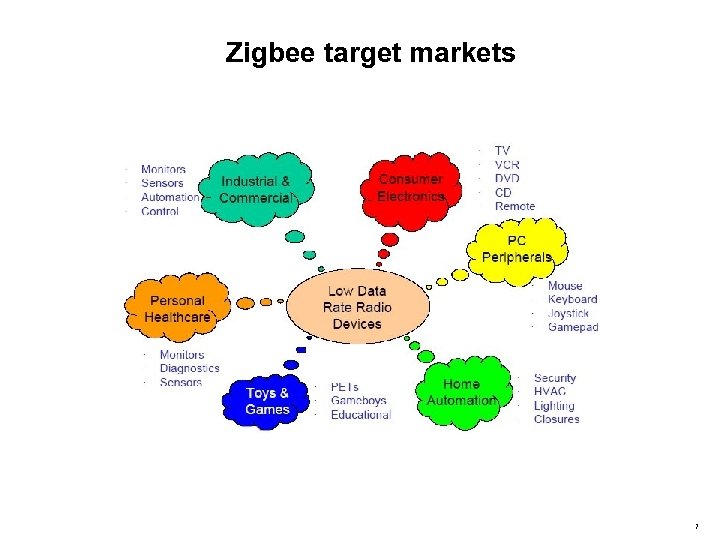
Zigbee target markets 7
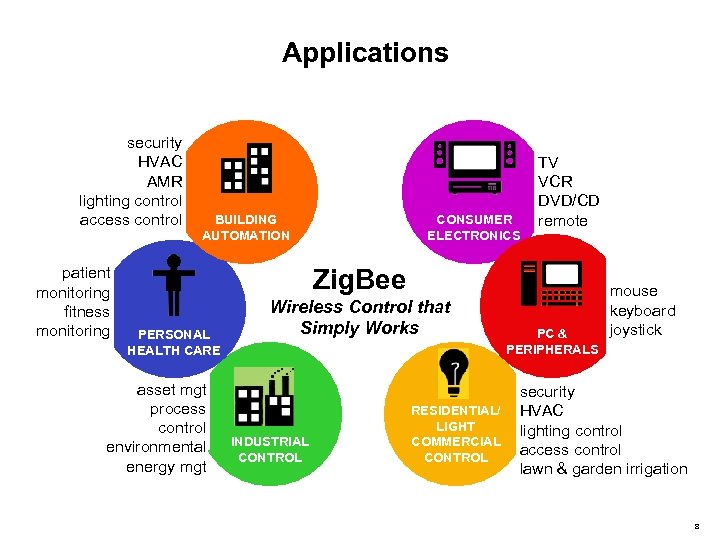
Applications security HVAC AMR lighting control access control patient monitoring fitness monitoring BUILDING AUTOMATION CONSUMER ELECTRONICS TV VCR DVD/CD remote Zig. Bee PERSONAL HEALTH CARE asset mgt process control environmental energy mgt Wireless Control that Simply Works INDUSTRIAL CONTROL RESIDENTIAL/ LIGHT COMMERCIAL CONTROL PC & PERIPHERALS mouse keyboard joystick security HVAC lighting control access control lawn & garden irrigation 8
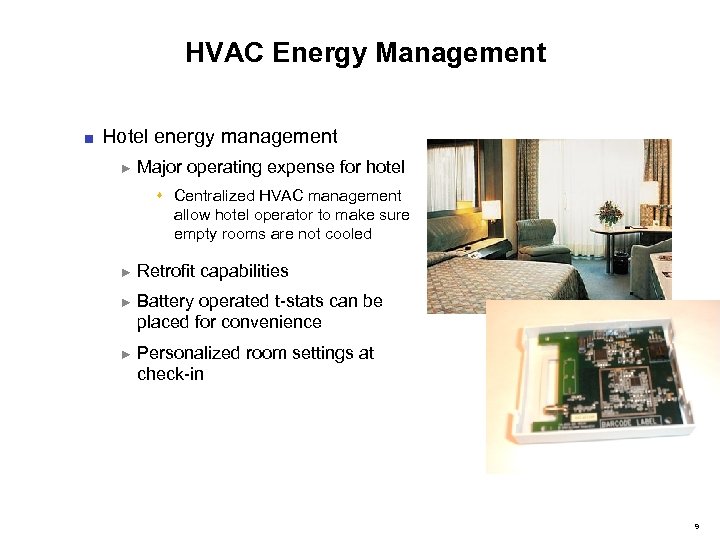
HVAC Energy Management ■ Hotel energy management ► Major operating expense for hotel s Centralized HVAC management allow hotel operator to make sure empty rooms are not cooled ► Retrofit capabilities ► Battery operated t-stats can be placed for convenience ► Personalized room settings at check-in 9
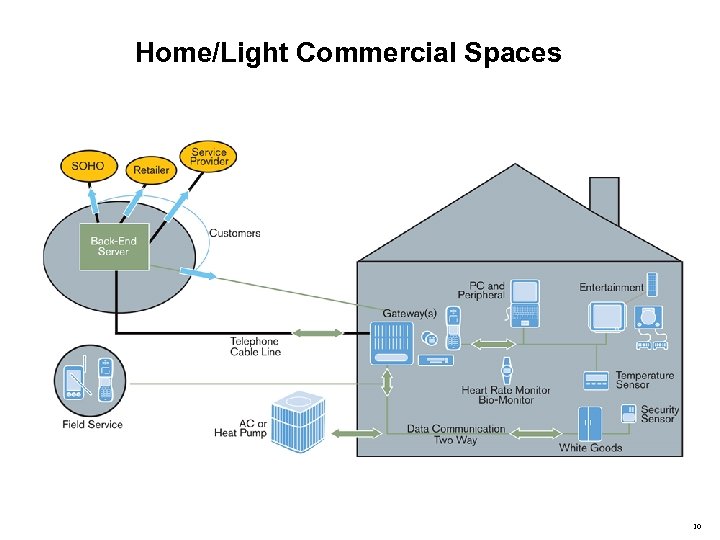
Home/Light Commercial Spaces 10
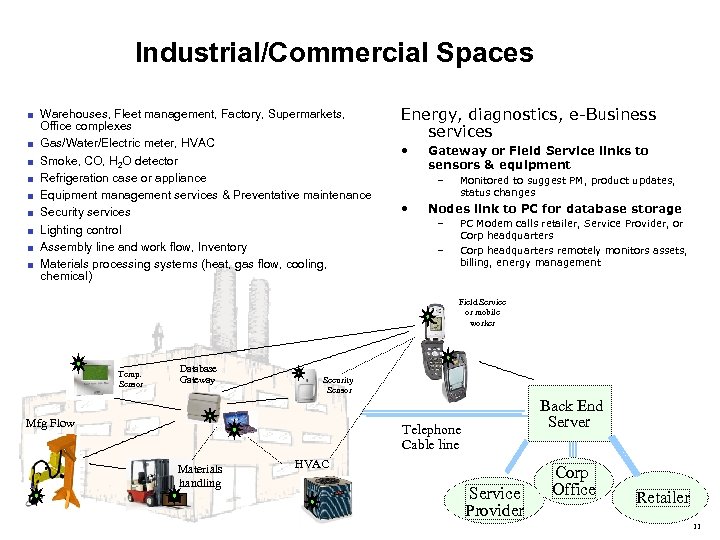
Industrial/Commercial Spaces ■ Warehouses, Fleet management, Factory, Supermarkets, ■ ■ ■ ■ Office complexes Gas/Water/Electric meter, HVAC Smoke, CO, H 2 O detector Refrigeration case or appliance Equipment management services & Preventative maintenance Security services Lighting control Assembly line and work flow, Inventory Materials processing systems (heat, gas flow, cooling, chemical) Energy, diagnostics, e-Business services • Gateway or Field Service links to sensors & equipment – • Monitored to suggest PM, product updates, status changes Nodes link to PC for database storage – – PC Modem calls retailer, Service Provider, or Corp headquarters remotely monitors assets, billing, energy management Field Service or mobile worker Temp. Sensor Database Gateway Security Sensor Mfg Flow Back End Server Telephone Cable line Materials handling HVAC Service Provider Corp Office Retailer 11

Asset Management ■ Within each container, sensors form a mesh network ■ Multiple containers in a ship form a mesh to report sensor data ■ Increased security through on- truck and on-ship tamper detection ■ Faster container processing. Manifest data and sensor data are known before ship docks at port 12
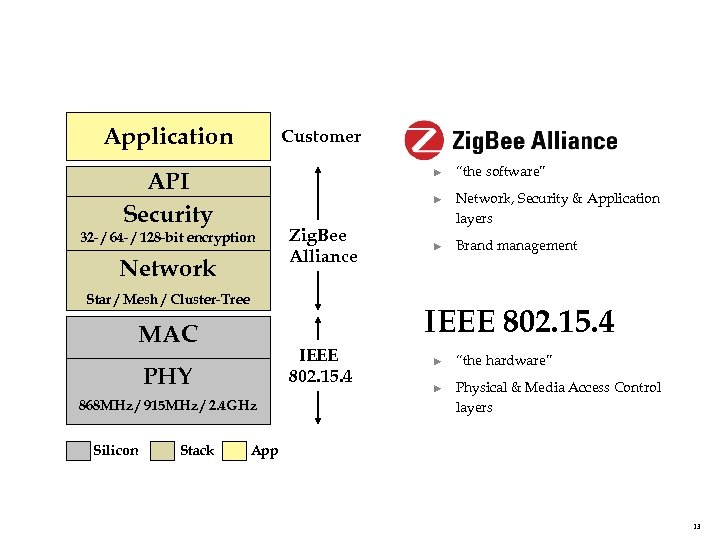
IEEE 802. 15. 4 & Zig. Bee In Context Application Customer API Security ► ► 32 - / 64 - / 128 -bit encryption Network Zig. Bee Alliance Star / Mesh / Cluster-Tree IEEE 802. 15. 4 PHY 868 MHz / 915 MHz / 2. 4 GHz Stack Network, Security & Application layers Brand management IEEE 802. 15. 4 MAC Silicon ► “the software” ► ► “the hardware” Physical & Media Access Control layers App 13
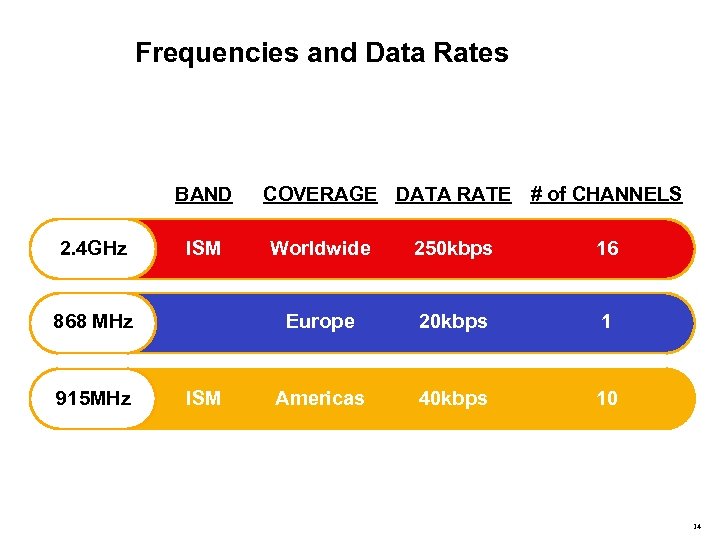
Frequencies and Data Rates BAND 2. 4 GHz ISM Worldwide 250 kbps 16 Europe 868 MHz 915 MHz COVERAGE DATA RATE # of CHANNELS 20 kbps 1 Americas 40 kbps 10 14
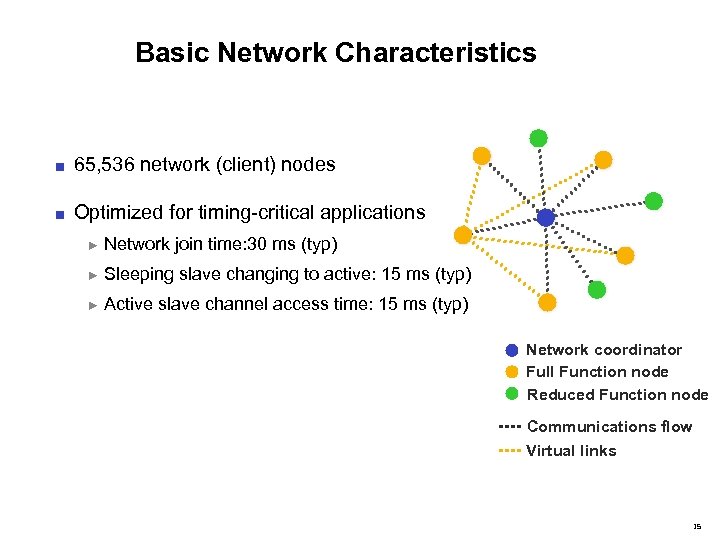
Basic Network Characteristics ■ 65, 536 network (client) nodes ■ Optimized for timing-critical applications ► Network join time: 30 ms (typ) ► Sleeping slave changing to active: 15 ms (typ) ► Active slave channel access time: 15 ms (typ) Network coordinator Full Function node Reduced Function node Communications flow Virtual links 15
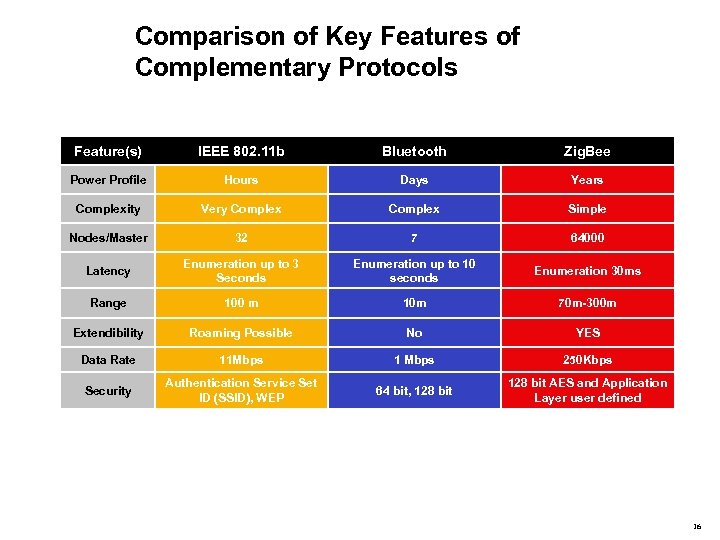
Comparison of Key Features of Complementary Protocols Feature(s) IEEE 802. 11 b Bluetooth Zig. Bee Power Profile Hours Days Years Complexity Very Complex Simple Nodes/Master 32 7 64000 Latency Enumeration up to 3 Seconds Enumeration up to 10 seconds Enumeration 30 ms Range 100 m 10 m 70 m-300 m Extendibility Roaming Possible No YES Data Rate 11 Mbps 1 Mbps 250 Kbps Security Authentication Service Set ID (SSID), WEP 64 bit, 128 bit AES and Application Layer user defined 16
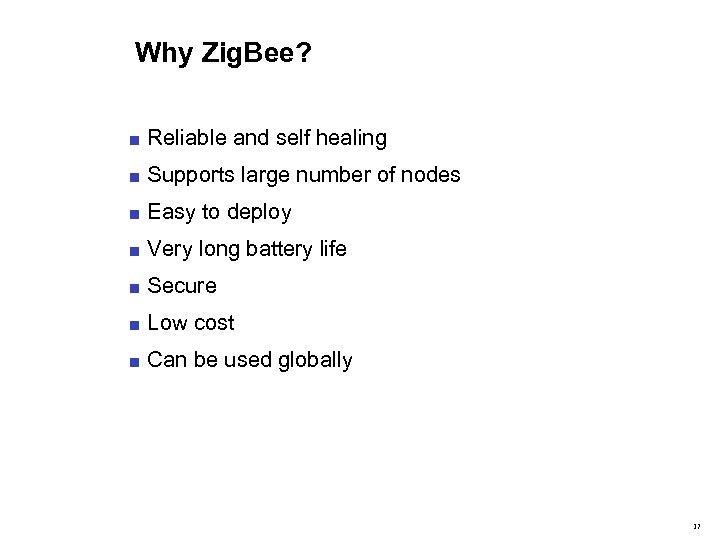
Why Zig. Bee? ■ Reliable and self healing ■ Supports large number of nodes ■ Easy to deploy ■ Very long battery life ■ Secure ■ Low cost ■ Can be used globally 17
IEEE 802. 15. 4 Tutorial
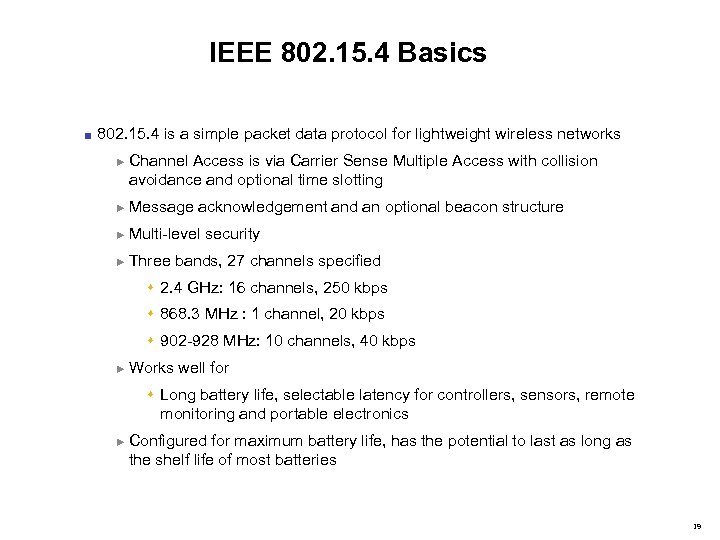
IEEE 802. 15. 4 Basics ■ 802. 15. 4 is a simple packet data protocol for lightweight wireless networks ► Channel Access is via Carrier Sense Multiple Access with collision avoidance and optional time slotting ► Message acknowledgement and an optional beacon structure ► Multi-level ► Three security bands, 27 channels specified s 2. 4 GHz: 16 channels, 250 kbps s 868. 3 MHz : 1 channel, 20 kbps s 902 -928 MHz: 10 channels, 40 kbps ► Works well for s Long battery life, selectable latency for controllers, sensors, remote monitoring and portable electronics ► Configured for maximum battery life, has the potential to last as long as the shelf life of most batteries 19
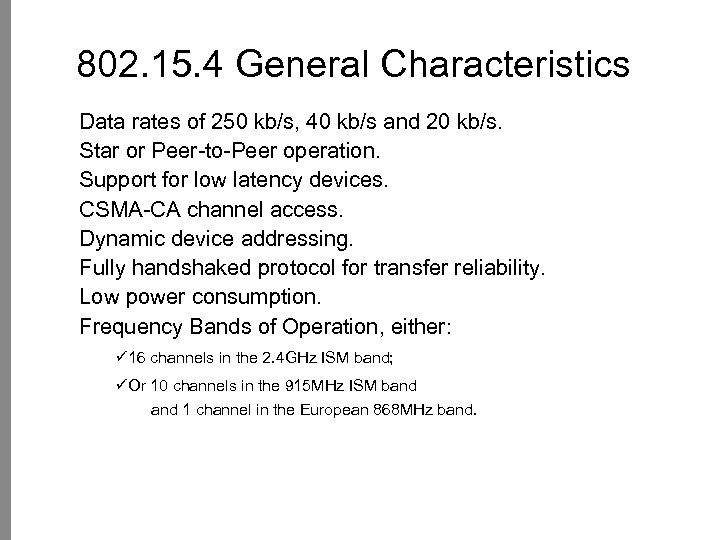
802. 15. 4 General Characteristics Data rates of 250 kb/s, 40 kb/s and 20 kb/s. Star or Peer-to-Peer operation. Support for low latency devices. CSMA-CA channel access. Dynamic device addressing. Fully handshaked protocol for transfer reliability. Low power consumption. Frequency Bands of Operation, either: ü 16 channels in the 2. 4 GHz ISM band; üOr 10 channels in the 915 MHz ISM band 1 channel in the European 868 MHz band.
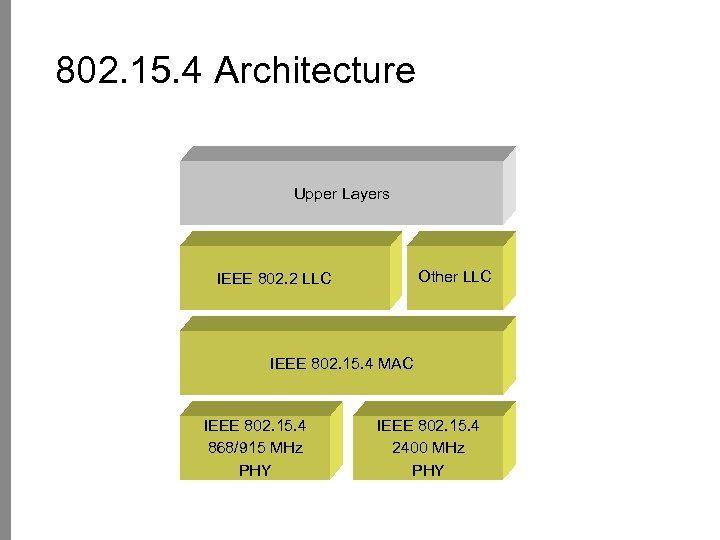
802. 15. 4 Architecture Upper Layers Other LLC IEEE 802. 2 LLC IEEE 802. 15. 4 MAC IEEE 802. 15. 4 868/915 MHz PHY IEEE 802. 15. 4 2400 MHz PHY
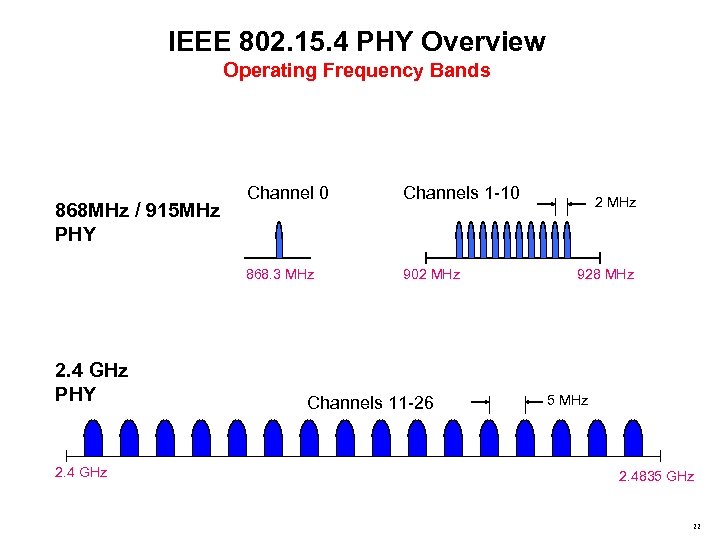
IEEE 802. 15. 4 PHY Overview Operating Frequency Bands 2. 4 GHz PHY 2. 4 GHz Channels 1 -10 868. 3 MHz 868 MHz / 915 MHz PHY Channel 0 902 MHz Channels 11 -26 2 MHz 928 MHz 5 MHz 2. 4835 GHz 22
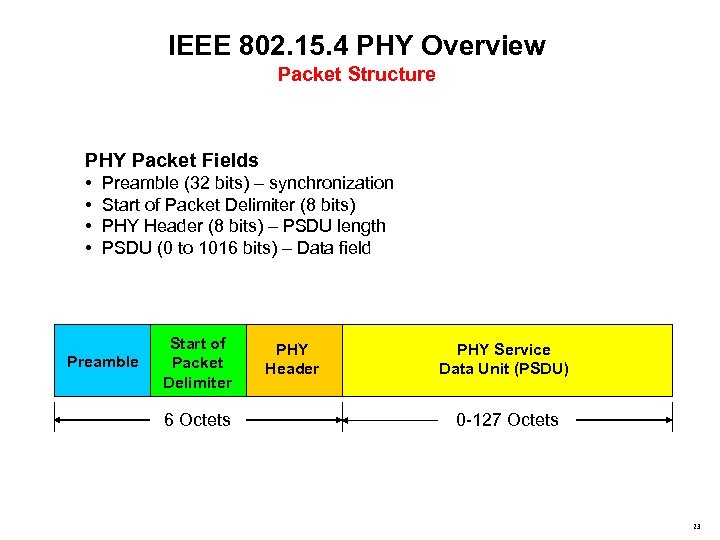
IEEE 802. 15. 4 PHY Overview Packet Structure PHY Packet Fields • • Preamble (32 bits) – synchronization Start of Packet Delimiter (8 bits) PHY Header (8 bits) – PSDU length PSDU (0 to 1016 bits) – Data field Preamble Start of Packet Delimiter 6 Octets PHY Header PHY Service Data Unit (PSDU) 0 -127 Octets 23
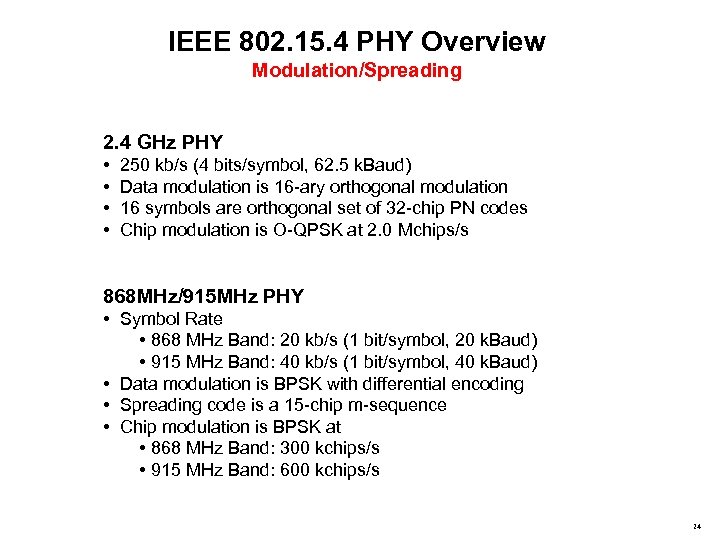
IEEE 802. 15. 4 PHY Overview Modulation/Spreading 2. 4 GHz PHY • • 250 kb/s (4 bits/symbol, 62. 5 k. Baud) Data modulation is 16 -ary orthogonal modulation 16 symbols are orthogonal set of 32 -chip PN codes Chip modulation is O-QPSK at 2. 0 Mchips/s 868 MHz/915 MHz PHY • Symbol Rate • 868 MHz Band: 20 kb/s (1 bit/symbol, 20 k. Baud) • 915 MHz Band: 40 kb/s (1 bit/symbol, 40 k. Baud) • Data modulation is BPSK with differential encoding • Spreading code is a 15 -chip m-sequence • Chip modulation is BPSK at • 868 MHz Band: 300 kchips/s • 915 MHz Band: 600 kchips/s 24
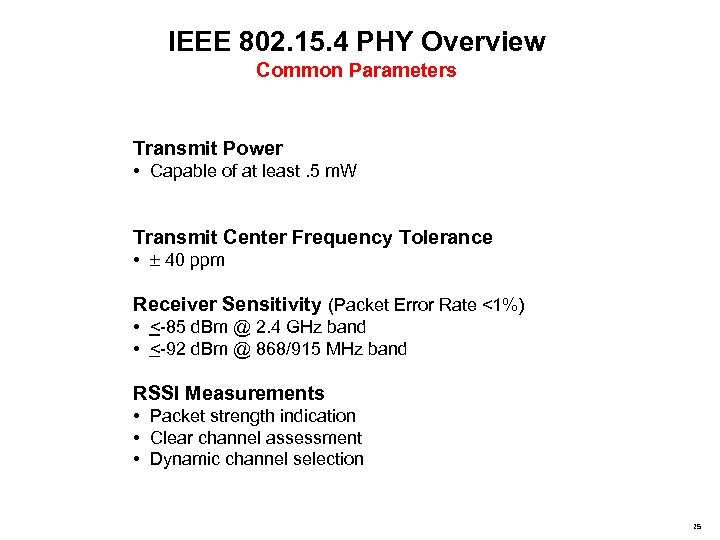
IEEE 802. 15. 4 PHY Overview Common Parameters Transmit Power • Capable of at least. 5 m. W Transmit Center Frequency Tolerance • 40 ppm Receiver Sensitivity (Packet Error Rate <1%) • <-85 d. Bm @ 2. 4 GHz band • <-92 d. Bm @ 868/915 MHz band RSSI Measurements • Packet strength indication • Clear channel assessment • Dynamic channel selection 25
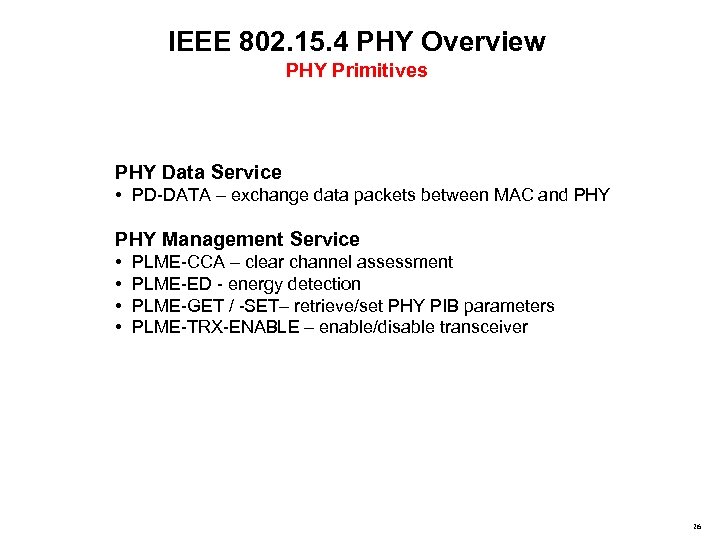
IEEE 802. 15. 4 PHY Overview PHY Primitives PHY Data Service • PD-DATA – exchange data packets between MAC and PHY Management Service • • PLME-CCA – clear channel assessment PLME-ED - energy detection PLME-GET / -SET– retrieve/set PHY PIB parameters PLME-TRX-ENABLE – enable/disable transceiver 26
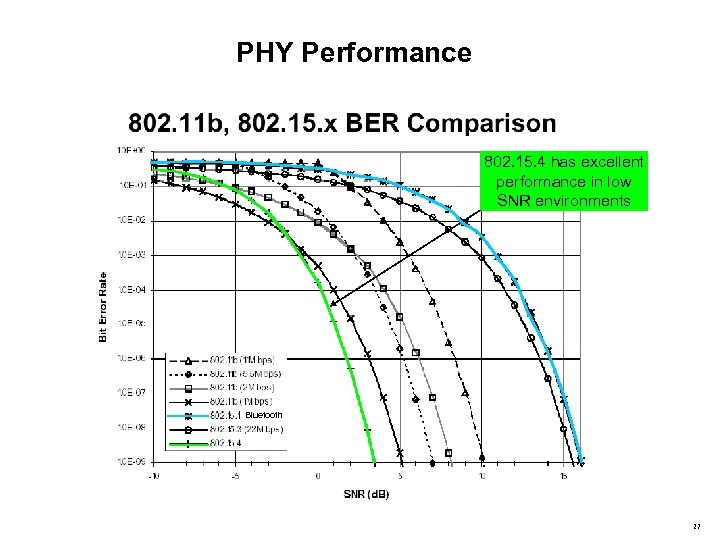
PHY Performance 802. 15. 4 has excellent performance in low SNR environments Bluetooth 27
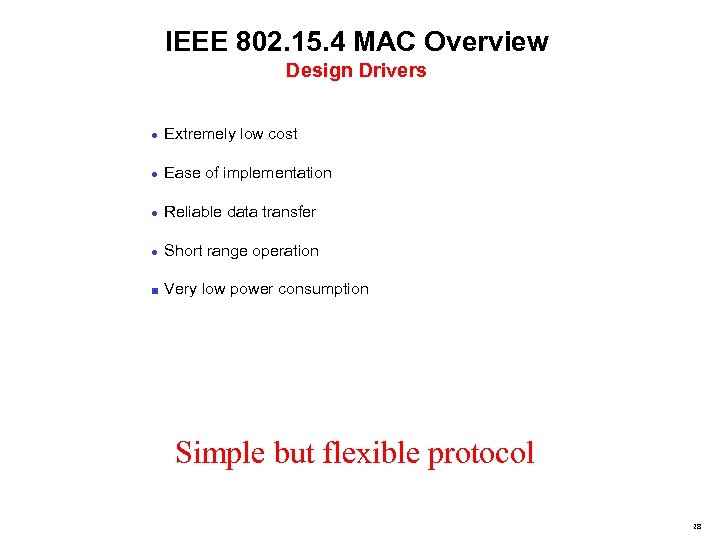
IEEE 802. 15. 4 MAC Overview Design Drivers · Extremely low cost · Ease of implementation · Reliable data transfer · Short range operation ■ Very low power consumption Simple but flexible protocol 28
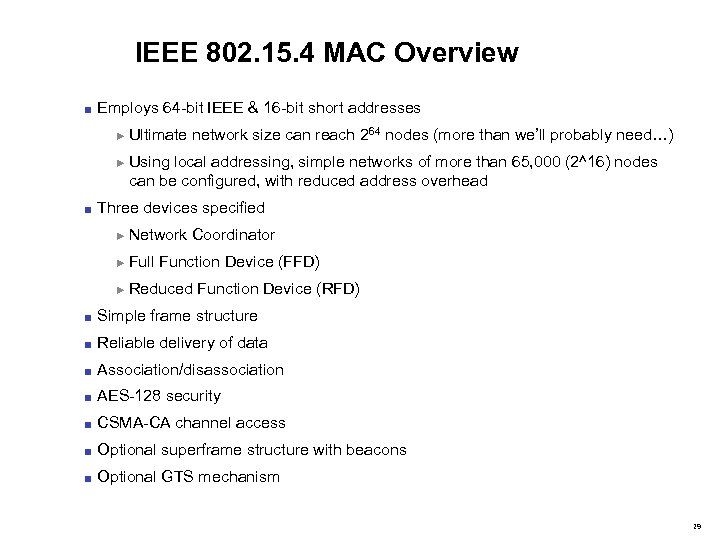
IEEE 802. 15. 4 MAC Overview ■ Employs 64 -bit IEEE & 16 -bit short addresses ► Ultimate network size can reach 264 nodes (more than we’ll probably need…) ► Using local addressing, simple networks of more than 65, 000 (2^16) nodes can be configured, with reduced address overhead ■ Three devices specified ► Network ► Full Coordinator Function Device (FFD) ► Reduced Function Device (RFD) ■ Simple frame structure ■ Reliable delivery of data ■ Association/disassociation ■ AES-128 security ■ CSMA-CA channel access ■ Optional superframe structure with beacons ■ Optional GTS mechanism 29
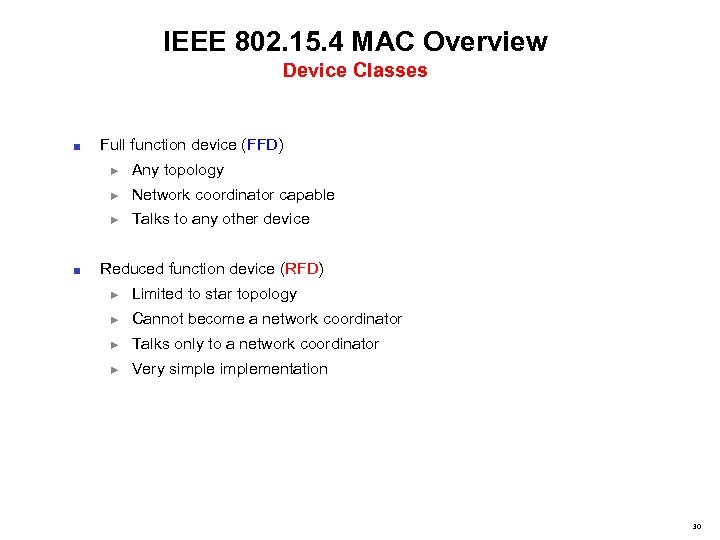
IEEE 802. 15. 4 MAC Overview Device Classes ■ Full function device (FFD) ► ► Network coordinator capable ► ■ Any topology Talks to any other device Reduced function device (RFD) ► Limited to star topology ► Cannot become a network coordinator ► Talks only to a network coordinator ► Very simplementation 30
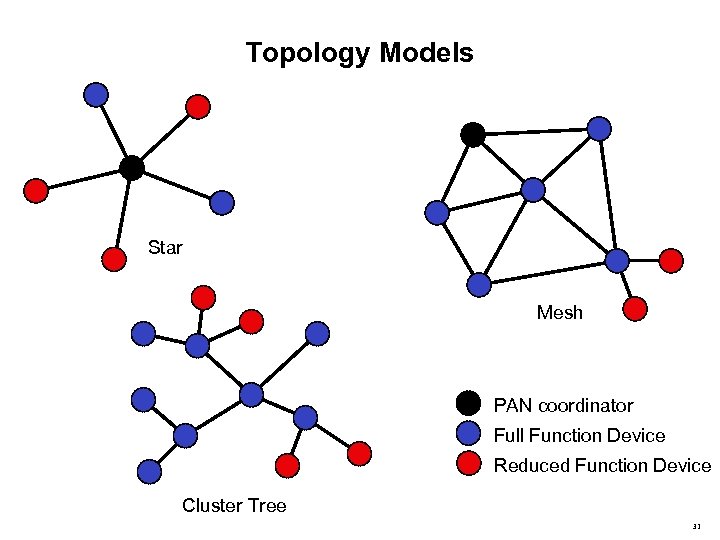
Topology Models Star Mesh PAN coordinator Full Function Device Reduced Function Device Cluster Tree 31
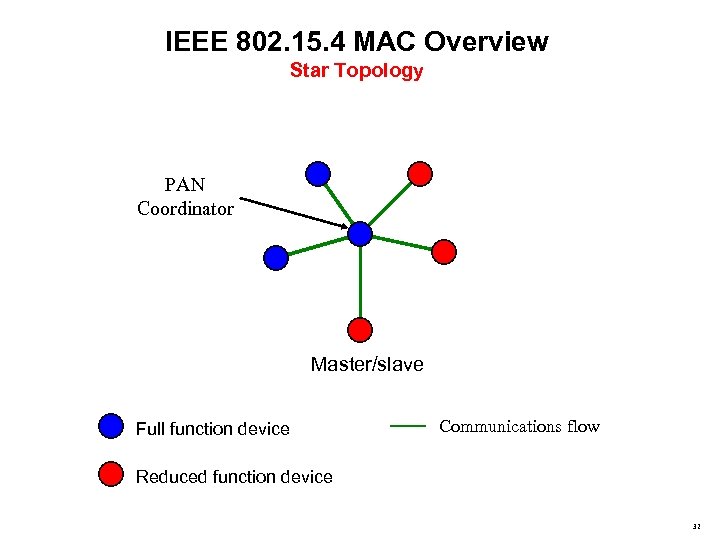
IEEE 802. 15. 4 MAC Overview Star Topology PAN Coordinator Master/slave Full function device Communications flow Reduced function device 32
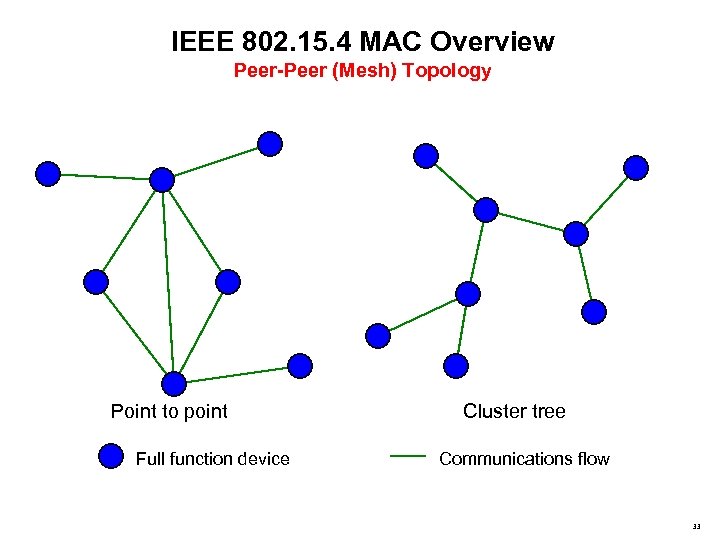
IEEE 802. 15. 4 MAC Overview Peer-Peer (Mesh) Topology Point to point Full function device Cluster tree Communications flow 33
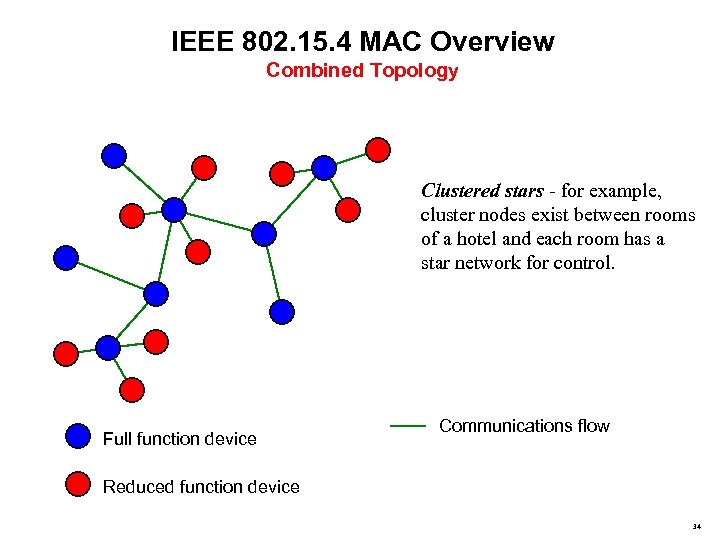
IEEE 802. 15. 4 MAC Overview Combined Topology Clustered stars - for example, cluster nodes exist between rooms of a hotel and each room has a star network for control. Full function device Communications flow Reduced function device 34
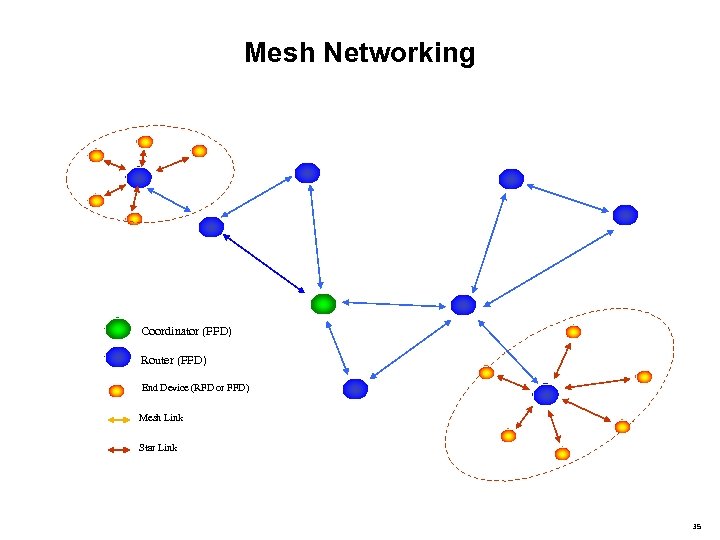
Mesh Networking Coordinator (FFD) Router (FFD) End Device (RFD or FFD) Mesh Link Star Link 35
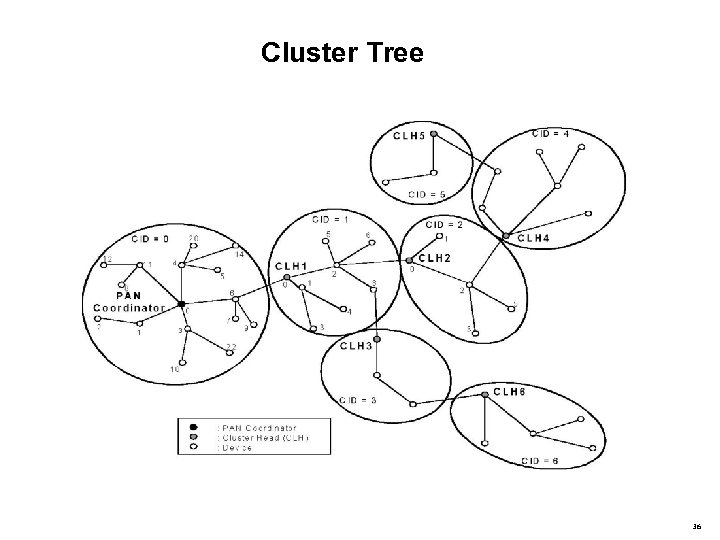
Cluster Tree 36
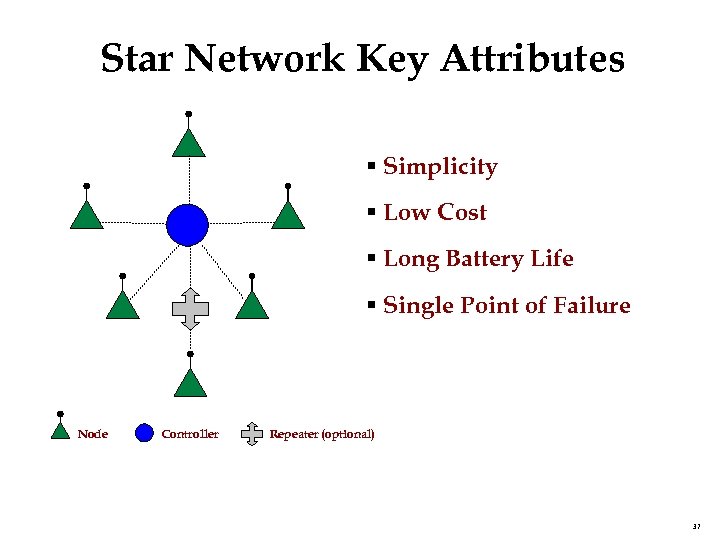
Star Network Key Attributes § Simplicity § Low Cost § Long Battery Life § Single Point of Failure Node Controller Repeater (optional) 37
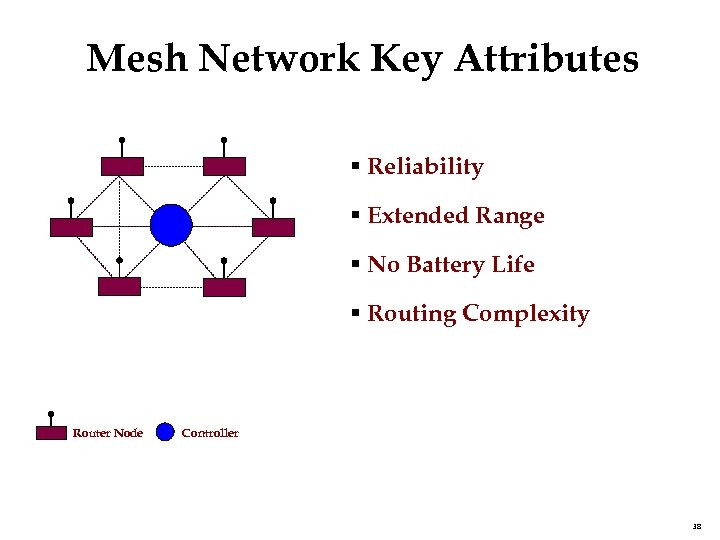
Mesh Network Key Attributes § Reliability § Extended Range § No Battery Life § Routing Complexity Router Node Controller 38
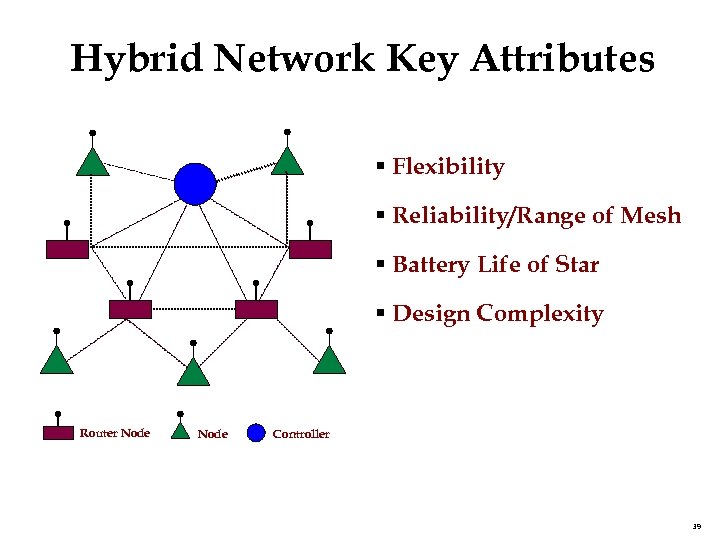
Hybrid Network Key Attributes § Flexibility § Reliability/Range of Mesh § Battery Life of Star § Design Complexity Router Node Controller 39
IEEE 802. 15. 4 MAC Overview Addressing ■ All devices have 64 bit IEEE addresses ■ Short addresses can be allocated ■ Addressing modes: ► Network + device identifier (star) ► Source/destination identifier (peer-peer) 40
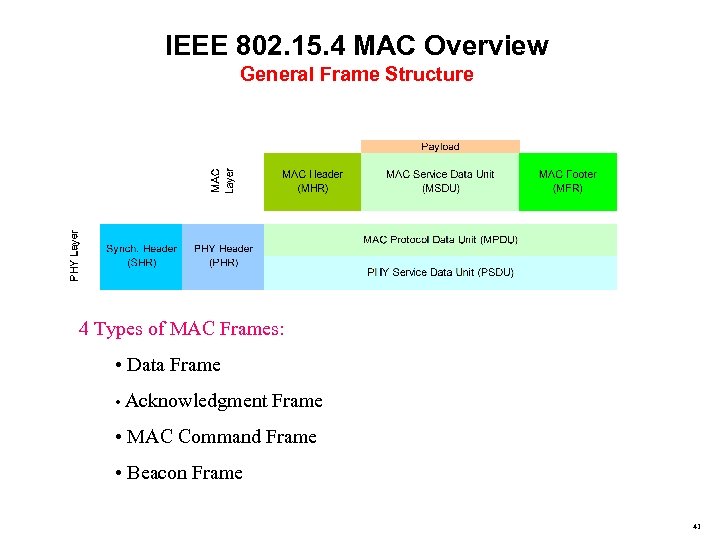
IEEE 802. 15. 4 MAC Overview General Frame Structure 4 Types of MAC Frames: • Data Frame • Acknowledgment Frame • MAC Command Frame • Beacon Frame 41
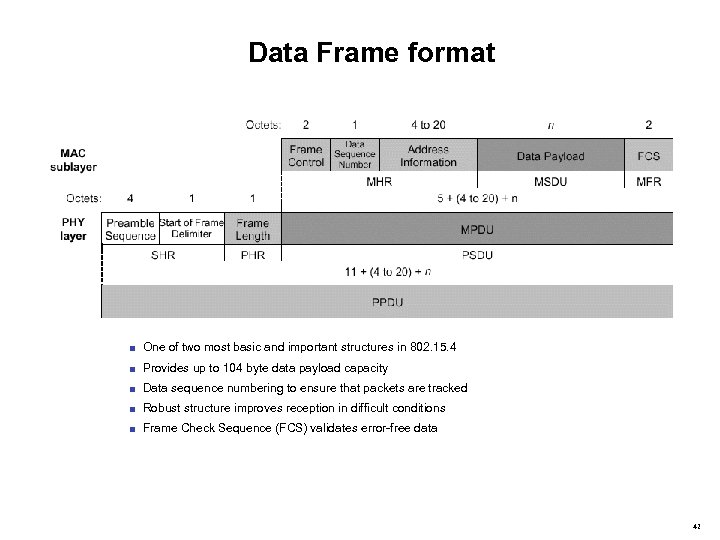
Data Frame format ■ One of two most basic and important structures in 802. 15. 4 ■ Provides up to 104 byte data payload capacity ■ Data sequence numbering to ensure that packets are tracked ■ Robust structure improves reception in difficult conditions ■ Frame Check Sequence (FCS) validates error-free data 42
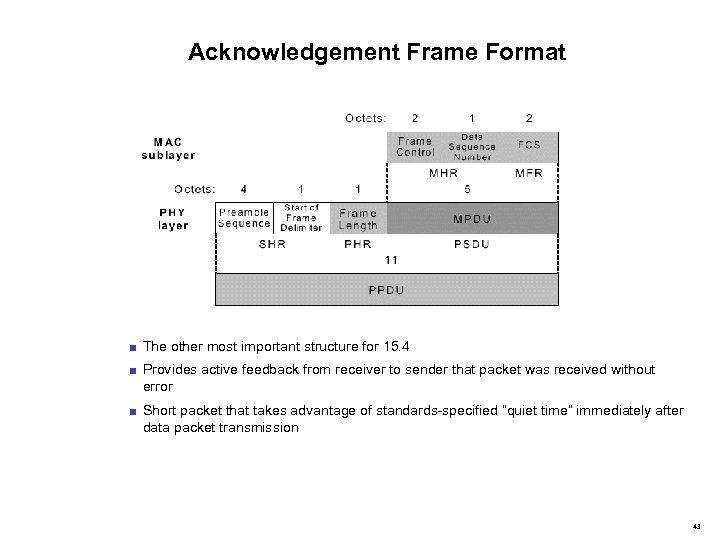
Acknowledgement Frame Format ■ The other most important structure for 15. 4 ■ Provides active feedback from receiver to sender that packet was received without error ■ Short packet that takes advantage of standards-specified “quiet time” immediately after data packet transmission 43
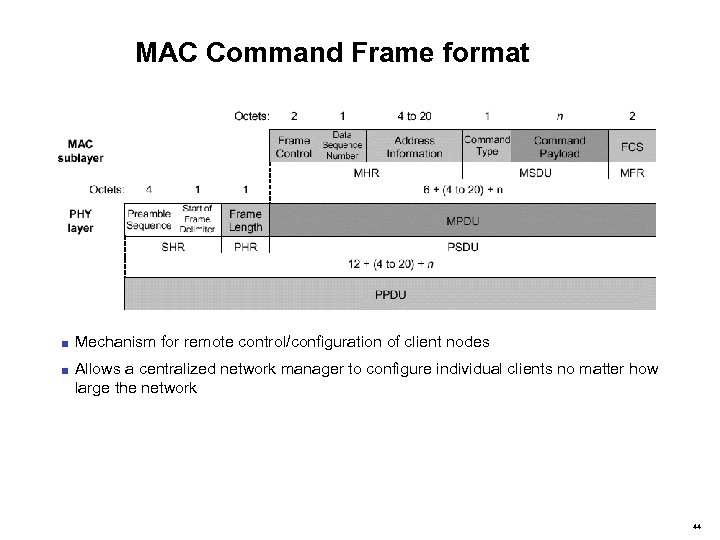
MAC Command Frame format ■ Mechanism for remote control/configuration of client nodes ■ Allows a centralized network manager to configure individual clients no matter how large the network 44
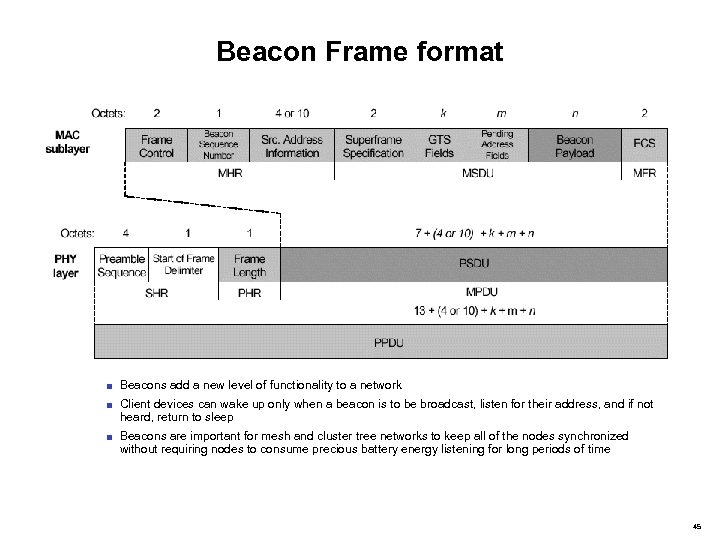
Beacon Frame format ■ Beacons add a new level of functionality to a network ■ Client devices can wake up only when a beacon is to be broadcast, listen for their address, and if not heard, return to sleep ■ Beacons are important for mesh and cluster tree networks to keep all of the nodes synchronized without requiring nodes to consume precious battery energy listening for long periods of time 45
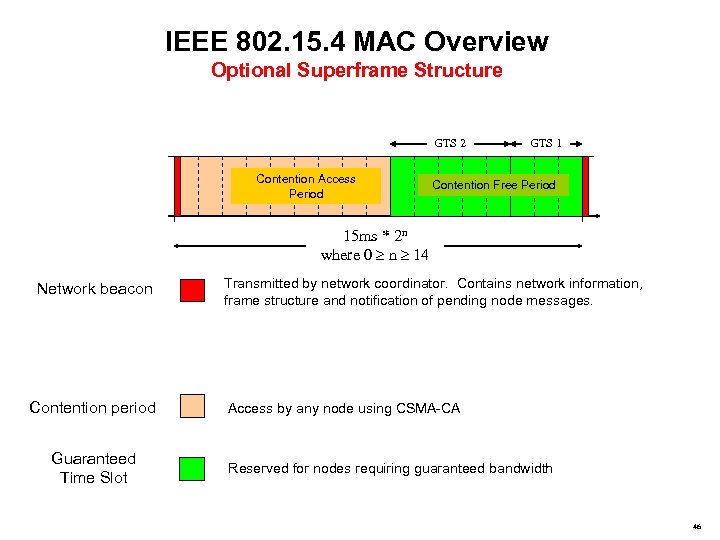
IEEE 802. 15. 4 MAC Overview Optional Superframe Structure GTS 2 Contention Access Period GTS 1 Contention Free Period 15 ms * 2 n where 0 n 14 Network beacon Contention period Guaranteed Time Slot Transmitted by network coordinator. Contains network information, frame structure and notification of pending node messages. Access by any node using CSMA-CA Reserved for nodes requiring guaranteed bandwidth 46
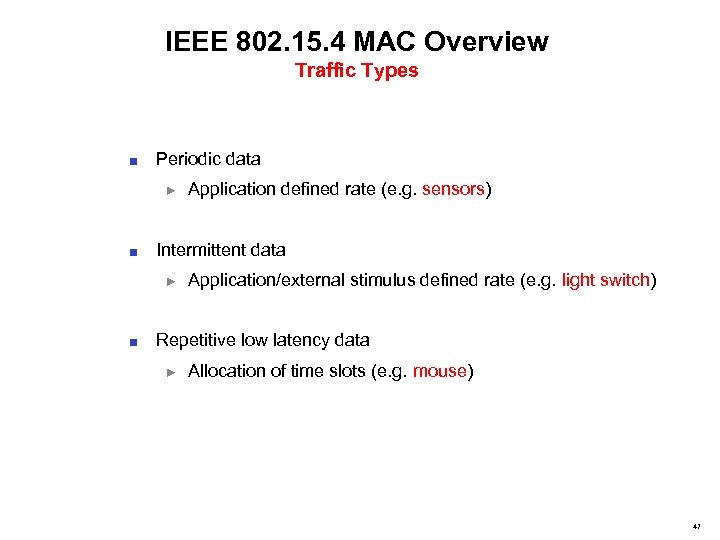
IEEE 802. 15. 4 MAC Overview Traffic Types ■ Periodic data ► ■ Intermittent data ► ■ Application defined rate (e. g. sensors) Application/external stimulus defined rate (e. g. light switch) Repetitive low latency data ► Allocation of time slots (e. g. mouse) 47
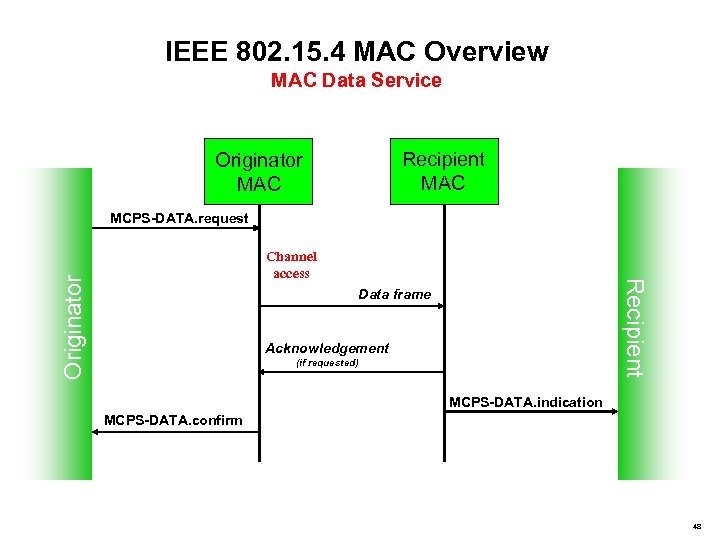
IEEE 802. 15. 4 MAC Overview MAC Data Service Recipient MAC Originator MAC MCPS-DATA. request Originator Recipient Channel access Data frame Acknowledgement (if requested) MCPS-DATA. indication MCPS-DATA. confirm 48
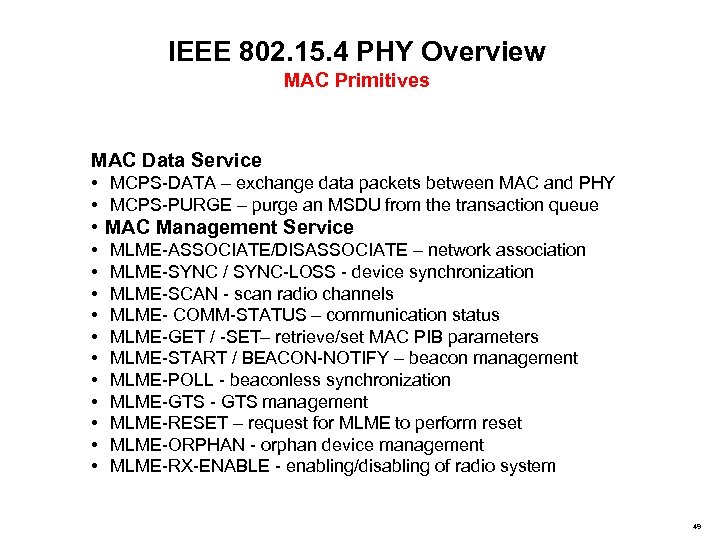
IEEE 802. 15. 4 PHY Overview MAC Primitives MAC Data Service • MCPS-DATA – exchange data packets between MAC and PHY • MCPS-PURGE – purge an MSDU from the transaction queue • MAC Management Service • • • MLME-ASSOCIATE/DISASSOCIATE – network association MLME-SYNC / SYNC-LOSS - device synchronization MLME-SCAN - scan radio channels MLME- COMM-STATUS – communication status MLME-GET / -SET– retrieve/set MAC PIB parameters MLME-START / BEACON-NOTIFY – beacon management MLME-POLL - beaconless synchronization MLME-GTS - GTS management MLME-RESET – request for MLME to perform reset MLME-ORPHAN - orphan device management MLME-RX-ENABLE - enabling/disabling of radio system 49
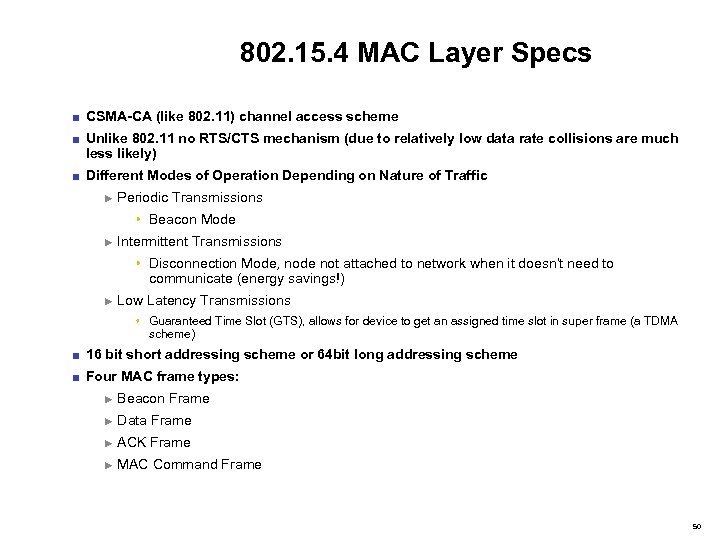
802. 15. 4 MAC Layer Specs ■ CSMA-CA (like 802. 11) channel access scheme ■ Unlike 802. 11 no RTS/CTS mechanism (due to relatively low data rate collisions are much less likely) ■ Different Modes of Operation Depending on Nature of Traffic ► Periodic Transmissions s Beacon Mode ► Intermittent Transmissions s Disconnection Mode, node not attached to network when it doesn't need to communicate (energy savings!) ► Low Latency Transmissions s Guaranteed Time Slot (GTS), allows for device to get an assigned time slot in super frame (a TDMA scheme) ■ 16 bit short addressing scheme or 64 bit long addressing scheme ■ Four MAC frame types: ► Beacon Frame ► Data Frame ► ACK Frame ► MAC Command Frame 50
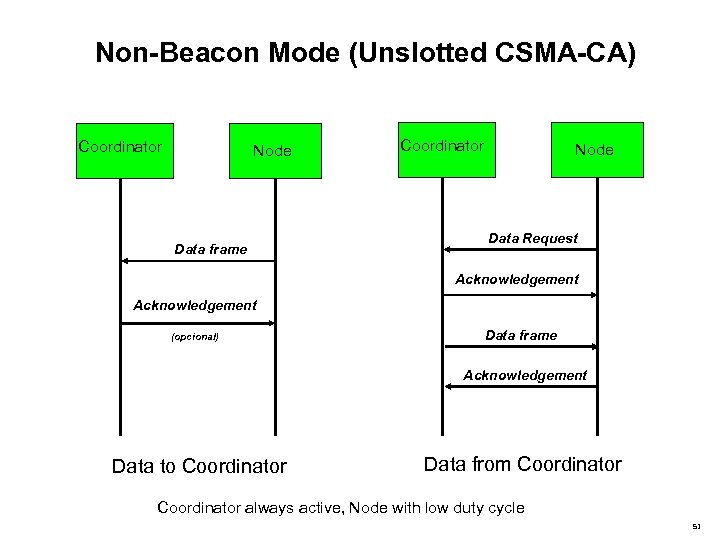
Non-Beacon Mode (Unslotted CSMA-CA) Coordinator Node Data frame Coordinator Node Data Request Acknowledgement (opcional) Data frame Acknowledgement Data to Coordinator Data from Coordinator always active, Node with low duty cycle 51
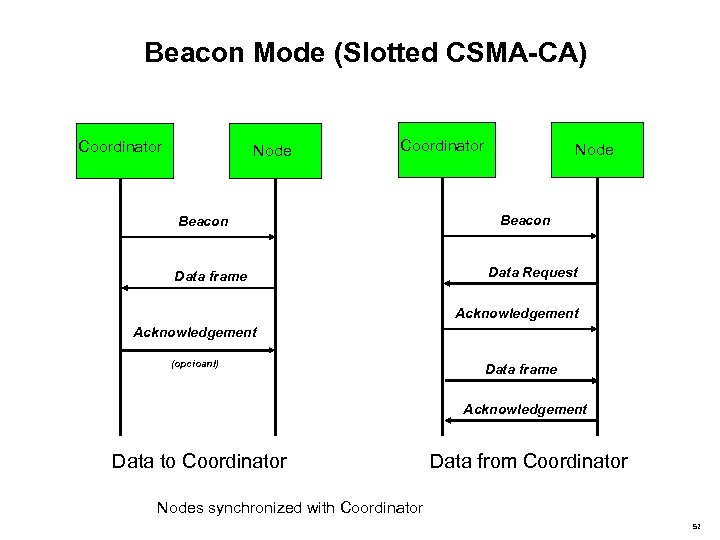
Beacon Mode (Slotted CSMA-CA) Coordinator Node Coordinator Beacon Data frame Node Beacon Data Request Acknowledgement (opcioanl) Data frame Acknowledgement Data to Coordinator Data from Coordinator Nodes synchronized with Coordinator 52
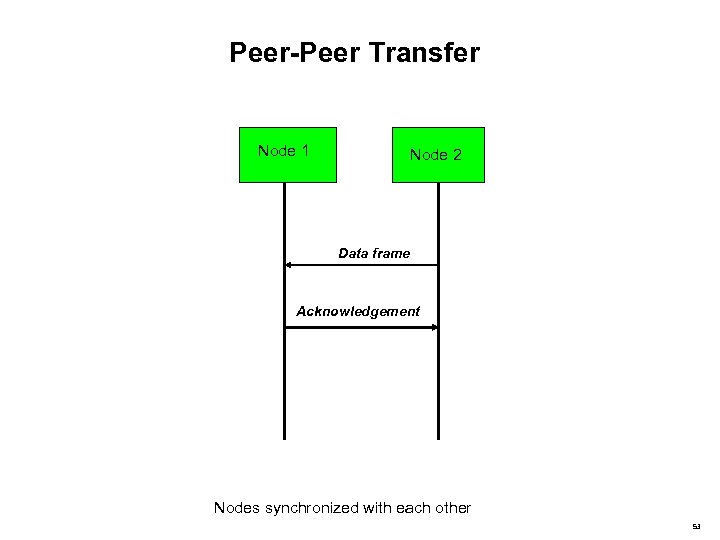
Peer-Peer Transfer Node 1 Node 2 Data frame Acknowledgement Nodes synchronized with each other 53
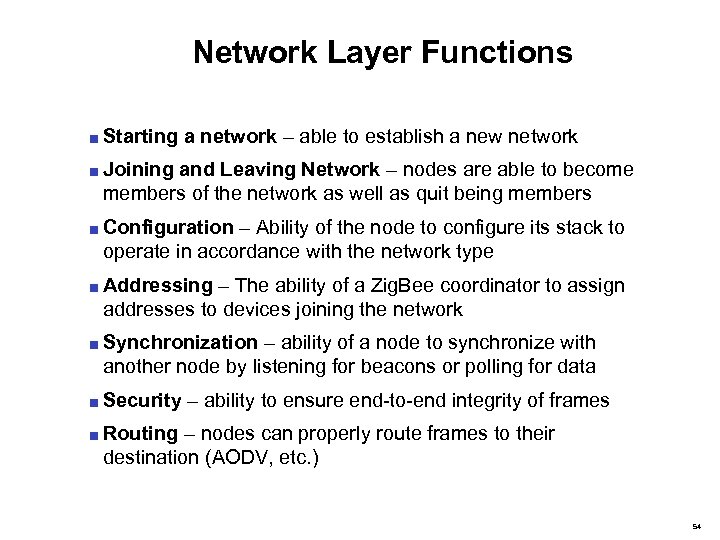
Network Layer Functions ■ Starting a network – able to establish a new network ■ Joining and Leaving Network – nodes are able to become members of the network as well as quit being members ■ Configuration – Ability of the node to configure its stack to operate in accordance with the network type ■ Addressing – The ability of a Zig. Bee coordinator to assign addresses to devices joining the network ■ Synchronization – ability of a node to synchronize with another node by listening for beacons or polling for data ■ Security – ability to ensure end-to-end integrity of frames ■ Routing – nodes can properly route frames to their destination (AODV, etc. ) 54
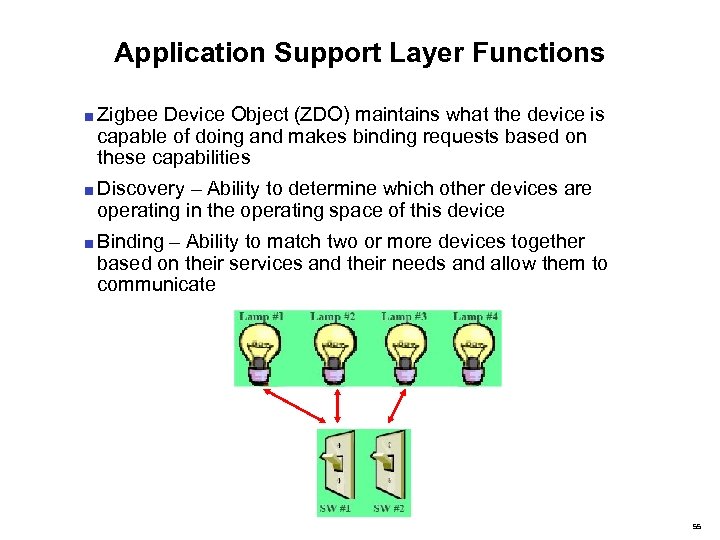
Application Support Layer Functions ■ Zigbee Device Object (ZDO) maintains what the device is capable of doing and makes binding requests based on these capabilities ■ Discovery – Ability to determine which other devices are operating in the operating space of this device ■ Binding – Ability to match two or more devices together based on their services and their needs and allow them to communicate 55
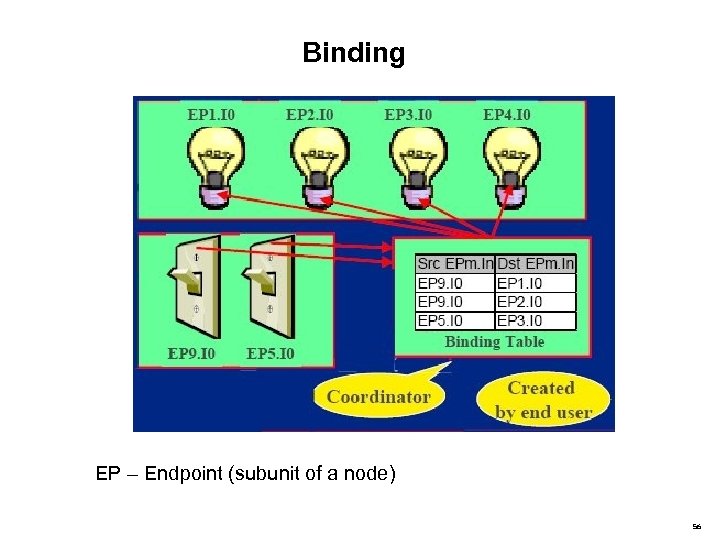
Binding EP – Endpoint (subunit of a node) 56
Mica. Z, Tiny. OS, and Zigbee 57
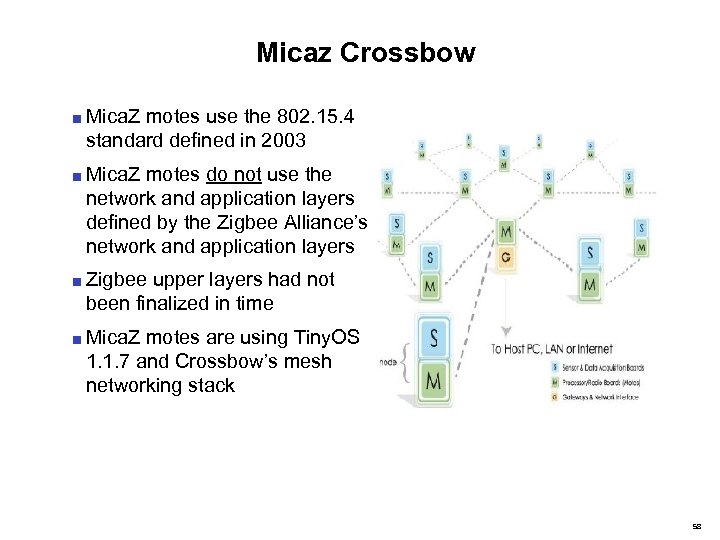
Micaz Crossbow ■ Mica. Z motes use the 802. 15. 4 standard defined in 2003 ■ Mica. Z motes do not use the network and application layers defined by the Zigbee Alliance’s network and application layers ■ Zigbee upper layers had not been finalized in time ■ Mica. Z motes are using Tiny. OS 1. 1. 7 and Crossbow’s mesh networking stack 58
Mica. Z Network & Application layers Network Layer: ■ Any Network Layer/ Routing Algorithm can be implemented in Tiny. OS ► Many available already Application Layer ■ open-source Tiny. OS supported ► Applications can be developed for use with Tiny. OS 59
More 802. 15. 4 Specs ■ Mica. Z Power Consumption ► 30 µW during sleep ► 33 m. W while active ■ Mica. Z Lifetime ► ~ 1 year (Zigbee specifies up to 2 years) ■ Mica. Z Range ► 75 – 100 m (outdoors) ► 20 – 30 m (indoors) 60
MICAz MOTE ■ IEEE 802. 15. 4 ■ 250 kbps radio ■ 128 KB program flash memory ■ 512 KB measurement log memory (xbow estimates > 100000 samples) ■ 10 bit Analog to Digital Converter ■ Red, Green, & Yellow LEDs 61
Tiny. OS ■ Open Source Operating System designed for MOTEs ■ Programs written in an extension of C called nes. C ► Tiny. OS is event driven ► nes. C - wire together components that handle events/fire commands through interfaces to build an application (highly modular) ■ Preinstalled (8 motes) Surge ad-hoc multi-hop (Destination- Sequenced Distance Vector routing) software (xbow) written in nes. C 62
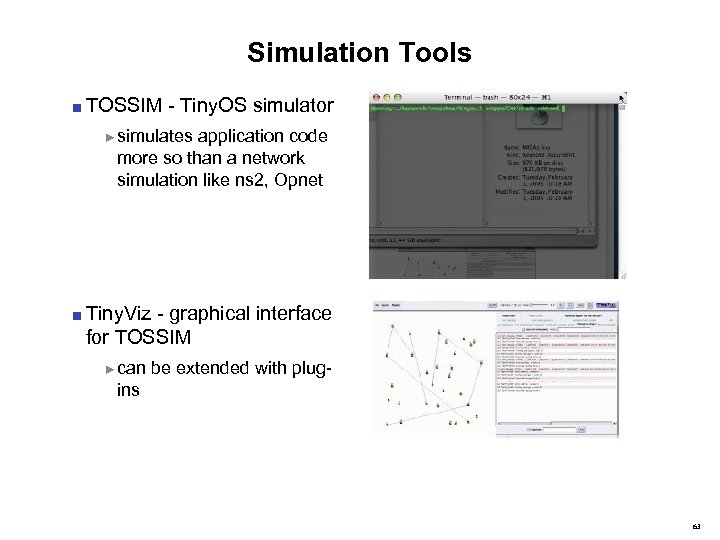
Simulation Tools ■ TOSSIM - Tiny. OS simulator ► simulates application code more so than a network simulation like ns 2, Opnet ■ Tiny. Viz - graphical interface for TOSSIM ► can be extended with plug- ins 63
Most important characteristics of WSN Survey conducted mid-2002 on the characteristics of a wireless sensor network most important to its users: ► Data Reliability ► Battery Life ► Cost ► Transmission Range ► Data Rate ► Data Latency ► Physical Size ► Data Security 64
Designing with 802. 15. 4 and Zig. Bee IEEE 802. 15. 4 vs Bluetooth
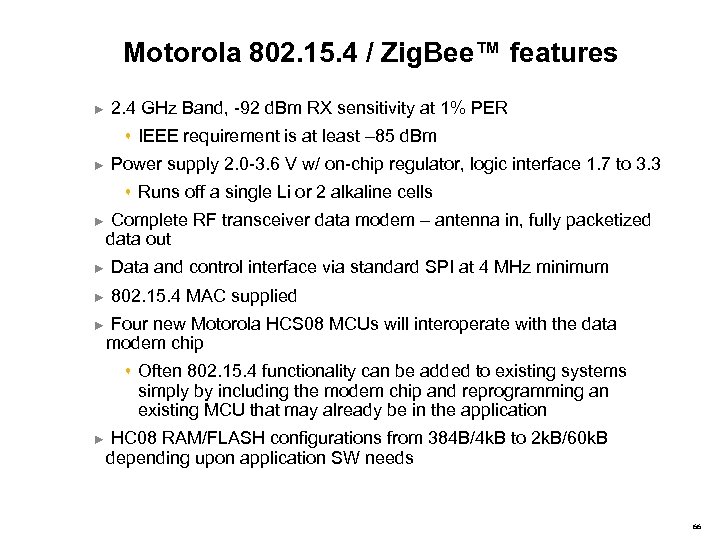
Motorola 802. 15. 4 / Zig. Bee™ features ► 2. 4 GHz Band, -92 d. Bm RX sensitivity at 1% PER s IEEE requirement is at least – 85 d. Bm ► Power supply 2. 0 -3. 6 V w/ on-chip regulator, logic interface 1. 7 to 3. 3 s Runs off a single Li or 2 alkaline cells ► Complete RF transceiver data modem – antenna in, fully packetized data out ► Data and control interface via standard SPI at 4 MHz minimum ► 802. 15. 4 MAC supplied ► Four new Motorola HCS 08 MCUs will interoperate with the data modem chip s Often 802. 15. 4 functionality can be added to existing systems simply by including the modem chip and reprogramming an existing MCU that may already be in the application ► HC 08 RAM/FLASH configurations from 384 B/4 k. B to 2 k. B/60 k. B depending upon application SW needs 66
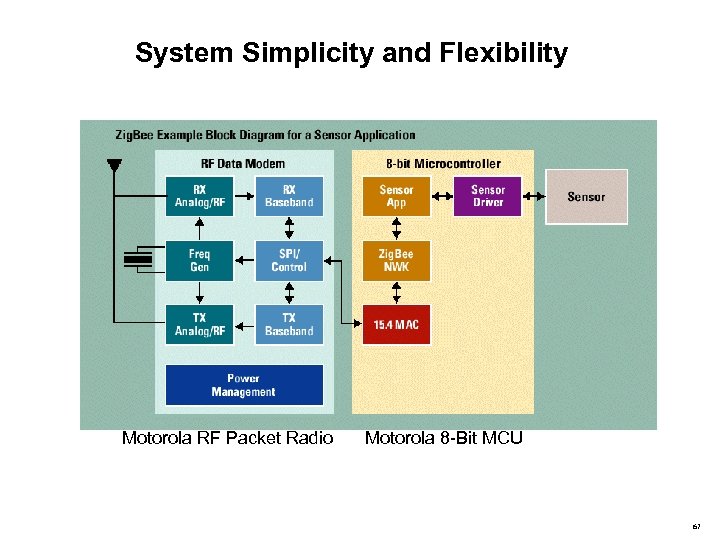
System Simplicity and Flexibility Motorola RF Packet Radio Motorola 8 -Bit MCU 67
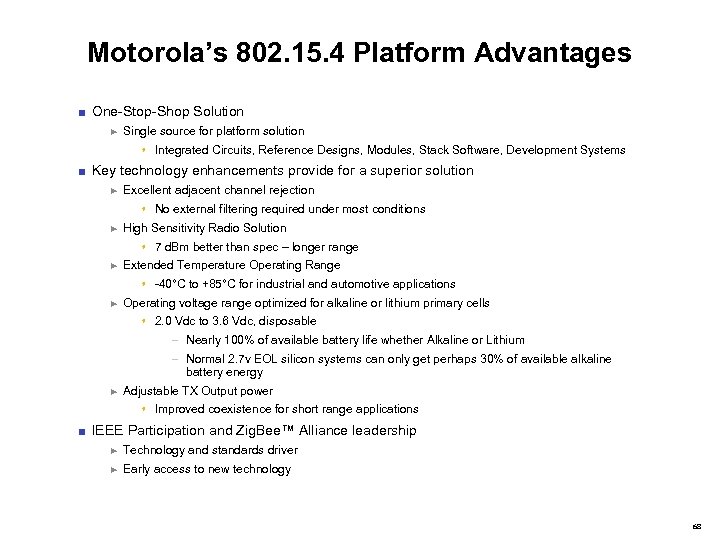
Motorola’s 802. 15. 4 Platform Advantages ■ One-Stop-Shop Solution ► Single source for platform solution s Integrated Circuits, Reference Designs, Modules, Stack Software, Development Systems ■ Key technology enhancements provide for a superior solution ► Excellent adjacent channel rejection s No external filtering required under most conditions ► High Sensitivity Radio Solution s 7 d. Bm better than spec – longer range ► Extended Temperature Operating Range s -40°C to +85°C for industrial and automotive applications ► Operating voltage range optimized for alkaline or lithium primary cells s 2. 0 Vdc to 3. 6 Vdc, disposable ► – Nearly 100% of available battery life whether Alkaline or Lithium – Normal 2. 7 v EOL silicon systems can only get perhaps 30% of available alkaline battery energy Adjustable TX Output power s Improved coexistence for short range applications ■ IEEE Participation and Zig. Bee™ Alliance leadership ► Technology and standards driver ► Early access to new technology 68
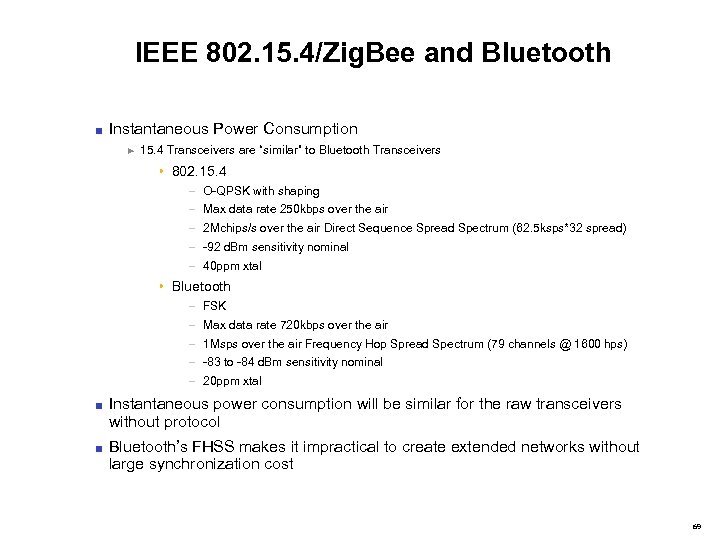
IEEE 802. 15. 4/Zig. Bee and Bluetooth ■ Instantaneous Power Consumption ► 15. 4 Transceivers are “similar” to Bluetooth Transceivers s 802. 15. 4 – – – O-QPSK with shaping Max data rate 250 kbps over the air 2 Mchips/s over the air Direct Sequence Spread Spectrum (62. 5 ksps*32 spread) -92 d. Bm sensitivity nominal 40 ppm xtal s Bluetooth – – – FSK Max data rate 720 kbps over the air 1 Msps over the air Frequency Hop Spread Spectrum (79 channels @ 1600 hps) -83 to -84 d. Bm sensitivity nominal 20 ppm xtal ■ Instantaneous power consumption will be similar for the raw transceivers without protocol ■ Bluetooth’s FHSS makes it impractical to create extended networks without large synchronization cost 69
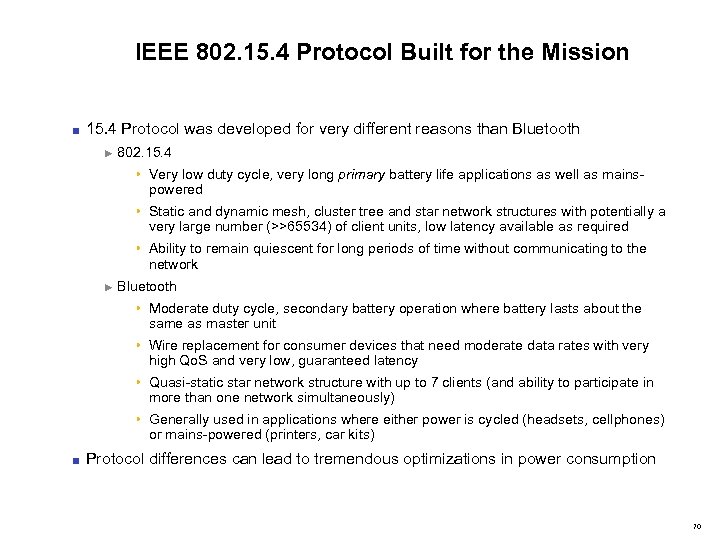
IEEE 802. 15. 4 Protocol Built for the Mission ■ 15. 4 Protocol was developed for very different reasons than Bluetooth ► 802. 15. 4 s Very low duty cycle, very long primary battery life applications as well as mainspowered s Static and dynamic mesh, cluster tree and star network structures with potentially a very large number (>>65534) of client units, low latency available as required s Ability to remain quiescent for long periods of time without communicating to the network ► Bluetooth s Moderate duty cycle, secondary battery operation where battery lasts about the same as master unit s Wire replacement for consumer devices that need moderate data rates with very high Qo. S and very low, guaranteed latency s Quasi-static star network structure with up to 7 clients (and ability to participate in more than one network simultaneously) s Generally used in applications where either power is cycled (headsets, cellphones) or mains-powered (printers, car kits) ■ Protocol differences can lead to tremendous optimizations in power consumption 70
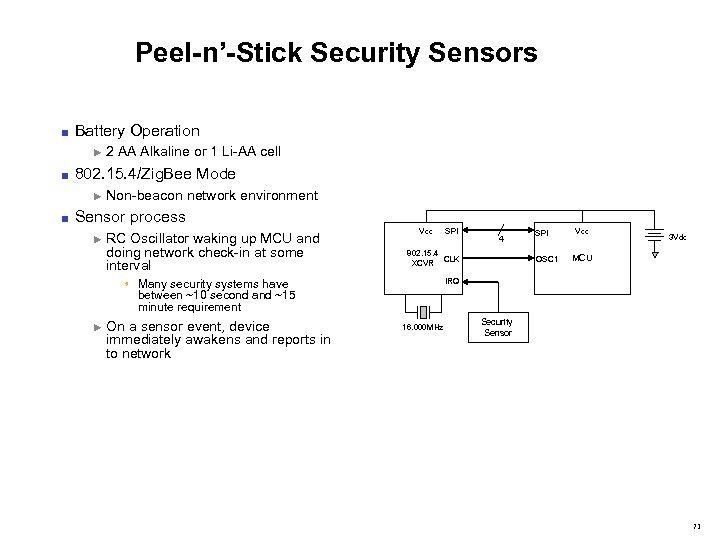
Peel-n’-Stick Security Sensors ■ Battery Operation ► 2 AA Alkaline or 1 Li-AA cell ■ 802. 15. 4/Zig. Bee Mode ► Non-beacon network environment ■ Sensor process ► RC Oscillator waking up MCU and doing network check-in at some interval Vcc On a sensor event, device immediately awakens and reports in to network 4 802. 15. 4 XCVR CLK SPI OSC 1 Vcc 3 Vdc MCU IRQ s Many security systems have between ~10 second and ~15 minute requirement ► SPI 16. 000 MHz Security Sensor 71
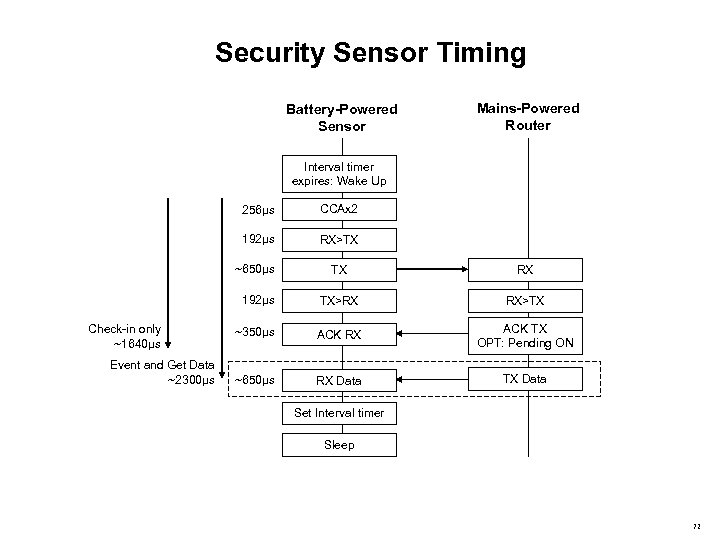
Security Sensor Timing Battery-Powered Sensor Mains-Powered Router Interval timer expires: Wake Up 256µs 192µs TX RX 192µs Event and Get Data ~2300µs RX>TX ~650µs Check-in only ~1640µs CCAx 2 TX>RX RX>TX ~350µs ACK RX ACK TX OPT: Pending ON ~650µs RX Data TX Data Set Interval timer Sleep 72
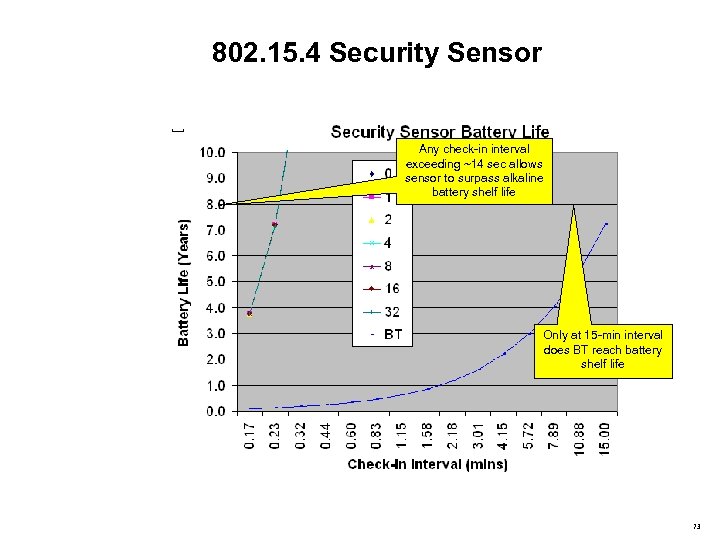
802. 15. 4 Security Sensor Any check-in interval exceeding ~14 sec allows sensor to surpass alkaline battery shelf life Only at 15 -min interval does BT reach battery shelf life 73
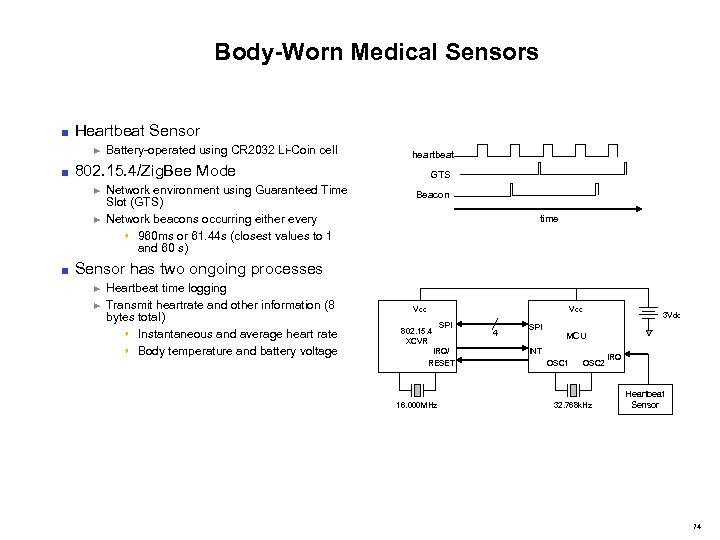
Body-Worn Medical Sensors ■ Heartbeat Sensor ► Battery-operated using CR 2032 Li-Coin cell heartbeat ■ 802. 15. 4/Zig. Bee Mode ► ► Network environment using Guaranteed Time Slot (GTS) Network beacons occurring either every s 960 ms or 61. 44 s (closest values to 1 and 60 s) GTS Beacon time ■ Sensor has two ongoing processes ► ► Heartbeat time logging Transmit heartrate and other information (8 bytes total) s Instantaneous and average heart rate s Body temperature and battery voltage Vcc 802. 15. 4 XCVR SPI IRQ/ RESET 16. 000 MHz 4 SPI 3 Vdc MCU INT OSC 1 OSC 2 32. 768 k. Hz IRQ Heartbeat Sensor 74
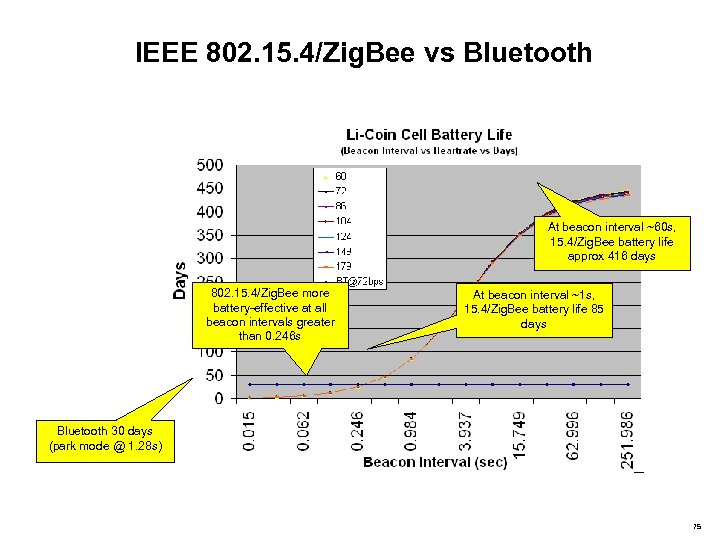
IEEE 802. 15. 4/Zig. Bee vs Bluetooth At beacon interval ~60 s, 15. 4/Zig. Bee battery life approx 416 days 802. 15. 4/Zig. Bee more battery-effective at all beacon intervals greater than 0. 246 s At beacon interval ~1 s, 15. 4/Zig. Bee battery life 85 days Bluetooth 30 days (park mode @ 1. 28 s) 75
Summary ■ IEEE 802. 15. 4 and Zig. Bee ► Designer concentrates on end application s Silicon vendors and Zig. Bee Alliance take care of transceiver, RF channel and protocol ► Reliable and robust communications ► Flexible network architectures ► Very long primary battery life (months to years to decades) ► Very inexpensive Bill Of Materials ► Low system complexity for the OEM ■ More Information ► Motorola: www. motorola. com/zigbee ► Zig. Bee: www. zigbee. org 76
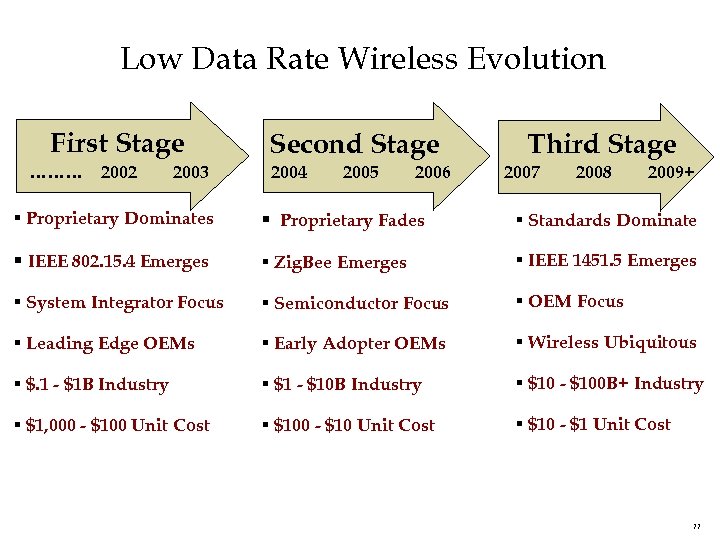
Low Data Rate Wireless Evolution First Stage ……… 2002 2003 Second Stage 2004 2005 2006 Third Stage 2007 2008 2009+ § Proprietary Dominates § Proprietary Fades § Standards Dominate § IEEE 802. 15. 4 Emerges § Zig. Bee Emerges § IEEE 1451. 5 Emerges § System Integrator Focus § Semiconductor Focus § OEM Focus § Leading Edge OEMs § Early Adopter OEMs § Wireless Ubiquitous § $. 1 - $1 B Industry § $1 - $10 B Industry § $10 - $100 B+ Industry § $1, 000 - $100 Unit Cost § $100 - $10 Unit Cost § $10 - $1 Unit Cost 77
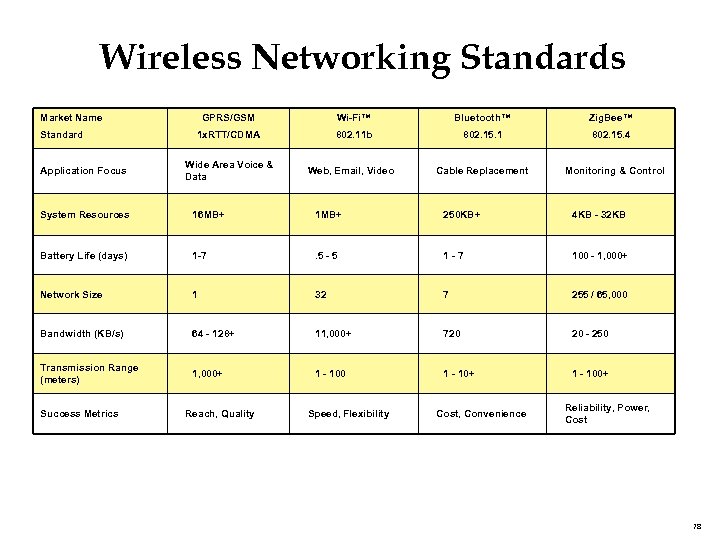
Wireless Networking Standards Market Name Standard Application Focus GPRS/GSM Wi-Fi™ Bluetooth™ Zig. Bee™ 1 x. RTT/CDMA 802. 11 b 802. 15. 1 802. 15. 4 Wide Area Voice & Data Web, Email, Video Cable Replacement Monitoring & Control System Resources 16 MB+ 1 MB+ 250 KB+ 4 KB - 32 KB Battery Life (days) 1 -7 . 5 - 5 1 -7 100 - 1, 000+ Network Size 1 32 7 255 / 65, 000 Bandwidth (KB/s) 64 - 128+ 11, 000+ 720 20 - 250 Transmission Range (meters) 1, 000+ 1 - 100 1 - 10+ 1 - 100+ Success Metrics Reach, Quality Speed, Flexibility Cost, Convenience Reliability, Power, Cost 78
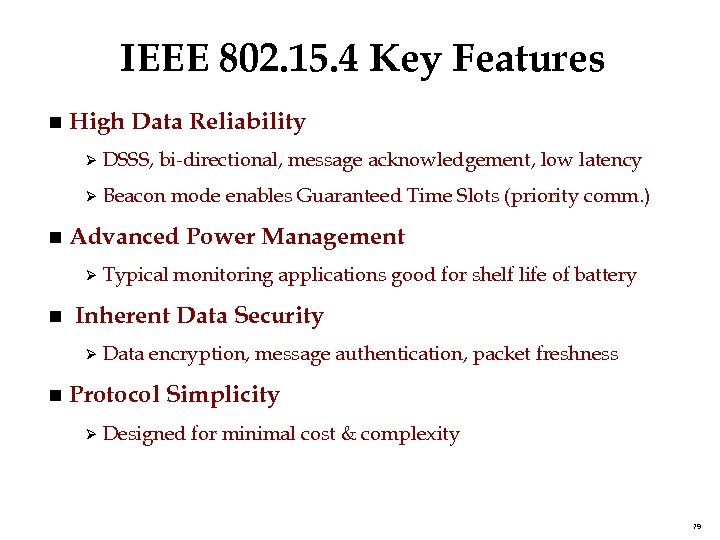
IEEE 802. 15. 4 Key Features n High Data Reliability Ø Ø n DSSS, bi-directional, message acknowledgement, low latency Beacon mode enables Guaranteed Time Slots (priority comm. ) Advanced Power Management Ø n Inherent Data Security Ø n Typical monitoring applications good for shelf life of battery Data encryption, message authentication, packet freshness Protocol Simplicity Ø Designed for minimal cost & complexity 79
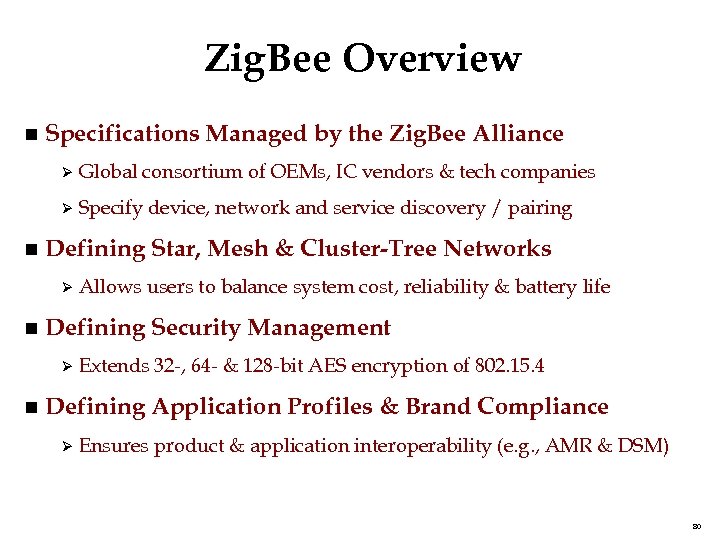
Zig. Bee Overview n Specifications Managed by the Zig. Bee Alliance Ø Ø n Global consortium of OEMs, IC vendors & tech companies Specify device, network and service discovery / pairing Defining Star, Mesh & Cluster-Tree Networks Ø n Defining Security Management Ø n Allows users to balance system cost, reliability & battery life Extends 32 -, 64 - & 128 -bit AES encryption of 802. 15. 4 Defining Application Profiles & Brand Compliance Ø Ensures product & application interoperability (e. g. , AMR & DSM) 80
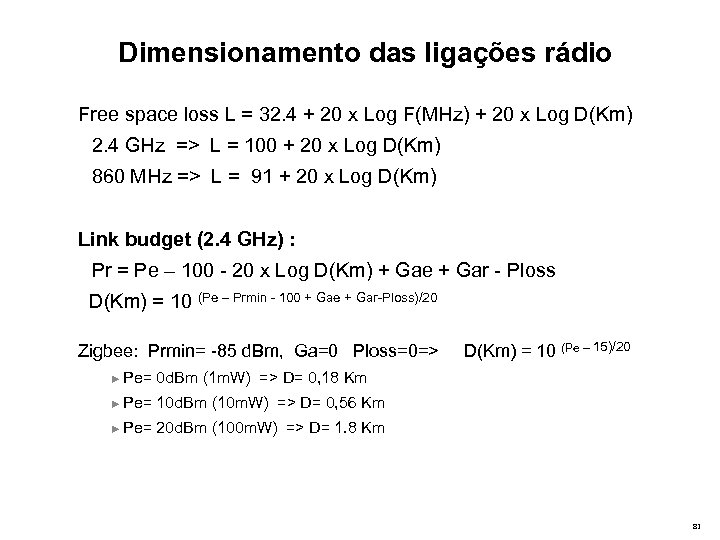
Dimensionamento das ligações rádio Free space loss L = 32. 4 + 20 x Log F(MHz) + 20 x Log D(Km) 2. 4 GHz => L = 100 + 20 x Log D(Km) 860 MHz => L = 91 + 20 x Log D(Km) Link budget (2. 4 GHz) : Pr = Pe – 100 - 20 x Log D(Km) + Gae + Gar - Ploss D(Km) = 10 (Pe – Prmin - 100 + Gae + Gar-Ploss)/20 Zigbee: Prmin= -85 d. Bm, Ga=0 Ploss=0=> ► Pe= 0 d. Bm (1 m. W) => D= 0, 18 Km ► Pe= 10 d. Bm (10 m. W) => D= 0, 56 Km ► Pe= D(Km) = 10 (Pe – 15)/20 20 d. Bm (100 m. W) => D= 1. 8 Km 81
Скачать презентацию Zig Bee IEEE 802 15 4 Zig
b187a212d04fb2daa50278b6b7e4e924.ppt