


 Скачать презентацию ZEVs in Vehicle-to-Grid V 2 G Applications Jasna
c8c852ec9882c03a64c175ce235cb533.ppt
- Количество слайдов: 23
 ZEVs in Vehicle-to-Grid (V 2 G) Applications Jasna Tomić Senior Consultant, West. Start-CALSTART Willett Kempton University of Delaware ZEV Symposium, CARB Sacramento — 25 -27 Sept 2006
 VEHICLE TYPES Electric-drive Vehicles (EDV) means on -board power electronics producing AC power • Battery: Full function & City Car • Fuel Cell: On-board H 2 & stat. reformer • Hybrid: ICE + battery
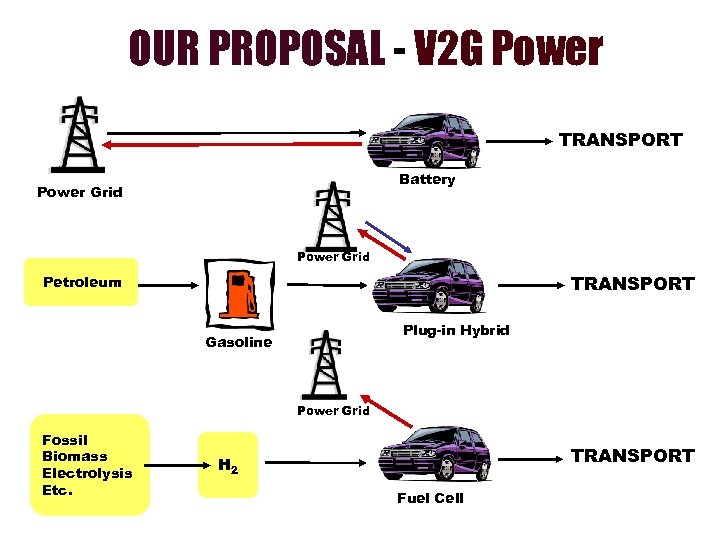 OUR PROPOSAL - V 2 G Power TRANSPORT Battery Power Grid TRANSPORT Petroleum Plug-in Hybrid Gasoline Power Grid Fossil Biomass Electrolysis Etc. TRANSPORT H 2 Fuel Cell
 Importance of V 2 G for ZEV • Cost of full-function ZEVs is relatively high • V 2 G provides revenue and helps offset that higher cost • Dual use of ZEV for clean transportation and grid power support; shared capital cost • Encourages early adoption of ZEVs
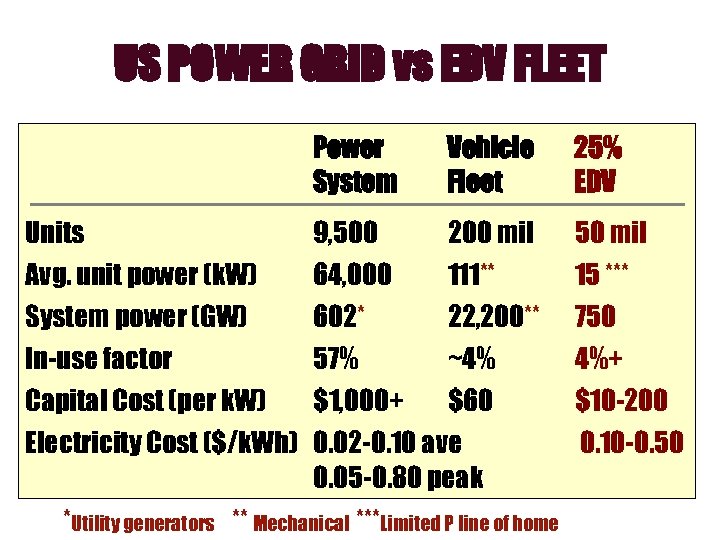 US POWER GRID vs EDV FLEET Power System Units Avg. unit power (k. W) System power (GW) In-use factor Vehicle Fleet 25% EDV 9, 500 64, 000 602* 57% 200 mil 111** 22, 200** ~4% 50 mil 15 *** 750 4%+ Capital Cost (per k. W) $1, 000+ $60 Electricity Cost ($/k. Wh) 0. 02 -0. 10 ave 0. 05 -0. 80 peak *Utility generators ** Mechanical ***Limited P line of home $10 -200 0. 10 -0. 50
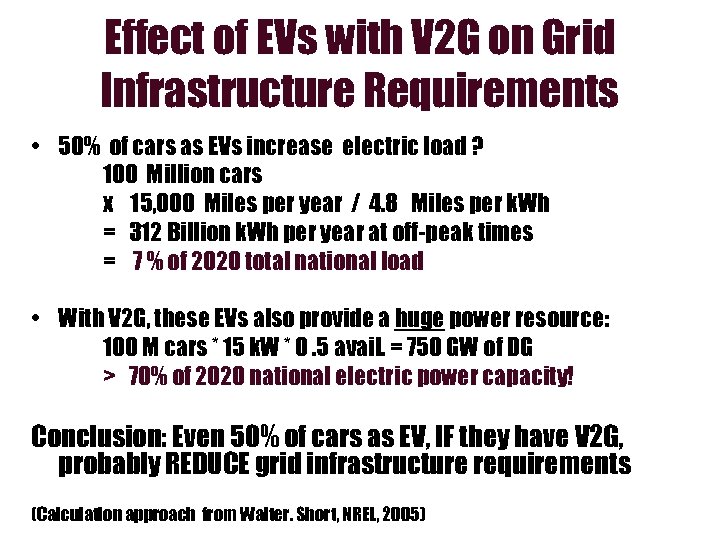 Effect of EVs with V 2 G on Grid Infrastructure Requirements • 50% of cars as EVs increase electric load ? 100 Million cars x 15, 000 Miles per year / 4. 8 Miles per k. Wh = 312 Billion k. Wh per year at off-peak times = 7 % of 2020 total national load • With V 2 G, these EVs also provide a huge power resource: 100 M cars * 15 k. W * 0. 5 avail. = 750 GW of DG > 70% of 2020 national electric power capacity! Conclusion: Even 50% of cars as EV, IF they have V 2 G, probably REDUCE grid infrastructure requirements (Calculation approach from Walter. Short, NREL, 2005)
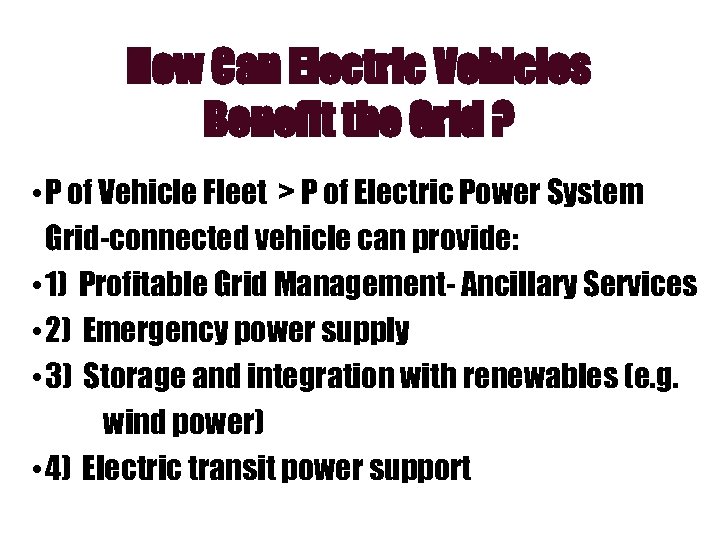 How Can Electric Vehicles Benefit the Grid ? • P of Vehicle Fleet > P of Electric Power System Grid-connected vehicle can provide: • 1) Profitable Grid Management- Ancillary Services • 2) Emergency power supply • 3) Storage and integration with renewables (e. g. wind power) • 4) Electric transit power support
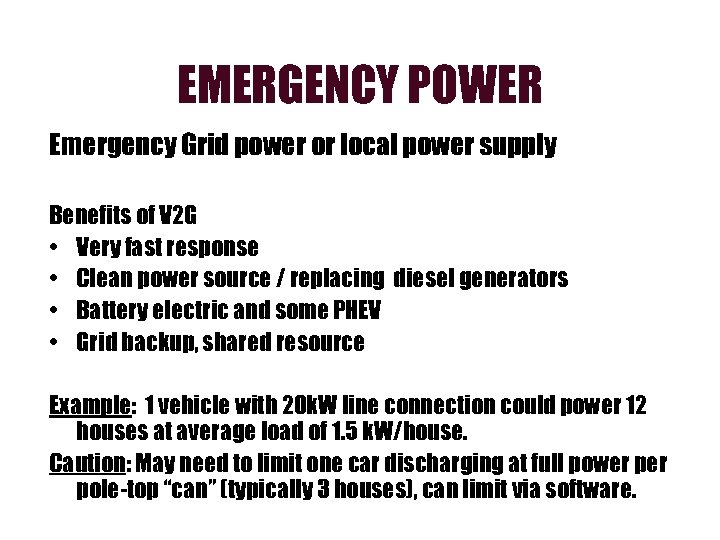 EMERGENCY POWER Emergency Grid power or local power supply Benefits of V 2 G • Very fast response • Clean power source / replacing diesel generators • Battery electric and some PHEV • Grid backup, shared resource Example: 1 vehicle with 20 k. W line connection could power 12 houses at average load of 1. 5 k. W/house. Caution: May need to limit one car discharging at full power pole-top “can” (typically 3 houses), can limit via software.
 ELECTRIC VEHICLES - STORAGE FOR WIND AND SOLAR • Use of Electric-drive vehicles with V 2 G could double wind resources (Short & Denholm 2006) or even enable 50% wind (Kempton &Tomic 2005) • EDVs provide both ancillary services and diurnal storage for intermittent renewables (presentation by Murley & Kempton)
 V 2 G FOR ELECTRIC TRANSIT POWER SUPPORT • Typical urban rail profile: full power for 10 sec, 1/2 power for 20 sec more • V 2 G can power traction spike for local rail • Billing: demand charges, take-or-pay, pay own A/S, etc. Many cost savings possible. (presentation by Nishinaga this session)
 V 2 G POWER FOR GRID MANAGEMENT ANCILLARY SERVICES • Ancillary Services (AS) • Regulation Services • Advantages of V 2 G for Regulation • Utility EDV Fleets for Regulation Services • Cost and Revenue Calculations • Sample results of 2 fleet cases
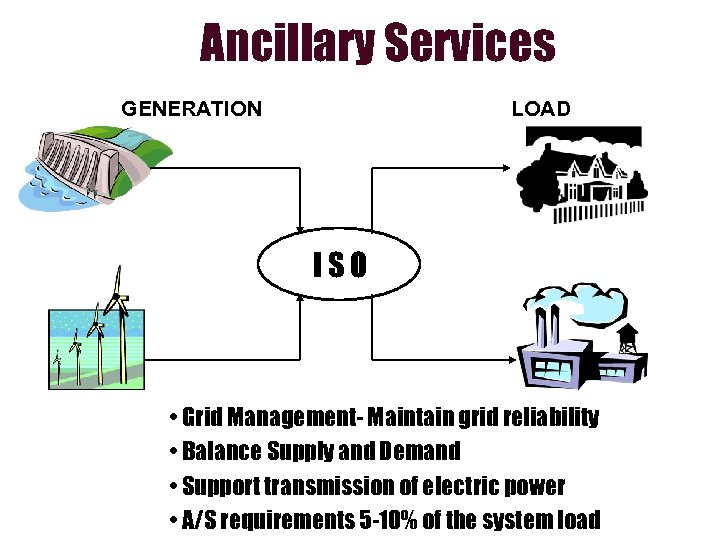 Ancillary Services GENERATION LOAD ISO • Grid Management- Maintain grid reliability • Balance Supply and Demand • Support transmission of electric power • A/S requirements 5 -10% of the system load
 Ancillary Services • Regulation: On-line generation synchronized to the grid to keep frequency and voltage steady. Energy is increased/decreased instantly (~ 2 -3 min) via automatic generation control (AGC) • Spinning Reserves: Additional generating capacity synchronized and ready to respond for ~10 min in case of failures. • Payments consist of: Capacity price ($/MW-h) + Energy price ($/MWh)
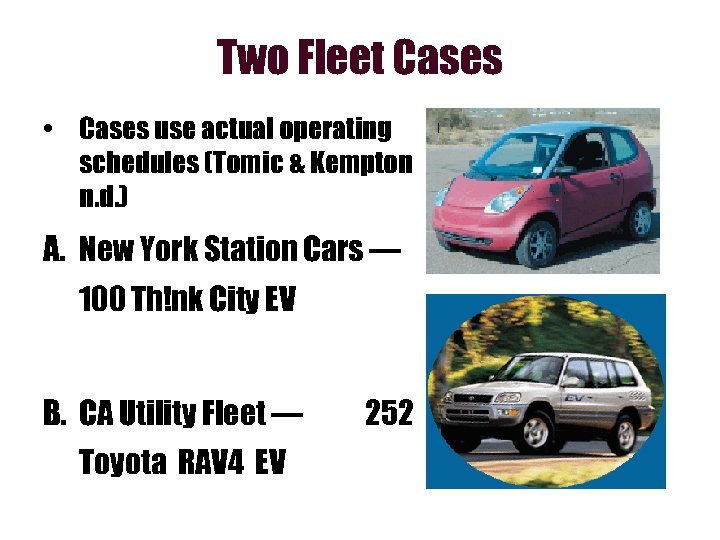 Two Fleet Cases • Cases use actual operating schedules (Tomic & Kempton n. d. ) A. New York Station Cars — 100 Th!nk City EV B. CA Utility Fleet — Toyota RAV 4 EV 252
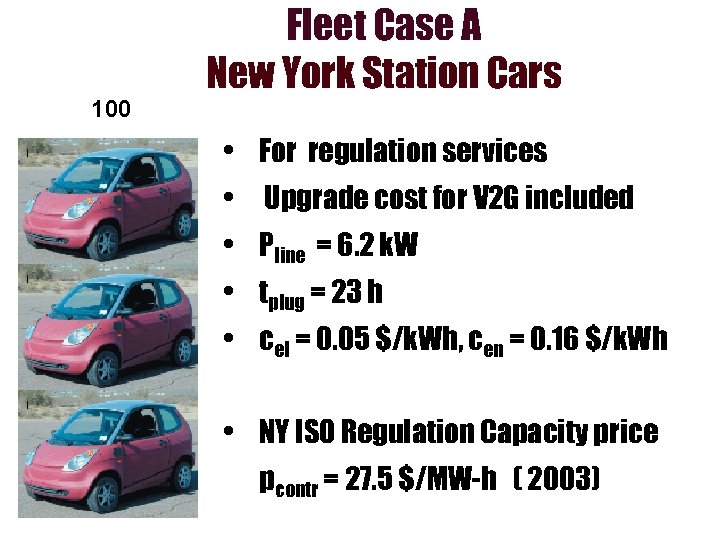 100 Fleet Case A New York Station Cars • For regulation services • Upgrade cost for V 2 G included • Pline = 6. 2 k. W • tplug = 23 h • cel = 0. 05 $/k. Wh, cen = 0. 16 $/k. Wh • NY ISO Regulation Capacity price pcontr = 27. 5 $/MW-h ( 2003)
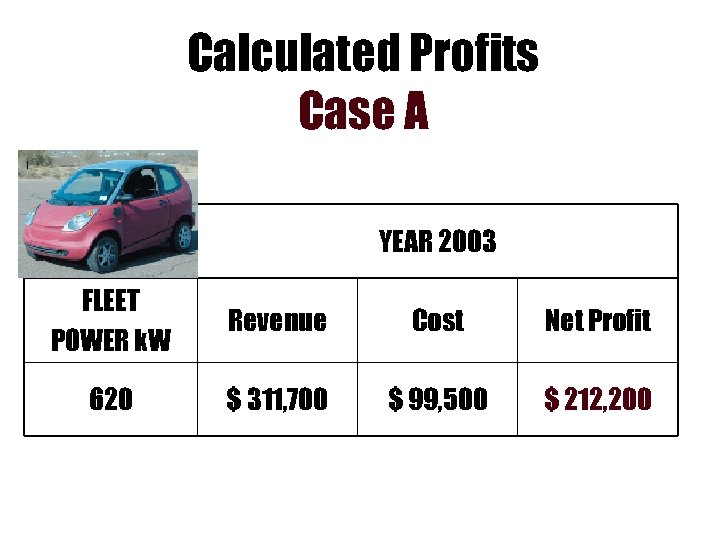 Calculated Profits Case A YEAR 2003 FLEET POWER k. W Revenue Cost Net Profit 620 $ 311, 700 $ 99, 500 $ 212, 200
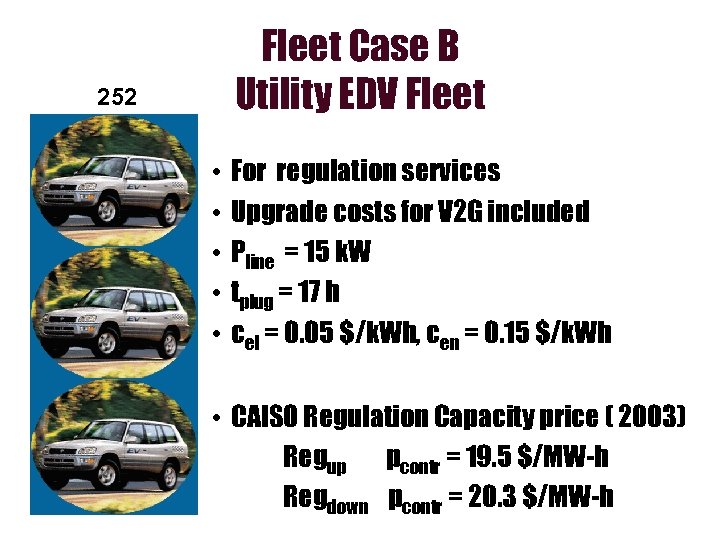 Fleet Case B Utility EDV Fleet 252 • • • For regulation services Upgrade costs for V 2 G included Pline = 15 k. W tplug = 17 h cel = 0. 05 $/k. Wh, cen = 0. 15 $/k. Wh • CAISO Regulation Capacity price ( 2003) Regup pcontr = 19. 5 $/MW-h Regdown pcontr = 20. 3 $/MW-h
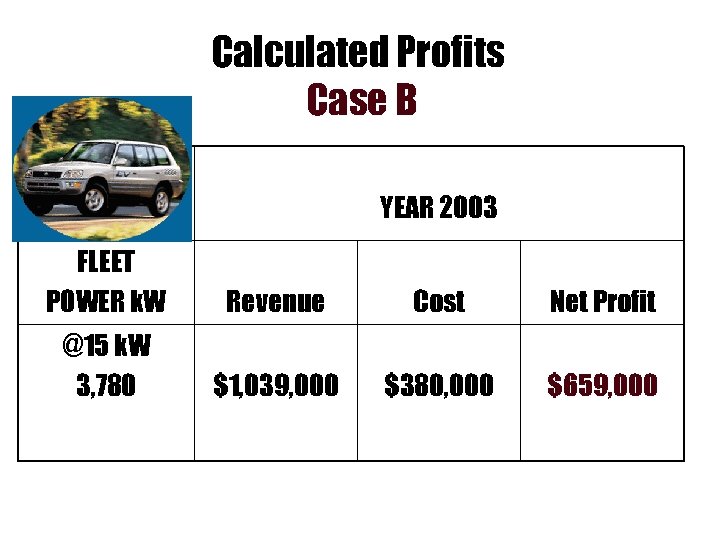 Calculated Profits Case B YEAR 2003 FLEET POWER k. W Revenue Cost Net Profit @15 k. W 3, 780 $1, 039, 000 $380, 000 $659, 000
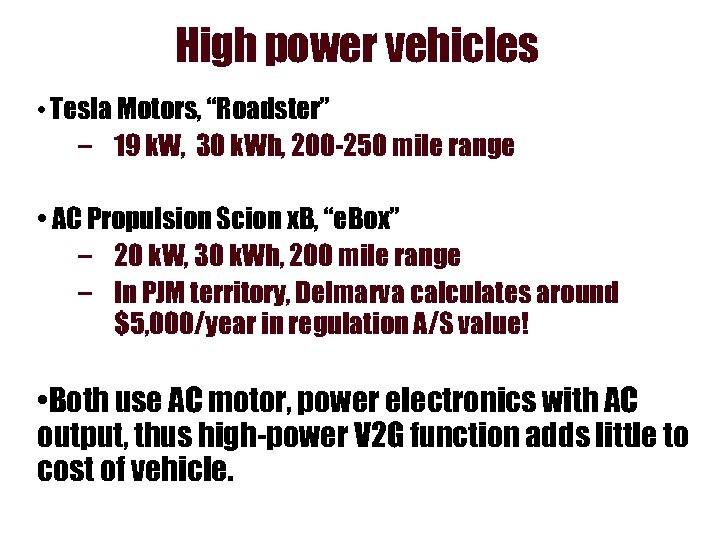 High power vehicles • Tesla Motors, “Roadster” – 19 k. W, 30 k. Wh, 200 -250 mile range • AC Propulsion Scion x. B, “e. Box” – 20 k. W, 30 k. Wh, 200 mile range – In PJM territory, Delmarva calculates around $5, 000/year in regulation A/S value! • Both use AC motor, power electronics with AC output, thus high-power V 2 G function adds little to cost of vehicle.
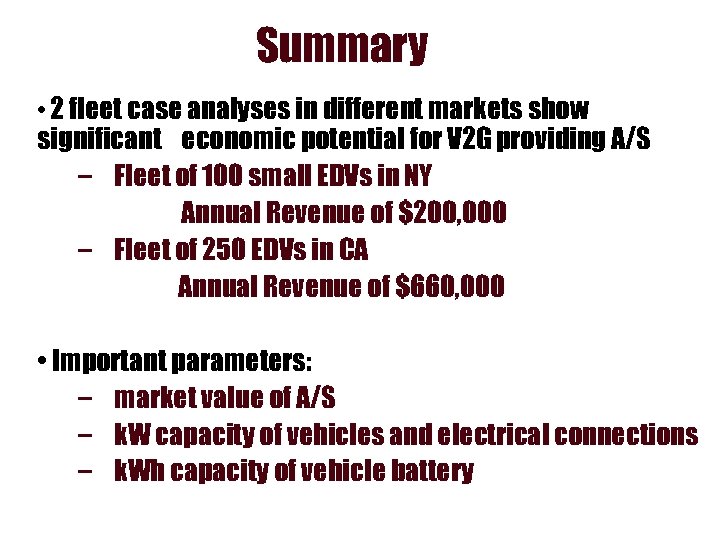 Summary • 2 fleet case analyses in different markets show significant economic potential for V 2 G providing A/S – Fleet of 100 small EDVs in NY Annual Revenue of $200, 000 – Fleet of 250 EDVs in CA Annual Revenue of $660, 000 • Important parameters: – market value of A/S – k. W capacity of vehicles and electrical connections – k. Wh capacity of vehicle battery
 Conclusions • V 2 G has high market value for regulation services and spinning reserves • Possible early adopters: Utility fleets, cars parked at urban transit
 CONCLUSIONS • V 2 G can substantially bring down the cost of owning and operating ZEVs. • High power connection favored, e. g. 20 k. W, for short, high power grid support at little incremental cost. • Benefits — clean transportation (no CO 2) and clean source of electric power.
 Acknowledgments Funded in part by: Kirsch Foundation and Conectiv Power Delivery More information: www. udel. edu/V 2 G JTomic@weststart. org Willett@udel. edu