


 Скачать презентацию ZÁKLADNÍ ŠKOLA OLOMOUC příspěvková organizace MOZARTOVA 48 779
0224779f5612f89b45ef6e4fe1cb3538.ppt
- Количество слайдов: 15
 ZÁKLADNÍ ŠKOLA OLOMOUC příspěvková organizace MOZARTOVA 48, 779 00 OLOMOUC tel. : 585 427 142, 775 116 442; fax: 585 422 713 email: kundrum@centrum. cz; www. zs-mozartova. cz Projekt: ŠKOLA RADOSTI, ŠKOLA KVALITY Registrační číslo projektu: CZ. 1. 07/1. 4. 00/21. 3688 EU PENÍZE ŠKOLÁM Operační program Vzdělávání pro konkurenceschopnost
 ZÁKLADNÍ ŠKOLA OLOMOUC příspěvková organizace MOZARTOVA 48, 779 00 OLOMOUC tel. : 585 427 142, 775 116 442; fax: 585 422 713 email: kundrum@centrum. cz; www. zs-mozartova. cz Autor: Mgr. Lenka Panglová Vzdělávací oblast: Jazyk a jazyková komunikace Vzdělávací obor: Anglický jazyk Vyučovací předmět: Anglický jazyk Ročník: 7. Tematická oblast: Gramatické jevy Téma hodiny: Present simple Označení DUM: VY_32_INOVACE_27. 01. PAN. AJ. 7 Vytvořeno: 06. 09. 2013
 Present simple – _________ přítomný čas prostý Types of SENTENCES A Positive sentence: • I go running every day. • You speak English very well. • They like films with subtitles. • We normally take a bus to school. I go … You speak… They like… We take…
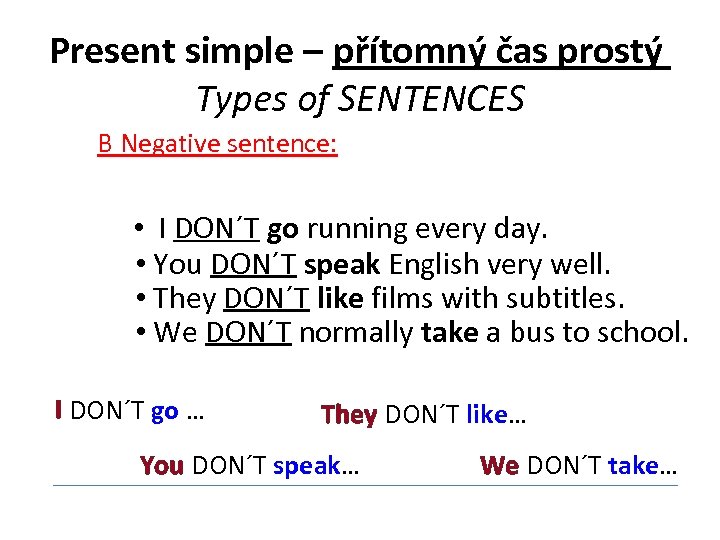 Present simple – _________ přítomný čas prostý Types of SENTENCES B Negative sentence: • I DON´T go running every day. • You DON´T speak English very well. • They DON´T like films with subtitles. • We DON´T normally take a bus to school. I DON´T go … They DON´T like… You DON´T speak… We DON´T take…
 COMPARISON POSITIVE vs NEGATIVE Positive sentence Negative sentence • I go swimming daily. • I don´t go swimming daily. • You speak too much. • You don´t speak too much. • They like skating. • They don´t like skating. • We buy orange juice in boxes. • We don´t buy orange juice in boxes.
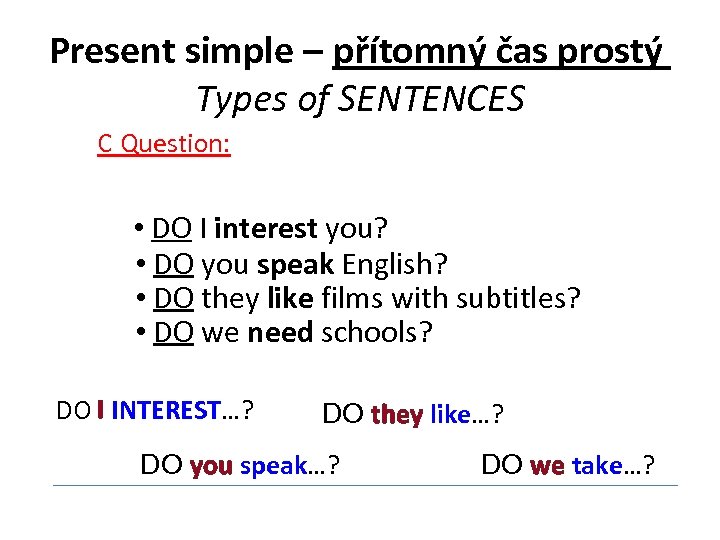 Present simple – _________ přítomný čas prostý Types of SENTENCES C Question: • DO I interest you? • DO you speak English? • DO they like films with subtitles? • DO we need schools? DO I INTEREST…? DO they like…? DO you speak…? DO we take…?
 COMPARISON POSITIVE vs QUESTION Positive sentence Question • I speak loudly enough. • Do I speak loudly enough? • You sleep eight hours at the weekends. • Do you sleep eight hours at the weekend? • They like snowboarding in the Alps. • Do they like snowboarding in the Alps? • We visit our grandparents on Saturdays or Sundays. • Do we visit our grandparents on Saturdays or Sundays?
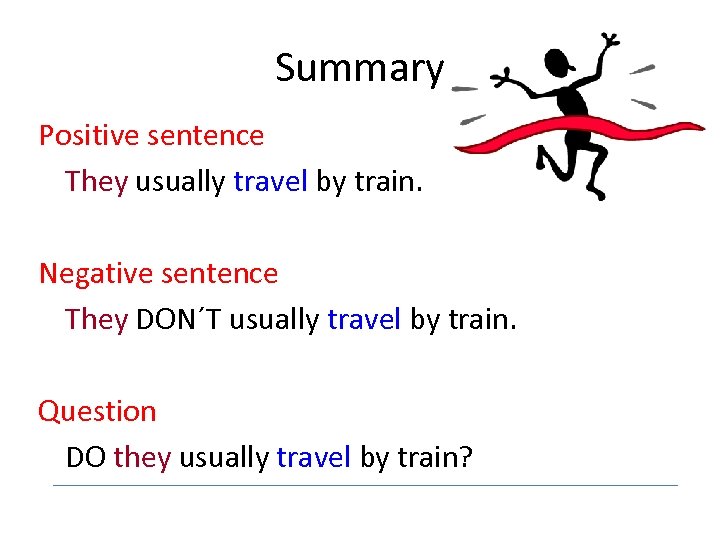 Summary Positive sentence They usually travel by train. Negative sentence They DON´T usually travel by train. Question DO they usually travel by train?
 přítomný čas prostý Present simple – _________ Types of VERBS FULL VERBS LOOK, TAKE, SING, EAT, WRITE, … „LAZY“ carry the meaning cannot make a question, negative sentence or short answer • need DO • • ? . DO you want me to sing? I DON´T spend too much time on my computer. Yes, I DO. /No, I DON´T. AUXILIARY VERBS • BE, HAVE GOT, CAN • „ACTIVE“ • can make any type of sentence • no meaning • don´t need anything
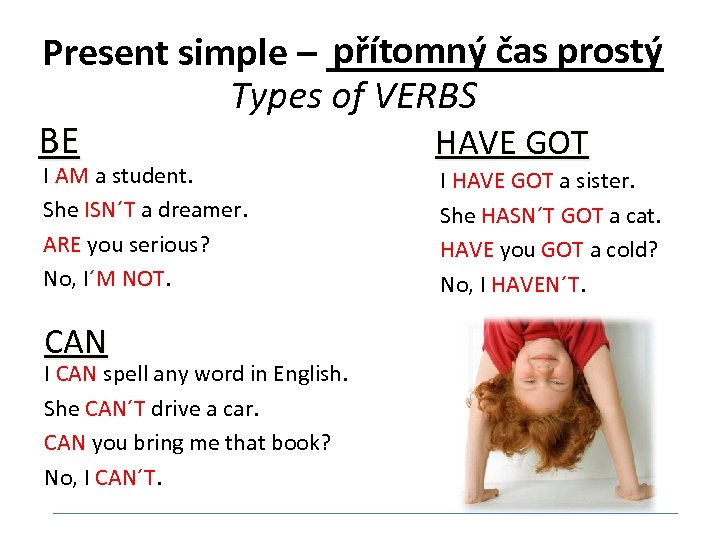 přítomný čas prostý Present simple – _________ Types of VERBS BE HAVE GOT I AM a student. She ISN´T a dreamer. ARE you serious? No, I´M NOT. CAN I CAN spell any word in English. She CAN´T drive a car. CAN you bring me that book? No, I CAN´T. I HAVE GOT a sister. She HASN´T GOT a cat. HAVE you GOT a cold? No, I HAVEN´T.
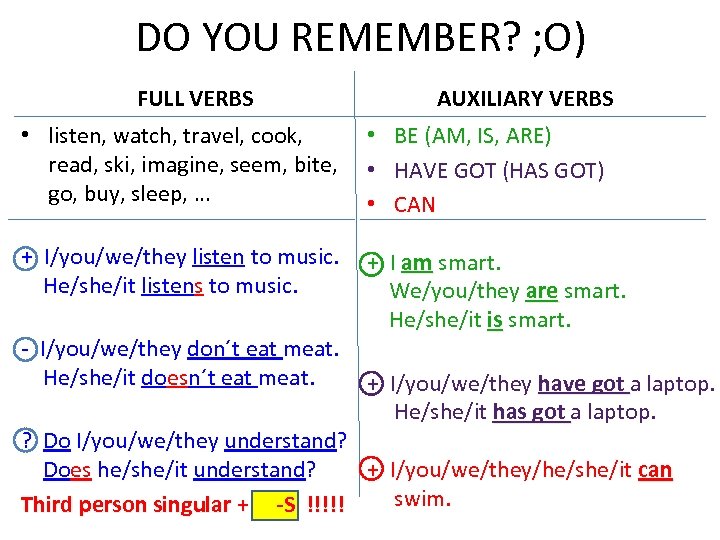 DO YOU REMEMBER? ; O) FULL VERBS AUXILIARY VERBS • listen, watch, travel, cook, read, ski, imagine, seem, bite, go, buy, sleep, … • BE (AM, IS, ARE) • HAVE GOT (HAS GOT) • CAN + I/you/we/they listen to music. He/she/it listens to music. + I am smart. We/you/they are smart. He/she/it is smart. - I/you/we/they don´t eat meat. He/she/it doesn´t eat meat. + I/you/we/they have got a laptop. He/she/it has got a laptop. ? Do I/you/we/they understand? Does he/she/it understand? + I/you/we/they/he/she/it can swim. Third person singular + -S !!!!!
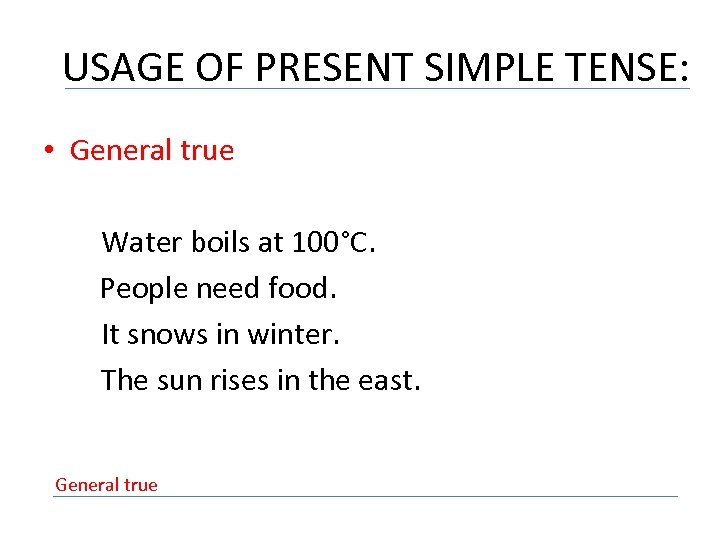 USAGE OF PRESENT SIMPLE TENSE: • General true Water boils at 100°C. People need food. It snows in winter. The sun rises in the east. General true
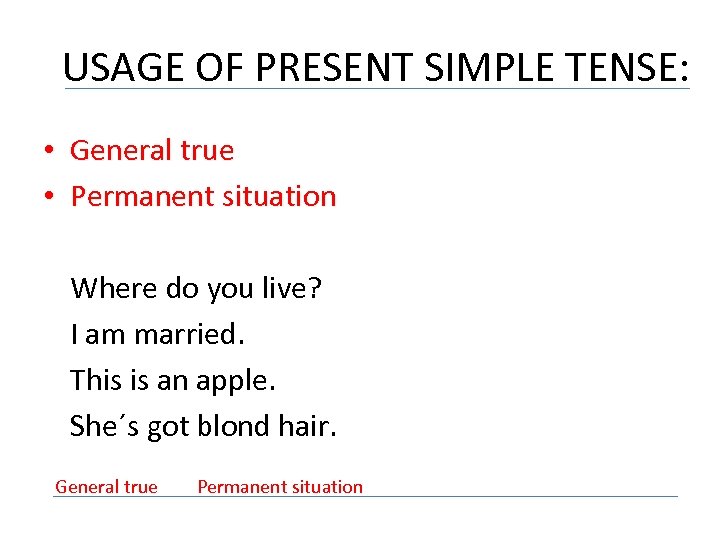 USAGE OF PRESENT SIMPLE TENSE: • General true • Permanent situation Where do you live? I am married. This is an apple. She´s got blond hair. General true Permanent situation
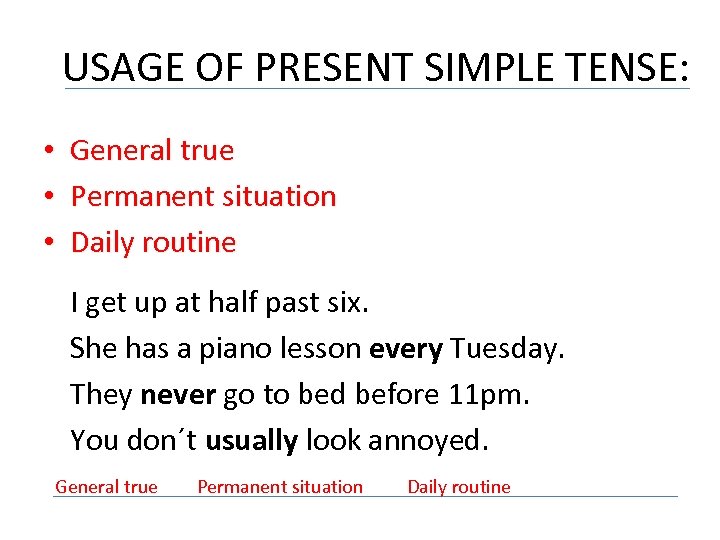 USAGE OF PRESENT SIMPLE TENSE: • • • General true Permanent situation Daily routine I get up at half past six. She has a piano lesson every Tuesday. They never go to bed before 11 pm. You don´t usually look annoyed. General true Permanent situation Daily routine
 ZÁKLADNÍ ŠKOLA OLOMOUC příspěvková organizace MOZARTOVA 48, 779 00 OLOMOUC tel. : 585 427 142, 775 116 442; fax: 585 422 713 email: kundrum@centrum. cz; www. zs-mozartova. cz Seznam použité literatury a pramenů: HUTCHINSON, T. Project 3 Third Edition Student's Book. Oxford : OUP, 2008, ISBN 978 -0 -19 -476310 -3, s. 4, 5. HUTCHINSON, T. , EDWARDS, L. Project Third edition – Workbook + CD-ROM. Oxford : OUP, 2008, ISBN 987 0 19 476355 4. s. 2, 66. Použité zdroje: Obrazový materiál Microsoft Office. je použit z galerie obrázků a klipartů