 Скачать презентацию Yurok Tribe Environmental Data Storage System A Tribal
fcd9f1e35d12dd9681e34e51bdf9fe51.ppt
- Количество слайдов: 19



Yurok Tribe Environmental Data Storage System: A Tribal model for data handling and regulatory reporting compliance
THE SELL The Exchange Network in present form is a concept and set of rules for how participants transmit and receive data to and from EPA. Ø More importantly to Tribes, the Network provides an opportunity to streamline data handling (reducing staff time required to push data to EPA), share data within ecoregions, and improve the way Tribes evaluate and respond to changing environmental conditions that affect the health of their nations. Ø
This Presentation In the next few slides, I would like to share how the Yurok Tribe has used Exchange Network funding to develop an innovative data handling and sharing system, with a secondary benefit of that system being transmission of data to EPA’s regulatory databases as required by our grant funding conditions. Ø Everything the Tribe has done is available to any interested Tribe to build off of, utilize, or copy; we are interested in encouraging Tribes to improve their internal data handling processes as a primary use of the EN, with satisfaction of EPA’s reporting requirements as a seamless component of that data management. Ø
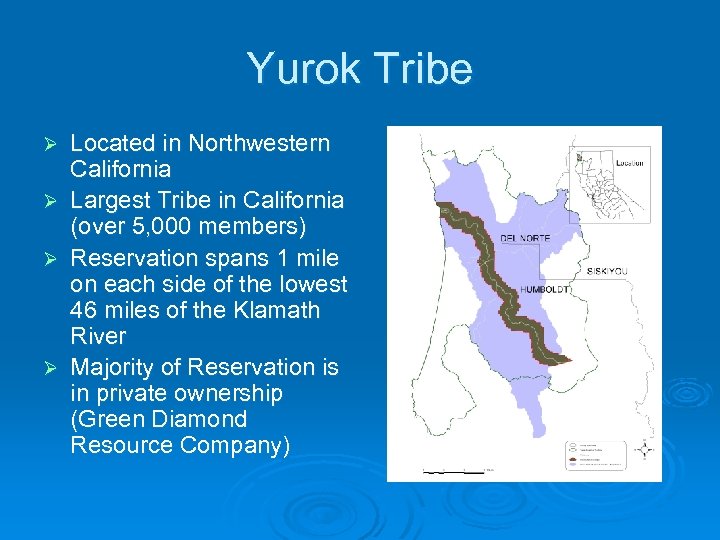
Yurok Tribe Ø Ø Located in Northwestern California Largest Tribe in California (over 5, 000 members) Reservation spans 1 mile on each side of the lowest 46 miles of the Klamath River Majority of Reservation is in private ownership (Green Diamond Resource Company)
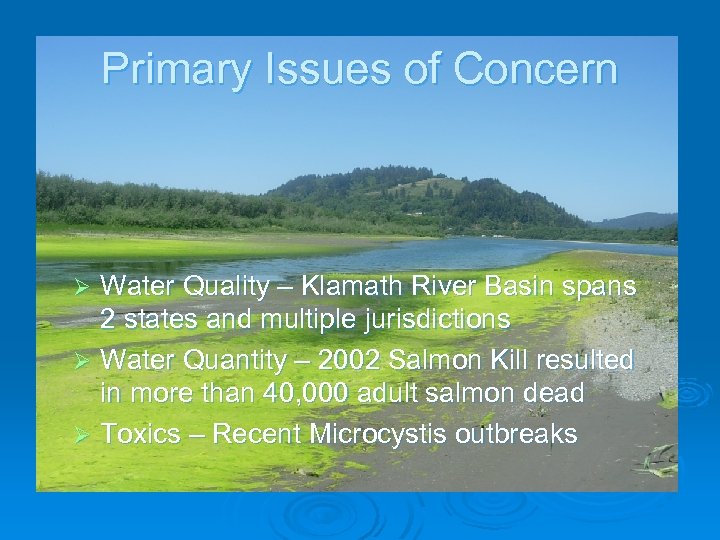
Primary Issues of Concern Water Quality – Klamath River Basin spans 2 states and multiple jurisdictions Ø Water Quantity – 2002 Salmon Kill resulted in more than 40, 000 adult salmon dead Ø Toxics – Recent Microcystis outbreaks Ø
Yurok Tribe Environmental Program Team of 9 full-time staff and 2 temporary staff Ø Conduct quality-assured environmental monitoring Ø Collect over 500, 000 data points per year Ø
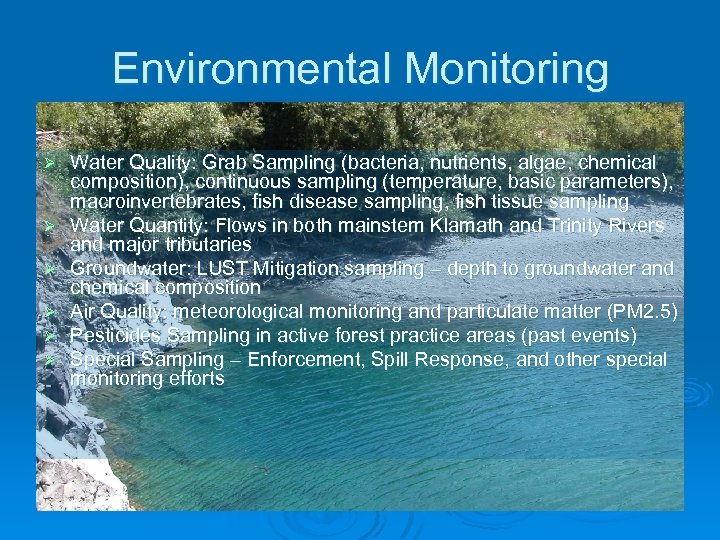
Environmental Monitoring Ø Ø Ø Water Quality: Grab Sampling (bacteria, nutrients, algae, chemical composition), continuous sampling (temperature, basic parameters), macroinvertebrates, fish disease sampling, fish tissue sampling Water Quantity: Flows in both mainstem Klamath and Trinity Rivers and major tributaries Groundwater: LUST Mitigation sampling – depth to groundwater and chemical composition Air Quality: meteorological monitoring and particulate matter (PM 2. 5) Pesticides Sampling in active forest practice areas (past events) Special Sampling – Enforcement, Spill Response, and other special monitoring efforts
Data Storage & Analysis Ø Old System: l l Excel-Based Required extensive work each year to analyze data and compose reports Resulted in numerous duplicate files and no security on unvalidated or validated data Data transfer to STORET or AQS extremely cumbersome Ø YEDSS: l l l Automates data validation Raw and validated data are segregated and protected Automates data summaries and charts for reports Pushes data automatically to AQS and STORET Also stores metadata, QA data, photos, and
Data Push Ø The Yurok Tribe has been uploading data to AQS using YEDSS since March of 2007 Ø The Yurok Tribe was the first Tribe in Region 9 to upload data to STORET/WQX with our first package delivered in August of 2007
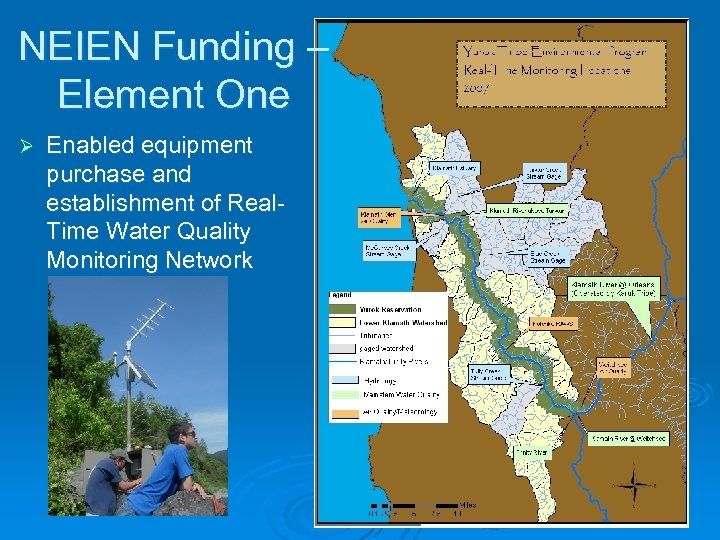
NEIEN Funding – Element One Ø Enabled equipment purchase and establishment of Real. Time Water Quality Monitoring Network
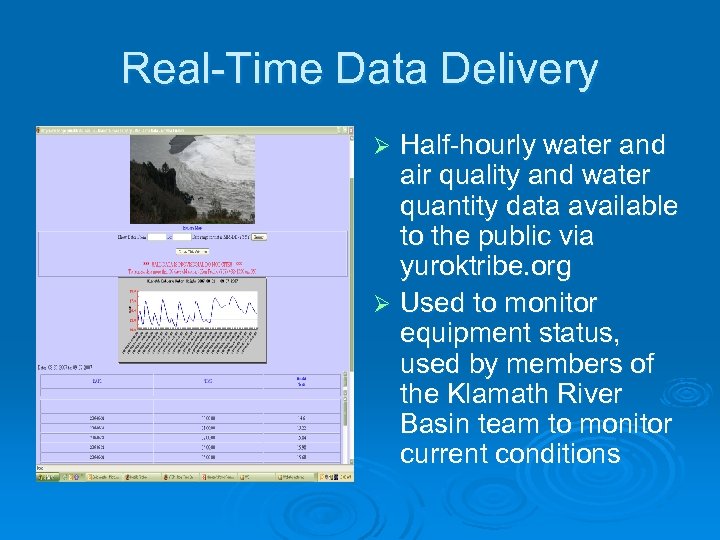
Real-Time Data Delivery Half-hourly water and air quality and water quantity data available to the public via yuroktribe. org Ø Used to monitor equipment status, used by members of the Klamath River Basin team to monitor current conditions Ø
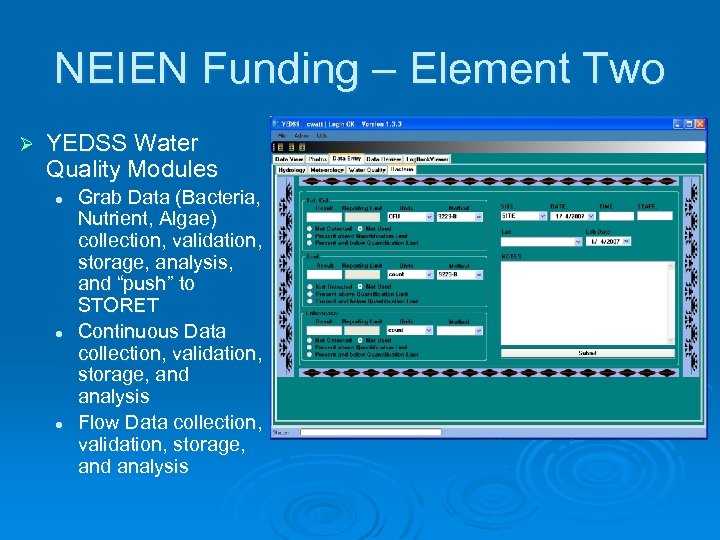
NEIEN Funding – Element Two Ø YEDSS Water Quality Modules l l l Grab Data (Bacteria, Nutrient, Algae) collection, validation, storage, analysis, and “push” to STORET Continuous Data collection, validation, storage, and analysis Flow Data collection, validation, storage, and analysis
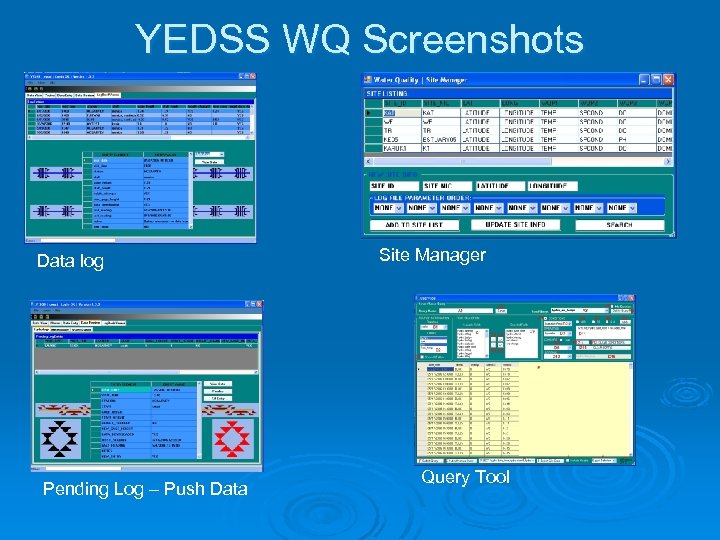
YEDSS WQ Screenshots Data log Pending Log – Push Data Site Manager Query Tool
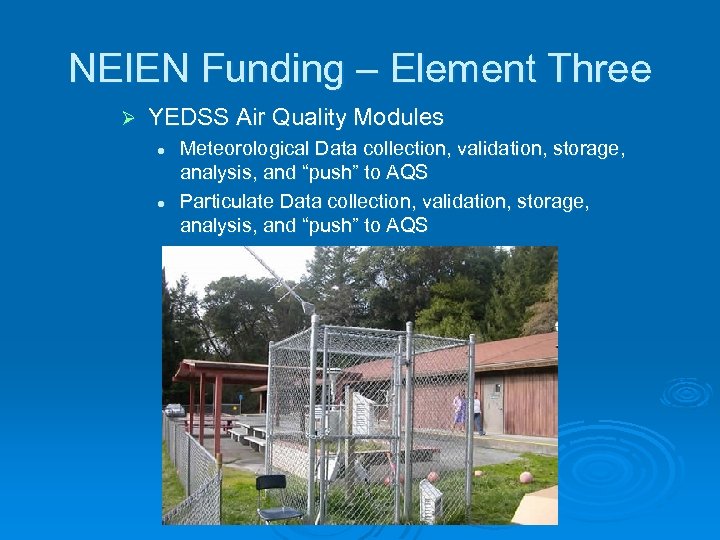
NEIEN Funding – Element Three Ø YEDSS Air Quality Modules l l Meteorological Data collection, validation, storage, analysis, and “push” to AQS Particulate Data collection, validation, storage, analysis, and “push” to AQS
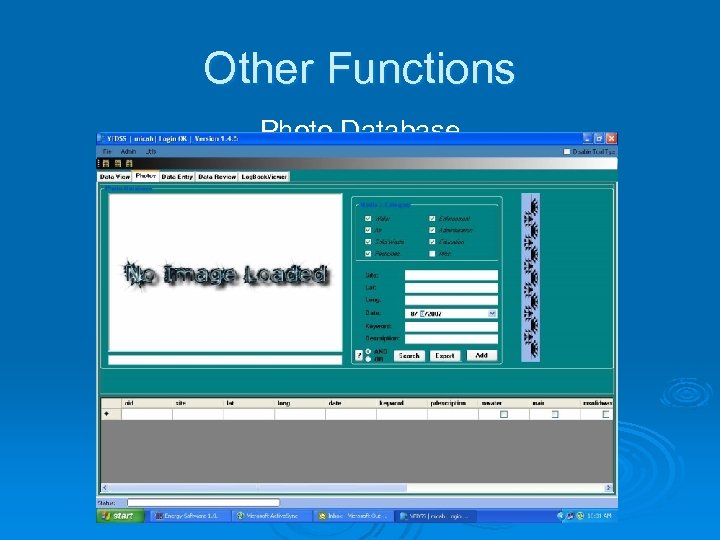
Other Functions Photo Database
Planned Functions Ø Mercury Monitoring Data Module (AQ) Ø STORET push of Continuous Data Ø Facility Registry System module and push Ø UST Tracking Module and push Ø Georeferenced Graphical Interface Ø Web-enabled queries of validated data and photos
Advantages for Tribes Ø Ø STORET and AQS “common” upload interfaces are cumbersome, time-consuming, and nearly impossible for a small program to utilize – YEDSS or a similar XMLencoded file transfer is seamless and automated YEDSS or similar program is useful for the Tribal program (validation, storage, analysis) as well as fulfilling the data upload requirements of EPA YEDSS is built using open-source code and a common programming language (SQL) – can be copied or modified by any programmer YEDSS has extensive quality-assurance and validation mechanisms automated – saves staff time; also has cutting-edge security measures to preserve data and protect system
DATA SECURITY Ø If you are concerned about potentially sensitive information held by your Tribe, there are 3 options: l l l Don’t send it in! Work with your Council, Legal Staff, and EPA Media staff to resolve concerns For non-funding specific information, Region 9 has had some success with “anonymous aggregation” of data
Contacts Ø Laura Mayo, Assistant Director – Cross-Media Division Ø lmayo@yuroktribe. nsn. us Ø Kevin Mc. Kernan, Director/QA Officer Ø kevin@yuroktribe. nsn. us Ø www. yuroktribe. org/departments/ytep. htm
Скачать презентацию Yurok Tribe Environmental Data Storage System A Tribal
fcd9f1e35d12dd9681e34e51bdf9fe51.ppt