 Скачать презентацию youthgrowth in more videos subscribe www youtube com c
fcce2f5dda98e4465bcb6acf49132a45.ppt
- Количество слайдов: 5



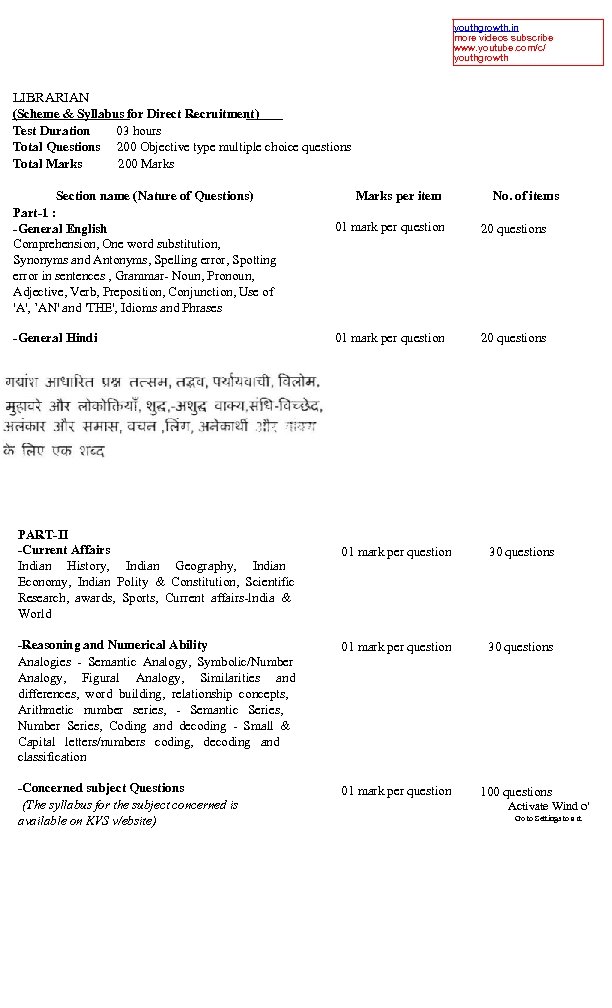
youthgrowth. in more videos subscribe www. youtube. com/c/ youthgrowth LIBRARIAN (Scheme & Syllabus for Direct Recruitment) Test Duration 03 hours Total Questions 200 Objective type multiple choice questions Total Marks 200 Marks Section name (Nature of Questions) Part-1 : -General English Comprehension, One word substitution, Synonyms and Antonyms, Spelling error, Spotting error in sentences , Grammar- Noun, Pronoun, Adjective, Verb, Preposition, Conjunction, Use of 'A', ’AN' and 'THE', Idioms and Phrases -General Hindi PART-II -Current Affairs Indian History, Indian Geography, Indian Economy, Indian Polity & Constitution, Scientific Research, awards, Sports, Current affairs-lndia & World Marks per item No. of items 01 mark per question 20 questions 01 mark per question 30 questions -Reasoning and Numerical Ability Analogies - Semantic Analogy, Symbolic/Number Analogy, Figural Analogy, Similarities and differences, word building, relationship concepts, Arithmetic number series, - Semantic Series, Number Series, Coding and decoding - Small & Capital letters/numbers coding, decoding and classification 01 mark per question 30 questions -Concerned subject Questions (The syllabus for the subject concerned is available on KVS v/ebsite) 01 mark per question 100 questions Activate Wind o' Go to Settings to a rt
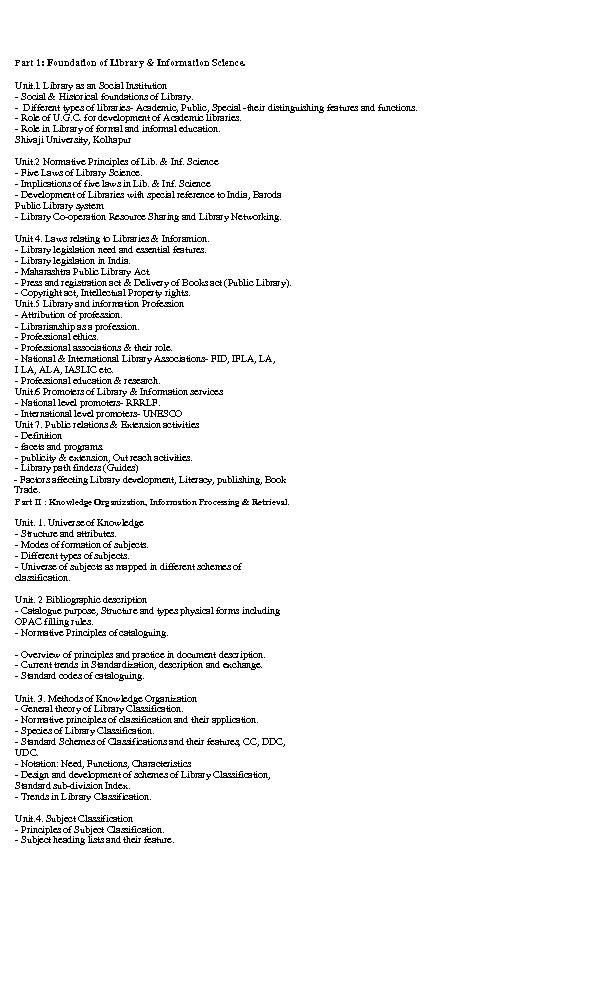
Part 1: Foundation of Library & Information Science. Unit. l. Library as an Social Institution - Social & Historical foundations of Library. - Different types of libraries- Academic, Public, Special -their distinguishing features and functions. - Role of U. G. C. for development of Academic libraries. - Role in Library of formal and informal education. Shivaji University, Kolhapur Unit. 2 Normative Principles of Lib. & Inf. Science - Five Laws of Library Science. - Implications of five laws in Lib. & Inf. Science - Development of Libraries with special reference to India, Baroda Public Library system - Library Co-operation Resource Sharing and Library Networking. Unit 4. Laws relating to Libraries & Inforamion. - Library legislation need and essential features. - Library legislation in India. - Maharashtra Public Library Act. - Press and registration act & Delivery of Books act (Public Library). - Copyright act, Intellectual Property rights. Unit. 5 Library and information Profession - Attribution of profession. - Librarianship as a profession. - Professional ethics. - Professional associations & their role. - National & International Library Associations- FID, IFLA, I LA, ALA, IASLIC etc. - Professional education & research. Unit. 6 Promoters of Library & Information services - National level promoters- RRRLF. - International level promoters- UNESCO Unit 7. Public relations & Extension activities - Definition - facets and programs. - publicity & extension, Out reach activities. - Library path finders (Guides) - Factors affecting Library development, Literacy, publishing, Book Trade. Part II : Knowledge Organization, Information Processing & Retrieval. Unit. 1. Universe of Knowledge - Structure and attributes. - Modes of formation of subjects. - Different types of subjects. - Universe of subjects as mapped in different schemes of classification. Unit. 2 Bibliographic description - Catalogue purpose, Structure and types physical forms including OPAC filling rules. - Normative Principles of cataloguing. - Overview of principles and practice in document description. - Current trends in Standardization, description and exchange. - Standard codes of cataloguing. Unit. 3. Methods of Knowledge Organization - General theory of Library Classification. - Normative principles of classification and their application. - Species of Library Classification. - Standard Schemes of Classifications and their features, CC, DDC, UDC. - Notation: Need, Functions, Characteristics - Design and development of schemes of Library Classification, Standard sub-division Index. - Trends in Library Classification. Unit. 4. Subject Classification - Principles of Subject Classification. - Subject heading lists and their feature.
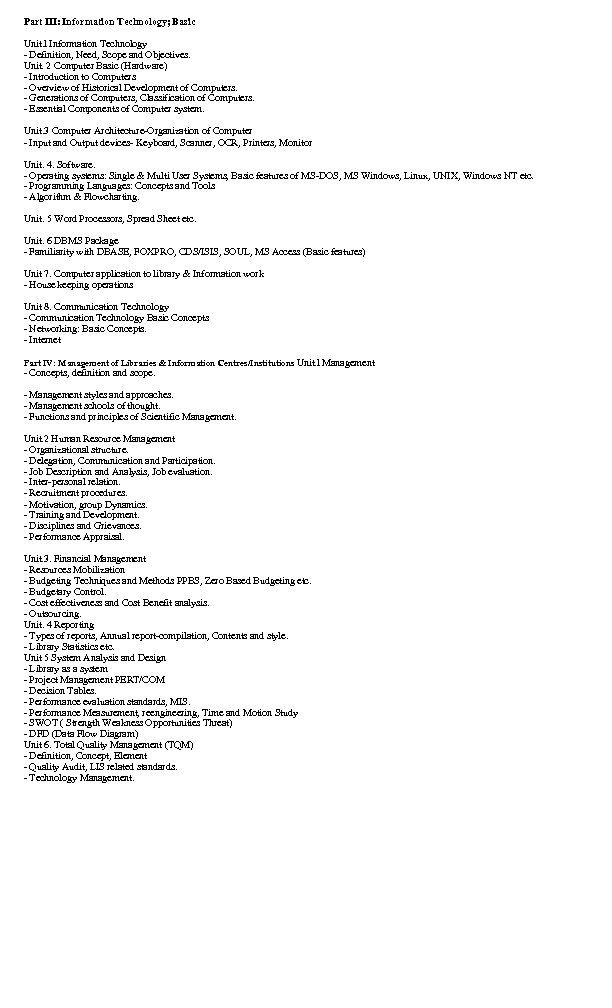
Part III: Information Technology; Basic Unit. l Information Technology - Definition, Need, Scope and Objectives. Unit. 2 Computer Basic (Hardware) - Introduction to Computers - Overview of Historical Development of Computers. - Generations of Computers, Classification of Computers. - Essential Components of Computer system. Unit. 3 Computer Architecture-Organization of Computer - Input and Output devices- Keyboard, Scanner, OCR, Printers, Monitor Unit. 4. Software. - Operating systems: Single & Multi User Systems, Basic features of MS-DOS, MS Windows, Linux, UNIX, Windows NT etc. - Programming Languages: Concepts and Tools - Algorithm & Flowcharting. Unit. 5 Word Processors, Spread Sheet etc. Unit. 6 DBMS Package - Familiarity with DBASE, FOXPRO, CDS/ISIS, SOUL, MS Access (Basic features) Unit 7. Computer application to library & Information work - House keeping operations Unit 8. Communication Technology - Communication Technology Basic Concepts - Networking: Basic Concepts. - Internet Part IV: Management of Libraries & Information Centres/Institutions Unit. l Management - Concepts, definition and scope. - Management styles and approaches. - Management schools of thought. - Functions and principles of Scientific Management. Unit. 2 Human Resource Management - Organizational structure. - Delegation, Communication and Participation. - Job Description and Analysis, Job evaluation. - Inter-personal relation. - Recruitment procedures. - Motivation, group Dynamics. - Training and Development. - Disciplines and Grievances. - Performance Appraisal. Unit. 3. Financial Management - Resources Mobilization - Budgeting Techniques and Methods PPBS, Zero Based Budgeting etc. - Budgetary Control. - Cost effectiveness and Cost Benefit analysis. - Outsourcing. Unit. 4 Reporting - Types of reports, Annual report-compilation, Contents and style. - Library Statistics etc. Unit 5 System Analysis and Design - Library as a system - Project Management PERT/COM - Decision Tables. - Performance evaluation standards, MIS. - Performance Measurement, reengineering, Time and Motion Study - SWOT ( Strength Weakness Opportunities Threat) - DFD (Data Flow Diagram) Unit 6. Total Quality Management (TQM) - Definition, Concept, Element - Quality Audit, LIS related standards. - Technology Management.
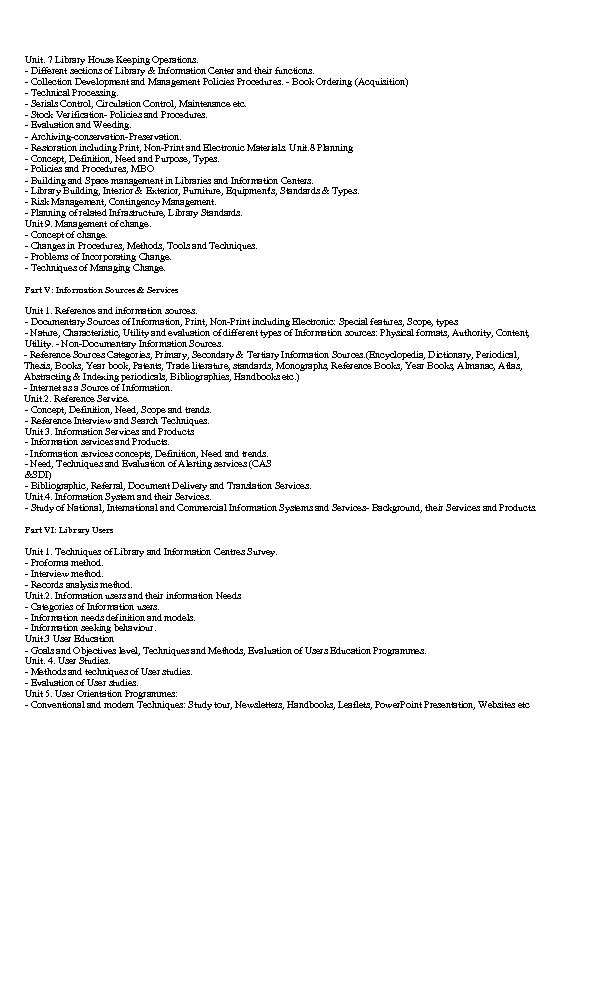
Unit. 7 Library House Keeping Operations. - Different sections of Library & Information Center and their functions. - Collection Development and Management Policies Procedures. - Book Ordering (Acquisition) - Technical Processing. - Serials Control, Circulation Control, Maintenance etc. - Stock Verification- Policies and Procedures. - Evaluation and Weeding. - Archiving-conservation-Preservation. - Restoration including Print, Non-Print and Electronic Materials. Unit. 8 Planning - Concept, Definition, Need and Purpose, Types. - Policies and Procedures, MBO - Building and Space management in Libraries and Information Centers. - Library Building, Interior & Exterior, Furniture, Equipment's, Standards & Types. - Risk Management, Contingency Management. - Planning of related Infrastructure, Library Standards. Unit 9. Management of change. - Concept of change. - Changes in Procedures, Methods, Tools and Techniques. - Problems of Incorporating Change. - Techniques of Managing Change. Part V: Information Sources & Services Unit 1. Reference and information sources. - Documentary Sources of Information, Print, Non-Print including Electronic: Special features, Scope, types - Nature, Characteristic, Utility and evaluation of different types of Information sources: Physical formats, Authority, Content, Utility. - Non-Documentary Information Sources. - Reference Sources Categories, Primary, Secondary & Tertiary Information Sources. (Encyclopedia, Dictionary, Periodical, Thesis, Books, Year book, Patents, Trade literature, standards, Monographs, Reference Books, Year Books, Almanac, Atlas, Abstracting & Indexing periodicals, Bibliographies, Handbooks etc. ) - Internet as a Source of Information. Unit. 2. Reference Service. - Concept, Definition, Need, Scope and trends. - Reference Interview and Search Techniques. Unit 3. Information Services and Products - Information services and Products. - Information services concepts, Definition, Need and trends. - Need, Techniques and Evaluation of Alerting services (CAS &SDI) - Bibliographic, Referral, Document Delivery and Translation Services. Unit. 4. Information System and their Services. - Study of National, International and Commercial Information Systems and Services- Background, their Services and Products. Part VI: Library Users Unit 1. Techniques of Library and Information Centres Survey. - Proforma method. - Interview method. - Records analysis method. Unit. 2. Information users and their information Needs - Categories of Information users. - Information needs definition and models. - Information seeking behaviour. Unit. 3 User Education - Goals and Objectives level, Techniques and Methods, Evaluation of Users Education Programmes. Unit. 4. User Studies. - Methods and techniques of User studies. - Evaluation of User studies. Unit 5. User Orientation Programmes: - Conventional and modern Techniques: Study tour, Newsletters, Handbooks, Leaflets, Power. Point Presentation, Websites etc
 Скачать презентацию youthgrowth in more videos subscribe www youtube com c
fcce2f5dda98e4465bcb6acf49132a45.ppt