 Скачать презентацию Youth Support Healthy School Professor Albert Lee MB
23e9072985af30ad7989a4387a25e792.ppt
- Количество слайдов: 36



Youth Support: Healthy School Professor Albert Lee MB BS (Lond) MD(CUHK) MPH FRCGP(Aus) FFPH(UK) FRCP(Irel) DCH Professor (Clinical), School of Public Health and Primary Care, Director of Centre for Health Education and Health Promotion, The Chinese University of Hong Kong. Chairman of Steering Committee of QEF Thematic Network of Healthy Schools QEF Seminar 13 October 2010
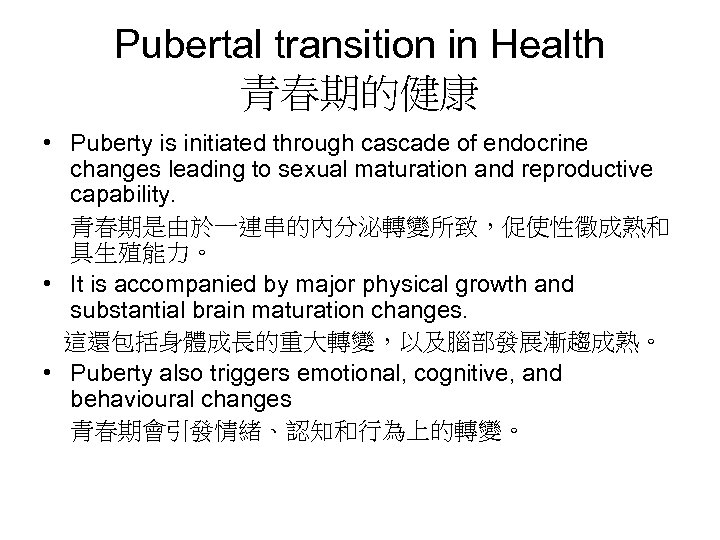
Pubertal transition in Health 青春期的健康 • Puberty is initiated through cascade of endocrine changes leading to sexual maturation and reproductive capability. 青春期是由於一連串的內分泌轉變所致,促使性徵成熟和 具生殖能力。 • It is accompanied by major physical growth and substantial brain maturation changes. 這還包括身體成長的重大轉變,以及腦部發展漸趨成熟。 • Puberty also triggers emotional, cognitive, and behavioural changes 青春期會引發情緒、認知和行為上的轉變。
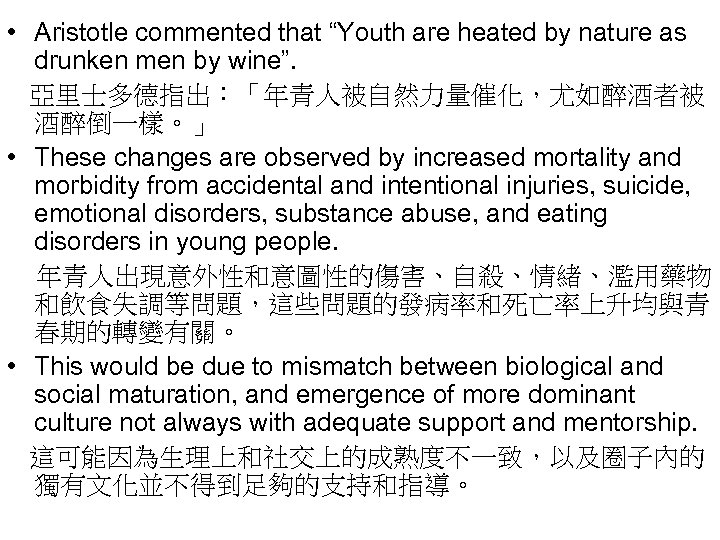
• Aristotle commented that “Youth are heated by nature as drunken men by wine”. 亞里士多德指出:「年青人被自然力量催化,尤如醉酒者被 酒醉倒一樣。」 • These changes are observed by increased mortality and morbidity from accidental and intentional injuries, suicide, emotional disorders, substance abuse, and eating disorders in young people. 年青人出現意外性和意圖性的傷害、自殺、情緒、濫用藥物 和飲食失調等問題,這些問題的發病率和死亡率上升均與青 春期的轉變有關。 • This would be due to mismatch between biological and social maturation, and emergence of more dominant culture not always with adequate support and mentorship. 這可能因為生理上和社交上的成熟度不一致,以及圈子內的 獨有文化並不得到足夠的支持和指導。
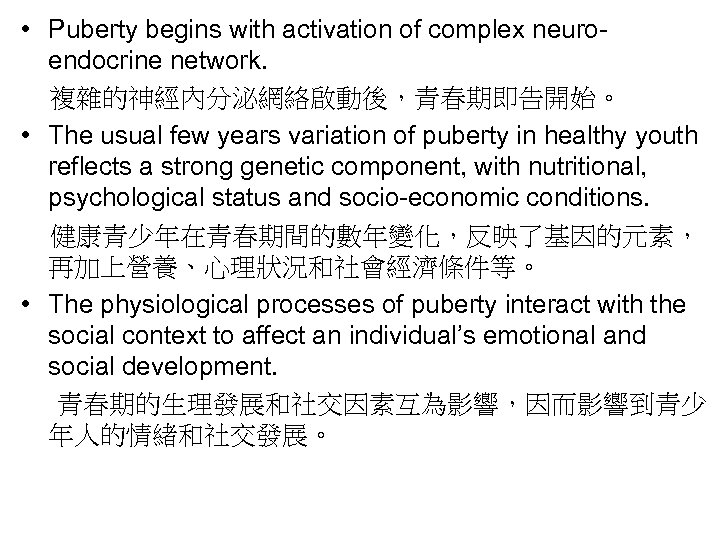
• Puberty begins with activation of complex neuroendocrine network. 複雜的神經內分泌網絡啟動後,青春期即告開始。 • The usual few years variation of puberty in healthy youth reflects a strong genetic component, with nutritional, psychological status and socio-economic conditions. 健康青少年在青春期間的數年變化,反映了基因的元素, 再加上營養、心理狀況和社會經濟條件等。 • The physiological processes of puberty interact with the social context to affect an individual’s emotional and social development. 青春期的生理發展和社交因素互為影響,因而影響到青少 年人的情緒和社交發展。
• Gonadal hormones affect a wide range of neuronal processes including sensitivity of neurotransmitter receptors which would affect cognitive abilities, aggression, regulation of affect, learning and memory. 男性荷爾蒙影響多個神經處理過程,包括神經傳導受體,可影響青少年的 認知能力、侵略性行為,還有對情感、學習和記憶的控制。 • Other physiological and psychological factors such as nutrition, genetics and sensory input would also affect development and the vulnerability to psychopathogies of different types Cameron JL. Annal NY Acad Sci 2004; 1021: 110 -23. 其他生理和心理因素如營養、基因和感官接收等,均影響個人的發展,以 及可能較易受各種心理病理問題的影響。 • There is also evidence of greater neural plasticity around puberty and persistent changes in neural function as result of external stimuli would have major implication on health promotion. (Stroud LR et al. Biol Psychiatry 2002; 52: 318 -27. 證據顯示,在青春期間,神經可塑性是較高的。但神經功能因外界刺 激而經常轉變,則可能對健康有重大的影響。 • Behavioural problems would arise as result of mismatch between emotional reactions and cognitive capacities of young people. 如青少年的情緒反應和認知能力存在差異,就會產生行為問題。
• Adolescent Brains Show Lower Activity in Areas That Control Risky Choices 青少年腦部對作出風險選擇方面的活動量較低 • A new NIMH study could help explain why adolescents are so prone to make risky choices. When contemplating risky decisions, they show less activity in regions of the brain that regulate processes involved in decision-making, compared with adults. 一項全新的NIMH研究可解釋為何青少年會作出較高風險的決定。在 遇到風險問題時,青少年腦部負責決策等問題的部份,在活動方面比 成年人較少。 • The areas are among the last to develop and are involved in control of “thinking” functions, including decision-making, and in processing reward-related input and behavior (the orbitofrontal/ventrolateral prefrontal cortex and dorsal anterior cingulate cortex). 這些部位幾乎是最後發展成熟的,並多控制「思考」的功能,包括作 決定,及處理奬勵有關的行為 (視覺額葉皮質區/腹側前額葉皮質區, 以及前扣帶皮質區)
Results of the study were reported in the March 9 issue of Neuropsychologia by Monique Ernst et al from the NIMH Emotional Development and Affective Neuroscience Branch. NIMH情緒發展和情感神經科學部的Monique Ernst et al,將研究結果 刊登於 3月9日的Neuropsychologia。 The results suggest that when it comes to making choices involving risk, adolescents do not engage the higher-thinking, decision-andreward areas of the brain as much as adults do. 結果建議,在作風險性決定時,青少年較成年人少使用腦部涉及深度 思維、決策及獎勵的部份。 Brain development continues throughout adolescence, and the reduced activity seen in specific areas in the healthy adolescents in this study appears to be normal. 青少年期的腦部發展持續,研究顯示青少年腦部某部位活動較少其實 是正常的。
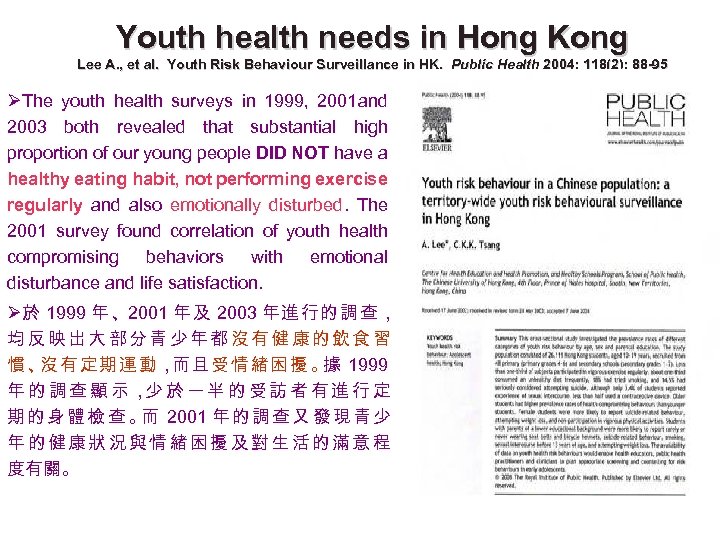
Youth health needs in Hong Kong Lee A. , et al. Youth Risk Behaviour Surveillance in HK. Public Health 2004; 118(2): 88 -95 ØThe youth health surveys in 1999, 2001 and 2003 both revealed that substantial high proportion of our young people DID NOT have a healthy eating habit, not performing exercise regularly and also emotionally disturbed. The 2001 survey found correlation of youth health compromising behaviors with emotional disturbance and life satisfaction. Ø於 1999 年、 2001 年及 2003 年進行的調查, 均反映出大部分青少年都沒有健康的飲食習 慣、 沒有定期運動, 而且受情緒困擾。 據 1999 年的調查顯示, 於一半的受訪者有進行定 少 期 的 身 體 檢 查 。 2001 年 的 調 查 又 發 現 青 少 而 年的健康狀況與情緒困擾及對生活的滿意程 度有關。
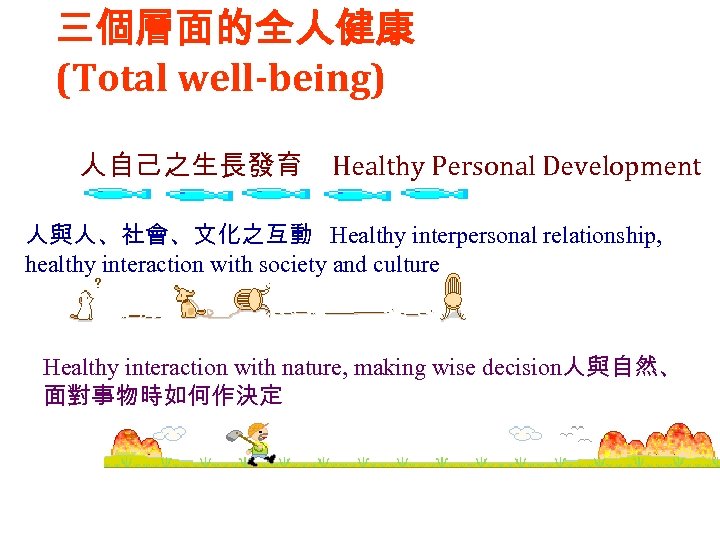
三個層面的全人健康 (Total well-being) 人自己之生長發育 Healthy Personal Development 人與人、社會、文化之互動 Healthy interpersonal relationship, healthy interaction with society and culture Healthy interaction with nature, making wise decision人與自然、 面對事物時如何作決定
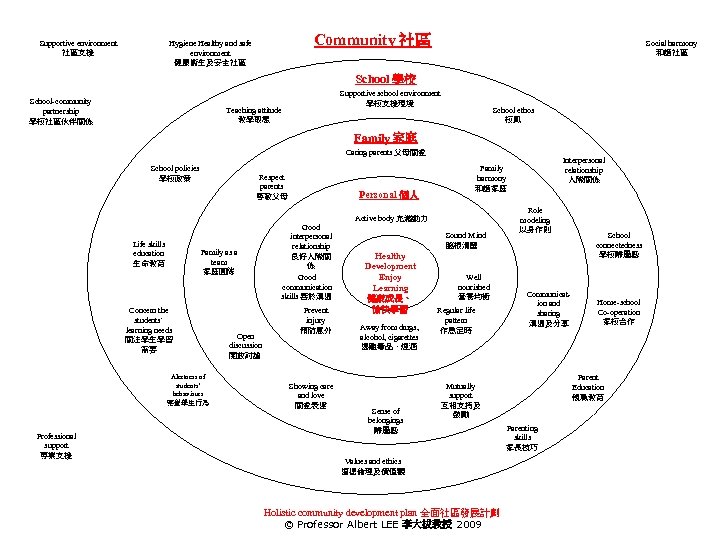
Supportive environment 社區支援 Community 社區 Hygiene Healthy and safe environment 健康衞生及安全社區 Social harmony 和諧社區 School 學校 School-community partnership 學校社區伙伴關係 Supportive school environment 學校支援環境 Teaching attitude 教學取態 School ethos 校風 Family 家庭 Caring parents 父母關愛 School policies 學校政策 Life skills education 生命教育 Respect parents 尊敬父母 Family as a team 家庭團隊 Concern the students’ learning needs 關注學生學習 需要 Alertness of students’ behaviours 察覺學生行為 Professional support 專業支援 Open discussion 開放討論 Personal 個人 Good interpersonal relationship 良好人際關 係 Good communication skills 善於溝通 Prevent injury 預防意外 Showing care and love 關愛表達 Role modeling 以身作則 Active body 充滿動力 Sound Mind 腦根清醒 Healthy Development Enjoy Learning 健康成長、 愉快學習 Away from drugs, alcohol, cigarettes 遠離毒品、煙酒 Sense of belongings 歸屬感 Interpersonal relationship 人際關係 Family harmony 和諧家庭 Well nourished 營養均衡 Communication and sharing 溝通及分享 Regular life pattern 作息定時 School connectedness 學校歸屬感 Home-school Co-operation 家校合作 Parent Education 親職教育 Mutually support 互相支持及 鼓勵 Parenting skills 家長技巧 Values and ethics 道德倫理及價值觀 Holistic community development plan 全面社區發展計劃 © Professor Albert LEE 李大拔教授 2009
Stewart-Brown, S. (2006). What is the evidence on school health promotion in improving school health or preventing disease and specifically what is the effectiveness of the health promoting schools approach? . Copenhagen: World Health Organization. Patton, G. Bond, L. , Carlin, J. , Thomas, L. Butler, H. , Glover, S. , Catalano, R. & Bowes, G. (2006). Promoting social inclusion in schools: A group-randomized trial on student health risk behaviour and well-being. American Journal of Public Health, 96, pp 9. Blum, R. Mc. Neely, C. & Rinehart, P. (2002). Improving the odds: The untapped power of schools to improve the health of teens. Center for Adolescent Health and Development, University of Minnesota • Recent evidence suggests that the way the school is led and managed, the experiences students have to participate and take responsibility for shaping policies, how teachers relate to and treat students and how school engages local community and parents, build many protective factors for health and reduces health risk behavior Stewart-Brown, 2006. Blum et al. 2002, Patton et al 2006). • 學校領導及管理; 學生的投入;老師對學生態 度;學生如何令社區及家長參與都可幫助建立 保護學童健康的因素及減低高危因素。
• The effective school health promotion programmes in changing health behaviors were more likely to be complex, multi- factorial and innovative activity in many domain (curriculum, school environment and community). Interventions of long duration were shown to be more effective (Stewart. Brown, 2006. ) • 多元化﹑ 多層面持續性及透過不同校本活動(課程﹑ 活動 ﹑ 環境﹑ 社區合作等) 是有效推行校本健康促進的主要元 素。
Marshall, B. , Sheehan, M. , Northfield, J. , Carlisle, R. and St. Leger, L. (2000) “School-based health promotion across Australia” Journal of School Health, 70: 6 pp 251 – 252. Lee, A. , St Leger, L. , Moon, A. S. (2005). Evaluating Health Promotion in Schools meeting the needs for education and health professionals: A case study of developing appropriate indictors and data collection methods in Hong Kong. Promotion and Education, 20(2): 177 -186. • Evidence has been gathered extensively about what schools actually do in health promotion using the HPS/CSH frame work. (Lee. St Leger & Moon, 2006; Marshall et al, 2001) • 近期已有不少實証反映學校如何按健康促進學校/全 面性學校衛生模式推動校本健康促進活動。
Moon A. M. , Mullee M. A. , Rogers L. , Thompson R. L. , Speller V. and Roderick P. (1999) Helping schools to become health-promoting environments – an evaluation of the Wessex Healthy Schools Award. Health Promotion International, 14: 111 -122. Lee A. , Cheng F. , St Leger L (2005 a). Evaluating Health Promoting Schools in Hong Kong: The Development of a Framework. Health Promotion International, 20(2): 177 -186. • Audit type of evidence has provided schools and health and education authorities with comprehensive maps about what is happening and how comprehensive it is. It can assist schools and authorities to concentrate on the gaps and affirm qualities work in schools through award upstream (Moon et al, 1999; Lec, Cheng & St Leger, 2005) • 核証式的檢視亦提供不少實証給學校﹑ 教育及醫療 機構一個全面性的藍圖去推動健康促進學校, 亦可 幫助學校及有關機構集中補救不足之處, 透過獎勵 計劃亦可以加強發展優質學校。
Health Promoting Setting approach as effective public health intervention • There is a paradigm shift of pubic health intervention from addressing the devastating effects of the living and working conditions on population health to modification of health risk behaviours by individuals; • and improvement of health literacy can help literacy individuals to build up the personal, cognitive and social skills which determine the ability of individuals to gain access to, understand use information to promote and maintain good health. • In many countries, there is a well structured health care system to address diseases ad illnesses but there is NO system addressing health particularly on NO promotion of positive health.
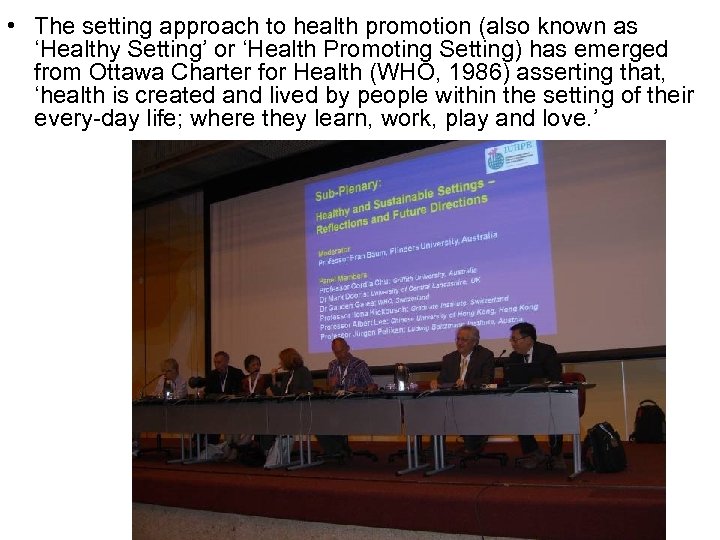
• The setting approach to health promotion (also known as ‘Healthy Setting’ or ‘Health Promoting Setting) has emerged from Ottawa Charter for Health (WHO, 1986) asserting that, ‘health is created and lived by people within the setting of their every-day life; where they learn, work, play and love. ’
Health Promoting Setting approach as Effective public health intervention • It has a long history of being organised around settings such as schools, communities and workplaces which provides the ‘social structures’ to reach the defined population and delivery of health promotion activities in the context of their daily lives. (Green et al, 2000; Lee et al, 2003). • A setting approach also argues for investment in social systems in which people spend their daily lives. • The approach can be regarded as an ecological model of health promotion in which health is determined by a complex interaction of environmental, organisational, and personal factors. . Green LW. , Poland B. , and Rootman I (2000). The Settings Approach to Health Promotion. In B Poland, LW Green and I Rootman (eds). Setting for Health Promotion: Linking Theory and Practice. Thousands Oaks, CA: Sage. Lee A. , Lee SH. , Tsang KK. , To CY. (2003). A comprehensive “Healthy Schools Programme” to promote school health: The Hong Kong experience in joining the efforts of Health and Education Sectors. Journal of Epidemiology and Community Health, 57, 174 -177.
Mission of a Health Promoting School 健康學校的使命 • Every child deserves to be given every opportunity to achieve their full potential 每個孩子都應該有機會發展個人潛能 • Aims of Health Promoting Schools: to empower students, staff and parents to actively influence their lives and their living conditions 健康學校的目標:增強學生、教職員、家長的能 力去影響自己的生命及生活狀況 (Peter Peacock, Past Minister of Education and Young People, Scotland)
Health Promoting Schools 健康促進學校 • Health Promotion (by WHO) 世界衛生組織將健康促進定義為 – The process of enabling people to increase control over, and to improve their health 增強人們掌控及改善自己健康的能力 • To ensure sustained positive changes 確保能持續地作出正面的改善 • To address the interwined social, educational, psychological, and health needs of school children 配合學童在社會、教育、心理和健康上的多種需要
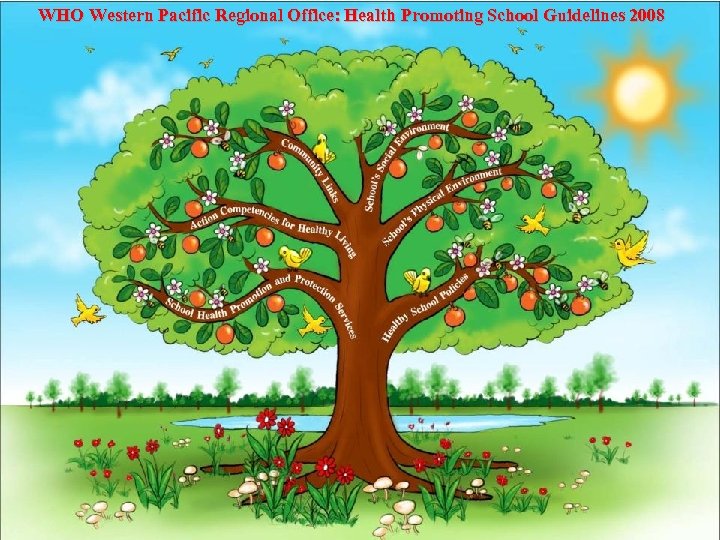
WHO Western Pacific Regional Office: Health Promoting School Guidelines 2008

WHO Stakeholders Consultation Meeting to update Regional Guidelines for HPS 35 March 2008, Singapore St Leger L. , Kobe LJ. , Lee A. , Mc. Call D. , Young I. School Health: - Achievements, Challenges and Priorities. In Mc. Queen D. , Jones C. Global Perspective on Health Promotion Effectiveness. Springer, New York, USA. , 2007.
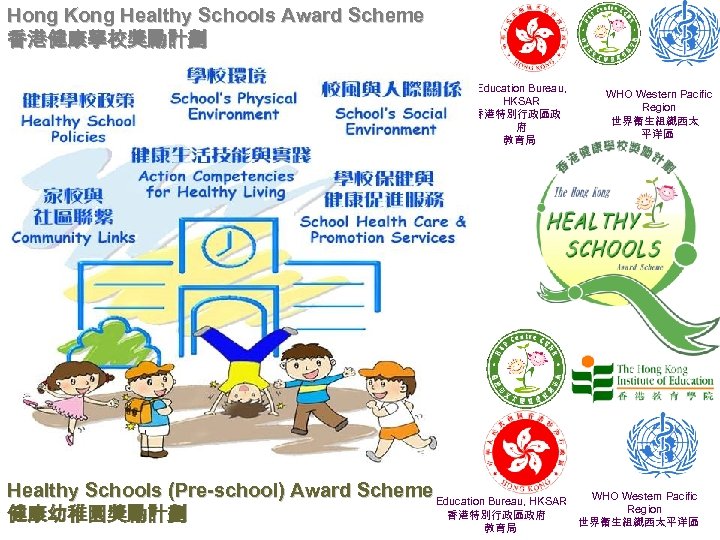
Hong Kong Healthy Schools Award Scheme 香港健康學校獎勵計劃 Education Bureau, HKSAR 香港特別行政區政 府 教育局 WHO Western Pacific Region 世界衞生組織西太 平洋區 Healthy Schools (Pre-school) Award Scheme Education Bureau, HKSAR 香港特別行政區政府 健康幼稚園獎勵計劃 教育局 WHO Western Pacific Region 世界衞生組織西太平洋區
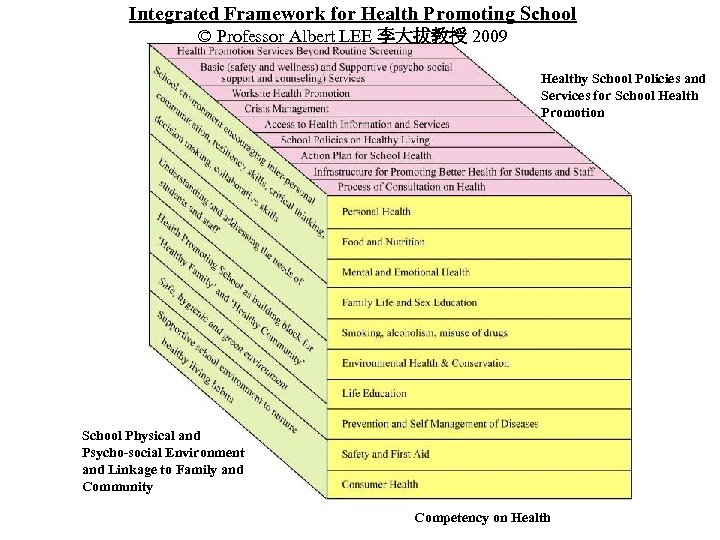
Integrated Framework for Health Promoting School © Professor Albert LEE 李大拔教授 2009 Healthy School Policies and Services for School Health Promotion School Physical and Psycho-social Environment and Linkage to Family and Community Competency on Health
On the whole, students from Healthy School award (HAS) group showed positive results in the health behaviours of students and actions taken by schools. 總括而言,就讀HSA之學童進行健康行為及HSA學校實踐健康促 進方面都有顯著的成果。
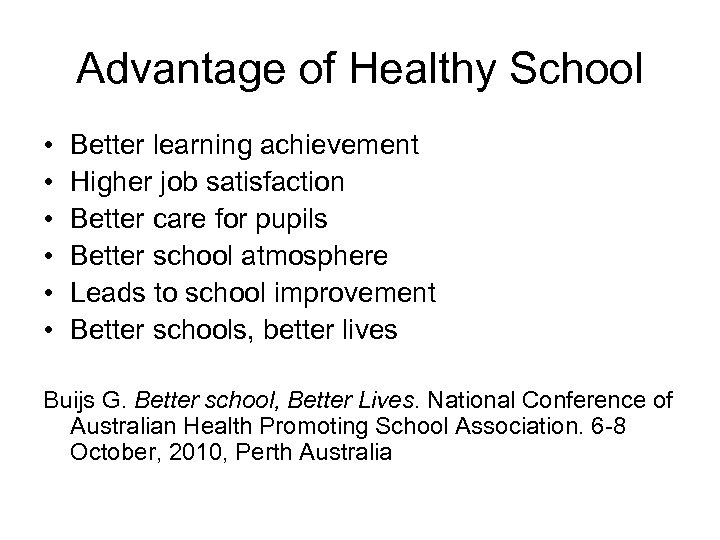
Advantage of Healthy School • • • Better learning achievement Higher job satisfaction Better care for pupils Better school atmosphere Leads to school improvement Better schools, better lives Buijs G. Better school, Better Lives. National Conference of Australian Health Promoting School Association. 6 -8 October, 2010, Perth Australia
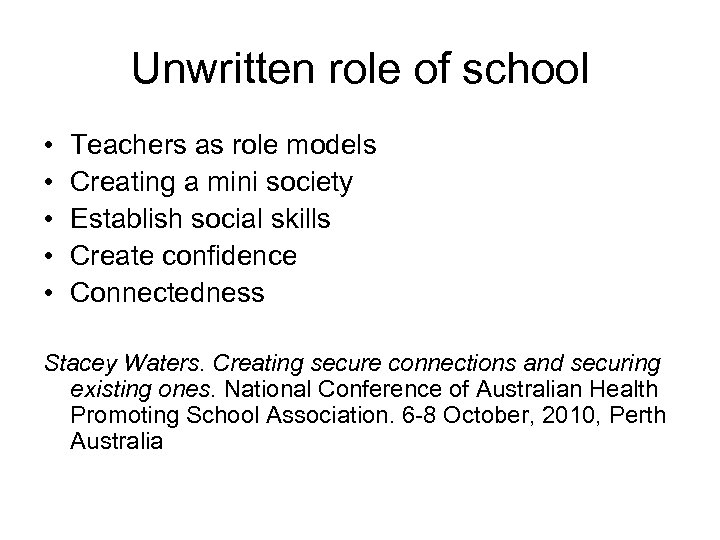
Unwritten role of school • • • Teachers as role models Creating a mini society Establish social skills Create confidence Connectedness Stacey Waters. Creating secure connections and securing existing ones. National Conference of Australian Health Promoting School Association. 6 -8 October, 2010, Perth Australia
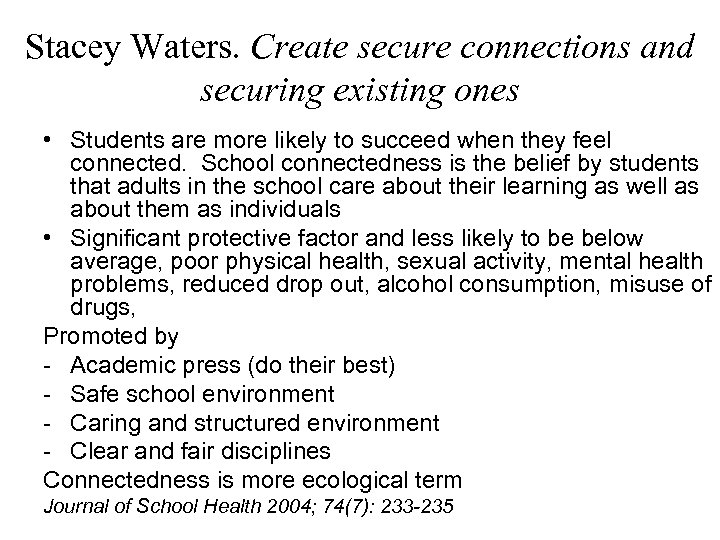
Stacey Waters. Create secure connections and securing existing ones • Students are more likely to succeed when they feel connected. School connectedness is the belief by students that adults in the school care about their learning as well as about them as individuals • Significant protective factor and less likely to be below average, poor physical health, sexual activity, mental health problems, reduced drop out, alcohol consumption, misuse of drugs, Promoted by - Academic press (do their best) - Safe school environment - Caring and structured environment - Clear and fair disciplines Connectedness is more ecological term Journal of School Health 2004; 74(7): 233 -235
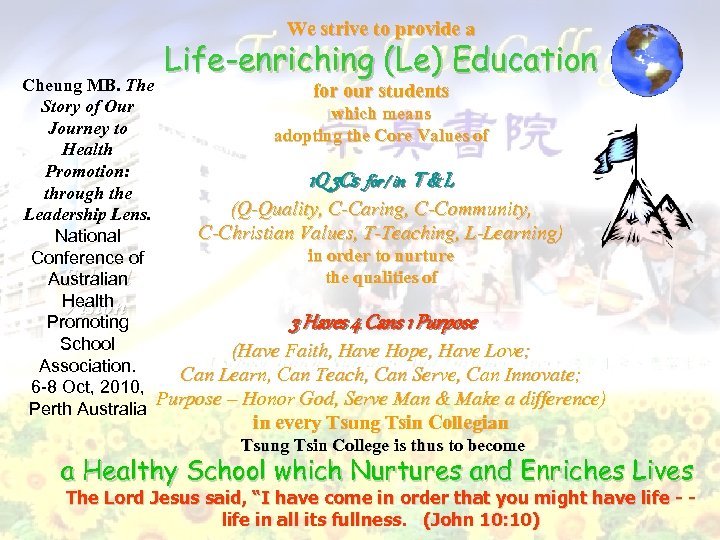
We strive to provide a Life-enriching (Le) Education Cheung MB. The for our students Story of Our which means Journey to adopting the Core Values of Health Promotion: 1 Q 3 Cs for / in T & L through the (Q-Quality, C-Caring, C-Community, Leadership Lens. C-Christian Values, T-Teaching, L-Learning) National in order to nurture Conference of the qualities of School Australian Health Vision 3 Haves 4 Cans 1 Purpose Promoting School (Have Faith, Have Hope, Have Love; Association. Can Learn, Can Teach, Can Serve, Can Innovate; 6 -8 Oct, 2010, Purpose – Honor God, Serve Man & Make a difference) Perth Australia in every Tsung Tsin Collegian Tsung Tsin College is thus to become a Healthy School which Nurtures and Enriches Lives The Lord Jesus said, “I have come in order that you might have life - life in all its fullness. (John 10: 10)
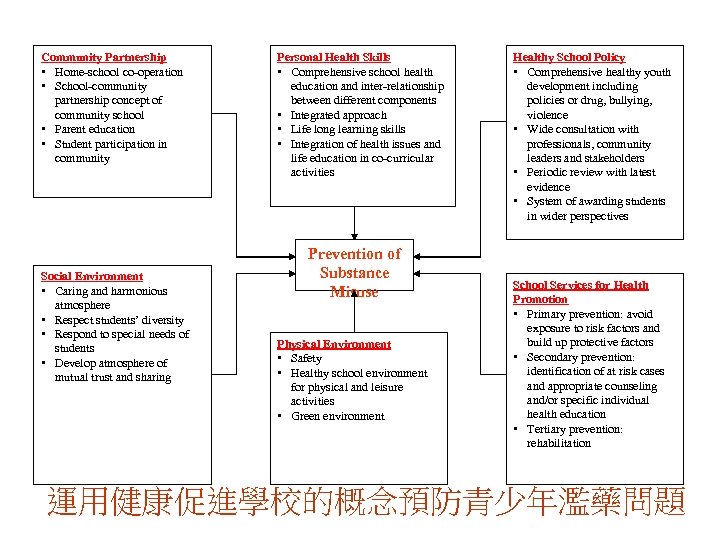
Community Partnership • Home-school co-operation • School-community partnership concept of community school • Parent education • Student participation in community Social Environment • Caring and harmonious atmosphere • Respect students’ diversity • Respond to special needs of students • Develop atmosphere of mutual trust and sharing Personal Health Skills • Comprehensive school health education and inter-relationship between different components • Integrated approach • Life long learning skills • Integration of health issues and life education in co-curricular activities Prevention of Substance Misuse Physical Environment • Safety • Healthy school environment for physical and leisure activities • Green environment Healthy School Policy • Comprehensive healthy youth development including policies or drug, bullying, violence • Wide consultation with professionals, community leaders and stakeholders • Periodic review with latest evidence • System of awarding students in wider perspectives School Services for Health Promotion • Primary prevention: avoid exposure to risk factors and build up protective factors • Secondary prevention: identification of at risk cases and appropriate counseling and/or specific individual health education • Tertiary prevention: rehabilitation 運用健康促進學校的概念預防青少年濫藥問題
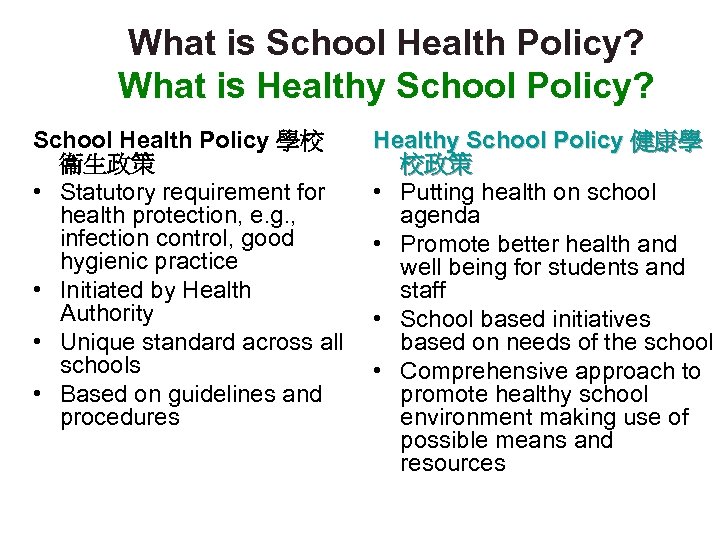
What is School Health Policy? What is Healthy School Policy? School Health Policy 學校 衞生政策 • Statutory requirement for health protection, e. g. , infection control, good hygienic practice • Initiated by Health Authority • Unique standard across all schools • Based on guidelines and procedures Healthy School Policy 健康學 校政策 • Putting health on school agenda • Promote better health and well being for students and staff • School based initiatives based on needs of the school • Comprehensive approach to promote healthy school environment making use of possible means and resources
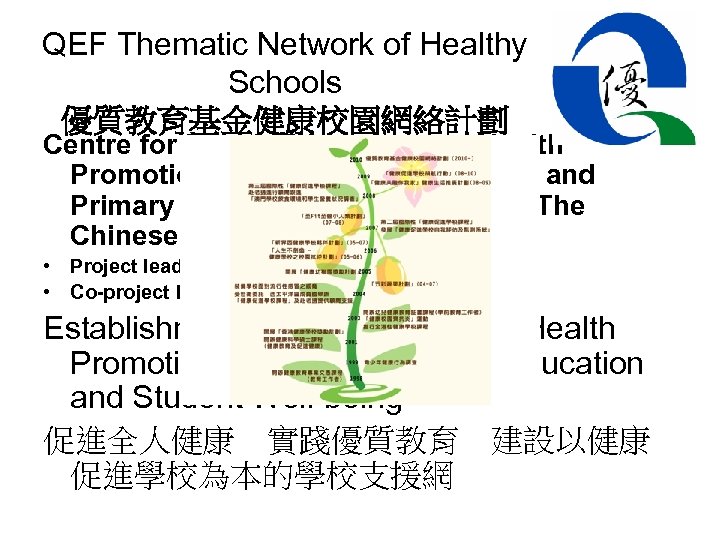
QEF Thematic Network of Healthy Schools 優質教育基金健康校園網絡計劃 Centre for Health Education and Health Promotion, School of Public Health and Primary Care, Faculty of Medicine, The Chinese University of Hong Kong • Project leader: Professor Albert Lee • Co-project leader: Dr. Robin Man-biu Cheung Establishment of Quality Circle of Health Promoting Schools for Quality Education and Student Well-being 促進全人健康 實踐優質教育 建設以健康 促進學校為本的學校支援網
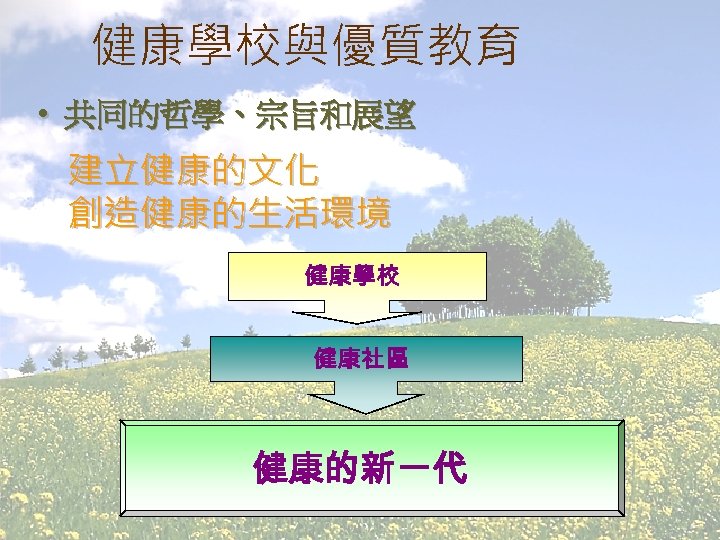
健康學校與優質教育 • 共同的哲學、宗旨和展望 建立健康的文化 創造健康的生活環境 健康學校 健康社區 健康的新一代
邁向十週年 健康資源贈閱及大優惠 共同推動健康 培育學童全人成長 香港中文大學醫學院健康教育及促進健康中心 http: //www. cuhk. edu. hk/med/hep

謝謝各位! 香港中文大學醫學院健康教育及促進健康 中心電話 :(852) 2693 3708 傳真 :(852) 2694 0004 電郵 :alee@cuhk. edu. . hk 網址 http: //www. cuhk. edu. hk/med/hep 地址 :香港新界沙田瀝源健康院 4字樓
Скачать презентацию Youth Support Healthy School Professor Albert Lee MB
23e9072985af30ad7989a4387a25e792.ppt