


 Скачать презентацию Youth Homelessness in the North East Survey Findings
7a7fc2d5a7e4da9355ceb9154712f162.ppt
- Количество слайдов: 14
 ‘Youth Homelessness in the North East’ Survey Findings 2016 Adele Irving, Senior Research Fellow, Northumbria University
 Research Aims & Objectives • Establish the regional picture of youth homelessness and identify changes over time. • Assess this against the national picture. • Inform policy and practice. – – – – The Extent of Youth Homelessness The Causes of Youth Homelessness Young People’s Support Needs A Strategic Response? Local Authority Prevention Activities Temporary Accommodation Moving On Challenges
 Methodology • Two online surveys – Local authorities – Homelessness organisations and housing associations Service providers (Providers) • Single homeless people, aged 16 -24 • February 2016 / Previous 12 months • Response rate: – 10 from local authorities – 8 from providers
 The Extent of Youth Homelessness • Ten LAs - 1, 255 persons of all ages presented as homeless in February 2016. Just 66 (5%) were 16 -24. – Six (60%) perceived youth homelessness had decreased since 2015. – Reflects national picture. • 622 young people sought housing advice and support in February 2016. – Mixed perceptions regarding change over time. • Eight providers supported 224 in February 2016. – Five (83%) reported no change in demand since 2015.
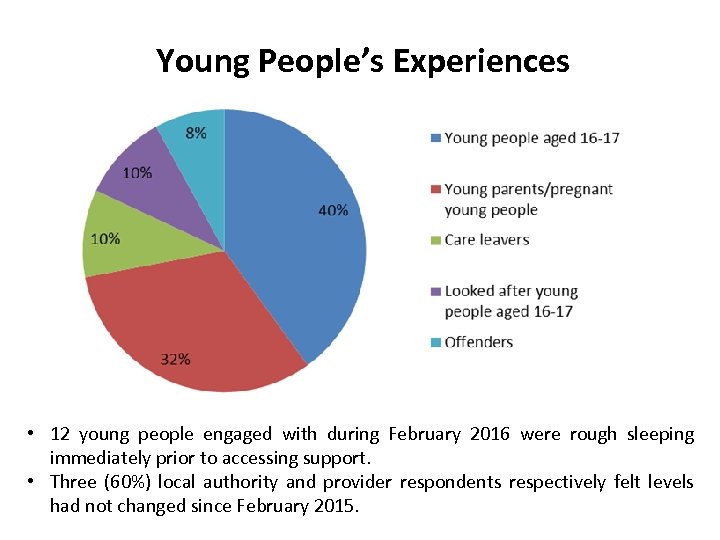 Young People’s Experiences • 12 young people engaged with during February 2016 were rough sleeping immediately prior to accessing support. • Three (60%) local authority and provider respondents respectively felt levels had not changed since February 2015.
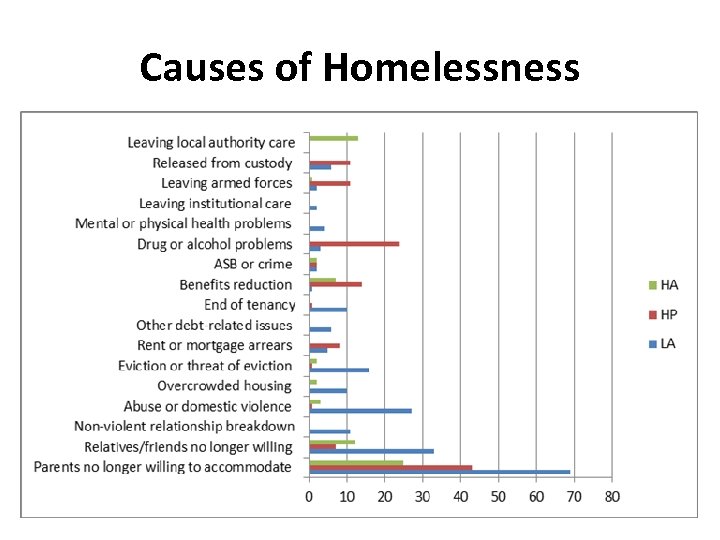 Causes of Homelessness
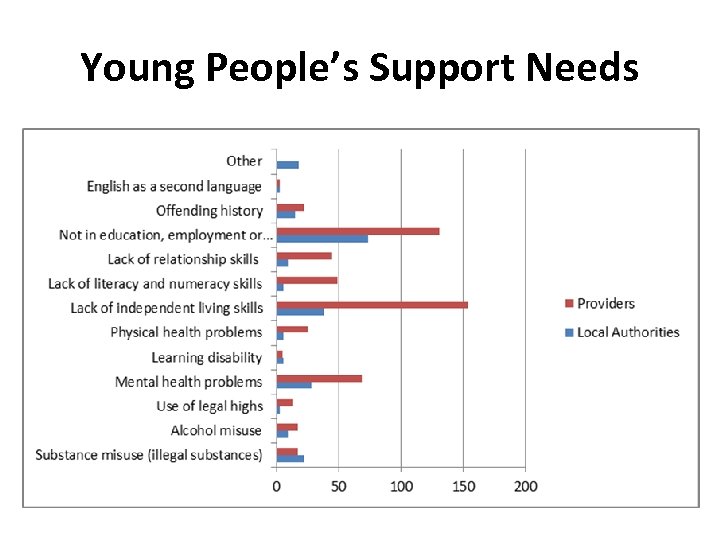 Young People’s Support Needs
 Complex Needs • Two thirds of respondents (7 of 11 or 64%) thought the number of young people presenting with complex needs had increased over time. • Three quarters of respondents (11 l of 15 or 73%) thought that the complexity of young people's needs had increased. • Five providers said they had been unable to assist young people in February 2016, mainly due to their needs being considered too high and being considered too high risk to others.
 A Strategic Response? • 8 of 10 LAs (80%) have a youth homelessness strategy, outlined within their overall homelessness strategies. One (10%) has a specific youth homelessness strategy. • YHNE Regional Homelessness Strategy and Action Plan (2016 -19) – Increase early intervention and prevention work; – Increase training and employment for young people affected by homelessness to enable them to secure a long-term future; – Influence policy makers and support joint commissioning in order to prevent, tackle and resolve youth homelessness in the North East; and – Improve the quality and range of temporary and supported accommodation. • Two thirds (4 of 6 or 67%) of respondents said a Positive Pathway is in place in their area. The remaining third (2 of 6 or 33%) said it is not.
 Prevention Activities • 106 positive actions to prevent youth homelessness and 25 successful relief cases during February 2016. • Joint protocols in place in all LAs. – Very effective in 2 cases (20%), effective in 6 (60%), ineffective in 2 (20%). – Considered less effective than in February 2015 (Harding et al, 2015). • 8 of 9 (89%) LAs report an adequate range of prevention services available. • Family mediation, resolving housing benefit problems and crisis interventions providing emergency support considered most effective interventions. • Most common uses for the prevention fund: paying rent deposits, addressing rent arrears, supporting young people in crisis.
 Temporary Accommodation • The majority of respondents reported levels of provision to be unchanged. • Provision in the North East appears to be more widespread than the national picture suggests (Homeless Link, 2015 a). • 5 LAs (50%) said they never use B&Bs for young people. 5 said rarely. • Higher usage than 2015 (Harding et al, 2015). • Nationally, 59% of areas report occasional use (Homeless Link, 2015 a). • Limited change in short-term accommodation provision. – Decreases in supported lodgings, shared housing with floating support and self-contained units with low or no support. • Difficulties re: emergency accommodation for young people with challenging/complex behaviour.
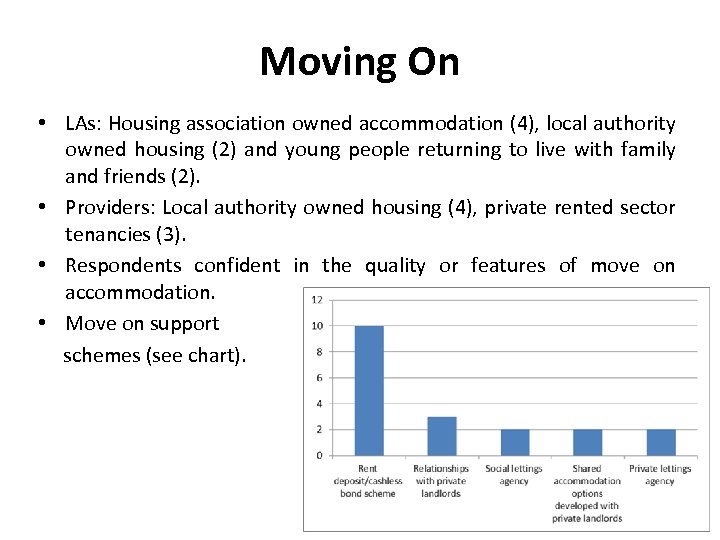 Moving On • LAs: Housing association owned accommodation (4), local authority owned housing (2) and young people returning to live with family and friends (2). • Providers: Local authority owned housing (4), private rented sector tenancies (3). • Respondents confident in the quality or features of move on accommodation. • Move on support schemes (see chart).
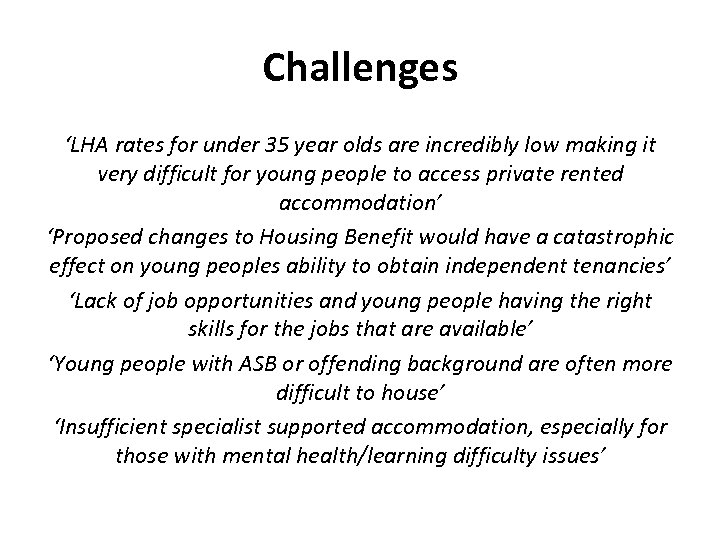 Challenges ‘LHA rates for under 35 year olds are incredibly low making it very difficult for young people to access private rented accommodation’ ‘Proposed changes to Housing Benefit would have a catastrophic effect on young peoples ability to obtain independent tenancies’ ‘Lack of job opportunities and young people having the right skills for the jobs that are available’ ‘Young people with ASB or offending background are often more difficult to house’ ‘Insufficient specialist supported accommodation, especially for those with mental health/learning difficulty issues’
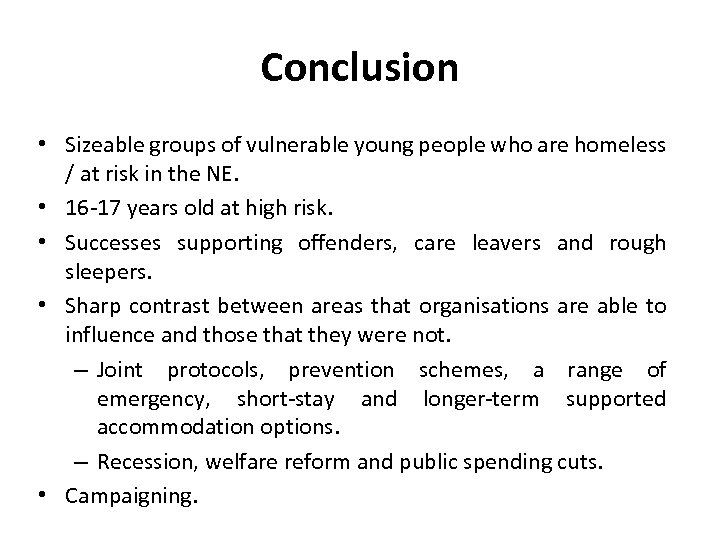 Conclusion • Sizeable groups of vulnerable young people who are homeless / at risk in the NE. • 16 -17 years old at high risk. • Successes supporting offenders, care leavers and rough sleepers. • Sharp contrast between areas that organisations are able to influence and those that they were not. – Joint protocols, prevention schemes, a range of emergency, short-stay and longer-term supported accommodation options. – Recession, welfare reform and public spending cuts. • Campaigning.