 Скачать презентацию Youth Build MIS Training Importance of Performance
0cc8f9f1809e4a9cc52eb63e7f16a78e.ppt
- Количество слайдов: 41



Youth. Build MIS Training
Importance of Performance and Reporting System n n n To provide program operators and front-line staff with information for decision-making and continuous improvement To provide DOL w/ information to ensure program accountability, to assist in identifying TA needs, and to aid evaluation To demonstrate program success to stakeholders (community, Congress, etc. )
Key Concepts: Enrollment n n n Enrollment is the point at which a participant is determined eligible to participate in the program. Enrollment occurs when the case manager enters an enrollment date for the participant. Enrollment usually occurs after the mental toughness component, but this is left to program discretion.
Enrollment n n n Each YB grant will have a targeted enrollment goal, determined by the grant size. The minimum enrollment goal will be calculated by dividing the total grant award for the current fiscal year by $15, 300. Enrollment cannot be backdated any further than your program’s grant start date.
Eligibility for YB n ü ü ü ü ü • To be eligible for YB, participant must be: Between 16 and 24 on the enrollment date AND A current or former foster youth And/Or A youth offender And/Or An adult offender And/Or A youth who is an individual with a disability And/Or A migrant farm worker youth And/Or A child of an incarcerated parent And/Or A low-income youth AND A high school drop-out Grantees should keep hard file documentation of proof of eligibility.
Eligibility Exception n n If the youth has a high school diploma/GED but is basic skills deficient, they can be enrolled under the 25% exemption. If the youth was referred by a high school guidance counselor to the Youth. Build program, they can be enrolled under the 25% exemption – only if the YB program to which they are referred is a high school diplomagranting program.
Additional Eligibility for Federal Program n Selective Service Registration for Males l If a participant is male and 18 -25, must document that they are already registered for selective service (if not already registered, assist them with registration).
Assessment n n n Assessment is an important part of case management and assessment information is required to be entered into the MIS within 14 days from the enrollment date. Basic skills and employment assessments are the only assessments required to be completed within 14 days of enrollment. If they are not completed within 14 days, the case manager will not be able to enter any other data on the participant until the assessment information is entered. Another assessment that is encouraged but not required is the participant’s individual development plan (IDP). This is a goal setting tool to be used by case managers with their participants
Services n Must track 7 categories of services l l l l Education/Job Training Workforce Preparation Community Involvement Mentoring Health Services Supportive Services (including followup services) Post-Secondary Exploration and Planning
Services n Education/Job Training: l l l l n Math/Reading Remediation GED Preparation HS Preparation Vocational/Occupational Skills Training On the Job Training Other Education or Job Training Registered Pre-Apprenticeship Workforce Preparation: l l l Subsidized Employment Internship Workforce Information Work Readiness Training Career/Life Skills Counseling Other Workforce Preparation
Services n Community Involvement: l l n n Community Service Other Community Involvement Activities Mentoring Health Services: l l l Substance Abuse Treatment Mental Health Treatment Emergency Medical Care Non-Emergency Medical Care Pregnancy Other Health Services
Services n Supportive Services: l l l • • Child Care Services Needs Related Payments Follow-up Mentoring Services Transportation Services Other Follow-up Services Other Supportive Services Post-Secondary Exploration or Planning Services provided should be categorized into one of these service elements
Key Concepts: Exit n Ø Ø • Exit occurs in one of two ways: Successful exit: The youth completes all facets of the IDP and is ready to graduate from the program. Unsuccessful exit: The youth chooses to exit the program before successful completion, is incarcerated, or is asked to leave. Youth who leave as unsuccessful exits will be included in the long-term measures of performance.
Other Reasons for Exit n n Exceptions to the unsuccessful exit: l Death l Health/Medical Reason l Family Care l Reservist Called to Active Duty l Transferred or Relocated If any of these occur, document and exit participant – they are excluded from the long-term measures
Program Services vs. Follow-Up Services n n n Program services occur during active participation. Follow-up activities occur after successful exit from the program. Program should begin follow-up contact in the quarter immediately after the quarter during which the participant exited.
Follow-Up n n Follow-up services are intended to ensure participant is successful in retaining employment and/or participating in postsecondary education or training Follow-up also necessary for data collection Must follow-up for data collection purposes in each of the first 3 quarters after exit quarter Begin follow up in quarter after quarter containing the exit date
Follow-Up n n Required information to collect at follow-up: l 1 st, 2 nd, and 3 rd quarter: placement in employment or education, credential attainment l Literacy/numeracy gains are collected one year from initial basic skills assessment Follow-up for program purposes should be more extensive than quarterly contact for data collection
Performance Measures Enrollment Rate n Placement in Employment/Education (CM) n Degree/Certificate Attainment Rate (CM) n Literacy/Numeracy Gain (CM) n Note: CM = Common Measure
Additional Performance Measures Retention in Employment/Education Placement n Recidivism Rate n
Short-Term Indicators of Performance n n n Enrollment Rate Number of Initial Job Placements Average Hourly Wage Rate at Placement Number of Job Re-Placements Average Hours Worked 1 st Week of Placement Number Obtained High School Diploma or GED Number Obtained a Certificate Entered Post-Secondary Education Entered Vocational/Occupational Skills Training Entered Pre-Apprenticeship Entered Registered Apprenticeship
Goals Because YB is a new DOL initiative, goals are based on limited data n These are initial benchmarks for grantees to gauge their progress and may be adjusted based on data from first year of program n
Enrollment Rate: measures the success of a grant in meeting their enrollment goal n Tracked in Program-to-date column of quarterly performance report n Goal is 100% n
Placement in Education or Employment n n n Placement Rate: % of participants placed in employment, postsecondary education, military, or long -term occupational training in first quarter after exit quarter divided by total participants who exited in previous quarter Long-term exit-based measure so very little data in first year Goal is 70%
Certificate Attainment Rate n - - n Certificate Attainment Rate: Number of participants who attain degree or skills certificate by end of 3 rd quarter after exit divided by total participants This includes attainment of GED, high school diploma, and industry-recognized occupational skills certificates Long-term, exit-based measure – no information in first year The goal is 50%
Definition of a Certificate n n Awarded in recognition of an individual’s attainment of measurable technical or occupational skills necessary to gain employment or advance within an occupation. Technical/occupational skills are based on standards developed/endorsed by employers. Certificates awarded by WIBs not included Work Readiness certificates not included
Literacy/Numeracy Gains n n n Literacy/Numeracy Gains: Of those that are assessed as basic skills deficient, number who increase one or more educational functioning levels in literacy or numeracy divided by participants that were basic skills deficient at enrollment and are less than oneyear post enrollment To be included in the numerator, an individual must advance one or more Adult Basic Education (ABE) or English as a Second Language (ESL) functioning levels l Gain can occur in literacy or numeracy – can pre-test at different levels in each category The goal is 50%
Recidivism Rate n n Recidivism Rate: % of participants that were youth or adult offenders at enrollment who are re-arrested or re-incarcerated for revocation of parole/probation within one year from enrollment date l If rearrested and subsequently released without conviction, can be taken out of numerator l If no re-arrest/re-incarceration at 1 year from enrollment date, must enter “not rearrested” in MIS Goal is 20% or below
Retention Rate n n Retention Rate: Of those placed in employment or education in the first quarter after exit, % of participants who are still in employment or education in the second and third quarters after exit l Calculation captures the retention of youth in post-program placements – for those who are in a placement in the first quarter after exit, are they still in a placement in the third quarter after exit l Long-term, exit-based measure – should track counts in section E of quarterly report Goal is 75%
Documentation n Very important to provide as much documentation as possible in case files - should include: Documentation of eligibility l Documentation of services received l Documentation of outcomes – employment, post-secondary education, educational attainments, recidivism l
Reporting Requirements n n n Grantees are required to submit 3 reports, each on a quarterly basis: Narrative (qualitative) report, ETA-9130 (financial), and Performance (quantitative) report Performance and Narrative Reports submitted through MIS system (ETA 9130 submitted separately through ETA reporting system) – both use www. etareports. doleta. gov All reports due 45 days following the end of each quarter
ARRA Grantee Reporting n n n There is an additional reporting requirement for ARRA grantees. They must report basic fiscal and performance data on central ARRA reporting website: www. federalreporting. gov This report is due no later than 10 days after the quarter end – first report is due October 10, 2009.
Reporting Quarterly Performance Report based on data input into MIS n DOL will not view individual data entered into MIS n Grantee should view quarterly report and check for errors before certifying report and submitting to DOL n
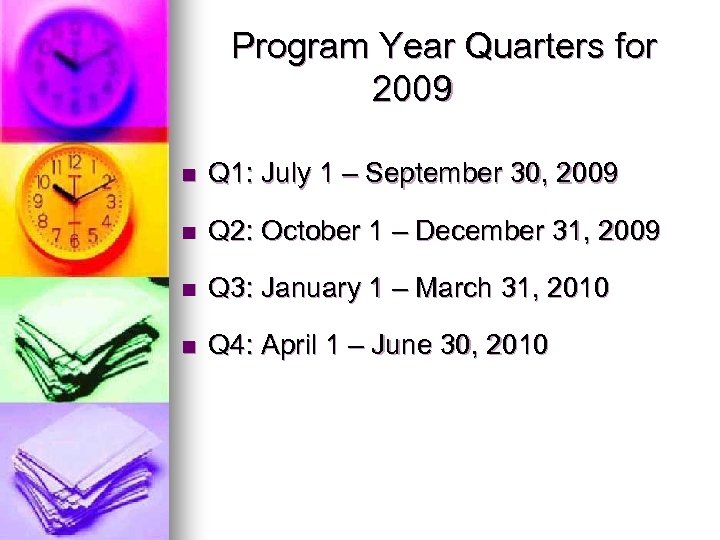
Program Year Quarters for 2009 n Q 1: July 1 – September 30, 2009 n Q 2: October 1 – December 31, 2009 n Q 3: January 1 – March 31, 2010 n Q 4: April 1 – June 30, 2010
Example n n Grantee has an enrollment goal of 37 youth. Period of performance is July 1, 2009 through June 30, 2012 Enrollment date is October 1, 2009 First cohort will exit May 15, 2010
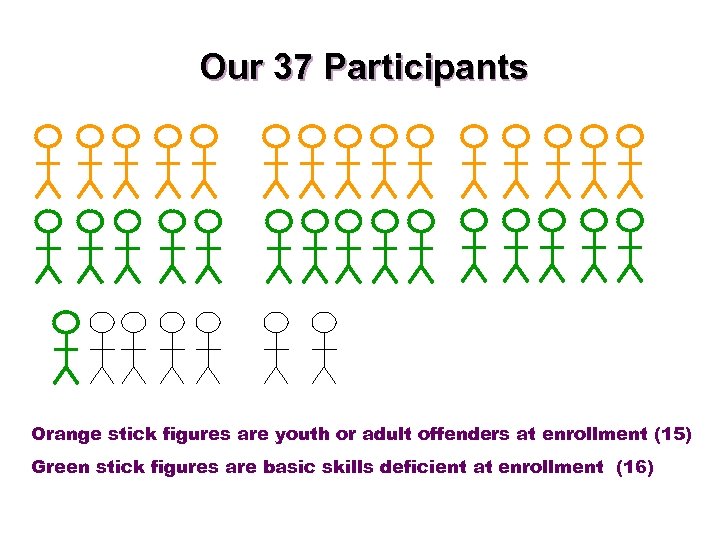
Our 37 Participants Orange stick figures are youth or adult offenders at enrollment (15) Green stick figures are basic skills deficient at enrollment (16)
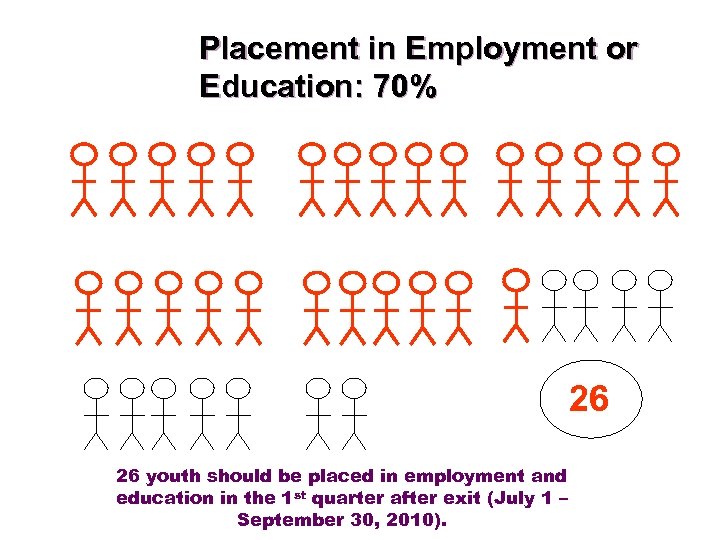
Placement in Employment or Education: 70% 26 26 youth should be placed in employment and education in the 1 st quarter after exit (July 1 – September 30, 2010).
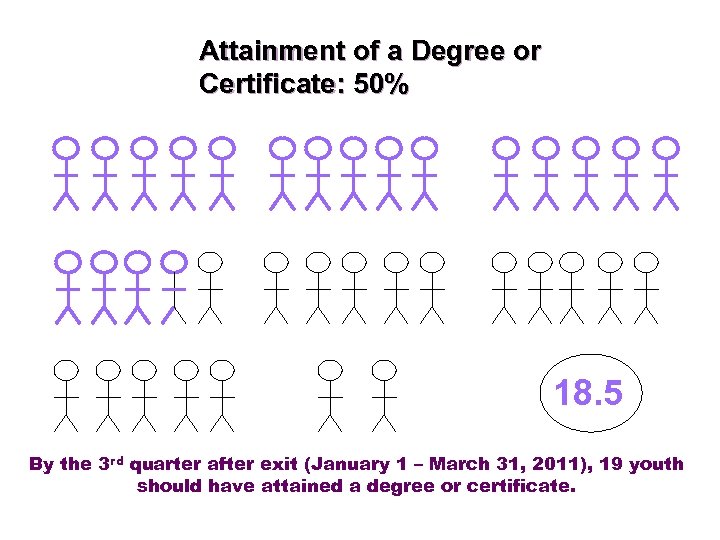
Attainment of a Degree or Certificate: 50% 18. 5 By the 3 rd quarter after exit (January 1 – March 31, 2011), 19 youth should have attained a degree or certificate.
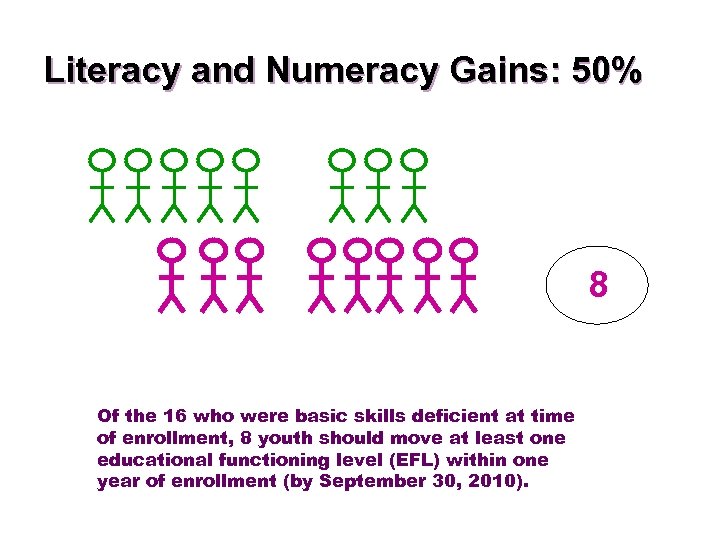
Literacy and Numeracy Gains: 50% 8 Of the 16 who were basic skills deficient at time of enrollment, 8 youth should move at least one educational functioning level (EFL) within one year of enrollment (by September 30, 2010).
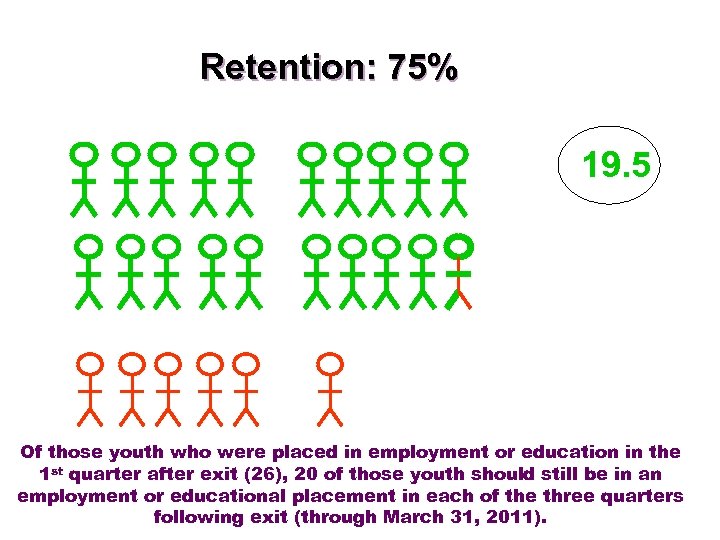
Retention: 75% 19. 5 Of those youth who were placed in employment or education in the 1 st quarter after exit (26), 20 of those youth should still be in an employment or educational placement in each of the three quarters following exit (through March 31, 2011).
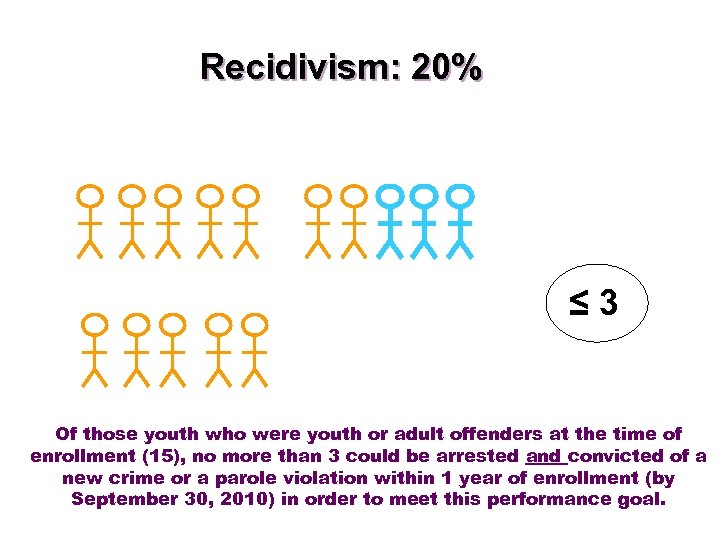
Recidivism: 20% ≤ 3 Of those youth who were youth or adult offenders at the time of enrollment (15), no more than 3 could be arrested and convicted of a new crime or a parole violation within 1 year of enrollment (by September 30, 2010) in order to meet this performance goal.
Contact Information n Help Desk: 1 -866 -680 -0855 (tollfree) missupport@youthbuild. org n Jenn Smith: 202 -693 -3597 smith. jenn@dol. gov
Скачать презентацию Youth Build MIS Training Importance of Performance
0cc8f9f1809e4a9cc52eb63e7f16a78e.ppt