


 Скачать презентацию Youth and Employment A focus on the most
cffa5521d896f8e82d68c8cf1db96c20.ppt
- Количество слайдов: 40
 Youth and Employment A focus on the most vulnerable Amir Ullah Khan India Development Foundation WDR, 17 December 2005
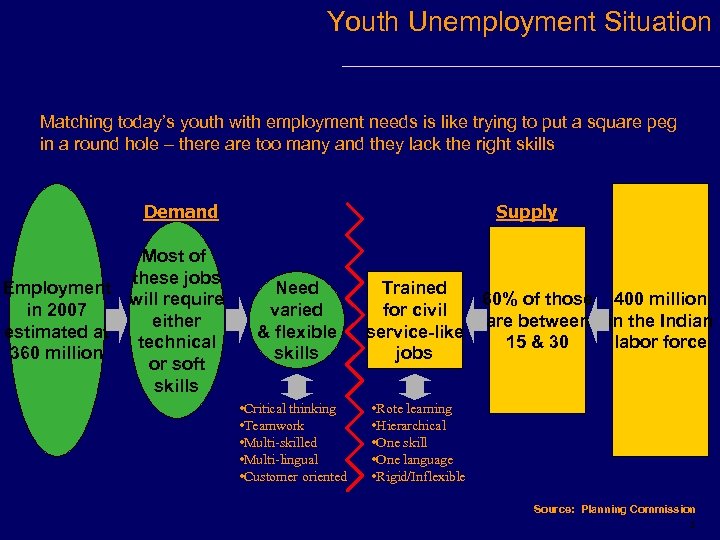 Youth Unemployment Situation Matching today’s youth with employment needs is like trying to put a square peg in a round hole – there are too many and they lack the right skills Demand Employment in 2007 estimated at 360 million Most of these jobs will require either technical or soft skills Supply Need varied & flexible skills Trained for civil service-like jobs • Critical thinking • Teamwork • Multi-skilled • Multi-lingual • Customer oriented • Rote learning • Hierarchical • One skill • One language • Rigid/Inflexible 60% of those 400 million are between in the Indian 15 & 30 labor force Source: Planning Commission 2
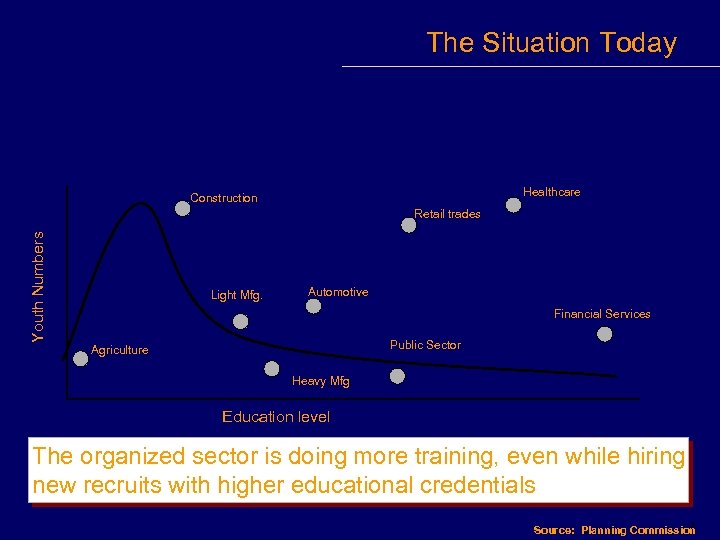 The Situation Today Healthcare Construction Youth Numbers Retail trades Light Mfg. Automotive Financial Services Public Sector Agriculture Heavy Mfg. Education level The organized sector is doing more training, even while hiring new recruits with higher educational credentials 3 Source: Planning Commission
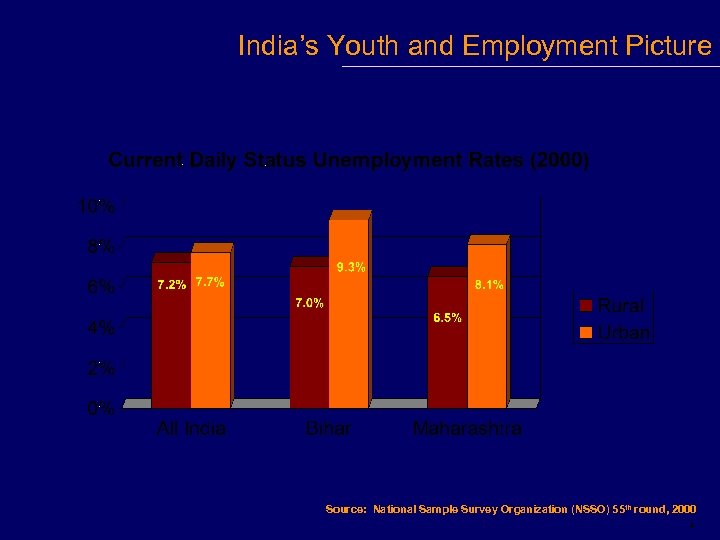 India’s Youth and Employment Picture Source: National Sample Survey Organization (NSSO) 55 th round, 2000 4
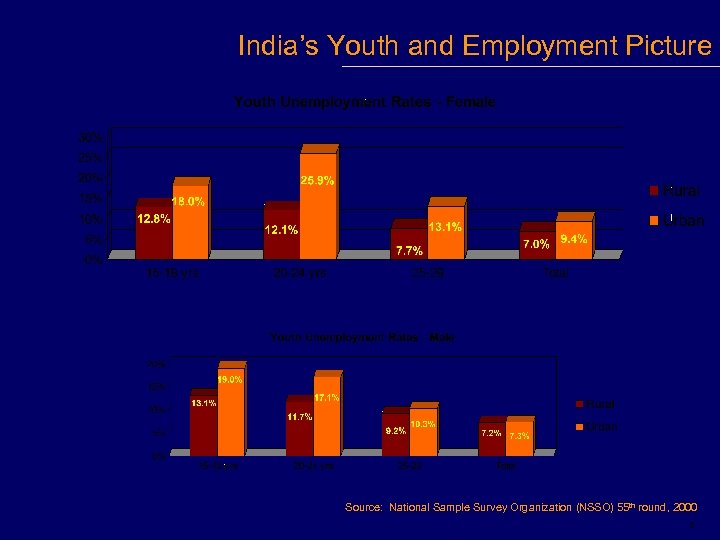 India’s Youth and Employment Picture Source: National Sample Survey Organization (NSSO) 55 th round, 2000 5
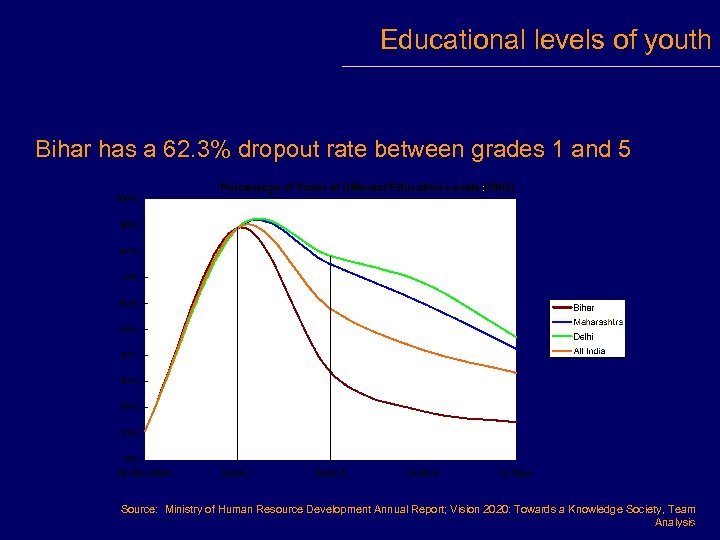 Educational levels of youth Bihar has a 62. 3% dropout rate between grades 1 and 5 Source: Ministry of Human Resource Development Annual Report; Vision 2020: Towards a Knowledge Society, Team Analysis 6
 Characteristics of the Unemployed Ø Poor learning outcomes § Ability to read and write § Speaking and communications skills Ø Low employability skills (soft skills) § English § Presentation skills § Etiquette and hygiene § Work ethic Ø Not adaptable or portable § Low numeracy § Low computer/IT familiarity § Lack of multi-skills Ø Poor opportunities for Entrepreneurship 7
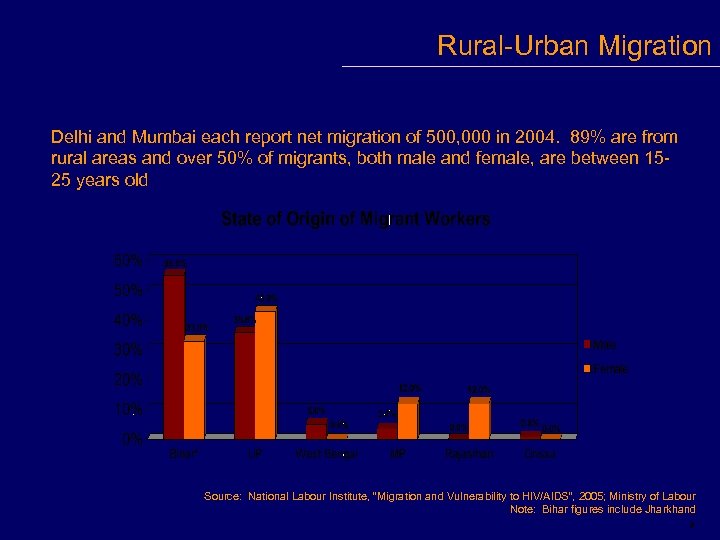 Rural-Urban Migration Delhi and Mumbai each report net migration of 500, 000 in 2004. 89% are from rural areas and over 50% of migrants, both male and female, are between 1525 years old Source: National Labour Institute, “Migration and Vulnerability to HIV/AIDS”, 2005; Ministry of Labour Note: Bihar figures include Jharkhand 8
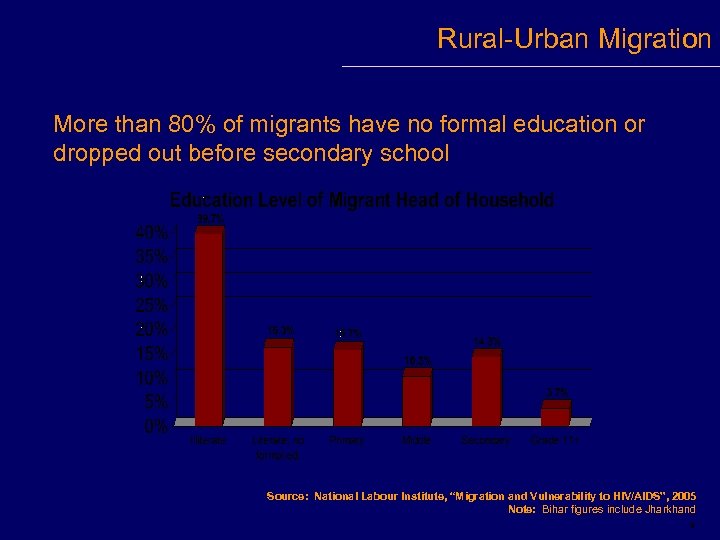 Rural-Urban Migration More than 80% of migrants have no formal education or dropped out before secondary school Source: National Labour Institute, “Migration and Vulnerability to HIV/AIDS”, 2005 Note: Bihar figures include Jharkhand 9
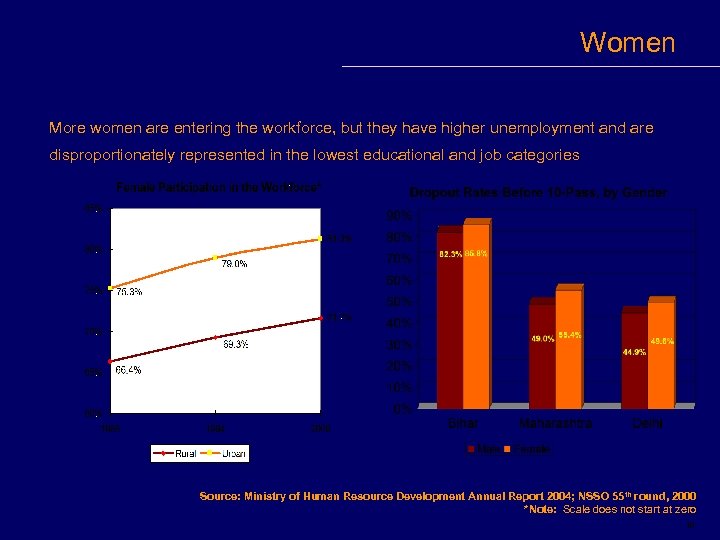 Women More women are entering the workforce, but they have higher unemployment and are disproportionately represented in the lowest educational and job categories Source: Ministry of Human Resource Development Annual Report 2004; NSSO 55 th round, 2000 *Note: Scale does not start at zero 10
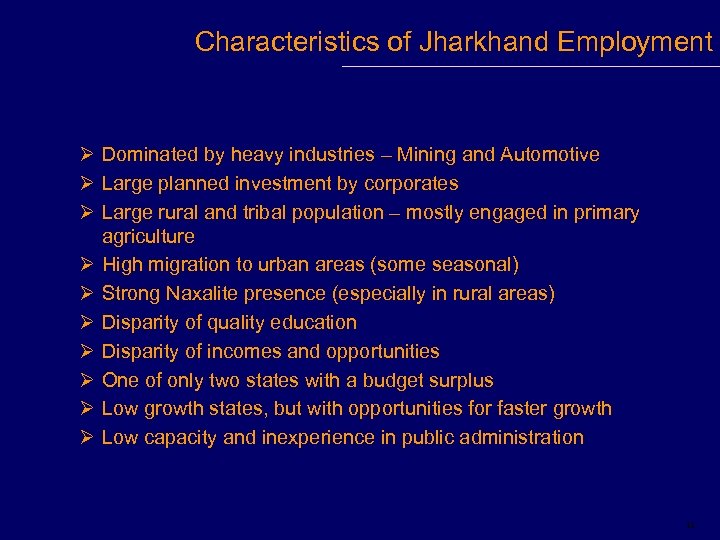 Characteristics of Jharkhand Employment Ø Dominated by heavy industries – Mining and Automotive Ø Large planned investment by corporates Ø Large rural and tribal population – mostly engaged in primary agriculture Ø High migration to urban areas (some seasonal) Ø Strong Naxalite presence (especially in rural areas) Ø Disparity of quality education Ø Disparity of incomes and opportunities Ø One of only two states with a budget surplus Ø Low growth states, but with opportunities for faster growth Ø Low capacity and inexperience in public administration 11
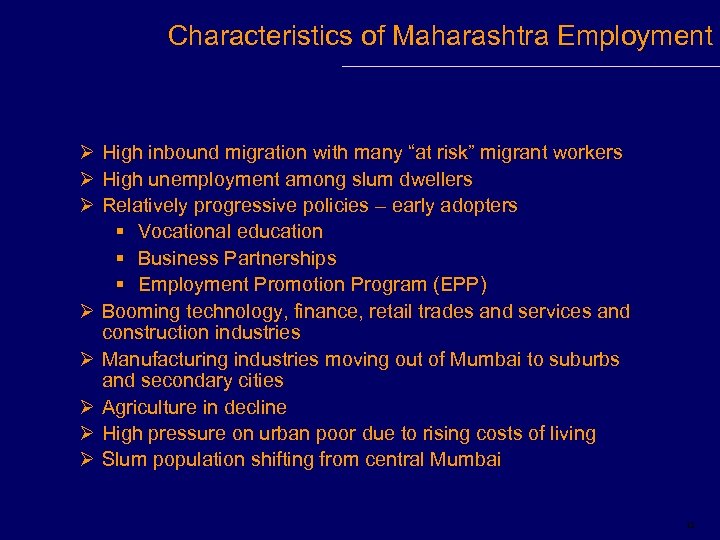 Characteristics of Maharashtra Employment Ø High inbound migration with many “at risk” migrant workers Ø High unemployment among slum dwellers Ø Relatively progressive policies – early adopters § Vocational education § Business Partnerships § Employment Promotion Program (EPP) Ø Booming technology, finance, retail trades and services and construction industries Ø Manufacturing industries moving out of Mumbai to suburbs and secondary cities Ø Agriculture in decline Ø High pressure on urban poor due to rising costs of living Ø Slum population shifting from central Mumbai 12
 Characteristics of Delhi Region Employment Ø Similar to Maharashtra, but less progressive Ø 500, 000 net inbound migration per year Ø Booming retail, hospitality, tourism, household services and construction industries Ø Substantial “at risk” migrants predominantly from Bihar, Jharkhand Uttar Pradesh Ø High unemployment among slum dwellers 13
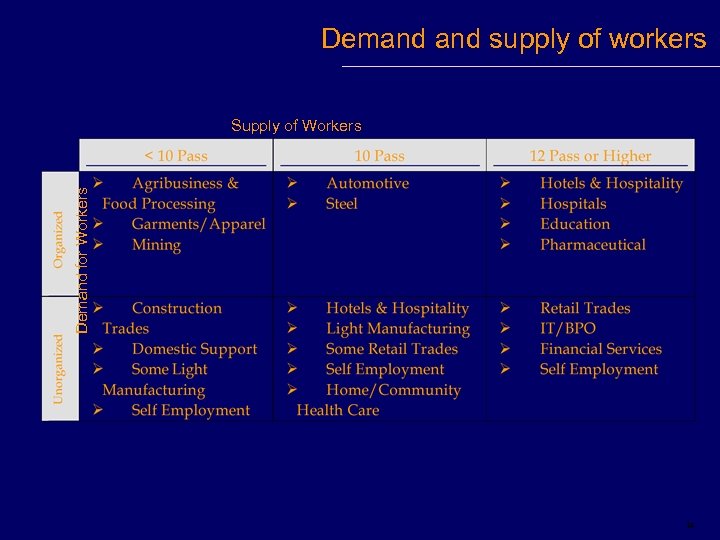 Demand supply of workers Demand for Workers Supply of Workers 14
 Emerging Trends in Education & Training India is going through enormous changes right now, not just demographically • • Secondary education pressures increasing Rural-Urban migration increasing Services industries growing Policy environment liberalizing Increasing demand for technical professions (Engg, MBA, MCA, Finance, IT) Increasing underemployment of workers with mid-level or non-technical credentials Manufacturing sector growing, but job opportunities not keeping pace 15
 Rapid Growth in the Service Sector • • • Closer correlation between economic growth and employment growth – higher elasticity of employment Growing middle class has more disposable income and is more sophisticated requiring more services and conveniences Rural poor also market for services • Banking • Insurance • Health Economic growth in traditional industries like manufacturing, but employment growth is low because of automation, higher productivity and restrictive labor laws. 16
 Findings - OSY • • Ignorance of career possibilities Lack of job search skills / confidence Recognize need for English Recognize need to get employable skills Ignorance how to get employable skills Ignorance of skills earnings potentials Optimistic about their futures 17
 Problems of Skills Training Providers • Majority Public sector VET institutions ineffective – ossified teachers, management, curricula, equipment • Secondary / primary education vocationalization will be slow/difficult • Quality problems – much is poor 18
 Emerging Trends in Education Government plans • • “Universal” primary & secondary education Curricula and instruction for needs of new economy • Employability Vocational training • Multi-skilling • Close links with business • New skills • Recognize informal learning Encourage Entrepreneurship 19
 Education trends Ø Mobility = IT and English literacy § High demand § Increase in private sector schooling Ø Secondary education double crunch! Ø Teacher shortages all levels public sector Ø Growth in private sector schools Ø Private high quality degree granting institutions pending Ø Demand-driven vocational training Ø Acceptance align education for the new economy 20
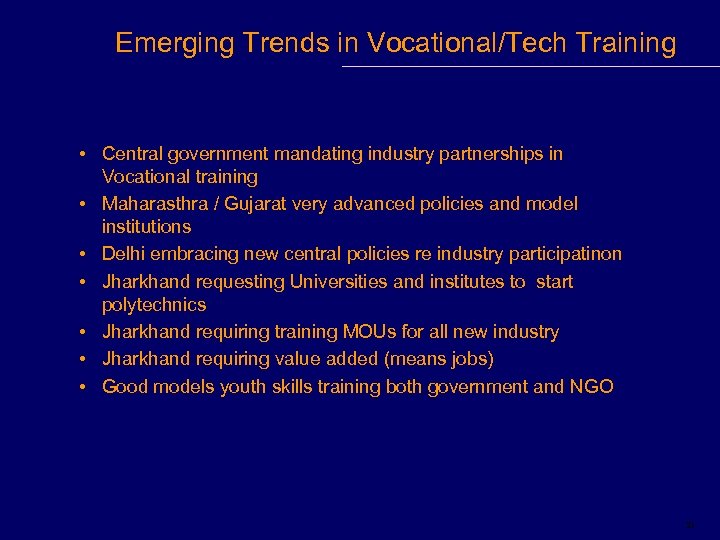 Emerging Trends in Vocational/Tech Training • Central government mandating industry partnerships in Vocational training • Maharasthra / Gujarat very advanced policies and model institutions • Delhi embracing new central policies re industry participatinon • Jharkhand requesting Universities and institutes to start polytechnics • Jharkhand requiring training MOUs for all new industry • Jharkhand requiring value added (means jobs) • Good models youth skills training both government and NGO 21
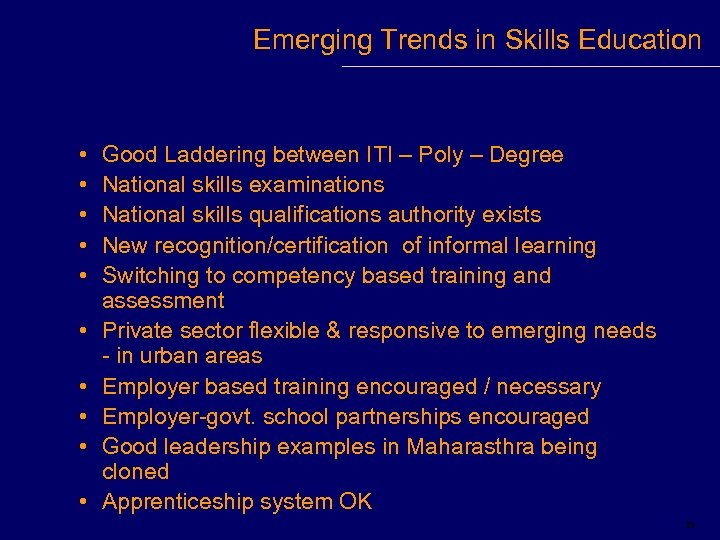 Emerging Trends in Skills Education • • • Good Laddering between ITI – Poly – Degree National skills examinations National skills qualifications authority exists New recognition/certification of informal learning Switching to competency based training and assessment Private sector flexible & responsive to emerging needs - in urban areas Employer based training encouraged / necessary Employer-govt. school partnerships encouraged Good leadership examples in Maharasthra being cloned Apprenticeship system OK 22
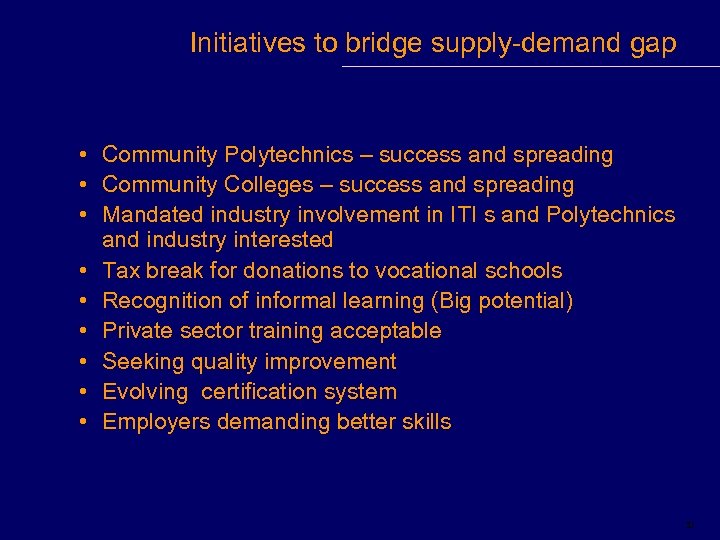 Initiatives to bridge supply-demand gap • Community Polytechnics – success and spreading • Community Colleges – success and spreading • Mandated industry involvement in ITI s and Polytechnics and industry interested • Tax break for donations to vocational schools • Recognition of informal learning (Big potential) • Private sector training acceptable • Seeking quality improvement • Evolving certification system • Employers demanding better skills 23
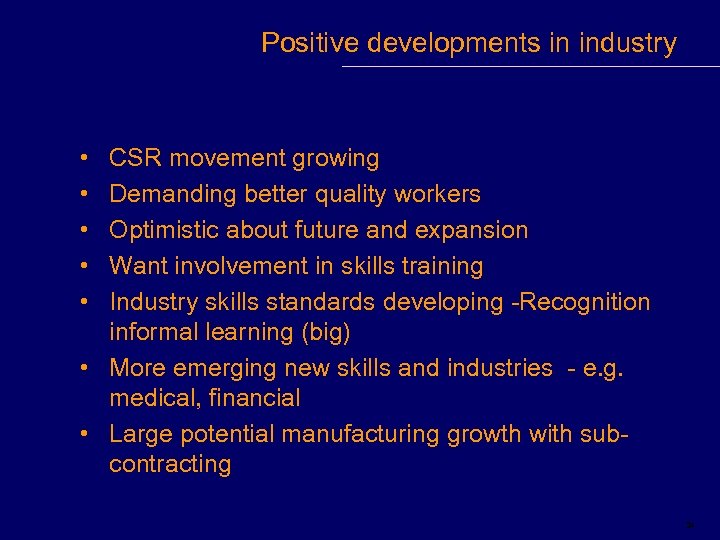 Positive developments in industry • • • CSR movement growing Demanding better quality workers Optimistic about future and expansion Want involvement in skills training Industry skills standards developing -Recognition informal learning (big) • More emerging new skills and industries - e. g. medical, financial • Large potential manufacturing growth with subcontracting 24
 Restrictive Policy Environment Tremendous pressures are building up for reform of outdated policies that are impeding the normal growth of healthy industries Contract Labor Act Industrial Disputes Act Interstate barriers to commerce Land distribution Reservations for small-scale industry Restrictions on food preservation 25
 Problems - cultural • Premium still on government jobs • Aversion to blue collar jobs • Skill shortages often culturally driven – e. g. nursing, serving • Cultural immobility • Women discrimination • Aversion to rural work • Family ties slow mobility / increase turnover • Little worker loyalty in new high skill industries 26
 Madarsahs • 1857, the first Director of Pubic Education in Punjab • Removal of all schools from the precints of mosques and other buildings of a religious character • Also directions of disuse of all books of a religious character in schools • Bentick 1835 – withdrawal of all support • His Lordship in Council is of the opinion that the great object of the British Government ought to be the promotion of European literature and science among the natives of India; and that all the funds appropriated for the purpose of education should be best employed on English education alone… • Change jn policy – Report of the Education Commission of 1882 27
 Madarsahs • Madarsahs are now seen as centres of obscurantism and superstition, and as one of the principal causes of Muslim decline. • In different Muslim countries the attack on the Madarsah system took different forms. In Turkey, 1925, Kemal Attaturk ordered the closing down of all Madarsahs • This policy was followed in several Muslim countries such as Albania and other countries in the vast Muslim belt in Central Asia 28
 Madarsahs • There are indeed a certain number of old fashioned Maktabs and Madarsahs which continue to give parrot like teaching of the Quran and even in these places no attempt is made either to improve the morals of the boys or bring them before the eternal truths of the faith. As a rule, prayers are but rarely repeated and when said not one per cent of the boys understand what they say and why 29
 Migration - problems • Unorganized (speculative) • draws the poor and uneducated • Slums, no social safety nets • Increased crime • Ideal is “Organized” migration to awaiting jobs • Now in some fields – construction, nursing, security • Could be better organized • Basic employable skills first • Health and safety awareness • Orientation to city life/recourse/life skills 30
 Underemployment The unemployment figures for India do not accurately reflect the true situation in India • Temporary work • Seasonal work • Self-employment • • Underpaid work Middlemen Non-formal sector - survival jobs Many over-educated for job 31
 Youth Reinforcing this focus is the fact that youth, particularly the unemployed, are also vulnerable to recruitment by extremist organizations • • • Ages 15 -24 School Drop-outs Those with unemployable credentials Unemployed / underemployed More exposure to/knowledge of the way the more privileged live Jharkhand problematic 21/26 districts controlled The economy is booming, but employment growth lags population growth – 14 million additional jobs will be needed by 2012 to keep pace. 32
 Problems - employers • Higher ed grad surplus / poor quality skewing job entrance criteria with employers skimming • Employer aversion to lower education workers as “troublemakers” • Labor laws restrain hiring and growth • Little use of apprenticeship for own employees • Finding staff for rural postings 33
 Options • • • Advocacy on labor reform Support CSRs Assist secondary system to trainers and develop new curricula Assist spread of community polytechnics and colleges Train the Trainers and capacity building • New management paradigm of ITI s and Polys • High speed teacher certificate program for trades practitioners • Use / development of new teaching methodologies Support Competency-Based training and Certification systems Organized Migration in construction trades, domestics etc Support access to basic information and understanding of rights for vulnerable youth – particularly rural youth and migrants Encourage ICICI rural bankers and finance instruments projects Experiment rural livelihood diversification 34
 Options (cont. ) • • • Strategy 1: Organized Migration for Construction Workers Strategy 2: Organized migration for domestics, nurse aides and home care workers Strategy 3: Rural village employment/self employment opportunity diversification Strategy 4: Rural Banking and Finance Training Programs Strategy 5: Vocational Teacher Professional Practitioner’s Diploma Strategy 6: Madarsah Initiative Scale Up Strategy 7: Support for Industry Management and Upgrading of ITI s and Polytechnics Strategy 8: Support for Industry-led Skills Certification Systems Strategy 9: Support for Industry-led Community Colleges and Polytechnics Strategy 10: Advocacy for Modification of Labor Laws and Streamlining of Manufacturing Start up Regulations Strategy 11: CSR Support Scale up of Model OSY Skills Development Programs 35
 Delhi School Education Act Ø The school must obtain Essential Certificate by establishing that its existence serves the public interest. The administrator decides by taking into account the number and categories of recognized schools already functioning in that locality, and general desirability of the school with reference to the suitability and sufficiency of the existing schools in the locality and the probable effect on them 36
 Delhi Municipal Corporation Ø No person shall keep or ply for hire a cycle rickshaw in Delhi unless he himself is the owner thereof and holds a license granted in that behalf by the Commissioner on payment of the fee that may, from time to time be fixed under sub section 2 of Section 430. Provided that no person shall be granted more than one such license. Ø Widow or handicapped 37
 Delhi Municipal Corporation Ø Cycle Rickshaw Bye laws 1960, Section 17 A. Ø Any rickshaw found plying for hire without a license or found driven by a person not having proper license shall be liable to be seized by the Commissioner or a person duly authorized in his behalf. The cycle rickshaw so seized shall be disposed off by public auction after dismantling, deformation of such process including smashing it into scrap after a reasonable time as may be decided by the Commissioner from time to time. 38
 Delhi Municipal Corporation Ø Street Hawkers technical Conditions Ø Sale of Ice cream by hawking Rule 6 Ø The ice cream salesman will not shout to attract customers nor will he sit or lie on the trolley at any time 39
 Thank you www. idfresearch. org