


 Скачать презентацию Your client is Declined for LTCI now what
c3e9b175a85a55b124918a195aa949d8.ppt
- Количество слайдов: 55
 Your client is Declined for LTCI…. now what? Christopher S. Barnthouse, MBA, CLTC
 Objectives: How systematic, process based LTC Education can help avoid this circumstance when executed properly n Special Risk products n Options for when one spouse is insurable and the other isn't n
 Objectives (cont. ): Prequalification Process n Asset-based Alternatives n Additional non-traditional instruments to help address the uninsurable issue n A new way to consider LTC Planning n
 How did you get there? (I. e. your client being uninsurable? )
 Could you have avoided it?
 Did you… …Prequalify the applicants? …Set Expectations? …discuss options and procedures in the event of a decline?
 What is your education delivery system?
 Have you committed it to paper?
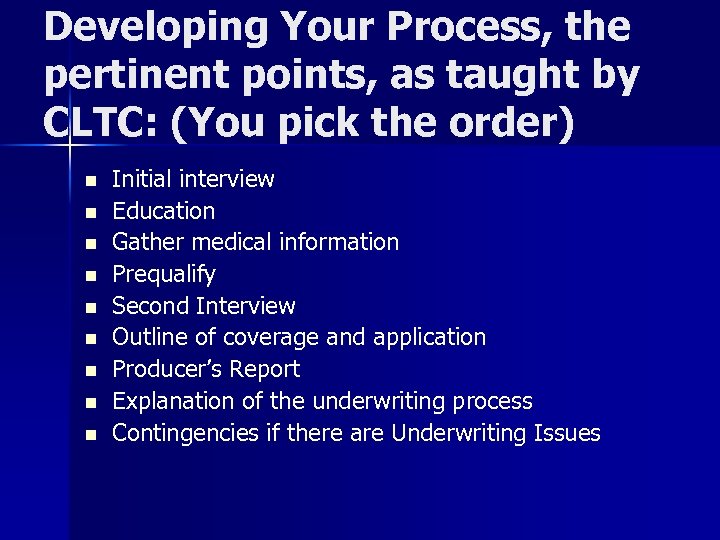 Developing Your Process, the pertinent points, as taught by CLTC: (You pick the order) n n n n n Initial interview Education Gather medical information Prequalify Second Interview Outline of coverage and application Producer’s Report Explanation of the underwriting process Contingencies if there are Underwriting Issues
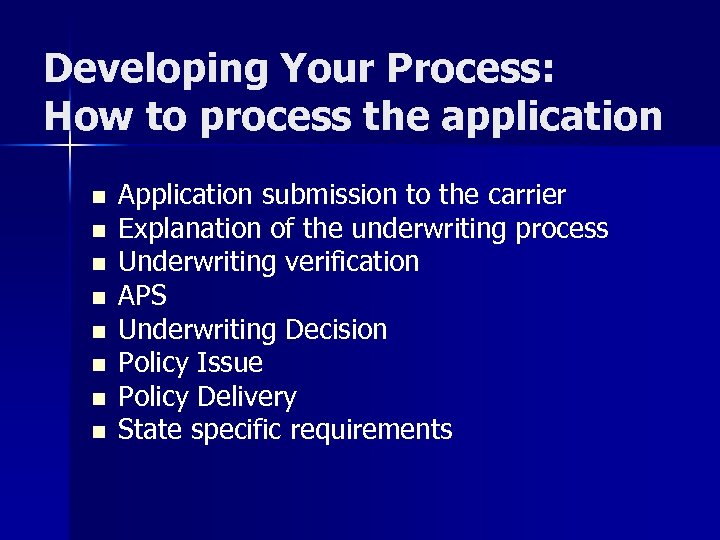 Developing Your Process: How to process the application n n n n Application submission to the carrier Explanation of the underwriting process Underwriting verification APS Underwriting Decision Policy Issue Policy Delivery State specific requirements
 n Systematic, Process Based LTC Education/Assistance: – Education/Discovery – Underwriting/Expectation Setting – Implementation
 Credibility: n n If your process is committed to paper, you can email it to the clients after your discussion. Once you have done this, you can refer to it during your educational process.
 n Underwriting/Expectation Setting: – Does the client present with significant or multiple medical issues? – Do you work with more than one carrier or instrument?
 Here is where the case is won or lost
 Underwriting/Expectation Setting: What data are you collecting for both the medical and financial component of the fact finder? n Get the client’s ok to create options for them. n Set reasonable expectations n
 Underwriting/Expectation Setting: Which carriers may be more accepting of certain history than others? n Instrument options n What financial data have you collected? n – Why is this important?
 Underwriting/Expectation Setting: n Which carriers may be more accepting of certain history than others? – Expectation setting with the client n – – Can just one of the two in a couple qualify? Traditional Health LTC? Asset-based LTC? Special Risk Products Which of these options gives your client the best chance to get an offer of coverage extended?
 What if one client can get it in a couple and the other can’t? n Expectations need to be set properly when the fact finder is taken – Do they understand the importance of going forward is heightened even further if one doesn’t qualify? n How have you made them understand this? – Is this eventuality a consideration in carrier choice? – Plan design options if one client qualifies and the other does not
 What if one client can get it in a couple and the other can’t? n n Plan design options if one can get it and the other can’t Find a non-traditional solution Seek options for making the uninsurable spouse insurable Make sure you have all available underwriting information when seeking a solution.
 WARNING: n Do NOT submit an application that you know will be declined. It may eliminate future options and upset the client.
 So you did everything right and your client still got declined, now what? Ask the underwriter: 1. What was the specific reason for the decline? 2. What would have to happen for the applicant to be accepted n n Find a solution for the applicant
 Insurance Alternatives to Traditional LTCi Asset-Based LTCi n Special Risk LTCi companies n Critical Care Insurance n Short Term Care Insurance n Life Settlements n
 Asset Based: Life w/ LTCi benefit • Offered by several carriers • Differs from Accelerated Death Benefits in that the LTC benefits are almost identical to regular long-term care insurance policies • Usually purchased primarily for LTC coverage —death benefit is a plus if the individual never needs care • Can be purchase with single premium or as a standard life policy • Can be funded with cash, CD’s, money market accounts or 1035 exchange from an existing life policy
 Asset Based: Life w/ LTCi benefit • Is usually underwritten for both LTCi and Life • LTCi underwriting can be fore flexible than with Traditional LTCi. • WARNING: With some life insurance carriers, although the underwriting is less rigid than with traditional LTCi, a decline from a LTCi carrier can be an automatic decline. DO NOT SUBMIT AN APPLICATION FOR LTCI IF YOU KNOW IT WILL BE DECLINED. IT MAY ELIMINATED THIS OPTION.
 Life/LTC Insurance • Generally can be two payment options for the LTC component to pay: • A monthly percentage, usually 2%-4% of the death benefit. • A monthly payment determined by dividing the death benefit by a number of years provided in the contract. • LTC benefit can be a multiple of the death benefit.
 Life/LTC Insurance • Considerations: • Does client have both a life and LTC need? • How do each of these products execute? • What kind of Chassis: • UL • WL • Underwriting: • Mortality • Morbidity
 Life/LTC Insurance • Considerations: • Payment options • Lump Sum • Schedule
 Alternative Financing Options for those that do not qualify for standard issue LTC This section reviews some alternatives for individuals who: • Cannot qualify for traditional health LTC
 Life Insurance • Accelerated Death Benefit—a feature or rider included with some life insurance policies. Provides cash advances against the death benefit while the individual is alive. • Different “triggers” depending on policy: – Terminally ill – Life threatening diagnosis such as AIDS – Need long-term care for an extended period of time – Permanently confined to a nursing home and needs assistance with their ADL’s
 Important Considerations • If an individual is uninsurable for LTCi, it is possible that to get some LTC benefits through an ADB on a life insurance policy if there is little or no health screening required • ADB policy payouts for LTC are often more limited than the benefits received from a typical LTCi policy. • The face value amount of life insurance may not be large enough to allow ADB payments sufficient to cover LTC needs. The benefit payments may be lower and the duration shorter than what is required to cover LTC expenses.
 More Important Considerations • Inflation protection is usually not offered. If inflation protection is not included, the ADB payment may not be sufficient to cover future long-term care costs. This means that the individual would need additional means to pay for his/her care. • Individuals need to consider that if they use the death benefit for long-term care, there may be little or no death benefit remaining for survivors. • Payments from an ADB could affect eligibility for Medicaid.
 Special Risk LTC Products • Special Risk LTCi • Critical Care Insurance • Short Term Care Insurance
 Special Risk LTC Products Caution: Many of these specialty carriers are rated A- and below. - Explain financial ratings to your clients - Check with compliance
 Special Risk LTCi • Carriers that take risks that are unacceptable to others Diabetes Overseas Coverage You need very specific and complete medical information.
 Critical Care Insurance • Covers Specific Conditions • Covers about 70% of the conditions that require LTCi • Underwriting is based strictly on drug usage. • Benefits are dollars per month for a specific duration • No inflation protection available
 Short Term Care Insurance • Provides a maximum of one year’s benefit • Underwriting is more lenient than traditional LTCi • Can be used in conjunction with a traditional LTCi policy
 Life Settlements Important Considerations: – No death benefit may be left for survivor/heirs – No health screening is required; the individual may be in good or poor health— value is higher with poorer health – There could be tax liabilities on the proceeds of the sale
 Life Settlements Important Considerations: – This is essentially a STOLi – Check with the insurer to see if an accelerated death benefit can be made available – This transaction may be taxable – Check with compliance before proposing
 Viatical Settlements Allow individuals to sell their life insurance policy to a third party and use the money to pay for care • Must be terminally ill (less than 2 year life expectancy) • Viatical company pays the individual an amount of money based on % of the death benefit and based on the individual’s life expectancy— • Viatical company now owns the policy and is its beneficiary—and must pay the premium • Unlike the life settlement, money received from a viatical is tax free
 Viatical Settlements • Important Considerations: – Individual must be terminally ill with a life expectancy of two years or less. – Individuals that are uninsurable for long-term care insurance can use the Viatical Settlement to pay for long-term care – The policy will no longer be available to pay a death benefit to the individual’s heirs. – Less than 50 percent of applicants for Viatical Settlements are approved – Check with compliance.
 Home Equity • Home equity is the difference between the appraised value of a home and what is owed on the mortgage(s) • When a person needs care often the mortgage is paid off and the value of their home has probably also increased beyond its original purchase price
 Important Considerations when Tapping into Equity • If an individual sells their home they will not be able to pass it on to theirs. • The sale price may not be enough to pay for long-term care needs. • Market conditions have a great affect on the selling price of the home. • It is possible that taxes may need to be paid on the capital gains depending on the sale price relative to the original purchase price and other considerations.
 Reverse Mortgages • Receive cash against the value of the home without selling the home • Can choose to receive lump-sum, a monthly payment, or a line of credit • No restrictions on how home funds are used—therefore can be used to fund LTC insurance or to pay for long term care itself
 Qualifications • Borrowers must be 62 or older, there are no health requirements • The home must be the primary residence • The individual is not required to provide any income or credit history. • Reverse mortgage funds must be used to pay off any existing mortgage or other debt against the home and to make required home repairs. The remaining funds can be used for any other purpose. • A reverse mortgage must be in first lien position, which makes it very difficult to borrow any more against the home. • Reverse Mortgages can be refinanced if the value of the house increases significantly in value. • All potential borrowers must first meet with a HUDapproved reverse mortgage counselor before they can start the loan process.
 CAUTION • Using Home Equity should be a last resort • The primary residence is protected against Medicaid spend down so long as one spouse can live in it.
 Long Term Care Annuities Immediate or Deferred Good News: All underwriting is completed before any money changes hands Bad News: Deferred annuity underwriting is nearly as stringent as traditional LTCi
 Long Term Care Annuities • Annuity is a series of regular payments over a specified period of time • Two Common types: – Deferred Long Term Care Annuity – Impaired Risk SPIA
 Long Term Care Annuities • Deferred Annuity working Metrics: • • DB X 30 X Multiple Client finances first 3 years LTC Interest Rate Annuity Interest Rate Rider (Silver Lining) Questionnaire Not offered in all states
 SPIA Working Metrics: • Product underwritten on the basis of annuitant’s health rather than his/her life expectancy. • The more grave the illnes the less the upfront payment to purchase a given lifetime monthly benefit. • Benefit generally ends at the death of annuitant
 Immediate Long Term Care Annuity • Owner makes a single premium to an insurance company and in exchange receives a specified monthly income • May be medically underwritten—payout is higher based on shorter life expectancy • Payment from the annuity may not be enough to cover care (depending on premium and increasing cost of care)
 Deferred Long-Term Care Annuity • Creates two funds: one for long-term care expenses and the other is a cash value fund. The care fund grows at a higher rate • If care is needed, funds can be accessed immediately • If care is never needed, acts as a regular annuity • Minimal underwriting is required—those who cannot get traditional LTC coverage may qualify
 Important Considerations: – If the long-term care fund is not used, it can be passed to the individual’s heirs. – The annuity may not be enough to pay for your long-term care expenses. – Inflation may make the monthly income you receive from the annuity less than what the individual needs.
 Other Options • Veterans Benefits • Elder Law Attorney
 Conclusion n Avoid declines and surprises through thorough prequalification n In the event of a decline, get specific reasons and what would result in a more favorable underwriting decision. n With complete information, find a solution that meets both the client’s needs and risk tolerance n Check with compliance
 For More Information Christopher S. Barnthouse, MBA, CLTC 500 East 96 th Street STE 125 Indianapolis, IN 46240 (317) 819 -0575 chris. barnthouse@nm. com