 Скачать презентацию Your CA s CA Team Briefing
Dutch-WUDC-CA-Team-Briefing.pptx
- Количество слайдов: 46



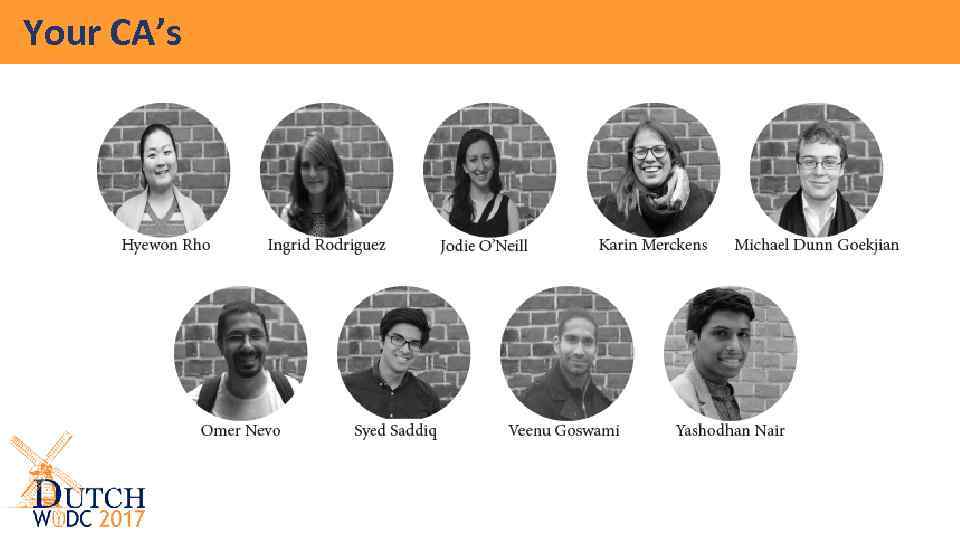
Your CA’s
CA Team Briefing § § § Introductory points 10 key things to get right Motions Speaker scale Feedback Adjudication Test
Introductory points § Judging on the basis of persuasiveness § Points of information - max 1 point, max 15 seconds § Clarifying / challenging a model - pg. 19 of the WUDC manual
10 Key things to get right
1. Policies Opening Government can propose any policy that fulfils the motion. Opening Opposition has the option, but not the obligation or expectation, to propose any counter policy that consumes equal resources to Opening Government’s, and does not fulfill the motion.
2. Extensions Any contribution to the debate that has not already been fully explained is a new contribution to the debate. This includes rebuttal, examples and framing.
3. Summary / whip speeches Summary / whip speakers can clarify and defend arguments made by the extension speaker and respond to existing material but can not begin entirely new arguments.
4. Role fulfilment is not a substitute for overall persuasiveness.
5. Falling out of the debate / being boxed out Other teams ignoring arguments does not weaken them.
6. Contradictions A contradiction only invalidates the arguments that depend on it. ‘Even if’s’, or identifying multiple ways in which an argument can play out, are not contradictions.
7. Language and persuasiveness Accent has no role in persuasiveness and merely rephrasing arguments, with no new analysis, does not add value.
8. Style Good style comes in many forms, and the judge’s so-called personal preference for one style over another may well reflect bias.
9. Global context This is a global tournament, so, unless specifically stated otherwise, motions should be debated in a global context. However, different arguments may well have different weightings in different contexts.
10. How much thinking should a judge do? Judges should, to the greatest extent possible, compare arguments based only on what was said in the debate. Where a judge is unable to assess a set of arguments based only on what was said in the debate, they should do so using the smallest and most reasonable set of assumptions, and be prepared to explain these in their oral adjudication.
Motions
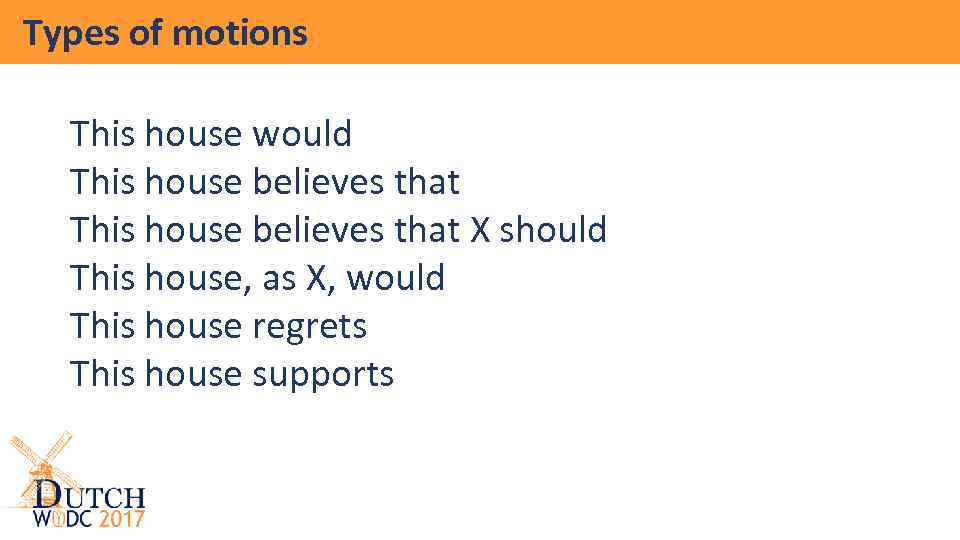
Types of motions This house would This house believes that X should This house, as X, would This house regrets This house supports
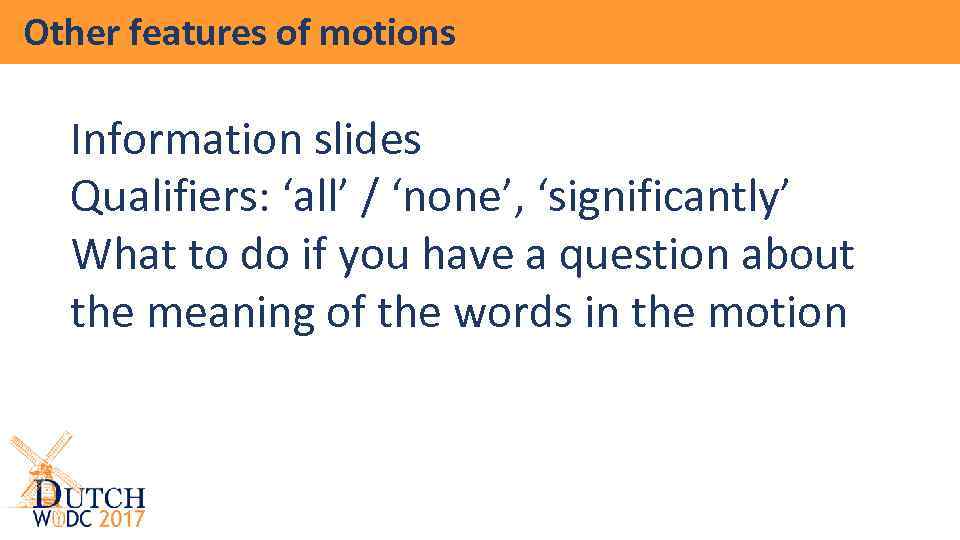
Other features of motions Information slides Qualifiers: ‘all’ / ‘none’, ‘significantly’ What to do if you have a question about the meaning of the words in the motion
Speaker scale
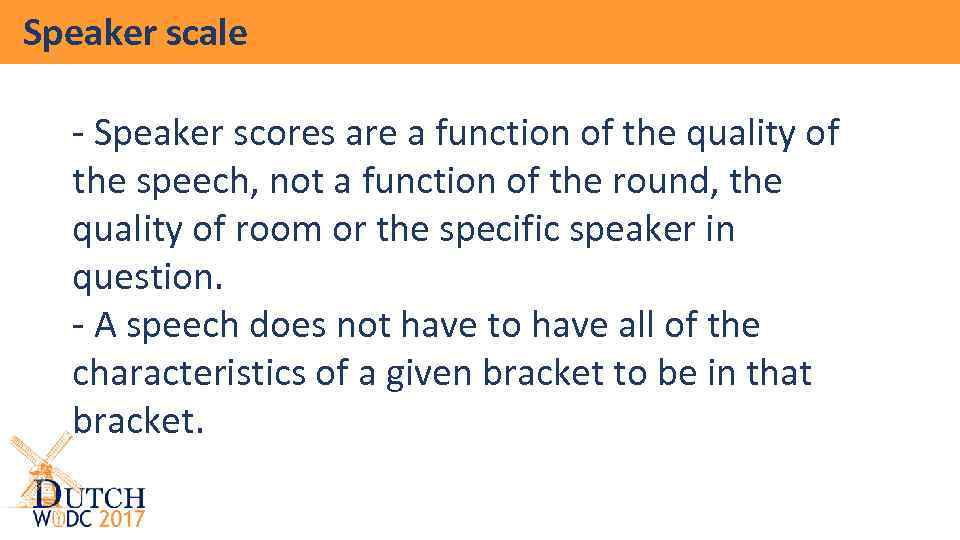
Speaker scale - Speaker scores are a function of the quality of the speech, not a function of the round, the quality of room or the specific speaker in question. - A speech does not have to have all of the characteristics of a given bracket to be in that bracket.
Feedback
Feedback ALWAYS do it Only comment with information not necessarily contained in your numerical scores
Adjudication Test
Open Questions • Justification & Feedback are more important than ranking and speaks. • A factor (with multiple choice questions and CV) that goes into the initial ranking. • Ongoing ranking throughout the competition will be updated with feedback.
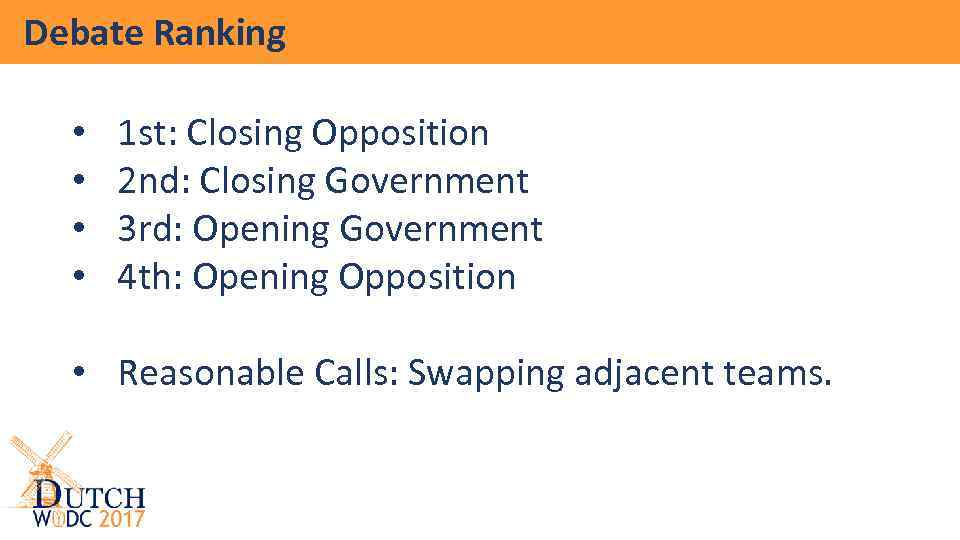
Debate Ranking • • 1 st: Closing Opposition 2 nd: Closing Government 3 rd: Opening Government 4 th: Opening Opposition • Reasonable Calls: Swapping adjacent teams.
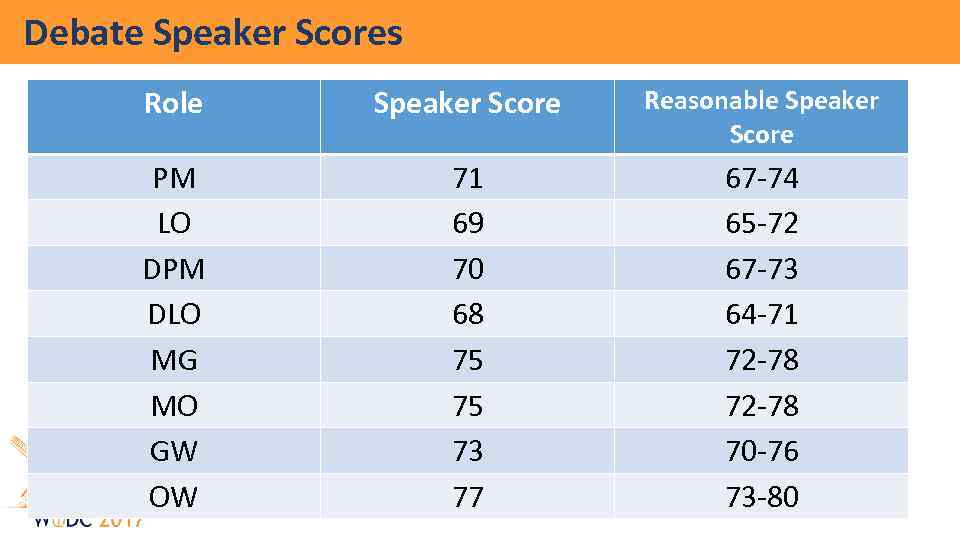
Debate Speaker Scores Role Speaker Score Reasonable Speaker Score PM LO DPM DLO MG MO GW OW 71 69 70 68 75 75 73 77 67 -74 65 -72 67 -73 64 -71 72 -78 70 -76 73 -80
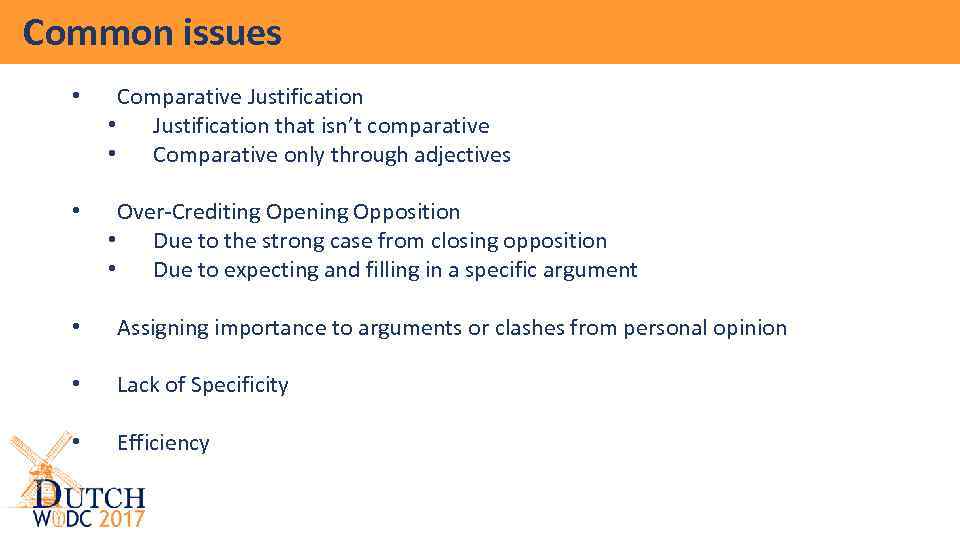
Common issues • Comparative Justification • Justification that isn’t comparative • Comparative only through adjectives • Over-Crediting Opening Opposition • Due to the strong case from closing opposition • Due to expecting and filling in a specific argument • Assigning importance to arguments or clashes from personal opinion • Lack of Specificity • Efficiency
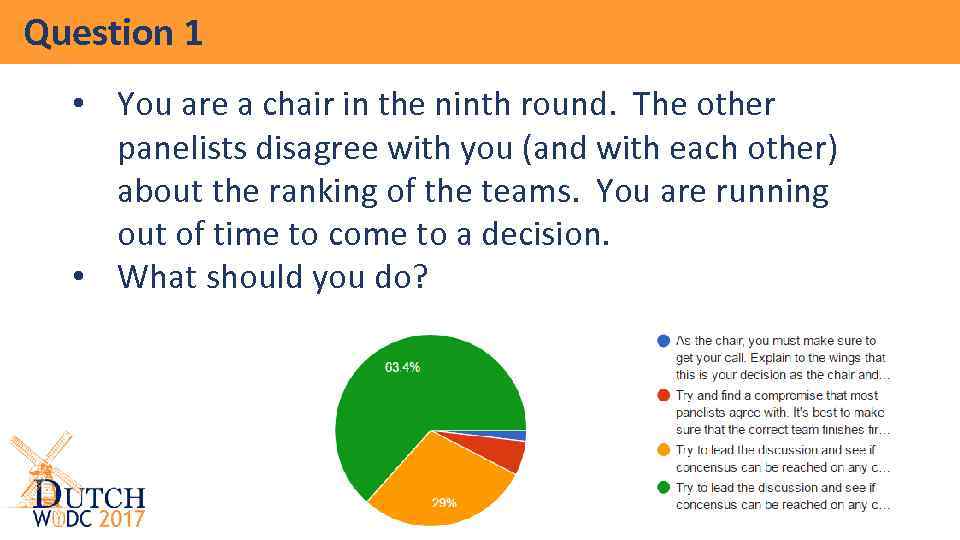
Question 1 • You are a chair in the ninth round. The other panelists disagree with you (and with each other) about the ranking of the teams. You are running out of time to come to a decision. • What should you do?
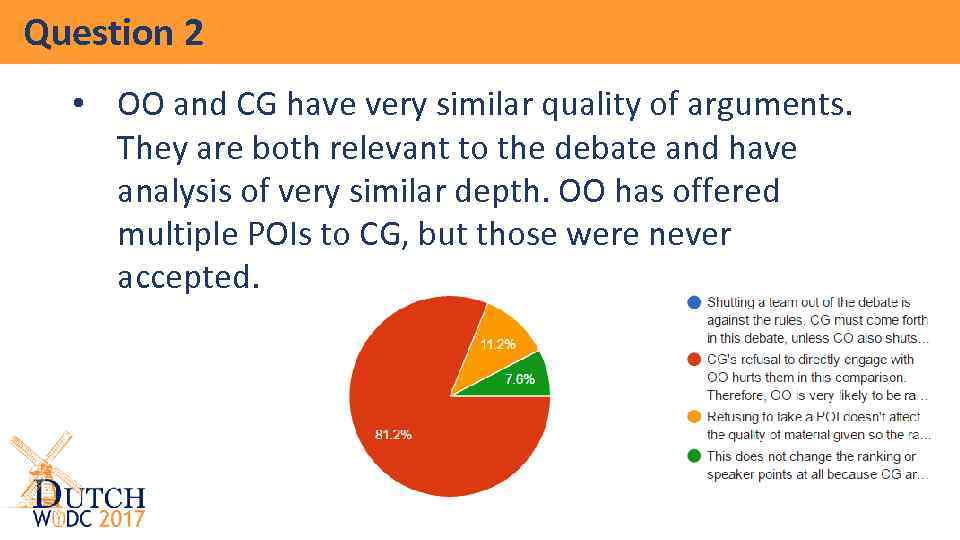
Question 2 • OO and CG have very similar quality of arguments. They are both relevant to the debate and have analysis of very similar depth. OO has offered multiple POIs to CG, but those were never accepted.
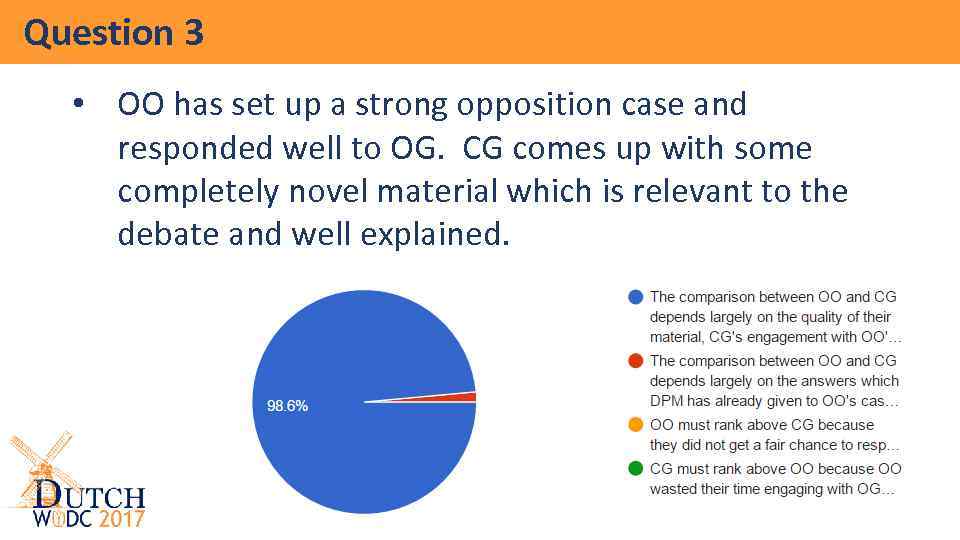
Question 3 • OO has set up a strong opposition case and responded well to OG. CG comes up with some completely novel material which is relevant to the debate and well explained.
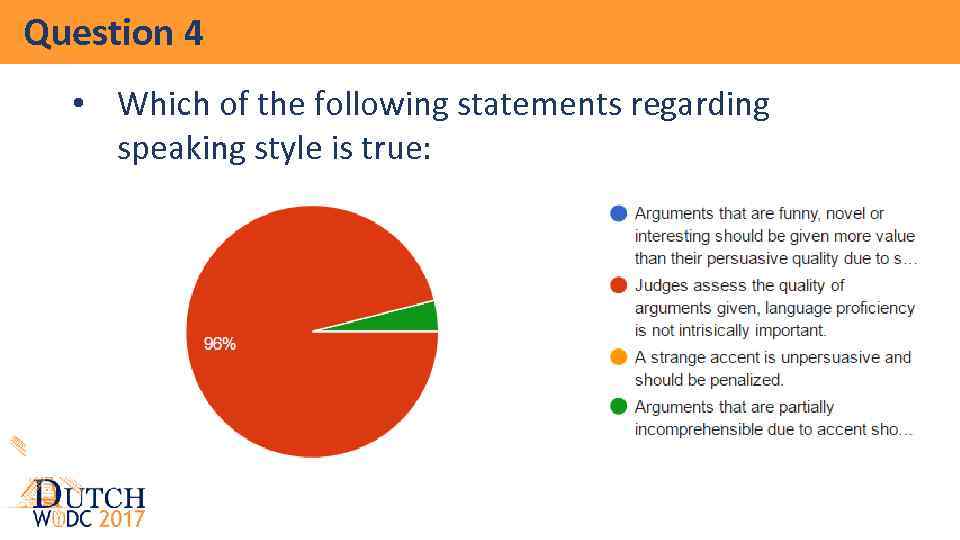
Question 4 • Which of the following statements regarding speaking style is true:
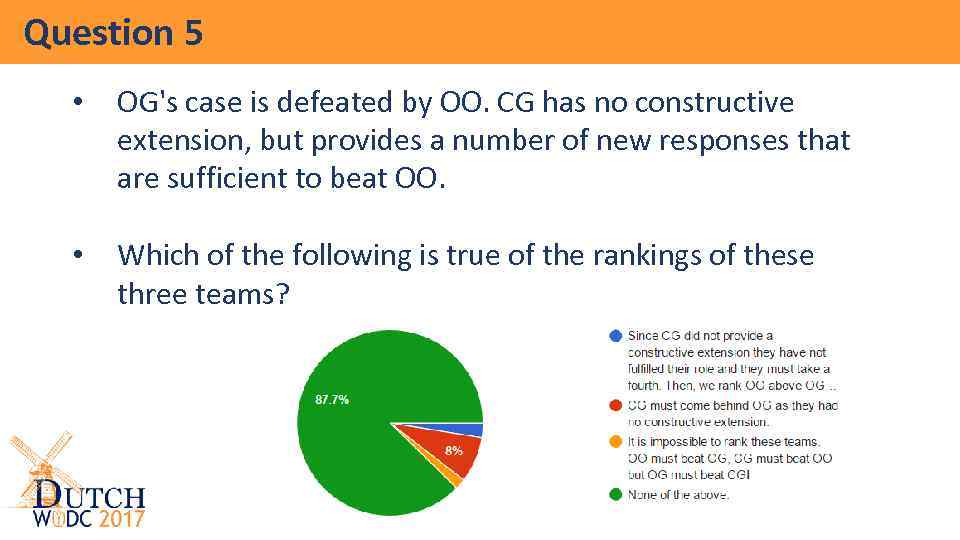
Question 5 • OG's case is defeated by OO. CG has no constructive extension, but provides a number of new responses that are sufficient to beat OO. • Which of the following is true of the rankings of these three teams?
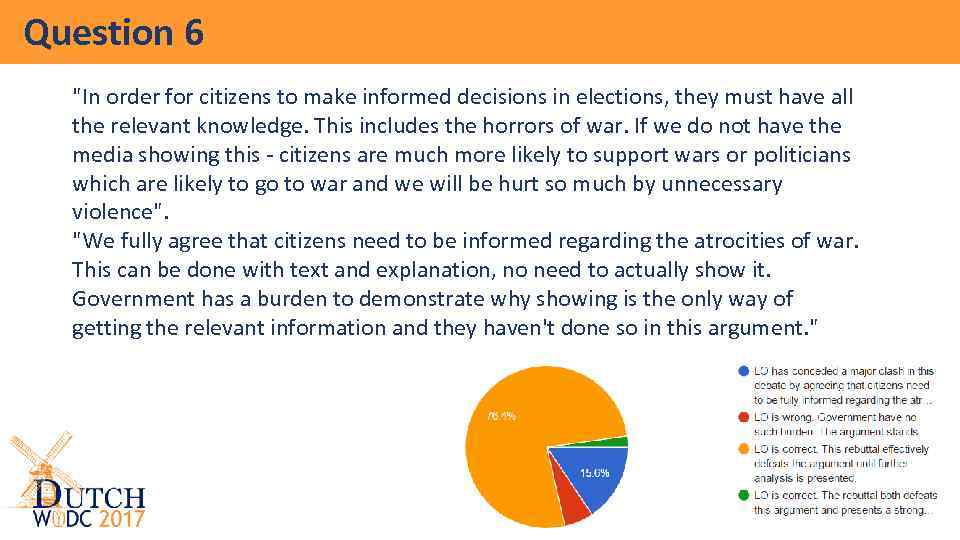
Question 6 "In order for citizens to make informed decisions in elections, they must have all the relevant knowledge. This includes the horrors of war. If we do not have the media showing this - citizens are much more likely to support wars or politicians which are likely to go to war and we will be hurt so much by unnecessary violence". "We fully agree that citizens need to be informed regarding the atrocities of war. This can be done with text and explanation, no need to actually show it. Government has a burden to demonstrate why showing is the only way of getting the relevant information and they haven't done so in this argument. "
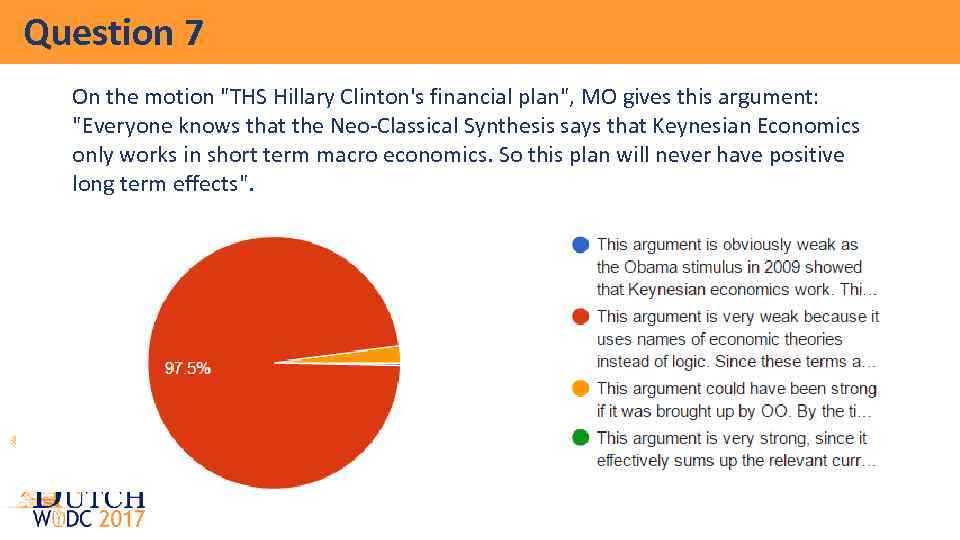
Question 7 On the motion "THS Hillary Clinton's financial plan", MO gives this argument: "Everyone knows that the Neo-Classical Synthesis says that Keynesian Economics only works in short term macro economics. So this plan will never have positive long term effects".
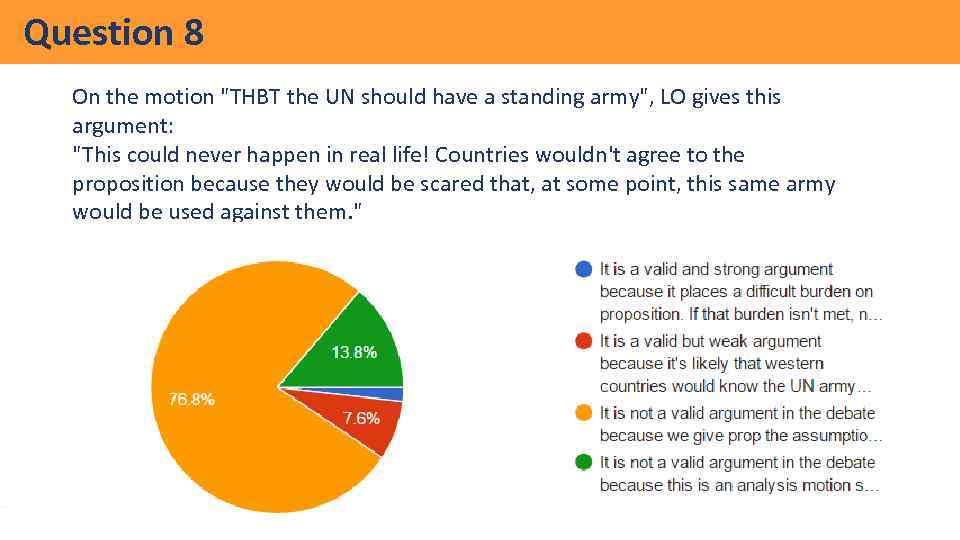
Question 8 On the motion "THBT the UN should have a standing army", LO gives this argument: "This could never happen in real life! Countries wouldn't agree to the proposition because they would be scared that, at some point, this same army would be used against them. "
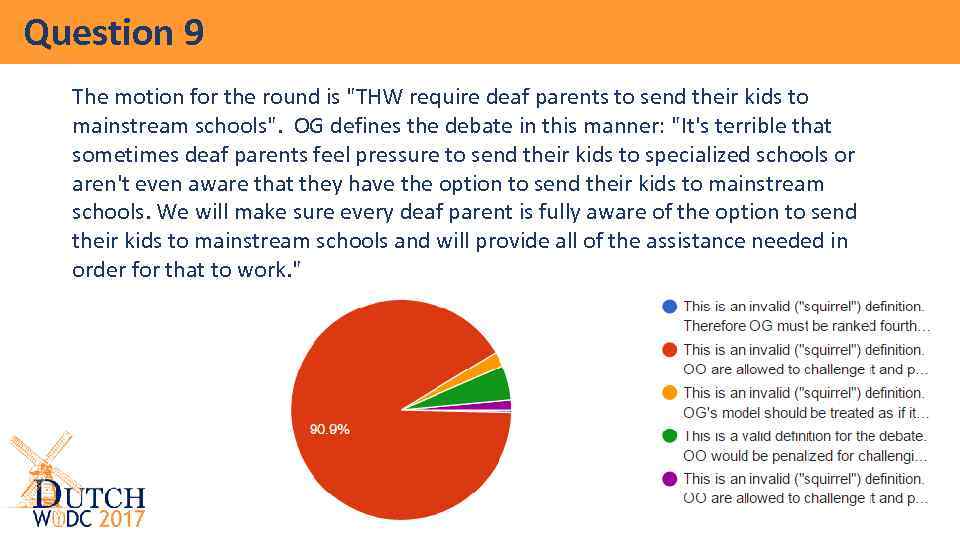
Question 9 The motion for the round is "THW require deaf parents to send their kids to mainstream schools". OG defines the debate in this manner: "It's terrible that sometimes deaf parents feel pressure to send their kids to specialized schools or aren't even aware that they have the option to send their kids to mainstream schools. We will make sure every deaf parent is fully aware of the option to send their kids to mainstream schools and will provide all of the assistance needed in order for that to work. "
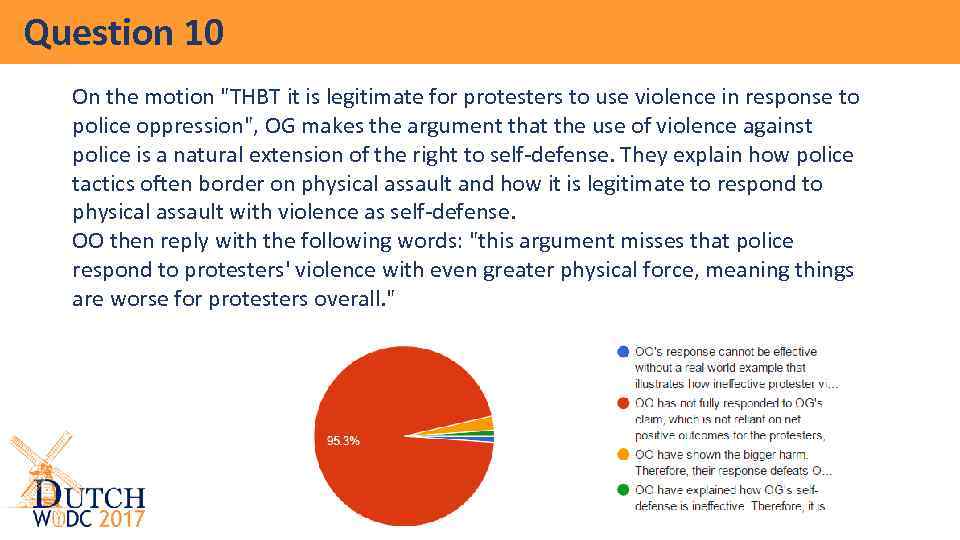
Question 10 On the motion "THBT it is legitimate for protesters to use violence in response to police oppression", OG makes the argument that the use of violence against police is a natural extension of the right to self-defense. They explain how police tactics often border on physical assault and how it is legitimate to respond to physical assault with violence as self-defense. OO then reply with the following words: "this argument misses that police respond to protesters' violence with even greater physical force, meaning things are worse for protesters overall. "
Question 11 "There will be more cases of violence even after the conflict ends and they will be worse. Religious sites and symbols are one of the only things that push for moral actions, especially when the people are already under a lot of stress and in a bad place. The religious symbols are what connects people together and to their past. Moreover, religious leaders and symbols are almost always a force against the worst types of violence. By hurting them, it becomes harder to get people to be good and less violent. That's why things will be much worse even after the conflict is over. “ "This policy is going to aggravate bloodshed and relapses in post conflict societies. In fractured post-war societies, the sources of traditional moral authority are often the doctrine and the institution of the church. In destroying the symbols that are holding a fragile and torn people together, the same symbols that are sustaining the traditional identities: You're undermining those moral restrictions on human behavior. This is particularly pernicious because the most abhorrent atrocities are almost universally opposed by the creed and moral authority of the church. Thus, relapses of horrid violence are more plausible and more atrocious. "
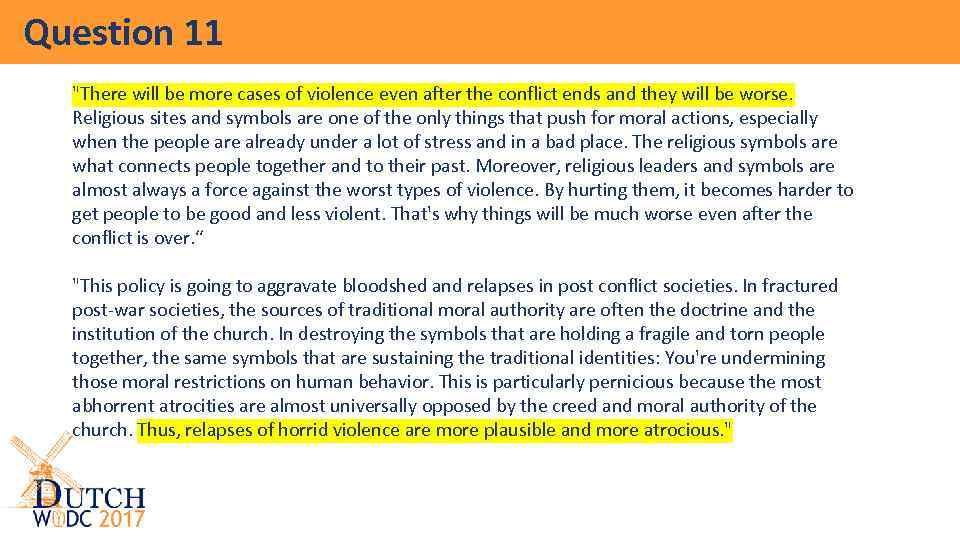
Question 11 "There will be more cases of violence even after the conflict ends and they will be worse. Religious sites and symbols are one of the only things that push for moral actions, especially when the people are already under a lot of stress and in a bad place. The religious symbols are what connects people together and to their past. Moreover, religious leaders and symbols are almost always a force against the worst types of violence. By hurting them, it becomes harder to get people to be good and less violent. That's why things will be much worse even after the conflict is over. “ "This policy is going to aggravate bloodshed and relapses in post conflict societies. In fractured post-war societies, the sources of traditional moral authority are often the doctrine and the institution of the church. In destroying the symbols that are holding a fragile and torn people together, the same symbols that are sustaining the traditional identities: You're undermining those moral restrictions on human behavior. This is particularly pernicious because the most abhorrent atrocities are almost universally opposed by the creed and moral authority of the church. Thus, relapses of horrid violence are more plausible and more atrocious. "
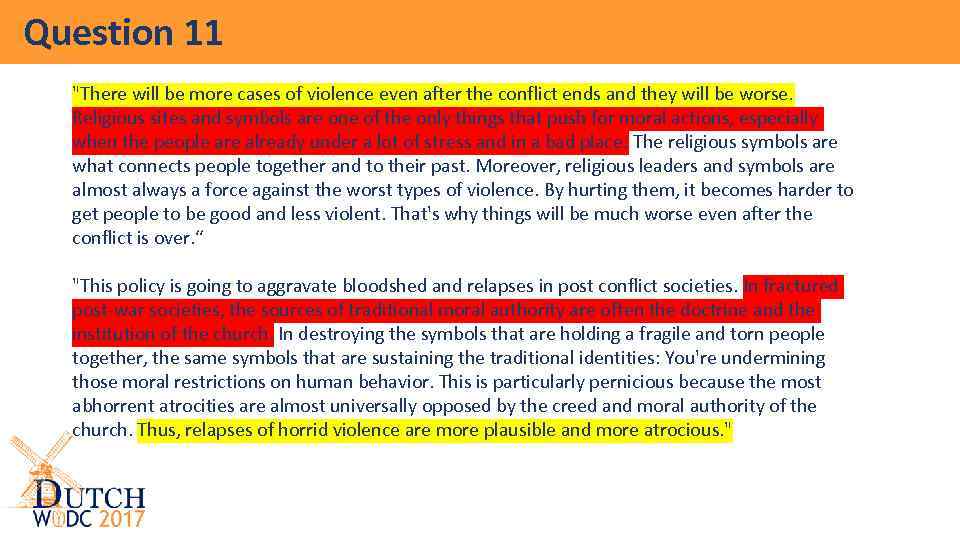
Question 11 "There will be more cases of violence even after the conflict ends and they will be worse. Religious sites and symbols are one of the only things that push for moral actions, especially when the people are already under a lot of stress and in a bad place. The religious symbols are what connects people together and to their past. Moreover, religious leaders and symbols are almost always a force against the worst types of violence. By hurting them, it becomes harder to get people to be good and less violent. That's why things will be much worse even after the conflict is over. “ "This policy is going to aggravate bloodshed and relapses in post conflict societies. In fractured post-war societies, the sources of traditional moral authority are often the doctrine and the institution of the church. In destroying the symbols that are holding a fragile and torn people together, the same symbols that are sustaining the traditional identities: You're undermining those moral restrictions on human behavior. This is particularly pernicious because the most abhorrent atrocities are almost universally opposed by the creed and moral authority of the church. Thus, relapses of horrid violence are more plausible and more atrocious. "
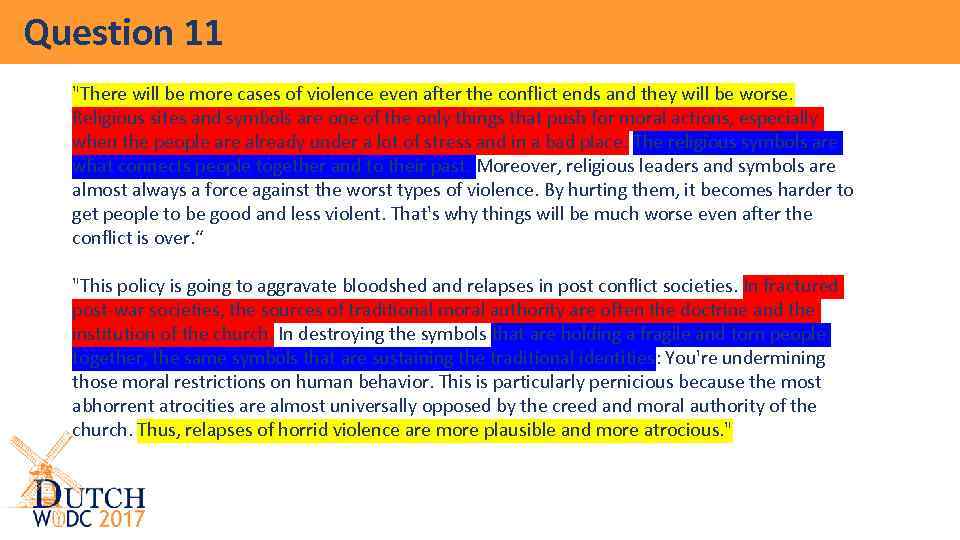
Question 11 "There will be more cases of violence even after the conflict ends and they will be worse. Religious sites and symbols are one of the only things that push for moral actions, especially when the people are already under a lot of stress and in a bad place. The religious symbols are what connects people together and to their past. Moreover, religious leaders and symbols are almost always a force against the worst types of violence. By hurting them, it becomes harder to get people to be good and less violent. That's why things will be much worse even after the conflict is over. “ "This policy is going to aggravate bloodshed and relapses in post conflict societies. In fractured post-war societies, the sources of traditional moral authority are often the doctrine and the institution of the church. In destroying the symbols that are holding a fragile and torn people together, the same symbols that are sustaining the traditional identities: You're undermining those moral restrictions on human behavior. This is particularly pernicious because the most abhorrent atrocities are almost universally opposed by the creed and moral authority of the church. Thus, relapses of horrid violence are more plausible and more atrocious. "
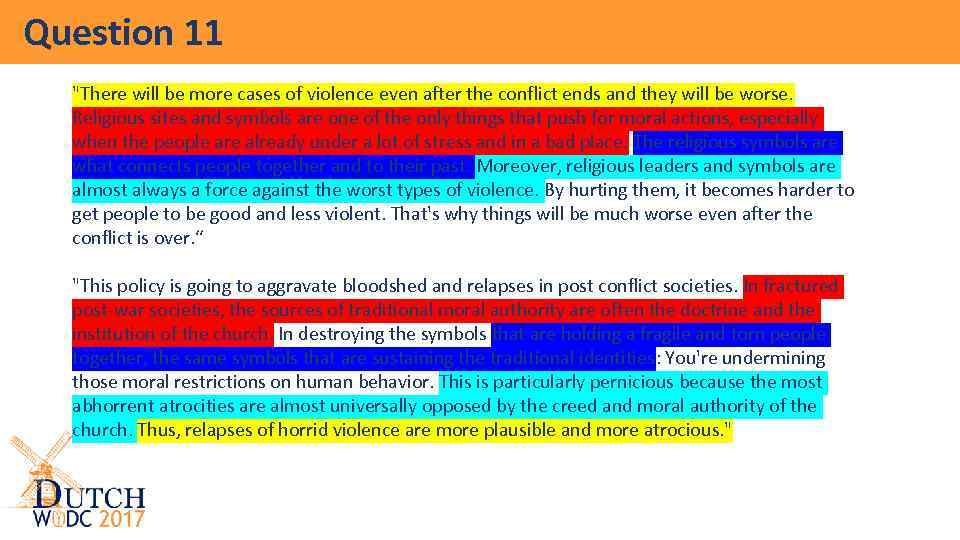
Question 11 "There will be more cases of violence even after the conflict ends and they will be worse. Religious sites and symbols are one of the only things that push for moral actions, especially when the people are already under a lot of stress and in a bad place. The religious symbols are what connects people together and to their past. Moreover, religious leaders and symbols are almost always a force against the worst types of violence. By hurting them, it becomes harder to get people to be good and less violent. That's why things will be much worse even after the conflict is over. “ "This policy is going to aggravate bloodshed and relapses in post conflict societies. In fractured post-war societies, the sources of traditional moral authority are often the doctrine and the institution of the church. In destroying the symbols that are holding a fragile and torn people together, the same symbols that are sustaining the traditional identities: You're undermining those moral restrictions on human behavior. This is particularly pernicious because the most abhorrent atrocities are almost universally opposed by the creed and moral authority of the church. Thus, relapses of horrid violence are more plausible and more atrocious. "
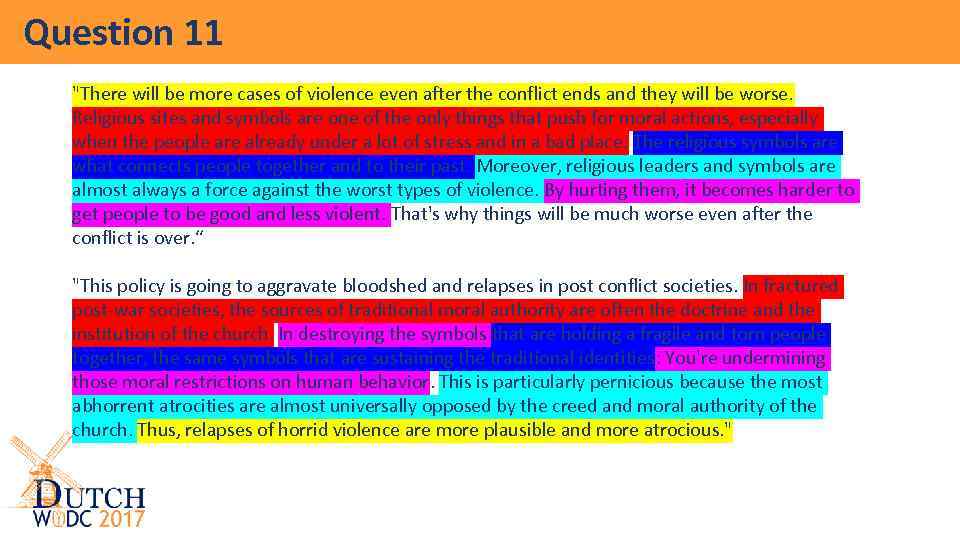
Question 11 "There will be more cases of violence even after the conflict ends and they will be worse. Religious sites and symbols are one of the only things that push for moral actions, especially when the people are already under a lot of stress and in a bad place. The religious symbols are what connects people together and to their past. Moreover, religious leaders and symbols are almost always a force against the worst types of violence. By hurting them, it becomes harder to get people to be good and less violent. That's why things will be much worse even after the conflict is over. “ "This policy is going to aggravate bloodshed and relapses in post conflict societies. In fractured post-war societies, the sources of traditional moral authority are often the doctrine and the institution of the church. In destroying the symbols that are holding a fragile and torn people together, the same symbols that are sustaining the traditional identities: You're undermining those moral restrictions on human behavior. This is particularly pernicious because the most abhorrent atrocities are almost universally opposed by the creed and moral authority of the church. Thus, relapses of horrid violence are more plausible and more atrocious. "
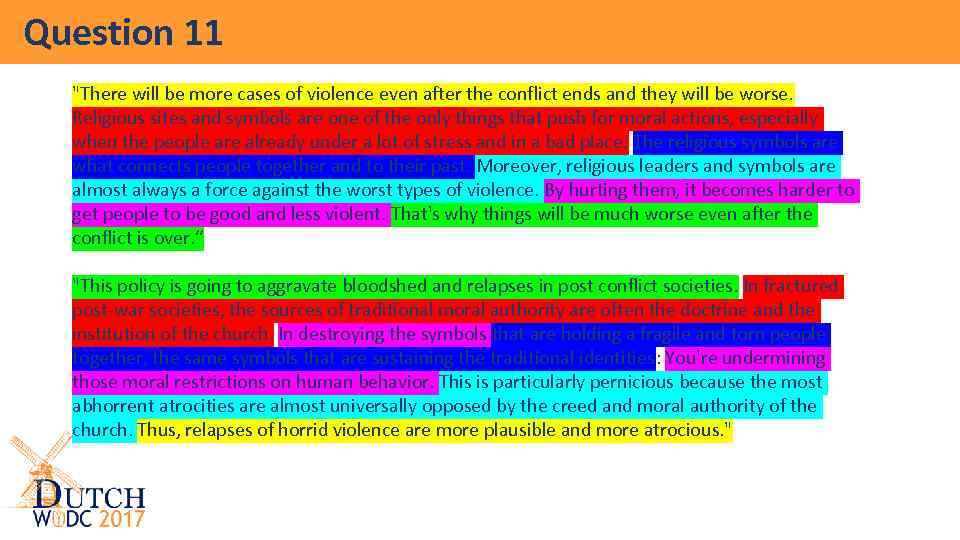
Question 11 "There will be more cases of violence even after the conflict ends and they will be worse. Religious sites and symbols are one of the only things that push for moral actions, especially when the people are already under a lot of stress and in a bad place. The religious symbols are what connects people together and to their past. Moreover, religious leaders and symbols are almost always a force against the worst types of violence. By hurting them, it becomes harder to get people to be good and less violent. That's why things will be much worse even after the conflict is over. “ "This policy is going to aggravate bloodshed and relapses in post conflict societies. In fractured post-war societies, the sources of traditional moral authority are often the doctrine and the institution of the church. In destroying the symbols that are holding a fragile and torn people together, the same symbols that are sustaining the traditional identities: You're undermining those moral restrictions on human behavior. This is particularly pernicious because the most abhorrent atrocities are almost universally opposed by the creed and moral authority of the church. Thus, relapses of horrid violence are more plausible and more atrocious. "
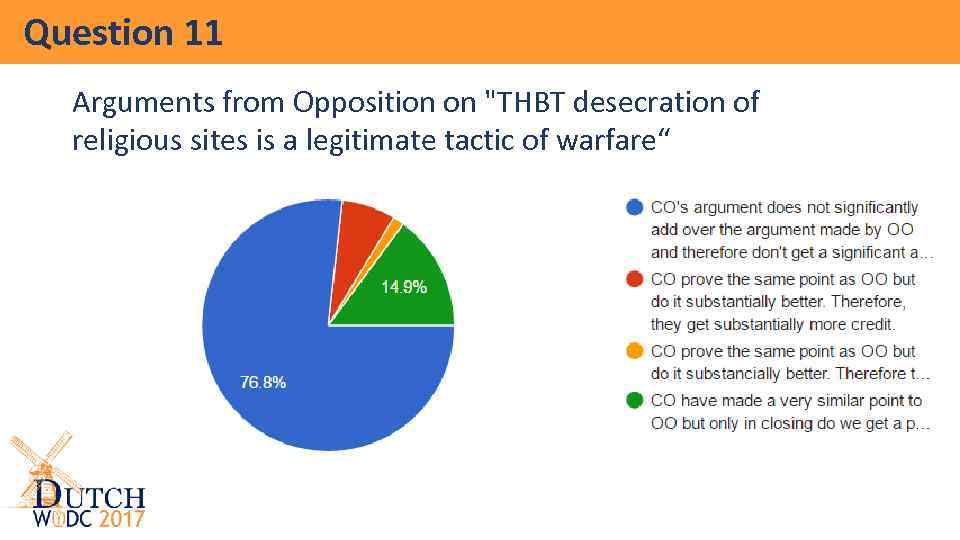
Question 11 Arguments from Opposition on "THBT desecration of religious sites is a legitimate tactic of warfare“
 Скачать презентацию Your CA s CA Team Briefing
Dutch-WUDC-CA-Team-Briefing.pptx