


 Скачать презентацию Young People s Health in an International Context The
476b8db7cb43f0ac82ccf9f4a8aa440d.ppt
- Количество слайдов: 64
 Young People’s Health in an International Context The Health Behaviour in School-Aged Children (HBSC): WHO Collaborative Cross-National Study Candace Currie HBSC PI for Scotland & HBSC International Coordinator Antony Morgan HBSC PI for England & Head of HBSC International Policy Development Group
 Gaining a perspective on young people’s health in the UK: evidence from HBSC n Comparative analysis : how does the health of young people in the UK compare to those of other countries in the Europe and North America n Trends over time: how has health of young people in the UK changed over last two decades n Health inequalities: how does health vary according to gender and socioeconomic status n Implications for improving young people’s health in UK: examples of good practice and policy
 What is HBSC? n An international study conducted in member countries in WHO European Region, USA and Canada n Initiated in 1983 in 3 countries in Northern Europe interested in gathering comparative data on young people’s health in social context
 HBSC study ‘short history’ shortly after its initiation designated as WHO collaborative study; new members began to join n First cross-national survey in five countries in 1983/4 followed by second in 1985/6; thereafter survey every four years n now 43 participating countries n HBSC international network of >270 researchers n
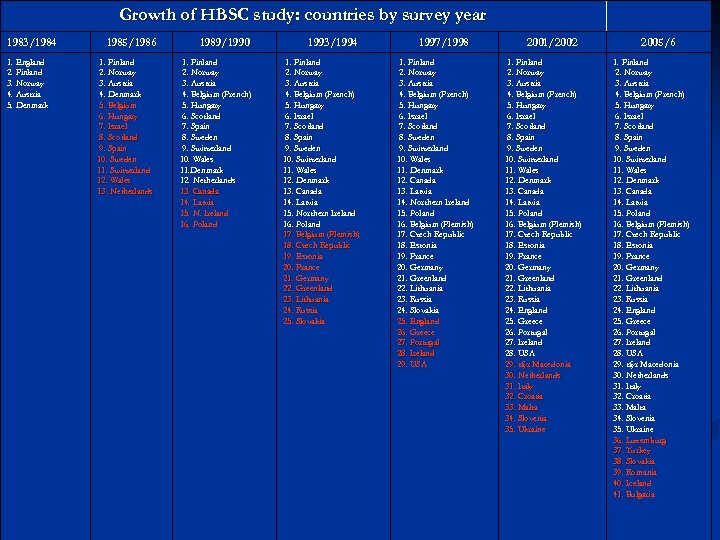 Growth of HBSC study: countries by survey year 1983/1984 1. England 2. Finland 3. Norway 4. Austria 5. Denmark 1985/1986 1. Finland 2. Norway 3. Austria 4. Denmark 5. Belgium 6. Hungary 7. Israel 8. Scotland 9. Spain 10. Sweden 11. Switzerland 12. Wales 13. Netherlands 1989/1990 1993/1994 1. Finland 2. Norway 3. Austria 4. Belgium (French) 5. Hungary 6. Scotland 7. Spain 8. Sweden 9. Switzerland 10. Wales 11. Denmark 12. Netherlands 13. Canada 14. Latvia 15. N. Ireland 16. Poland 1. Finland 2. Norway 3. Austria 4. Belgium (French) 5. Hungary 6. Israel 7. Scotland 8. Spain 9. Sweden 10. Switzerland 11. Wales 12. Denmark 13. Canada 14. Latvia 15. Northern Ireland 16. Poland 17. Belgium (Flemish) 18. Czech Republic 19. Estonia 20. France 21. Germany 22. Greenland 23. Lithuania 24. Russia 25. Slovakia 1997/1998 1. Finland 2. Norway 3. Austria 4. Belgium (French) 5. Hungary 6. Israel 7. Scotland 8. Sweden 9. Switzerland 10. Wales 11. Denmark 12. Canada 13. Latvia 14. Northern Ireland 15. Poland 16. Belgium (Flemish) 17. Czech Republic 18. Estonia 19. France 20. Germany 21. Greenland 22. Lithuania 23. Russia 24. Slovakia 25. England 26. Greece 27. Portugal 28. Ireland 29. USA 2001/2002 1. Finland 2. Norway 3. Austria 4. Belgium (French) 5. Hungary 6. Israel 7. Scotland 8. Spain 9. Sweden 10. Switzerland 11. Wales 12. Denmark 13. Canada 14. Latvia 15. Poland 16. Belgium (Flemish) 17. Czech Republic 18. Estonia 19. France 20. Germany 21. Greenland 22. Lithuania 23. Russia 24. England 25. Greece 26. Portugal 27. Ireland 28. USA 29. tfyr Macedonia 30. Netherlands 31. Italy 32. Croatia 33. Malta 34. Slovenia 35. Ukraine 2005/6 1. Finland 2. Norway 3. Austria 4. Belgium (French) 5. Hungary 6. Israel 7. Scotland 8. Spain 9. Sweden 10. Switzerland 11. Wales 12. Denmark 13. Canada 14. Latvia 15. Poland 16. Belgium (Flemish) 17. Czech Republic 18. Estonia 19. France 20. Germany 21. Greenland 22. Lithuania 23. Russia 24. England 25. Greece 26. Portugal 27. Ireland 28. USA 29. tfyr Macedonia 30. Netherlands 31. Italy 32. Croatia 33. Malta 34. Slovenia 35. Ukraine 36. Luxemburg 37. Turkey 38. Slovakia 39. Romania 40. Iceland 41. Bulgaria
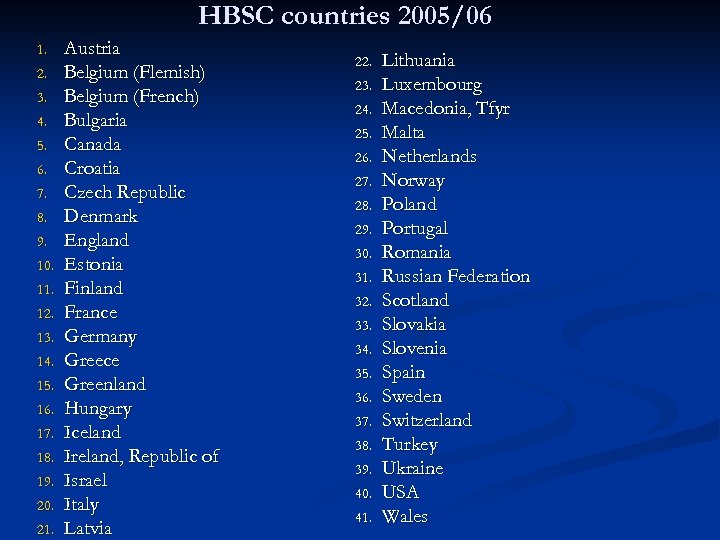 HBSC countries 2005/06 1. 2. 3. 4. 5. 6. 7. 8. 9. 10. 11. 12. 13. 14. 15. 16. 17. 18. 19. 20. 21. Austria Belgium (Flemish) Belgium (French) Bulgaria Canada Croatia Czech Republic Denmark England Estonia Finland France Germany Greece Greenland Hungary Iceland Ireland, Republic of Israel Italy Latvia 22. 23. 24. 25. 26. 27. 28. 29. 30. 31. 32. 33. 34. 35. 36. 37. 38. 39. 40. 41. Lithuania Luxembourg Macedonia, Tfyr Malta Netherlands Norway Poland Portugal Romania Russian Federation Scotland Slovakia Slovenia Spain Sweden Switzerland Turkey Ukraine USA Wales
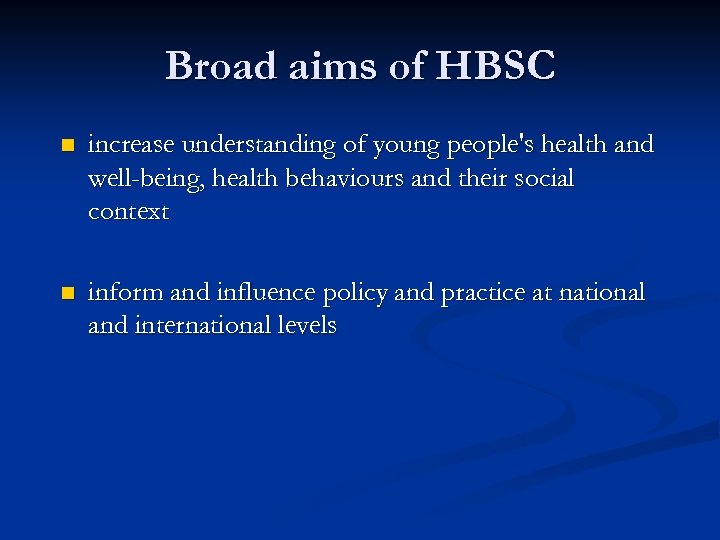 Broad aims of HBSC n increase understanding of young people's health and well-being, health behaviours and their social context n inform and influence policy and practice at national and international levels
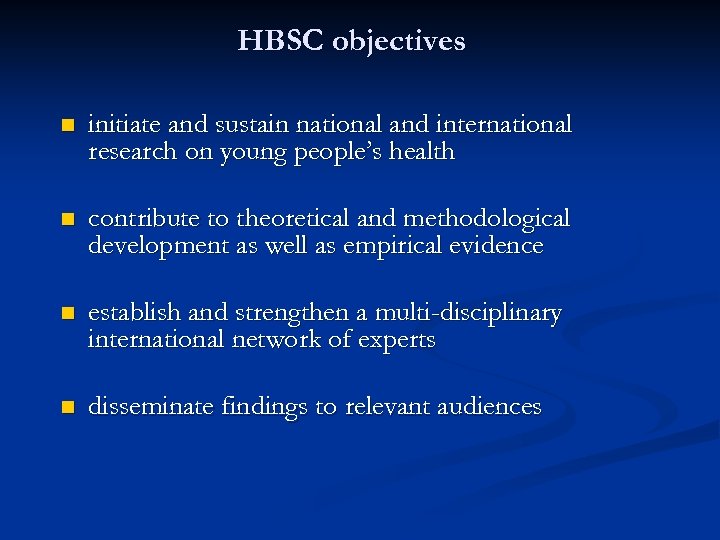 HBSC objectives n initiate and sustain national and international research on young people’s health n contribute to theoretical and methodological development as well as empirical evidence n establish and strengthen a multi-disciplinary international network of experts n disseminate findings to relevant audiences
 HBSC network collaboration National teams collaborate on all aspects of international study through their membership of the HBSC network n n Design of survey instrument and protocol Development of survey methodology Data analysis Publication and dissemination
 HBSC in UK n Scotland Wales joined the study in the mid 1980 s and England in 1998; N Ireland participated in surveys 1990, 1994 and 1998 n HBSC International Coordinating Centre based at Child and Adolescent Health Research Unit (CAHRU), University of Edinburgh since 1995
 Survey method School –based, pupil self complete, teacher or researcher administered n Three age groups with mean age 11. 5, 13. 5 and 15. 5 years n National surveys conducted at time of year to obtain correct mean ages n Sample size: 1, 550 per age group n Every 4 years n
 Health and behaviour n n n n n Perceived health, well-being and life satisfaction Smoking, drinking and cannabis use Physical activity and sedentary behaviour Eating and dieting Body image Height and weight Sexual behaviour Bullying and fighting Injuries
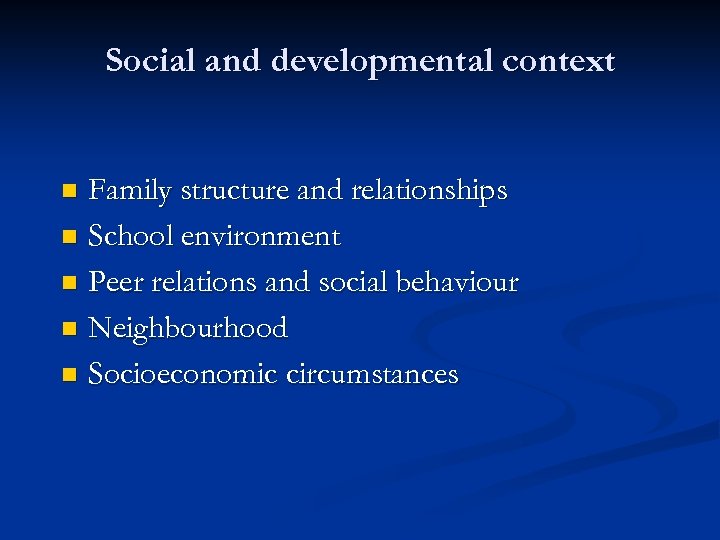 Social and developmental context Family structure and relationships n School environment n Peer relations and social behaviour n Neighbourhood n Socioeconomic circumstances n
 Highlighting key health issues in the UK n look at comparative analysis, trends over time and health inequalities n focus on various aspects of young people’s health of policy concern: substance use, physical activity, BMI and body image, healthy eating, well-being n present examples of dissemination to policy and practice
 Comparative analysis Alcohol use
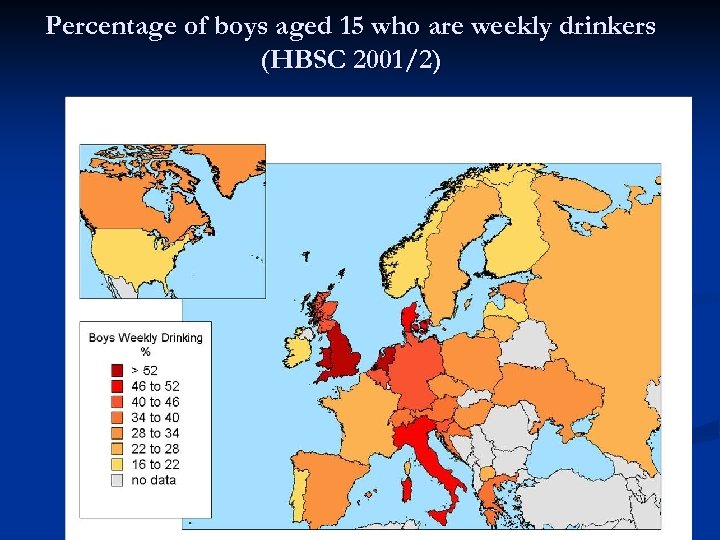 Percentage of boys aged 15 who are weekly drinkers (HBSC 2001/2)
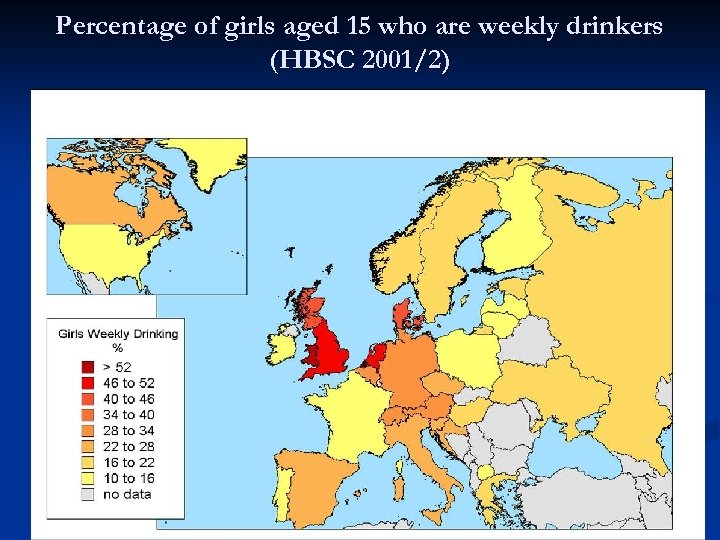 Percentage of girls aged 15 who are weekly drinkers (HBSC 2001/2)
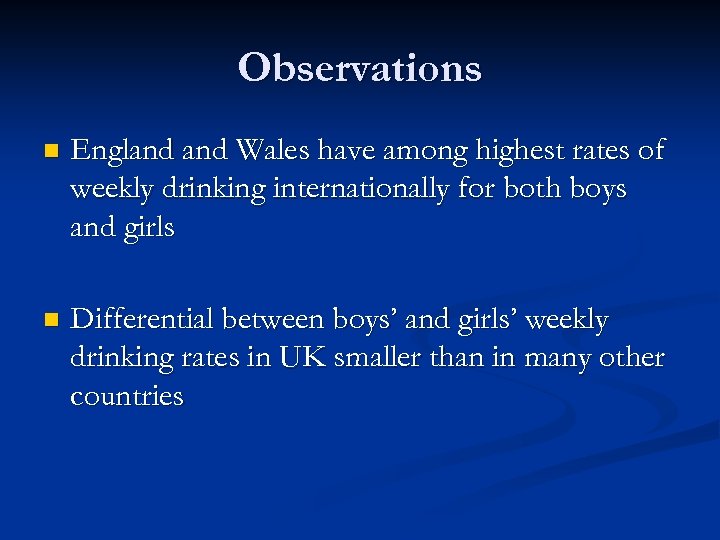 Observations n England Wales have among highest rates of weekly drinking internationally for both boys and girls n Differential between boys’ and girls’ weekly drinking rates in UK smaller than in many other countries
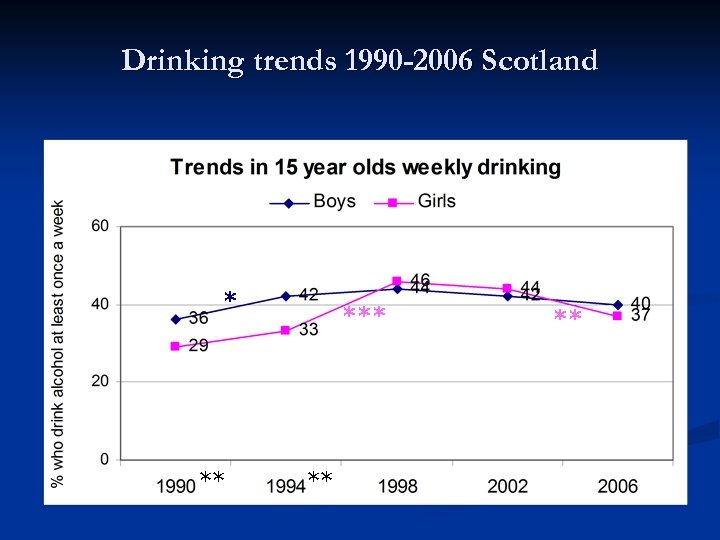 Drinking trends 1990 -2006 Scotland * * ** ** **
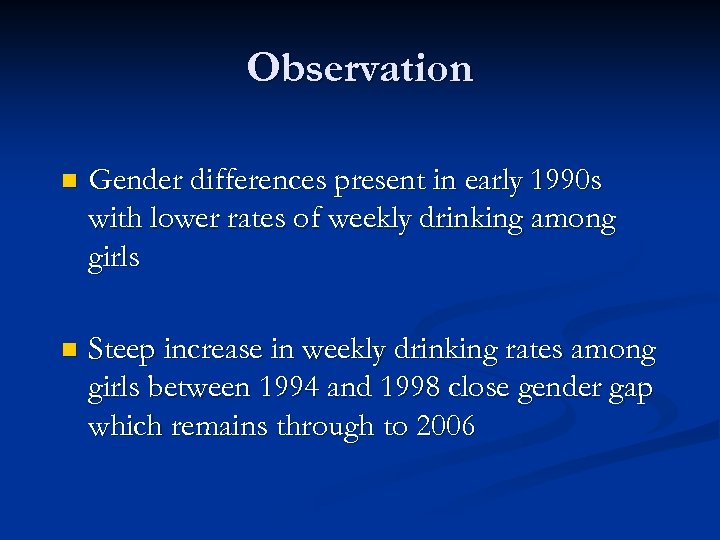 Observation n Gender differences present in early 1990 s with lower rates of weekly drinking among girls n Steep increase in weekly drinking rates among girls between 1994 and 1998 close gender gap which remains through to 2006
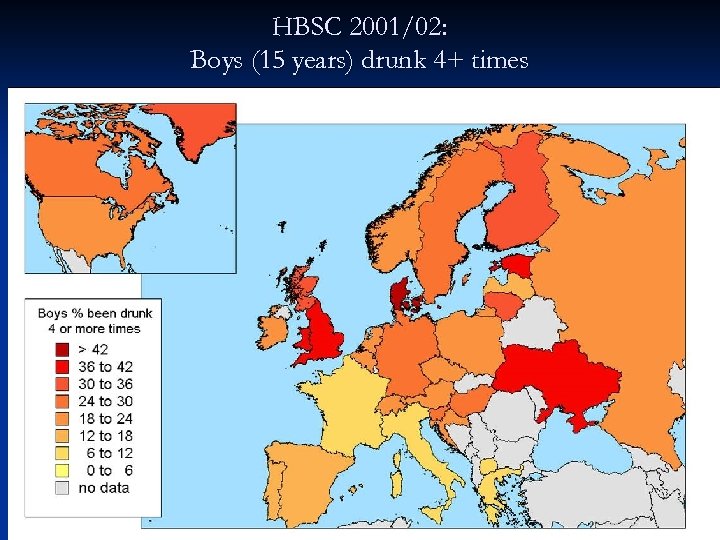 HBSC 2001/02: Boys (15 years) drunk 4+ times
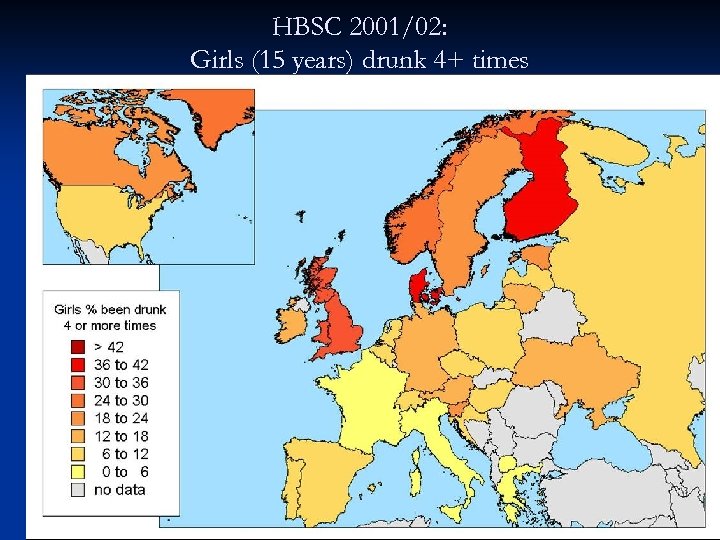 HBSC 2001/02: Girls (15 years) drunk 4+ times
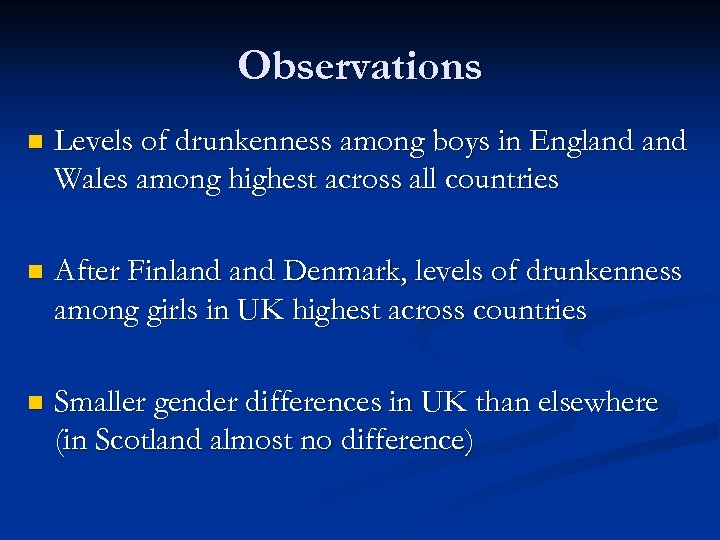 Observations n Levels of drunkenness among boys in England Wales among highest across all countries n After Finland Denmark, levels of drunkenness among girls in UK highest across countries n Smaller gender differences in UK than elsewhere (in Scotland almost no difference)
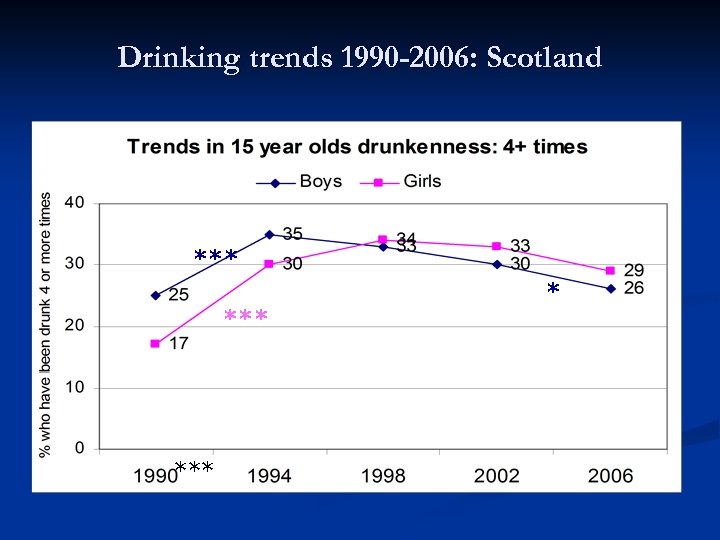 Drinking trends 1990 -2006: Scotland *** *** *
 Observation n Large gender difference present in 1990 disappear as girls’ drunkenness rates rise more steeply than boys n Gender gap closes by 1998 and remains through to 2006
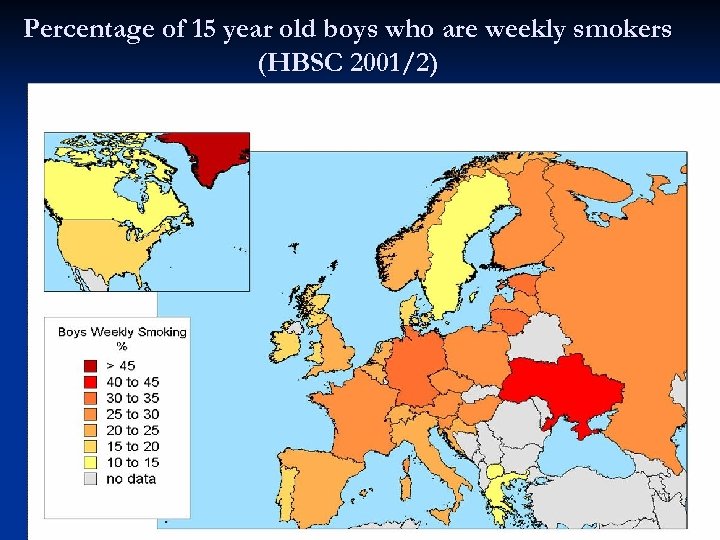 Percentage of 15 year old boys who are weekly smokers (HBSC 2001/2)
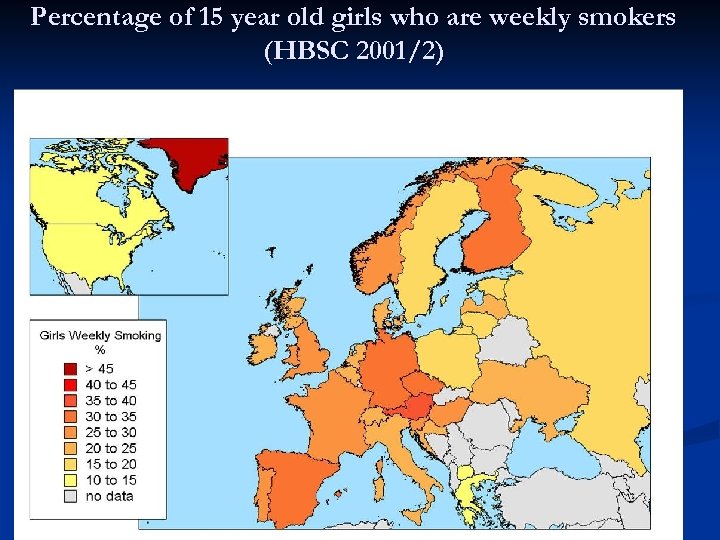 Percentage of 15 year old girls who are weekly smokers (HBSC 2001/2)
 Observations n Much lower rates of smoking are found in the US and Canada n Scotland Wales have lower rates of weekly smoking among boys than in England n There is a pattern in western Europe of higher rates of weekly smoking among girls than boys
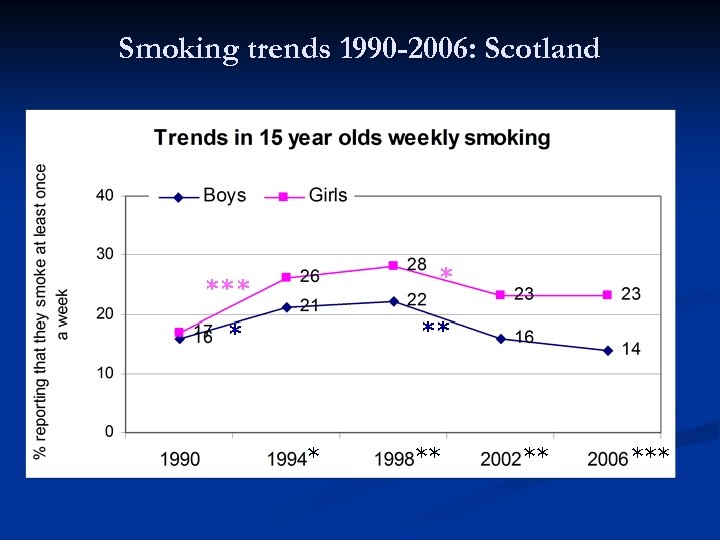 Smoking trends 1990 -2006: Scotland * * ** *** * * ** ***
 Observation n Whereas in 1990 boys and girls had equal rates of weekly smoking, increasing rates are accompanied by a growing gender gap n From 1994 to 2006 girls’ rates are significantly higher than boys
 Observations: gender trends in substance use n Over the sixteen years studied there is rather little change in the substance use habits of boys with similar levels at the beginning and end of this 16 year period n This is in contrast to very substantial changes in girls’ substance use behaviour which has increased considerably over this time period
 Health improvement implications n Are there different risk and protective factors operating in relation to substance use among boys and girls – how have these changed across the last two decades? n What social and developmental factors need to be addressed in any prevention/ intervention programmes n What lessons can we learn from other countries? E. g. Norway (smoking), France (drinking)
 ‘Global’ gender patterns
 Global gender patterns n Suggest powerful biological and cultural determinants of behaviour and well-being n These may be more difficult to intervene on? n Should we expect equality in health outcomes? Have any countries achieved it?
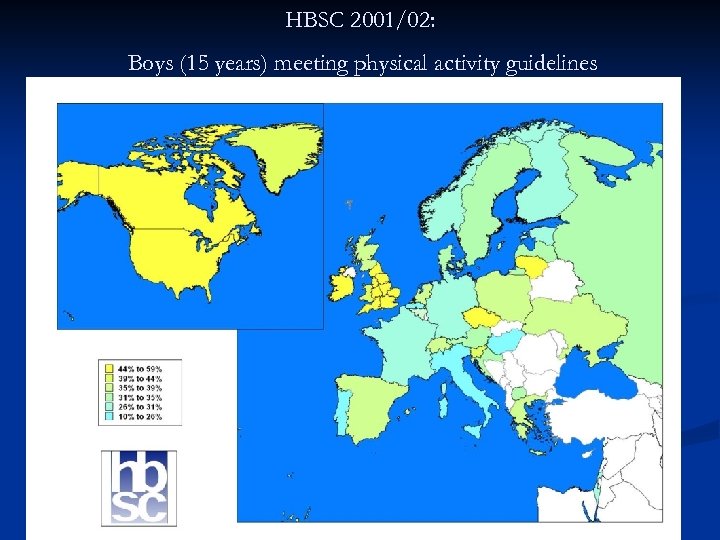 HBSC 2001/02: Boys (15 years) meeting physical activity guidelines
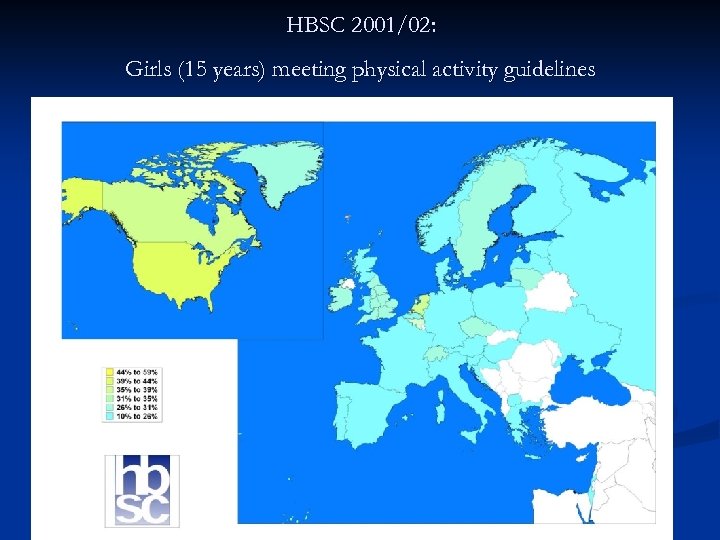 HBSC 2001/02: Girls (15 years) meeting physical activity guidelines
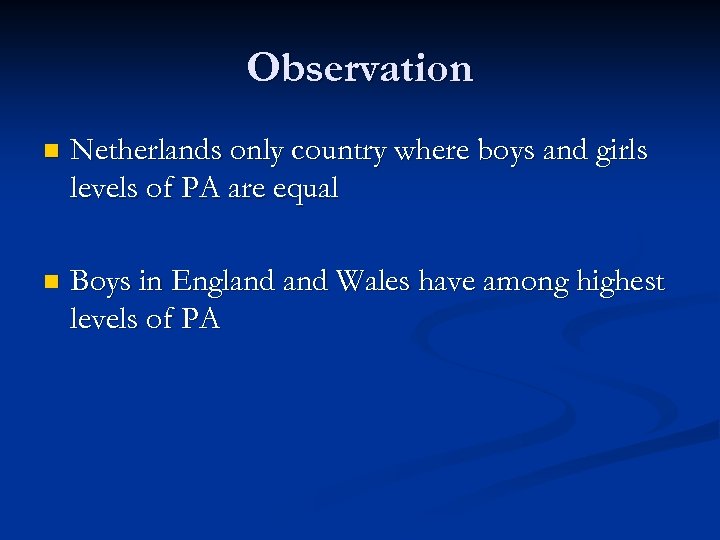 Observation n Netherlands only country where boys and girls levels of PA are equal n Boys in England Wales have among highest levels of PA
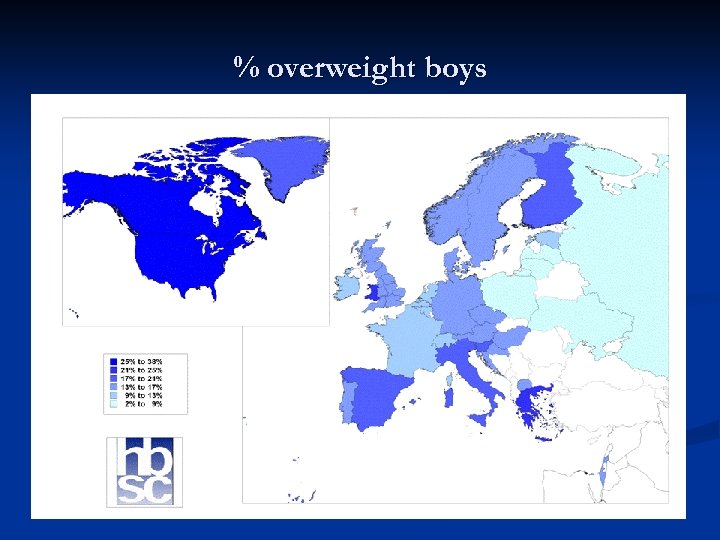 % overweight boys
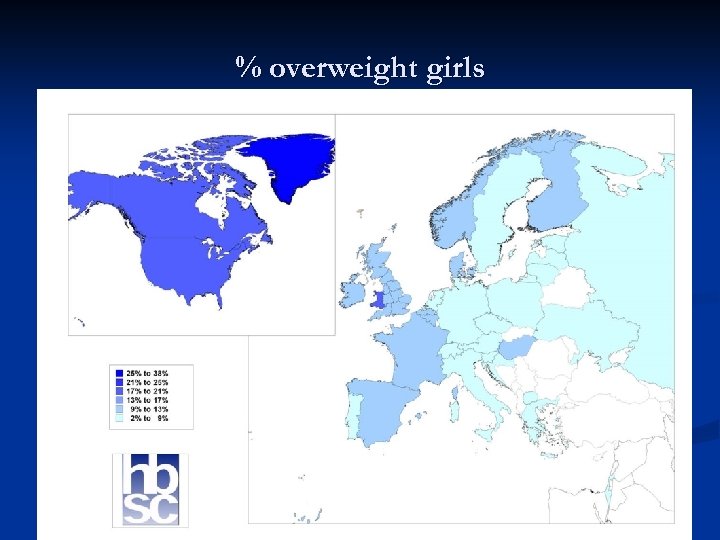 % overweight girls
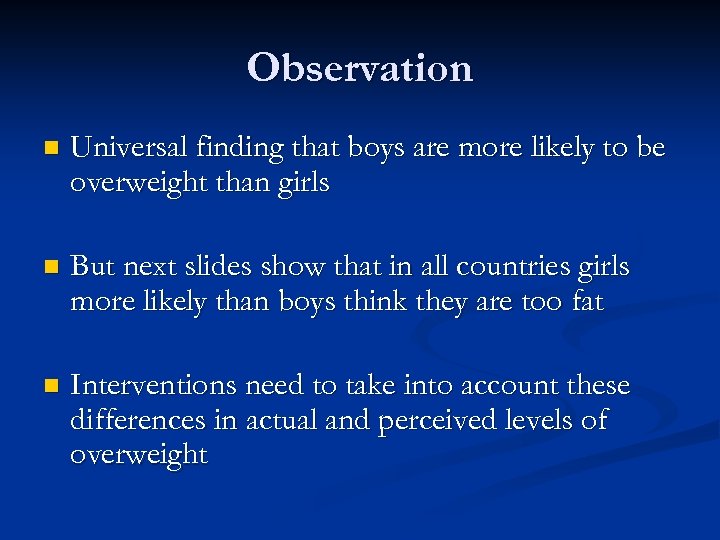 Observation n Universal finding that boys are more likely to be overweight than girls n But next slides show that in all countries girls more likely than boys think they are too fat n Interventions need to take into account these differences in actual and perceived levels of overweight
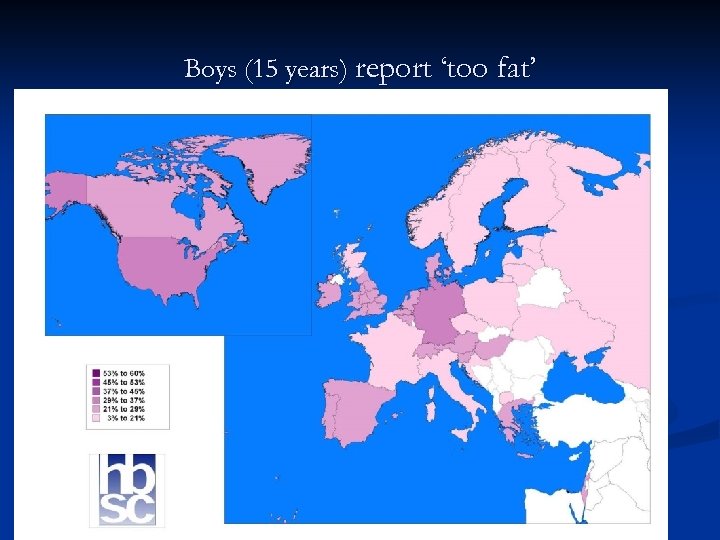 Boys (15 years) report ‘too fat’
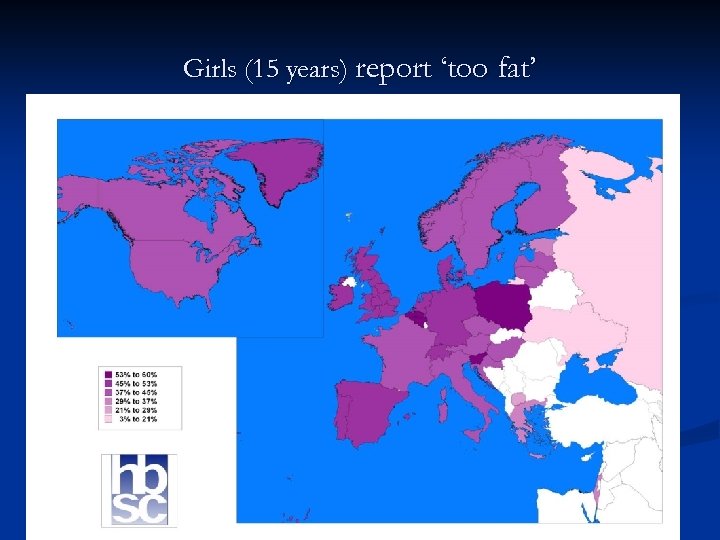 Girls (15 years) report ‘too fat’
 Socioeconomic inequalities Family affluence and adolescent health
 Scotland * England Wales
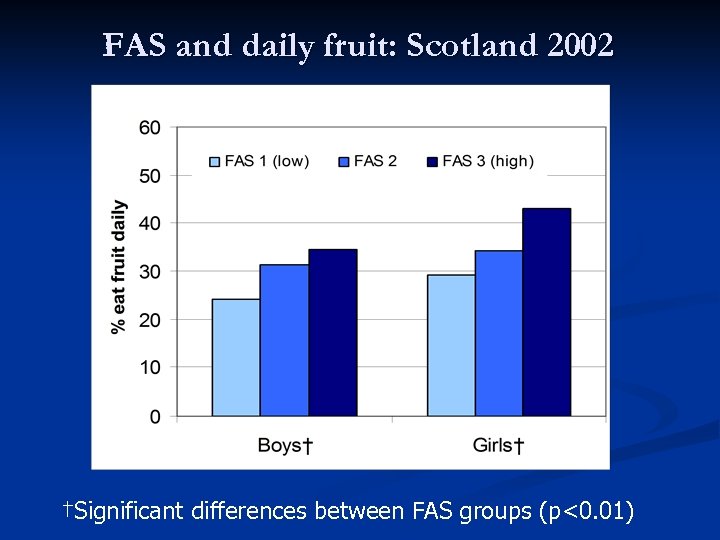 FAS and daily fruit: Scotland 2002 43% 34% 35% 31% 24% 29% †Significant differences between FAS groups (p<0. 01)
 Daily fruit and FAS n FAS gradients in around half countries especially in Eastern Europe n higher percent of daily fruit consumption among young people with higher FAS
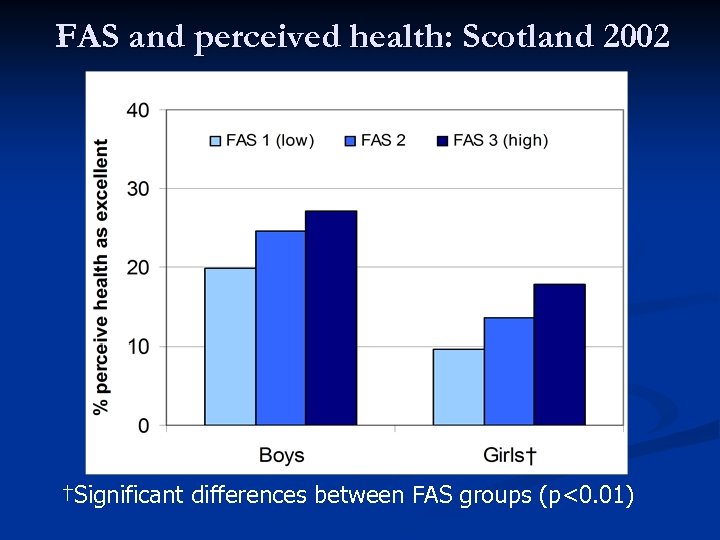 FAS and perceived health: Scotland 2002 27% 25% 20% 18% 14% 10% †Significant differences between FAS groups (p<0. 01)
 FAS and perceived health FAS gradients found in almost every country with better health among young people with higher FAS
 Dissemination Scientific n Policy n Practice n
 Data analysis and scientific publications n Complete list of all HBSC papers on: www. hbsc. org/publications/journal-articles. html n Every scientific article logged on international publications database and tracked on-line through progress from planned to accepted n 165 published papers; 127 currently in prep/ submitted
 Dissemination to policy and practice n National Reports, Briefing Papers and Fact Sheets published by UK teams n International Reports (published by WHO) ‘Young People’s Health in Context’ (2004); ‘Inequalities in Young People’s Health’ (2008) n WHO/ HBSC Forum initiated in 2006
 WHO/HBSC Forum n Collaboration between HBSC study and its partner the WHO Regional Office for Europe n Purpose is to support Member States in integrating measures to address socieconomic determinants of health into policies and interventions to promote young people’s health
 WHO/HBSC Forum 2006 Forum: socioeconomic determinants of healthy eating habits and physical activity levels among adolescents 2007 Forum: social cohesion and mental health among young people in Europe
 Risk versus protective factors n The more we provide young people with opportunities to experience and accumulate the positive effects of protective factors, the more likely they are to achieve and sustain mental well being in later life

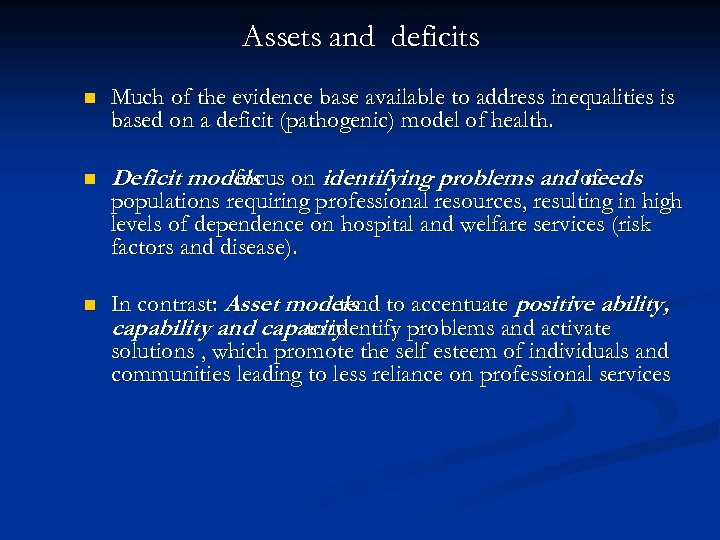 Assets and deficits n Much of the evidence base available to address inequalities is based on a deficit (pathogenic) model of health. n Deficit models on identifying problems and of focus needs n In contrast: Asset models to accentuate positive ability, tend capability and capacity to identify problems and activate solutions , which promote the self esteem of individuals and communities leading to less reliance on professional services populations requiring professional resources, resulting in high levels of dependence on hospital and welfare services (risk factors and disease).
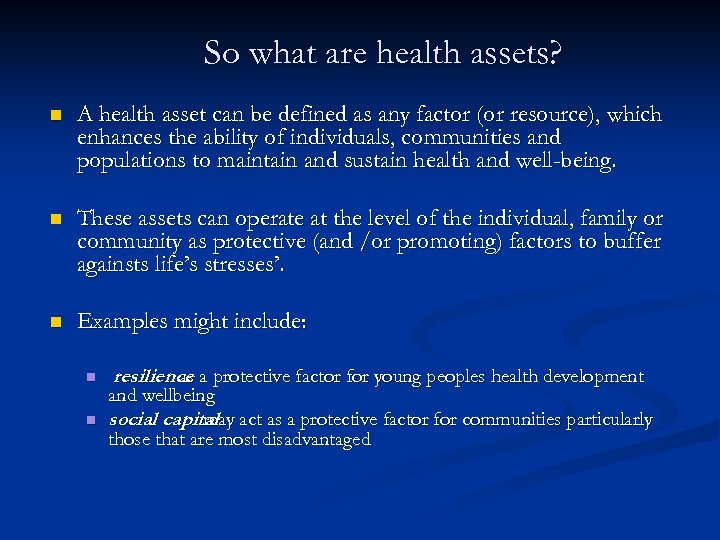 So what are health assets? n A health asset can be defined as any factor (or resource), which enhances the ability of individuals, communities and populations to maintain and sustain health and well-being. n These assets can operate at the level of the individual, family or community as protective (and /or promoting) factors to buffer againsts life’s stresses’. n Examples might include: n n resilience a protective factor for young peoples health development as and wellbeing social capital act as a protective factor for communities particularly may those that are most disadvantaged
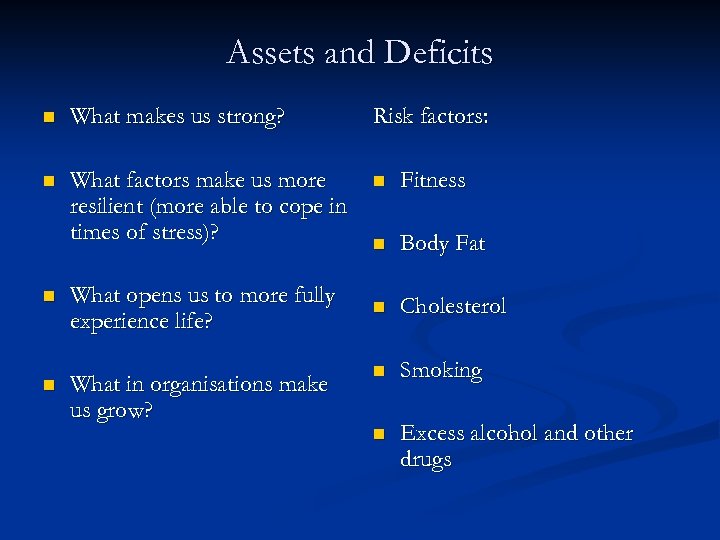 Assets and Deficits n What makes us strong? Risk factors: n What factors make us more resilient (more able to cope in times of stress)? n Fitness n Body Fat n Cholesterol n Smoking n Excess alcohol and other drugs n What opens us to more fully experience life? n What in organisations make us grow?
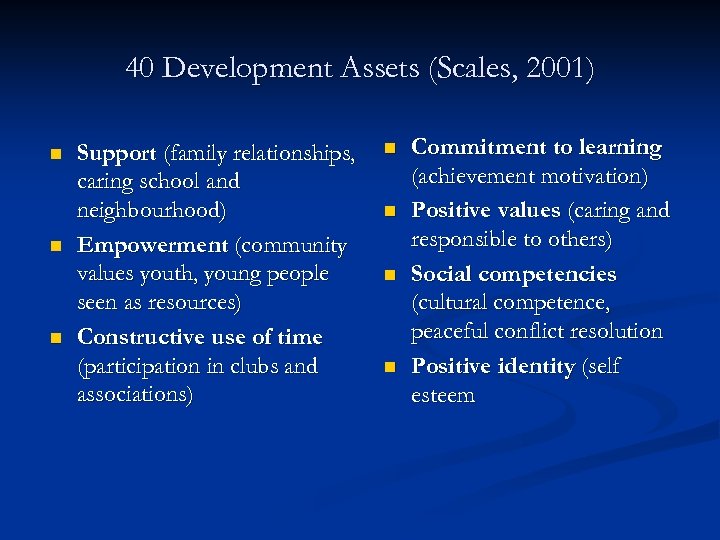 40 Development Assets (Scales, 2001) n n n Support (family relationships, caring school and neighbourhood) Empowerment (community values youth, young people seen as resources) Constructive use of time (participation in clubs and associations) n n Commitment to learning (achievement motivation) Positive values (caring and responsible to others) Social competencies (cultural competence, peaceful conflict resolution Positive identity (self esteem
 Other examples of health assets: resilience n Resilient young people possess problem solving skills, social competence and a sense of purpose. n Resilience can support young people to rise above poor circumstances and succeed.
 Other examples of health assets: social cohesion n Social cohesion a key health asset operating at the community level. n Young people living in cohesive communities have an increased sense of belonging and have an active role in decision making with their communities. n Young people living in cohesive communities where they feel safe are more likely to report higher levels of health and mental well being.
 Building an evidence base for young people’s mental well being: an asset model. n Are some assets (protective factors) more important than others? n What are the cumulative effects of multiple assets on young people's mental well being? n How do different social and cultural impact on the benefits of these assets? ‘Redressing the balance between asset and deficit models for research’
 An asset model for research, policy and practice n Focus on positive health promoting and protecting factors for the creation of health. n Emphasis on a life course approach to understanding the most important key assets at each life stage. n Passionate about the need to involve individuals, communities and populations all aspects of health development process in n Many of the key assets for creating health lie within the social context of people’s life'stherefore has the potential to and contribute to reducing health inequalities
 Acknowledgements HBSC International Research Network Scottish HBSC team: University of Edinburgh HBSC International Coordinating Centre: University of Edinburgh HBSC International Databank: University of Bergen www. hbsc. org