


 Скачать презентацию Young Migrants Social Family Support and their Health in
6b9f616cd5edb8e11067c59c0edac545.ppt
- Количество слайдов: 1
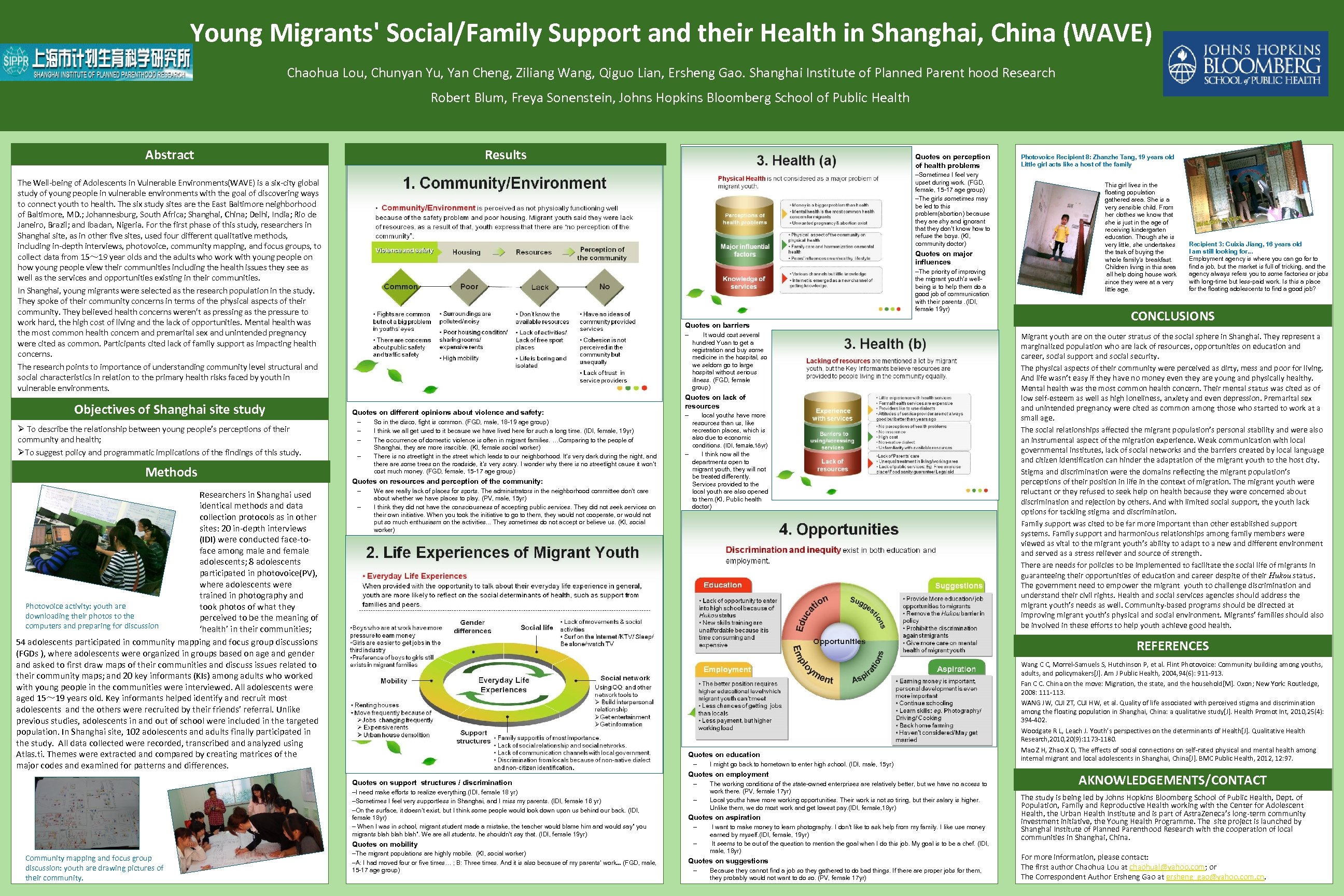 Young Migrants' Social/Family Support and their Health in Shanghai, China (WAVE) Chaohua Lou, Chunyan Yu, Yan Cheng, Ziliang Wang, Qiguo Lian, Ersheng Gao. Shanghai Institute of Planned Parent hood Research Robert Blum, Freya Sonenstein, Johns Hopkins Bloomberg School of Public Health Abstract Results –Sometimes I feel very upset during work. (FGD, female, 15 -17 age group) –The girls sometimes may be led to this problem(abortion) because they are shy and ignorant that they don’t know how to refuse the boys. (KI, community doctor) The Well-being of Adolescents in Vulnerable Environments(WAVE) is a six-city global study of young people in vulnerable environments with the goal of discovering ways to connect youth to health. The six study sites are the East Baltimore neighborhood of Baltimore, MD. ; Johannesburg, South Africa; Shanghai, China; Delhi, India; Rio de Janeiro, Brazil; and Ibadan, Nigeria. For the first phase of this study, researchers in Shanghai site, as in other five sites, used four different qualitative methods, including in-depth interviews, photovoice, community mapping, and focus groups, to collect data from 15~ 19 year olds and the adults who work with young people on how young people view their communities including the health issues they see as well as the services and opportunities existing in their communities. In Shanghai, young migrants were selected as the research population in the study. They spoke of their community concerns in terms of the physical aspects of their community. They believed health concerns weren't as pressing as the pressure to work hard, the high cost of living and the lack of opportunities. Mental health was the most common health concern and premarital sex and unintended pregnancy were cited as common. Participants cited lack of family support as impacting health concerns. The research points to importance of understanding community level structural and social characteristics in relation to the primary health risks faced by youth in vulnerable environments. Objectives of Shanghai site study Ø To describe the relationship between young people’s perceptions of their community and health; ØTo suggest policy and programmatic implications of the findings of this study. Methods Researchers in Shanghai used identical methods and data collection protocols as in other sites: 20 in-depth interviews (IDI) were conducted face-toface among male and female adolescents; 8 adolescents participated in photovoice(PV), where adolescents were trained in photography and Photovoice activity: youth are took photos of what they downloading their photos to the perceived to be the meaning of computers and preparing for discussion ‘health’ in their communities; 54 adolescents participated in community mapping and focus group discussions (FGDs ), where adolescents were organized in groups based on age and gender and asked to first draw maps of their communities and discuss issues related to their community maps; and 20 key informants (KIs) among adults who worked with young people in the communities were interviewed. All adolescents were aged 15~ 19 years old. Key informants helped identify and recruit most adolescents and the others were recruited by their friends’ referral. Unlike previous studies, adolescents in and out of school were included in the targeted population. In Shanghai site, 102 adolescents and adults finally participated in the study. All data collected were recorded, transcribed analyzed using Atlas. ti. Themes were extracted and compared by creating matrices of the major codes and examined for patterns and differences. Quotes on major influences –The priority of improving the migrant youth’s wellbeing is to help them do a good job of communication with their parents. (IDI, female 19 yr) Quotes on barriers – Quotes on different opinions about violence and safety: – – So in the disco, fight is common. (FGD, male, 18 -19 age group) I think we all get used to it because we have lived here for such a long time. (IDI, female, 19 yr) The occurrence of domestic violence is often in migrant families. …Comparing to the people of Shanghai, they are more irascible. (KI, female social worker) There is no streetlight in the street which leads to our neighborhood. It’s very dark during the night, and there are some trees on the roadside, it’s very scary. I wonder why there is no streetlight cause it won’t cost much money. (FGD, female, 15 -17 age group) Quotes on resources and perception of the community: – – We are really lack of places for sports. The administrators in the neighborhood committee don’t care about whether we have places to play. (PV, male, 15 yr) I think they did not have the consciousness of accepting public services. They did not seek services on their own initiative. When you took the initiative to go to them, they would not cooperate, or would not put so much enthusiasm on the activities. . . They sometimes do not accept or believe us. (KI, social worker) It would cost several hundred Yuan to get a registration and buy some medicine in the hospital, so we seldom go to large hospital without serious illness. (FGD, female group) Quotes on lack of resources – local youths have more resources than us, like recreation places, which is also due to economic conditions. (IDI, female, 18 yr) – I think now all the departments open to migrant youth, they will not be treated differently. Services provided to the local youth are also opened to them. (KI, Public health doctor) Photovoice Recipient 8: Zhanzhe Tang, 19 years old Little girl acts like a host of the family This girl lives in the floating population gathered area. She is a very sensible child. From her clothes we know that she is just in the age of receiving kindergarten education. Though she is very little, she undertakes the task of buying the whole family’s breakfast. Children living in this area all help doing house work since they were at a very little age. Recipient 3: Cuixia Jiang, 16 years old I am still looking for. . . Employment agency is where you can go for to find a job, but the market is full of tricking, and the agency always refers you to some factories or jobs with long-time but less-paid work. Is this a place for the floating adolescents to find a good job? CONCLUSIONS Migrant youth are on the outer stratus of the social sphere in Shanghai. They represent a marginalized population who are lack of resources, opportunities on education and career, social support and social security. The physical aspects of their community were perceived as dirty, mess and poor for living. And life wasn’t easy if they have no money even they are young and physically healthy. Mental health was the most common health concern. Their mental status was cited as of low self-esteem as well as high loneliness, anxiety and even depression. Premarital sex and unintended pregnancy were cited as common among those who started to work at a small age. The social relationships affected the migrant population’s personal stability and were also an instrumental aspect of the migration experience. Weak communication with local governmental institutes, lack of social networks and the barriers created by local language and citizen identification can hinder the adaptation of the migrant youth to the host city. Stigma and discrimination were the domains reflecting the migrant population’s perceptions of their position in life in the context of migration. The migrant youth were reluctant or they refused to seek help on health because they were concerned about discrimination and rejection by others. And with limited social support, the youth lack options for tackling stigma and discrimination. Family support was cited to be far more important than other established support systems. Family support and harmonious relationships among family members were viewed as vital to the migrant youth’s ability to adapt to a new and different environment and served as a stress reliever and source of strength. There are needs for policies to be implemented to facilitate the social life of migrants in guaranteeing their opportunities of education and career despite of their Hukou status. The government need to empower the migrant youth to challenge discrimination and understand their civil rights. Health and social services agencies should address the migrant youth’s needs as well. Community-based programs should be directed at improving migrant youth’s physical and social environment. Migrants’ families should also be involved in these efforts to help youth achieve good health. REFERENCES Quotes on education – I might go back to hometown to enter high school. (IDI, male, 15 yr) Quotes on employment Quotes on support structures / discrimination –I need make efforts to realize everything. (IDI, female 18 yr) –Sometimes I feel very supportless in Shanghai, and I miss my parents. (IDI, female 16 yr) –On the surface, it doesn’t exist, but I think some people would look down upon us behind our back. (IDI, female 18 yr) – When I was in school, migrant student made a mistake, the teacher would blame him and would say” you migrants blah”. We are all students, he shouldn’t say that. (IDI, female 19 yr) Quotes on mobility Community mapping and focus group discussion: youth are drawing pictures of their community. Quotes on perception of health problems –The migrant populations are highly mobile. (KI, social worker) –A: I had moved four or five times… ; B: Three times. And it is also because of my parents’ work… (FGD, male, 15 -17 age group) – – The working conditions of the state-owned enterprises are relatively better, but we have no access to work there. (PV, female 17 yr) Local youths have more working opportunities. Their work is not so tiring, but their salary is higher. Unlike them, we do most work and get lowest pay. (IDI, female, 18 yr) Quotes on aspiration – – I want to make money to learn photography. I don’t like to ask help from my family. I like use money earned by myself. (IDI, female, 19 yr) It seems to be out of the question to mention the goal when I do this job. My goal is to be a chef. (IDI, male, 18 yr) Quotes on suggestions – Because they cannot find a job so they gathered to do bad things. If there are proper jobs for them, they probably would not want to do so. (PV, female 17 yr) Wang C C, Morrel-Samuels S, Hutchinson P, et al. Flint Photovoice: Community building among youths, adults, and policymakers[J]. Am J Public Health, 2004, 94(6): 911 -913. Fan C C. China on the move: Migration, the state, and the household[M]. Oxon; New York: Routledge, 2008: 111 -113. WANG JW, CUI ZT, CUI HW, et al. Quality of life associated with perceived stigma and discrimination among the floating population in Shanghai, China: a qualitative study[J]. Health Promot Int, 2010, 25(4): 394 -402. Woodgate R L, Leach J. Youth’s perspectives on the determinants of Health[J]. Qualitative Health Research, 2010, 20(9): 1173 -1180. Mao Z H, Zhao X D, The effects of social connections on self-rated physical and mental health among internal migrant and local adolescents in Shanghai, China[J]. BMC Public Health, 2012, 12: 97. AKNOWLEDGEMENTS/CONTACT The study is being led by Johns Hopkins Bloomberg School of Public Health, Dept. of Population, Family and Reproductive Health working with the Center for Adolescent Health, the Urban Health Institute and is part of Astra. Zeneca’s long-term community investment initiative, the Young Health Programme. The site project is launched by Shanghai Institute of Planned Parenthood Research with the cooperation of local communities in Shanghai, China. For more information, please contact: The first author Chaohua Lou at chaohual@yahoo. com; or The Correspondent Author Ersheng Gao at ersheng_gao@yahoo. com. cn.