 Скачать презентацию You Can t Fool the Bladder Police Effective Use
c99d18dc0c9406c33c35832b272e9bd7.ppt
- Количество слайдов: 37



You Can’t Fool the “Bladder Police” Effective Use of Urine Drug Screening
Why Test? • Accountability • Create and maintain safe treatment environment • Compliance with licensing or policy
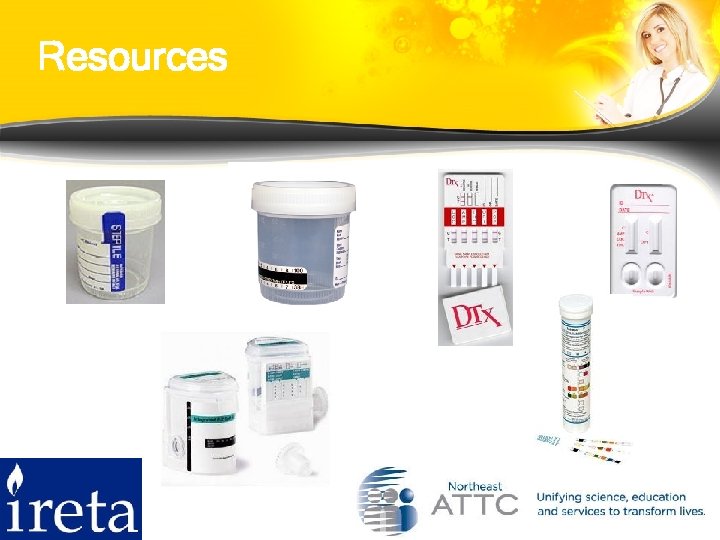
Collection • Supervised or unsupervised • When to collect • Staff training • Temperature monitored cups • Adulterant testing
In-house Testing • Cost • Staff training • Type of test kit • Staff issues • What to test for • Client privacy • When to test
Lab Testing • Prescription • Staff training • What to test for • Completing forms • When to test • Storage and pick up
Testing – How it Works • Drug Testing Systems Ø One Test Systems ü Use immunoassay (IA) to detect the presence of drugs and ü Are most often used for medical purposes in clinical and rehabilitation settings Ø Two Test Systems ü Commonly use immunoassay as an initial test followed by a more specific confirmatory test using a different technology and ü Are used for results requiring a high level of certainty John M. Mitchell Immunoassays as an Initial Test in Drug Testing. Center for Forensic Sciences
Testing – How it Works What is an Immunoassay? • An immunoassay is a biochemical test that measures the concentration of a substance in a liquid (a portion of a biological specimen) using the reaction of an antibody or antibodies to its antigen (drug) John M. Mitchell Immunoassays as an Initial Test in Drug Testing. Center for Forensic Sciences

Testing – How it Works What are Antibodies and Antigens? • Antibodies are a type of protein produced by the immune system in response to foreign substances (antigens) • Antibodies bind to the antigen responsible for their production John M. Mitchell Immunoassays as an Initial Test in Drug Testing. Center for Forensic Sciences
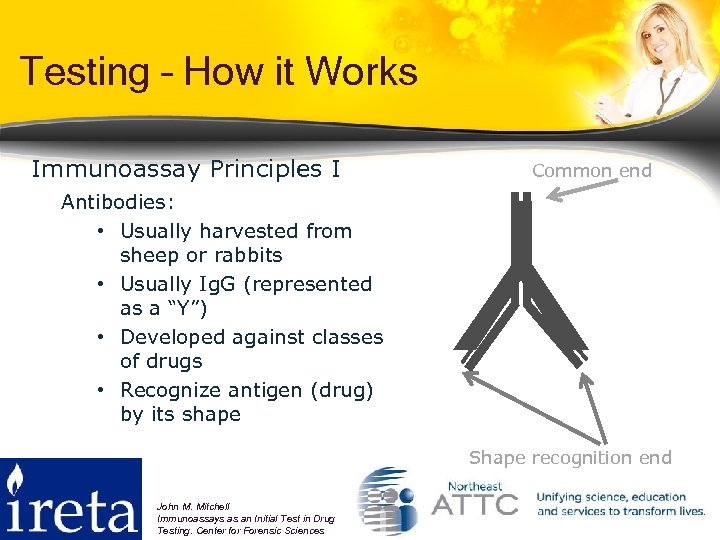
Testing – How it Works Antibodies: • Usually harvested from sheep or rabbits • Usually Ig. G (represented as a “Y”) • Developed against classes of drugs • Recognize antigen (drug) by its shape Y Immunoassay Principles I Common end Shape recognition end John M. Mitchell Immunoassays as an Initial Test in Drug Testing. Center for Forensic Sciences
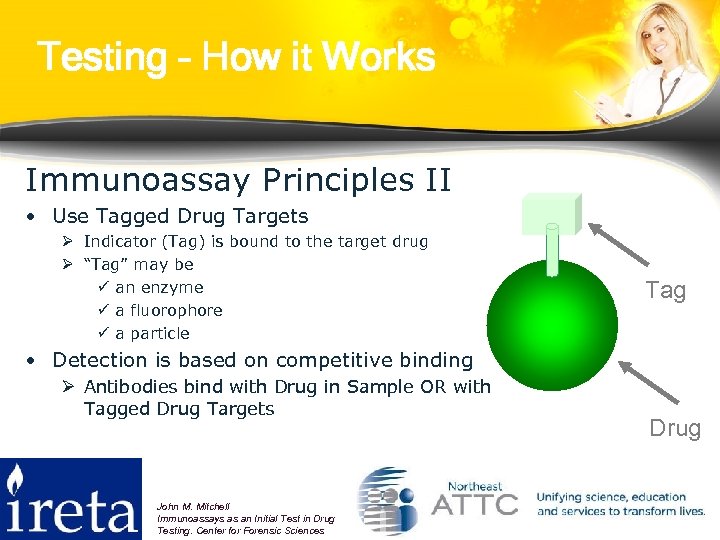
Testing – How it Works Immunoassay Principles II • Use Tagged Drug Targets Ø Indicator (Tag) is bound to the target drug Ø “Tag” may be ü an enzyme ü a fluorophore ü a particle “Tag” • Detection is based on competitive binding Ø Antibodies bind with Drug in Sample OR with Tagged Drug Targets John M. Mitchell Immunoassays as an Initial Test in Drug Testing. Center for Forensic Sciences Drug
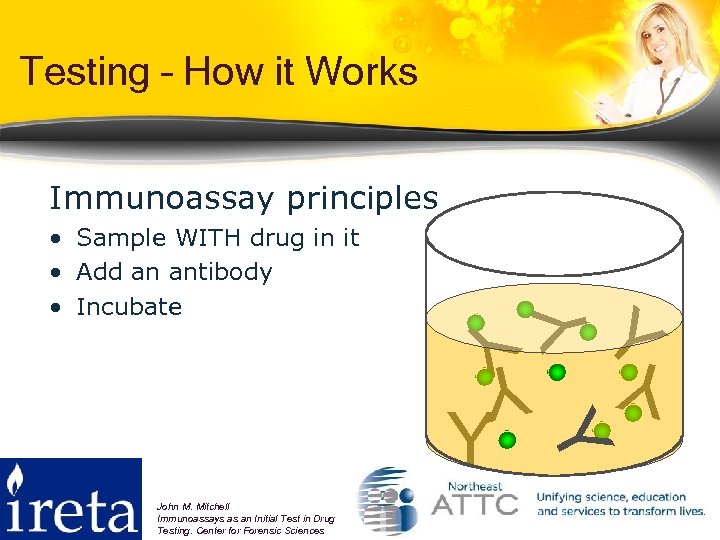
Testing – How it Works Immunoassay principles Y Y John M. Mitchell Immunoassays as an Initial Test in Drug Testing. Center for Forensic Sciences Y Y Y • Sample WITH drug in it • Add an antibody • Incubate
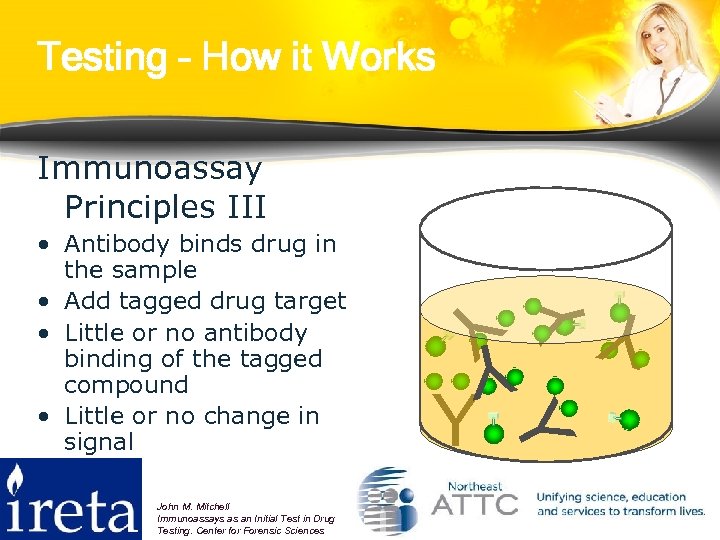
Testing – How it Works Y Y John M. Mitchell Immunoassays as an Initial Test in Drug Testing. Center for Forensic Sciences Y • Antibody binds drug in the sample • Add tagged drug target • Little or no antibody binding of the tagged compound • Little or no change in signal Y Immunoassay Principles III
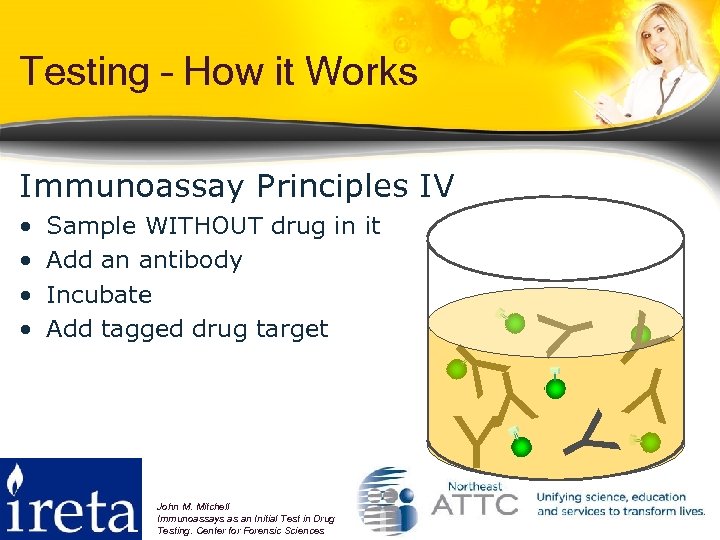
Testing – How it Works Immunoassay Principles IV Y Y John M. Mitchell Immunoassays as an Initial Test in Drug Testing. Center for Forensic Sciences Y Y Sample WITHOUT drug in it Add an antibody Incubate Add tagged drug target Y • •
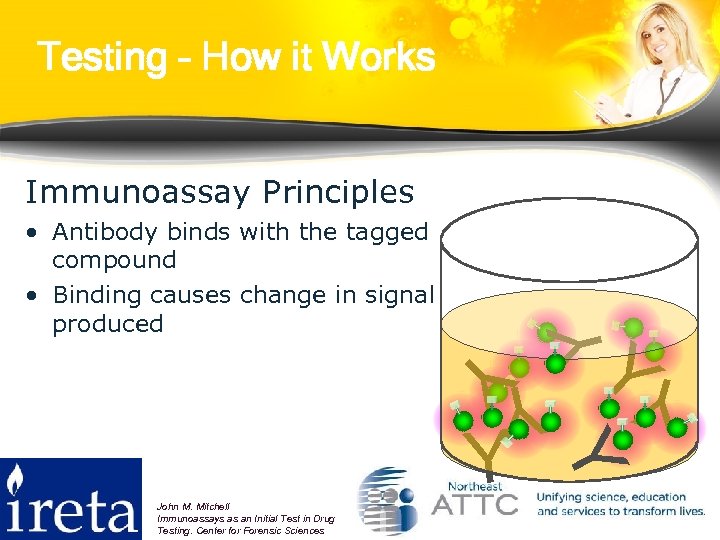
Testing – How it Works Immunoassay Principles Y Y Y John M. Mitchell Immunoassays as an Initial Test in Drug Testing. Center for Forensic Sciences Y Y • Antibody binds with the tagged compound • Binding causes change in signal produced
Testing – How it Works Testing with Immunoassays • Immunoassays are used to screen donor specimens for the possible presence of a drug or a class of drugs • These tests may be conducted on-site as part of the collection process or in a laboratory or other facility • On-site testing is normally conducted with a Point of Collection Test (POCT) device • Most testing is conducted in laboratories which have validated procedures and validated analytical instrumentation • Immunoassays allow some laboratories to test more than 10, 000 donor specimens a day John M. Mitchell Immunoassays as an Initial Test in Drug Testing. Center for Forensic Sciences
Testing – How it Works Immunoassay Specificity • Specificity is the affinity of an immunoassay for the target drug • Specificity is measured by cross reactivity: Ø the response exhibited when an immunoassay reacts with a compound other than the target drug • Specificity limits the conclusions that can be drawn from immunoassay results John M. Mitchell Immunoassays as an Initial Test in Drug Testing. Center for Forensic Sciences
Testing – How it Works Low Specificity • An immunoassay with low specificity will react with many antigens (drugs) with similar structure • Example: One Amphetamine immunoassay with a cutoff of 300 ng/m. L of D-Amphetamine gives a positive result with: Ø D, L-Amphetamine (300 ng/m. L), Phentermine (400 ng/m. L), Tranylcypromine (500 ng/m. L), Methamphetamine (1, 000 ng/m. L), Ephedrine (1, 000 ng/m. L), or Phenylpropanolamine (1, 000 ng/m. L) Ø Therefore, a positive result from this immunoassay test would not prove use of amphetamine John M. Mitchell Immunoassays as an Initial Test in Drug Testing. Center for Forensic Sciences
Tampering • Diluting • “Doping” • Substitution
Tampering • Diluting Ø Hyper saturating the body with fluids to dilute metabolites possibly below the 50 ng/m. L threshold, depending on your metabolism. ü AZO ü Certo ü Niacin ü QCarbo ü Vinegar ü XXtra Clean ü Fiber pills ü Quick Flush ü Ready Clean pills ü Terminator Gold ü Rapid Cleanse ü Clear Choice ü Detox Tea ü MC 1 ü Goldenseal ü Vale Triple Strength
Tampering • “Doping” Ø Adding different chemicals that defeat immunoglobulin/antigen binding ü ü ü ü Bleach (powdered) Water Ammonia Blood Draino Goldenseal Hydrogen Peroxide Lemon Juice ü Liquid Soap ü Mary Jane’s Super. Clean 13 ü Purifyit ü Sodium Nitrate ü Table Salt ü Vinegar ü Visine ü WD 40
Tampering • Substitution Ø Concealed container Ø Injection Ø Catheterization Ø Cigar containers/droppers
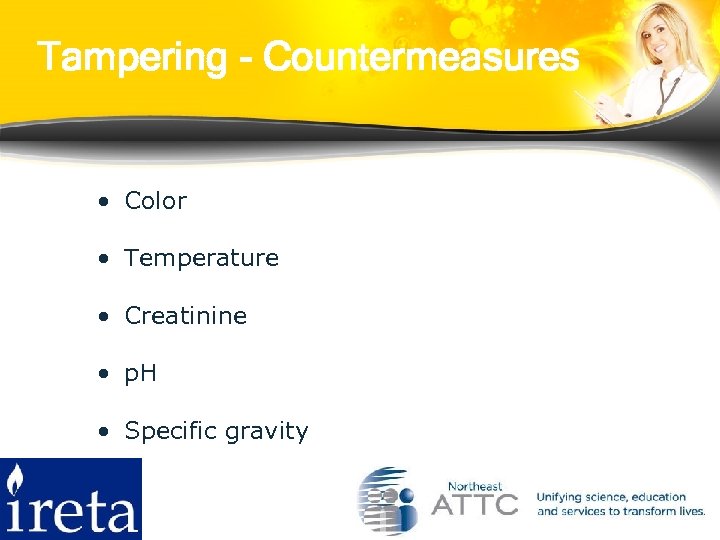
Tampering - Countermeasures • Color • Temperature • Creatinine • p. H • Specific gravity
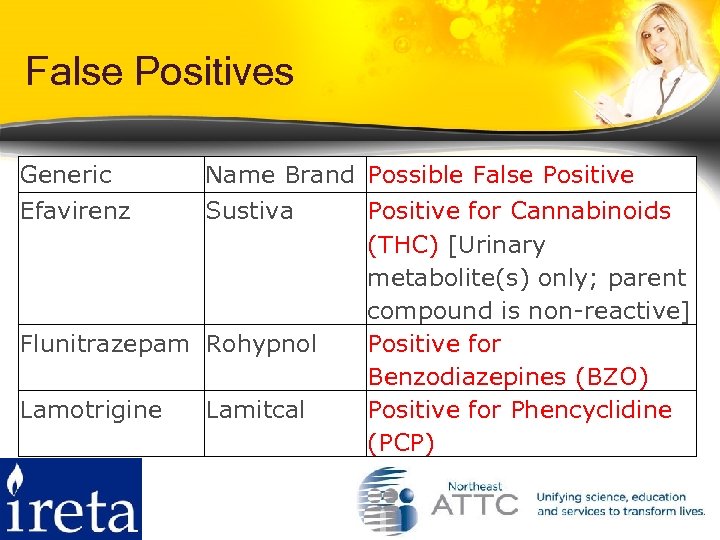
False Positives Generic Efavirenz Name Brand Possible False Positive Sustiva Positive for Cannabinoids (THC) [Urinary metabolite(s) only; parent compound is non-reactive] Flunitrazepam Rohypnol Positive for Benzodiazepines (BZO) Lamotrigine Lamitcal Positive for Phencyclidine (PCP)
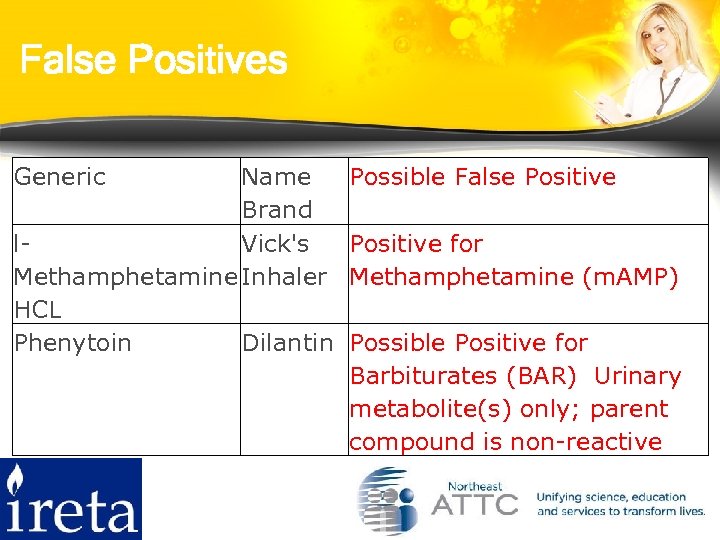
False Positives Generic Name Brand l. Vick's Methamphetamine Inhaler HCL Phenytoin Dilantin Possible False Positive for Methamphetamine (m. AMP) Possible Positive for Barbiturates (BAR) Urinary metabolite(s) only; parent compound is non-reactive
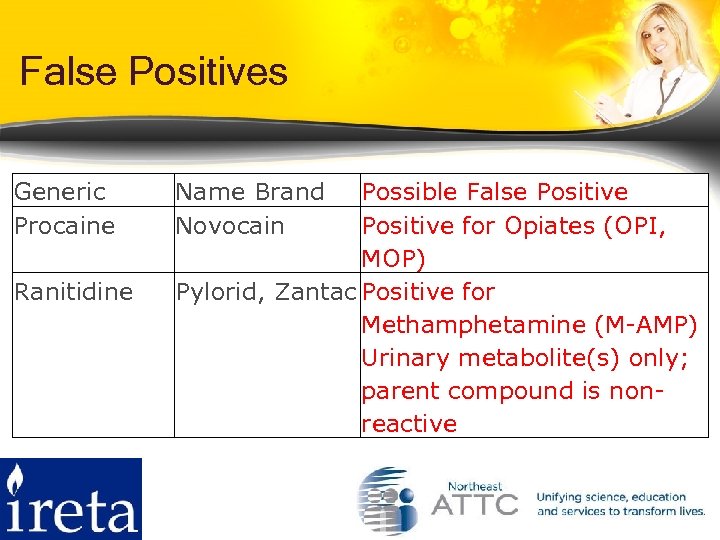
False Positives Generic Procaine Ranitidine Name Brand Novocain Possible False Positive for Opiates (OPI, MOP) Pylorid, Zantac Positive for Methamphetamine (M-AMP) Urinary metabolite(s) only; parent compound is nonreactive
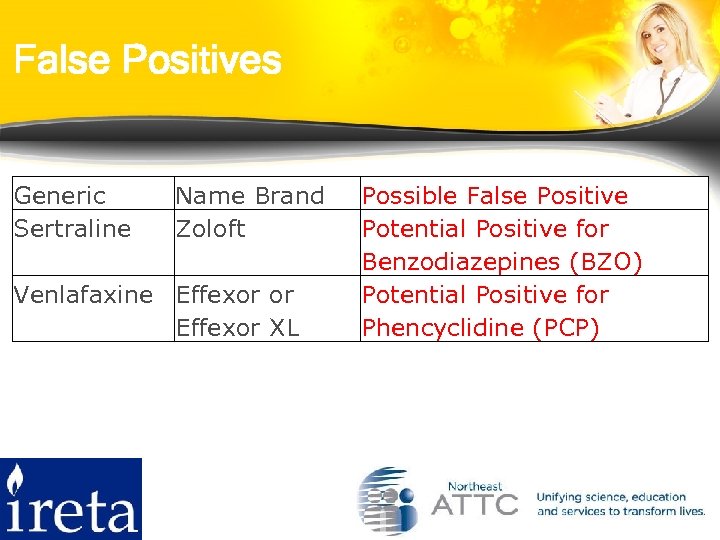
False Positives Generic Sertraline Name Brand Zoloft Venlafaxine Effexor or Effexor XL Possible False Positive Potential Positive for Benzodiazepines (BZO) Potential Positive for Phencyclidine (PCP)
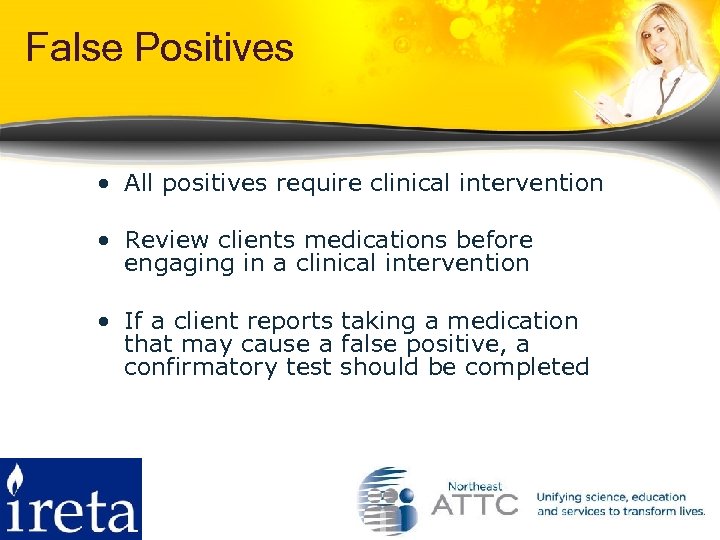
False Positives • All positives require clinical intervention • Review clients medications before engaging in a clinical intervention • If a client reports taking a medication that may cause a false positive, a confirmatory test should be completed
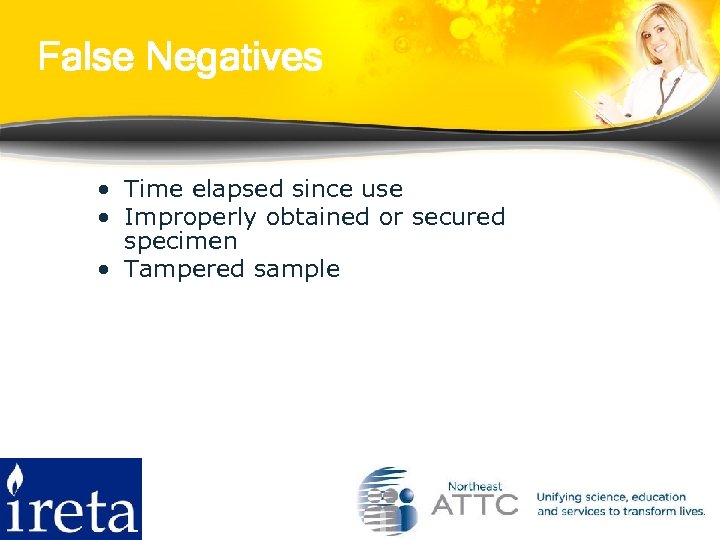
False Negatives • Time elapsed since use • Improperly obtained or secured specimen • Tampered sample
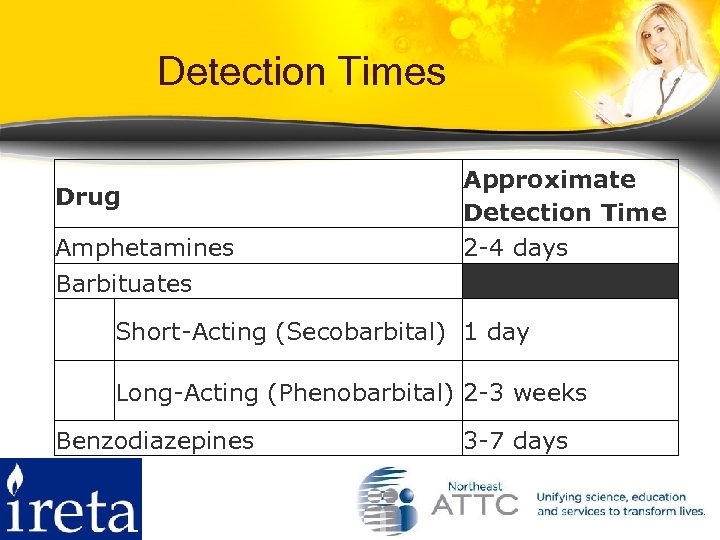
Detection Times Drug Amphetamines Barbituates Approximate Detection Time 2 -4 days Short-Acting (Secobarbital) 1 day Long-Acting (Phenobarbital) 2 -3 weeks Benzodiazepines 3 -7 days
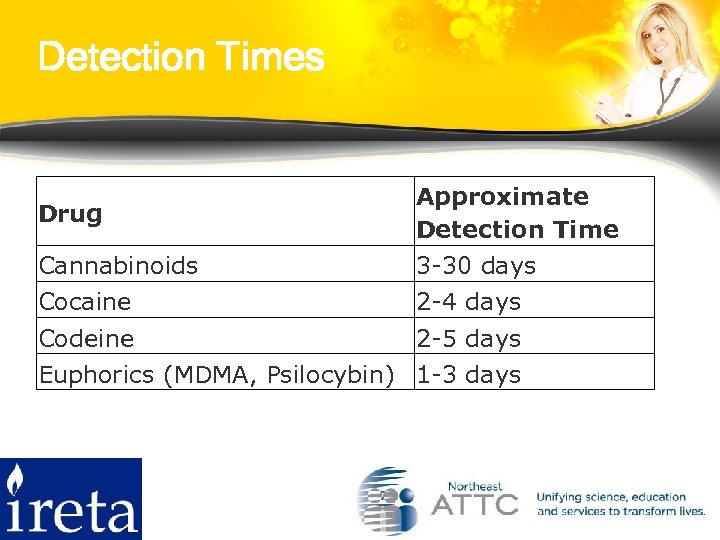
Detection Times Drug Approximate Detection Time Cannabinoids 3 -30 days Cocaine 2 -4 days Codeine 2 -5 days Euphorics (MDMA, Psilocybin) 1 -3 days
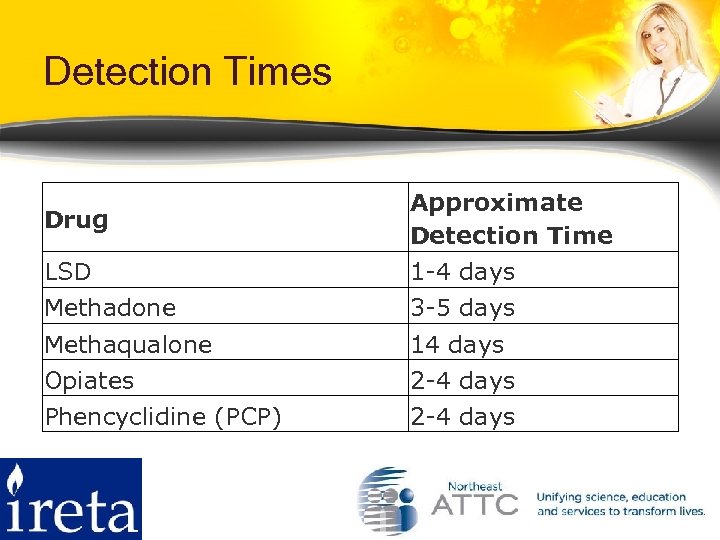
Detection Times Drug Approximate Detection Time LSD 1 -4 days Methadone 3 -5 days Methaqualone 14 days Opiates 2 -4 days Phencyclidine (PCP) 2 -4 days
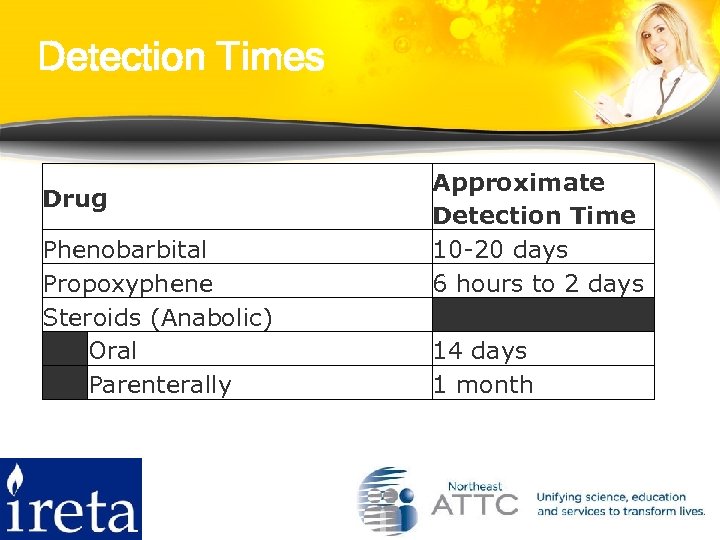
Detection Times Drug Phenobarbital Propoxyphene Steroids (Anabolic) Oral Parenterally Approximate Detection Time 10 -20 days 6 hours to 2 days 14 days 1 month
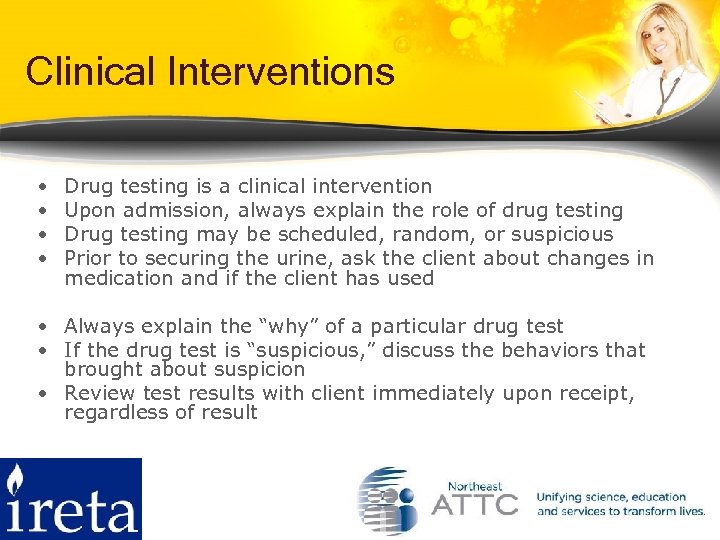
Clinical Interventions • • Drug testing is a clinical intervention Upon admission, always explain the role of drug testing Drug testing may be scheduled, random, or suspicious Prior to securing the urine, ask the client about changes in medication and if the client has used • Always explain the “why” of a particular drug test • If the drug test is “suspicious, ” discuss the behaviors that brought about suspicion • Review test results with client immediately upon receipt, regardless of result
Clinical Interventions • Negative drug screen Ø Congratulate the client Ø Review what drugs were tested for Ø Ask the client about use of drugs not tested Ø Ask about issue/problems when the sample was secured
Clinical Interventions • Positive drug screen Ø Tell the client you have the results and ask if the client has anything to share Ø Review what drugs were tested for and indicate what was positive Ø Allow the client time to respond Ø Ask the client about use of drugs not tested Ø Ask about when the client used, the circumstances Ø Review/discuss consequences Ø If discharge, make appropriate referral Ø If no discharge, develop relapse prevention plan
Resources
Resources • Collins, Jennifer. Laboratory Perspective on Additional Drug Testing and Associated Costs. MEDTOX Laboratories, Inc. • Mitchell, John M. Immunoassays as an Initial Test in Drug Testing. Center for Forensic Sciences. RTI International • TROUBLESHOOTING GUIDE DRUGS OF ABUSE. Innovacon, Inc. San Diego, CA • http: //www. drug-test-facts. com • http: //www. drugabuse. gov/nidahome. html • http: //www. drugdetection. net/drug. htm
Скачать презентацию You Can t Fool the Bladder Police Effective Use
c99d18dc0c9406c33c35832b272e9bd7.ppt