 Скачать презентацию Yield Management Model for e-Services Parijat Dube and
f38f56a6dfac46e1597a0c179deb35de.ppt
- Количество слайдов: 27




Yield Management Model for e-Services Parijat Dube and Laura Wynter IBM T J Watson Research Center Yorktown Heights, NY Tieming Liu Oklahoma State University Stillwater, OK
Presentation Outline Introduction The Multi-Period Revenue Management Model Case Study & Numerical Analysis Future Directions and Conclusions 2
On-Demand IT Service On-Demand is a business model –an alternative to the buy-and-use and lease models for IT resources, including hardware, software and network. On-Demand means offering IT resources to firms when they need it, in the quantity that is required. On-Demand means paying for use only. 3
Why RM for On-Demand IT ? Marginal cost of providing on-demand IT services is very low, one time investment in infrastructure. Market for on-demand services is segmentable, with different job requirements, urgencies, and price sensitivities. While mainly large players (IBM, HP, Sun) are touting on-demand now, field will grow to a large number of mid-size providers -> synchronization of pricing is inevitable. 4
Presentation Outline Introduction The Multi-Period Revenue Management Model – The Multi-Period Logit Demand Model – Capacity Constraints – Optimization Problem Case Study & Computational Analysis Future Directions and Conclusions 5
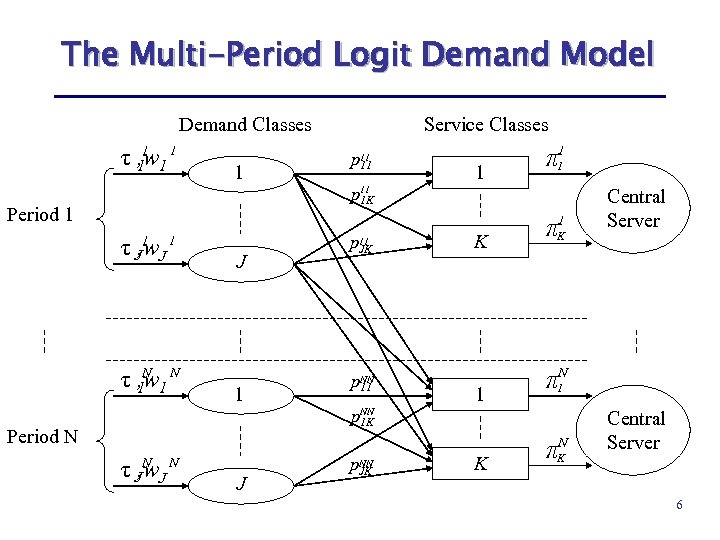
The Multi-Period Logit Demand Model Service Classes Demand Classes τ 11 1 1 , w 1 p 11 11 1 1 π 1 p 11 1 K Period 1 τ J 1 , w τ 1 N 1 N , w J 1 11 p. JK p. NN 11 K 1 1 π K N π 1 p 1 K NN Period N τ JN J N , w J NN p. JK K Central Server N π K Central Server 6
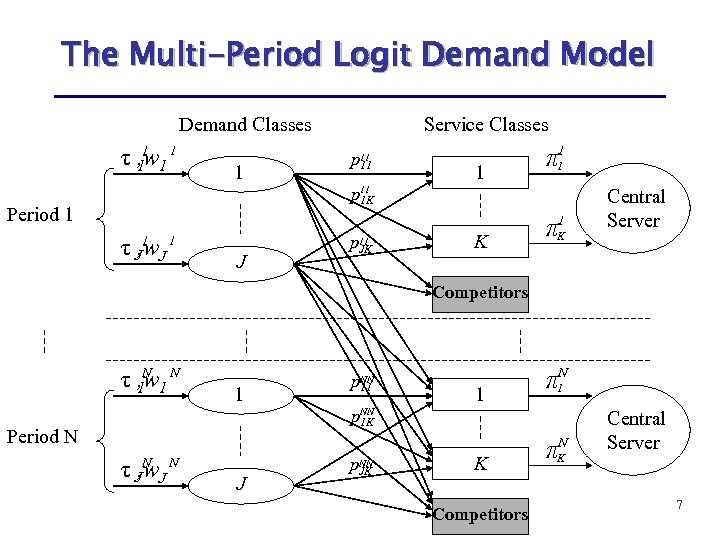
The Multi-Period Logit Demand Model Service Classes Demand Classes τ 11 1 1 , w 1 p 11 11 1 1 π 1 p 11 1 K Period 1 τ J 1 , w J 11 p. JK K 1 π K Central Server Competitors τ 1 N 1 N , w 1 p. NN 11 1 N π 1 p 1 K NN Period N τ JN J N , w J NN p. JK K Competitors N π K Central Server 7
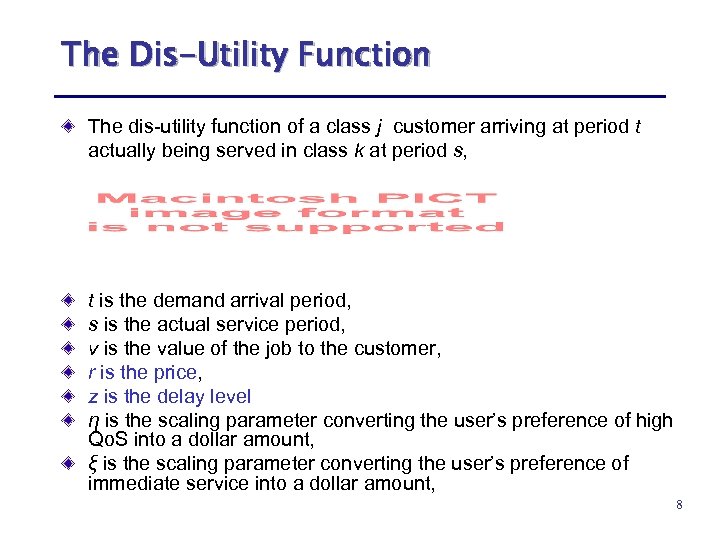
The Dis-Utility Function The dis-utility function of a class j customer arriving at period t actually being served in class k at period s, t is the demand arrival period, s is the actual service period, v is the value of the job to the customer, r is the price, z is the delay level η is the scaling parameter converting the user’s preference of high Qo. S into a dollar amount, ξ is the scaling parameter converting the user’s preference of immediate service into a dollar amount, 8
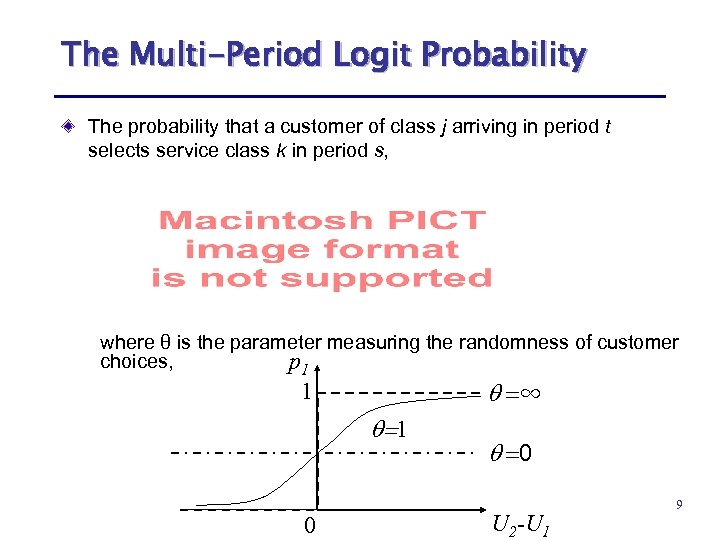
The Multi-Period Logit Probability The probability that a customer of class j arriving in period t selects service class k in period s, where θ is the parameter measuring the randomness of customer choices, p 1 q =∞ 1 q=1 0 q =0 U 2 -U 1 9
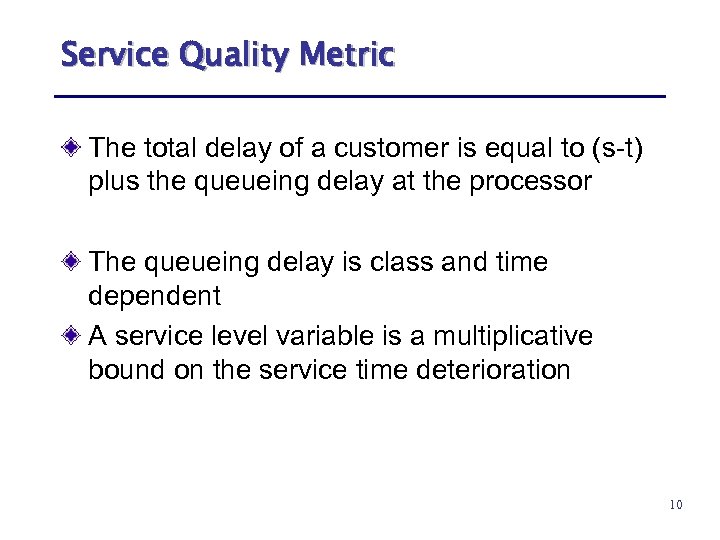
Service Quality Metric The total delay of a customer is equal to (s-t) plus the queueing delay at the processor The queueing delay is class and time dependent A service level variable is a multiplicative bound on the service time deterioration 10

Capacity Constraints Under the assumptions of Poisson arrivals and generalized processor sharing, the probability of the actual processing time exceeding the promised sojourn time can be bounded by: where T 0 is the baseline processing time, z is the promised service level, μis the CPU processing rate, and c is the number of CPUs. The equality is equivalent to, The system has to satisfy the natural capacity constraints on the CPU percentages, f, 11

Multi-Period Optimization Model 12
Presentation Outline Introduction The Multi-Period Revenue Management Model Case Study & Computational Analysis Future Directions and Conclusions 13
Computational Analysis Objectives of numerical analysis : – How much does the policy affect revenue? – What are the revenue-optimizing values of r and z? – Is there any monotonicity of the transition with respect to control and demand parameters? – Sensitivity analysis : how do problem parameters affect r, z? – Other impacts of differentiated pricing? 14
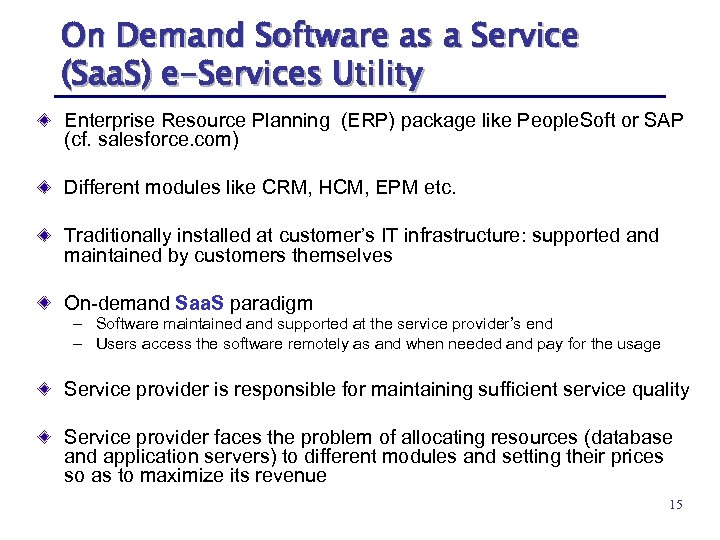
On Demand Software as a Service (Saa. S) e-Services Utility Enterprise Resource Planning (ERP) package like People. Soft or SAP (cf. salesforce. com) Different modules like CRM, HCM, EPM etc. Traditionally installed at customer’s IT infrastructure: supported and maintained by customers themselves On-demand Saa. S paradigm – Software maintained and supported at the service provider’s end – Users access the software remotely as and when needed and pay for the usage Service provider is responsible for maintaining sufficient service quality Service provider faces the problem of allocating resources (database and application servers) to different modules and setting their prices so as to maximize its revenue 15
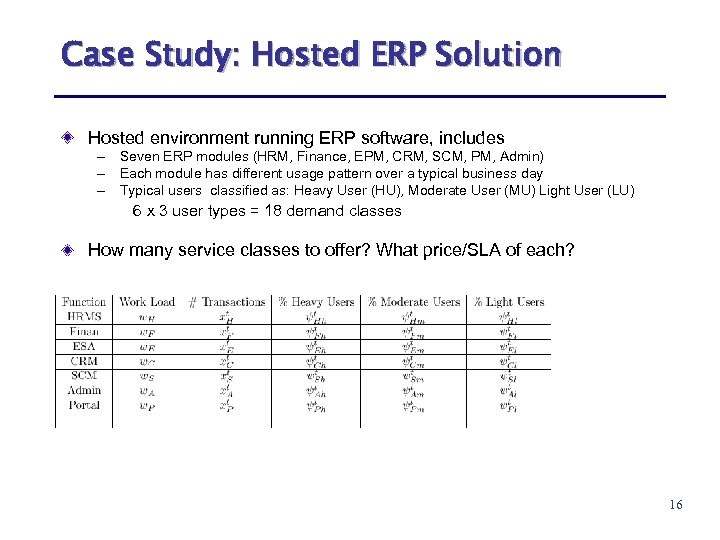
Case Study: Hosted ERP Solution Hosted environment running ERP software, includes – Seven ERP modules (HRM, Finance, EPM, CRM, SCM, PM, Admin) – Each module has different usage pattern over a typical business day – Typical users classified as: Heavy User (HU), Moderate User (MU) Light User (LU) 6 x 3 user types = 18 demand classes How many service classes to offer? What price/SLA of each? 16
Case Study: Hosted ERP Solution Decision Horizon: A typical business day Divide a day into different intervals depending upon the intensity of usage – periods of low, moderate and heavy activity We assume a competitor offering delay bound of 5 units at a price set to $50. This represents the “market”. 17
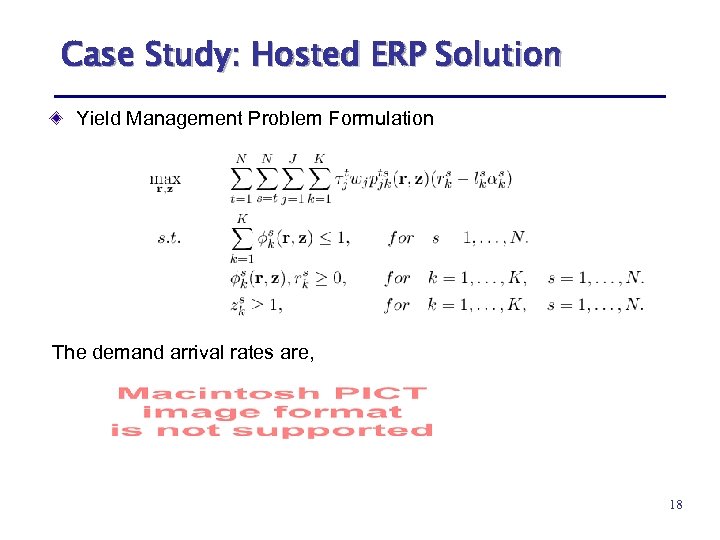
Case Study: Hosted ERP Solution Yield Management Problem Formulation The demand arrival rates are, 18
Revenue Vs. Number of Classes Concave increasing in number of classes From 1 to 4 service classes, revenue increase: 25% fo high cap, 23% for low cap 19
Scenario with Max of 2 service classes One class with very good service and high price: for high-end customers Second class on the average is closer to competitor’s offering Price-service class offerings vary with demand over the duration of the day 20
Scenario with Max of 3 service classes Three service classes are offered in only two time intervals Third service class takes the role of a class very close to the competitors in the intervals where second class offers significantly better service at a higher price 21

Effect of Capacity on YM: low capacity At second peak 14 -16: 00 only a single class is open; with a very high price $100 and good service level 3. 78 When capacity is low, offer fewer high end classes 22
Demand Captured Vs. No. of Service Classes: High Capacity Service provider can offer full spectrum of service classes As the number of service classes increases the market share increases as well 23
Demand Captured Vs. No. of Service Classes: Low Capacity The optimal solution favors less service classes but with higher service levels and higher price Due to limited capacity the fraction of demand captured is lesser 24
Presentation Outline Introduction The Multi-Period Revenue Management Model Computational Analysis & Case Study Conclusion and Future Directions 25
Conclusions Revenue management makes sense for the Saa. S/ hosted solutions industry Important to link pricing and revenue with service level optimization in this industry— parameter interactions are intertwined As an example, here, potential revenue increased with the increase in service classes, up to 25% Marginal benefits are as expected concave increasing in the number of service classes With multiple classes one class normally tracks the competitor’s offering and the other classes provide better service at higher price capturing high end customers 26
Future Directions Stable and fast algorithms, Capacity expansion: consider cost of adding capacity as needed within model, Consider the dynamics where the service provider itself may be a customer of additional capacity on-demand. …. 27
Скачать презентацию Yield Management Model for e-Services Parijat Dube and
f38f56a6dfac46e1597a0c179deb35de.ppt