


 Скачать презентацию Year 2 Curriculum Evening SUE MCGREGOR LINDA HOWES
08dcf4e2ce679c325d60f5fafcf7ae3f.ppt
- Количество слайдов: 48
 Year 2 Curriculum Evening SUE MCGREGOR LINDA HOWES
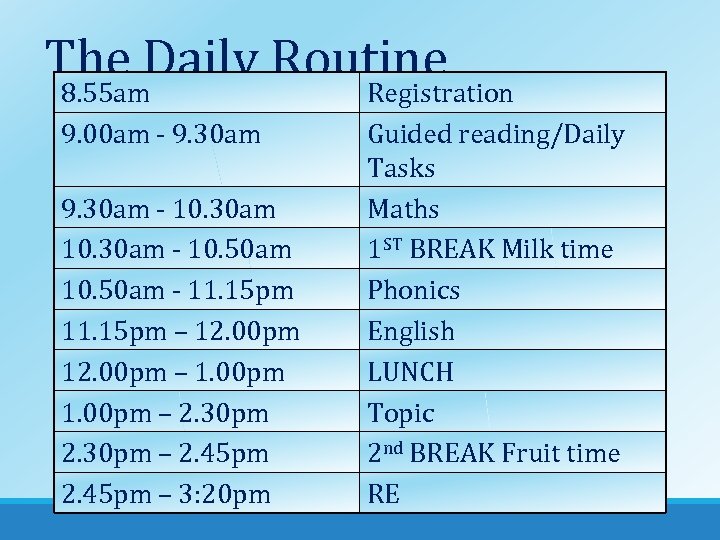 The Daily Routine 8. 55 am Registration 9. 00 am - 9. 30 am - 10. 50 am - 11. 15 pm – 12. 00 pm – 1. 00 pm – 2. 30 pm – 2. 45 pm – 3: 20 pm Guided reading/Daily Tasks Maths 1 ST BREAK Milk time Phonics English LUNCH Topic 2 nd BREAK Fruit time RE
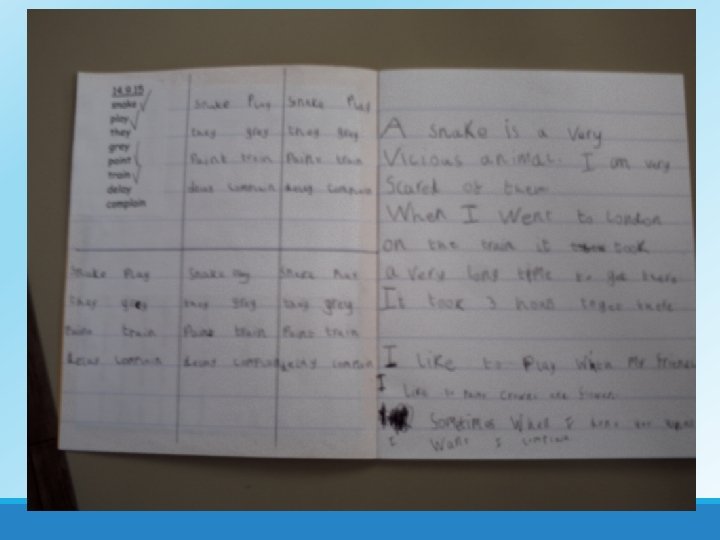
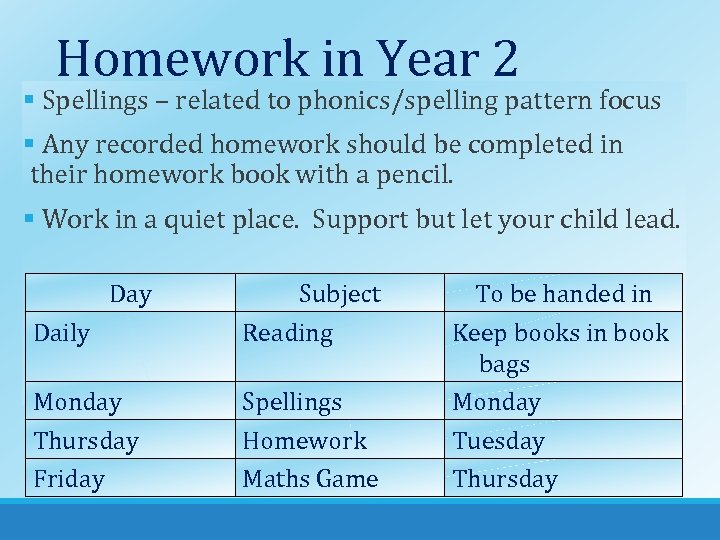 Homework in Year 2 § Spellings – related to phonics/spelling pattern focus § Any recorded homework should be completed in their homework book with a pencil. § Work in a quiet place. Support but let your child lead. Day Daily Subject Reading Monday Thursday Friday Spellings Homework Maths Game To be handed in Keep books in book bags Monday Tuesday Thursday
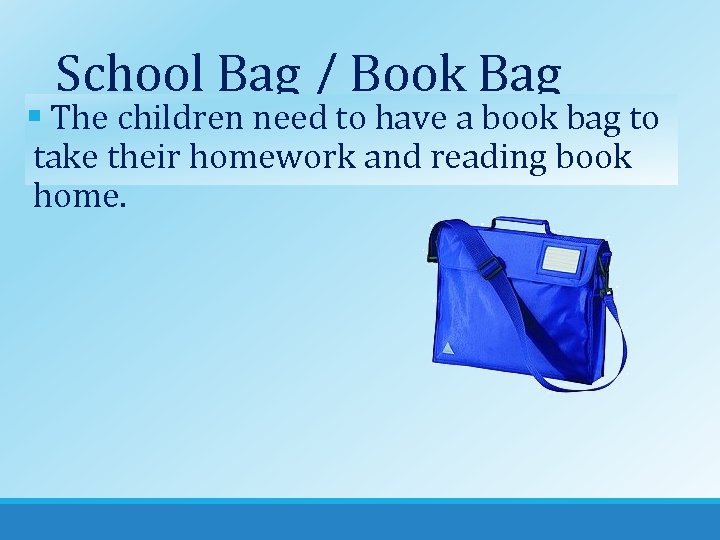 School Bag / Book Bag § The children need to have a book bag to take their homework and reading book home.
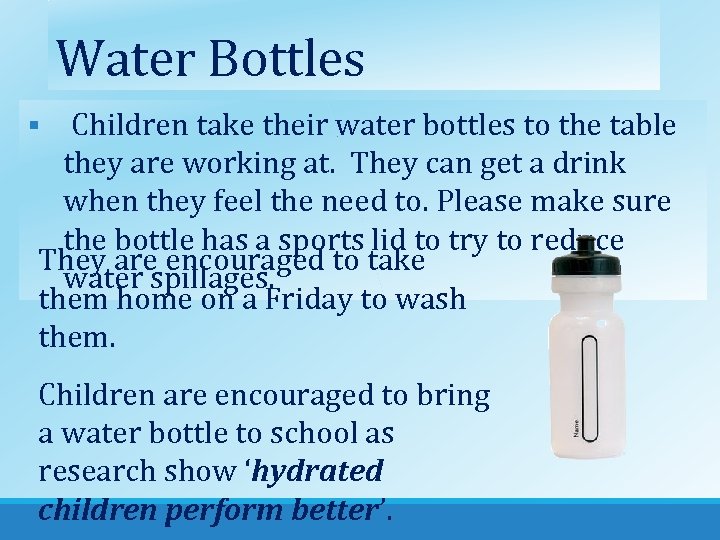 Water Bottles Children take their water bottles to the table they are working at. They can get a drink when they feel the need to. Please make sure the bottle has a sports lid to try to reduce They are encouraged to take water spillages. them home on a Friday to wash them. § Children are encouraged to bring a water bottle to school as research show ‘hydrated children perform better’.
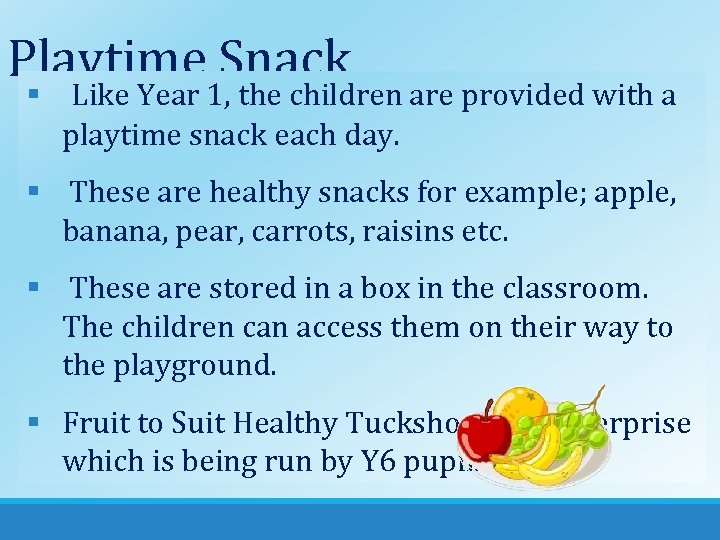 Playtime Snack § Like Year 1, the children are provided with a playtime snack each day. § These are healthy snacks for example; apple, banana, pear, carrots, raisins etc. § These are stored in a box in the classroom. The children can access them on their way to the playground. § Fruit to Suit Healthy Tuckshop – an enterprise which is being run by Y 6 pupils.
 School Council § Two children from each class (Years 1 -6) are voted to represent their class as part of the school council. § If the children want to be considered for the council, they can write a manifesto. § The school council meets to discuss areas that they would like to develop in the school, based on the ideas and discussions of the children in their class. § The council talk to the relevant teachers about implementing/developing any aspects that arise in discussions.
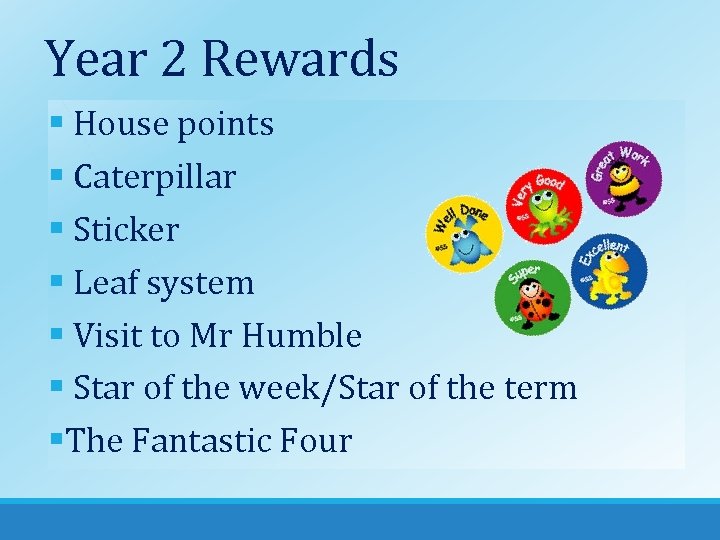 Year 2 Rewards § House points § Caterpillar § Sticker § Leaf system § Visit to Mr Humble § Star of the week/Star of the term §The Fantastic Four
 Year 2 Curriculum Core Subjects § RE § English § Maths § Science § Computing Foundation Subjects § Physical Education § History § Geography § Art § Design & Technology § Music § French Science, History, Geography, Art and Technology form our Topic work.
 Lessons in Year 2 Children are taught in structured lessons, which consists of 4 main parts: - Sharing of the AIM and Success Criteria - Whole class teaching (smartboards / powerpoints / practical and interactive) - Independent work (individual / paired / small group) - Plenary (summary of lesson) Assessment is continuous and tracked to ensure that each child’s unique needs are catered for.
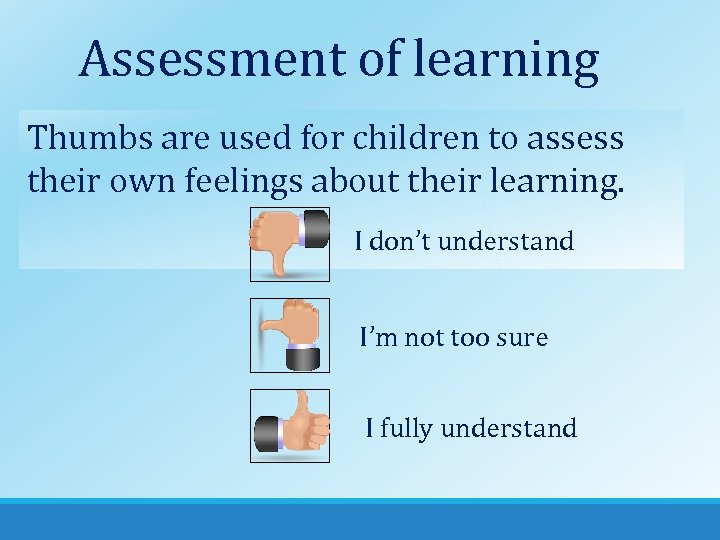 Assessment of learning Thumbs are used for children to assess their own feelings about their learning. I don’t understand I’m not too sure I fully understand
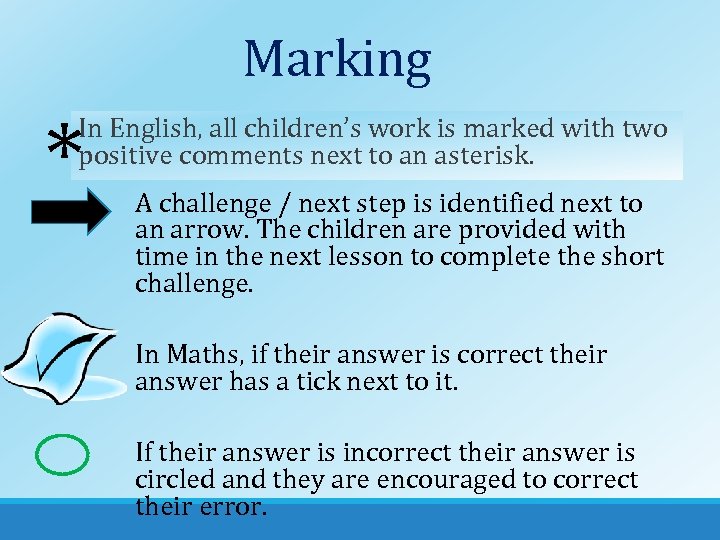 Marking * In English, all children’s work is marked with two positive comments next to an asterisk. A challenge / next step is identified next to an arrow. The children are provided with time in the next lesson to complete the short challenge. In Maths, if their answer is correct their answer has a tick next to it. If their answer is incorrect their answer is circled and they are encouraged to correct their error.
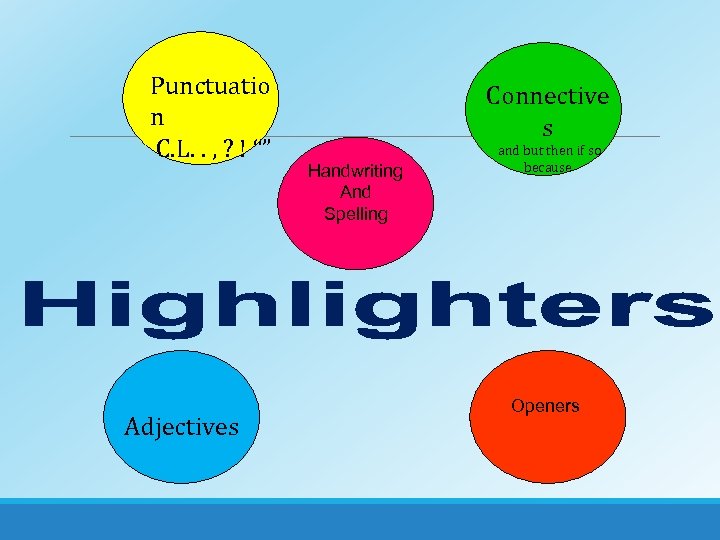 Punctuatio n C. L. . , ? ! “” Adjectives Connective s Handwriting And Spelling and but then if so because Openers
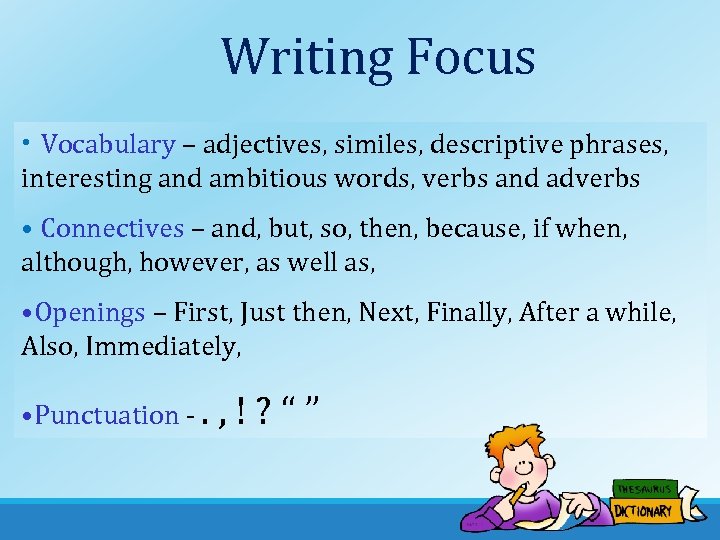 Writing Focus • Vocabulary – adjectives, similes, descriptive phrases, interesting and ambitious words, verbs and adverbs • Connectives – and, but, so, then, because, if when, although, however, as well as, • Openings – First, Just then, Next, Finally, After a while, Also, Immediately, • Punctuation -. , !? “”
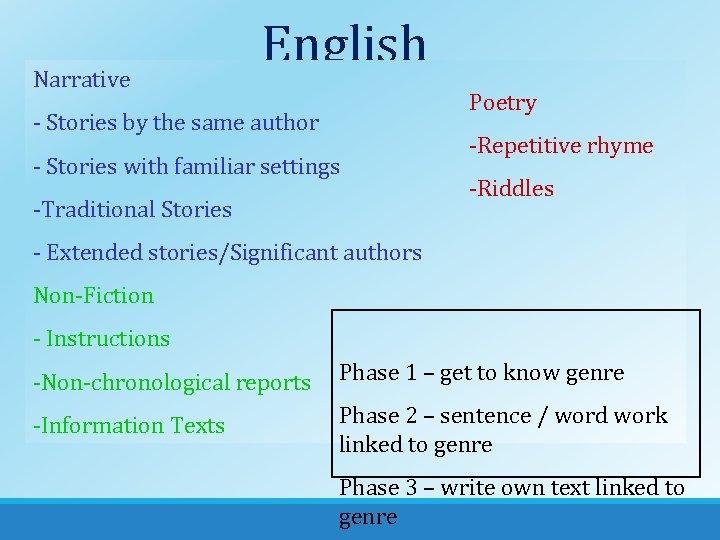 Narrative English Poetry - Stories by the same author - Stories with familiar settings -Traditional Stories -Repetitive rhyme -Riddles - Extended stories/Significant authors Non-Fiction - Instructions -Non-chronological reports Phase 1 – get to know genre -Information Texts Phase 2 – sentence / word work linked to genre Phase 3 – write own text linked to genre
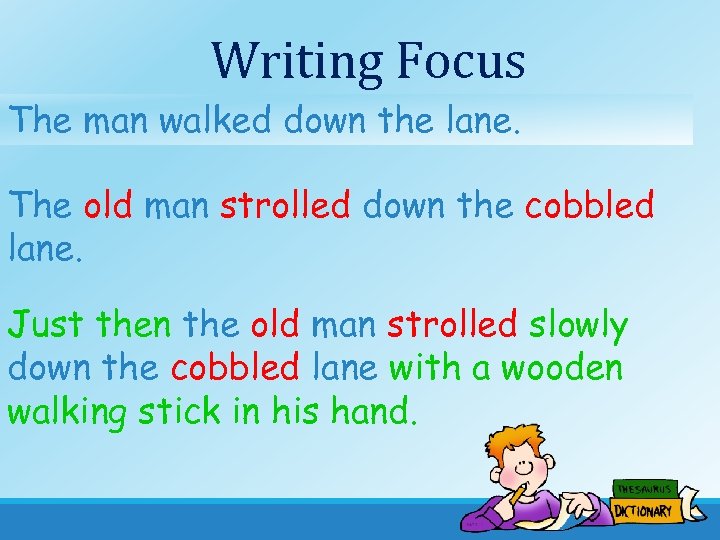 Writing Focus The man walked down the lane. The old man strolled down the cobbled lane. Just then the old man strolled slowly down the cobbled lane with a wooden walking stick in his hand.
 Guided Reading § Every group reads for 30 minutes at least once a week. § I read and deep dive the selected text with the guided group, while other children work on their ‘Daily Tasks’ which consists of consolidation of Maths and English. § Activities include: Punctuating sentences correctly, identifying adjectives in a text, ordering numbers, finding 10 more, 10 less § The book the children bring home each week has not been read before with their
 Phonics § Children are ability grouped according to their knowledge of phonics which is assessed at the beginning of year 2 and throughout the year. We have 3 phonics groups and Key Stage one all complete phonics at the same time so that the children can work with children at a similar level. § We will continue to develop spelling patterns in Year 2, before moving onto learning more specific spelling rules, such as ‘suffixes and prefixes’, ‘plurals’ and ‘tense’. § Alternative spellings of phonemes already known are explored and new ‘digraphs and trigraphs’ are
 Phonics Terminology Phonemes: The sounds in words Graphemes: The letters representing the sound Digraph: Two letters that make one sound Trigraph: Three letters that make one sound
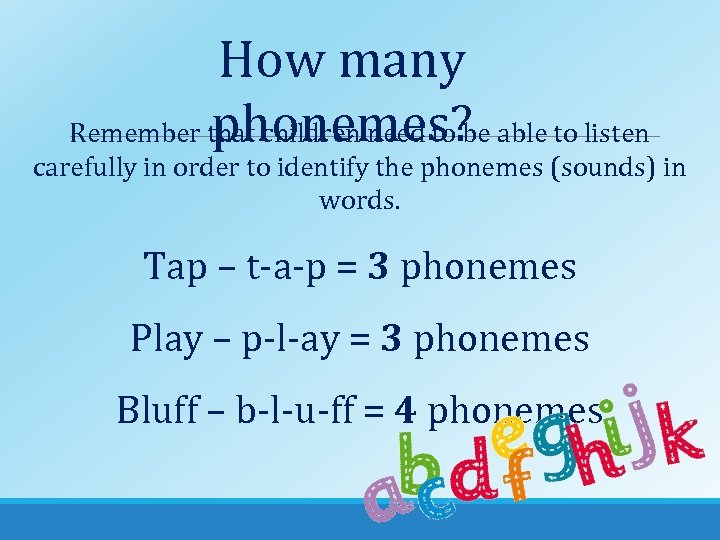 How many phonemes? Remember that children need to be able to listen carefully in order to identify the phonemes (sounds) in words. Tap – t-a-p = 3 phonemes Play – p-l-ay = 3 phonemes Bluff – b-l-u-ff = 4 phonemes
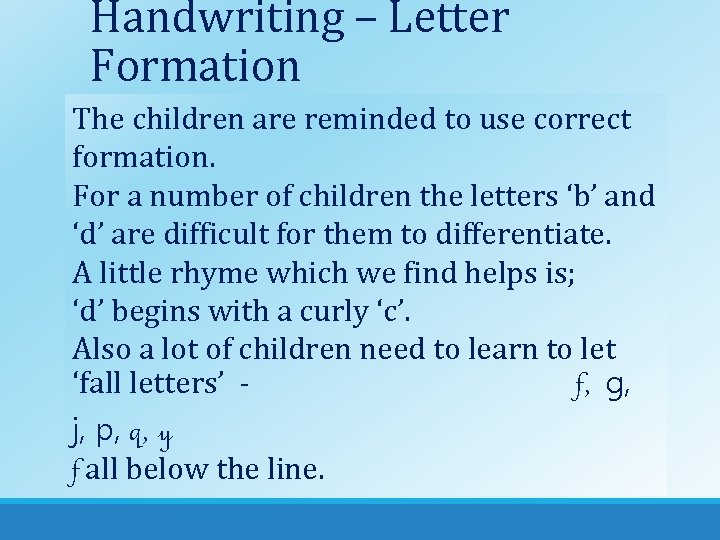 Handwriting – Letter Formation The children are reminded to use correct formation. For a number of children the letters ‘b’ and ‘d’ are difficult for them to differentiate. A little rhyme which we find helps is; ‘d’ begins with a curly ‘c’. Also a lot of children need to learn to let ‘fall letters’ f, g, j, p, q, y f all below the line.
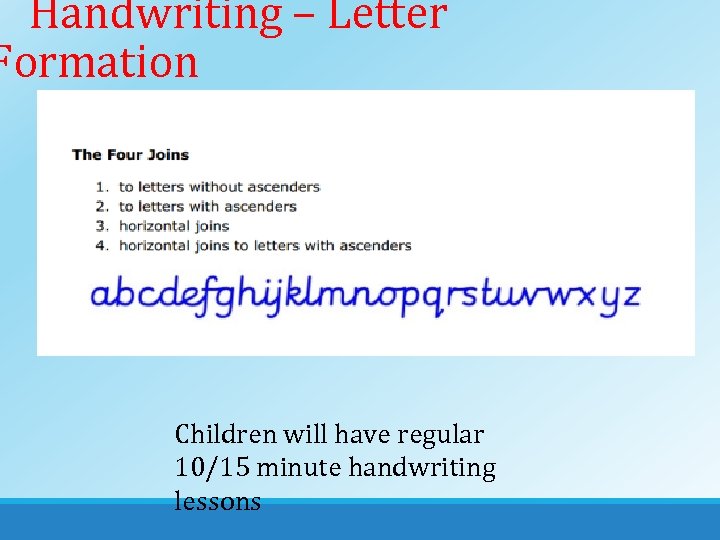 Handwriting – Letter Formation Children will have regular 10/15 minute handwriting lessons
 Numeracy Throughout the year the children will cover all strands of mathematics ; • Using and applying mathematics • Number • Measurement • Geometry – properties of shape • Statistics Using and applying mathematics Solve one-step problems involving numbers, money or measures and time. Applying learnt knowledge in a different context Working methodically Trial and error
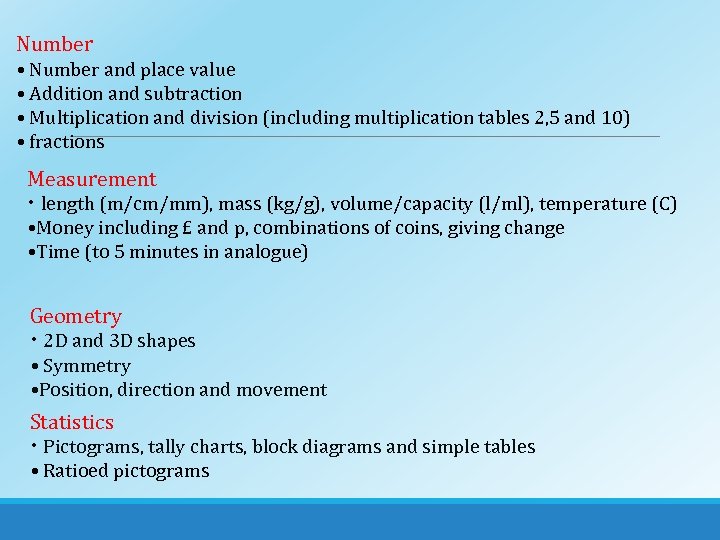 Number • Number and place value • Addition and subtraction • Multiplication and division (including multiplication tables 2, 5 and 10) • fractions Measurement • length (m/cm/mm), mass (kg/g), volume/capacity (l/ml), temperature (C) • Money including £ and p, combinations of coins, giving change • Time (to 5 minutes in analogue) Geometry • 2 D and 3 D shapes • Symmetry • Position, direction and movement Statistics • Pictograms, tally charts, block diagrams and simple tables • Ratioed pictograms
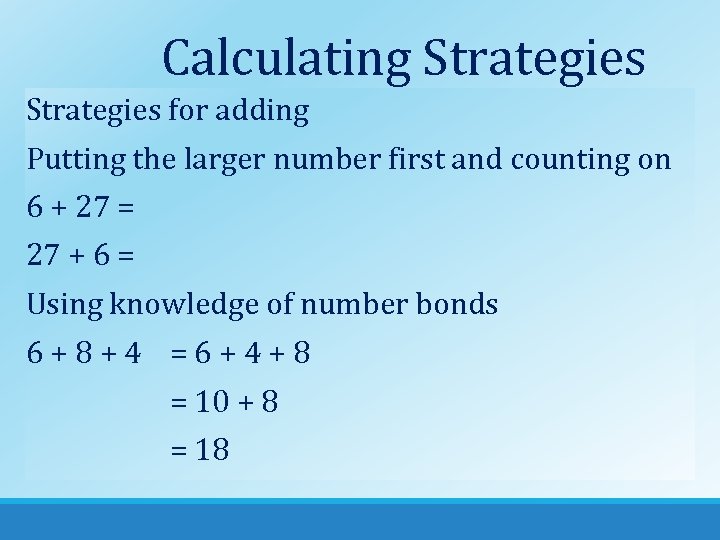 Calculating Strategies for adding Putting the larger number first and counting on 6 + 27 = 27 + 6 = Using knowledge of number bonds 6+8+4 =6+4+8 = 10 + 8 = 18
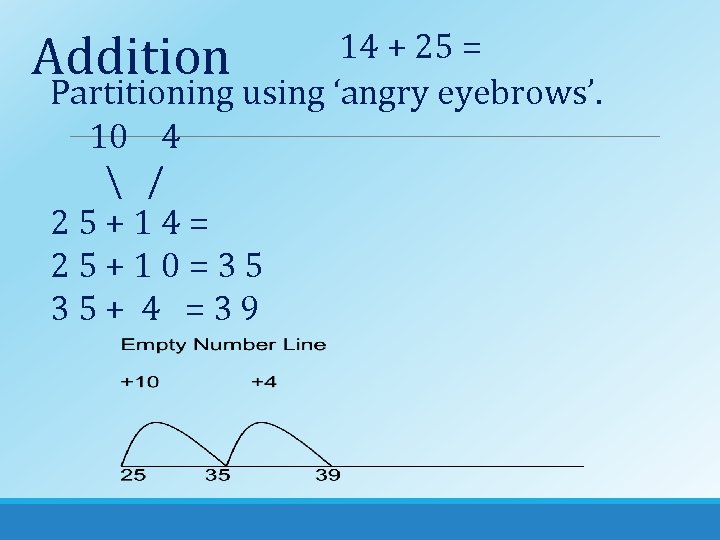 14 + 25 = Addition Partitioning using ‘angry eyebrows’. 10 4 / 25+14= 25+10=35 35+ 4 =39
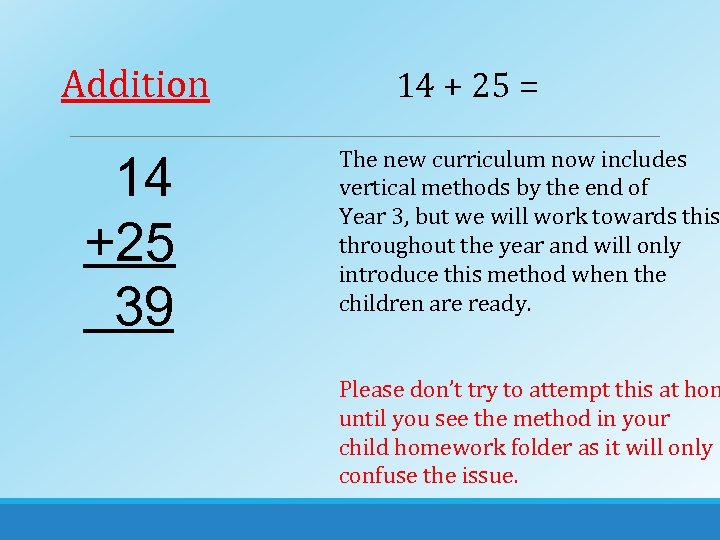 Addition 14 +25 39 14 + 25 = The new curriculum now includes vertical methods by the end of Year 3, but we will work towards this throughout the year and will only introduce this method when the children are ready. Please don’t try to attempt this at hom until you see the method in your child homework folder as it will only confuse the issue.
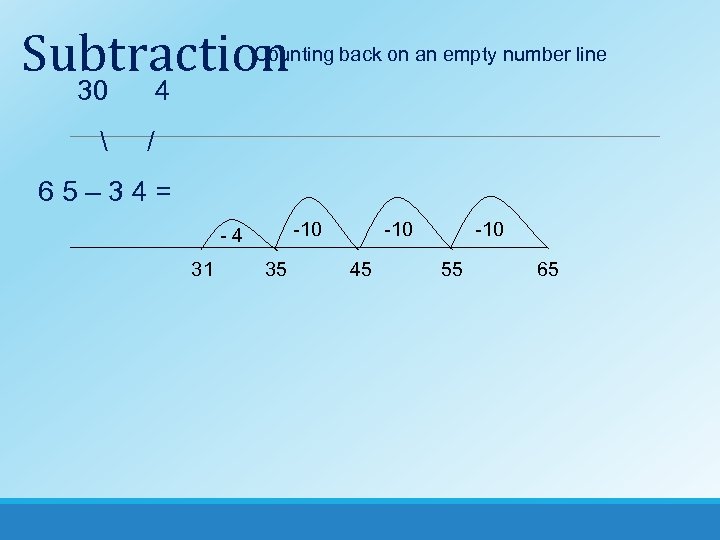 Subtraction Counting back on an empty number line 30 4 / 65– 34= -10 -4 31 35 -10 45 -10 55 65
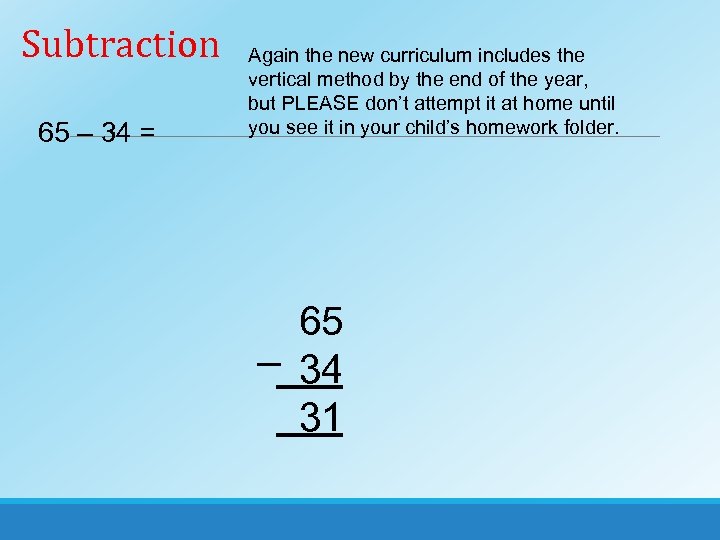 Subtraction 65 – 34 = Again the new curriculum includes the vertical method by the end of the year, but PLEASE don’t attempt it at home until you see it in your child’s homework folder. 65 _ 34 31
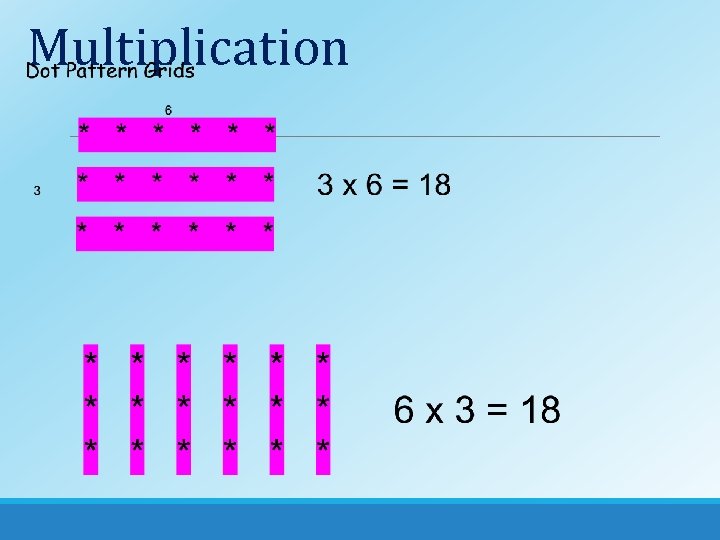 Multiplication
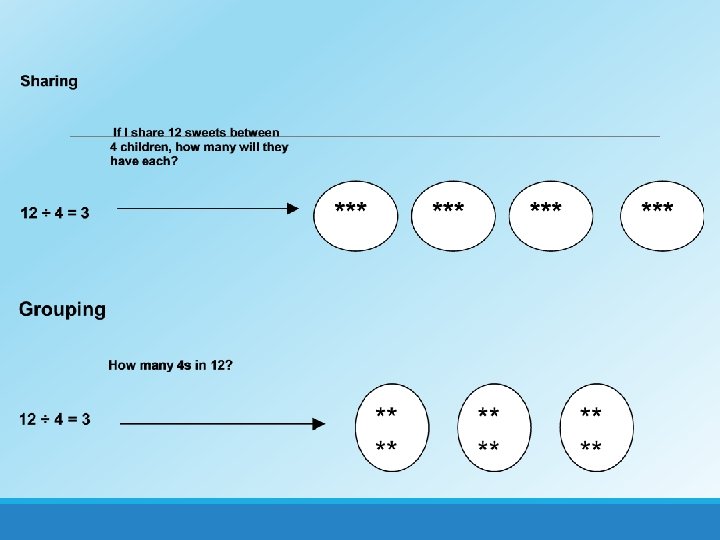
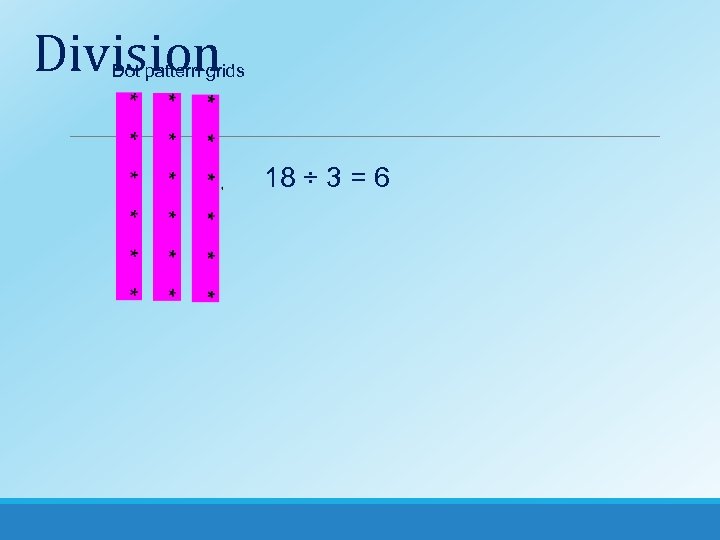 Division Dot pattern grids 18 ÷ 3 = 6
 An extra 5 minutes? ! It will really aid the children if they can confidently and rapidly recall number facts such as: § Number bonds to 10, 20, 100 § Counting forward/back from any number § Adding/Subtracting 1/10 § Multiplication facts for x 2, x 5, x 10 tables § Doubles and corresponding halves
 Science § Move It (Forces) § Healthy Me § Materials § Master chefs § Young Gardeners § Habitats
 Computi ng The children have two ICT sessions a week in the ICT room. One ICT specific lesson and another using ICT across the curriculum. Information Technology Computing Science (debugging, algorithms) Writing Stories Stay Safe Turtles/Bee bots/Logo Simulations Electronic Postcards
 Religious Education is based on the new “Come and See” programme. Autumn Term Beginnings Signs & Symbols Preparations Spring Term Books Thanksgiving Opportunities Summer Term Spread the Word Rules
 Topic TERM AUTUMN 1 AUTUMN 2 SPRING 1 TITLE Katie Morag and the Isle of Struay The Great Fire of London/Gateshead SPRING 2 Tales from around the World SUMMER 1 Grow your own SUMMER 2 Home and Abroad Heroes and me!
 PE § PE lessons take place on a Monday afternoon (1 hour) § P. E kit is needed for all PE lessons. Please ensure that all items, including shoes, are labelled. § Children MUST have their PE kit § If a child has forgotten their kit they will be given a spare kit
 French § The children have half an hour of French every Friday morning. § This is taught by Mrs Thomas. § As well as lots of oral work the children also learn to write simple French. Music §The children have half an hour of music also on a Friday. §This is taught by Mrs Bell.
 Year 2 SATs
 What are SATs? § SATs are tasks set by the government. § SATs are Standardised Assessment Tasks. § It is compulsory that all children complete the SATs tasks at the end of Year 2.
 § The focus is now on teacher assessment across the whole year and not on the SATs tasks that the children complete. § Children will still complete the tasks in May. These are used to back up and support the evidence and assessment collated across the year. § If the Teacher Assessment and SATs tasks scores differ, then the Teacher Assessment score stands.
 When do the SATs take place? § The children will sit their SATs tasks during the full month of May. § The children will work on their tasks mainly in small groups. § It is important that you try not to take the children out of school during May.
 SATs Tasks § The children complete SATs tasks in Maths (arithmetic and reasoning), Writing, Reading (fiction and non-fiction) and SPAG (spelling, punctuation and grammar). § The children may refer to them as quizzes.
 Levels At the end of June, the children will be given a level. Emerging Expected Exceeding
 Moderation of Teacher Assessments § South Tyneside LA have a team of moderators who can arrive at a school either with notification or unexpected requesting to see a child’s work and the teacher assessment scores. § They will ensure that the children have been assessed at the correct level.
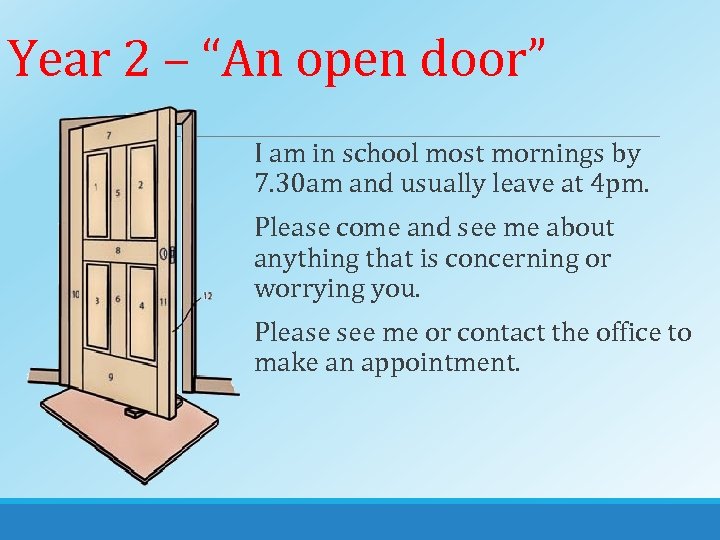 Year 2 – “An open door” I am in school most mornings by 7. 30 am and usually leave at 4 pm. Please come and see me about anything that is concerning or worrying you. Please see me or contact the office to make an appointment.