


 Скачать презентацию Yale School of Management Hedge Funds Lecture 2
5eb683b039ed838cee5a6689dfbe277b.ppt
- Количество слайдов: 36
 Yale School of Management Hedge Funds Lecture 2: Risk Management & Portfolio Construction Zhiwu Chen Yale School of Management 1
 Yale School of Management Today’s topics l Risk management: easier said than done? l Ways to control risk: pairs trading? l Managing risk with CAPM and APT l Managing hedge fund risk with Va. R l Case: Zebra Capital 2
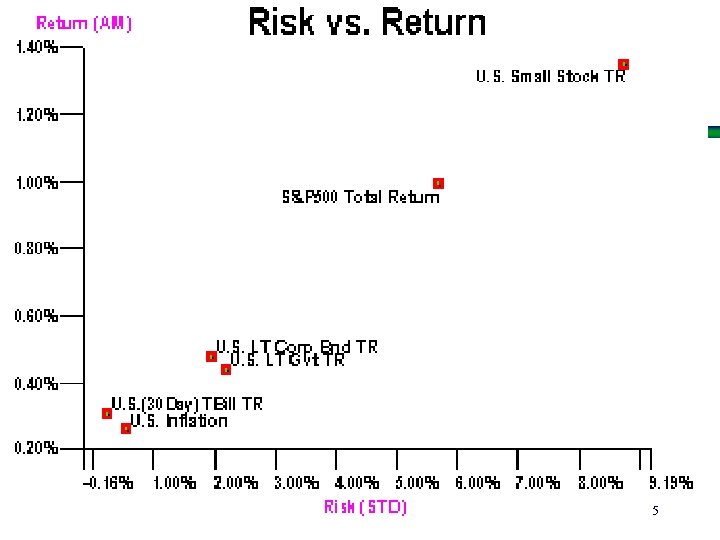
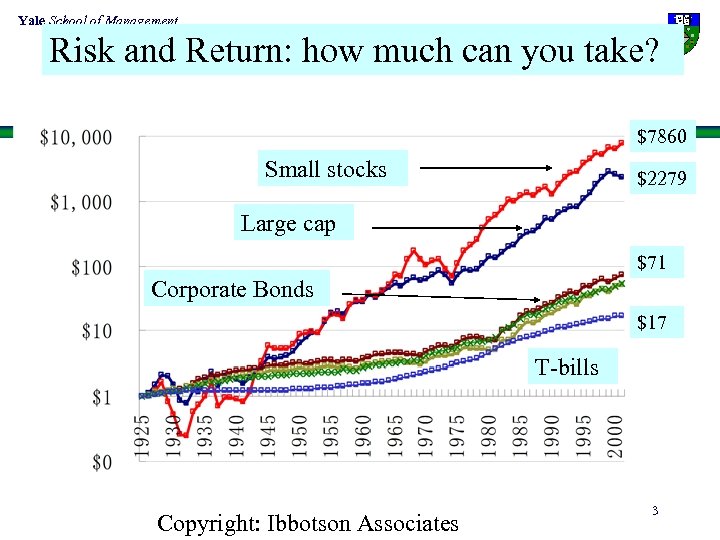 Yale School of Management Risk and Return: how much can you take? $7860 Small stocks $2279 Large cap $71 Corporate Bonds $17 T-bills Copyright: Ibbotson Associates 3
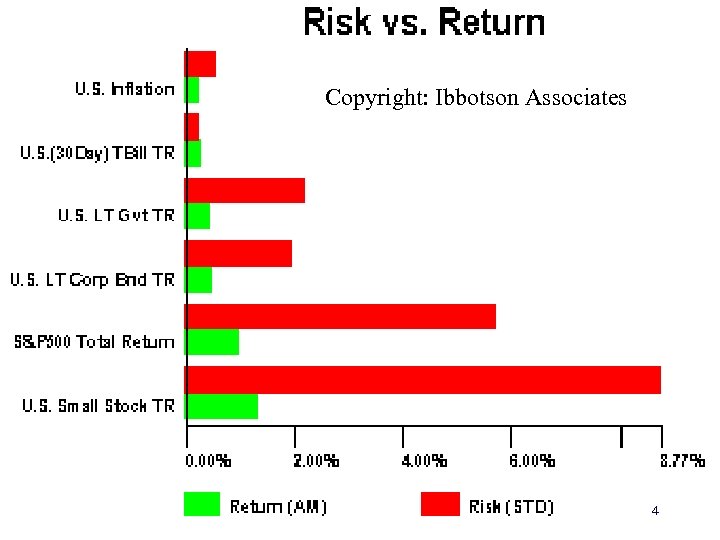 Yale School of Management Copyright: Ibbotson Associates 4
 Yale School of Management 5
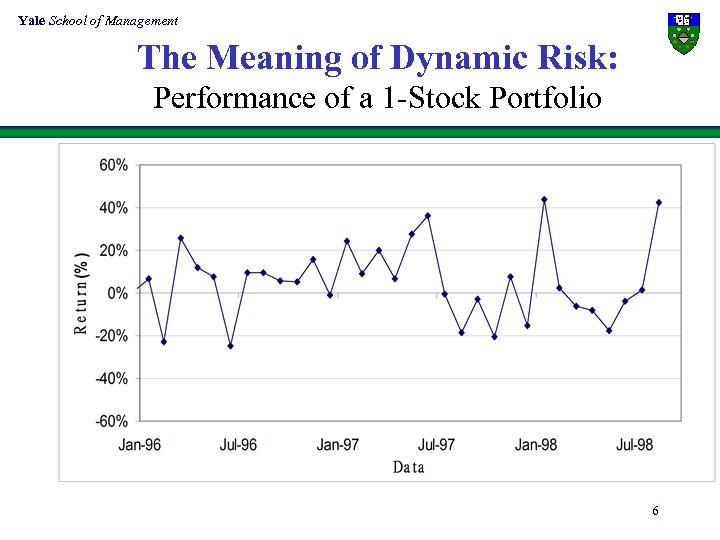 Yale School of Management The Meaning of Dynamic Risk: Performance of a 1 -Stock Portfolio 6
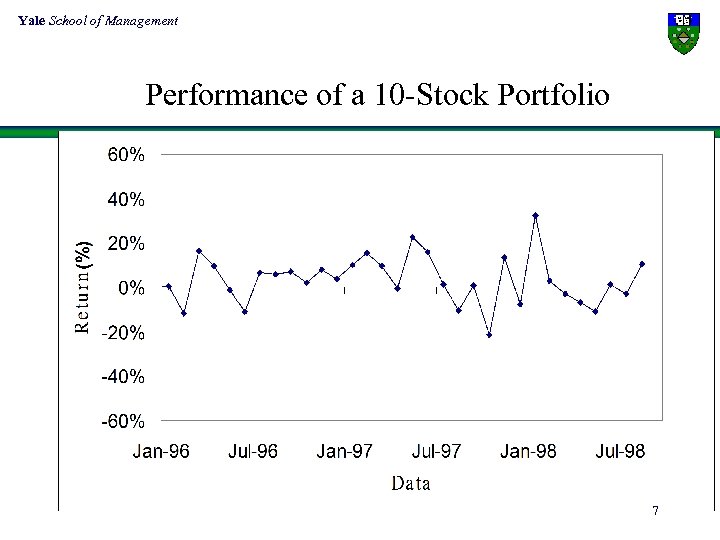 Yale School of Management Performance of a 10 -Stock Portfolio 7
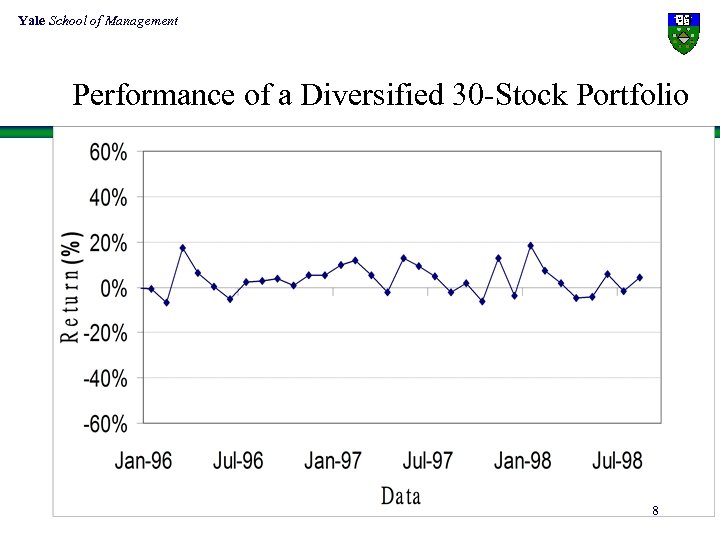 Yale School of Management Performance of a Diversified 30 -Stock Portfolio 8
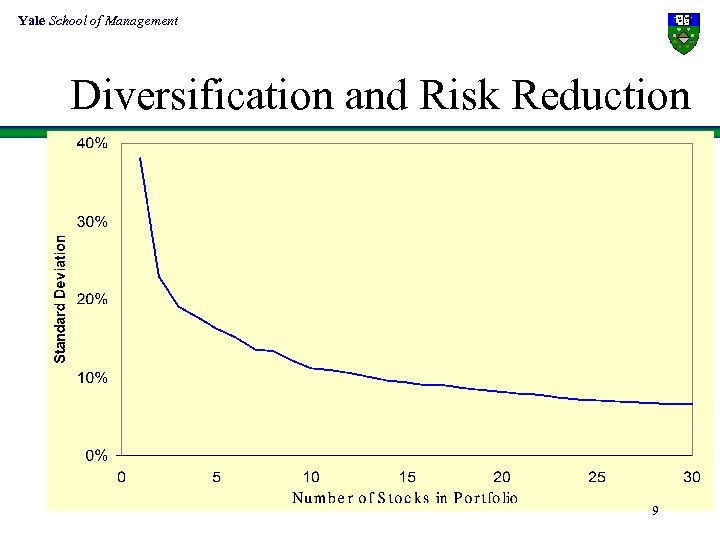 Yale School of Management Diversification and Risk Reduction 9
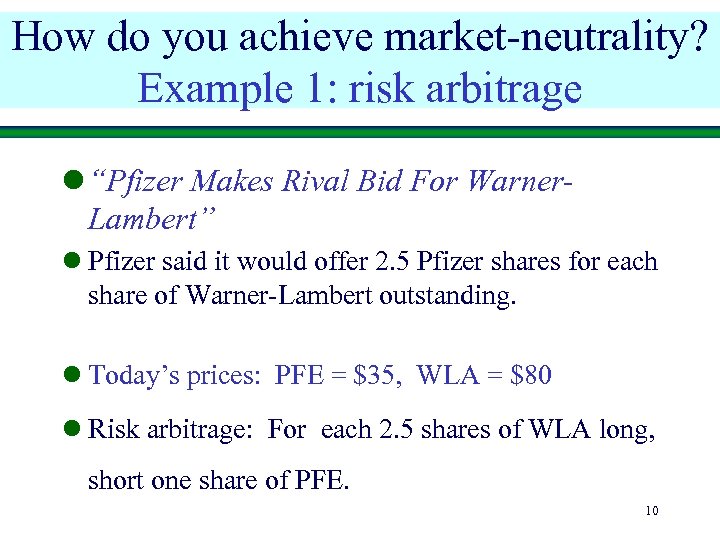 How do you achieve market-neutrality? Example 1: risk arbitrage Yale School of Management l “Pfizer Makes Rival Bid For Warner. Lambert” l Pfizer said it would offer 2. 5 Pfizer shares for each share of Warner-Lambert outstanding. l Today’s prices: PFE = $35, WLA = $80 l Risk arbitrage: For each 2. 5 shares of WLA long, short one share of PFE. 10
 Yale School of Management Example 2: pairs trading l Long IBM l Short e. Bay? l Dollar for dollar? 11
 Yale School of Management Pairs Trading is one type of Statistical “Arbitrage” l Identify a pair of stocks that move in tandem l When they diverge: ù short the higher one ù buy the lower one l Unwind upon convergence l Give me an example? 12
 Yale School of Management Who does it? l Proprietary trading desks ù Morgan Stanley ù Nunzio Tartaglia - 1980’s ù Other investment banks l Hedge funds (Long-short) ù D. E. Shaw? 13
 Yale School of Management Methodology in the Gatev, Goetzmann and Rouwenhorst (1999) Study l Two stages: ù Pairs Formation ù Pairs Trading l Committed Capital ù full period ù when-needed ù no extra leverage 14
 Yale School of Management Pairs Formation Period l Daily CRSP files l Eliminate stocks that missed a day trading in a year l Cumulative total return index for each stock l Also restrict to same broad industry category: Utilities, Transports, Financials, Industrials 15
 Yale School of Management Trading Period l Six-month periods: 1962 -1997 ù starting a new “trader” each month ù closing all positions at end of each six month l How many pairs to use? 5, 20 and 20 after first 100, then all pairs under distance metric 16
 Yale School of Management Trading Method l Open at 2 F (historical F over leading year) l Close upon convergence, or end of sixmonth period l Same-day vs. wait one day to control bidask effect 17
 Yale School of Management Results for Same Day Trading l Portfolio of 5 and 20 best pairs earn an average of 6% per six month period. l Average size of stocks in pairs: 3 rd to 4 th decile l Utilities predominate 18
 Yale School of Management l Insert pages here from the paper 19
 Yale School of Management Example 3: Long-Short Fund l Suppose you want ù To buy 100 stocks with low P/E ratios ù To short 100 stocks with high P/E ratios, $ for $ l What about exposure to systematic and unsystematic risks? How do you match the long and short sides? 20
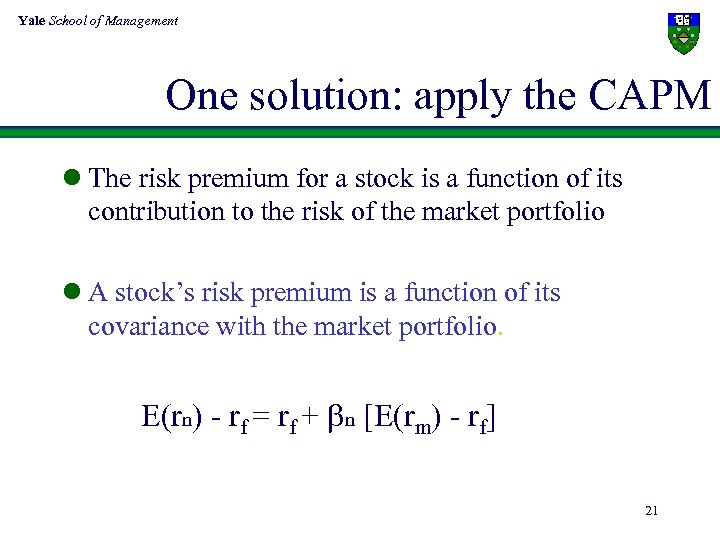 Yale School of Management One solution: apply the CAPM l The risk premium for a stock is a function of its contribution to the risk of the market portfolio l A stock’s risk premium is a function of its covariance with the market portfolio. E(rn) - rf = rf + n [E(rm) - rf] 21
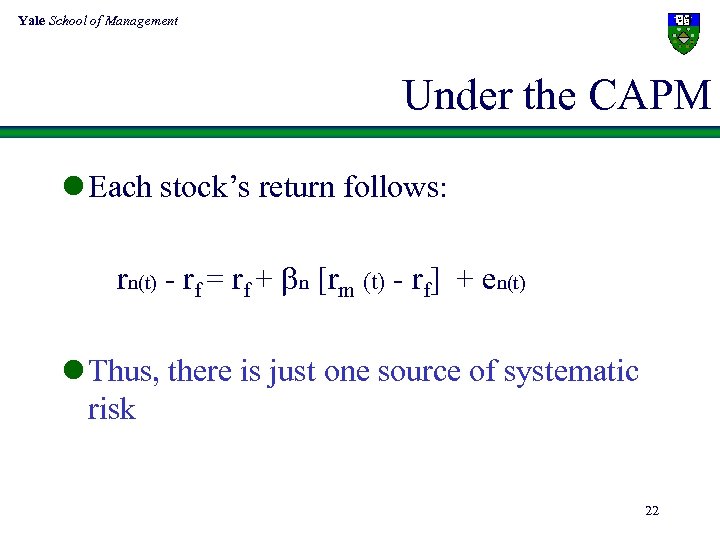 Yale School of Management Under the CAPM l Each stock’s return follows: rn(t) - rf = rf + n [rm (t) - rf] + en(t) l Thus, there is just one source of systematic risk 22
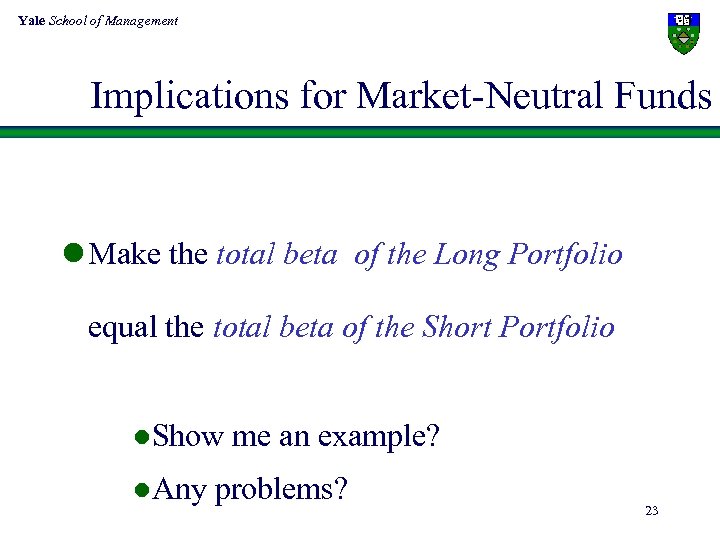 Yale School of Management Implications for Market-Neutral Funds l Make the total beta of the Long Portfolio equal the total beta of the Short Portfolio l. Show l. Any me an example? problems? 23
 Yale School of Management Or, use the APT factor betas l Multiple factors constitute “systematic risks”, not just the market portfolio! l Show me the equation, please! 24
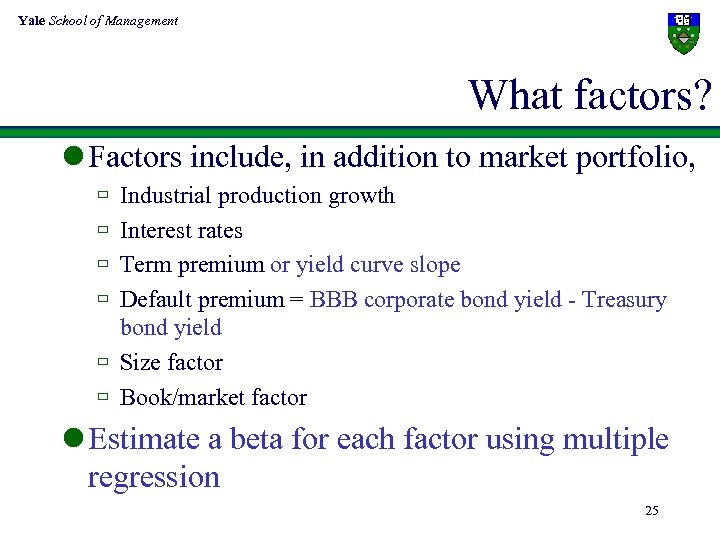 Yale School of Management What factors? l Factors include, in addition to market portfolio, ù ù Industrial production growth Interest rates Term premium or yield curve slope Default premium = BBB corporate bond yield - Treasury bond yield ù Size factor ù Book/market factor l Estimate a beta for each factor using multiple regression 25
 Yale School of Management Now, how do I make it market-neutral? l You want to make ù total factor beta of the Long Portfolio == total factor beta of the Short Portfolio, for every known factor! 26
 Yale School of Management Problems and Concerns? l How many factors are too few? Let the R-square speak! l But, ultimately, it is difficult to make the Long & the Short sides exactly match. 27
 Yale School of Management Risk Management l Keep a profile of your portfolio’s exposure to every known risk factor: ù Macroeconomic factors: interest rate, inflation, … ù Industry factors: oil, retail, semiconductor, …. l Barra, Ibbotson Associates, Northfield. . 28
 Yale School of Management Alternative method: use Value-at-Risk (Va. R) l VAR is the maximum loss over a target horizon within a confidence interval (or, under normal market conditions) l In other words, if none of the “extreme events” (i. e. , low-probability events) occurs, what is my maximum loss over a given time period? 29
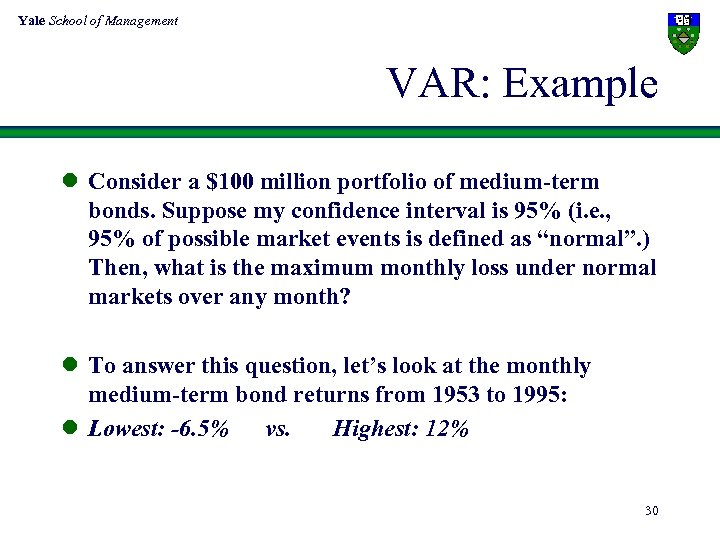 Yale School of Management VAR: Example l Consider a $100 million portfolio of medium-term bonds. Suppose my confidence interval is 95% (i. e. , 95% of possible market events is defined as “normal”. ) Then, what is the maximum monthly loss under normal markets over any month? l To answer this question, let’s look at the monthly medium-term bond returns from 1953 to 1995: l Lowest: -6. 5% vs. Highest: 12% 30
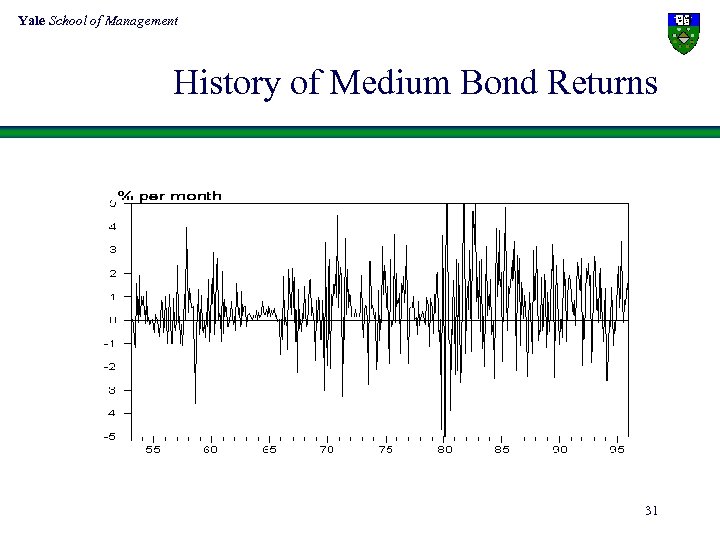 Yale School of Management History of Medium Bond Returns 31
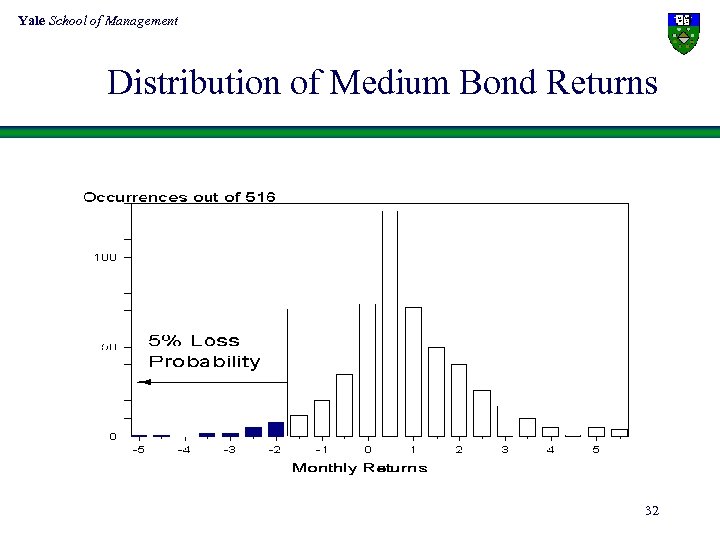 Yale School of Management Distribution of Medium Bond Returns 32
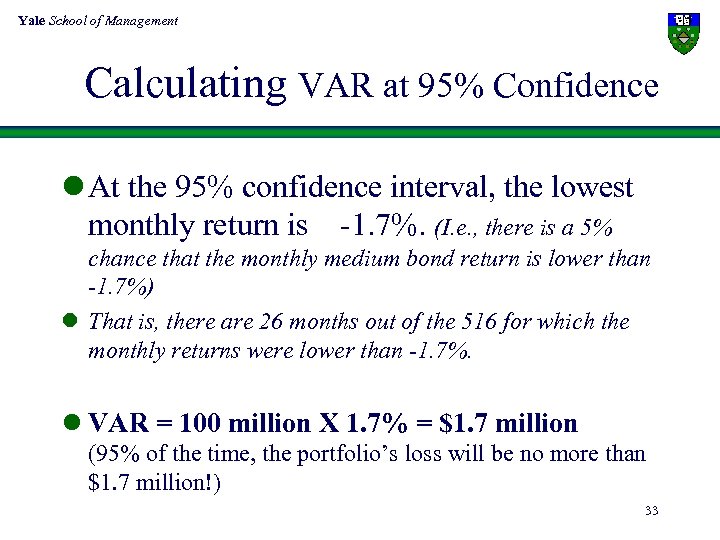 Yale School of Management Calculating VAR at 95% Confidence l At the 95% confidence interval, the lowest monthly return is -1. 7%. (I. e. , there is a 5% chance that the monthly medium bond return is lower than -1. 7%) l That is, there are 26 months out of the 516 for which the monthly returns were lower than -1. 7%. l VAR = 100 million X 1. 7% = $1. 7 million (95% of the time, the portfolio’s loss will be no more than $1. 7 million!) 33
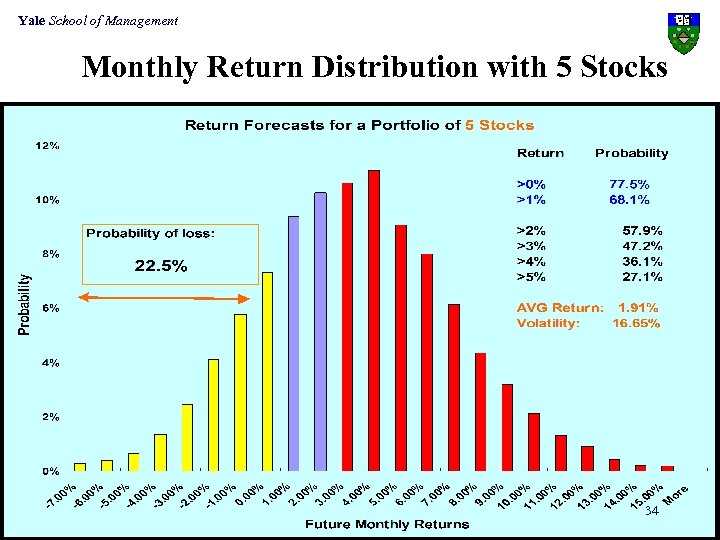 Yale School of Management Monthly Return Distribution with 5 Stocks 34
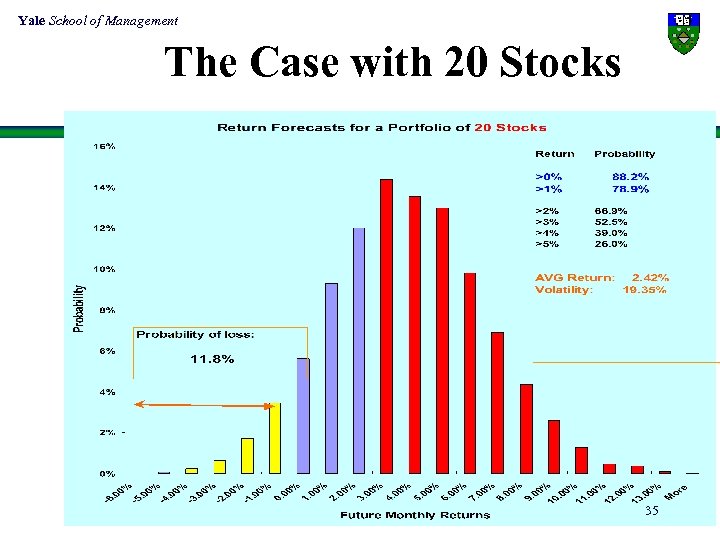 Yale School of Management The Case with 20 Stocks 35
 Yale School of Management Issues to Ponder on l What horizon is appropriate? A day, a month, or a year? l What confidence level to consider? * Are you risk averse? The more risk averse => (1) the higher confidence level necessary & (2) the lower VAR desired. 36