


 Скачать презентацию Yale Center for Medical Informatics YCMI Alz Pharm
7df2afa7f869cc455369d80ae60953e3.ppt
- Количество слайдов: 21
 Yale Center for Medical Informatics (YCMI) Alz. Pharm: an RDF Use Case for Semantic Web in Neuroscience
 Se. S 2006 Workshop, Beijing, China (Sept. 3, 2006) • Authors – – – – Hugo Y. K. Lam (CB&B Ph. D. Program) Kei Cheung (YCMI) Luis Marenco (YCMI) Perry Miller (YCMI) Nian Liu (YCMI) Chiquito Crasto (YCMI) Tim Clark (Mass. General Hospital, Harvard University) Yong Gao (Partners) June Kinoshita (Alz. Forum) Elizabeth Wu (Alz. Forum) Gwen Wong (Alz. Forum) Gordon Shepherd (Yale Neurobiology) Tom Morse (Yale Neurobiology) Susie Stephens (Oracle)
 Overview • Most of the neuroscience databases are neither integrated nor interoperating • A domain ontology is insufficient for integrating neuroscience data spanning multiple domains • We present a Semantic Web approach to building an e-Neuroscience data integration framework, which involves using RDF as a standard data model to facilitate representation and integration of data
 e-Neuroscience • Involves developing tools, technologies, and infrastructure to support multidisciplinary and collaborative science enabled by the Internet • Aims to address data integration problem in neuroscience • Fits the informatics-oriented goal of the Human Brain Project initiated by NIH • Provides a better understanding of brain function by integrating different levels of brain data.
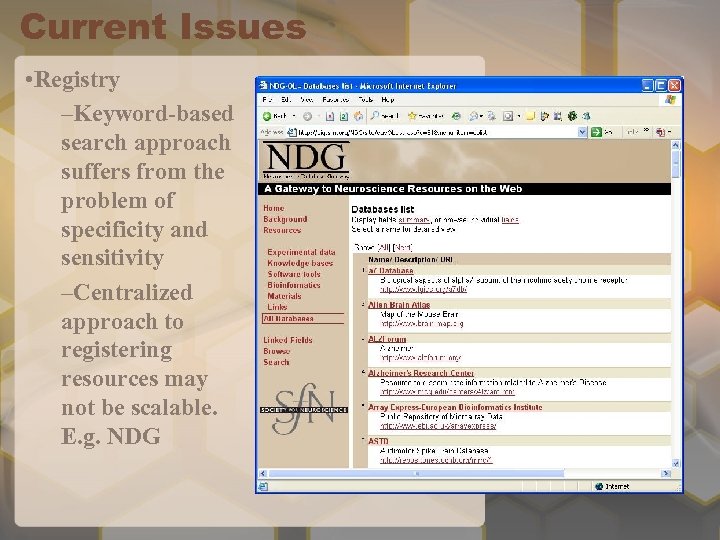 Current Issues • Registry –Keyword-based search approach suffers from the problem of specificity and sensitivity –Centralized approach to registering resources may not be scalable. E. g. NDG
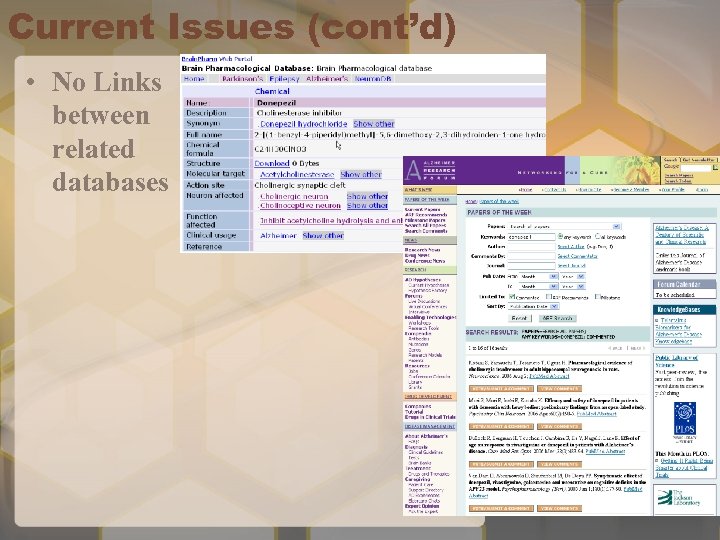 Current Issues (cont’d) • No Links between related databases
 Semantic Web Approach Representing and Integrating Data
 Semantic Web • Exposes the semantics of Web-accessible data in a standard machine-readable way so that the data can be more easily interpreted and integrated by computer programs (or Web agents) • Components of the Semantic Web technologies: – Ontology – Ontological Languages – Semantic-Web-aware Tools (e. g. , databases)
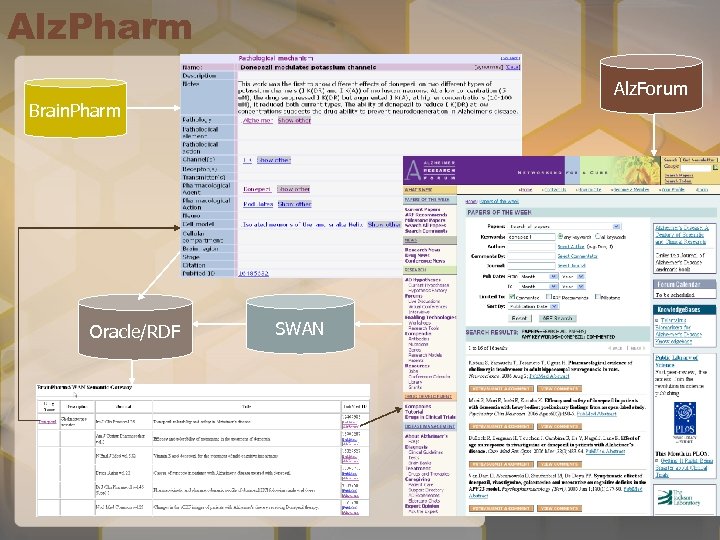
 RDF Data Modeling • Uses the Oracle RDF Data Model (which is installed on a Linux server) to build a Semantic Web data warehouse for integrating datasets extracted from two independently-developed neuroscience databases: – Brain. Pharm (a subdatabase of Sense. Lab) – SWAN (Semantic Web Applications in Neuromedicine)
 RDF Data Modeling • Brain. Pharm – A database under development to support research on drugs for the treatment of different neurological disorders (http: //senselab. med. yale. edu/senselab/Brain Pharm/alz. Data. asp) – Contains pharmacological agents that act on neuronal receptors and signal transduction pathways in the normal brain and in nervous disorders such as Alzheimer’s Disease (AD) – Enables searches for drug actions at the level of key molecular constituents, cell compartments and individual cells
 RDF Data Modeling • SWAN (http: //swan. mindinformatics. org/) – A project to develop knowledge management tools and resources for Alzheimer Disease (AD) researchers, based on an ecosystem model of scientific discourse – Uses an upper ontology, including the following components: scientists, experiments, publications, bibliographic databases, research collaborations, scientific web communities, and etc – Implemented using Semantic Web technology – Represents data in RDF format, – Currently stores a subset of data obtained from the Alzheimer Research Forum (http: //www. alzforum. org)
 Data Conversion & Loading • The drug-related (chemical) information are extracted from Brain. Pharm • The SWAN hypotheses and publications are extracted from Alzforum • SWAN data are already available in RDF format • Brain. Pharm exports data in its own XML format called EDSP (Electronic Data. Set Protocol) • Convert the EDSP/XML format into the corresponding RDF/XML format using XSL Transformation (XSLT) • Load both the SWAN and Brain. Pharm RDF datasets into the Oracle RDF Data Model using its data loader program, which takes RDF data in N-triple format
 RDF Based Queries • Oracle has extended SQL to provide support for an RDF query language, which allows users to perform queries against multiple RDF datasets • The following two examples illustrate how such queries can be made to retrieve and integrate data from Brain. Pharm and SWAN
 RDF Based Queries • Example One – Target • Query Brain. Pharm to group and count AD drugs based on their molecular targets – Result • There are 2 groups of drugs for AD. • The first one contains 5 drugs that act as acetylcholinesterase inhibitors. • The second one contains only 1 drug that is a N-methyl-D-aspartic acid (NMDA) receptor antagonist.
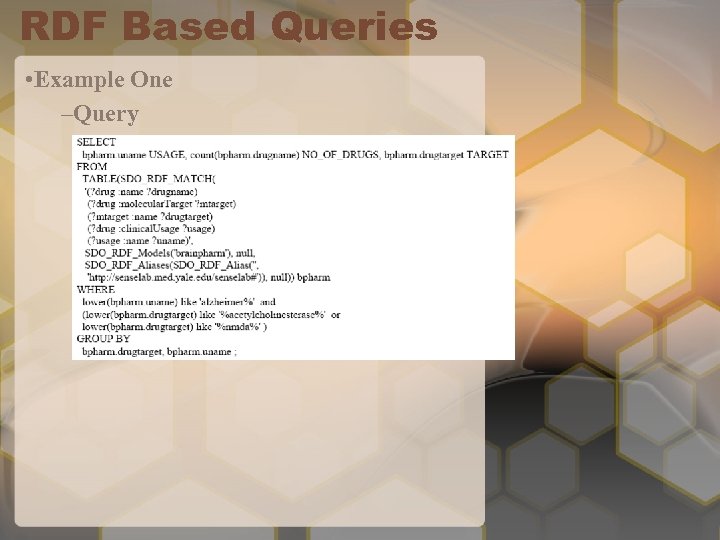 RDF Based Queries • Example One –Query
 RDF Based Queries • Example One – Remarks • Current implementations of RDF query languages (RQL) by specialized RDF stores do not support aggregate functions (e. g. , COUNT, SUM and AVERAGE) via “GROUP BY” • The Oracle RDF query language supports such functions, as it is a hybrid between RQL and SQL
 RDF Based Queries • Example Two – Target • Retrieves the information (stored in Brain. Pharm) about the AD drug “Donepezil” and publications (stored in SWAN) whose titles or abstracts contain the term “Donepezil” (case-insensitive) • Demonstrates the use of RDF inferencing based on the parentchild (is-a) relationship between the Publication class (e. g. , original articles retrieved from Pub. Med) and ARFPublication class (e. g. , Pub. Med articles that have been commented by researchers/curators associated with Alzforum) as defined in the SWAN RDF Schema
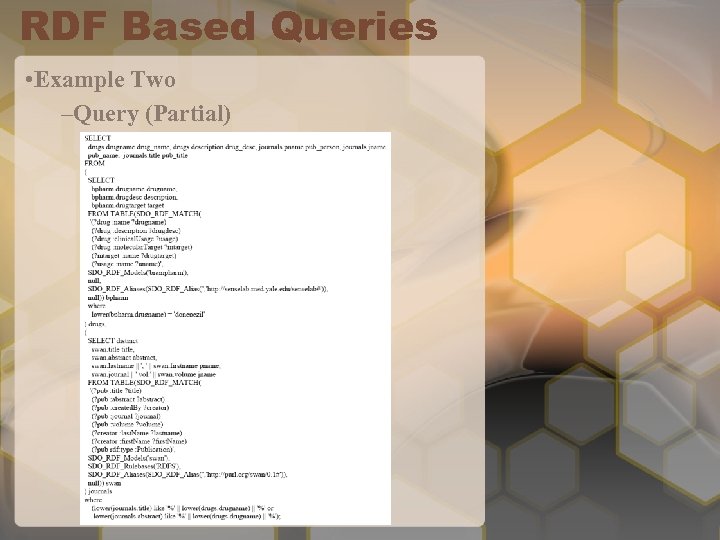 RDF Based Queries • Example Two –Query (Partial)
 RDF Based Queries • Example Two – Result • With the is-a inference rule incorporated into the query, it finds a total of 19 publications that are linked to claims and/or hypotheses that have to do with the effect of Donepezil on AD treatment • Among these publications, one of them belongs to the ARFPublication class (i. e. , one of the 19 publications is ARFcommented) • Given the ID (Pub. Med ID) of the commented publication, the user can retrieve the detailed comments through the Alzforum Web site
 RDF Based Queries • Example Two – Remarks • In the SWAN dataset, publications (e. g. , those retrieved from Pub. Med) are treated as instances of the Publication class • We define publications that have been commented in the Alzforum as instances of the ARFPublication class • The Oracle RDF Data Model allows us to create rules for hierarchical relationships from the RDFS for the data so that it enables us to find out all the publications and its subclasses (e. g. the ARF publications)
 Alz. Pharm Alz. Forum Brain. Pharm Oracle/RDF SWAN