



 Y, NE UR JO M O D AN TH G IC OU IN K ER E S F N M H O O A T : TT IC E 9: O 1 R C H. B N N T O FA I E CH T E R EC TH TH S U Y, O S R ER -O AV L S O U R LI ES V
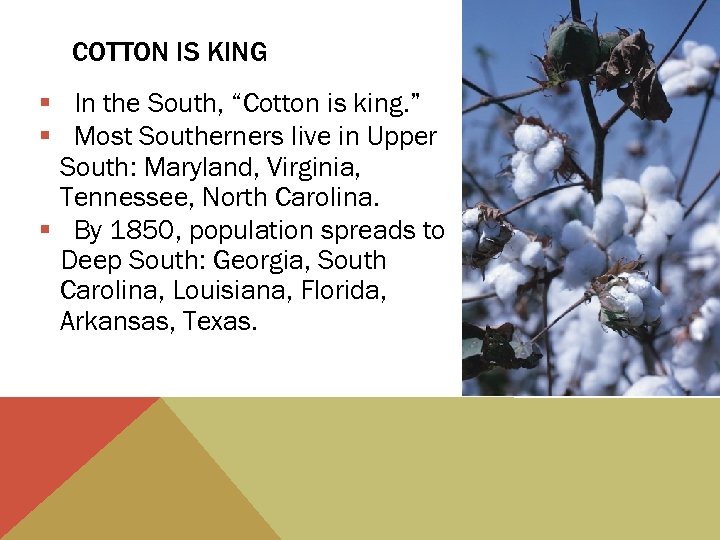 COTTON IS KING § In the South, “Cotton is king. ” § Most Southerners live in Upper South: Maryland, Virginia, Tennessee, North Carolina. § By 1850, population spreads to Deep South: Georgia, South Carolina, Louisiana, Florida, Arkansas, Texas.
 COTTON IS KING § Cotton is extremely painful & difficult to harvest. § 1793: Northerner, Eli Whitney, invents cotton gin, a simple machine for separating cotton from seeds. § Originally intended to make cotton production easier § With easier separating comes more demand for cotton, and thus more demand for land to grow it & slaves to pick it. § Land ultimately comes from Natives.
![COTTON ENGINE (“GIN”) Video [click]](https://present5.com/presentation/d50b2f2c27a5834896b8616368377f87/image-4.jpg "COTTON ENGINE (“GIN”) Video [click]") COTTON ENGINE (“GIN”) Video [click]
COTTON ENGINE (“GIN”) Video [click]
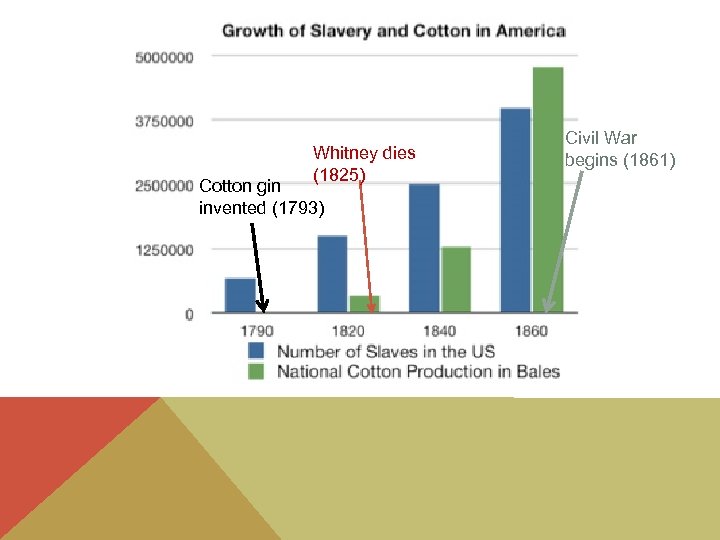 Whitney dies (1825) Cotton gin invented (1793) Civil War begins (1861)
 UPPER SOUTH VS. DEEP SOUTH §Both Upper & Deep South are agricultural. §Upper South still relies on tobacco, hemp, wheat, vegetables, etc. §Deep South is committed to cotton and some rice & sugarcane. §Increased demand for cotton/sugar = increased demand for slaves.
 SOUTHERN ECONOMY § While North is becoming industrial & urban, South is predominantly rural—based on country life & agriculture. § Why? § Agriculture becomes profitable. § Most Southerners lack capital—investment money— since most of their wealth is tied up in land & slaves. § Most Southerners lack $$ to buy goods. § The market isn’t as big in the South. § Many Southerners don’t want industry.
 SOUTHERN ECONOMY §Some Southerners argue for Southern industry. §William Gregg opens a North-inspired textile factory. §Joseph Reid Anderson improves Tredegar Iron Works in Virginia. §Without much industry, South is dependent on North for manufactured goods. §Industry would revive Upper South’s economy. §But South remains basically rural towns & plantations. §Only large cities: Baltimore, Charleston, & New Orleans.
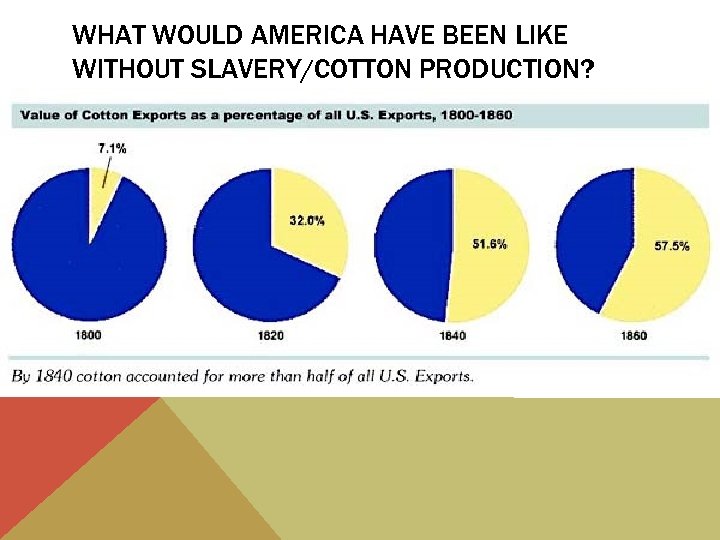 WHAT WOULD AMERICA HAVE BEEN LIKE WITHOUT SLAVERY/COTTON PRODUCTION?
 MOVING WEST §Cotton production moves west, leading to statehood for Mississippi, Alabama, & Arkansas. §But transportation is scarce. §Natural waterways are primary means of transportation. §Railways are present but rare. §As a result, Southern cities are disconnected & grow slowly.
 Y, E E N G U H UR JO LY S U N H A T LO U IC OU K N ER E S O ID M H TH R A T : OU E E 9: 2 S H T TH. I O N T H E N O E CH C T N S I M O N H O , TI LI RE A -O M NT O H LA P E FE
 LIFE ON SMALL FARMS §Most farmers are not rich plantation owners. §Most are yeomen, poorer farmers who don’t own slaves but do own land. §Others are tenant farmers, who own no land but work on rented land. §Still others live in tiny cabins and grow food only for themselves. §Most still look down on slaves.
 PLANTATIONS §Plantation homes are nice, but real wealth is in land, goods, & slaves. §Wealthiest 12% of slave-owners own over ½ of all slaves! §Plantation owners work for profit, hoping to offset fixed costs: housing & feeding workers and maintaining equipment.
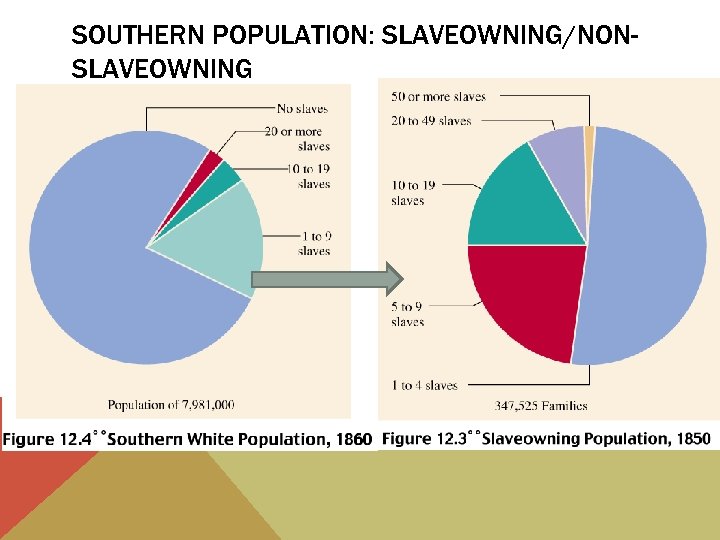 SOUTHERN POPULATION: SLAVEOWNING/NONSLAVEOWNING
 COTTON EXCHANGES §Price of cotton rises and falls. §Planters sell cotton to agents in big cities (like New Orleans, Charleston, Mobile & Savannah) during cotton exchanges. § Agents give planters credit, a kind of loan. §During this time, agents hold cotton until price rises, and then sell it for the highest price. §This means planters are always in debt, waiting for the agents to sell.
 LIFE ON THE PLANTATION §Wives have little leisure; they work hard and are bored. §Slaves work in fields and the home but always have an overseer, the plantation manager. §Slaves work sunrise to sunset; conditions are usually harsh. §Some slave-owners are not unkind to slaves, however. §Some free African-Americans even own slaves, usually family members, bought just to be freed.
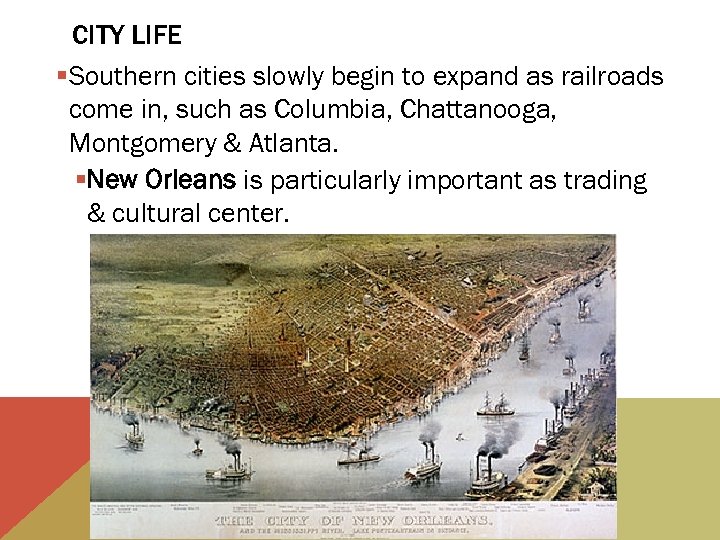 CITY LIFE §Southern cities slowly begin to expand as railroads come in, such as Columbia, Chattanooga, Montgomery & Atlanta. §New Orleans is particularly important as trading & cultural center.
 CITY LIFE §Free African-Americans are often able to create their own communities. §However, they are still discriminated against and denied equal treatment.
 EDUCATION IN THE SOUTH § Early on, only rich Southern children attend school much, usually private schools. § However, by mid-1800’s, many public schools are open in the South. § But South lags behind North in literacy—ability to read & write. § Many Southerners can’t afford to send kids away from work. § Very few people per sq. mi. § Many also feel education is private affair & govt. shouldn’t pay for it. § Slaves are not educated. § Learning to read & write gives them too much power.
 Y, E ! D N A R O U LR JO AI R N H N D A T IO N T U IC OU U O T R S R E E TI G S R M H N E A T : RI D N U HE. 9: O N 3 L I A E T U I H H CT EC T C S E TH E -O P R - LL A AB O AR D
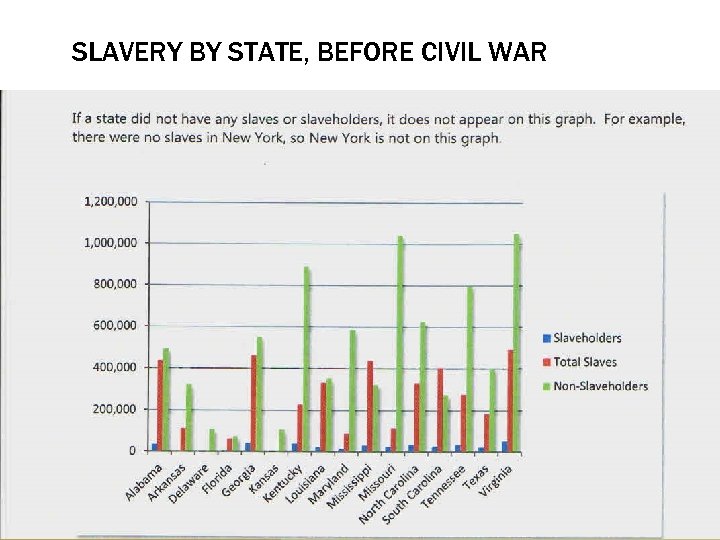 SLAVERY BY STATE, BEFORE CIVIL WAR
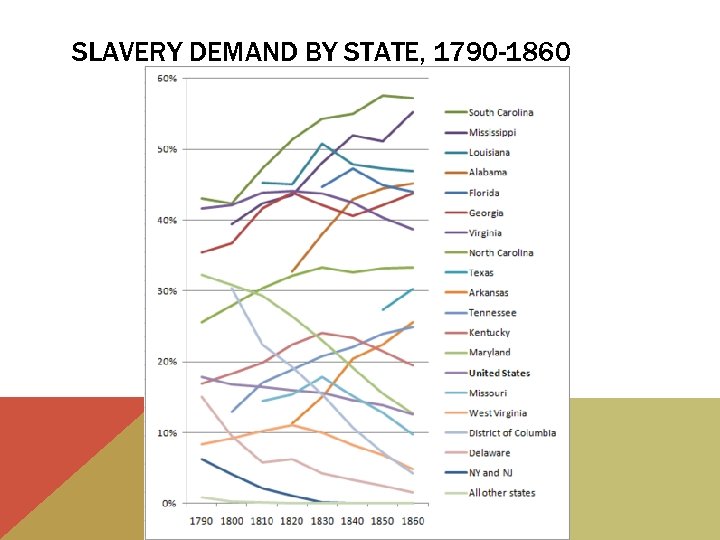 SLAVERY DEMAND BY STATE, 1790 -1860
 SLAVE FAMILY LIFE §Slaves can be sold/separated from family & friends at any time. §Because of this, slaves build long, strong family bonds. §Aunts, uncles, etc. raise children if parents taken away. §These are called extended families. §Slave marriages not recognized, though they do occur. §“…until death or separation do us part…”
 AFRICAN-AMERICAN CULTURE §Remember slave trade was outlawed in 1808 by the Constitution? §No new slaves can enter the country. §So by 1860 most slaves had been born in U. S. §How do slaves survive the life? §African culture, song, community, etc. mix w/ American culture. §Christianity also mixes w/ native religions.
 AFRICAN-AMERICAN CHRISTIANITY §Slaves see Christianity as religion of hope & promise of freedom. §Spirituals, African-American religious folk songs, get popular. §“Didn’t My Lord Deliver Daniel? ”, “Swing Low, Sweet Chariot, ” “Follow the Drinking Gourd, ” etc. §Often these “code songs” contain secret messages. §Daniel = slaves §Drinking gourd = Big Dipper, points to North
 SOLOMON NORTHUP, FORMER FREEDMAN, CAPTURED & ENSLAVED (1841) "The hands are required to be in the cotton field as soon as it is light in the morning, and, with the exception of ten or fifteen minutes, which is given them at noon to swallow their allowance of cold bacon, they are not permitted to be a moment idle until it is too dark to see, and when the moon is full, they often times labor till the middle of the night. They do not dare to stop even at dinner time, nor return to the quarters, however late it be until the order to halt is given by the driver. The day's work over in the field, the baskets are "toted, " or in other words, carried to the gin-house, where the cotton is weighed. No matter how fatigued and weary he may be -- no matter how much he longs for sleep and rest -- a slave never approaches the gin-house with his basket of cotton but with fear. If it falls short in weight -- if he has not performed the full task appointed of him, he knows that he must suffer. And if he has exceeded it by ten or twenty pounds, in all probability his master will measure the next day's task accordingly. So, whether he has too little or too much, his approach to the ginhouse is always with fear and trembling. "
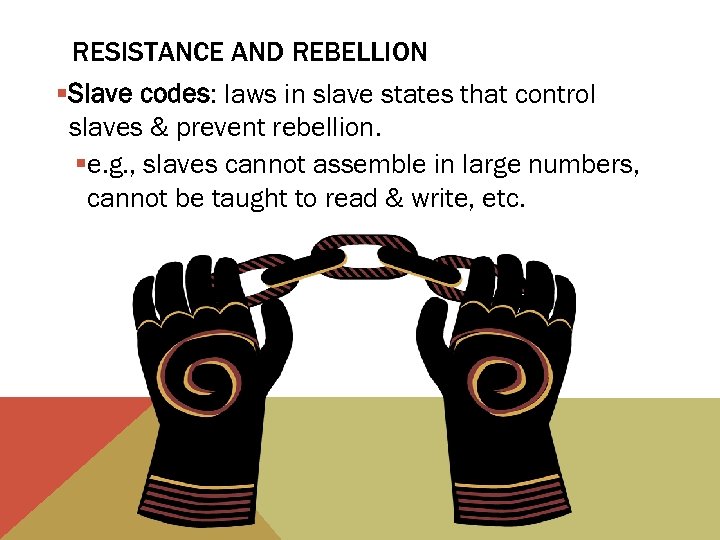 RESISTANCE AND REBELLION §Slave codes: laws in slave states that control slaves & prevent rebellion. §e. g. , slaves cannot assemble in large numbers, cannot be taught to read & write, etc.
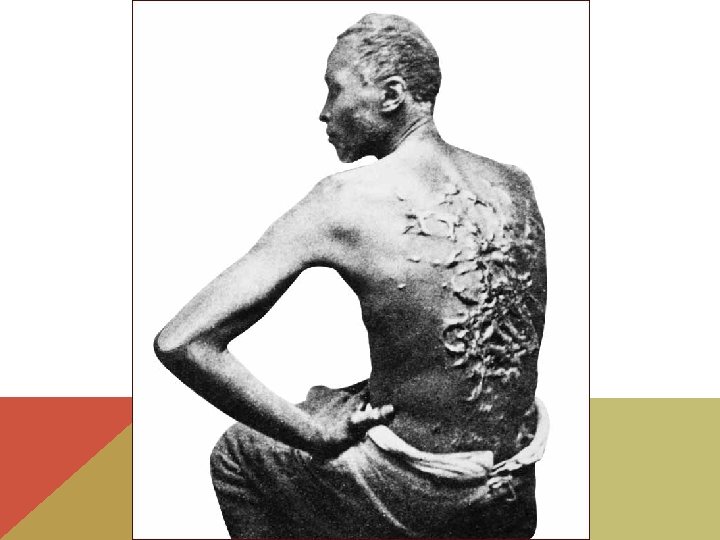
 RESISTANCE AND REBELLION §Some do rebel, such as Nat Turner, slave who educates himself. §Turner leads slaves on rampage in 1831—leads to 55 white people’s deaths. §Turner is hanged, and more slave codes are enforced. §Other slave leaders are Gabriel Prossner, Denmark Vesey & David Walker. §Vesey believes Bible & Dec. of Ind. forbid slavery.
 FROM DAVID WALKER’S APPEAL “…show me a page of history, either sacred or profane, on which a verse can be found, which maintains, that the Egyptians heaped the insupportable insult upon the children of Israel, by telling them that they were not of the human family. Can the whites deny this charge? Have they not, after having reduced us to the deplorable condition of slaves under their feet, held us up as descending originally from the tribes of Monkeys or Orang- Outangs? O! my God! I appeal to every man of feeling--is not this insupportable? Is it not heaping the most gross insult upon our miseries, because they have got us under their feet and we cannot help ourselves? Oh! pity us we pray thee, Lord Jesus, Master. -Has Mr. Jefferson declared to the world, that we are inferior to the whites, both in the endowments of our bodies and of minds? It is indeed surprising, that a man of such great learning, combined with such excellent natural parts, should speak so of a set of men in chains. I do not know what to compare it to, unless, like putting one wild deer in an iron cage, where it will be secured, and hold another by the side of the same, then let it go, and expect the one in the cage to run as fast as the one at liberty. ”
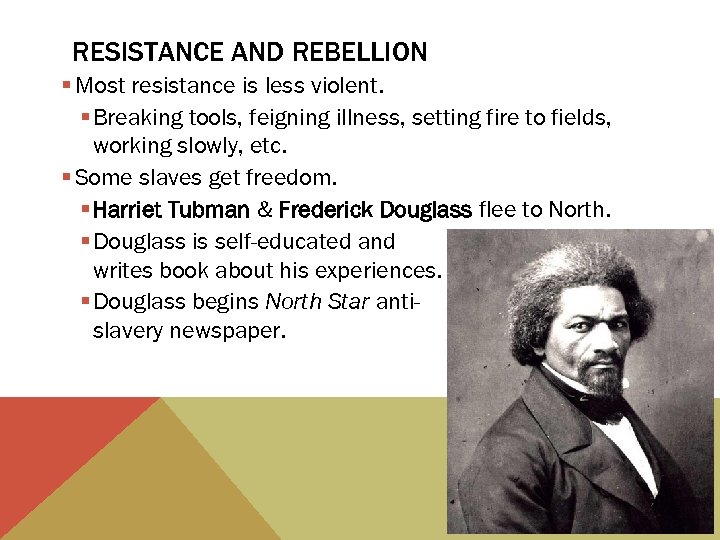 RESISTANCE AND REBELLION § Most resistance is less violent. § Breaking tools, feigning illness, setting fire to fields, working slowly, etc. § Some slaves get freedom. § Harriet Tubman & Frederick Douglass flee to North. § Douglass is self-educated and writes book about his experiences. § Douglass begins North Star antislavery newspaper.
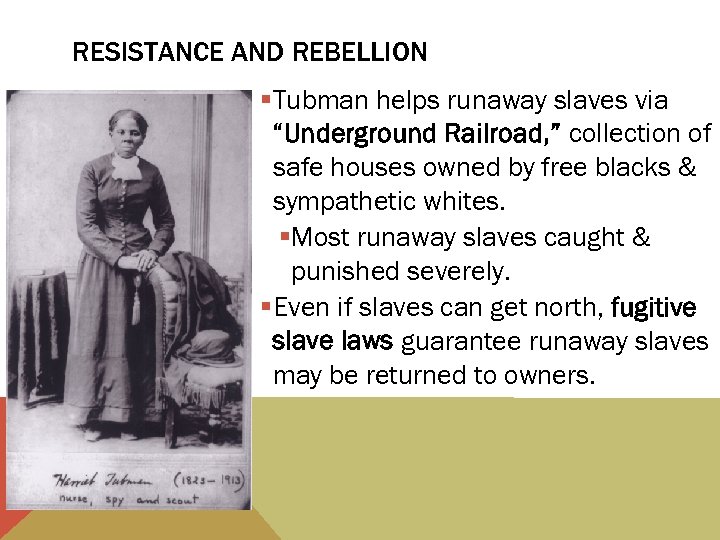 RESISTANCE AND REBELLION §Tubman helps runaway slaves via “Underground Railroad, ” collection of safe houses owned by free blacks & sympathetic whites. §Most runaway slaves caught & punished severely. §Even if slaves can get north, fugitive slave laws guarantee runaway slaves may be returned to owners.
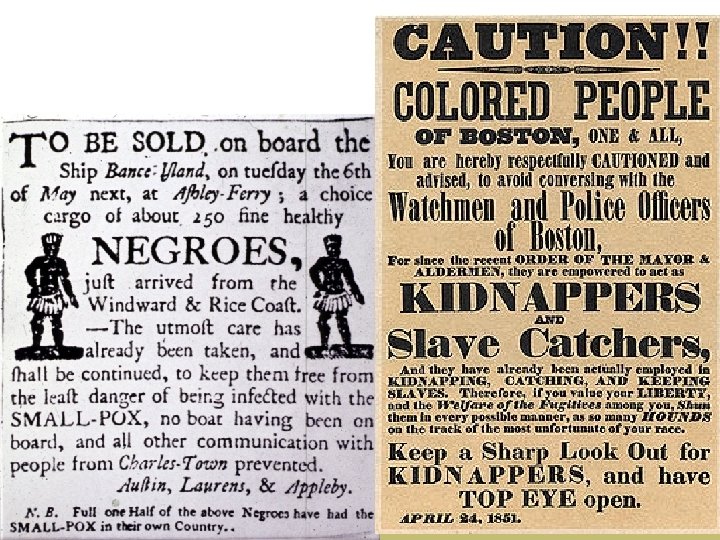
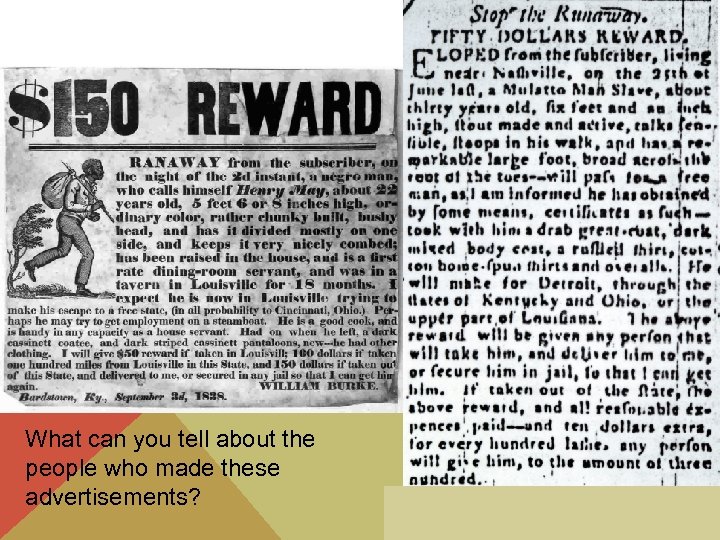 What can you tell about the people who made these advertisements?
 FIN
FIN