 Скачать презентацию YΠΟΥΡΓΕΙΟ ΠΟΛΙΤΙΣΜΟΥ ΠΑΙΔΕΙΑΣ ΚΑΙ ΘΡΗΣΚΕΥΜΑΤΩΝ ΓΕΝΙΚΗ ΓΡΑΜΜΑΤΕΙΑ ΕΡΕΥΝΑΣ
67f6342bab16952d78a33d1f76687b64.ppt
- Количество слайдов: 65




YΠΟΥΡΓΕΙΟ ΠΟΛΙΤΙΣΜΟΥ, ΠΑΙΔΕΙΑΣ ΚΑΙ ΘΡΗΣΚΕΥΜΑΤΩΝ ΓΕΝΙΚΗ ΓΡΑΜΜΑΤΕΙΑ ΕΡΕΥΝΑΣ ΚΑΙ ΤΕΧΝΟΛΟΓΙΑΣ ΔΙΑΧΕΙΡΙΣΤΗΣ ΠΡΟΓΡΑΜΜΑΤΟΣ Department of Political Science Centre for Political Research & Documentation (KEPET) Centre for Human Rights (KEADIK) EEA Grants/ GR 07 - 3757: “Neets 2” Project Theoretical Insights, Prior Research Findings and Key- Findings of the Quantitative Research of the ongoing ‘Neets 2” project: NEETs’ social inclusion/ exclusion, employability, civic values and political behavior. Synthesis Editing : Prof Nikos Papadakis (Project Team leader)
Table of Contents Preliminary remarks: Definitional Issues and Theoretical Insights Part I. On Youth Unemployment Part II. Neets in the EU (secondary data analysis) Part III. Neets in Greece (secondary data analysis) Part IV. Prior Research findings on Neets’ characteristics Part V. Key Findings of the ongoing Neets 2 EEA – funded project Final Conclusions References
Preliminary remarks: Definitional Issues and Theoretical Insights The case of NEETs (young people not in education, employment or training) does not just concern the European Union, but it extends at a broader international level (see in detail Papadakis, 2013: 48). As Liang (2009: 18) points out, the phenomenon of NEETs in many Asian countries constitutes a major problem not only at family level but also at governmental and societal level, such as in China, Japan and Korea (see also Drakaki, Papadakis, Kyridis & Papargyris 2014: 243). “Today, despite the lack of an internationally accepted definition of NEETs, an indicator has been developed in the EU (NEET indicator), which has been widely used since the beginning of the recession to perform cross-country comparisons at a European (EU) as well as at an international level (OECD countries)” (Drakaki, Papadakis et al. 2014: 243). Specifically, the term NEET in most European countries refers to young people aged 15 -24 (European Commission, 2013: 2 & Kotroyannos et al 2015: 270). As regards NEETs’ sub-categories among their total population, according to the Eurofound (2012) NEETs in Europe may be classified in five main sub-groups, namely the following: “the conventionally unemployed, the largest subgroup, …. the unavailable, …. the disengaged…. the opportunity-seekers…. the voluntary NEETs” (Eurofound, 2012: 24). It seems that specific groups have an increased probability of becoming NEETs, including those “with low levels of education, an immigration background, some level of disability or problems of mental health as well as young people with a problematic family background” (Eurofound, 2012: 55 -56). There is obviously a heterogeneity within the NEETs category/ group (Papadakis et al 2015: 47). The share of the NEETs population varies among EU member states.
According to Mac. Donald, while there is little doubt that “young people who are NEET can face a range of disadvantages” (my emphasis), it is also true that the category may include “emerging adults”, who are simply better off and “experimenting with life-style choices, postponing occupational commitments, perhaps enjoying gap years” (Mac. Donald 2011: 431). Furlong (2006: 553) correctly points out that Neets as a social category is a “flawed concept”, merging some “extremely disadvantaged” with others who are in fact “able to exercise choices” (Furlong 2006: 553). Williamson (2005: 13), argues that the label Neets became ‘a crude proxy by which wider forms of ‘social exclusion’ may be defined’.
v. In Greece, until recently, no field research dealing with NEETs has been conducted. According to the 2012 Eurofound study, Greece belongs to the cluster of European countries with high NEETs’ percentages, an inherent gender dimension, remarkable rates of inactivity, no particular work experience, medium and highly educated NEETs, who are particularly disheartened (Eurofound 2012: 39 -40 and Drakaki et al. 2014: 245). v. The national-scale research project on NEETs, namely the “Absents’ Barometer: The NEETs” (2011 - 2013) confirmed several of the Eurofound assertions and findings, while it questioned others (see analytically Papadakis 2013 and Papadakis et al 2015: 44 - 75) v. That project’s findings set the base for a) the NEETs composite indicator, b) the establishment of an integrated policy proposal (in multiple levels of public policies and within different scenarios), c) the formation of the NEETs GIS, and d) the creation of a road map for an integrated intervention to prevent the social exclusion of NEETs, leading to an applied public policy complex. v. At the same time a) the main characteristics of NEETs problems were recorded, b) their demographic and social characteristics were analyzed, c) the main factors contributing to the characterization of a young person as a NEET (gender, age, urbanity, educational level, family income, nationality) were examined, d) their views and attitudes in respect to education and training, employment, social welfare and the political system as well as their strategies regarding a way out of the situation they are suffering were analyzed, e) the impact deriving from the expansion of the NEETs phenomenon at an economic and social level was investigated, (impact assessment) f) taxonomic categories to address the profile of the NEET in Greece (in relation to the profiles of the NEETs in Europe) were formed and g) integrated interpretations on this multi-perspective and complex phenomenon were attempted.
v. Now, a new EEA- funded (EEA Grants/ GR 07 - 3757) project titled “Research and Comprehensive Intervention for the social inclusion of a major socially vulnerable group: Psychological profile / psychopathology, skills' profile, needs assessment and programmes' development for trainingreskilling and psychological support towards the re-inclusion of "young people not in education, employment of training/ NEETS 2"”, is in progress. v. The project includes, among others, a large- scale quantitative research aiming at A) mapping the specific psychological profiles and/or possible high risk for psychopathology among Greek NEETs and B) Analyze the different facets of the impact of the ongoing recession to NEETs’’ life course, civic values and political behavior. v. As already mentioned, NEETs consist a heterogeneous and vulnerable social group, that may be associated with several different parameters, such as poor educational attainment, teenage pregnancy, disability, as well as mental health issues (see Papadakis et al 2015: 44 -75 and Kotroyannos et al 2015: 272 - 276). v. Psychopathology may be either a risk factor or a consequence of being a NEET. However, up to date, there are very few studies addressing the association between psychopathology and the NEETs phenomenon. In a large US national study investigating psychopathology as a risk factor for becoming a NEET, Breslau et al found that conduct disorder and ADHD are risk factors for failure to graduate high school (Breslau et al 2011). v. Moreover, a large scale study conducted by the World Health Organization, including 16 different countries, showed that specific mental disorders, i. e. mood/anxiety disorders, substances abuse and impulse disorders, are associated with non-completion of education both in high and in low-income countries (Lee et al 2009)
üOn the other hand being a NEET can lead to social isolation, lack of daily routine, lack of supervision that takes place in school / work, and low self-esteem for failing to fulfill the family and society expectations. All the above could result to development of psychopathology and even-more could lead to social exclusion and hamper employability. üData on the first hypothesis are very limited. A study in New Zealand found that among teenagers and young unemployed people, the risk of suicidality, substances abuse and antisocial behaviors is significantly high (Fergusson, Horwood, Woodward 2001). Finally, an interesting study among NEETs in Mexico showed that teenager NEETs have higher risk for mood anxiety disorders, substances abuse, conduct disorders and suicide, compared to those who are still in education (Benjet et al 2012). üBased on the Absents’ Barometer findings the authors conclude that the education milieu has a protective role against the development of psychopathology as well as against the complete social exclusion. In Greece (as well as in E. U. ) no similar studies have been conducted so far. The project “Absents’ Barometer” found that, among Greek NEETS, anxiety and despair rates are prevalent to the 54% and 31% of the sample, respectively (see Kotroyannos et al 2015: 275 - 276). üBased on the above-mentioned, the relevant research, within the Neets 2 project, investigates among other issues in respect to symptoms of anxiety, mood disorders, Attention Deficit Hyperactivity Disorder (ADHD), drug and alcohol abuse, suicidality and personality traits (possibly grouped in different clusters reflecting the heterogeneity of our group) which, may be associated with behavioral disorders, using weighted, structured questionnaires and scales validated in Greek. üSome of the findings related to psychological issues are presented hereby, while the emphasis of the presentation in on issues related to Neets’ employability, civic values and political behavior. üThe main relevant findings of the quantitative research on the abovementioned issues are presented hereby for the first time.

PART I On Youth Unemployment
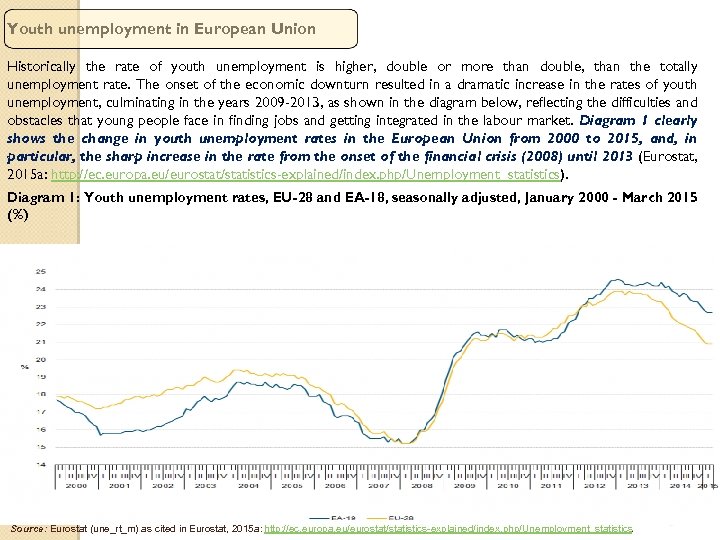
Youth unemployment in European Union Historically the rate of youth unemployment is higher, double or more than double, than the totally unemployment rate. The onset of the economic downturn resulted in a dramatic increase in the rates of youth unemployment, culminating in the years 2009 -2013, as shown in the diagram below, reflecting the difficulties and obstacles that young people face in finding jobs and getting integrated in the labour market. Diagram 1 clearly shows the change in youth unemployment rates in the European Union from 2000 to 2015, and, in particular, the sharp increase in the rate from the onset of the financial crisis (2008) until 2013 (Eurostat, 2015 a: http: //ec. europa. eu/eurostat/statistics-explained/index. php/Unemployment_statistics). Diagram 1: Youth unemployment rates, EU-28 and EA-18, seasonally adjusted, January 2000 - March 2015 (%) Source: Eurostat (une_rt_m) as cited in Eurostat, 2015 a: http: //ec. europa. eu/eurostat/statistics-explained/index. php/Unemployment_statistics. 9
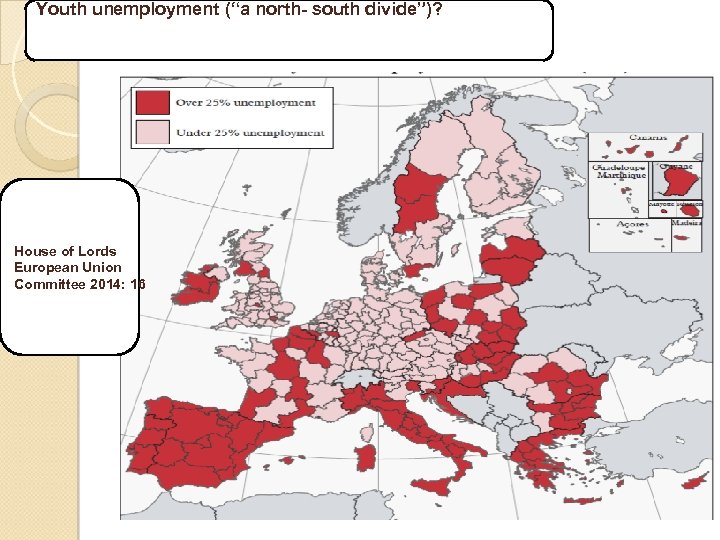
Youth unemployment (“a north- south divide”)? House of Lords European Union Committee 2014: 16
Youth unemployment in Greece Undoubtedly Greece is one of the EU countries where the impact of the economic crisis was rapid and visible from the first months it hit the country. Although, according to a study of Eurofound “Greece is not considered one of the countries dramatically influenced by the economic recession in terms of employment, and consequently, in an increase of youth unemployment. . ” (Eurofound, 2012: 39 & 41 as ref. in Drakaki, Papadakis, Kyridis & Papargyris, 2014: 245), however the statistics in the field of employment are quite different from the above assertion and disapprove it. Specifically, based on recent Eurostatistics which published in May 2016, youth unemployment in Greece dropped to 51, 4% (February 2016) from 51, 6% which was in April 2015 and 51, 9% in January 2016. However, Greek youth unemployment still remains jointly with Spain (45% in April 2016) at the top of the ranking among M-S (Eurostat, 2016 a: http: //ec. europa. eu/eurostat/documents/2995521/7412086/3 -31052016 -AP-EN. pdf/d 9 ad 7 f 43 -ce 6 d 494 b-8777 -f 30 d 42505328). In relation to youth unemployment and sex, in February 2016 in Greece the percentage of women’s youth unemployment was higher (57, 1%) than men’s (46, 7%) (Eurostat, 2016 b: http: //ec. europa. eu/eurostat/tgm/refresh. Table. Action. do? tab=table&plugin=1&pcode=teilm 021&lang uage=en). In particular, at regional level within the period 2008 -2015, although the increase in all regions in Greece is undeniable, it observed a significant increase in youth unemployment rates in Thessalia (2010: 34, 4%, 2015: 60, 3%), Peloponnisos(2010: 29%, 2015: 50, 5%), Notio Aigaio (2008: 14, 9%, 2015: 33, 8%), Attiki (2008: 19, 1%, 2015: 47, 2%) and Kriti (2008: 14%, 2015: 40, 4%) (Eurostat, 2016 c: http: //appsso. eurostat. ec. europa. eu/nui/submit. View. Table. Action. do) (see Table 2). 11
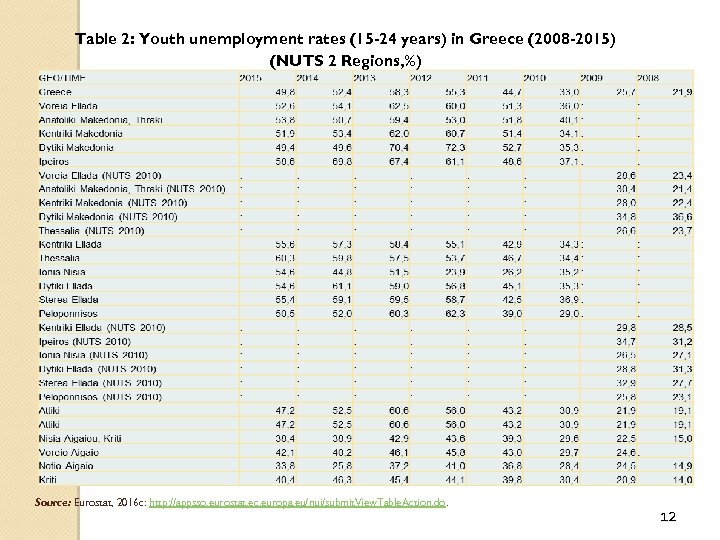
Table 2: Youth unemployment rates (15 -24 years) in Greece (2008 -2015) (NUTS 2 Regions, %) Source: Eurostat, 2016 c: http: //appsso. eurostat. ec. europa. eu/nui/submit. View. Table. Action. do. 12

PART II Neets in Europe
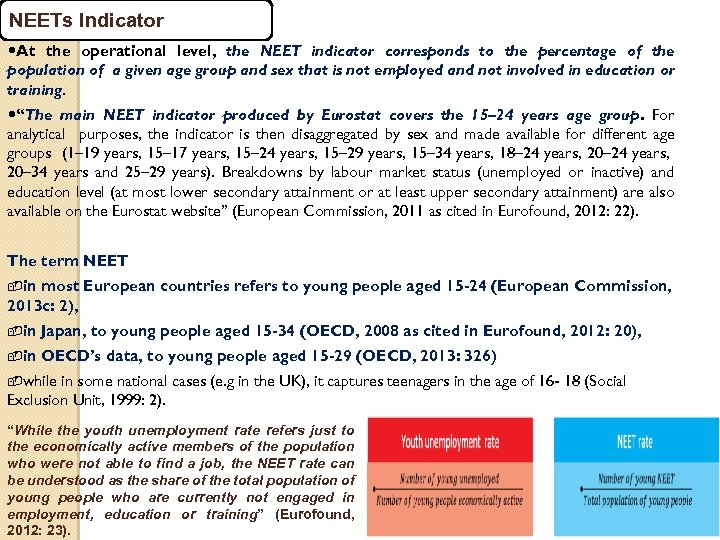
NEETs Indicator At the operational level, the NEET indicator corresponds to the percentage of the population of a given age group and sex that is not employed and not involved in education or training. “The main NEET indicator produced by Eurostat covers the 15– 24 years age group. For analytical purposes, the indicator is then disaggregated by sex and made available for different age groups (1– 19 years, 15– 17 years, 15– 24 years, 15– 29 years, 15– 34 years, 18– 24 years, 20– 34 years and 25– 29 years). Breakdowns by labour market status (unemployed or inactive) and education level (at most lower secondary attainment or at least upper secondary attainment) are also available on the Eurostat website” (European Commission, 2011 as cited in Eurofound, 2012: 22). The term NEET -in most European countries refers to young people aged 15 -24 (European Commission, 2013 c: 2), -in Japan, to young people aged 15 -34 (OECD, 2008 as cited in Eurofound, 2012: 20), -in OECD’s data, to young people aged 15 -29 (OECD, 2013: 326) -while in some national cases (e. g in the UK), it captures teenagers in the age of 16 - 18 (Social Exclusion Unit, 1999: 2). “While the youth unemployment rate refers just to the economically active members of the population who were not able to find a job, the NEET rate can be understood as the share of the total population of young people who are currently not engaged in employment, education or training” (Eurofound, 2012: 23). 14
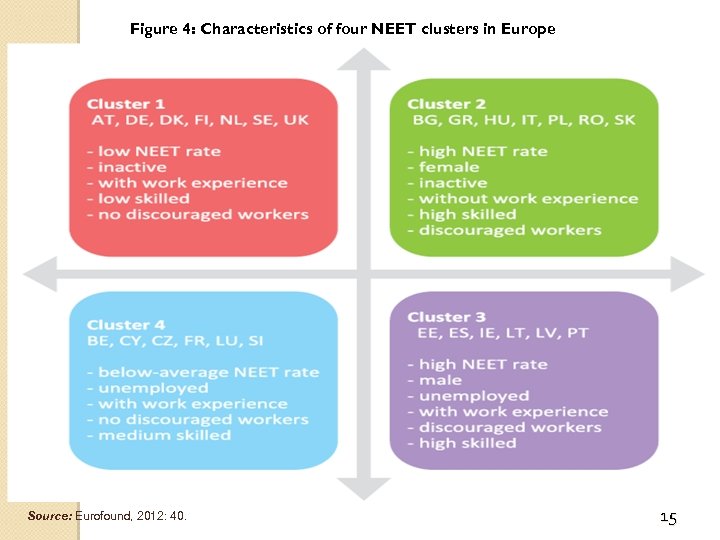
Figure 4: Characteristics of four NEET clusters in Europe Source: Eurofound, 2012: 40. 15
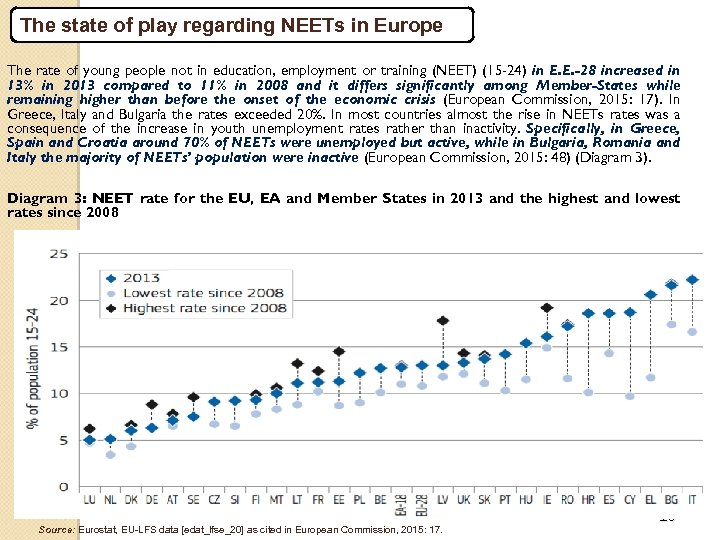
The state of play regarding NEETs in Europe The rate of young people not in education, employment or training (NEET) (15 -24) in E. E. -28 increased in 13% in 2013 compared to 11% in 2008 and it differs significantly among Member-States while remaining higher than before the onset of the economic crisis (European Commission, 2015: 17). In Greece, Italy and Bulgaria the rates exceeded 20%. In most countries almost the rise in NEETs rates was a consequence of the increase in youth unemployment rates rather than inactivity. Specifically, in Greece, Spain and Croatia around 70% of NEETs were unemployed but active, while in Bulgaria, Romania and Italy the majority of NEETs’ population were inactive (European Commission, 2015: 48) (Diagram 3). Diagram 3: NEET rate for the EU, EA and Member States in 2013 and the highest and lowest rates since 2008 Source: Eurostat, EU-LFS data [edat_lfse_20] as cited in European Commission, 2015: 17. 16
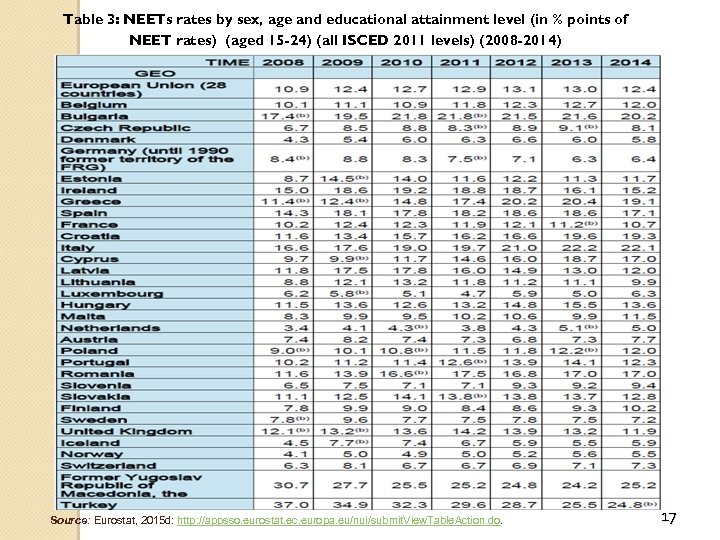
Table 3: NEETs rates by sex, age and educational attainment level (in % points of NEET rates) (aged 15 -24) (all ISCED 2011 levels) (2008 -2014) Source: Eurostat, 2015 d: http: //appsso. eurostat. ec. europa. eu/nui/submit. View. Table. Action. do. 17
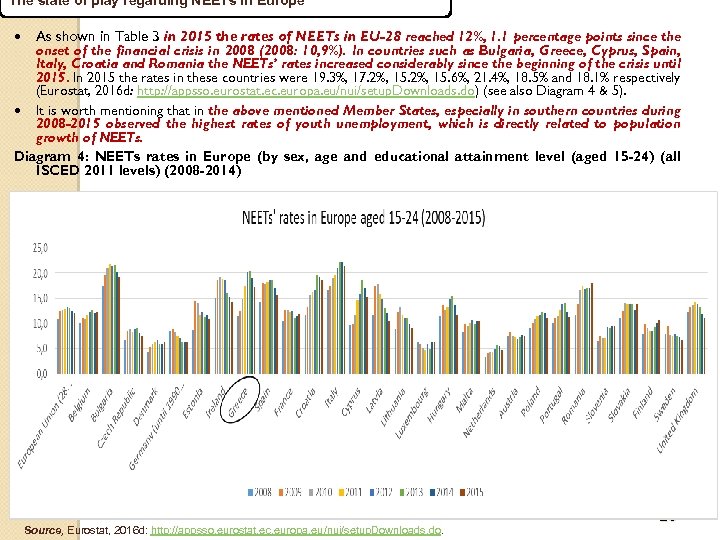
The state of play regarding NEETs in Europe As shown in Table 3 in 2015 the rates of NEETs in EU-28 reached 12%, 1. 1 percentage points since the onset of the financial crisis in 2008 (2008: 10, 9%). In countries such as Bulgaria, Greece, Cyprus, Spain, Italy, Croatia and Romania the NEETs’ rates increased considerably since the beginning of the crisis until 2015. In 2015 the rates in these countries were 19. 3%, 17. 2%, 15. 6%, 21. 4%, 18. 5% and 18. 1% respectively (Eurostat, 2016 d: http: //appsso. eurostat. ec. europa. eu/nui/setup. Downloads. do) (see also Diagram 4 & 5). It is worth mentioning that in the above mentioned Member States, especially in southern countries during 2008 -2015 observed the highest rates of youth unemployment, which is directly related to population growth of NEETs. Diagram 4: NEETs rates in Europe (by sex, age and educational attainment level (aged 15 -24) (all ISCED 2011 levels) (2008 -2014) Source, Eurostat, 2016 d: http: //appsso. eurostat. ec. europa. eu/nui/setup. Downloads. do. 18
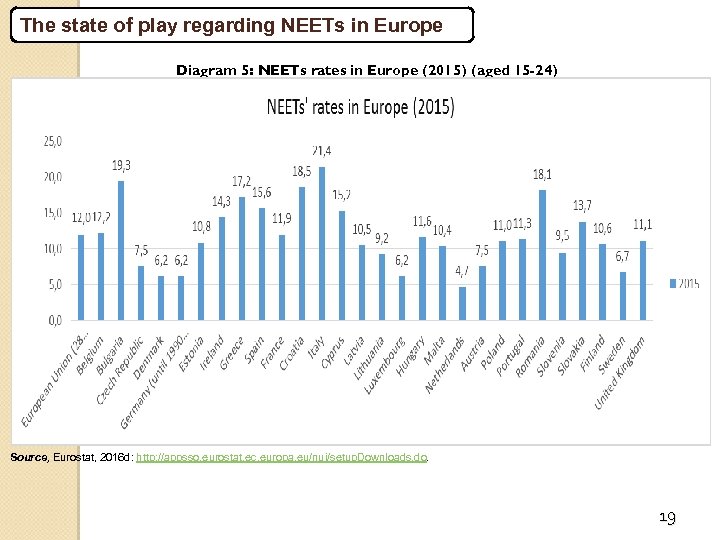
The state of play regarding NEETs in Europe Diagram 5: NEETs rates in Europe (2015) (aged 15 -24) Source, Eurostat, 2016 d: http: //appsso. eurostat. ec. europa. eu/nui/setup. Downloads. do. 19

PART III Neets in Greece
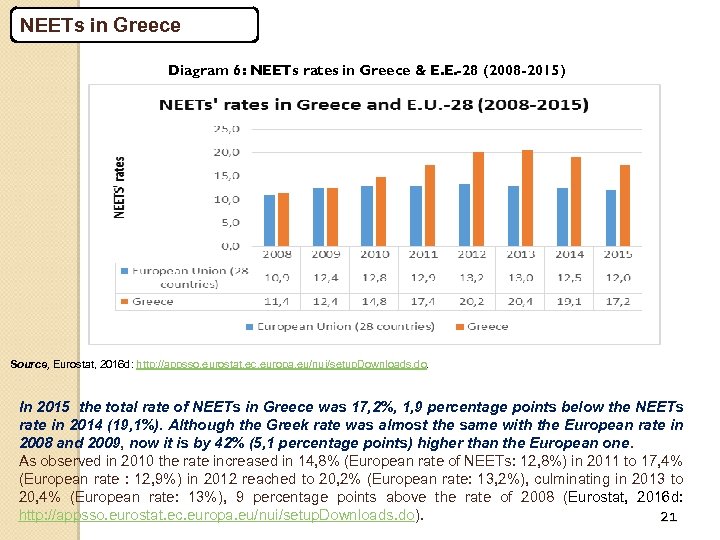
NEETs in Greece Diagram 6: NEETs rates in Greece & E. E. -28 (2008 -2015) Source, Eurostat, 2016 d: http: //appsso. eurostat. ec. europa. eu/nui/setup. Downloads. do. In 2015 the total rate of NEETs in Greece was 17, 2%, 1, 9 percentage points below the NEETs rate in 2014 (19, 1%). Although the Greek rate was almost the same with the European rate in 2008 and 2009, now it is by 42% (5, 1 percentage points) higher than the European one. As observed in 2010 the rate increased in 14, 8% (European rate of NEETs: 12, 8%) in 2011 to 17, 4% (European rate : 12, 9%) in 2012 reached to 20, 2% (European rate: 13, 2%), culminating in 2013 to 20, 4% (European rate: 13%), 9 percentage points above the rate of 2008 (Eurostat, 2016 d: http: //appsso. eurostat. ec. europa. eu/nui/setup. Downloads. do). 21
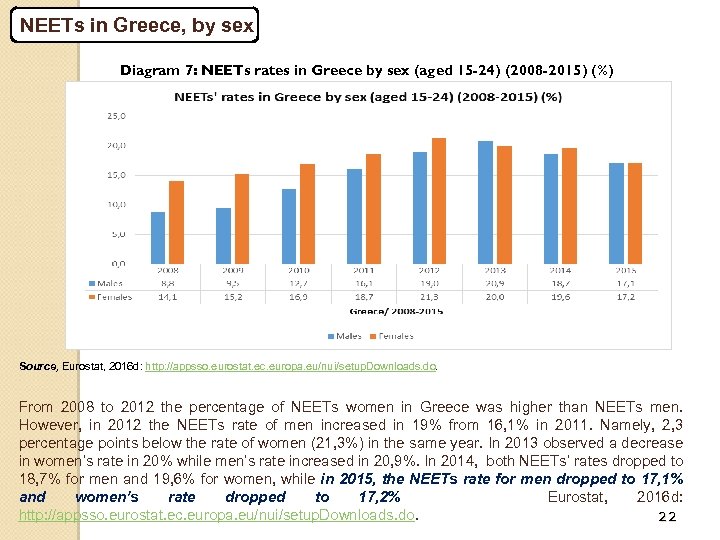
NEETs in Greece, by sex Diagram 7: NEETs rates in Greece by sex (aged 15 -24) (2008 -2015) (%) Source, Eurostat, 2016 d: http: //appsso. eurostat. ec. europa. eu/nui/setup. Downloads. do. From 2008 to 2012 the percentage of NEETs women in Greece was higher than NEETs men. However, in 2012 the NEETs rate of men increased in 19% from 16, 1% in 2011. Namely, 2, 3 percentage points below the rate of women (21, 3%) in the same year. In 2013 observed a decrease in women’s rate in 20% while men’s rate increased in 20, 9%. In 2014, both NEETs’ rates dropped to 18, 7% for men and 19, 6% for women, while in 2015, the NEETs rate for men dropped to 17, 1% and women’s rate dropped to 17, 2% Eurostat, 2016 d: http: //appsso. eurostat. ec. europa. eu/nui/setup. Downloads. do. 22
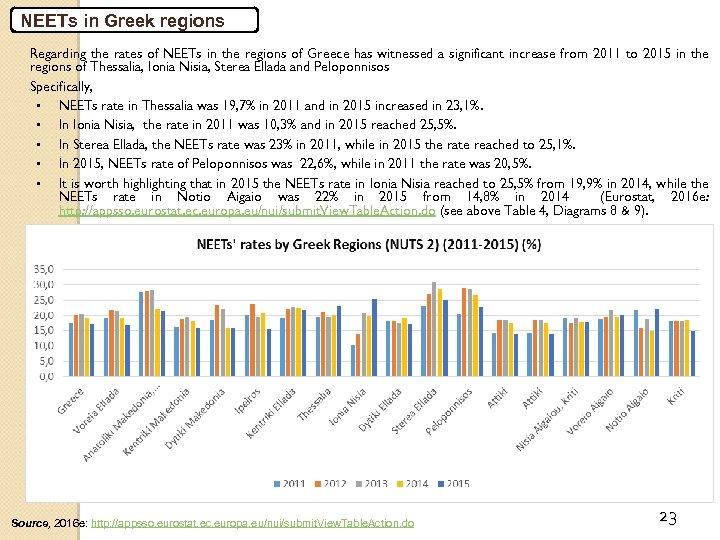
NEETs in Greek regions Regarding the rates of NEETs in the regions of Greece has witnessed a significant increase from 2011 to 2015 in the regions of Thessalia, Ionia Nisia, Sterea Ellada and Peloponnisos Specifically, NEETs rate in Thessalia was 19, 7% in 2011 and in 2015 increased in 23, 1%. In Ionia Nisia, the rate in 2011 was 10, 3% and in 2015 reached 25, 5%. In Sterea Ellada, the NEETs rate was 23% in 2011, while in 2015 the rate reached to 25, 1%. In 2015, NEETs rate of Peloponnisos was 22, 6%, while in 2011 the rate was 20, 5%. It is worth highlighting that in 2015 the NEETs rate in Ionia Nisia reached to 25, 5% from 19, 9% in 2014, while the NEETs rate in Notio Aigaio was 22% in 2015 from 14, 8% in 2014 (Eurostat, 2016 e: http: //appsso. eurostat. ec. europa. eu/nui/submit. View. Table. Action. do (see above Table 4, Diagrams 8 & 9). Diagram 8: NEETs rates by Greek Regions (aged 15 -24) (2011 -2015) (%) Source, 2016 e: http: //appsso. eurostat. ec. europa. eu/nui/submit. View. Table. Action. do 23
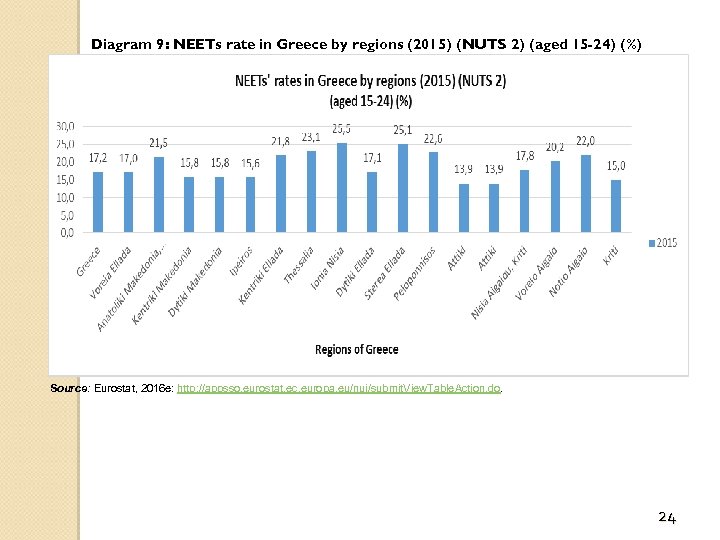
Diagram 9: NEETs rate in Greece by regions (2015) (NUTS 2) (aged 15 -24) (%) Source: Eurostat, 2016 e: http: //appsso. eurostat. ec. europa. eu/nui/submit. View. Table. Action. do. 24
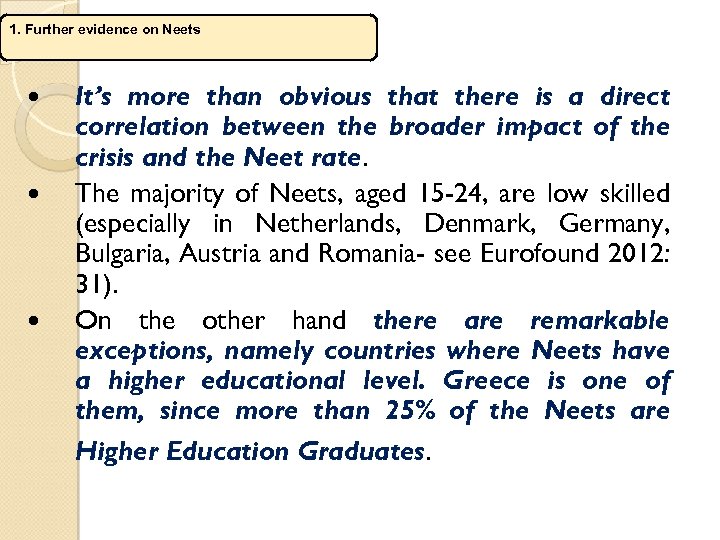
1. Further evidence on Neets It’s more than obvious that there is a direct correlation between the broader impact of the crisis and the Neet rate. The majority of Neets, aged 15 -24, are low skilled (especially in Netherlands, Denmark, Germany, Bulgaria, Austria and Romania- see Eurofound 2012: 31). On the other hand there are remarkable exceptions, namely countries where Neets have a higher educational level. Greece is one of them, since more than 25% of the Neets are Higher Education Graduates.
PART IV Prior Research findings on Greek Neets’ characteristics
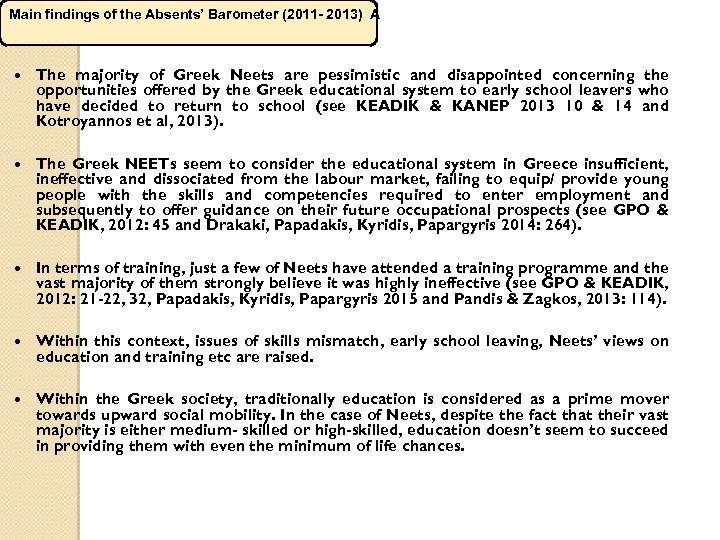
Main findings of the Absents’ Barometer (2011 - 2013) A The majority of Greek Neets are pessimistic and disappointed concerning the opportunities offered by the Greek educational system to early school leavers who have decided to return to school (see KEADIK & KANEP 2013 10 & 14 and Kotroyannos et al, 2013). The Greek NEETs seem to consider the educational system in Greece insufficient, ineffective and dissociated from the labour market, failing to equip/ provide young people with the skills and competencies required to enter employment and subsequently to offer guidance on their future occupational prospects (see GPO & KEADIK, 2012: 45 and Drakaki, Papadakis, Kyridis, Papargyris 2014: 264). In terms of training, just a few of Neets have attended a training programme and the vast majority of them strongly believe it was highly ineffective (see GPO & KEADIK, 2012: 21 -22, 32, Papadakis, Kyridis, Papargyris 2015 and Pandis & Zagkos, 2013: 114). Within this context, issues of skills mismatch, early school leaving, Neets’ views on education and training etc are raised. Within the Greek society, traditionally education is considered as a prime mover towards upward social mobility. In the case of Neets, despite the fact that their vast majority is either medium- skilled or high-skilled, education doesn’t seem to succeed in providing them with even the minimum of life chances.
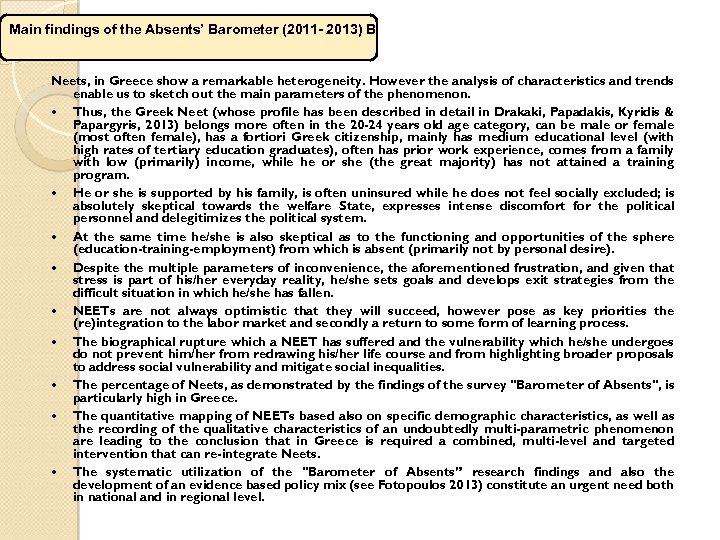
Main findings of the Absents’ Barometer (2011 - 2013) B In conclusion Neets, in Greece show a remarkable heterogeneity. However the analysis of characteristics and trends enable us to sketch out the main parameters of the phenomenon. Thus, the Greek Neet (whose profile has been described in detail in Drakaki, Papadakis, Kyridis & Papargyris, 2013) belongs more often in the 20 -24 years old age category, can be male or female (most often female), has a fortiori Greek citizenship, mainly has medium educational level (with high rates of tertiary education graduates), often has prior work experience, comes from a family with low (primarily) income, while he or she (the great majority) has not attained a training program. He or she is supported by his family, is often uninsured while he does not feel socially excluded; is absolutely skeptical towards the welfare State, expresses intense discomfort for the political personnel and delegitimizes the political system. At the same time he/she is also skeptical as to the functioning and opportunities of the sphere (education-training-employment) from which is absent (primarily not by personal desire). Despite the multiple parameters of inconvenience, the aforementioned frustration, and given that stress is part of his/her everyday reality, he/she sets goals and develops exit strategies from the difficult situation in which he/she has fallen. NEETs are not always optimistic that they will succeed, however pose as key priorities the (re)integration to the labor market and secondly a return to some form of learning process. The biographical rupture which a NEET has suffered and the vulnerability which he/she undergoes do not prevent him/her from redrawing his/her life course and from highlighting broader proposals to address social vulnerability and mitigate social inequalities. The percentage of Neets, as demonstrated by the findings of the survey "Barometer of Absents", is particularly high in Greece. The quantitative mapping of NEETs based also on specific demographic characteristics, as well as the recording of the qualitative characteristics of an undoubtedly multi-parametric phenomenon are leading to the conclusion that in Greece is required a combined, multi-level and targeted intervention that can re-integrate Neets. The systematic utilization of the "Barometer of Absents” research findings and also the development of an evidence based policy mix (see Fotopoulos 2013) constitute an urgent need both in national and in regional level.
PART V Findings of the ongoing Neets 2 EEA – funded project On Neets’ profile b. On Neets’ psychological profile c. On Neets’ employability, civic values and political behavior a.
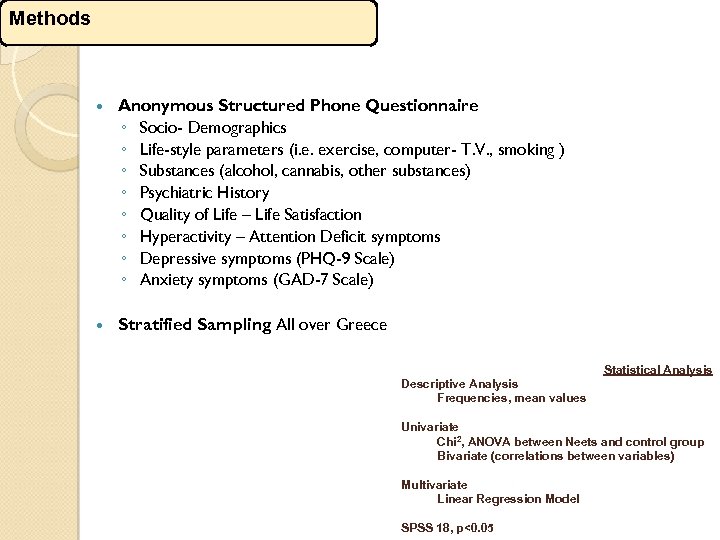
Methods Anonymous Structured Phone Questionnaire ◦ Socio- Demographics ◦ Life-style parameters (i. e. exercise, computer- T. V. , smoking ) ◦ Substances (alcohol, cannabis, other substances) ◦ Psychiatric History ◦ Quality of Life – Life Satisfaction ◦ Hyperactivity – Attention Deficit symptoms ◦ Depressive symptoms (PHQ-9 Scale) ◦ Anxiety symptoms (GAD-7 Scale) Stratified Sampling All over Greece Statistical Analysis Descriptive Analysis Frequencies, mean values Univariate Chi 2, ANOVA between Neets and control group Bivariate (correlations between variables) Multivariate Linear Regression Model SPSS 18, p<0. 05
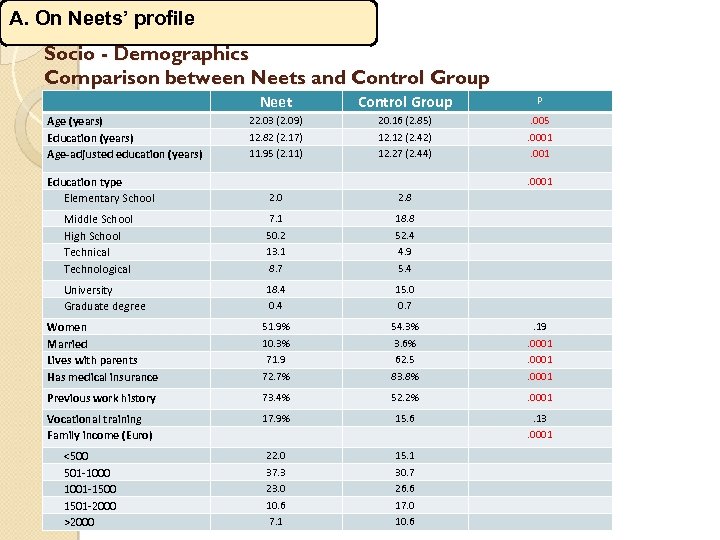
A. On Neets’ profile Socio - Demographics Comparison between Neets and Control Group Neet Age (years) Education (years) Age-adjusted education (years) Education type Elementary School Control Group p 22. 03 (2. 09) 20. 16 (2. 85) . 005 12. 82 (2. 17) 12. 12 (2. 42) . 0001 11. 95 (2. 11) 12. 27 (2. 44) . 001. 0001 2. 0 2. 8 7. 1 18. 8 50. 2 52. 4 13. 1 4. 9 8. 7 5. 4 University Graduate degree 18. 4 15. 0 0. 4 0. 7 Women Married Lives with parents Has medical insurance 51. 9% 54. 3% . 19 10. 3% 3. 6% . 0001 71. 9 62. 5 . 0001 72. 7% 83. 8% . 0001 Previous work history 73. 4% 52. 2% . 0001 Vocational training Family income (Euro) 17. 9% 15. 6 . 13 Middle School High School Technical Technological <500 501 -1000 1001 -1500 1501 -2000 >2000 . 0001 22. 0 15. 1 37. 3 30. 7 23. 0 26. 6 10. 6 17. 0 7. 1 10. 6
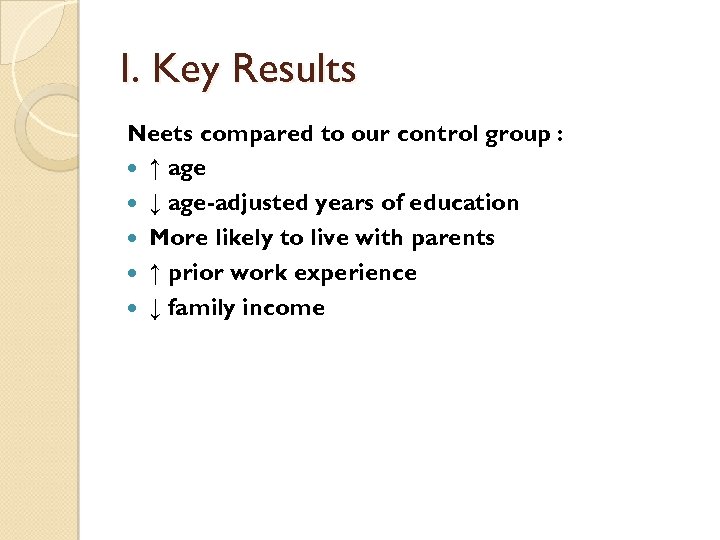
I. Key Results Neets compared to our control group : ↑ age ↓ age-adjusted years of education More likely to live with parents ↑ prior work experience ↓ family income
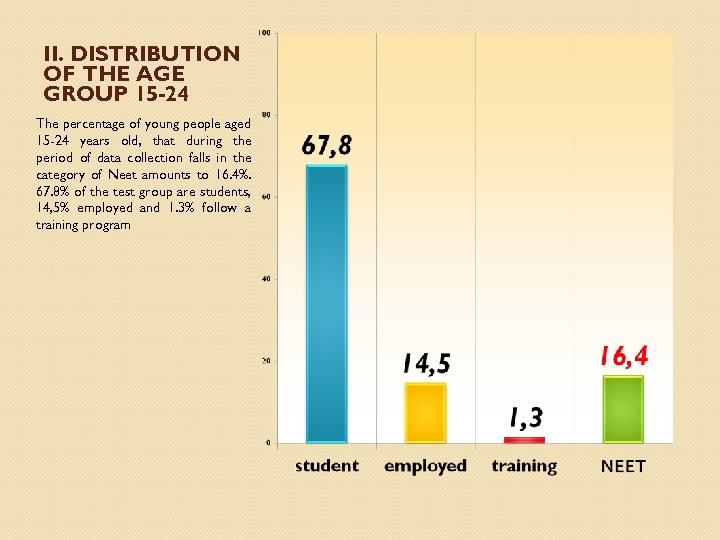
II. DISTRIBUTION OF THE AGE GROUP 15 -24 The percentage of young people aged 15 -24 years old, that during the period of data collection falls in the category of Neet amounts to 16. 4%. 67. 8% of the test group are students, 14, 5% employed and 1. 3% follow a training program
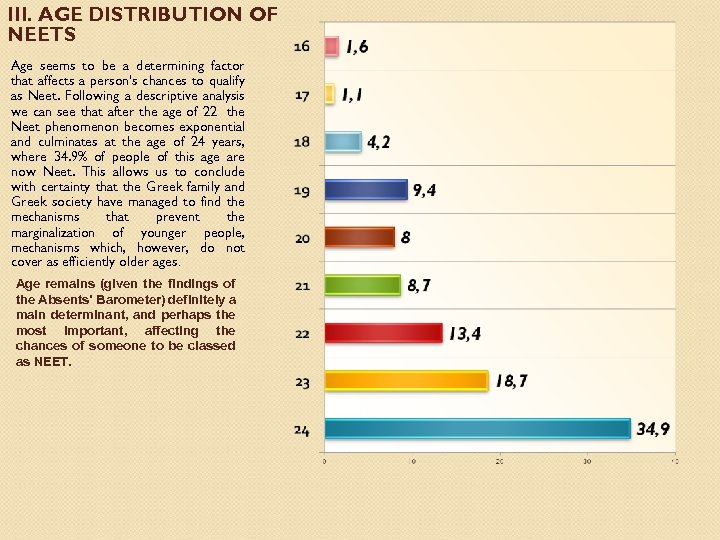
III. AGE DISTRIBUTION OF NEETS Age seems to be a determining factor that affects a person's chances to qualify as Neet. Following a descriptive analysis we can see that after the age of 22 the Neet phenomenon becomes exponential and culminates at the age of 24 years, where 34. 9% of people of this age are now Neet. This allows us to conclude with certainty that the Greek family and Greek society have managed to find the mechanisms that prevent the marginalization of younger people, mechanisms which, however, do not cover as efficiently older ages. Age remains (given the findings of the Absents’ Barometer) definitely a main determinant, and perhaps the most important, affecting the chances of someone to be classed as NEET.

It is obvious that the relatively low rates of early school dropout and respectively the very high rates of completion of upper secondary education explain the low incidence of Neets in the younger age groups. Here it should be pointed out that in Greek society it is strongly observed the phenomenon of institutional extension of adolescence (Kelpanidis, 2000), which is due to two main factors: -(a) the keeping children who become adults in the family residence, regardless the reasons of this choice (unemployment, obsessed with family, economic reasons) and -(b) the at all costs continuation of studies and the nonintegration into the labor market for study purposes. v. In other words, the traditional social enclave of family undertakes the treating of social pathologies that “occur” to its members, assuming the role of “social protector” not only where when its members cannot be protected but also acting unsolicitedly. v. Based on all the aforementioned the existence of a social norm (the supportive role of the family) that plays a key role in the life of NEETs and which remains a crucial factor of support, with multi-level repercussions in the reconstruction of their disrupted life course.
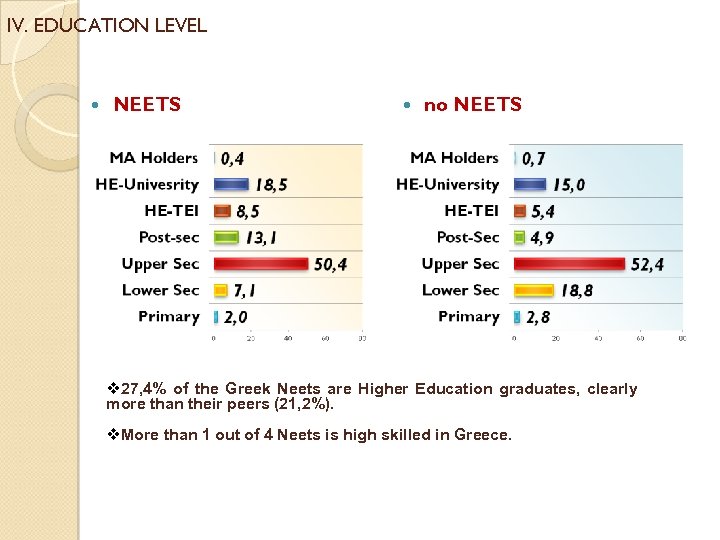
IV. EDUCATION LEVEL NEETS no NEETS v 27, 4% of the Greek Neets are Higher Education graduates, clearly more than their peers (21, 2%). v. More than 1 out of 4 Neets is high skilled in Greece.
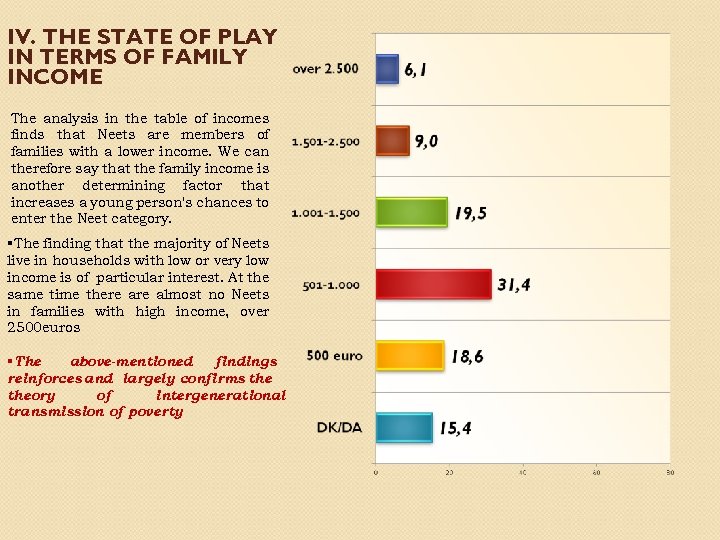
IV. THE STATE OF PLAY IN TERMS OF FAMILY INCOME The analysis in the table of incomes finds that Neets are members of families with a lower income. We can therefore say that the family income is another determining factor that increases a young person's chances to enter the Neet category. The finding that the majority of Neets live in households with low or very low income is of particular interest. At the same time there almost no Neets in families with high income, over 2500 euros The above-mentioned findings reinforces and largely confirms theory of intergenerational transmission of poverty
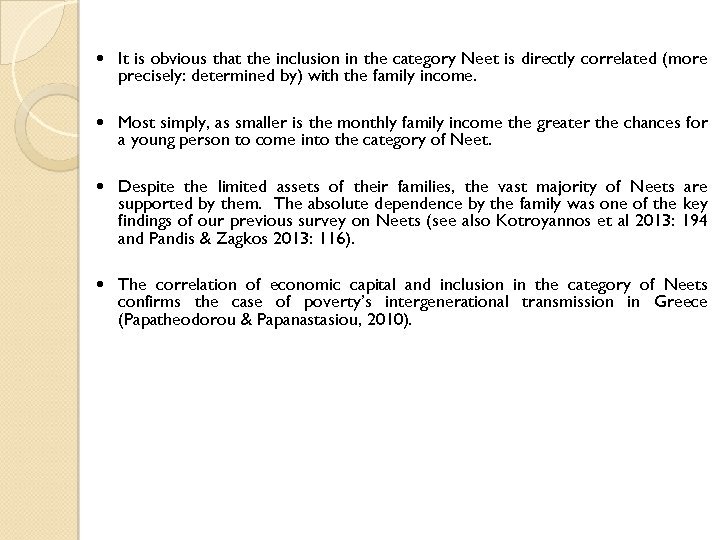
It is obvious that the inclusion in the category Neet is directly correlated (more precisely: determined by) with the family income. Most simply, as smaller is the monthly family income the greater the chances for a young person to come into the category of Neet. Despite the limited assets of their families, the vast majority of Neets are supported by them. The absolute dependence by the family was one of the key findings of our previous survey on Neets (see also Kotroyannos et al 2013: 194 and Pandis & Zagkos 2013: 116). The correlation of economic capital and inclusion in the category of Neets confirms the case of poverty’s intergenerational transmission in Greece (Papatheodorou & Papanastasiou, 2010).
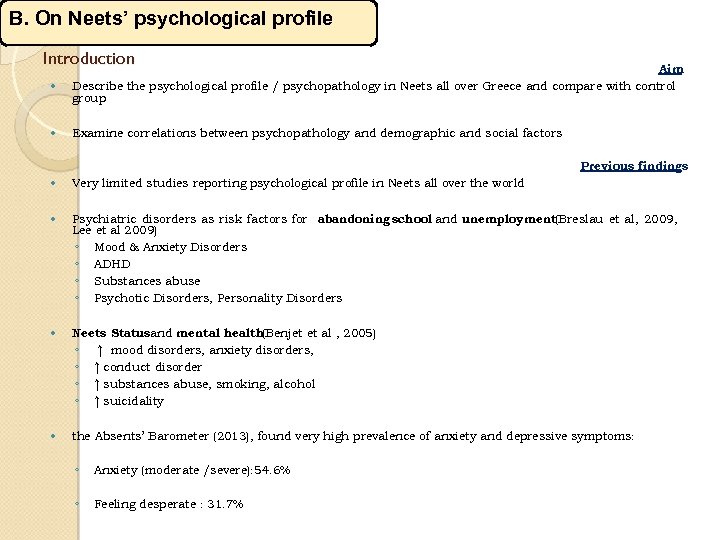
B. On Neets’ psychological profile Introduction Aim Describe the psychological profile / psychopathology in Neets all over Greece and compare with control group Examine correlations between psychopathology and demographic and social factors Previous findings Very limited studies reporting psychological profile in Neets all over the world Psychiatric disorders as risk factors for abandoning school and unemployment(Breslau et al, 2009, Lee et al 2009) ◦ Mood & Anxiety Disorders ◦ ADHD ◦ Substances abuse ◦ Psychotic Disorders, Personality Disorders Neets Statusand mental health(Benjet et al , 2005) ◦ ↑ mood disorders, anxiety disorders, ◦ ↑ conduct disorder ◦ ↑ substances abuse, smoking, alcohol ◦ ↑ suicidality the Absents’ Barometer (2013), found very high prevalence of anxiety and depressive symptoms: ◦ Anxiety (moderate /severe): 54. 6% ◦ Feeling desperate : 31. 7%
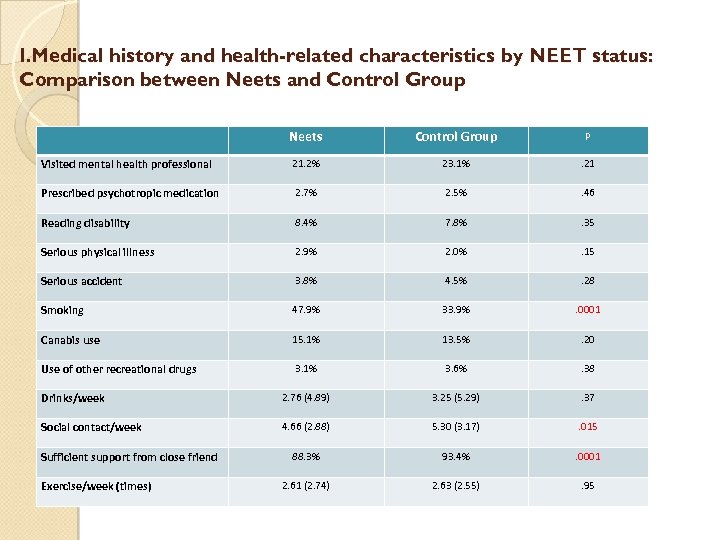
I. Medical history and health-related characteristics by NEET status: Comparison between Neets and Control Group Neets Control Group p Visited mental health professional 21. 2% 23. 1% . 21 Prescribed psychotropic medication 2. 7% 2. 5% . 46 Reading disability 8. 4% 7. 8% . 35 Serious physical illness 2. 9% 2. 0% . 15 Serious accident 3. 8% 4. 5% . 28 Smoking 47. 9% 33. 9% . 0001 Canabis use 15. 1% 13. 5% . 20 Use of other recreational drugs 3. 1% 3. 6% . 38 Drinks/week 2. 76 (4. 89) 3. 25 (5. 29) . 37 Social contact/week 4. 66 (2. 88) 5. 30 (3. 17) . 015 88. 3% 93. 4% . 0001 2. 61 (2. 74) 2. 63 (2. 55) . 95 Sufficient support from close friend Exercise/week (times)
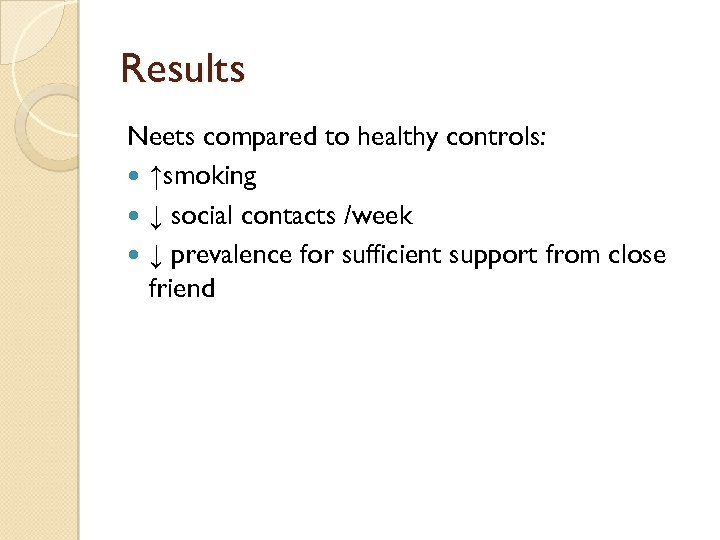
Results Neets compared to healthy controls: ↑smoking ↓ social contacts /week ↓ prevalence for sufficient support from close friend
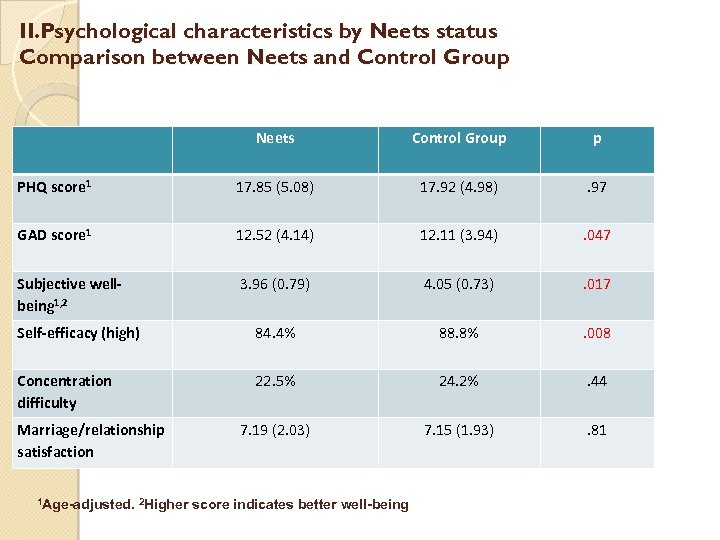
II. Psychological characteristics by Neets status Comparison between Neets and Control Group Neets Control Group p PHQ score 1 17. 85 (5. 08) 17. 92 (4. 98) . 97 GAD score 1 12. 52 (4. 14) 12. 11 (3. 94) . 047 Subjective wellbeing 1, 2 3. 96 (0. 79) 4. 05 (0. 73) . 017 Self-efficacy (high) 84. 4% 88. 8% . 008 Concentration difficulty 22. 5% 24. 2% . 44 7. 19 (2. 03) 7. 15 (1. 93) . 81 Marriage/relationship satisfaction 1 Age-adjusted. 2 Higher score indicates better well-being
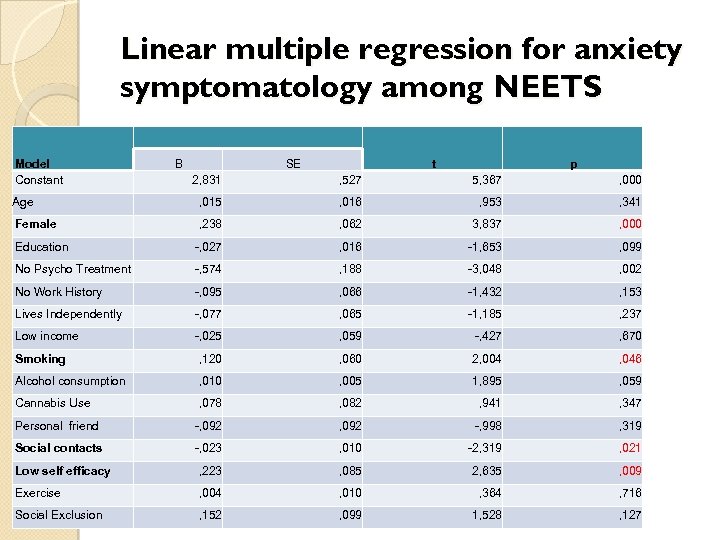
Linear multiple regression for anxiety symptomatology among NEETS Model Constant B SE t p 2, 831 , 527 5, 367 , 000 Age , 015 , 016 , 953 , 341 Female , 238 , 062 3, 837 , 000 Education -, 027 , 016 -1, 653 , 099 No Psycho Treatment -, 574 , 188 -3, 048 , 002 No Work History -, 095 , 066 -1, 432 , 153 Lives Independently -, 077 , 065 -1, 185 , 237 Low income -, 025 , 059 -, 427 , 670 Smoking , 120 , 060 2, 004 , 046 Alcohol consumption , 010 , 005 1, 895 , 059 Cannabis Use , 078 , 082 , 941 , 347 Personal friend -, 092 -, 998 , 319 Social contacts -, 023 , 010 -2, 319 , 021 Low self efficacy , 223 , 085 2, 635 , 009 Exercise , 004 , 010 , 364 , 716 Social Exclusion , 152 , 099 1, 528 , 127
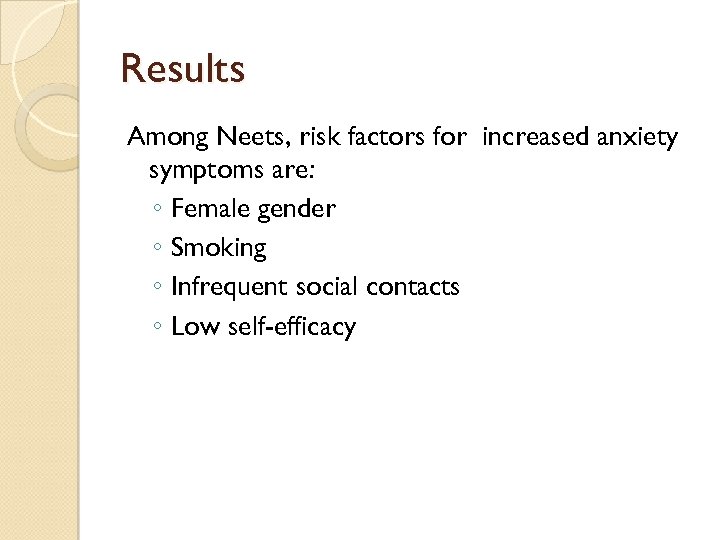
Results Among Neets, risk factors for increased anxiety symptoms are: ◦ Female gender ◦ Smoking ◦ Infrequent social contacts ◦ Low self-efficacy
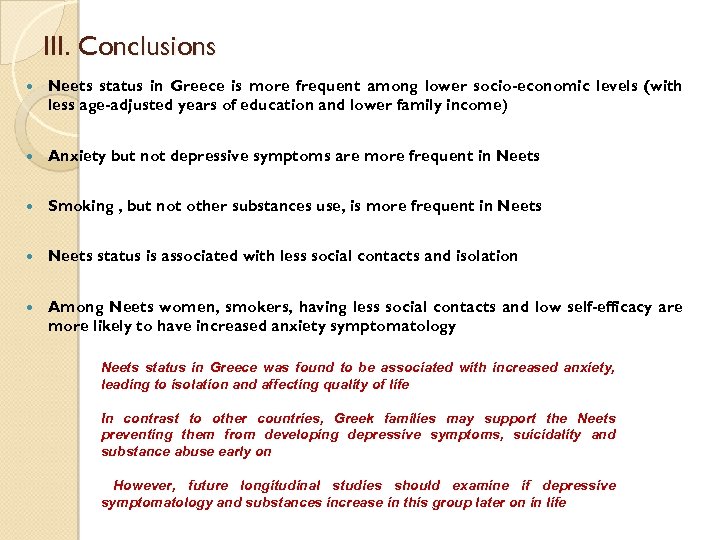
III. Conclusions Neets status in Greece is more frequent among lower socio-economic levels (with less age-adjusted years of education and lower family income) Anxiety but not depressive symptoms are more frequent in Neets Smoking , but not other substances use, is more frequent in Neets status is associated with less social contacts and isolation Among Neets women, smokers, having less social contacts and low self-efficacy are more likely to have increased anxiety symptomatology Neets status in Greece was found to be associated with increased anxiety, leading to isolation and affecting quality of life In contrast to other countries, Greek families may support the Neets preventing them from developing depressive symptoms, suicidality and substance abuse early on However, future longitudinal studies should examine if depressive symptomatology and substances increase in this group later on in life
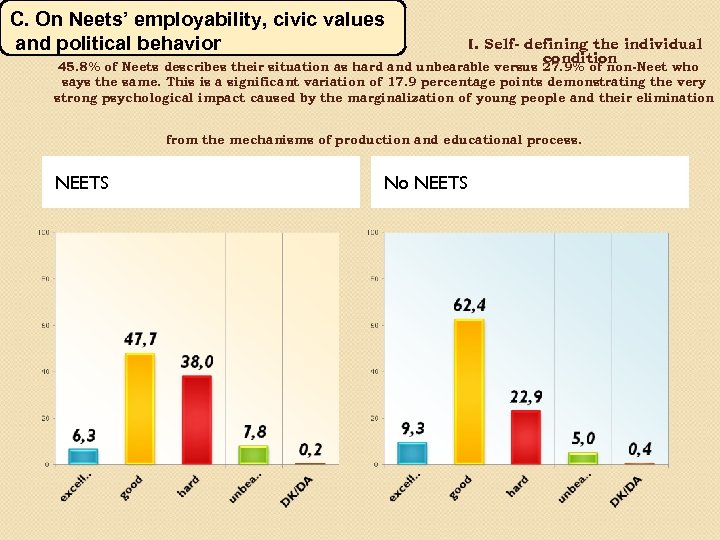
C. On Neets’ employability, civic values and political behavior I. Self- defining the individual condition 45. 8% of Neets describes their situation as hard and unbearable versus 27. 9% of non-Neet who says the same. This is a significant variation of 17. 9 percentage points demonstrating the very strong psychological impact caused by the marginalization of young people and their elimination from the mechanisms of production and educational process. NEETS No NEETS
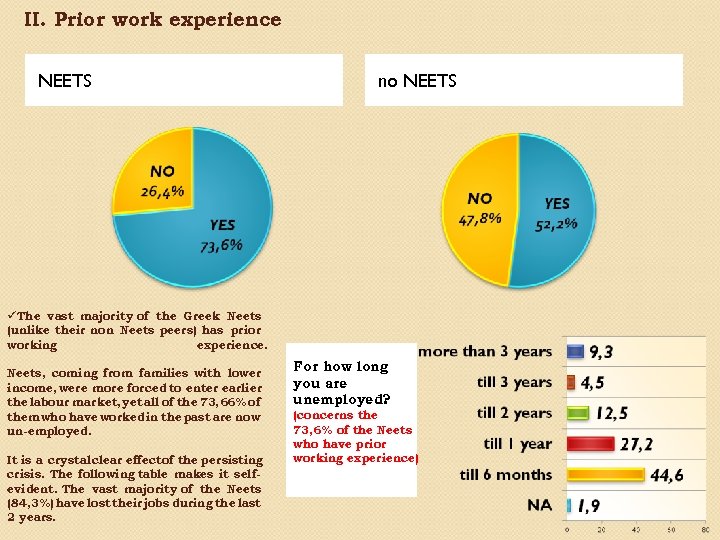
II. Prior work experience NEETS no NEETS üThe vast majority of the Greek Neets (unlike their non Neets peers) has prior working experience. Neets, coming from families with lower income, were more forced to enter earlier the labour market, yet all of the 73, 66% of them who have worked in the past are now un-employed. It is a crystal clear effect of the persisting crisis. The following table makes it selfevident. The vast majority of the Neets (84, 3%) have lost their jobs during the last 2 years. For how long you are unemployed? (concerns the 73, 6% of the Neets who have prior working experience)
üThe vast majority of Neets who has worked in the past, did it mainly in the tertiary sector. Neets usually have previous work experience, due to seasonal employment. They mainly have worked in catering, leisure and tourism. üGiven that we could presume that the ones recently unemployed belong to the category of seasonal employment. Yet 39, 7% of the Neets, being before employed, have lost their jobs more than 6 months and less than 2 years ago. That’ not the case for seasonal employment. üFrom the group of Neets with prior work experience, the majority are men 20 -24 years old. ü 26, 4% of Neets have not even entered the labor market. ü 13, 8% of the ones who did it, are now long-term unemployed üDelaying entry or being dis-enganged from the labour market decisively hampers the possibility of integration into employment in general. üRegarding the employment situation and broadly the relationship of NEETS to employment, it is clear from the findings that the economic crisis has contributed decisively to their unemployment, as grosso modo two main categories of Neets have been formulated: - those who have not worked at all and -- those who worked for a while and have been laid-off either because of cutbacks in personnel, either due to bankruptcy of the company that were employed, or because they were seasonal or occasional workers. Of course, it should not also be ignored the case of those Neets who left voluntarily.
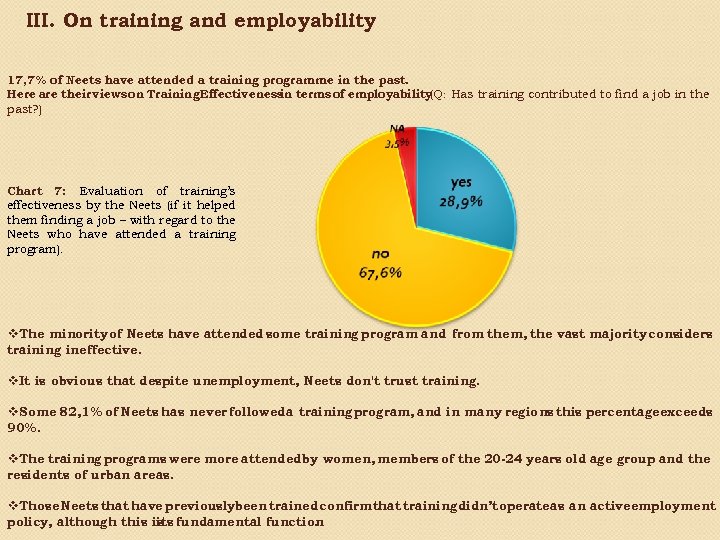
III. On training and employability 17, 7% of Neets have attended a training programme in the past. Here are their views on Training Effectiveness terms of employability Has training contributed to find a job in the in (Q: past? ) Chart 7: Evaluation of training’s effectiveness by the Neets (if it helped them finding a job – with regard to the Neets who have attended a training program). v. The minority of Neets have attended some training program and from them, the vast majority considers training ineffective. v. It is obvious that despite unemployment, Neets don't trust training. v. Some 82, 1% of Neets has never followeda training program, and in many regions this percentageexceeds 90%. v. The training programs were more attended by women, members of the 20 -24 years old age group and the residents of urban areas. v. Those Neets that have previouslybeen trained confirmthat training didn’t operate as an activeemployment policy, although this is fundamental function its.
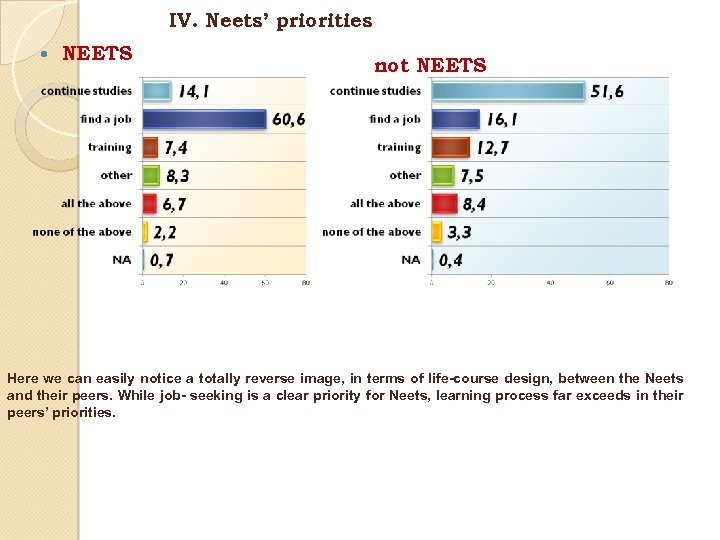
IV. Neets’ priorities NEETS not NEETS Here we can easily notice a totally reverse image, in terms of life-course design, between the Neets and their peers. While job- seeking is a clear priority for Neets, learning process far exceeds in their peers’ priorities.
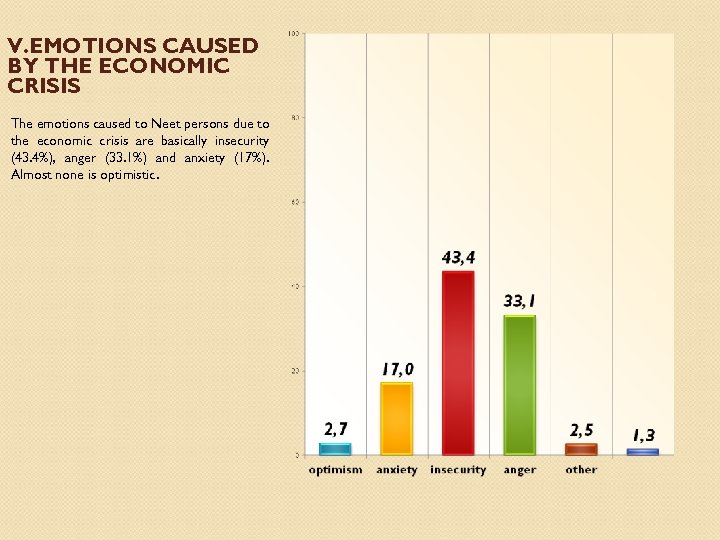
V. EMOTIONS CAUSED BY THE ECONOMIC CRISIS The emotions caused to Neet persons due to the economic crisis are basically insecurity (43. 4%), anger (33. 1%) and anxiety (17%). Almost none is optimistic.
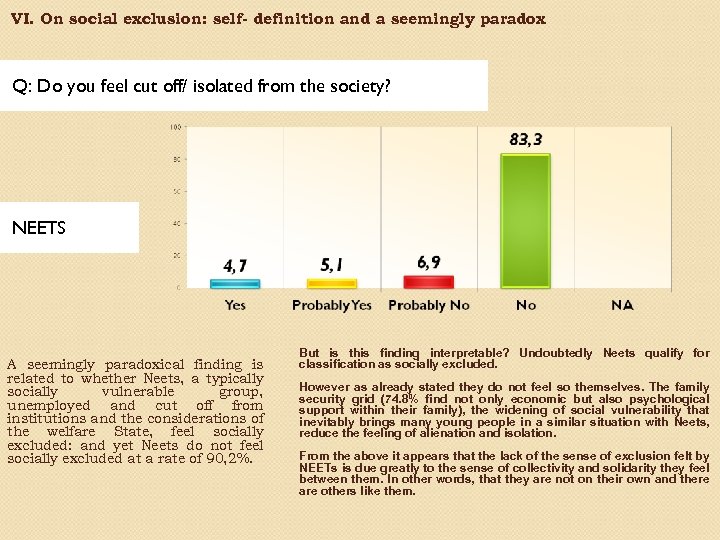
VI. On social exclusion: self- definition and a seemingly paradox Q: Do you feel cut off/ isolated from the society? NEETS A seemingly paradoxical finding is related to whether Neets, a typically socially vulnerable group, unemployed and cut off from institutions and the considerations of the welfare State, feel socially excluded: and yet Neets do not feel socially excluded at a rate of 90, 2%. But is this finding interpretable? Undoubtedly Neets qualify for classification as socially excluded. However as already stated they do not feel so themselves. The family security grid (74. 8% find not only economic but also psychological support within their family), the widening of social vulnerability that inevitably brings many young people in a similar situation with Neets, reduce the feeling of alienation and isolation. From the above it appears that the lack of the sense of exclusion felt by NEETs is due greatly to the sense of collectivity and solidarity they feel between them. In other words, that they are not on their own and there are others like them.
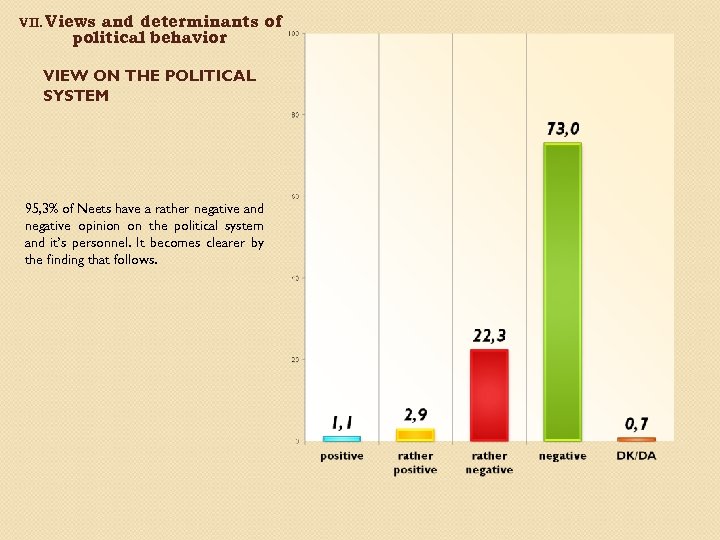
VII. Views and determinants of political behavior VIEW ON THE POLITICAL SYSTEM 95, 3% of Neets have a rather negative and negative opinion on the political system and it’s personnel. It becomes clearer by the finding that follows.
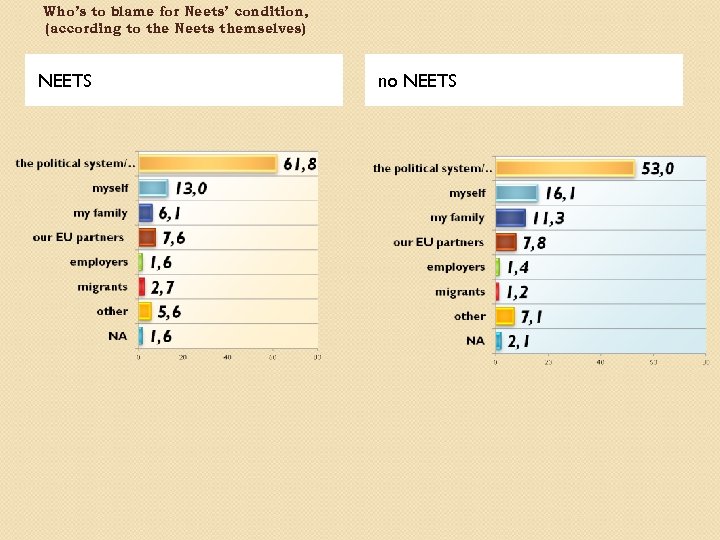
Who’s to blame for Neets’ condition, (according to the Neets themselves) NEETS no NEETS
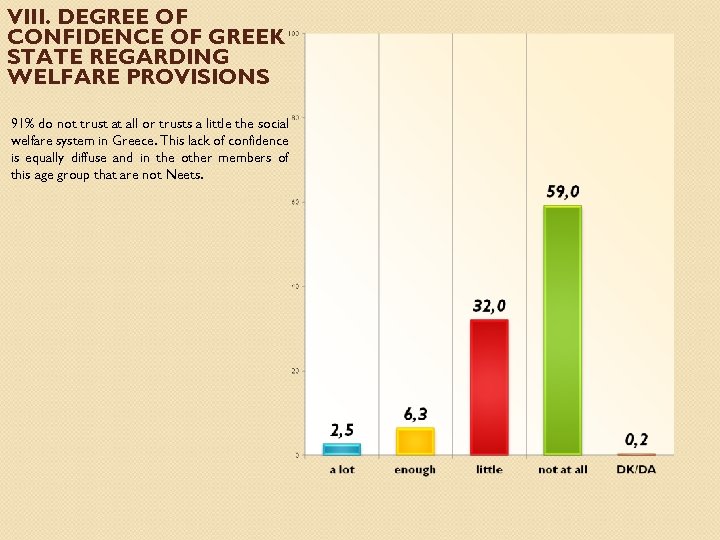
VIII. DEGREE OF CONFIDENCE OF GREEK STATE REGARDING WELFARE PROVISIONS 91% do not trust at all or trusts a little the social welfare system in Greece. This lack of confidence is equally diffuse and in the other members of this age group that are not Neets.
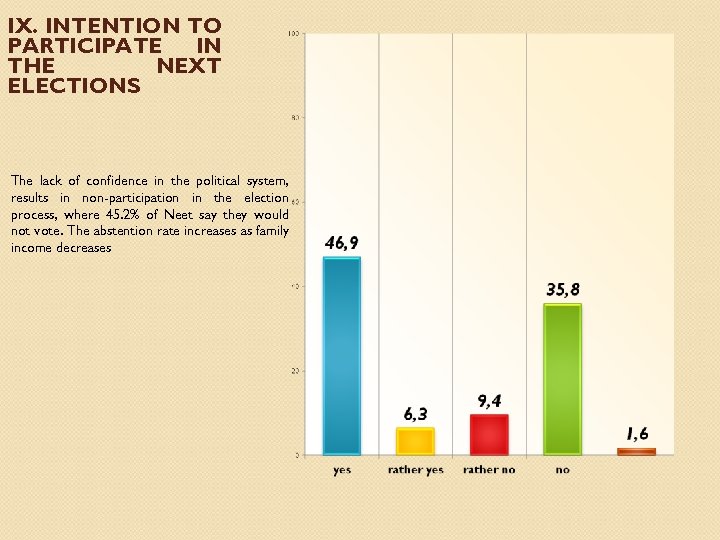
IX. INTENTION TO PARTICIPATE IN THE NEXT ELECTIONS The lack of confidence in the political system, results in non-participation in the election process, where 45. 2% of Neet say they would not vote. The abstention rate increases as family income decreases

Neets, as already noted, consider as pivotal the role of the Welfare State in reversing the situation in which they have fallen into. Neets are absolutely frustrated both by the operation of the welfare State, as well as by the State in general, its structures, the civilian personnel and the political parties. The frustration by the inefficiency of the Greek welfare state and generally by the Greek political system is also obvious in NEETs’ confidence indicators which show that they hardly trust anyone else other than their family and those closest to them, e. g. friends; and this is combined with the personal disappointment, due to the situation in which they are found. Here we should note that the insecurity and uncertainty that has breached the frame of their biography’s co-articulation (framework of standard biography - see in more detail on this issue Alheit & Bergamini 1998: 122), meets the deadlock in Neets cases who feel strongly the emotion of frustration (and, as we have seen, not a small portion of them). v However, the internalization of professional deadlock as an only personal failure and not as an educational and social dysfunction constitutes a painful experience that can lead to frustration and the generalization of insecurity with the cancelation of personal dreams, the feeling of low self-esteem, and in extreme cases to nihilism (see Panagiotopoulos, 2005). v Youth unemployment, low wages, the mismatch between studies and specializations demanded, flexible and “black labor”, constitute a painful context for young people. v On the individual level, the social and psychological implications see to be severe.

FINAL CONCLUSIONS I On the state of play and the overall impact of the crisis on Neets’ life course Skeptical towards the educational system and training structures, frustrated by the operation and effectiveness the welfarestate, in a difficult of financial, social and psychological-emotional position, completely negative to the political system and personnel, been in an (unsuccessful)job search, trapped in dailystress and relyingalmostexclusively family, Neets seem to try to re on -design their life-course. These goalsare associated primarily with the integration intothe labormarket and secondly with some form of reintegration into the educational process. At this point it should also be noted that unemployment is the most important factor, bringing side effects to NEETs. Most NEETs consider that above all they must find work in order to survive. The combination of social vulnerability and pessimism leads directly to the withdrawal, an extremely dangerous phenomenon. In essence the percentage of the “pessimists” confirms the “vicious circle of poverty” (see in detail Pyrgiotakis, 1998).
FINAL CONCLUSIONS II v. Neets, in Greece show a remarkable heterogeneity. However the analysis of characteristics and trends enable us to sketch out, with relative safety, the main parameters of the phenomenon. v. Thus, the Greek Neet belongs more often in the 20 -24 years old age category, can be male or female (most often female), has a fortiori Greek citizenship, mainly has medium educational level (but also is not negligible the proportion of tertiary education graduates), often has prior work experience, comes from a family with low (primarily) income, while he or she (the great majority) has not attained a training program (Drakaki, Papadakis, Kyridis & Papargyris, 2013). v. He or she is supported by his family, is often uninsured while is absolutely skeptical towards the welfare State, expresses intense discomfort for the political personnel and delegitimizes the political system. v. At the same time he/she is also skeptical as to the functioning and opportunities of the realm (education-trainingemployment) from which is absent (primarily not by personal desire). v. Despite the multiple parameters of inconvenience, the aforementioned frustration, and given that stress is part of his/her everyday reality, he/she sets goals and develops exit strategies from the difficult situation in which he/she has fallen. NEETs are not always optimistic that they will succeed, however pose as key priorities the (re)integration to the labor market and secondly a return to some form of learning process. v. The biographical rupture which a NEET has suffered and the vulnerability which he/she undergoes do not prevent him/her from redrawing his/her life orbit and from highlighting broader proposals to address social vulnerability and mitigate social inequalities.

The disruption of their life course, which was established by the various biographical embodiments of Greek society (social norms, standard framework of biography) as well as by personal choices and events (see Fischer & Kohli, 1987: 28 as cited in Tsiolis, 2006: 125) and the start of a new life path under adverse conditions, leads NEETs towards to a search of their identity as a subject and as part of the society in which they live (Passerini, 1998: 21 -38 as cited in Tsiolis, 2006: 126). The similarity of their own biographical routes with those of their peers contributes greatly to NEETs’ biographical reconsideration for the (re) construction of their “self” identity (see Tsiolis, 2006: 127) and in understanding him/herself and his/her existence as a person and as a whole in Greek society. Going out and discussing with people who belong to socially vulnerable groups, NEETs’ adopt another level of meaning and interpretation. The dialogue among NEETs or similar socially vulnerable groups and the exchange of views, experiences and the storytelling of events and incidents on how one comes to that state contributes, in a individualized manner now, in the creation of a continuous and coherent form of events that have been instrumental in one becoming a NEET (for personalization process see also Tsiolis 2006: 122 -128), and allows them to redefine and to protect them identity, but also to develop exit strategies. The understanding and awareness of the key choices made by NEETs and the significant effect of external factors (political, economic, institutional, etc. ) and of their social environment, contribute to NEETs’ interpretation of the interaction that exists between their social exclusion and the various stages of their life course (see in detail about these issues Linde, 1993 as cited in Tsiolis 2006: 127). It cannot however be ignored a remarkable percentage of Neets indicate that they have no such support from anywhere. They have completely crossed the “threshold of suffering”. It is the most burdened subcategory of Neets.

References P. Alheit, & S. Bergamini, Biographical research and life history research, in S. Papaioannou (ed. ), Social Transformation, Education and Local Community, Rethymnon, University of Crete – International Postgraduate Summer School, 1998, 122 -130 (in Greek). Audit Commission, Against the odds: Re-engaging young people in education, employment or training, Audit Commission, London, 2010. D. Bell & D. Blanchflower, Youth Unemployment: Déjà vu? Institute for the Study of Labour, Bonn, 2010. P. Bourdieu, The Distinction, Patakis, Athens, 2002 (in Greek). R. Breen, Explaining Cross National Variation in Youth Unemployment. Market and Institutional Factors, European Sociological Review, 2005, vol. 21, n. 2, 125 134. J. Bynner, & S. Parsons, ‘Social exclusion and the transition from school to work: the case of young people not in employment education or training (NEET)’, Journal of Vocational Behaviour, 2000, vol. 60, 289– 309. Centre for the Development of Educational Policy (KANEP/ GSEE), The basic figures of education. The Greek Higher Education. Part A′, KANEP/ GSEE, Athens, 2013 (in Greek). M. Drakaki, N. Papadakis, A. Kyridis & A. Papargyris, The NEET’s profile in Greece, in N. Papadakis (ed. ), Absents’ Barometer: The NEETs (Young People Not in Education, Employment or Training) in Greece, Sideris, 2013, Athens, 209 - 240 (in Greek). Eurofound, NEETs – Young people not in employment, education or training: Characteristics, costs and policy responses in Europe, Publications Office of the European Union, Luxembourg, 2012. European Commission, Progress Towards the Lisbon objectives in Education & Training. Indicators & benchmarks, Brussels, EC DG EAC (SEC (2009)1616, E. C. , Brussels, 2009. European Commission, Youth neither in employment nor education and training (NEET). Presentation of data for the 27 Member States – EMCO Contribution, European Commission/ DG Employment, Social Affairs and Inclusion, 2011. Available online at: http: //ec. europa. eu/social/key. Documents. jsp? type=5&policy. Area=81&sub. Category=115&country=0&year=0&adv. Search. Key=emcoopinioncontributions&mo de=advanced. Submit&lang. Id=en (accessed March, 24, 2014). European Commission, Commission Staff Working Document. Vocational Education and training for better skills, growth and jobs. Accompanying the document B. Coles, Youth and Social Policy, UCL Press, London, 1995. Communication from the Commission “Rethinking education: investing in skills for better socio-economic outcomes”, Strasbourg, E. C. , SWD (2012) 375 final, 2012. Available online at: http: //ec. europa. eu/education/news/rethinking/sw 375_en. pdf (accessed March, 24, 2014). European Commission, Education and Training Monitor 2013, Brussels, E. C. DG EAC, 2013. Available online at: http: //ec. europa. eu/education/documents/eatm/education-and-training-monitor-2013_en. pdf (accessed March, 24, 2014). Eurostat, Europe in figures. Eurostat Yearbook 2012, Luxembourg, Publications Office of the European Union, 2012. Available online at http: //epp. eurostat. ec. europa. eu/cache/ITY_OFFPUB/KS-CD-12 -001/EN/KS-CD-12 -001 -EN. PDF (accessed March, 24, 2014). Eurostat, Euro Indicators. Euro area unemployment, in Eurostat News Release, 102/2013, 2 July, 2013. Ν. Fotopoulos, The phenomenon that is sweeping in Greece, Europe. The outcasts of Education - Student leakage and early school leaving in Greece and Europe, The Eleftherotypia, , 16. 2. 2010. Available at: http: //www. enet. gr/? i=news. el. article&id=132384 (accessed March, 24, 2014). Ν. Fotopoulos, The problem of Neets and the Greek reality. Seeking solutions to Greece's Memorandum, στο N. Papadakis (ed. ), Absents’ Barometer: The NEETs (Young People Not in Education, Employment or Training) in Greece, Sideris, Athens, 2013.
A. Furlong, ‘Not a very NEET solution: representing problematic labour market transitions among early school-leavers’, Work, Employment and Society, 2006, vol. 20, n. 3, 553– 569. A. Furlong, & A. Biggart, ‘“Framing choices”: a longitudinal study of occupational aspirations among 13 to 16 -year olds’, Journal of Education and Work, 1999, vol. 12, n. 1, 21– 35. A. Furlong & F. Cartmel, Vulnerable Young Men in Fragile Labour Markets: Employment, Unemployment and the Search for Long-term Security , York Publishing, York, 2004. C. Godfrey, S. Hutton, J. Bradshaw, B. Coles, B. Craig, & J. Johnson, Estimating the cost of being 'Not in education, employment or training' at age 16 -18 (No. Research Report RR 346), Queen's Printer for Department for Education and Skills, Colegate, Norwich, 2002. GPO and KEADIK, Project: Absents’ Barometer. Detection, categorization and empirical grounding of policy proposals for tackling a new form of social vulnerability: The NEETs (Young People Not in Education, Employment or Training). Deliverable 3. 1 a: Report of the NEETs’ distribution by gender, intermediate ages-categories, ethnocultural origin, educational level and the distribution by administrative region (first phase of quantitative research), 2012 (in Greek). GPO and KEADIK, Project: Absents’ Barometer. Detection, categorization and empirical grounding of policy proposals for tackling a new form of social vulnerability: The NEETs (Young People Not in Education, Employment or Training). Deliverable 3. 1 b: Report of the NEETs’ distribution by administrative region and district (second phase of quantitative research). “Presentation and analysis of the findings of the quantitative research”, 2013 (in Greek). P. Gregg, and E. Tominey, ‘The wage scar from youth unemployment’, Labour Economics, 2005, vol. 12, n. 4, 487 -509. J. Hill, Young people not in education, training or employment. Key indicators, Ministry of Social Development, Wellington, 2003. International Labour Office, Global Employment Trends for Youth 2013: A generation at a risk, Geneva, ILO, 2013, Available online at: http: //www. ilo. org/wcmsp 5/groups/public/---dgreports/---dcomm/documents/publication/wcms_212423. pdf (accessed March, 24, 2014). A. Inui, NEETs, freeters and flexibility. Reflecting precarious situations in the new labour market, in A. Furlong (Ed. ), Handbook of Youth and Young Adulthood. New perspectives and agendas Oxon, Routledge, 2009, 176 -181, Available online at: http: //www. google. gr/books? hl=el&lr=&id=jw. Hv. DIm. TTo. C&oi=fnd&pg=PA 176&dq=related: Hfqbosp 4 r. Z 8 J: scholar. google. com/&ots=Qh. Pjm. Mg. JKv&sig=sqz. Yn. Rqh 2 GUULIBe. Hxljlvaairk&redir_esc=y#v=onepage&q &f=false (accessed March, 24, 2014). E. Kalerante, A. Kyridis, N. Fotopoulos, The skills society, Proceedings of the 2 nd International Conference of Greek Sociological Society (EKE), EKE, Athens, 2009 (in Greek). KANEP/ GSEE, The fundamentals of education. The Greek higher education. Part A, ΚΑΝΕΠ/ ΓΣΕΕ, Athens, 2013. KEADIK & KANEP/ GSEE, Absents’ Barometer. Detection, categorization and empirical grounding of policy proposals for tackling a new form of social vulnerability: The NEETs (Young People Not in Education, Employment or Training). Deliverable 4. 4 b: Report with the final findings and the conclusions of the qualitative research and classification categories, 2013 (in Greek). M. Kelpanidis, Welfare State and Education, Kyriakidis Brothers, Thessaloniki, 2000 (in Greek). G. Kokkinos, “Youth and NEET”: What reveals the recent research of Eurofound about the “future of Europe”. Which is the situation in Greece? KANEP/ GSEE, Athens, 2013. Available online at: http: //www. kanep-gsee. gr/content/neoi-kai-neet-ti-apotyponei-prosfati-ereyna-toy-eurofound-gia-mellon-tis-eyropispoia-einai, (accessed March, 24, 2014), (in Greek). D. Kotroyannos, S. Tzagkarakis, A. Kamekis, & M. Chourdakis, Presentation of the findings of qualitative interviews and the role of welfare state, in N. Papadakis (ed. ), Absents’ Barometer: The NEETs (Young People Not in Education, Employment or Training) in Greece. Sideris, Athens, 2013, 105 - 208, (in Greek). A. Kyridis, & V. Drossos, Thirty years inequality in Greek Education, Contemporary Education, 2011, vol. 118, 68 -79, (in Greek). A. Kyridis, The Greek educational inequality and the entrance to the University (1955 -1985), Gutenberg, Athens, 1997 (in Greek). A. Kyridis, Ch. Aggelaki, E. Mavrikaki, E. & S. Smaga, (1998), Operational conditions of the public schools in Greece – Infrastructure – 1 st Part: Early Childhood Education, Contemporary Education, vol. 104, 78 -88 (in Greek). A. Kyridis, Ch. Aggelaki, E. Mavrikaki, E. & S. Smaga, Operational conditions of the public schools in Greece – Infrastructure – 2 nd Part: The Primary Schools, Contemporary Education, 1999, vol. 105, 83 -92 (in Greek).
A. Kyridis, Ch. Aggelaki, E. Mavrikaki, E. & S. Smaga, Operational conditions of the public schools in Greece – Infrastructure – 3 rd Part: The Public Lower Secondary Schools (in Greek), Contemporary Education, 1999 b, vol. 106, 57 -65 (in Greek). A. Kyridis, Ch. Aggelaki, E. Mavrikaki, E. & S. Smaga, Operational conditions of the public schools in Greece – Infrastructure – 3 rd Part: The Public General Upper Secondary Schools, Contemporary Education, 1999 c, vol. 107, 91 -99 (in Greek). A. Kyridis, E. Mavrikaki E. & A. Neroutsos, A contribution to the study of the Greek educational inequality based on the statistics of the Higher Education (time period 1984 -1991), Contemporary Education, 1995, vol. 76, 29 -37 (in Greek) A. Kyridis, N. Papadakis, N. , Fotopoulos, N. , Chronopoulou, A. & Ch. Zagkos, Filling in the Implementation Gap? Problems in the Greek Educational System - An Evidence-based Explanatory Framework and Critical Reflections, Current Issues in Education (CIE), 2011, vol. 14, n. 3, 1 -19. A. Kyridis, H. Tsakiridou, Ch. Zagkos, M. Koutouzis, & Ch Tziamtzi, Educational inequalities and school dropout in Greece. A regional issue, in International Journal of Education, 2011, vol. 3, n. 2, 115. R. Mac. Donald, ‘Youth transitions, unemployment and underemployment. Plus ça change, plus c’est la même chose? ’ Journal of Sociology, 2011, vol. 47, n. 4, 427– 444. N. Panagiotopoulos, The Unemployed’s Grief, Polytropon, Athens, 2005, (in Greek) P. Pandis, & Ch. Zagkos, Social and demographic characteristics of NEETs: The case of Greece, in N. Papadakis (ed. ), Absents’ Barometer: The NEETs (Young People Not in Education, Employment or Training) in Greece, Sideris, Athens, 2013, 109 - 120 (in Greek). N. Papadakis, Towards a paradigm shift? The recent economic downturn, the EU 2020 strategy (2010 - 2020), and the new EU policy in Education, Training and Lifelong Learning, Seminar within the framework of the LLAKES Seminars, Institute of Education/ LLAKES Research Centre, London, 2012 N. Papadakis, Public Policies on Education and Training. On the epistemological and methodological components of the field and the European state of play, in A. I. -D. Metaxas (ed. ), Political Science: Interdisciplinary and Critical Approach of Politics, 2013, Sideris, Athens, (in Greek). N. Papadakis, N. (2013 b), NEETs in Europe: Convergences and divergences, in N. Papadakis (ed. ), Absents’ Barometer: The NEETs (Young People Not in Education, Employment or Training) in Greece, Sideris, Athens, 2013, 15 - 75 (in Greek). A. Papargyris, Α. (2013), Presentation and analysis of the results of quantitative research, in N. Papadakis (ed. ), Absents’ Barometer: The NEETs (Young People Not in Education, Employment or Training) in Greece, Sideris, Athens, 2013 (in Greek). Ch. Papatheodorou, & S. A. Papanastasiou, Intergenerational transmission of poverty in Greece and the EU: Theoretical approaches and empirical analysis, ΙΝΕ/GSEE, Athens, 2010. Pedagogical Institute, Research of the Employment of the Graduates of the Upper Secondary Education (TEE-Unified Upper Secondary School), MINERA, Athens, 2008 (in Greek). Y. Pirgiotakis, Socialization and educational inequalities, Grigoris, Athens, 1998. I. Popham, Tacking NEETs: Research on Action and Other Factors that Can Contribute to a Reduction in the Numbers of Young People Not in Education, Employment or Training (NEET), Df. ES Publications, Nottingham, 2003. J. Rifkin, «Rethinking the Future of Employment in the E. U. » , in European Conference on «The future of work. Key challenges for the European Employment Strategy» , Athens, 13 -14 February 2003. S. Roberts, ‘One step forward, one step Beck: a contribution to the ongoing conceptual debate in youth studies’, Journal of Youth Studies, 2012, vol. 15, n. 3, 389 -401. S. Roberts, 'Beyond 'Neet' and tidy pathways: Considering the 'missing middle' of youth transition studies', Journal of Youth Studies, 2011, vol. 14, n. 1, 21 -40. S. Roberts, 'Misrepresenting choice biographies? ' Journal of Youth Studies, 2010, vol. 13, n. 1, 137 -149. I. Schoon, ‘Adaptations to changing times: agency in context’, International Journal of Psychology, 2007, vol. 42, n. 2, 94– 101. T. Shildrick & R. Mac. Donald, ‘In defence of subculture: Young people, leisure and social divisions’, Journal of Youth Studies, 2011, vol. 9, n. 2, 125 -140. A. Strauss, & C. Corbin, Basics of Qualitative Research. Grounded Theory, Sage, London, 1990. H. Tsakiridou, A. Kyridis, & I. Vamvakidou, Women in Greece: issues of social exclusion and social vulnerability. What Greek university students believe about women’s position in the Greek society? In International Conference Proceedings, Human Rights and Violent Behaviour: The Social and Educational Perspective, University of Cyprus, 2011, 273 – 292. G. Tsiolis, Life stories and biographical narratives - The biographical approach in qualitative sociological research, Kritiki, Athens, 2006. D. Woodman, The mysterious case of the pervasive choice biography: Ulrich Beck, structure/agency, and the middling state of theory in the sociology of youth, Journal of Youth Studies, 2009, vol. 12, n. 3, 243 -256. The Prince’s Trust, The Cost of Exclusion: Counting the cost of youth disadvantage in the UK, The Prince’s Trust, 2007. S. Yates, M. Payne, ‘Not so NEET? A Critique of the Use of ‘NEET’ in Setting Targets for Interventions with Young People’, Journal of Youth Studies, 2006, vol. 9, n. 3, 329 -344. H. Williamson, ‘Young People and Social Inclusion. An overview of policy and practice’ in M. Barry (ed. ), Youth Policy and Social Inclusion. Critical Debates with Young People, Routledge, London, 2005.
References 2 Drakaki, M. , Papadakis, N. , Kyridis, A. & Papargyris A. (2014), Who’s The Greek Neet? Parameters, Trends and Common Characteristics of a Heterogeneous Group, in International Journal of Humanities and Social Science Vol. 4, No. 6; April 2014, pp. 240 -254. Eurofound (2012). NEETs. Young people not in employment, education or training: Characteristics, costs and policy responses in Europe. Luxembourg: Publications Office of the European Union. Available online at: http: //www. eurofound. europa. eu/pubdocs/2012/54/en/1/EF 1254 EN. pdf. European Commission (2008). Commission staff working document. Progress Towards the Lisbon Objectives in Education & Training. Indicators & Benchmarks. Available online at: http: //ec. europa. eu/education/lifelonglearning-policy/doc/report 08/report_en. pdf. European Commission (2010), Proposal for a Council Decision on guidelines for the employment policies of the Member States – Part II of the Europe 2020 Integrated Guidelines, Brussels. European Commission (2011), Youth neither in employment nor education and training (NEET) Presentation of data for the 27 Member States , EMCO Contribution. European Commission (2015), Employment and Social Developments in Europe 2014, Luxembourg: Publications Office of the European Union. Available online at: http: //ec. europa. eu/social/key. Documents. jsp? adv. Search. Key=Employment+and+Social+Developments+in+Europea+2014&mode=advanced. Submit&lang. Id=en&poli cy. Area=&type=0&country=0&year=0. Eurostat (2014), Unemployment rates by sex, age and NUTS 2 regions (%) (lfst_r_lfu 3 rt). Available online at: http: //epp. eurostat. ec. europa. eu/portal/page/portal/region_cities/regional_statistics/database. Eurostat (2015 a), Unemployment Statistics. Available online at: http: //ec. europa. eu/eurostat/statistics-explained/index. php/Unemployment_statistics. 64
Eurostat (2015 b), Eurostat Newsrelease. Euroindicators: March 2015. Euro area unemployment rate at 11. 3%. 76/2015 - 30 April 2015. Available online at: http: //ec. europa. eu/eurostat/documents/2995521/6807651/3 -30042015 -AP-EN. pdf/c 619 bed 7 -7 d 9 d-4992 - 95 c 3 -f 84 e 91 bfcc 1 d. Eurostat (2015 c), Harmonised unemployment rate by sex – age group 15 -24. Available online at: http: //ec. europa. eu/eurostat/tgm/refresh. Table. Action. do? tab=table&plugin=1&pcode=teilm 021&language=en. Eurostat (2015 d), Young people neither in employment nor in education and training by sex, age and educational attainment level (in % points of NEET rates), [edat_lfse_21] (downloaded data from Eurostat). Available data online at: http: //appsso. eurostat. ec. europa. eu/nui/submit. View. Table. Action. do. Eurostat (2015 e), Young people neither in employment nor in education and training by sex and NUTS 2 regions (NEET rates), [edat_lfse_22] (downloaded data from Eurostat). Available data online at: http: //appsso. eurostat. ec. europa. eu/nui/submit. View. Table. Action. do. Eurostat (2016 a), Eurostat Newsrelease. Euroindicators: April 2016. Euro area unemployment at 10. 2%. 105/2016 – 31 May 2016. Available online at: http: //ec. europa. eu/eurostat/documents/2995521/7412086/3 -31052016 -AP-EN. pdf/d 9 ad 7 f 43 -ce 6 d-494 b-8777 -f 30 d 42505328. Eurostat (2016 b), Harmonised unemployment rate by sex age group 15 -24. Available online at: http: //ec. europa. eu/eurostat/tgm/refresh. Table. Action. do? tab=table&plugin=1&pcode=teilm 021&language=en. Eurostat (2016 c), Youth unemployment rate by sex and NUTS 2 regions. Available online at: http: //appsso. eurostat. ec. europa. eu/nui/submit. View. Table. Action. do. Eurostat (2016 d), Young people neither in employment nor in education and training by sex, age and educational attainment level (NEET rates) [yth_empl_160]. Available online at: http: //appsso. eurostat. ec. europa. eu/nui/setup. Downloads. do. Eurostat (2016 e), Young people neither in employment nor in education and training by sex and NUTS 2 regions (NEET rates) [edat_lfse_22]. Available online at: http: //appsso. eurostat. ec. europa. eu/nui/submit. View. Table. Action. do Social Exclusion Unit (1999). Bridging the Gap: New Opportunities for 16– 18 year olds not in Education, Employment or Training. London. Available online at: http: //www. partnershipforyounglondon. org. uk/data/files/1419/bridging_the_gap_seu_1999. pdf. Fotopoulos, N. (2010). The increasing phenomenon of school drop-out in Greece and Europe. Eleftherotypia Newspaper (Athens), 16. 2. 2010. Available online at: http: //www. enet. gr/? i=news. el. article&id=132384 (G). OECD (2013). Education at a Glance 2013: OECD Indicators. Paris: OECD Publishing. Available online at: http: //www. oecd. org/edu/eag 2013%20%28 eng%29 -FINAL%2020%20 June%202013. pdf. Papadakis, N. (2013), NEETs in Europe: Convergences and divergences. In N. Papadakis (Ed. ), Absents’ Barometer: NEETs (Young People Not in Education, Employment or Training) in Greece. Athens: Sideris (pp. 15 -75) (G). 65
Скачать презентацию YΠΟΥΡΓΕΙΟ ΠΟΛΙΤΙΣΜΟΥ ΠΑΙΔΕΙΑΣ ΚΑΙ ΘΡΗΣΚΕΥΜΑΤΩΝ ΓΕΝΙΚΗ ΓΡΑΜΜΑΤΕΙΑ ΕΡΕΥΝΑΣ
67f6342bab16952d78a33d1f76687b64.ppt