 Скачать презентацию XXXII Simpósio Brasileiro de Redes de Computadores e
fc5507f73b089f16b5a6c77082ba15d1.ppt
- Количество слайдов: 52



XXXII Simpósio Brasileiro de Redes de Computadores e Sistemas Distribuídos Florianópolis, 5 a 9 de Maio de 2014 Evoluções da Tecnologia NFV, sua Sinergia com SDN e Impactos e Oportunidades na Rede FIBRE Cesar Marcondes (UFSCar)
Agenda • Motivation; – Problem Statement, Trends in IT & Telecom challenges • Network Functions Virtualization – Vision; Approach; Benefits & Promises – The ETSI NFV ISG; WG; Architecture • • • NFV Requirements and Challenges Use Cases, Proof-of-Concepts Enabling Technologies DEMO: Vyatta Discussion on FIBRE Future
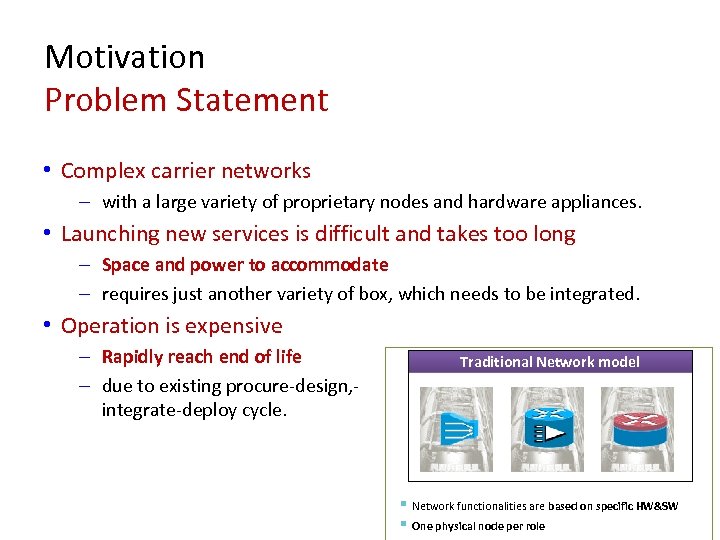
Motivation Problem Statement • Complex carrier networks – with a large variety of proprietary nodes and hardware appliances. • Launching new services is difficult and takes too long – Space and power to accommodate – requires just another variety of box, which needs to be integrated. • Operation is expensive – Rapidly reach end of life – due to existing procure-design, integrate-deploy cycle. Traditional Network model § Network functionalities are based on specific HW&SW § One physical node per role
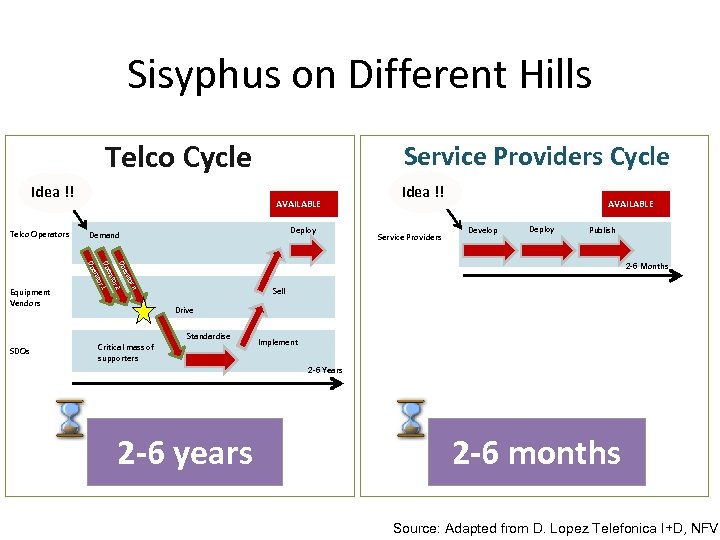
Sisyphus on Different Hills Telco Cycle Idea !! Telco Operators AVAILABLE Deploy Demand Service Providers AVAILABLE Develop Deploy Publish 2 -6 Months to r 1 2 n Sell Drive Standardise SDOs Idea !! er a Op to r er a Op Equipment Vendors Service Providers Cycle Critical mass of supporters Implement 2 -6 Years 2 -6 years 2 -6 months Source: Adapted from D. Lopez Telefonica I+D, NFV
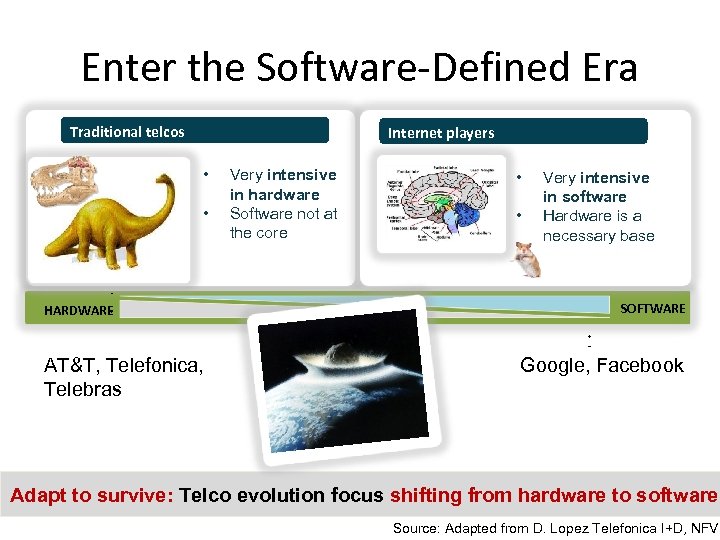
Enter the Software-Defined Era Traditional telcos Internet players • • Very intensive in hardware Software not at the core x • • Very intensive in software Hardware is a necessary base - SOFTWARE + HARDWARE + - AT&T, Telefonica, Telebras Google, Facebook Adapt to survive: Telco evolution focus shifting from hardware to software Source: Adapted from D. Lopez Telefonica I+D, NFV
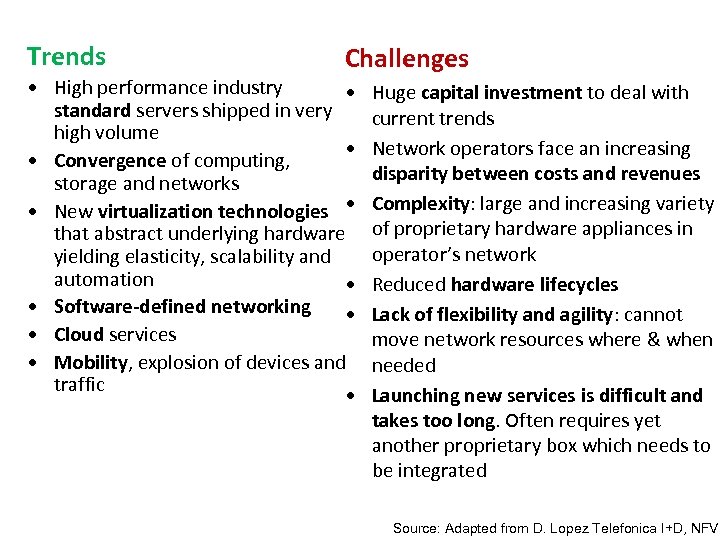
Trends Challenges • High performance industry • standard servers shipped in very high volume • • Convergence of computing, storage and networks • New virtualization technologies • that abstract underlying hardware yielding elasticity, scalability and automation • • Software-defined networking • • Cloud services • Mobility, explosion of devices and traffic • Huge capital investment to deal with current trends Network operators face an increasing disparity between costs and revenues Complexity: large and increasing variety of proprietary hardware appliances in operator’s network Reduced hardware lifecycles Lack of flexibility and agility: cannot move network resources where & when needed Launching new services is difficult and takes too long. Often requires yet another proprietary box which needs to be integrated Source: Adapted from D. Lopez Telefonica I+D, NFV
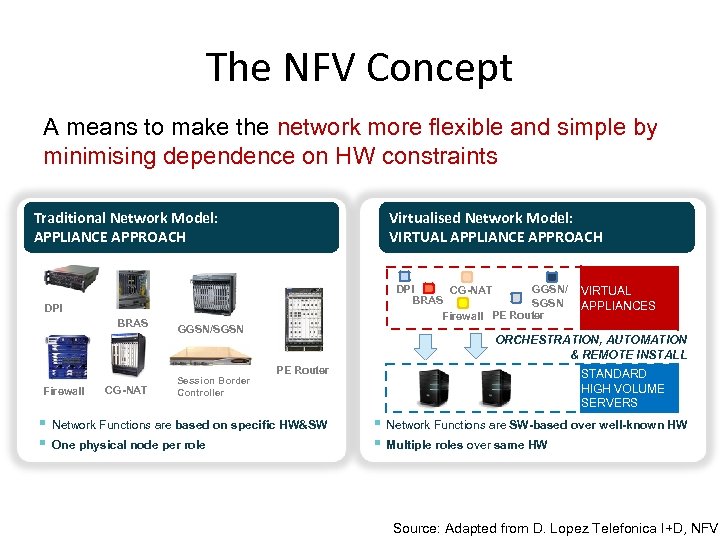
The NFV Concept A means to make the network more flexible and simple by minimising dependence on HW constraints Traditional Network Model: APPLIANCE APPROACH Virtualised Network Model: VIRTUAL APPLIANCE APPROACH v v DPI GGSN/ CG-NAT BRAS SGSN Firewall PE Router DPI BRAS Firewall CG-NAT GGSN/SGSN Session Border Controller VIRTUAL APPLIANCES ORCHESTRATION, AUTOMATION & REMOTE INSTALL PE Router § Network Functions are based on specific HW&SW § One physical node per role STANDARD HIGH VOLUME SERVERS § Network Functions are SW-based over well-known HW § Multiple roles over same HW Source: Adapted from D. Lopez Telefonica I+D, NFV
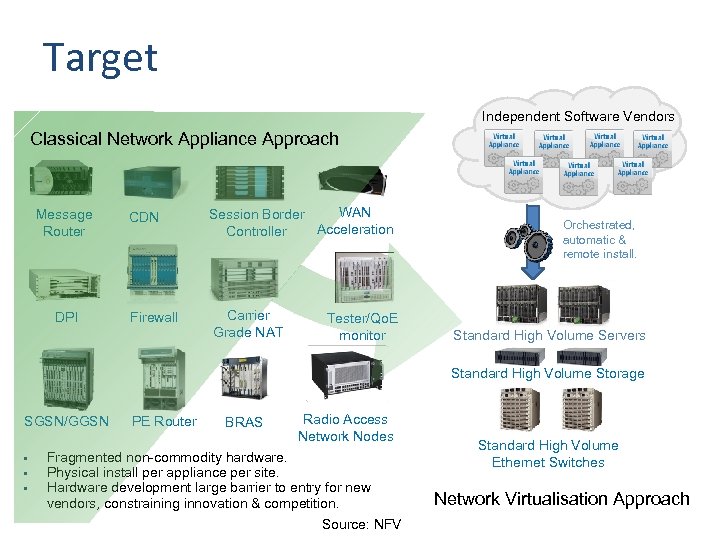
Target Independent Software Vendors Classical Network Appliance Approach Message Router DPI CDN WAN Session Border Acceleration Controller Firewall Carrier Grade NAT Tester/Qo. E monitor Orchestrated, automatic & remote install. Standard High Volume Servers Standard High Volume Storage SGSN/GGSN • • • PE Router BRAS Radio Access Network Nodes Fragmented non-commodity hardware. Physical install per appliance per site. Hardware development large barrier to entry for new vendors, constraining innovation & competition. Source: NFV Standard High Volume Ethernet Switches Network Virtualisation Approach
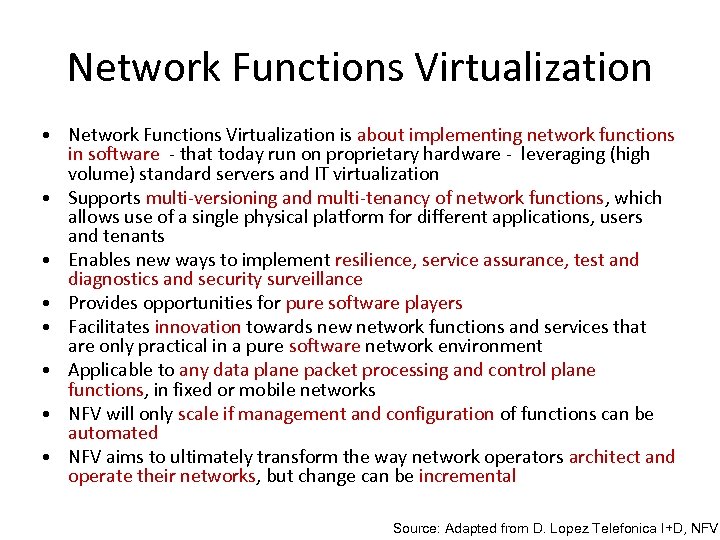
Network Functions Virtualization • Network Functions Virtualization is about implementing network functions in software - that today run on proprietary hardware - leveraging (high volume) standard servers and IT virtualization • Supports multi-versioning and multi-tenancy of network functions, which allows use of a single physical platform for different applications, users and tenants • Enables new ways to implement resilience, service assurance, test and diagnostics and security surveillance • Provides opportunities for pure software players • Facilitates innovation towards new network functions and services that are only practical in a pure software network environment • Applicable to any data plane packet processing and control plane functions, in fixed or mobile networks • NFV will only scale if management and configuration of functions can be automated • NFV aims to ultimately transform the way network operators architect and operate their networks, but change can be incremental Source: Adapted from D. Lopez Telefonica I+D, NFV
Benefits & Promises of NFV • Reduced equipment costs (CAPEX) – through consolidating equipment and economies of scale of IT industry. • Increased speed of time to market – by minimising the typical network operator cycle of innovation. • Availability of network appliance multi-version and multi-tenancy, – allows a single platform for different applications, users and tenants. • Enables a variety of eco-systems and encourages openness. • Encouraging innovation to bring new services and generate new revenue streams. Source: NFV
Benefits & Promises of NFV • • • Flexibility to easily, rapidly, dynamically provision and instantiate new services in various locations Improved operational efficiency • by taking advantage of the higher uniformity of the physical network platform and its homogeneity to other support platforms. Software-oriented innovation to rapidly prototype and test new services and generate new revenue streams More service differentiation & customization Reduced (OPEX) operational costs: reduced power, reduced space, improved network monitoring IT-oriented skillset and talent Source: Adapted from D. Lopez Telefonica I+D, NFV
So, why we need/want NFV(/SDN)? 1. Virtualization: Use network resource without worrying about where it is physically located, how much it is, how it is organized, etc. 2. Orchestration: Manage thousands of devices 3. Programmable: Should be able to change behavior on the fly. 4. Dynamic Scaling: Should be able to change size, quantity 5. Automation 6. Visibility: Monitor resources, connectivity 7. Performance: Optimize network device utilization 8. Multi-tenancy 9. Service Integration 10. Openness: Full choice of modular plug-ins Note: These are exactly the same reasons why we need/want SDN. Source: Adapted from Raj Jain
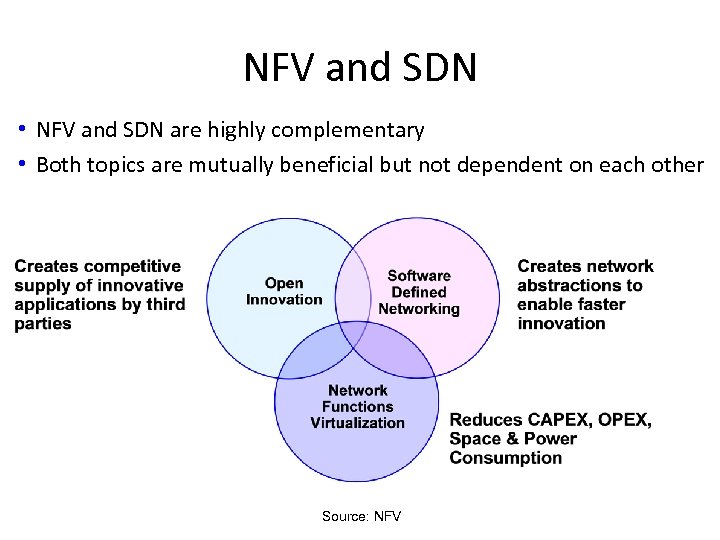
NFV and SDN • NFV and SDN are highly complementary • Both topics are mutually beneficial but not dependent on each other Source: NFV
NFV vs SDN • NFV: re-definition of network equipment architecture • NFV was born to meet Service Provider (SP) needs: – Lower CAPEX by reducing/eliminating proprietary hardware – Consolidate multiple network functions onto industry standard platforms • SDN: re-definition of network architecture • SDN comes from the IT world: – Separate the data and control layers, while centralizing the control – Deliver the ability to program network behavior using welldefined interfaces
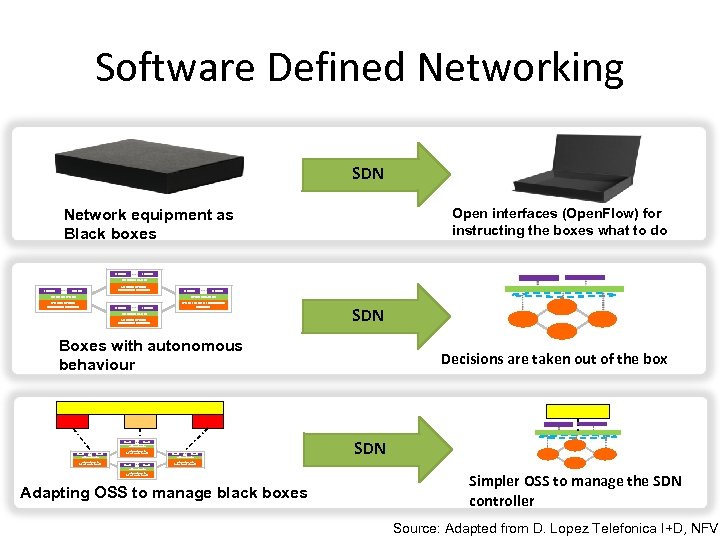
Software Defined Networking SDN Open interfaces (Open. Flow) for instructing the boxes what to do Network equipment as Black boxes FEATURE OPERATING SYSTEM FEATURE SPECIALIZED PACKET FORWARDING HARDWARE FEATURE OPERATING SYSTEM SPECIALIZED PACKET FORWARDING HARDWARE FEATURE OPERATING SYSTEM SPECIALIZED PACKET FORWARDING HARDWARE SDN Boxes with autonomous behaviour FEATURE OPERATING SYSTEM FEATURE SPECIALIZED PACKET FORWARDING HARDWARE OPERATING SYSTEM SPECIALIZED PACKET FORWARDING HARDWARE FEATURE OPERATING SYSTEM FEATURE Decisions are taken out of the box SDN SPECIALIZED PACKET FORWARDING HARDWARE OPERATING SYSTEM SPECIALIZED PACKET FORWARDING HARDWARE Adapting OSS to manage black boxes Simpler OSS to manage the SDN controller Source: Adapted from D. Lopez Telefonica I+D, NFV
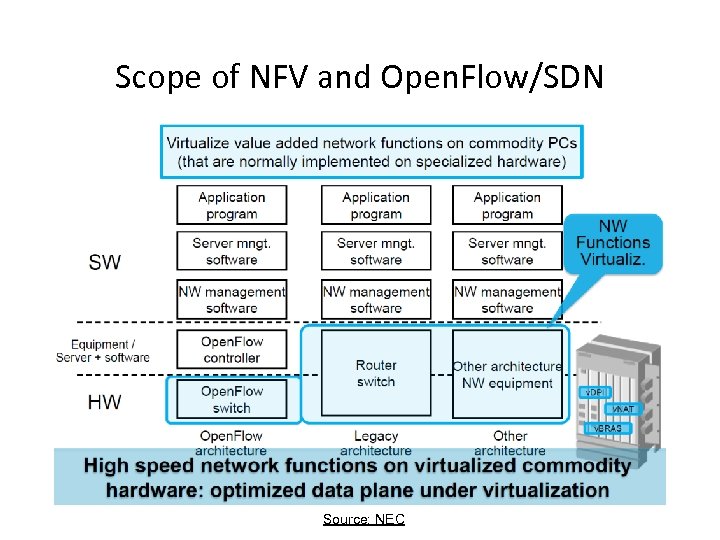
Scope of NFV and Open. Flow/SDN Source: NEC
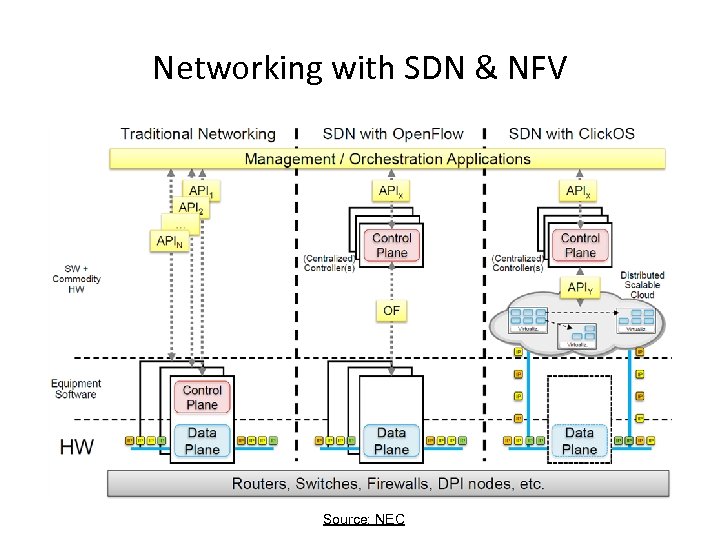
Networking with SDN & NFV Source: NEC
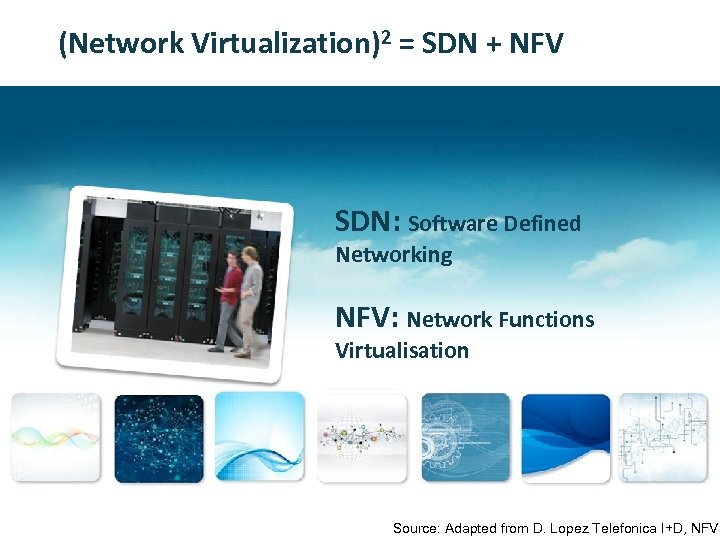
(Network Virtualization)2 = SDN + NFV SDN: Software Defined Networking NFV: Network Functions Virtualisation Source: Adapted from D. Lopez Telefonica I+D, NFV
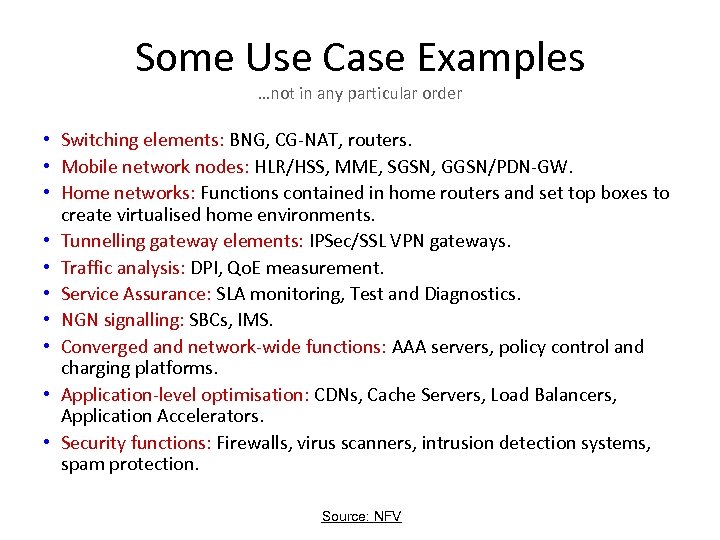
Some Use Case Examples …not in any particular order • Switching elements: BNG, CG-NAT, routers. • Mobile network nodes: HLR/HSS, MME, SGSN, GGSN/PDN-GW. • Home networks: Functions contained in home routers and set top boxes to create virtualised home environments. • Tunnelling gateway elements: IPSec/SSL VPN gateways. • Traffic analysis: DPI, Qo. E measurement. • Service Assurance: SLA monitoring, Test and Diagnostics. • NGN signalling: SBCs, IMS. • Converged and network-wide functions: AAA servers, policy control and charging platforms. • Application-level optimisation: CDNs, Cache Servers, Load Balancers, Application Accelerators. • Security functions: Firewalls, virus scanners, intrusion detection systems, spam protection. Source: NFV
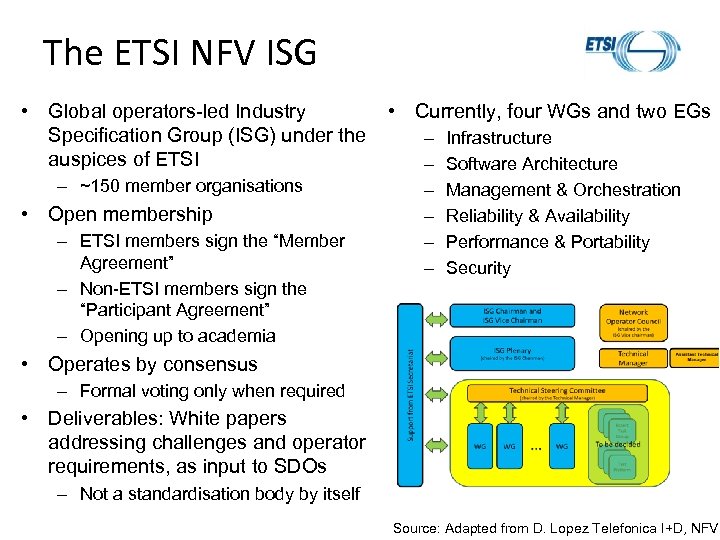
The ETSI NFV ISG • Global operators-led Industry • Currently, four WGs and two EGs Specification Group (ISG) under the – Infrastructure auspices of ETSI – Software Architecture – ~150 member organisations • Open membership – ETSI members sign the “Member Agreement” – Non-ETSI members sign the “Participant Agreement” – Opening up to academia – – Management & Orchestration Reliability & Availability Performance & Portability Security • Operates by consensus – Formal voting only when required • Deliverables: White papers addressing challenges and operator requirements, as input to SDOs – Not a standardisation body by itself Source: Adapted from D. Lopez Telefonica I+D, NFV
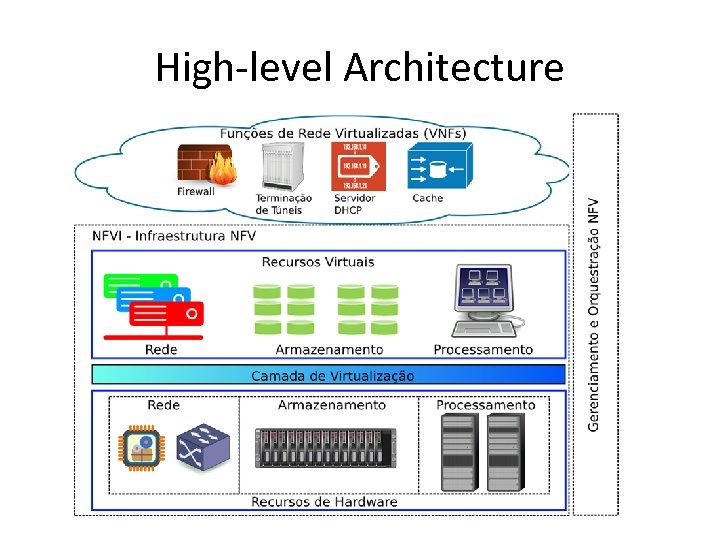
High-level Architecture
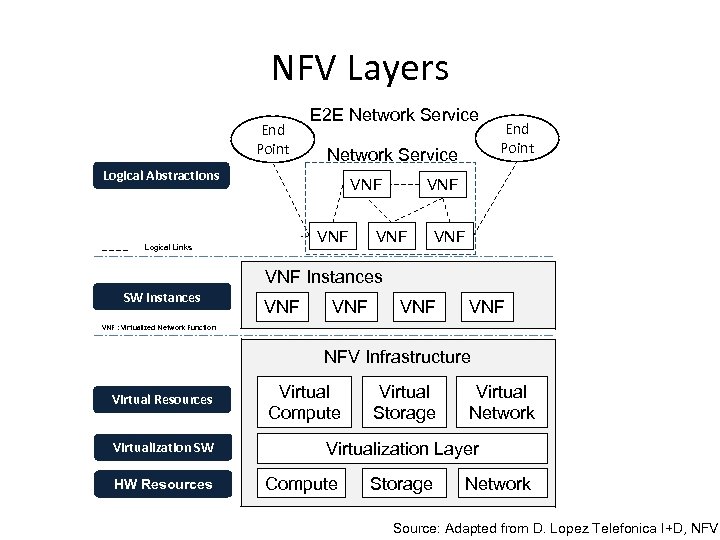
NFV Layers End Point E 2 E Network Service Logical Abstractions VNF Logical Links End Point VNF VNF Instances SW Instances VNF VNF VNF : Virtualized Network Function NFV Infrastructure Virtual Resources Virtualization SW HW Resources Virtual Compute Virtual Storage Virtual Network Virtualization Layer Compute Storage Network Source: Adapted from D. Lopez Telefonica I+D, NFV
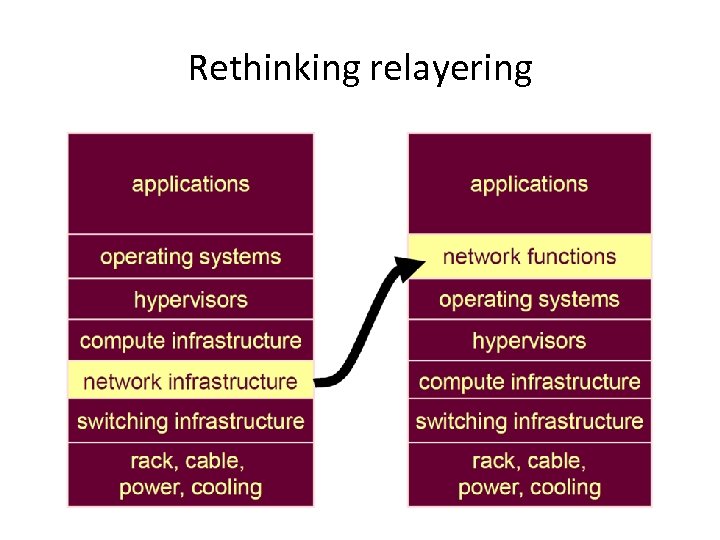
Rethinking relayering
Requirements and Challenges NFV
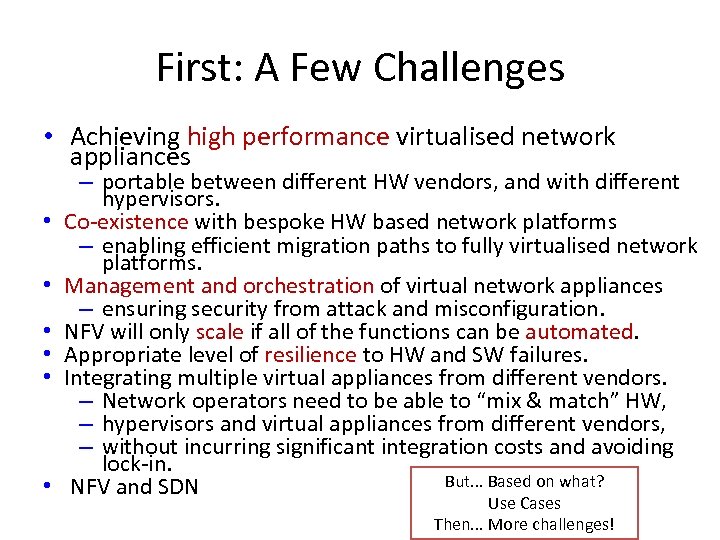
First: A Few Challenges • Achieving high performance virtualised network appliances • • • – portable between different HW vendors, and with different hypervisors. Co-existence with bespoke HW based network platforms – enabling efficient migration paths to fully virtualised network platforms. Management and orchestration of virtual network appliances – ensuring security from attack and misconfiguration. NFV will only scale if all of the functions can be automated. Appropriate level of resilience to HW and SW failures. Integrating multiple virtual appliances from different vendors. – Network operators need to be able to “mix & match” HW, – hypervisors and virtual appliances from different vendors, – without incurring significant integration costs and avoiding lock-in. But. . . Based on what? NFV and SDN Use Cases Then. . . More challenges!
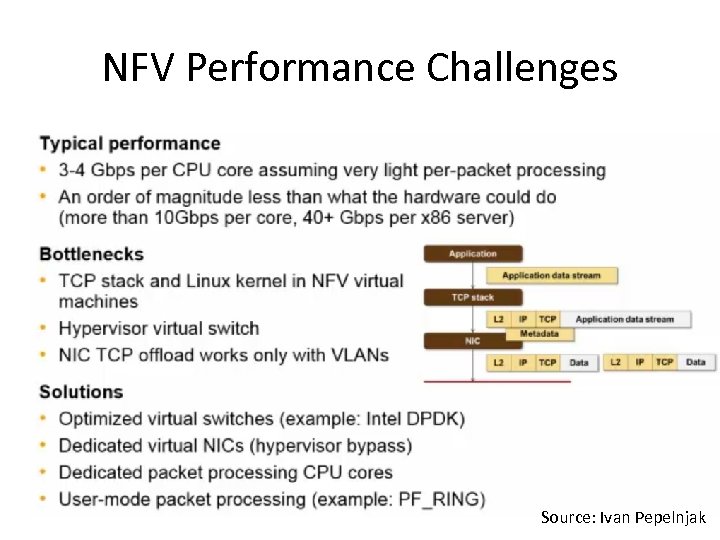
NFV Performance Challenges Source: Ivan Pepelnjak
Use Cases NFV
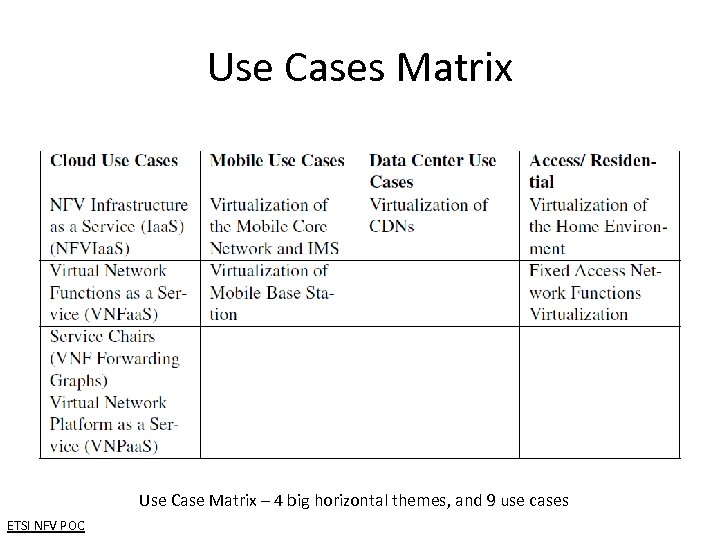
Use Cases Matrix Use Case Matrix – 4 big horizontal themes, and 9 use cases ETSI NFV POC
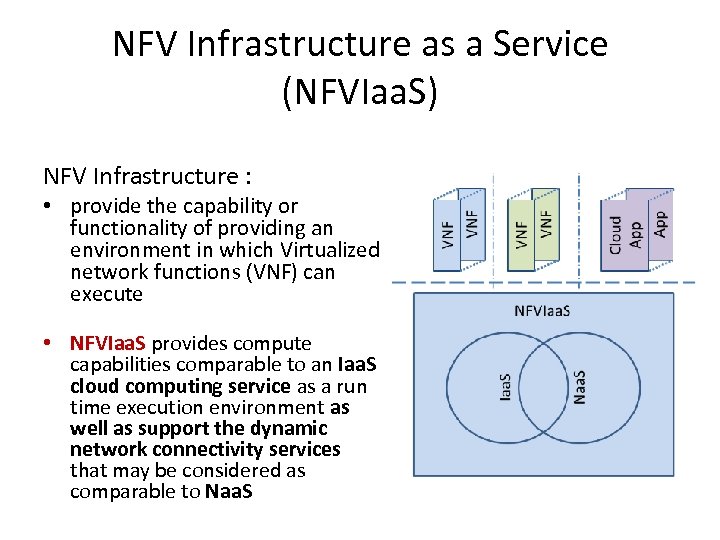
NFV Infrastructure as a Service (NFVIaa. S) NFV Infrastructure : • provide the capability or functionality of providing an environment in which Virtualized network functions (VNF) can execute • NFVIaa. S provides compute capabilities comparable to an Iaa. S cloud computing service as a run time execution environment as well as support the dynamic network connectivity services that may be considered as comparable to Naa. S
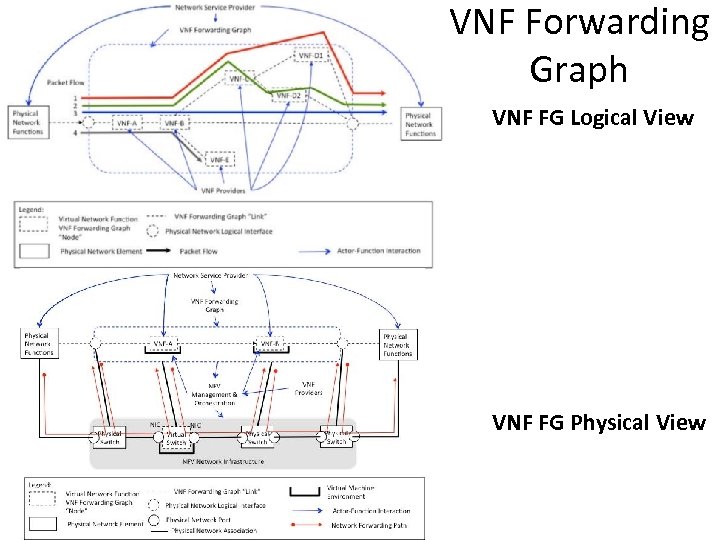
VNF Forwarding Graph VNF FG Logical View VNF FG Physical View
Mobile Core Network and IMS • Mobile networks are populated with a large variety of proprietary hardware appliances • Flexible allocation of Network Functions on such hardware resource pool could highly improve network usage efficiency • Accommodate increased demand for particular services (e. g. voice) without fully relying on the call restriction control mechanisms in a largescale natural disaster scenario such as the Great East Japan Earthquake
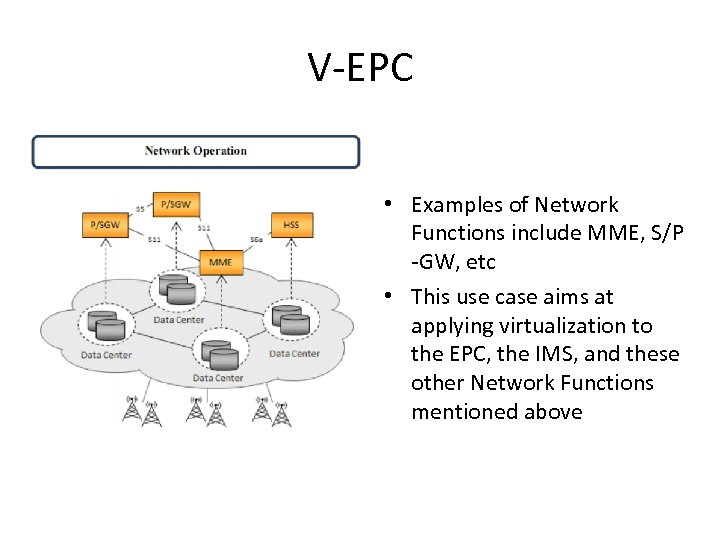
V-EPC • Examples of Network Functions include MME, S/P -GW, etc • This use case aims at applying virtualization to the EPC, the IMS, and these other Network Functions mentioned above
Virtualization of Mobile Base Station • Mobile network traffic is significantly increasing by the demand generated by application of mobile devices, while the ARPU (revenue) is difficult to increase • LTE is also considered as radio access part of EPS (Evolved Packet System) which is required to fullfil the requirements of high spectral efficiency, high peak data rates, short round trip time and frequency flexibility in radio access network (RAN) • Virtualisation of mobile base station leverages IT virtualisation technology to realize at least a part of RAN nodes onto standard IT servers, storages and switches
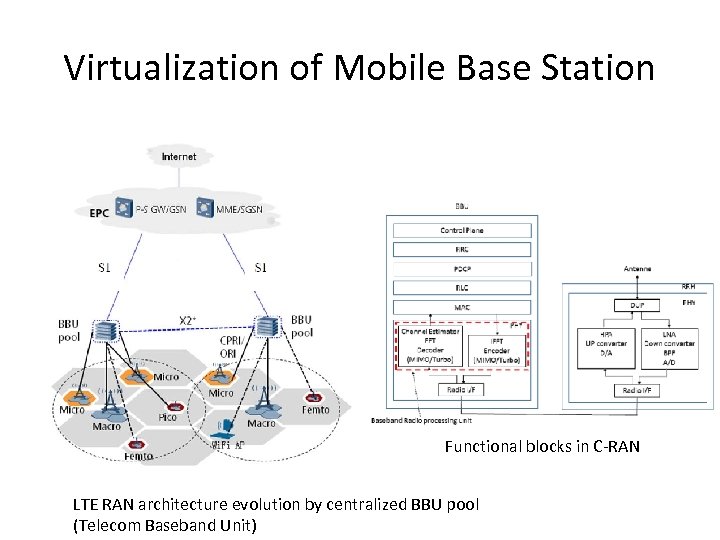
Virtualization of Mobile Base Station Functional blocks in C-RAN LTE RAN architecture evolution by centralized BBU pool (Telecom Baseband Unit)
Proof-of-Concepts NFV
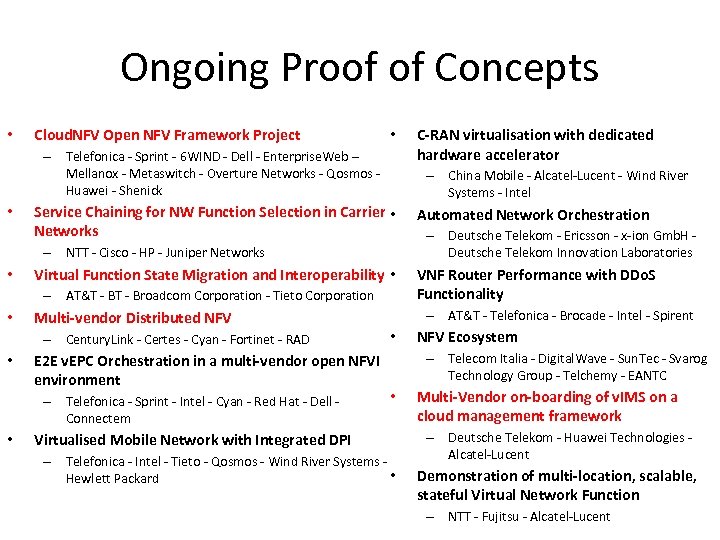
Ongoing Proof of Concepts • Cloud. NFV Open NFV Framework Project • – Telefonica - Sprint - 6 WIND - Dell - Enterprise. Web – Mellanox - Metaswitch - Overture Networks - Qosmos Huawei - Shenick • – China Mobile - Alcatel-Lucent - Wind River Systems - Intel Service Chaining for NW Function Selection in Carrier • Networks – NTT - Cisco - HP - Juniper Networks • Virtual Function State Migration and Interoperability • – AT&T - Broadcom Corporation - Tieto Corporation • Multi-vendor Distributed NFV – Century. Link - Certes - Cyan - Fortinet - RAD • E 2 E v. EPC Orchestration in a multi-vendor open NFVI environment – Telefonica - Sprint - Intel - Cyan - Red Hat - Dell Connectem • C-RAN virtualisation with dedicated hardware accelerator Automated Network Orchestration – Deutsche Telekom - Ericsson - x-ion Gmb. H Deutsche Telekom Innovation Laboratories VNF Router Performance with DDo. S Functionality – AT&T - Telefonica - Brocade - Intel - Spirent • NFV Ecosystem – Telecom Italia - Digital. Wave - Sun. Tec - Svarog Technology Group - Telchemy - EANTC • Virtualised Mobile Network with Integrated DPI – Telefonica - Intel - Tieto - Qosmos - Wind River Systems • Hewlett Packard Multi-Vendor on-boarding of v. IMS on a cloud management framework – Deutsche Telekom - Huawei Technologies Alcatel-Lucent Demonstration of multi-location, scalable, stateful Virtual Network Function – NTT - Fujitsu - Alcatel-Lucent
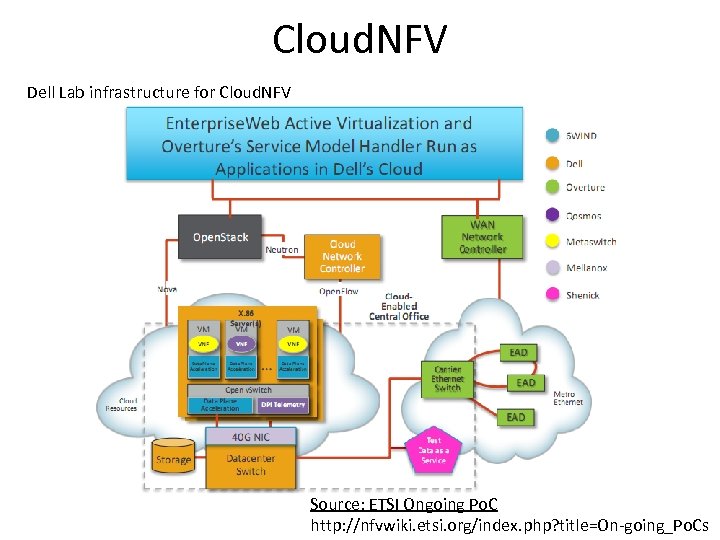
Cloud. NFV Dell Lab infrastructure for Cloud. NFV Source: ETSI Ongoing Po. C http: //nfvwiki. etsi. org/index. php? title=On-going_Po. Cs
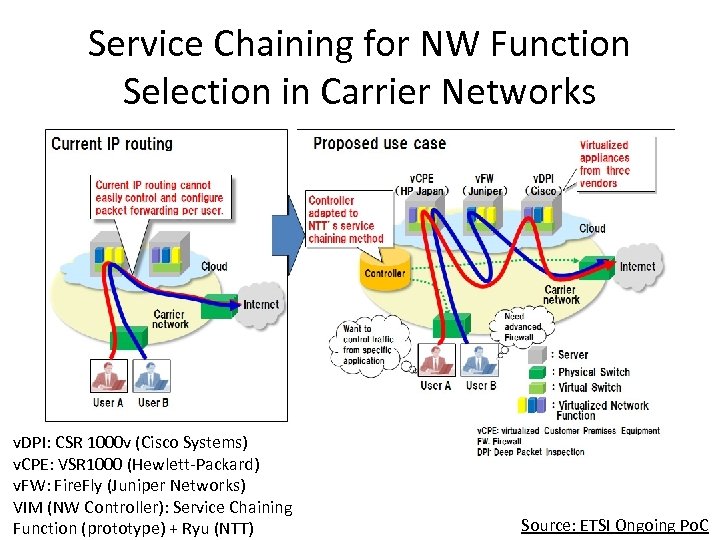
Service Chaining for NW Function Selection in Carrier Networks v. DPI: CSR 1000 v (Cisco Systems) v. CPE: VSR 1000 (Hewlett-Packard) v. FW: Fire. Fly (Juniper Networks) VIM (NW Controller): Service Chaining Function (prototype) + Ryu (NTT) Source: ETSI Ongoing Po. C
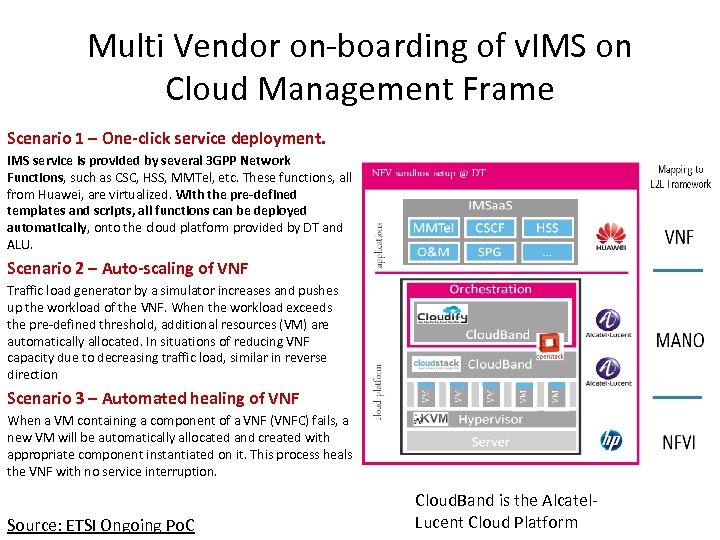
Multi Vendor on-boarding of v. IMS on Cloud Management Frame Scenario 1 – One-click service deployment. IMS service is provided by several 3 GPP Network Functions, such as CSC, HSS, MMTel, etc. These functions, all from Huawei, are virtualized. With the pre-defined templates and scripts, all functions can be deployed automatically, onto the cloud platform provided by DT and ALU. Scenario 2 – Auto-scaling of VNF Traffic load generator by a simulator increases and pushes up the workload of the VNF. When the workload exceeds the pre-defined threshold, additional resources (VM) are automatically allocated. In situations of reducing VNF capacity due to decreasing traffic load, similar in reverse direction Scenario 3 – Automated healing of VNF When a VM containing a component of a VNF (VNFC) fails, a new VM will be automatically allocated and created with appropriate component instantiated on it. This process heals the VNF with no service interruption. Source: ETSI Ongoing Po. C Cloud. Band is the Alcatel. Lucent Cloud Platform
ENABLING TECHNOLOGIES
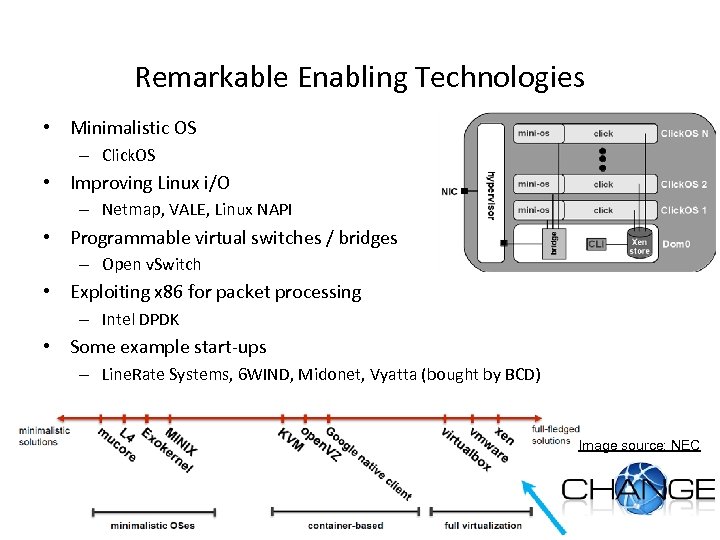
Remarkable Enabling Technologies • Minimalistic OS – Click. OS • Improving Linux i/O – Netmap, VALE, Linux NAPI • Programmable virtual switches / bridges – Open v. Switch • Exploiting x 86 for packet processing – Intel DPDK • Some example start-ups – Line. Rate Systems, 6 WIND, Midonet, Vyatta (bought by BCD) Image source: NEC
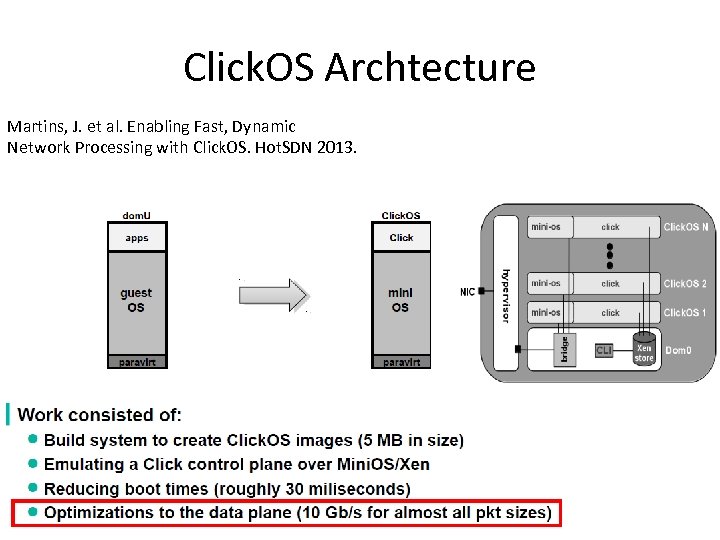
Click. OS Archtecture Martins, J. et al. Enabling Fast, Dynamic Network Processing with Click. OS. Hot. SDN 2013.
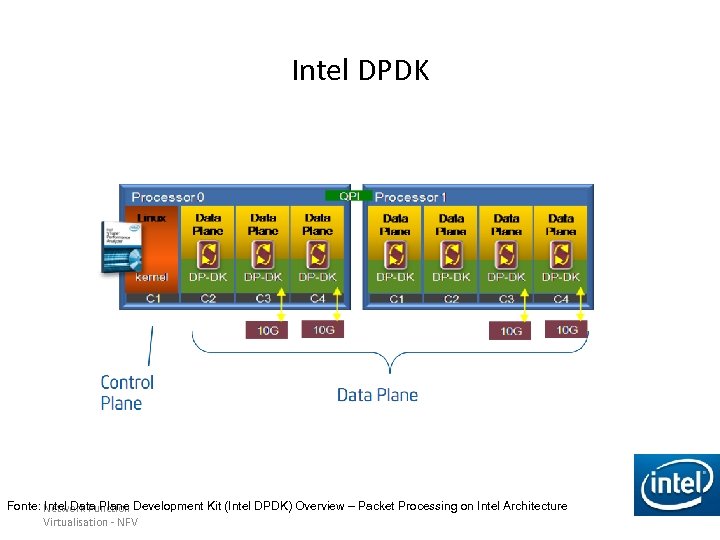
Intel DPDK Fonte: Intel Data Plane Development Kit (Intel DPDK) Overview – Packet Processing on Intel Architecture Network Function Virtualisation - NFV
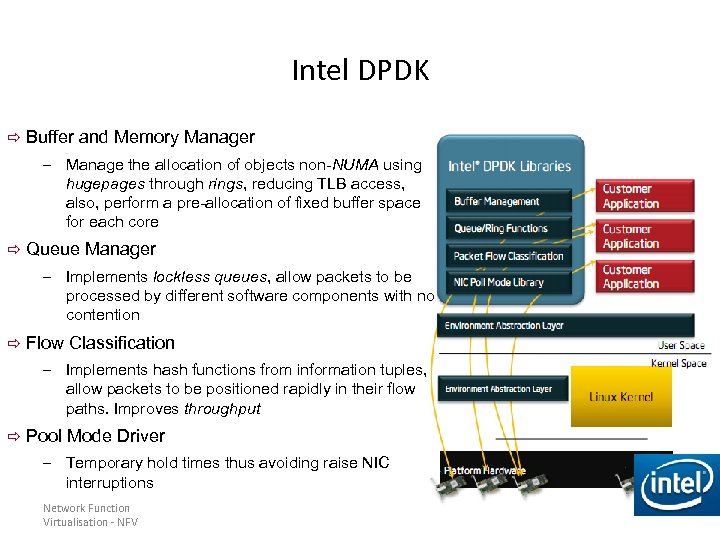
Intel DPDK Buffer and Memory Manager – Manage the allocation of objects non-NUMA using hugepages through rings, reducing TLB access, also, perform a pre-allocation of fixed buffer space for each core Queue Manager – Implements lockless queues, allow packets to be processed by different software components with no contention Flow Classification – Implements hash functions from information tuples, allow packets to be positioned rapidly in their flow paths. Improves throughput Pool Mode Driver – Temporary hold times thus avoiding raise NIC interruptions Network Function Virtualisation - NFV
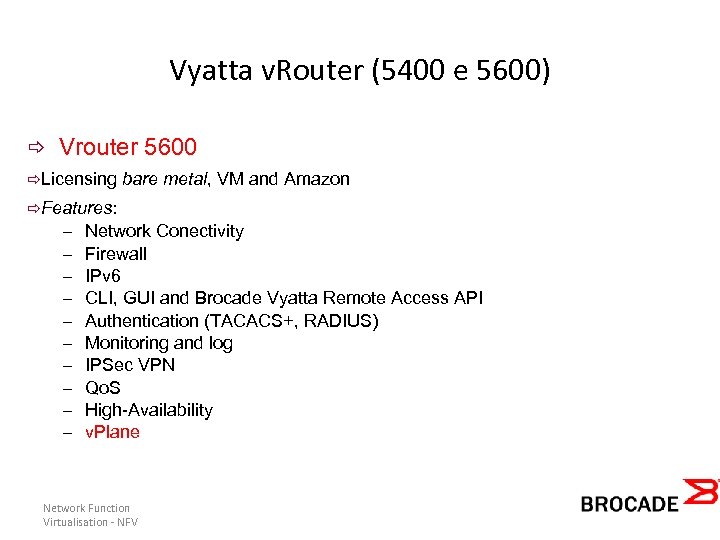
Vyatta v. Router (5400 e 5600) Vrouter 5600 Licensing bare metal, VM and Amazon Features: – – – – – Network Conectivity Firewall IPv 6 CLI, GUI and Brocade Vyatta Remote Access API Authentication (TACACS+, RADIUS) Monitoring and log IPSec VPN Qo. S High-Availability v. Plane Network Function Virtualisation - NFV
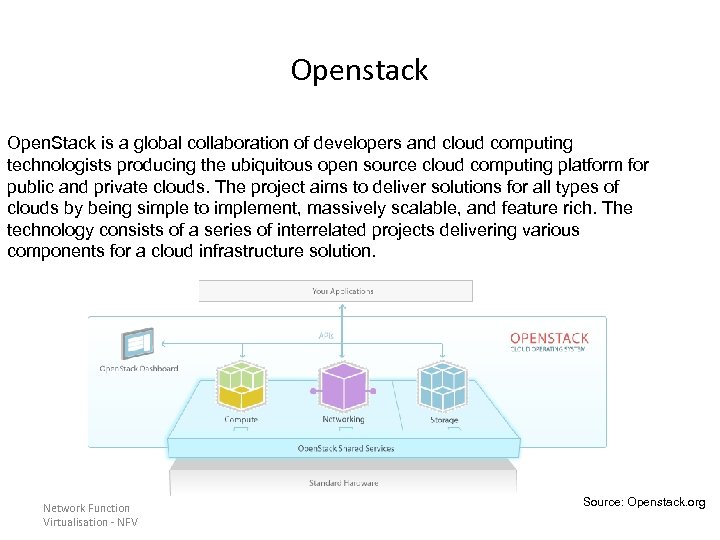
Openstack Open. Stack is a global collaboration of developers and cloud computing technologists producing the ubiquitous open source cloud computing platform for public and private clouds. The project aims to deliver solutions for all types of clouds by being simple to implement, massively scalable, and feature rich. The technology consists of a series of interrelated projects delivering various components for a cloud infrastructure solution. Network Function Virtualisation - NFV Source: Openstack. org
Network Function Virtualisation - NFV
http: //www. fibre-ict. eu/ IMPACT AND OPPORTUNITIES (FIBRE)
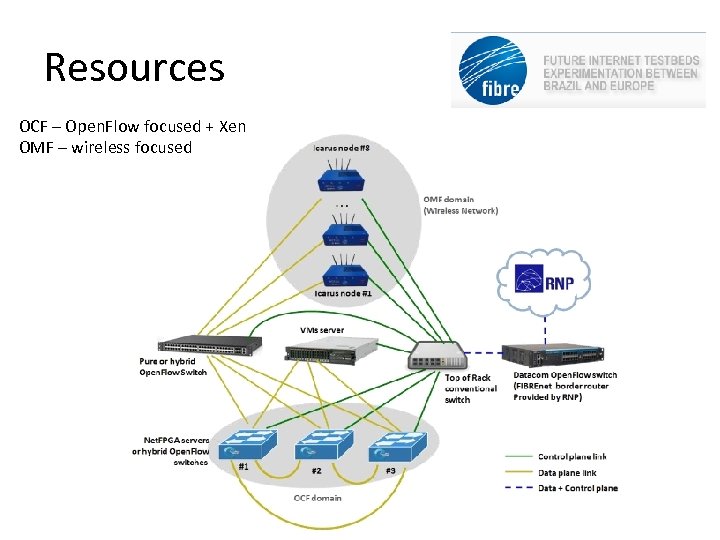
Resources OCF – Open. Flow focused + Xen OMF – wireless focused
NFV Po. C (v. Router) on FIBRE • We have developed a demo for the SBRC 2014 Tutorial 1 – “Network Function Virtualization: Perspectivas, Realidades e Desafios” • Vyatta v. Router 5600 • KVM/Red. Hat • DPDK (hardware and 4 -1 G NIC support it) • OVS • Iperf • Open. Stack • How to do the same on FIBRE? • Vyatta v. Router 5600 • DPDK – how to do it? Without impacting shareness? • Open. Flow Stitching – change Linux Bridges to OVS? • Generating Traffic using net. FPGA (ongoing work UFSCar) • Orchestration? How to do that? (Open. Stack on top of OCF? ) - Open. Stack versus OCF
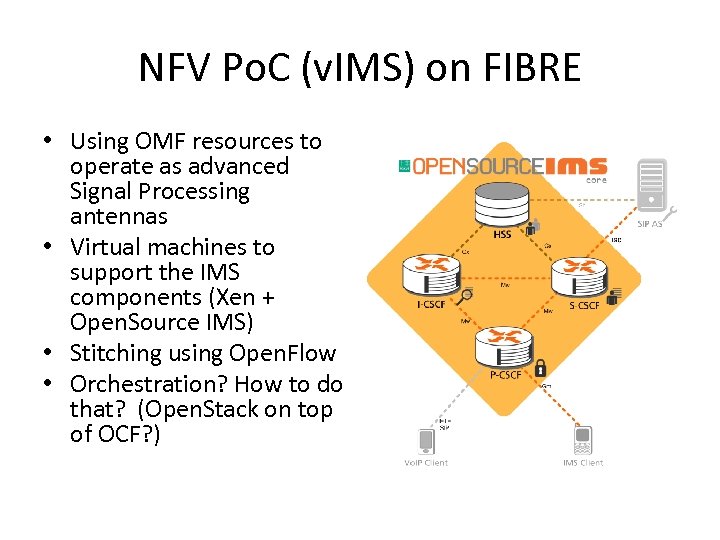
NFV Po. C (v. IMS) on FIBRE • Using OMF resources to operate as advanced Signal Processing antennas • Virtual machines to support the IMS components (Xen + Open. Source IMS) • Stitching using Open. Flow • Orchestration? How to do that? (Open. Stack on top of OCF? )
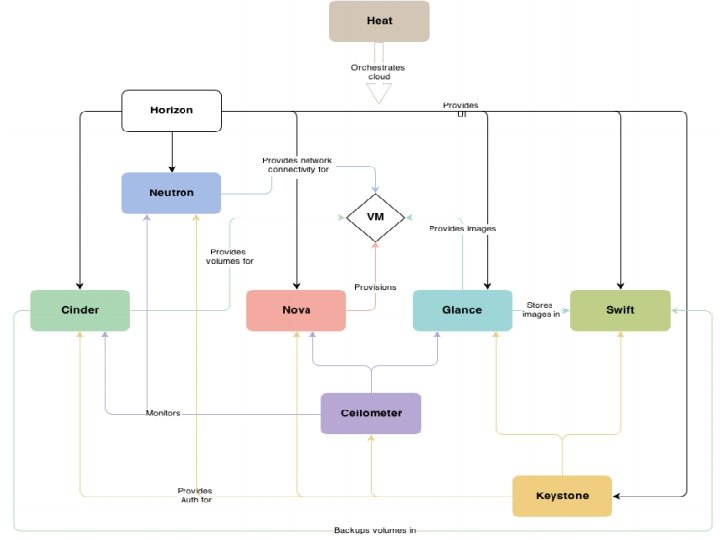
Architectural Changes and Evolution • OCF & OMF vs SFA vs Open. Stack • Open. Stack with Open. Flow (challenge) • Orchestration Module – Heat (Open. Stack) • OF 1. 0 vs OF 1. 3+ • Evolution – More hardware • 1 server is not enough! • At least 3 IBM-similar servers • upgrade memory for more VM – Include Open. Stack • As another direct CMF – Virtualization, Open. Stack and Open. Flow Technologies Courses (during all RNP events) – More Use as it becomes open to the community
Скачать презентацию XXXII Simpósio Brasileiro de Redes de Computadores e
fc5507f73b089f16b5a6c77082ba15d1.ppt