


 Скачать презентацию XP Explained Chapters 7 -9 Primary Practices
f92b43decceb0b99bff98acfe8443ac9.ppt
- Количество слайдов: 26
 XP Explained Chapters 7 -9
 Primary Practices ¡ Sit together l l l ¡ Ideal Resistance Multi-site Whole Team l l l All the necessary skills in a single management structure This is dynamic No fractional staff
 Primary Practices ¡ Informative workspace l l l ¡ Key metrics as big graphs and charts Visible planning and tracking Requirements groups Energized Work l l 40 hour week Focus time
 Primary Practices ¡ Pair Programming (switch as needed, maybe multiple times per day) l l l Keep each other on task Brainstorm Clarify Switch lead when one is stuck Hold each accountable
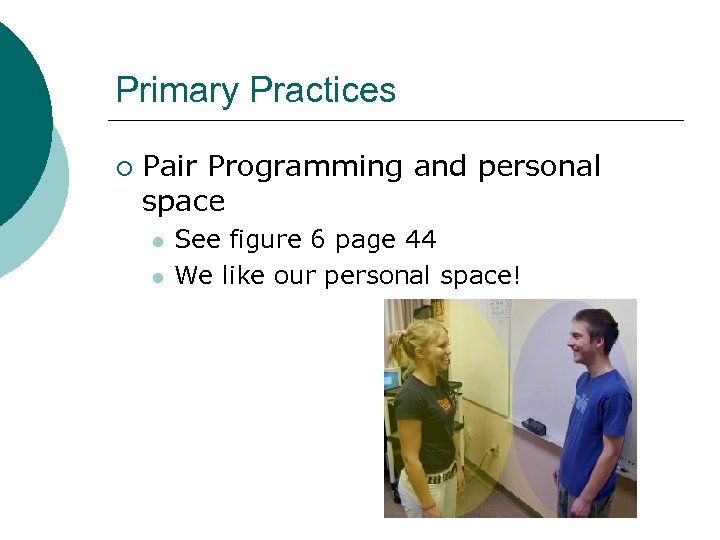 Primary Practices ¡ Pair Programming and personal space l l See figure 6 page 44 We like our personal space!
 Primary Practices ¡ Stories l Plan using units of customer visible functionality Provide a 2 click way for customers to dial frequently used numbers ¡ Make technical requirements visible with test cases ¡ l l Requirement is a misnomer Value cannot be determined with out cost estimates
 Primary Practices ¡ Weekly Cycle l Weekly meeting Review progress ¡ Customer pick new weeks worth of stories ¡ Break stories into tasks, team members sign up for tasks and estimate them ¡ l Start the week by writing automated test
 Primary Practices ¡ Quarterly Cycle l l Reflect on the team, project, progress. Process, and alignment with larger goals Quarterly meeting ¡ Identify bottlenecks ¡ Initiate repairs ¡ Plan themes ¡ Big picture – where the project fits within stakeholder concerns
 Primary Practices ¡ Slack l l Everything can’t be planned Include tasks in the plan that could be dropped
 Primary Practices ¡ Ten Minute Build l l Automatically build and test in 10 minutes. What if you can’t ¡ You can more often that you think
 Primary Practices ¡ Continuous integration l l l Integrate and test changes after no more than a couple of hours Integration can take more time that the original programming Synchronous is better than Asynchronous
 Primary Practices ¡ Test first Programming l l l Write the tests before the code –and do it at a very fine level of granularity. If it is hard to write a test you have a design problem not a test problem Rhythm
 Primary Practices ¡ Incremental Design l l Invest in the design of the system every day Defer design decisions to the last responsible moment The most effective time to design is in the light of experience The closer the implementation of a design mechanism to the time it is actually needed, the more efficient
 Chapter 8 Getting Started
 Getting Started ¡ Make adopting XP an XP project l Write stories Educate management ¡ Attending training ¡ Automate the build ¡ l l l Prioritize the stories Estimate their time and cost Create and track metrics
 Chapter 9 Corollary Practices
 Corollary Practices ¡ Real Customer Involvement l Make your stakeholders part of the team
 Corollary Practices ¡ Incremental Deployment l Run parallel systems if necessary
 Corollary Practices ¡ Team Continuity l Don’t throw everyone back into the “labor pool” once a project is finished
 Corollary Practices ¡ Shrinking Teams l As a team grows in capability, keep its workload constant but gradually reduce its size
 Corollary Practices ¡ Root Cause Analysis l l When you find a defect, eliminate the defect and the cause The goal is that the team won’t ever make the same mistake again I expect that individuals will make mistakes, but my process should ensure that my team doesn’t make mistakes Five whys
 Corollary Practices ¡ Shared Code l Anyone can improve any part of the system at anytime Eliminates bottlenecks ¡ Doesn’t work across team boundries ¡
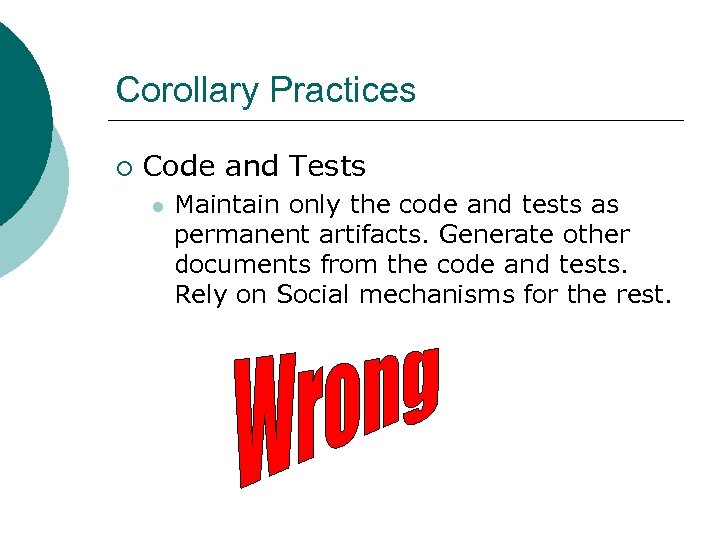 Corollary Practices ¡ Code and Tests l Maintain only the code and tests as permanent artifacts. Generate other documents from the code and tests. Rely on Social mechanisms for the rest.
 Corollary Practices ¡ Single Code Base l l Duplication is not fun and it is very expensive Frameworks can help solve this
 Corollary Practices ¡ Daily Deployment l Put new software into production every night
 Corollary Practices ¡ Negotiated Scope Contract l Write contracts that fix time, costs, and quality but call for an ongoing negotiation of the scope ¡ l Fix scope but leave specific requirement to ongoing negotiation Sign a series of shorter contracts rather than one big one