 Скачать презентацию XML for the smaller publisher Cambridge University Press
2ca270ead917d4df2ba04953ddf9ae59.ppt
- Количество слайдов: 16



XML for the smaller publisher Cambridge University Press – Case study Andy Williams Manager Content Services & Ac. Production Director - Europe
Context – Academic & Professional books • Approx 1500 new titles per annum • XML first workflow for as many as possible – not author-supplied La. Te. X – Probably about 65% of the frontlist • Since 2001 • Single dedicated Academic books DTD (CBML) • All front list to Adobe e. Books, bulk of XML titles to Mobi/HTML e. Books
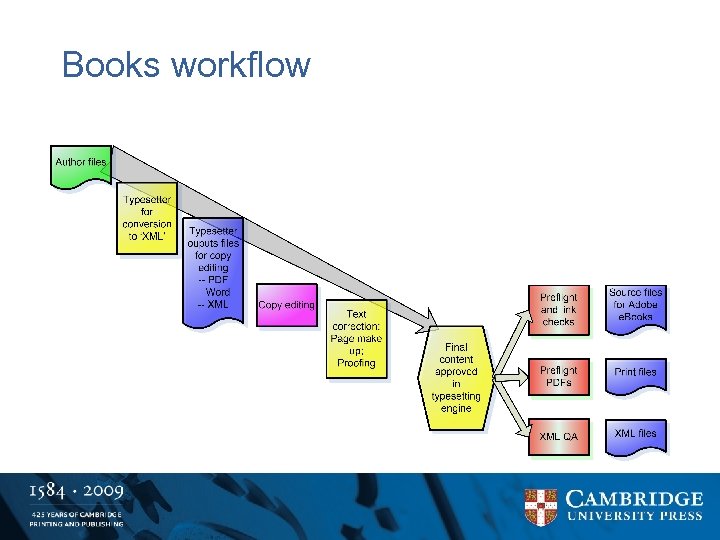
Books workflow
Context - Journals • • • 231 journal titles; approx 1, 000 issues/annum 204 as XML workflow for full text All require XML headers for online platform Scanned archive – references as XML Dedicated journals DTD (informed by NLM but more granular) – CJML • NLM used as the ‘transfer’ format to hand to our online platform plus 3 rd parties
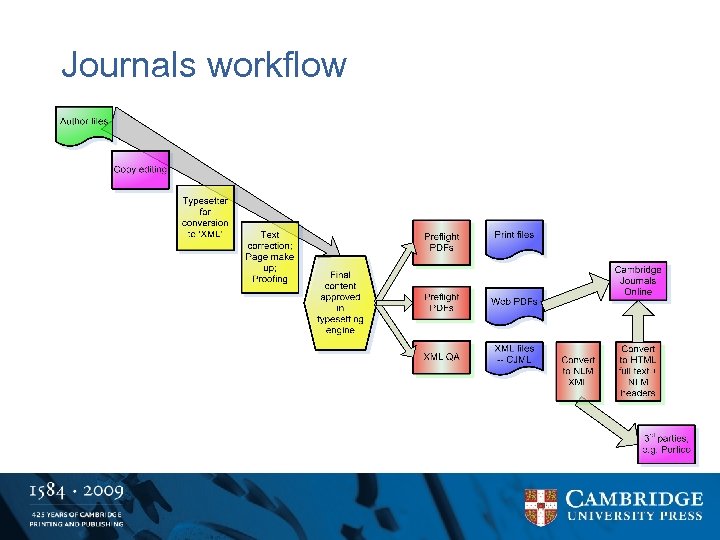
Journals workflow
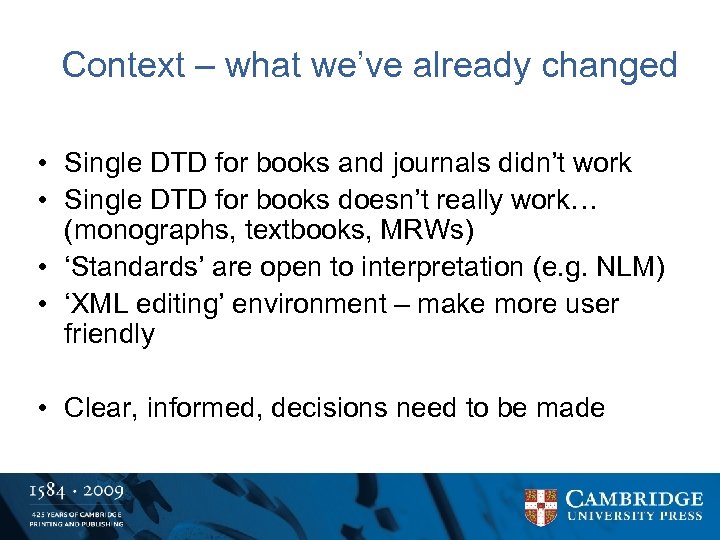
Context – what we’ve already changed • Single DTD for books and journals didn’t work • Single DTD for books doesn’t really work… (monographs, textbooks, MRWs) • ‘Standards’ are open to interpretation (e. g. NLM) • ‘XML editing’ environment – make more user friendly • Clear, informed, decisions need to be made
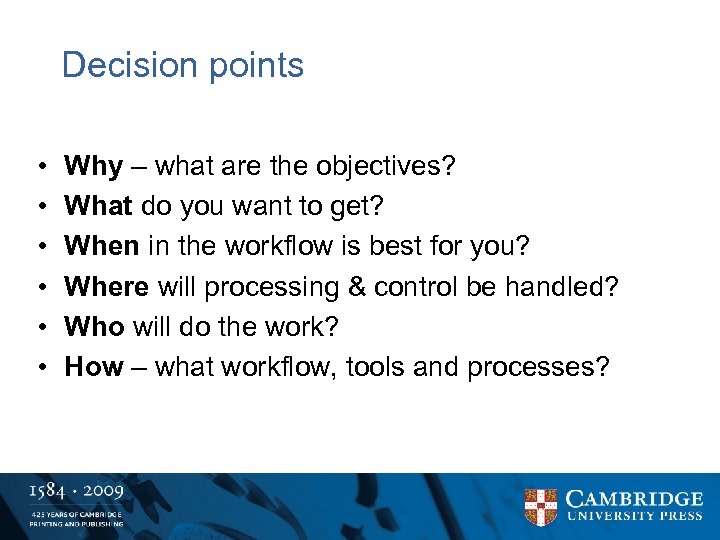
Decision points • • • Why – what are the objectives? What do you want to get? When in the workflow is best for you? Where will processing & control be handled? Who will do the work? How – what workflow, tools and processes?
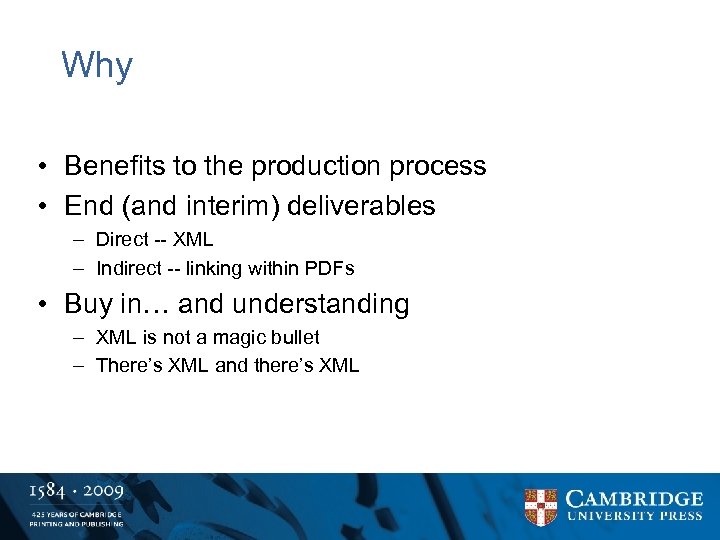
Why • Benefits to the production process • End (and interim) deliverables – Direct -- XML – Indirect -- linking within PDFs • Buy in… and understanding – XML is not a magic bullet – There’s XML and there’s XML
What • • Bespoke DTD Standard DTD (TEI, docbook, NLM) No DTD Schema How many? Who to maintain? Just XML? Application files, style files?
When • • At start, early, late or back end? CUP books – before copy editing CUP journals – after copy editing (cf RSC) Constraints – – – Editorial tools Tradition Authors Additional QA costs
Where • • In house Out house Offshore Map where you stand today, future reality and draw a route plan • Take it steady
Who • • • XML coding Typesetting/pagination QA Archiving DTD maintenance Associated tools – automated QA and transformations
How • Put it all together • Do you predicate the supplier workflow and tools, or just the outputs you want? – In. Design and In. Copy – Word templates – La. Te. X; 3 B 2 • Return to beginning – why? Monitor and review and change
Other lessons learnt • • • Drivers and buy in Disruptive Traditional publishing models may not be ideal Support and infrastructure People and cultural issues bigger than technical issues • Still need a decent user-friendly editing tool • Don’t forget the non-XML titles
Conclusions • Full cost/benefit analysis first – Be clear on the implications (technical resources etc) – “Automated not automatic” • Get your ‘customers’ on board • Small scale experiments? • Would we do it now (if we hadn’t already)… – Journals – definitely – ELT – trying to catch up – Academic books – perhaps more selectively
Questions? Andy Williams Manager Content Services & Ac. Production Director – Europe awilliams@cambridge. org
Скачать презентацию XML for the smaller publisher Cambridge University Press
2ca270ead917d4df2ba04953ddf9ae59.ppt