


 Скачать презентацию XML as the Foundation for e -Marketplaces
b592a1de128a6da12ba0ba941c8034cd.ppt
- Количество слайдов: 65
 XML as the Foundation for e -Marketplaces
 Outline Business Model and Technology Coevolution for e-commerce n The XML Revolution n Electronic Marketplaces and Marketplace Networks n Document Exchange Architecture n The XML Common Business Library n x. CBL in the Global Trading Web n
 Business Model and Technology Co. Evolution for E-Commerce
 n n Traditional Electronic Business Traditional models for electronic business are based on long-term, point-to-point, and tightly coupled relationships Electronic Data Interchange (EDI) used since 1980 s to automate routine transactions between established trading partners, especially for direct goods, supply chains But EDI syntax not programmer or Web-friendly Not well-suited for small businesses or more spontaneous, open market transactions like indirect procurement
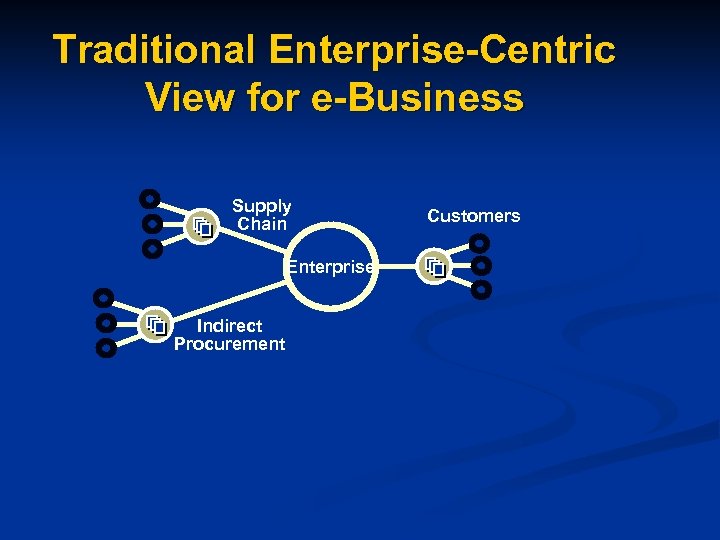 Traditional Enterprise-Centric View for e-Business Supply Chain Enterprise Indirect Procurement Customers
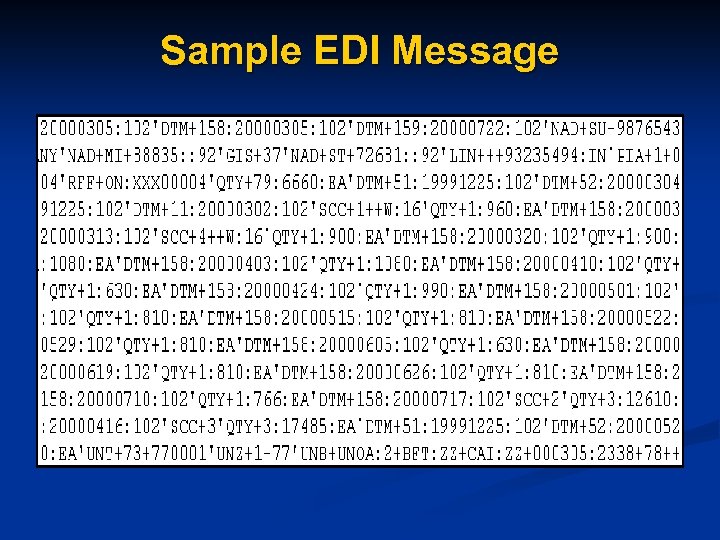 Sample EDI Message
 Business Trends Relentless search for competitive advantage n Ruthless efficiency necessary for survival n Accelerating cycle times n Focus shifting from administrative efficiency in the enterprise to winning in the marketplace n
 Business Inefficiencies n Lack of real time information for basic business decisions n Inability to connect supply to demand increases costs and limits revenue n Disparate technology across the value chain makes planning & collaboration slow and expensive
 Problem/Solution Mismatch n Current problems primarily result from poor visibility and collaboration with external commercial relationships n Current solutions provide tools that focus on internal administrative and control processes of the enterprise
 The Internet Was Supposed to Change Everything The Internet will enable new business models for marketplaces, trading communities, outsourcing, open sourcing, buying consortia, auctions, supply chain integration and “virtual enterprises” that are fundamentally different. . .
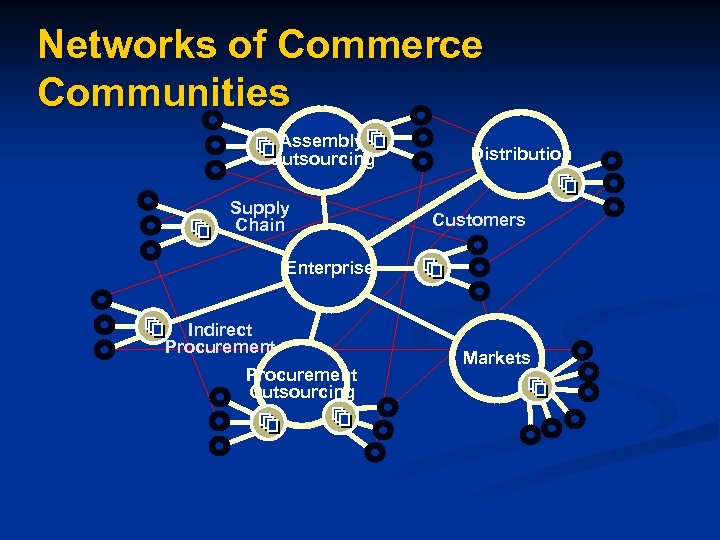 Networks of Commerce Communities Assembly Outsourcing Supply Chain Distribution Customers Enterprise Indirect Procurement Outsourcing Markets
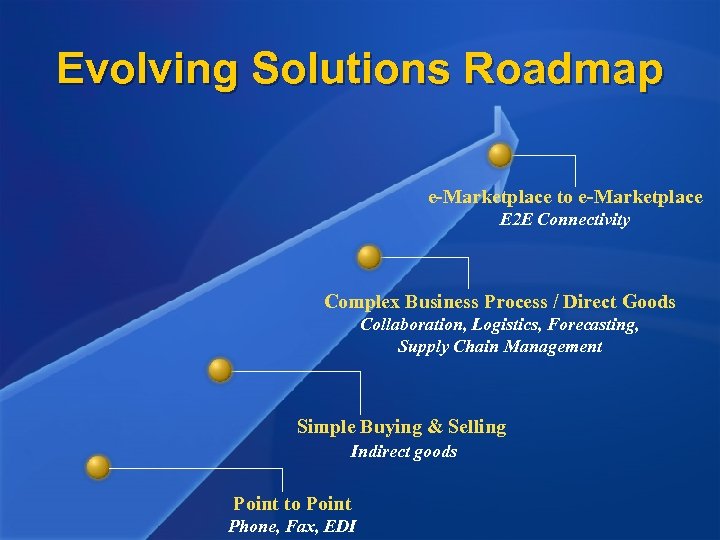 Evolving Solutions Roadmap e-Marketplace to e-Marketplace E 2 E Connectivity Complex Business Process / Direct Goods Collaboration, Logistics, Forecasting, Supply Chain Management Simple Buying & Selling Indirect goods Point to Point Phone, Fax, EDI
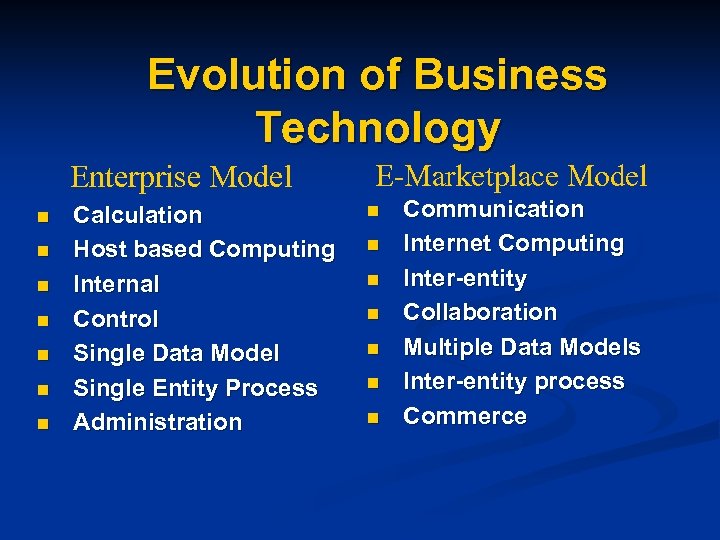 Evolution of Business Technology Enterprise Model n n n n Calculation Host based Computing Internal Control Single Data Model Single Entity Process Administration E-Marketplace Model n n n n Communication Internet Computing Inter-entity Collaboration Multiple Data Models Inter-entity process Commerce
 Internet Business Models & Integration Requirements n n Business models and relationships are experimental and evolving and have shorter lifetimes overall “Describe once, {sell, buy} anywhere” is the goal Both initial integration cost and incremental cost to evolve must be low Point-to-point coupling approaches won’t scale
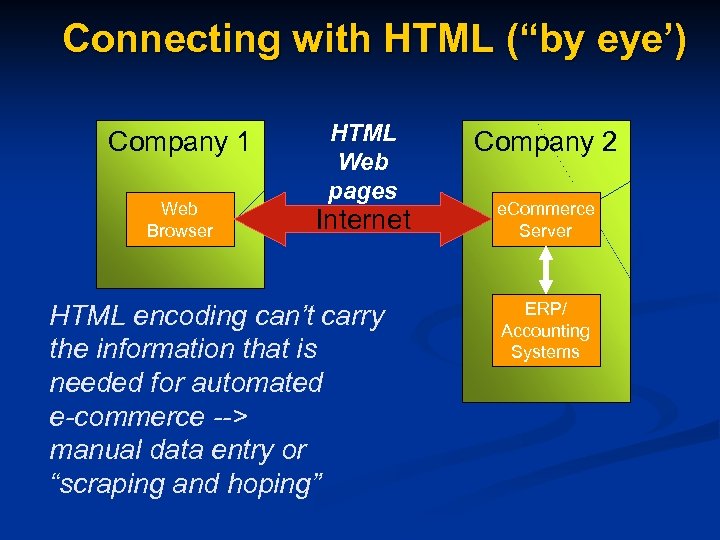 Connecting with HTML (“by eye’) Company 1 Web Browser HTML Web pages Internet HTML encoding can’t carry the information that is needed for automated e-commerce --> manual data entry or “scraping and hoping” Company 2 e. Commerce Server ERP/ Accounting Systems
 HTML’s Limitations for Integration n The Web was created as a publishing medium, not as an e-commerce platform HTML, the Web’s language for encoding information, is format-oriented and meant to be understood “by eye” n simple structures: headings, lists, links n Browsers are “hard wired” to render HTML as web pages No content-based encoding means that HTML can’t be effectively searched or processed by business applications
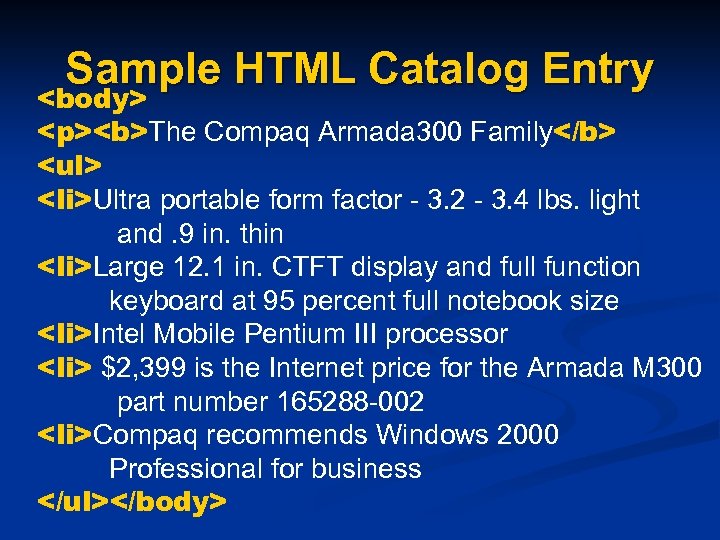 Sample HTML Catalog Entry
The Compaq Armada 300 Family
- Ultra portable form factor - 3. 2 - 3. 4 lbs. light and. 9 in. thin
- Large 12. 1 in. CTFT display and full function keyboard at 95 percent full notebook size
- Intel Mobile Pentium III processor
- $2, 399 is the Internet price for the Armada M 300 part number 165288 -002
- Compaq recommends Windows 2000 Professional for business
 The XML Revolution
 XML: Extensible Markup Language Instead of a fixed set of format-oriented tags, XML allows you to create whatever set of tags are needed for your type of information n This makes any XML instance “selfdescribing” and easily understood by computers and people n
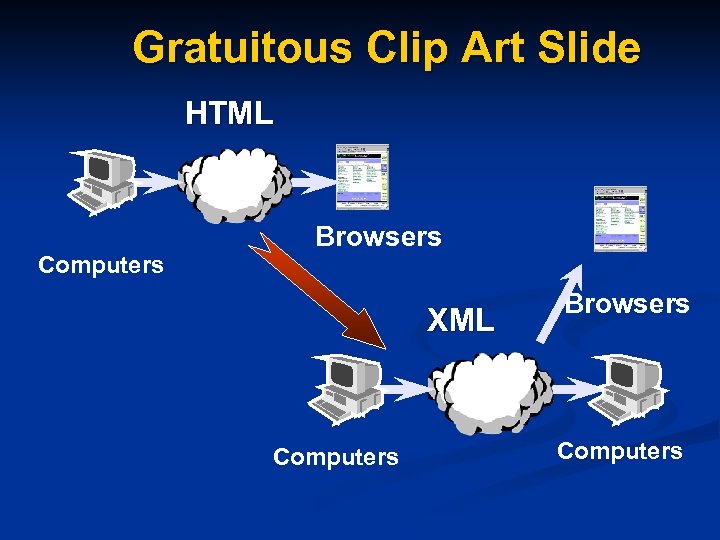 Gratuitous Clip Art Slide HTML Computers Browsers XML Computers Browsers Computers
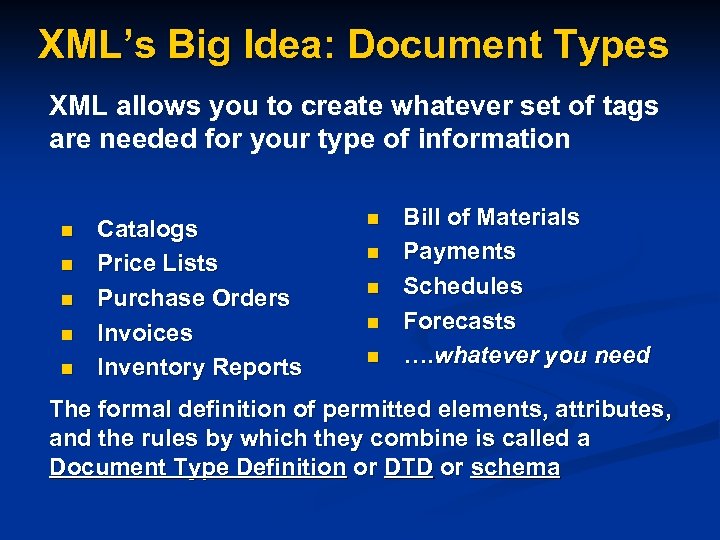 XML’s Big Idea: Document Types XML allows you to create whatever set of tags are needed for your type of information n n Catalogs Price Lists Purchase Orders Invoices Inventory Reports n n n Bill of Materials Payments Schedules Forecasts …. whatever you need The formal definition of permitted elements, attributes, and the rules by which they combine is called a Document Type Definition or DTD or schema
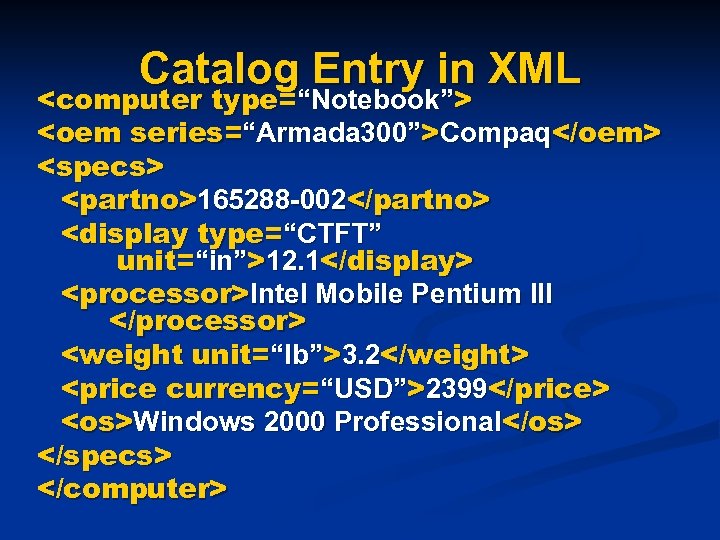 Catalog Entry in XML
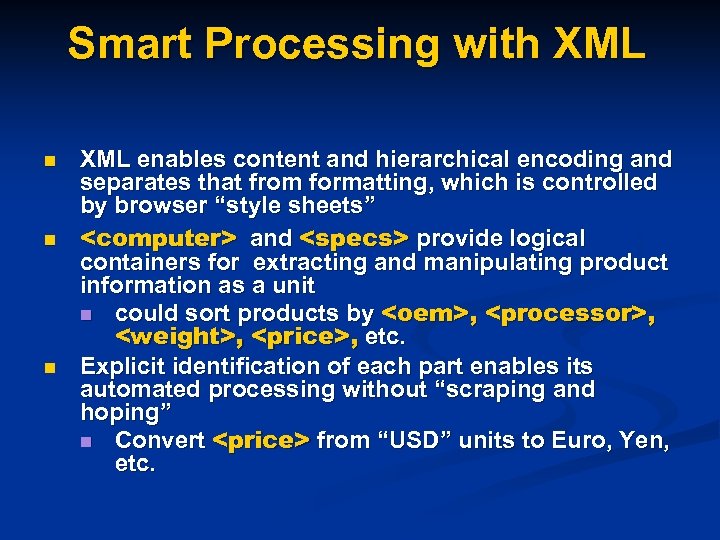 Smart Processing with XML n n n XML enables content and hierarchical encoding and separates that from formatting, which is controlled by browser “style sheets”
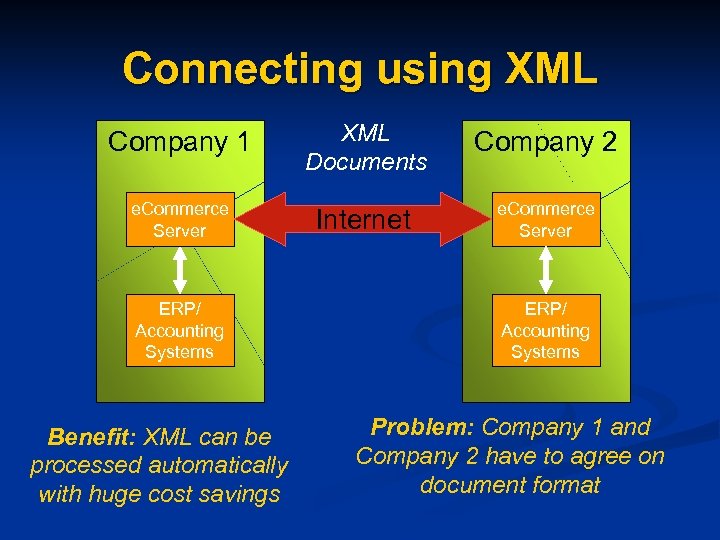 Connecting using XML Company 1 e. Commerce Server ERP/ Accounting Systems Benefit: XML can be processed automatically with huge cost savings XML Documents Company 2 Internet e. Commerce Server ERP/ Accounting Systems Problem: Company 1 and Company 2 have to agree on document format
 Electronic Marketplaces and Marketplace Networks
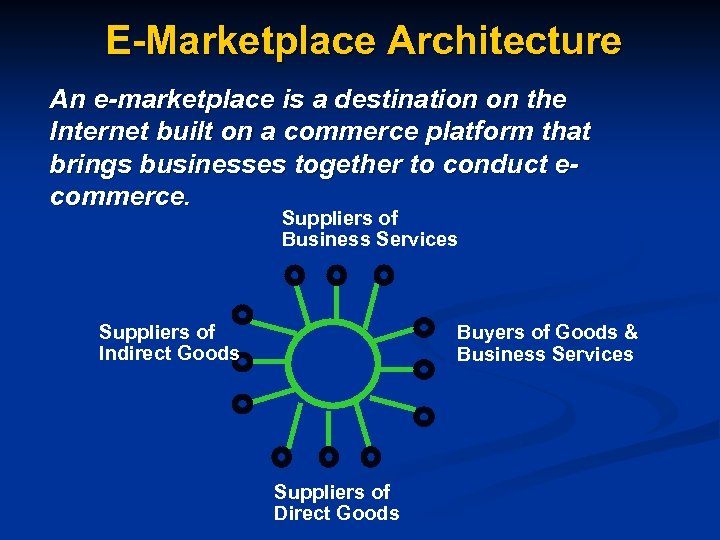 E-Marketplace Architecture An e-marketplace is a destination on the Internet built on a commerce platform that brings businesses together to conduct ecommerce. Suppliers of Business Services Suppliers of Indirect Goods Buyers of Goods & Business Services Suppliers of Direct Goods
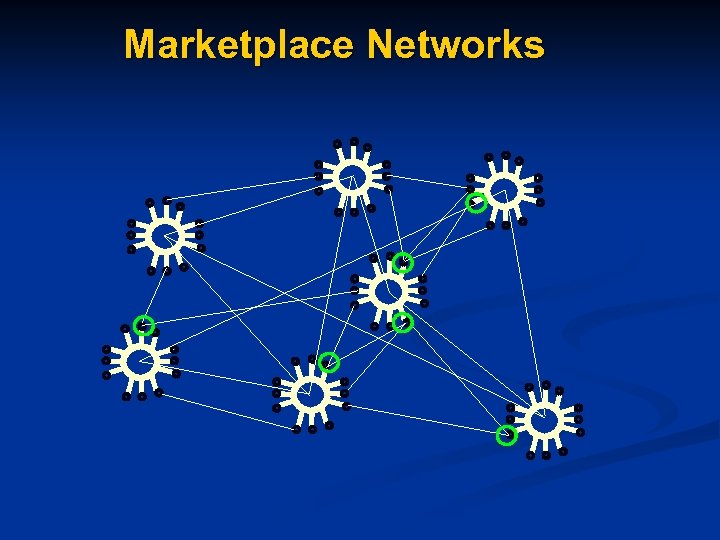 Marketplace Networks
 Example: Commerce One EMarketplace Solution Commerce One creates a highly transparent commerce community with suppliers, partners, and customers n Commerce One provides a complete ebusiness solution n Strategy, Platform, Software, Services Commerce One accesses existing enterprise systems with the disparate technologies of suppliers, partners, and customers
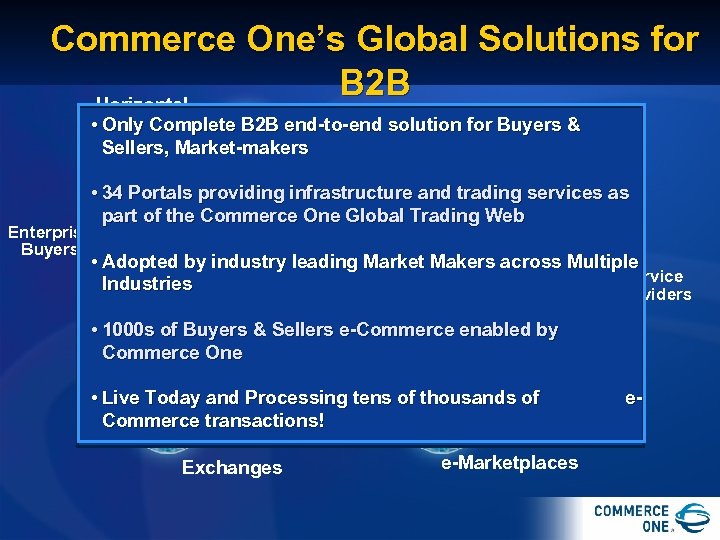 Commerce One’s Global Solutions for B 2 B Horizontal Sellers Trading • Only Complete B 2 B end-to-end solution for Buyers & Portals Solutions Sellers, Market-makers for buyers, sellers and market-makers • 34 Portals providing infrastructure and trading services as part of the Commerce One Global Trading Web Enterprise Buyers Enabling next generation collaborative B 2 B • Adopted by industry leading Market Makers across Multiple trading services that connect buyers Service Industries and sellers in a real-time environment - Providers • 1000 s of Buyersmaximizing commerce & Sellers e-Commerce enabled by Commerce One • Live Today and Processing tens of thousands of Commerce transactions! Exchanges e-Marketplaces e-
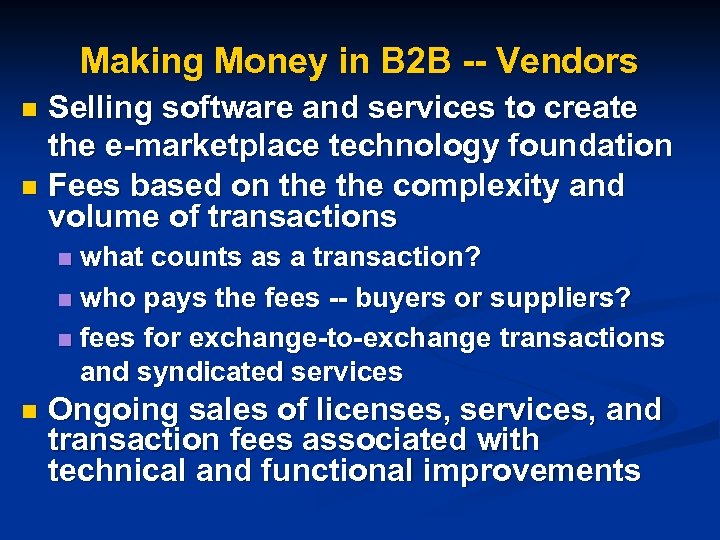 Making Money in B 2 B -- Vendors Selling software and services to create the e-marketplace technology foundation n Fees based on the complexity and volume of transactions n what counts as a transaction? n who pays the fees -- buyers or suppliers? n fees for exchange-to-exchange transactions and syndicated services n n Ongoing sales of licenses, services, and transaction fees associated with technical and functional improvements
 Making Money in B 2 B -Vendors and Customers n Equity owning a share of the new company created to run an e-marketplace n only valuable if the company can go public n not going to happen anytime soon n
 Making Money in B 2 B -Customers n Market efficiency driving costs out of supply chain for all participants n exploiting & refining existing business relationships & experience n putting an external “market face” on enterprise applications n n Standards are crucial to these concerns
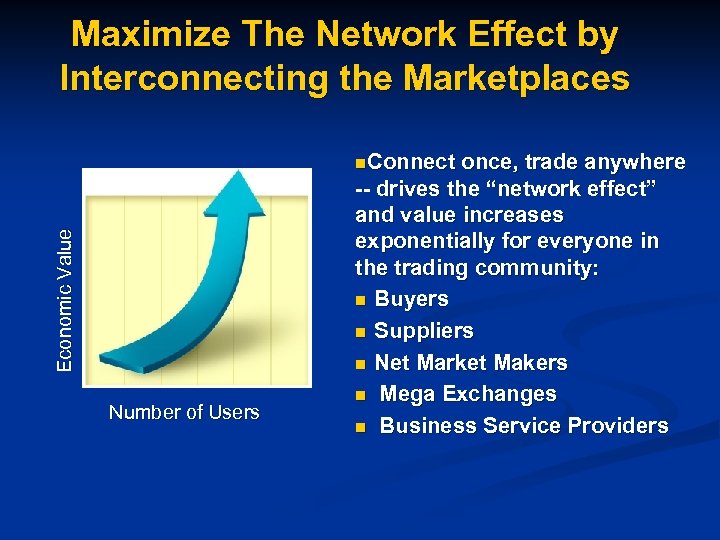 Maximize The Network Effect by Interconnecting the Marketplaces Economic Value n. Connect Number of Users once, trade anywhere -- drives the “network effect” and value increases exponentially for everyone in the trading community: n Buyers n Suppliers n Net Market Makers n Mega Exchanges n Business Service Providers
 The Global Trading Web n The Global Trading Web is the world’s largest business-to-business Internet trading community, comprised of many open e-marketplaces, accelerating the movement of global trade onto the web. “The Global Trading Web is the Internet enhanced for business. ”
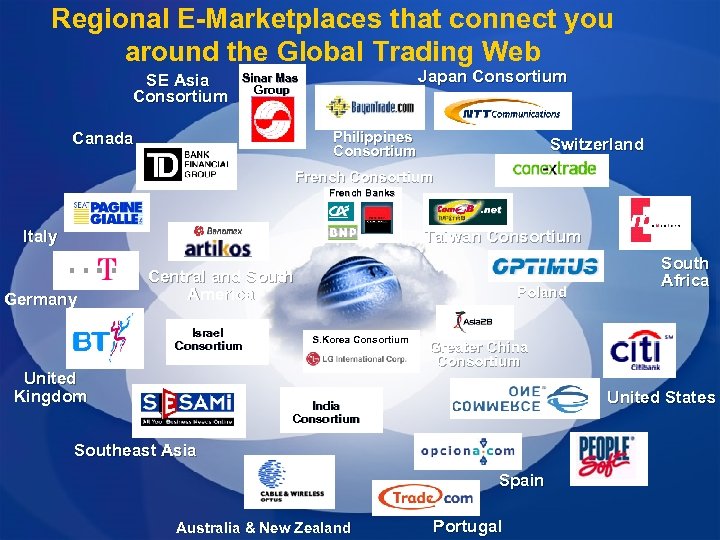 Regional E-Marketplaces that connect you around the Global Trading Web SE Asia Consortium Japan Consortium Sinar Mas Group Philippines Consortium Canada Switzerland French Consortium French Banks Italy Taiwan Consortium Germany Central and South America Israel Consortium United Kingdom Poland S. Korea Consortium Greater China Consortium United States India Consortium Southeast Asia Spain Australia & New Zealand South Africa Portugal
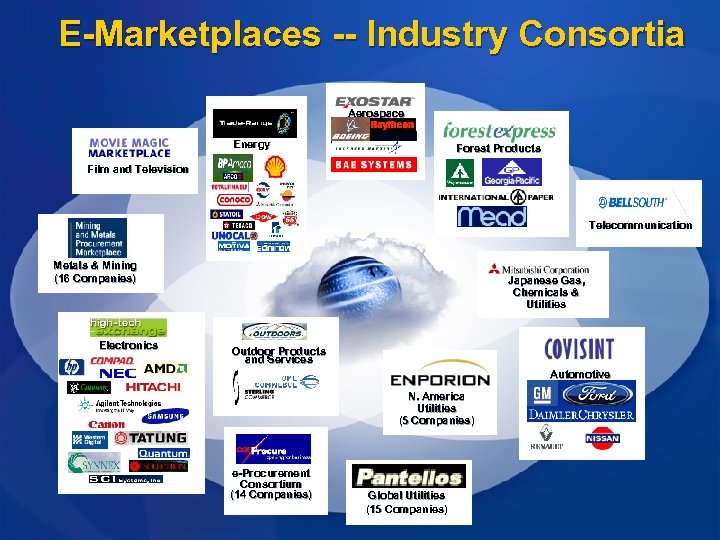 E-Marketplaces -- Industry Consortia Aerospace Energy Forest Products Film and Television Telecommunication Metals & Mining (16 Companies) Electronics “MMProcurement” Metals & Mining 16 Equity Partners Japanese Gas, Chemicals & Utilities Outdoor Products and Services Automotive N. America Utilities (5 Companies) e-Procurement Consortium (14 Companies) Global Utilities (15 Companies)
 Document Exchange Architecture for Electronic Marketplaces and Marketplace Networks
 What Defines a Marketplace? The “market maker/operator” n The participating businesses n The services these businesses provide to each other n The messages and documents that are exchanged to request and perform the services n
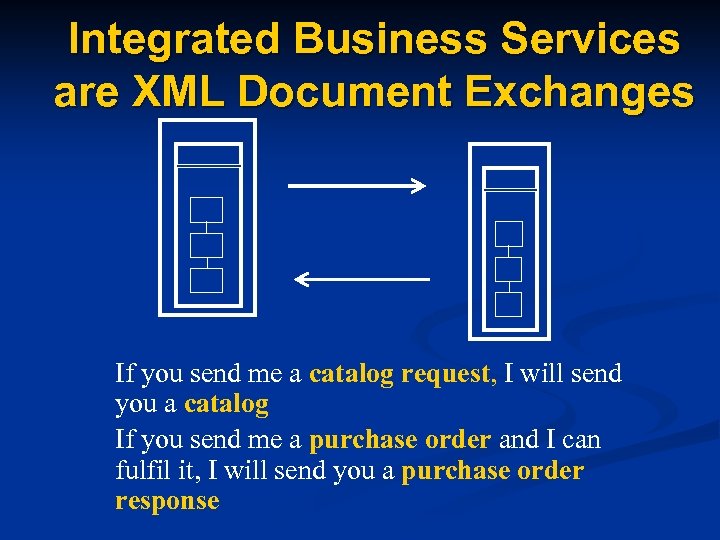 Integrated Business Services are XML Document Exchanges If you send me a catalog request, I will send you a catalog If you send me a purchase order and I can fulfil it, I will send you a purchase order response
 n XML Document Exchange Architecture Document exchange is a more natural way to think about doing business n n Less brittle than APIs (how enterprise sw vendors think) More consistent with legacy EDI XML is application and vendor neutral, making it easy to provide “open” marketplace with 3 rd party buying and selling apps and other marketplace services like payment, taxation, logistics… Document exchange between marketplaces is fundamentally the same as within a marketplace -> Global Trading Web
 The XML Common Business Library (x. CBL)
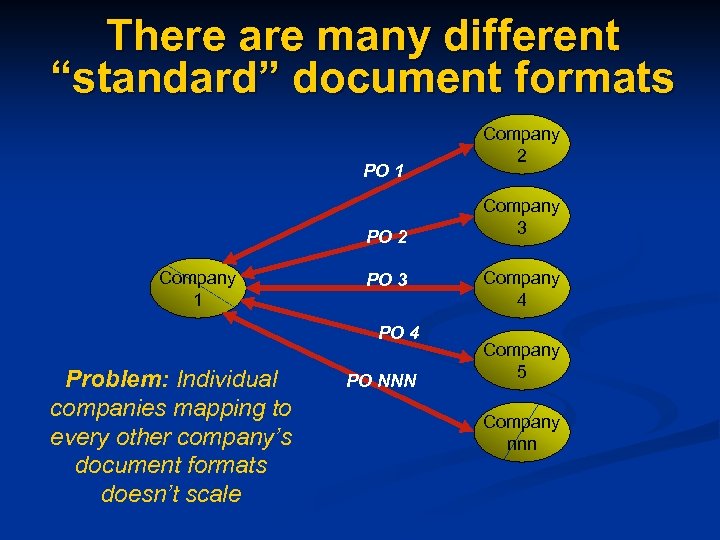 There are many different “standard” document formats PO 1 PO 2 Company 1 PO 3 PO 4 Problem: Individual companies mapping to every other company’s document formats doesn’t scale PO NNN Company 2 Company 3 Company 4 Company 5 Company nnn
 XML and Metcalfe’s Law n The value of a language depends on how many people (or computers) understand it n How do you encourage and enable others to understand your language?
 XML and Metcalfe’s Law n Traditional EDI approach: n BIG COMPANY: Speak MY language or I won’t do business with you! n SMALL COMPANY: Yes, master.
 XML and Metcalfe’s Law n The XML approach: n Excuse me, please, here are the rules of my language if you’d like to speak with me…
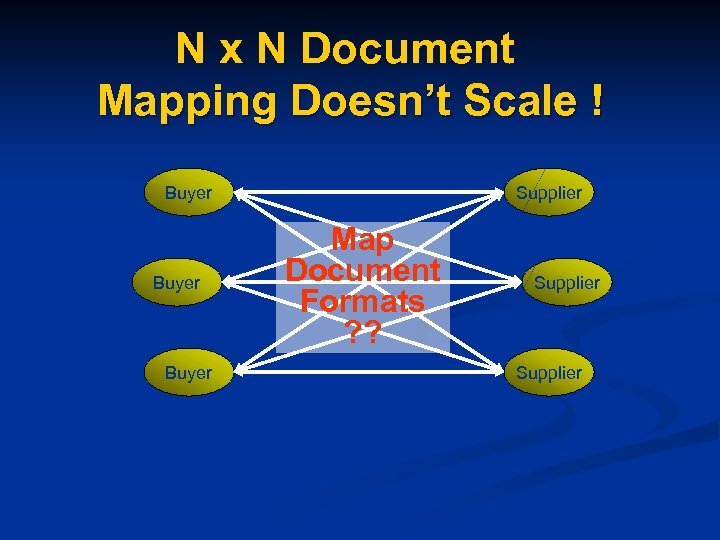 N x N Document Mapping Doesn’t Scale ! Buyer Supplier Map Document Formats ? ? Supplier
 The XML Common Business Library n The FIRST “horizontal” XML specification (started 3/97) n n a set of reusable XML components that are common to many business domains a framework for creating documents with a common architecture we were so far out in front here that this work was partly funded by a research grant from the US Department of Commerce’s Advanced Technology Program in October 1997 Documents built and extended according to the CBL frameworks can be understood from their common message elements
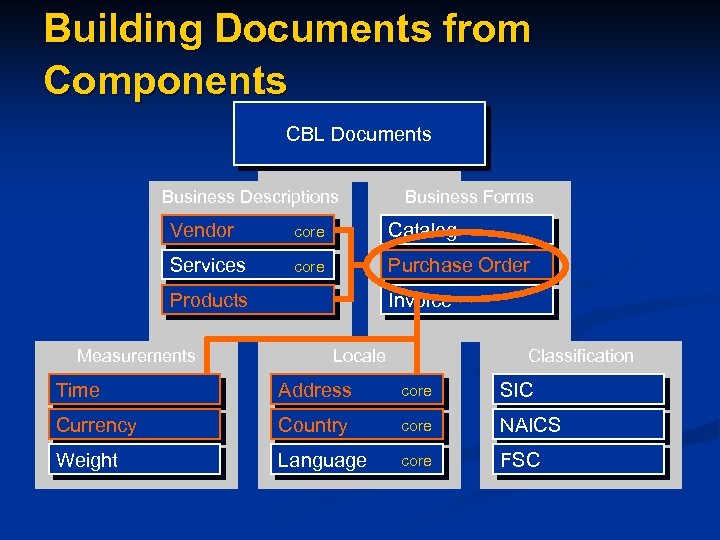 Building Documents from Components CBL Documents Business Descriptions Business Forms Vendor core Catalog Services core Purchase Order Products Measurements Invoice Locale Classification Time Address core SIC Currency Country core NAICS Weight Language core FSC
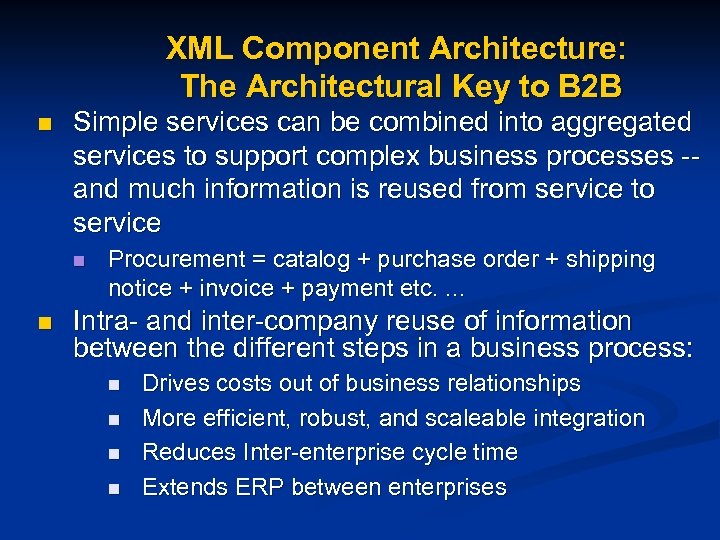 XML Component Architecture: The Architectural Key to B 2 B n Simple services can be combined into aggregated services to support complex business processes -and much information is reused from service to service n n Procurement = catalog + purchase order + shipping notice + invoice + payment etc. . Intra- and inter-company reuse of information between the different steps in a business process: n n Drives costs out of business relationships More efficient, robust, and scaleable integration Reduces Inter-enterprise cycle time Extends ERP between enterprises
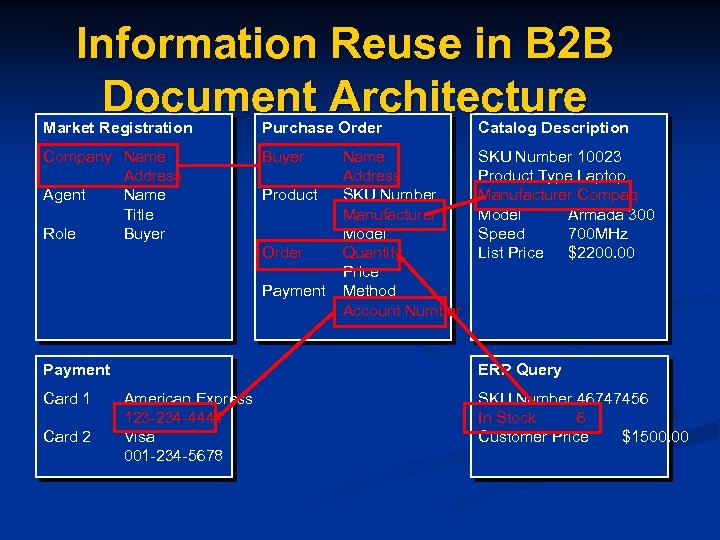 Information Reuse in B 2 B Document Architecture Market Registration Purchase Order Catalog Description Company Name Address Agent Name Title Role Buyer SKU Number 10023 Product Type Laptop Manufacturer Compaq Model Armada 300 Speed 700 MHz List Price $2200. 00 Product Order Payment Card 1 Card 2 Name Address SKU Number Manufacturer Model Quantity Price Method Account Number ERP Query American Express 123 -234 -4444 Visa 001 -234 -5678 SKU Number 46747456 In Stock 6 Customer Price $1500. 00
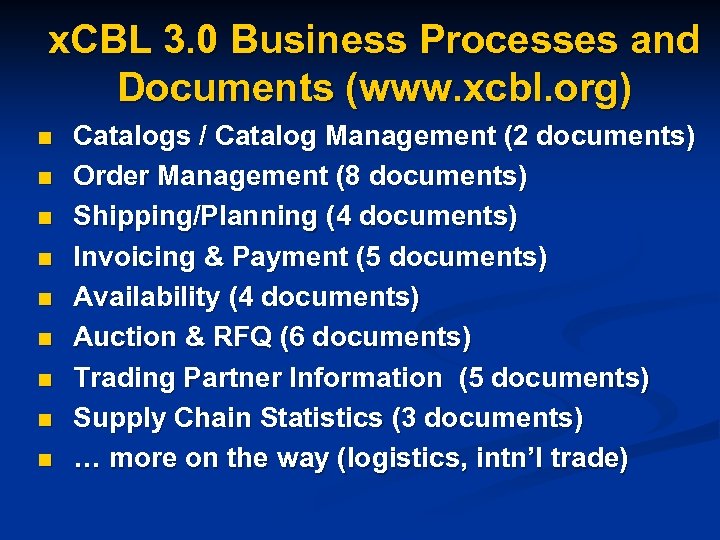 x. CBL 3. 0 Business Processes and Documents (www. xcbl. org) n n n n n Catalogs / Catalog Management (2 documents) Order Management (8 documents) Shipping/Planning (4 documents) Invoicing & Payment (5 documents) Availability (4 documents) Auction & RFQ (6 documents) Trading Partner Information (5 documents) Supply Chain Statistics (3 documents) … more on the way (logistics, intn’l trade)
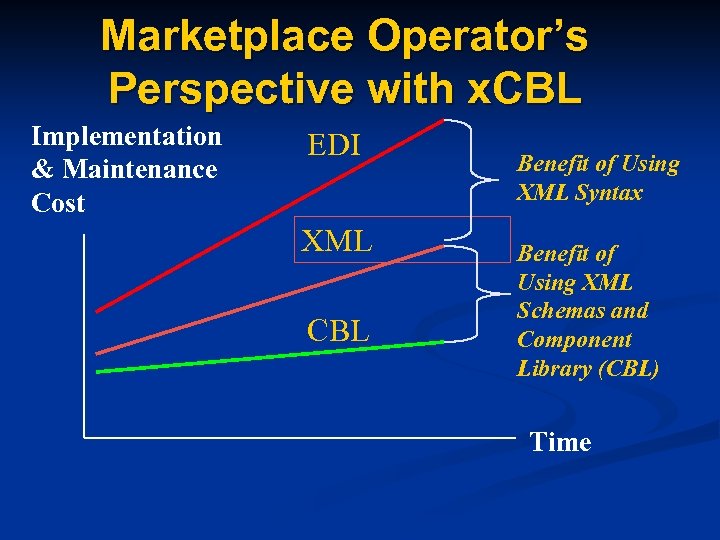
 XML {vs. , and, or} EDI
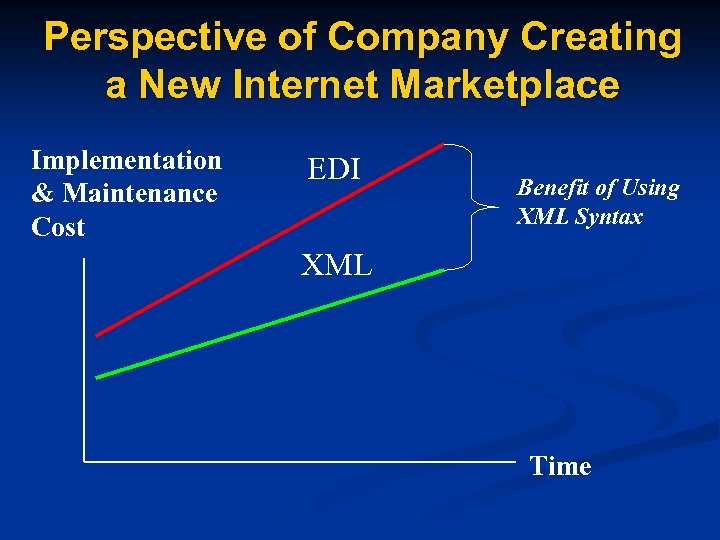 Perspective of Company Creating a New Internet Marketplace Implementation & Maintenance Cost EDI Benefit of Using XML Syntax XML Time
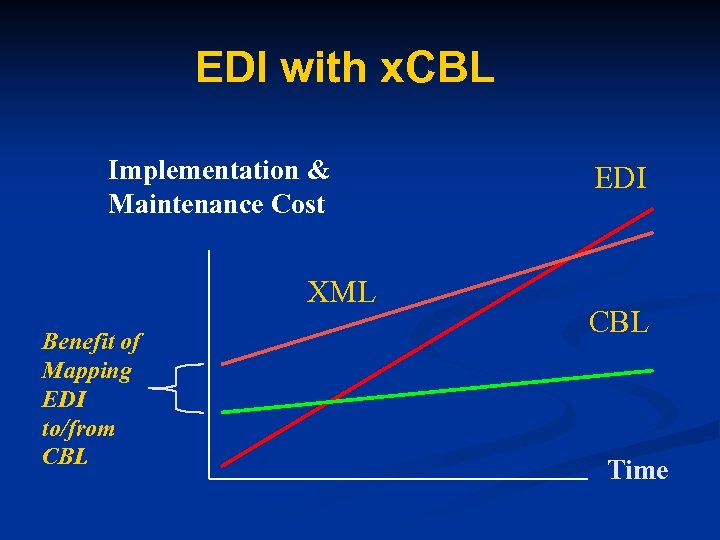
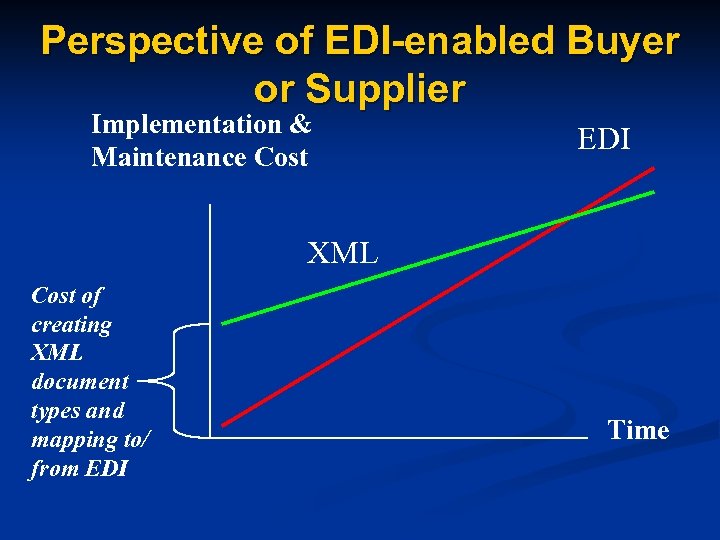 Perspective of EDI-enabled Buyer or Supplier Implementation & Maintenance Cost EDI XML Cost of creating XML document types and mapping to/ from EDI Time
 So EDI must be part of the solution, too. . . EDI is NOT dead. Most of big companies (auto, aerospace, petroleum, utilities, etc. ) are heavily invested in EDI n We must preserve the business processes and expertise embedded in their EDI implementations n We do this in a way that supports a technical migration path to XML and a value proposition that justifies making the transition n
 x. CBL Combines EDI and XML n n n EDI standards provide a strong nonproprietary semantic foundation for x. CBL Companies using EDI today see a clear migration path in x. CBL for mapping from EDI applications to XML SMEs for whom EDI is not cost-effective can use x. CBL in simple Web applications to interoperate with EDI partners
 Marketplace Operator’s Perspective with x. CBL Implementation & Maintenance Cost EDI XML CBL Benefit of Using XML Syntax Benefit of Using XML Schemas and Component Library (CBL) Time
 EDI with x. CBL Implementation & Maintenance Cost XML Benefit of Mapping EDI to/from CBL EDI CBL Time
 x. CBL and Interoperability
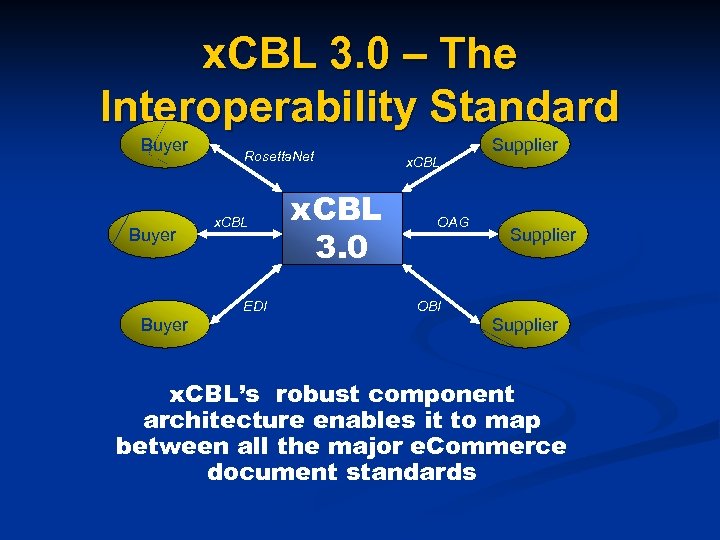 x. CBL 3. 0 – The Interoperability Standard Buyer Rosetta. Net x. CBL EDI Buyer x. CBL 3. 0 Supplier x. CBL OAG Supplier OBI Supplier x. CBL’s robust component architecture enables it to map between all the major e. Commerce document standards
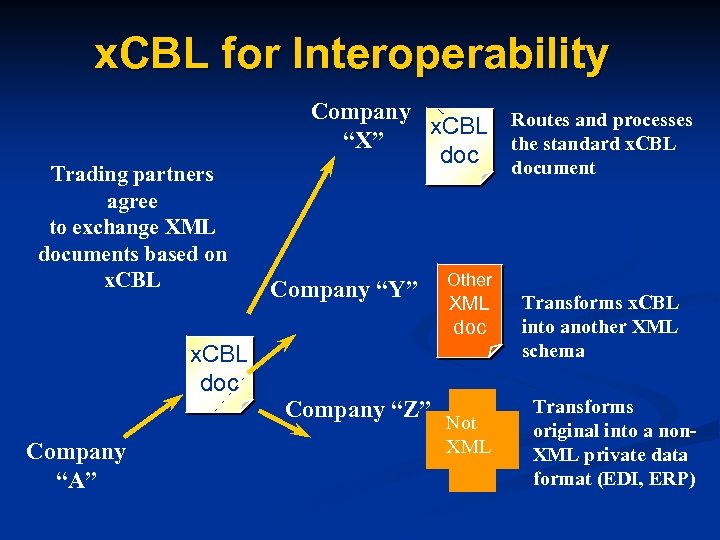 x. CBL for Interoperability Trading partners agree to exchange XML documents based on x. CBL doc Company “A” Company x. CBL Routes and processes “X” the standard x. CBL document Company “Y” Company “Z” Other XML doc Not XML Transforms x. CBL into another XML schema Transforms original into a non. XML private data format (EDI, ERP)
 How x. CBL Enables the Global Trading Web n n Every Marketplace in the GTW begins with standard business services implemented using XML document interchanges defined using x. CBL This ensures that: n some standard versions of common business services are available everywhere n the standard messages mean the same thing everywhere
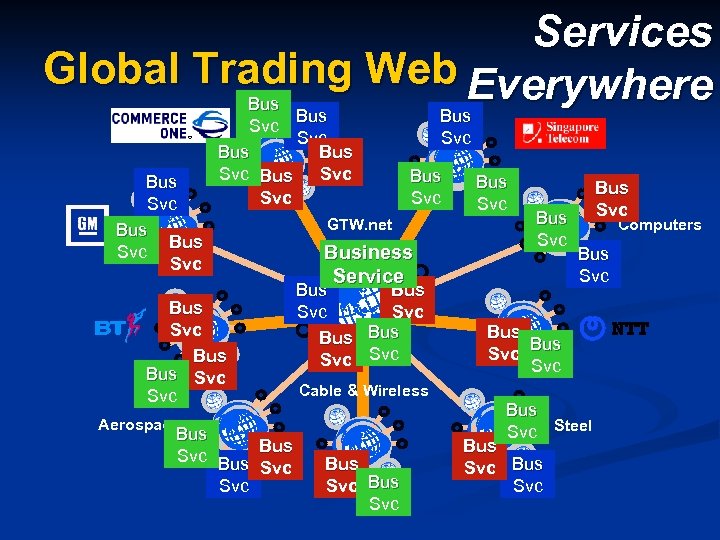 Services Global Trading Web Everywhere Bus Bus Svc Svc Bus Svc Bus Svc GTW. net Business Service Bus Bus Svc Svc Bus Svc Computers Bus Svc Cable & Wireless Bus Svc Steel Aerospace Bus Svc Svc Bus Svc
 Customization with Interoperability n Any market operator or business can develop a new or enhanced service, register it and the XML documents that it uses, and make it available to other businesses within its marketplace and throughout the GTW n These new or customized services are implemented using the standard components whenever possible n This reuse enables vertical and regional Marketplaces to interoperate on the basis of their shared x. CBL document cores
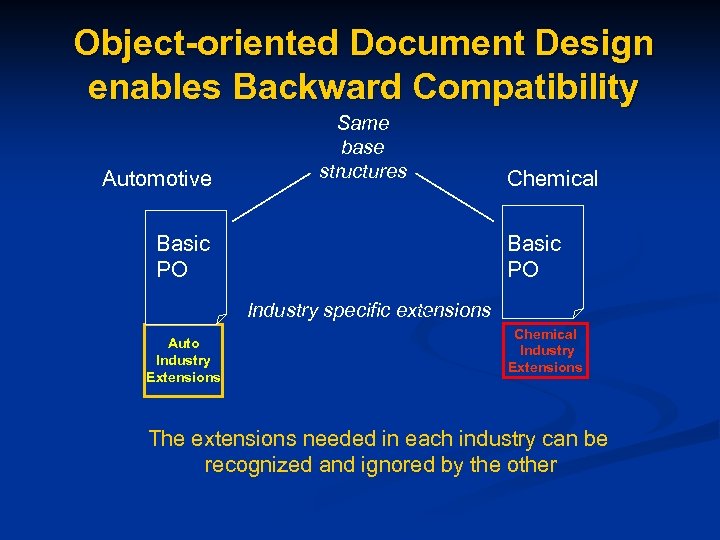 Object-oriented Document Design enables Backward Compatibility Automotive Same base structures Basic PO Chemical Basic PO Industry specific extensions Auto Industry Extensions Chemical Industry Extensions The extensions needed in each industry can be recognized and ignored by the other