 Скачать презентацию XLoom Communications 10 GB-100 GB Parallel Optical Interconnect
731be55b4b0178fe11edf3b66c1a3d29.ppt
- Количество слайдов: 35



XLoom Communications 10 GB-100 GB Parallel Optical Interconnect Challenges Dr. Hanan Yinnon Consultant, Former CSO XLoom Communications, Ltd. , Tel Aviv, Israel March 10 th, 2011 XLoom Proprietary and Confidential 1
Outline The need for optical interconnect solutions Current solutions XLoom i. Flame optical engine 4 parallel lane 5 Gbps transceiver based on XLoom i. Flame - Avdat Future development 2
The need for optical interconnect solutions Current solutions XLoom i. Flame optical engine 4 parallel lane 5 Gbps transceiver based on XLoom i. Flame - Avdat Future development 3
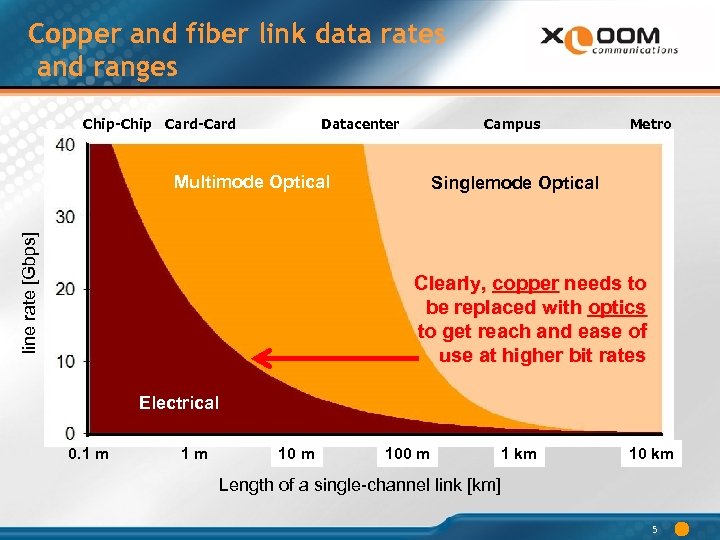
Copper and fiber link data rates and ranges Chip-Chip Card-Card Datacenter Campus line rate [Gbps] Multimode Optical Metro Singlemode Optical Clearly, copper needs to be replaced with optics to get reach and ease of use at higher bit rates Electrical 0. 1 m 1 m 100 m 1 km 10 km Length of a single-channel link [km] 5
Optical transmission options Electronics Ø Current electronic technology limits bit rate to around 40 Gbps per single transmitter Optics Ø Multimode fibers can be used at low wavelength (850 nm) where inexpensive lasers are available (VCSEL) Ø However, Multimode fibers have limited bandwidth – max effective ~ 5 GHz*km Ø Lasers are also approaching the bandwidth limitation Solutions Ø Wavelength Division Multiplexing (WDM) – expensive, used for SM system only Ø Parallel multi-lane interconnects – viable solution for short lengths XLoom Proprietary and Confidential 8
Still in 2011, many links use copper The main problem is cost Optics and analog electronics cost does not scale like digital electronics Due to: • The need for manual or semi-automatic processes – mostly alignment issues • Sensitivity of diode lasers to operating conditions – need for optimization • Integration of optics and electronics requires combination of a variety of technologies besides semiconductor design and fabrication. Commonly used Figure-of-Merit for interconnects is given in $/Gbps Today it is common to pay $ 2/Gbps/end for optical interconnect, but Xloom’s target is <$0. 1/Gbps/end 9
? How to lower cost of optics Design Ø Multi-lane interconnects – 4, 10, 12 or even more Ø Multimode fiber – more tolerant to misalignment in light coupling Ø Vertical cavity laser diodes (VCSEL) – lower component cost and lower power consumption for same speed, mounting ease Manufacturing Ø Large-scale optical coupling alignment – wafer scale and passive alignment should lend itself to full automation Ø Controllable, repeatable process, not “rocket science” 10
and 100 Gbps Ethernet 40 v v v IEEE 802. 3 ba – intended mostly for data centers Various link definitions: backplane, data cables, multi-mode fibers, single-mode fibers Largest market share expected to be multi-mode links Two MMF options: v 40 GBASE-SR 4 – 2 x 4 parallel lanes (duplex) v 100 GBASE-SR 10 – 2 x 10 parallel lanes (duplex) Two MM fiber types: v OM 3 – max link length 100 m v OM 4 – max link length 150 m 12
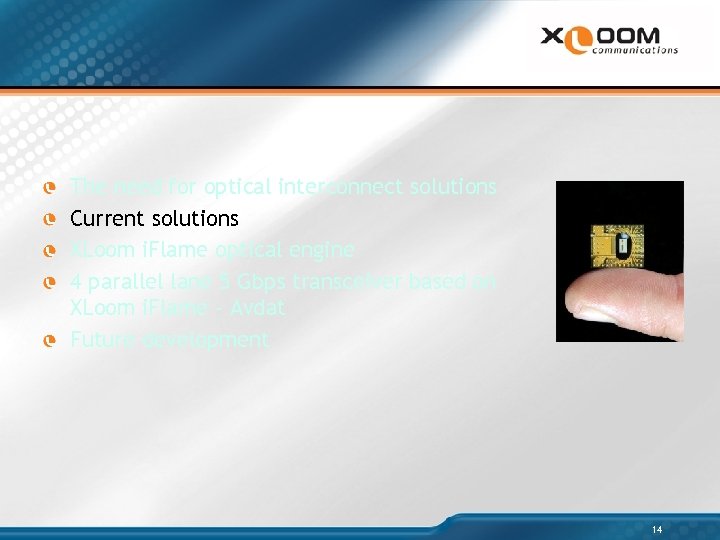
The need for optical interconnect solutions Current solutions XLoom i. Flame optical engine 4 parallel lane 5 Gbps transceiver based on XLoom i. Flame - Avdat Future development 14
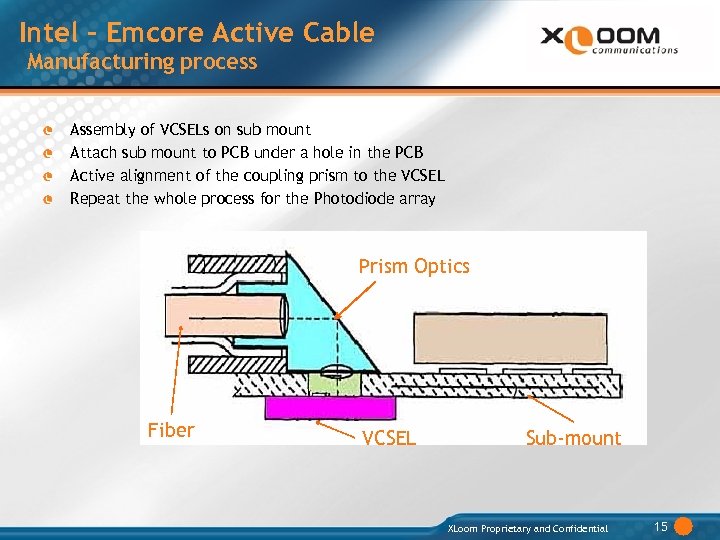
Intel – Emcore Active Cable Manufacturing process Assembly of VCSELs on sub mount Attach sub mount to PCB under a hole in the PCB Active alignment of the coupling prism to the VCSEL Repeat the whole process for the Photodiode array Prism Optics Fiber VCSEL Sub-mount XLoom Proprietary and Confidential 15
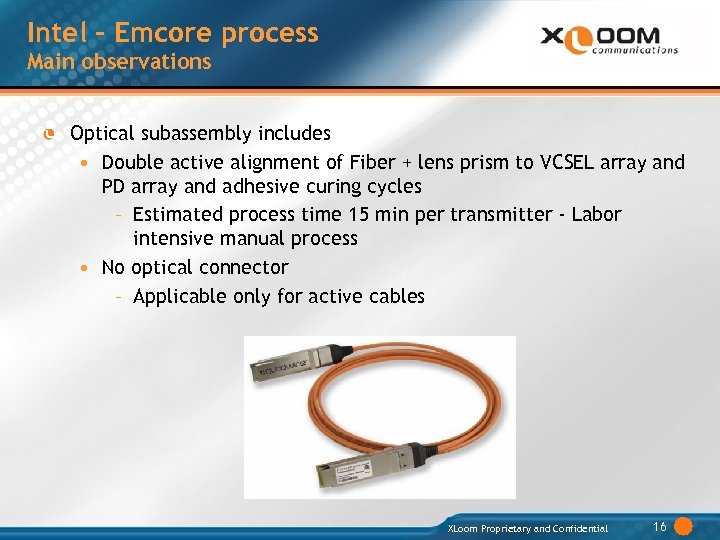
Intel – Emcore process Main observations Optical subassembly includes • Double active alignment of Fiber + lens prism to VCSEL array and PD array and adhesive curing cycles – Estimated process time 15 min per transmitter - Labor intensive manual process • No optical connector – Applicable only for active cables XLoom Proprietary and Confidential 16
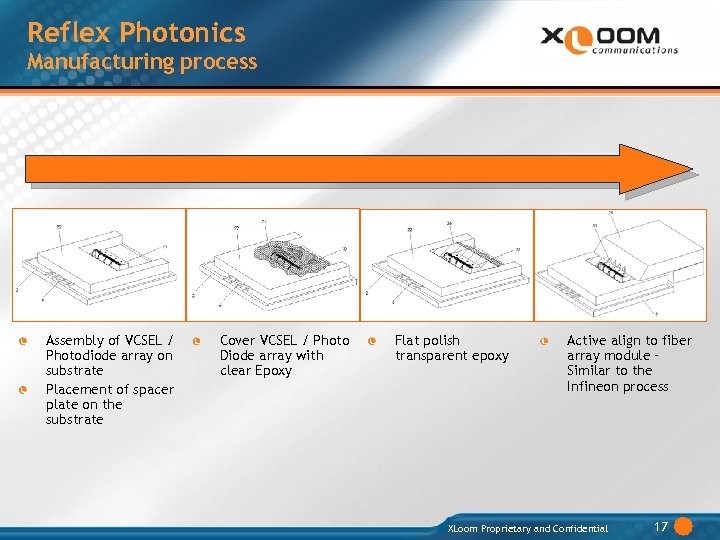
Reflex Photonics Manufacturing process Assembly of VCSEL / Photodiode array on substrate Placement of spacer plate on the substrate Cover VCSEL / Photo Diode array with clear Epoxy Flat polish transparent epoxy Active align to fiber array module – Similar to the Infineon process XLoom Proprietary and Confidential 17
Outline The need for optical interconnect solutions Current solutions XLoom i. Flame optical engine 4 parallel lane 5 Gbps transceiver based on XLoom i. Flame - Avdat Future development 18
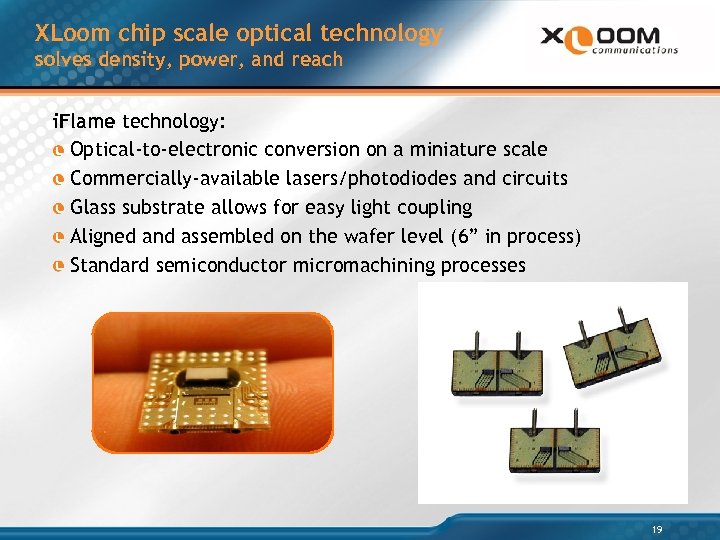
XLoom chip scale optical technology solves density, power, and reach i. Flame technology: Optical-to-electronic conversion on a miniature scale Commercially-available lasers/photodiodes and circuits Glass substrate allows for easy light coupling Aligned and assembled on the wafer level (6” in process) Standard semiconductor micromachining processes 19
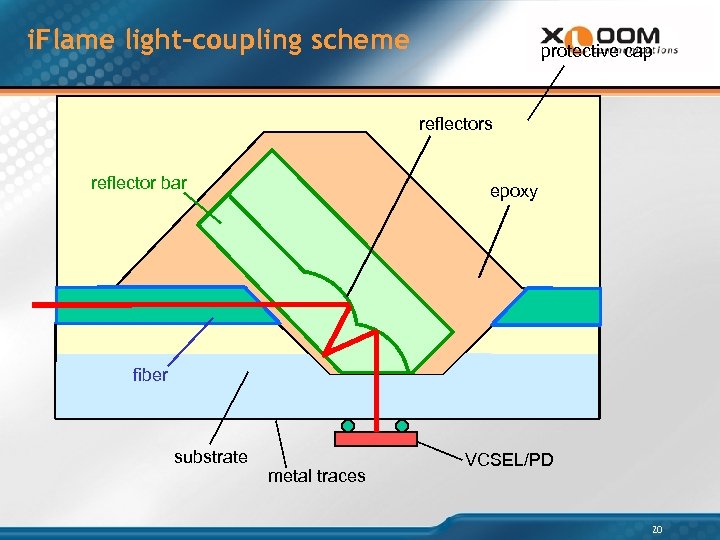
i. Flame light-coupling scheme protective cap reflectors reflector bar epoxy fiber substrate metal traces VCSEL/PD 20
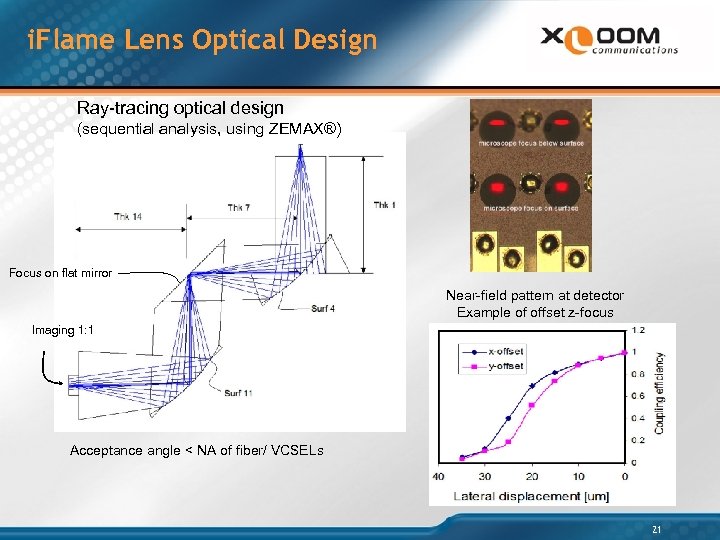
i. Flame Lens Optical Design Ray-tracing optical design (sequential analysis, using ZEMAX®) Focus on flat mirror Near-field pattern at detector Example of offset z-focus Imaging 1: 1 Acceptance angle < NA of fiber/ VCSELs 21
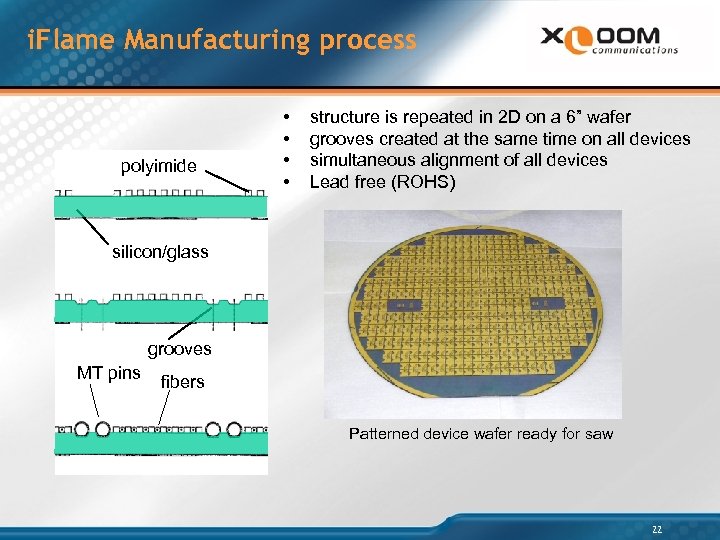
i. Flame Manufacturing process polyimide • • structure is repeated in 2 D on a 6” wafer grooves created at the same time on all devices simultaneous alignment of all devices Lead free (ROHS) silicon/glass grooves MT pins fibers Patterned device wafer ready for saw 22
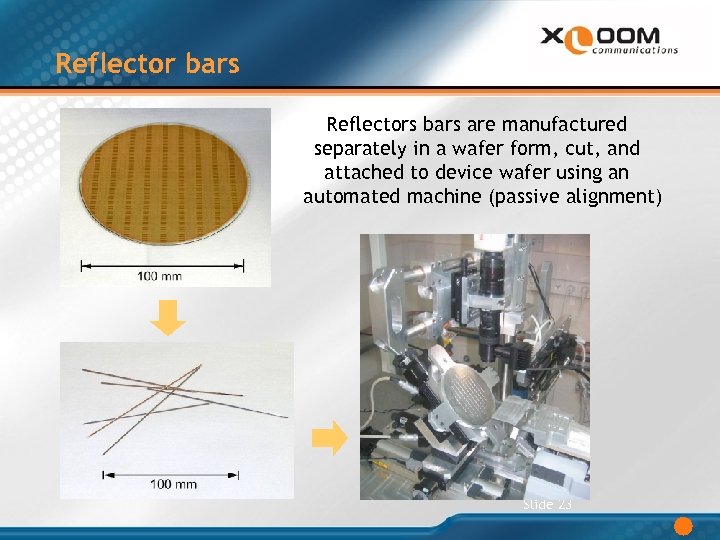
Reflector bars Reflectors bars are manufactured separately in a wafer form, cut, and attached to device wafer using an automated machine (passive alignment) Slide 23
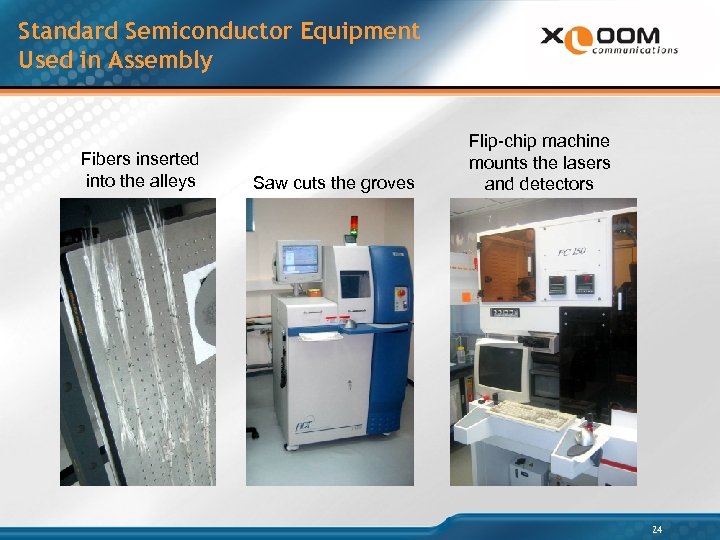
Standard Semiconductor Equipment Used in Assembly Fibers inserted into the alleys Saw cuts the groves Flip-chip machine mounts the lasers and detectors 24
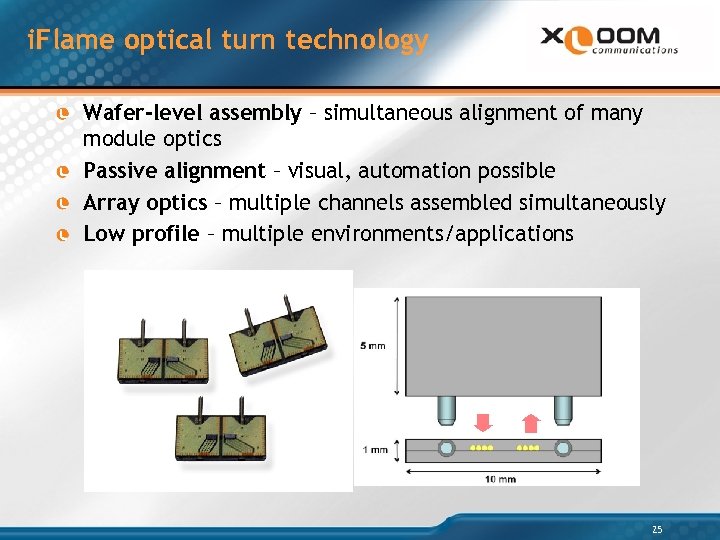
i. Flame optical turn technology Wafer-level assembly – simultaneous alignment of many module optics Passive alignment – visual, automation possible Array optics – multiple channels assembled simultaneously Low profile – multiple environments/applications 25
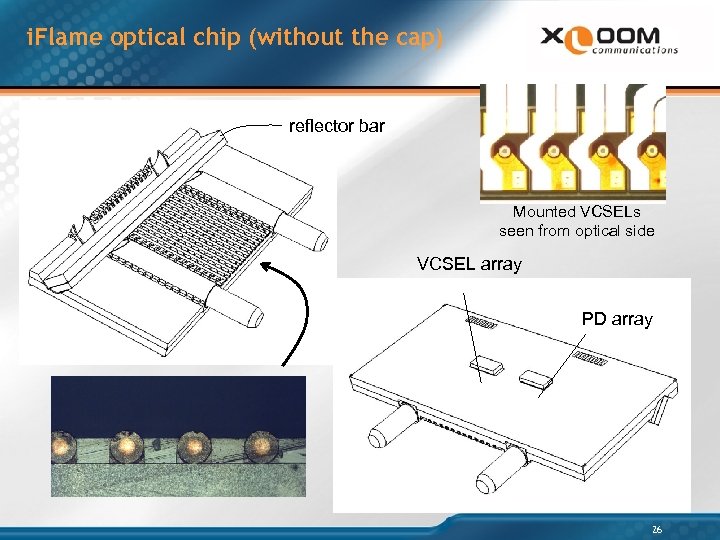
i. Flame optical chip (without the cap) reflector bar Mounted VCSELs seen from optical side VCSEL array PD array 26
The need for optical interconnect solutions Current solutions XLoom i. Flame optical engine 4 parallel lane 5 Gbps transceiver based on XLoom i. Flame - Avdat Future development 27
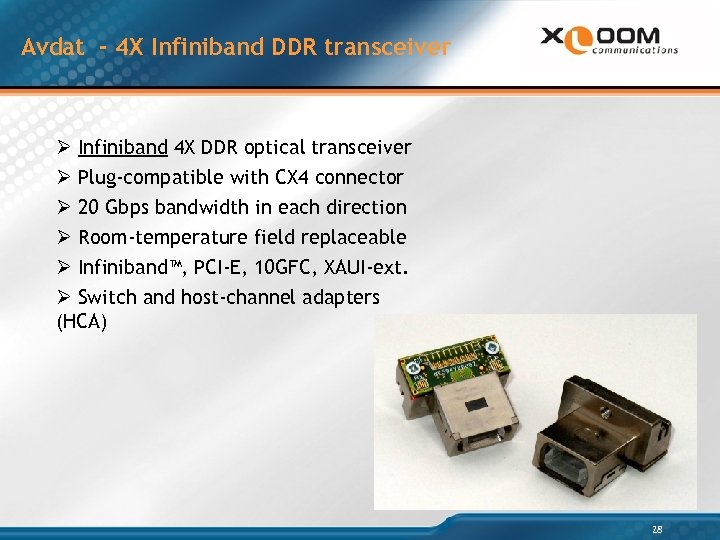
Avdat - 4 X Infiniband DDR transceiver Ø Infiniband 4 X DDR optical transceiver Ø Plug-compatible with CX 4 connector Ø 20 Gbps bandwidth in each direction Ø Room-temperature field replaceable Ø Infiniband™, PCI-E, 10 GFC, XAUI-ext. Ø Switch and host-channel adapters (HCA) 28
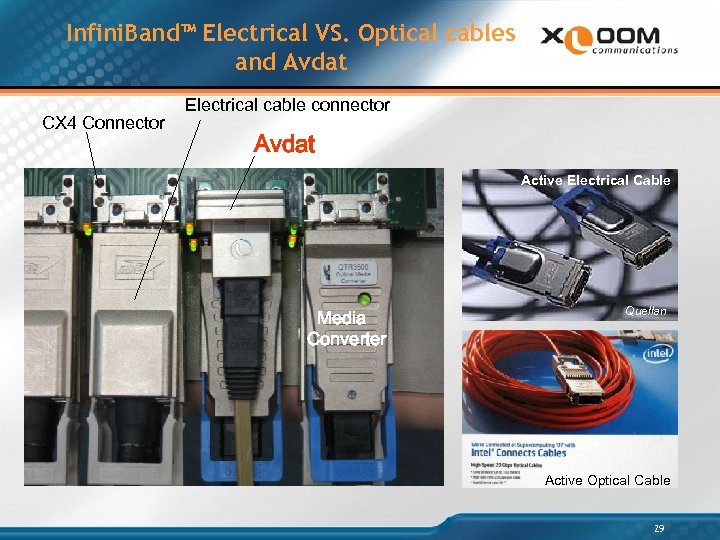
Infini. Band™ Electrical VS. Optical cables and Avdat CX 4 Connector Electrical cable connector Avdat Active Electrical Cable Media Converter Quellan Active Optical Cable 29
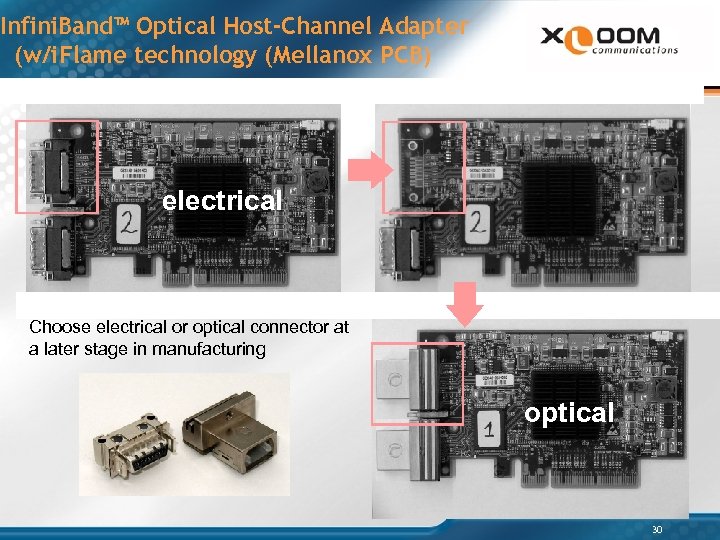
Infini. Band™ Optical Host-Channel Adapter (w/i. Flame technology (Mellanox PCB) electrical Choose electrical or optical connector at a later stage in manufacturing optical 30
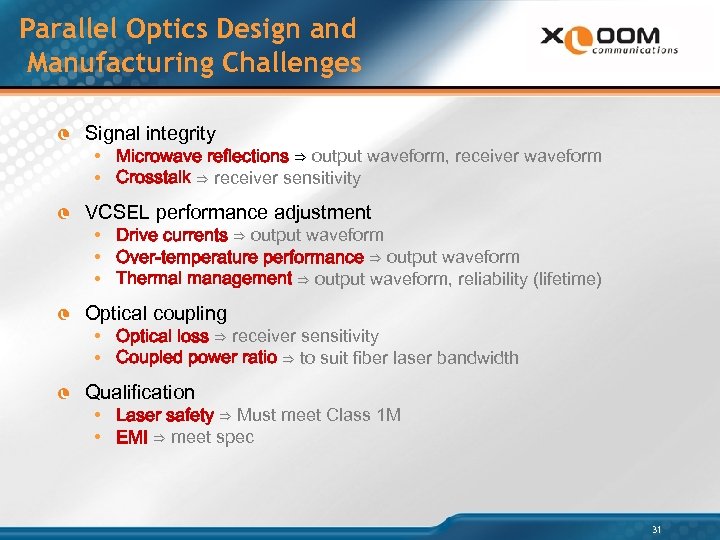
Parallel Optics Design and Manufacturing Challenges Signal integrity • Microwave reflections ⇒ output waveform, receiver waveform • Crosstalk ⇒ receiver sensitivity VCSEL performance adjustment • Drive currents ⇒ output waveform • Over-temperature performance ⇒ output waveform • Thermal management ⇒ output waveform, reliability (lifetime) Optical coupling • Optical loss ⇒ receiver sensitivity • Coupled power ratio ⇒ to suit fiber laser bandwidth Qualification • Laser safety ⇒ Must meet Class 1 M • EMI ⇒ meet spec 31
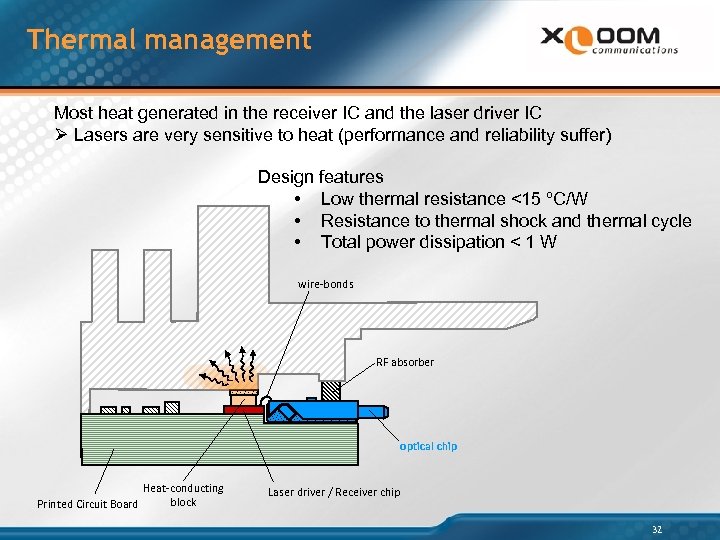
Thermal management Most heat generated in the receiver IC and the laser driver IC Ø Lasers are very sensitive to heat (performance and reliability suffer) Design features • Low thermal resistance <15 ºC/W • Resistance to thermal shock and thermal cycle • Total power dissipation < 1 W wire-bonds RF absorber optical chip Heat-conducting block Printed Circuit Board Laser driver / Receiver chip 32
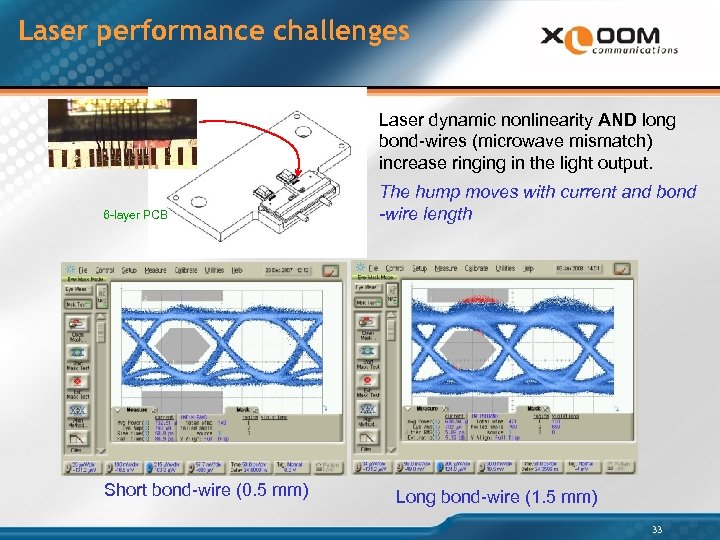
Laser performance challenges Laser dynamic nonlinearity AND long bond-wires (microwave mismatch) increase ringing in the light output. 6 -layer PCB Short bond-wire (0. 5 mm) The hump moves with current and bond -wire length Long bond-wire (1. 5 mm) 33
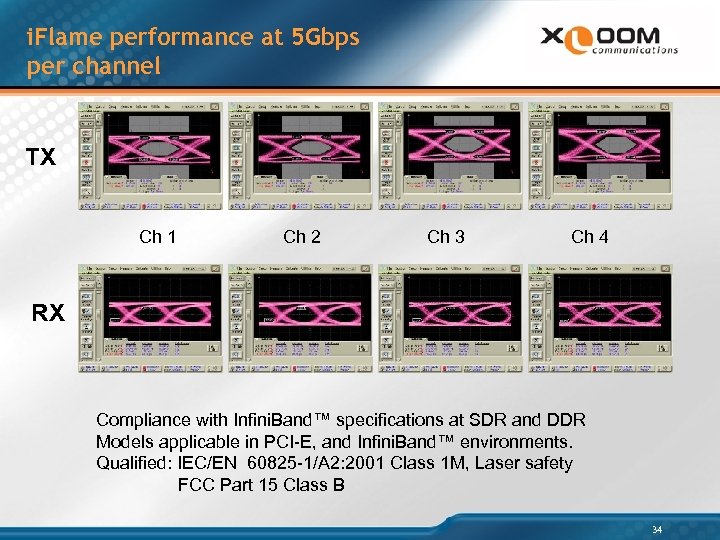
i. Flame performance at 5 Gbps per channel TX Ch 1 Ch 2 Ch 3 Ch 4 RX Compliance with Infini. Band™ specifications at SDR and DDR Models applicable in PCI-E, and Infini. Band™ environments. Qualified: IEC/EN 60825 -1/A 2: 2001 Class 1 M, Laser safety FCC Part 15 Class B 34
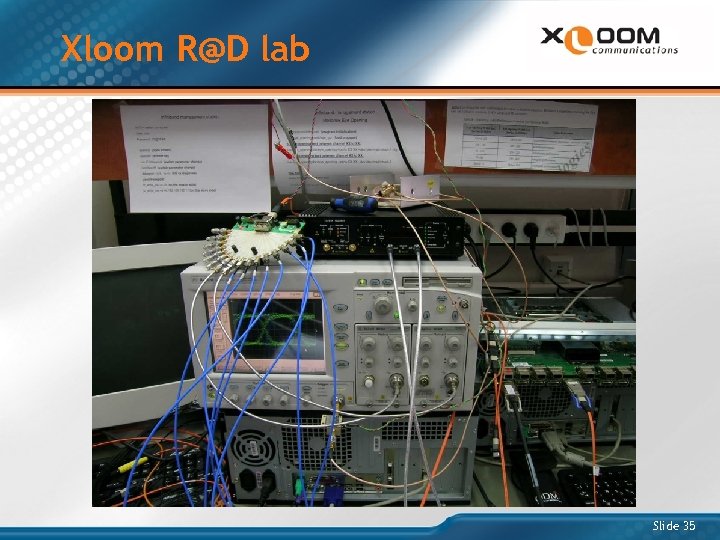
Xloom R@D lab Slide 35
The need for optical interconnect solutions Current solutions XLoom i. Flame optical engine 4 parallel lane 5 Gbps transceiver based on XLoom i. Flame - Avdat Future development 36
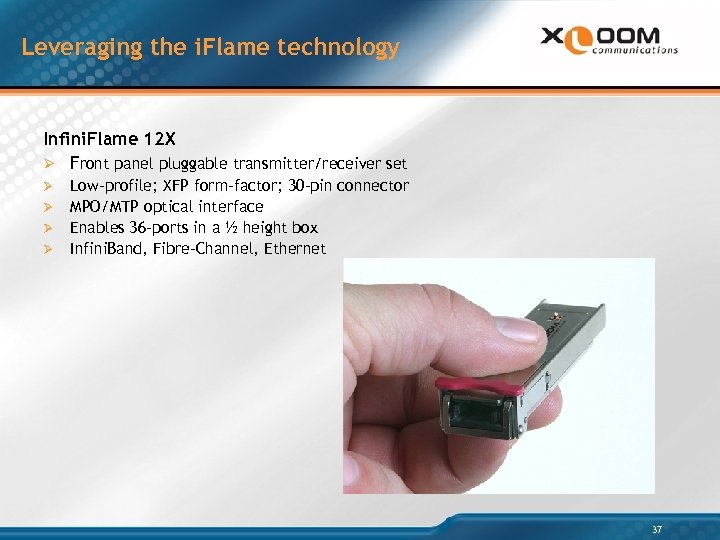
Leveraging the i. Flame technology Infini. Flame 12 X Ø Front panel pluggable transmitter/receiver set Ø Ø Low-profile; XFP form-factor; 30 -pin connector MPO/MTP optical interface Enables 36 -ports in a ½ height box Infini. Band, Fibre-Channel, Ethernet 37
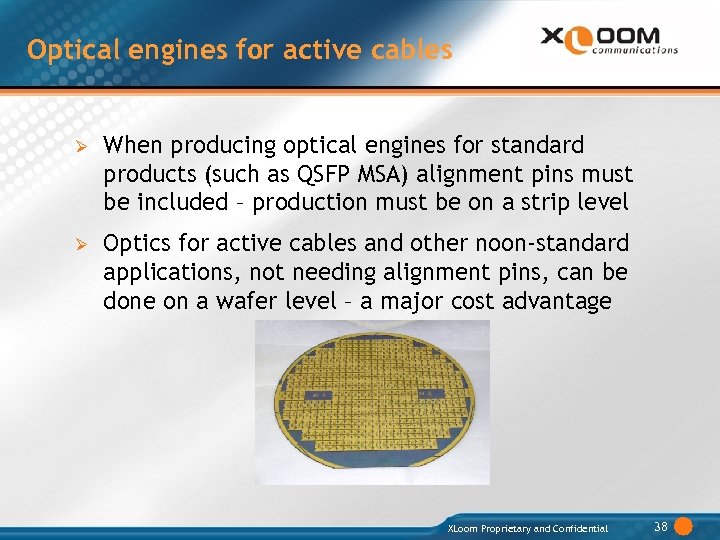
Optical engines for active cables Ø When producing optical engines for standard products (such as QSFP MSA) alignment pins must be included – production must be on a strip level Ø Optics for active cables and other noon-standard applications, not needing alignment pins, can be done on a wafer level – a major cost advantage XLoom Proprietary and Confidential 38
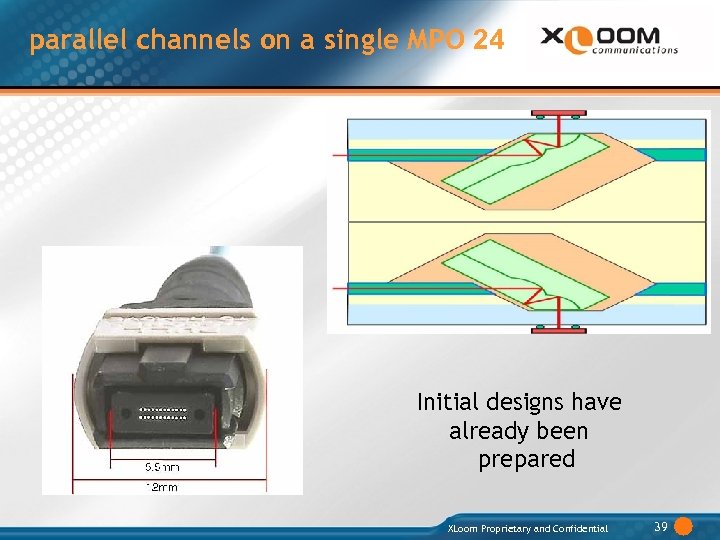
parallel channels on a single MPO 24 Initial designs have already been prepared XLoom Proprietary and Confidential 39

Thank You XLoom Proprietary and Confidential 40
Скачать презентацию XLoom Communications 10 GB-100 GB Parallel Optical Interconnect
731be55b4b0178fe11edf3b66c1a3d29.ppt