 Скачать презентацию XIX Symposium Neuroradiologicum Evaluation of Neuro Best Contrast
54cec9b45b1e2624b84fd354eb7fe8c1.ppt
- Количество слайдов: 25



XIX Symposium Neuroradiologicum Evaluation of Neuro Best Contrast Filter for Head CT Z. Rumboldt, S. Tipnis, D. Vincent, M. V. Spampinato, G. Goldsberry, W. Huda Medical University of South Carolina Charleston, SC, USA
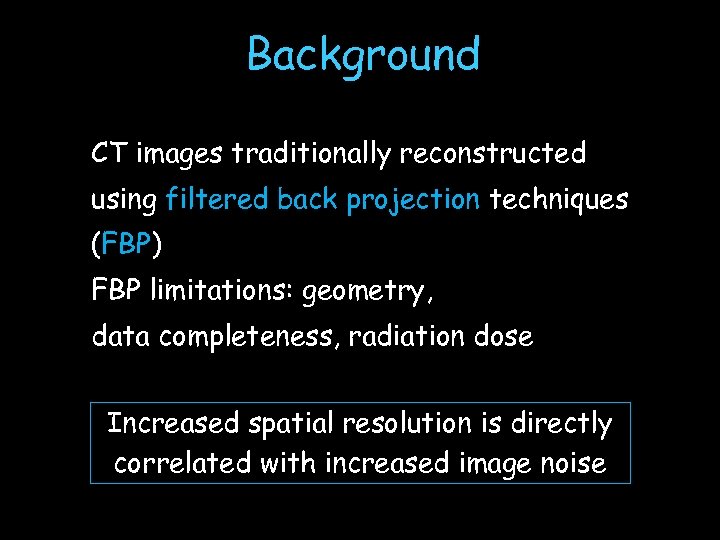
Background CT images traditionally reconstructed using filtered back projection techniques (FBP) FBP limitations: geometry, data completeness, radiation dose Increased spatial resolution is directly correlated with increased image noise
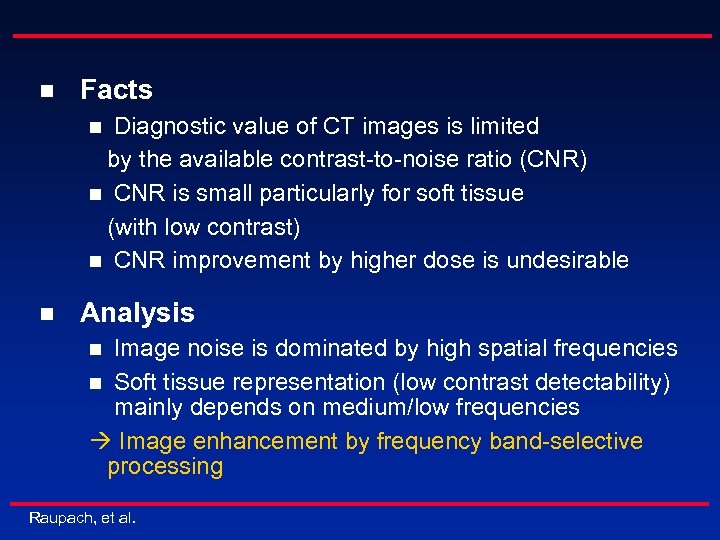
n Facts Diagnostic value of CT images is limited by the available contrast-to-noise ratio (CNR) n CNR is small particularly for soft tissue (with low contrast) n CNR improvement by higher dose is undesirable n n Analysis Image noise is dominated by high spatial frequencies n Soft tissue representation (low contrast detectability) mainly depends on medium/low frequencies Image enhancement by frequency band-selective processing n Raupach, et al.
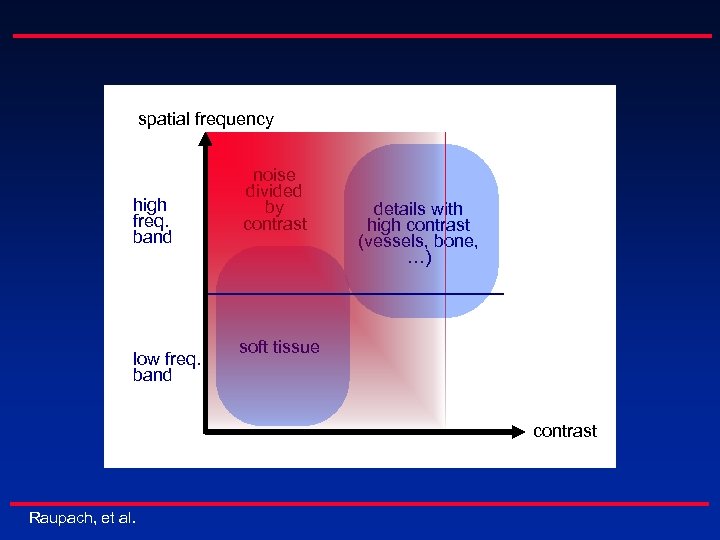
spatial frequency high freq. band low freq. band noise divided by contrast details with high contrast (vessels, bone, …) soft tissue contrast Raupach, et al.
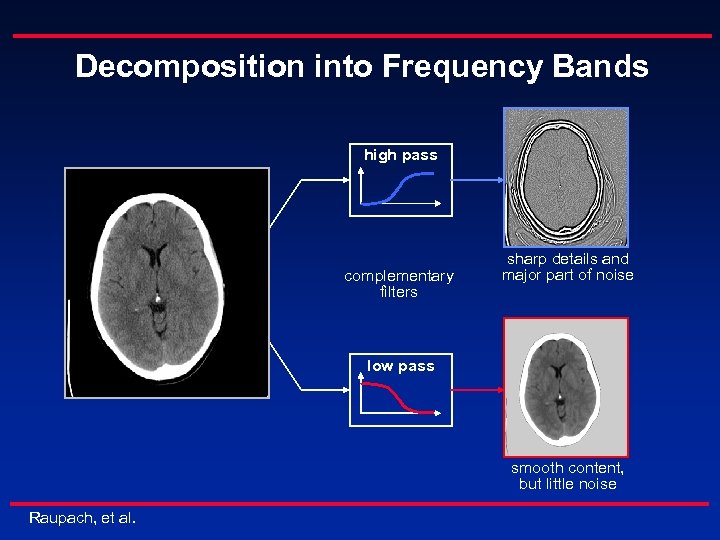
Decomposition into Frequency Bands high pass complementary filters sharp details and major part of noise low pass smooth content, but little noise Raupach, et al.
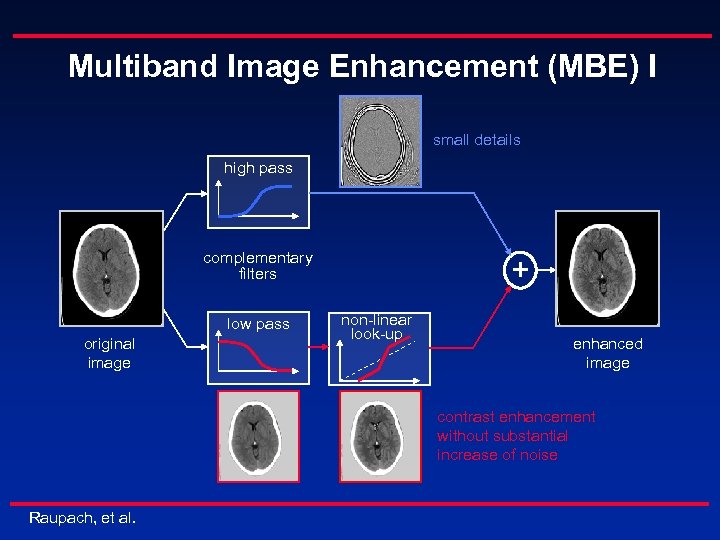
Multiband Image Enhancement (MBE) I small details high pass complementary filters low pass original image + non-linear look-up enhanced image contrast enhancement without substantial increase of noise Raupach, et al.
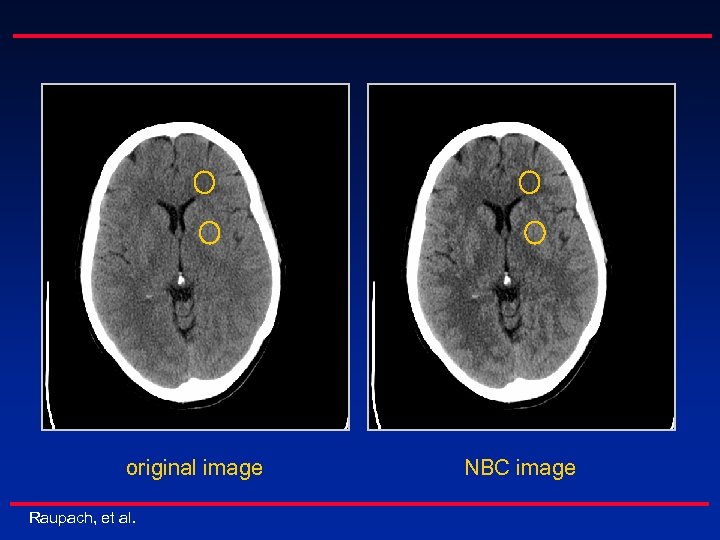
original image Raupach, et al. NBC image
n MBE improves CNR of specific image features n n Head: gray/white matter differentiation (CNR gain up to ~40%) CNR improvement can be translated into radiation dose reduction n n 30% less dose demonstrated in example realistic in general: 20% (further clinical studies needed) Raupach, et al.
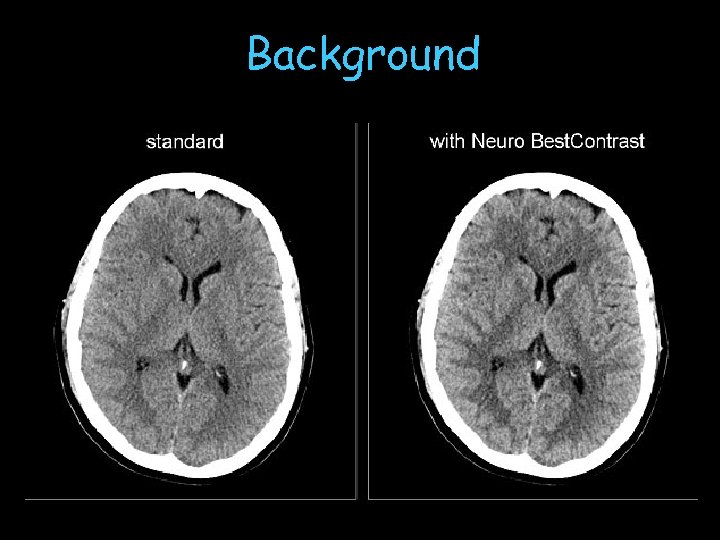
Background
Purpose NBC Evaluation in a Clinical Setting Novel Methodology for lesion detection Comparison with normal scans with the same filter, not the same scan with different filters side by side
Materials and Methods Part 1 5 consecutive Head CT scans with FBP 7 consecutive Head CT scans with NBC HU measurements – circular ROI Part 2 Novel Methodology for lesion detection
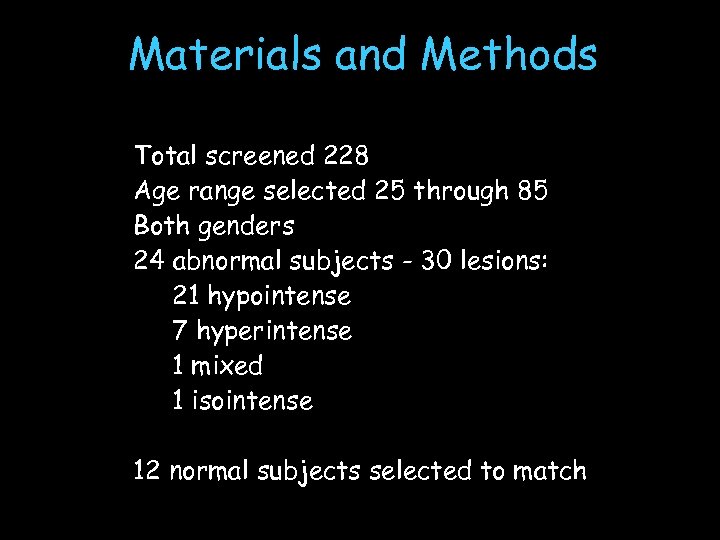
Materials and Methods Total screened 228 Age range selected 25 through 85 Both genders 24 abnormal subjects - 30 lesions: 21 hypointense 7 hyperintense 1 mixed 1 isointense 12 normal subjects selected to match
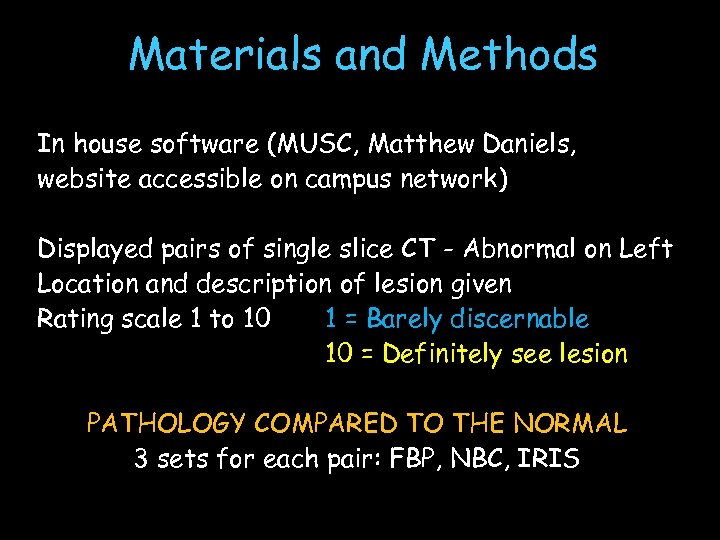
Materials and Methods In house software (MUSC, Matthew Daniels, website accessible on campus network) Displayed pairs of single slice CT - Abnormal on Left Location and description of lesion given Rating scale 1 to 10 1 = Barely discernable 10 = Definitely see lesion PATHOLOGY COMPARED TO THE NORMAL 3 sets for each pair: FBP, NBC, IRIS
Every reader trained on practice set prior to study Individual randomization for every reader Materials and Methods Every reader trained on practice set prior to study Individual randomization for every reader Analysis Ratios of obtained values: NBC/FBP IRIS/FBP
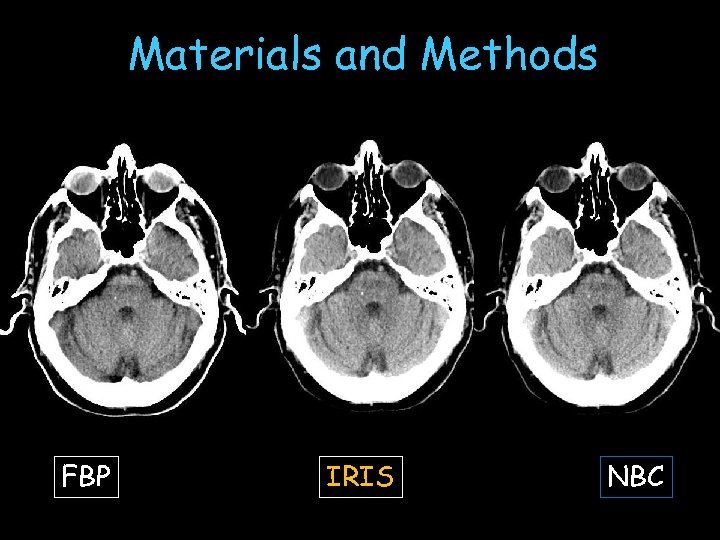
Materials and Methods FBP IRIS NBC
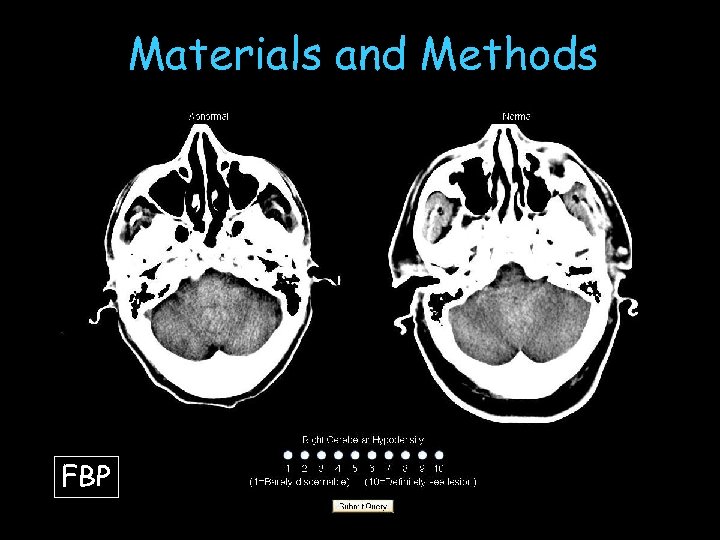
Materials and Methods FBP
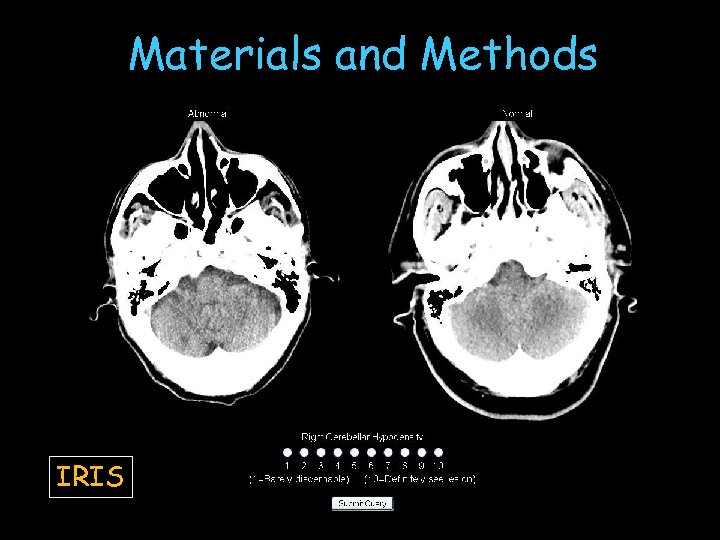
Materials and Methods IRIS
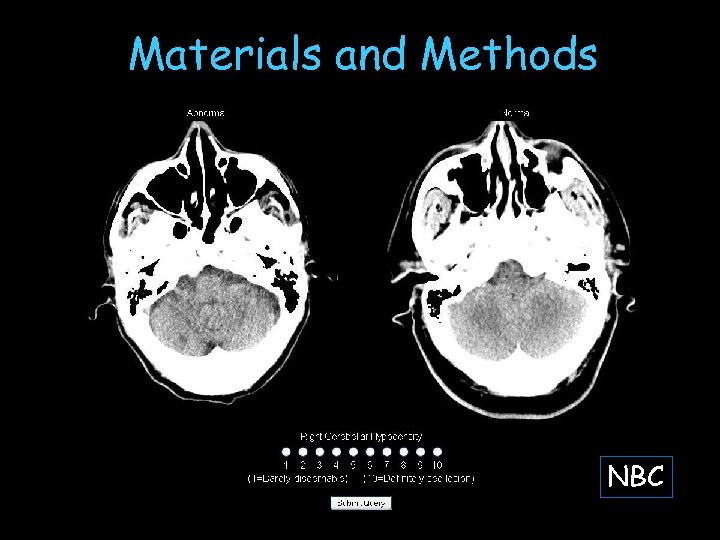
Materials and Methods NBC
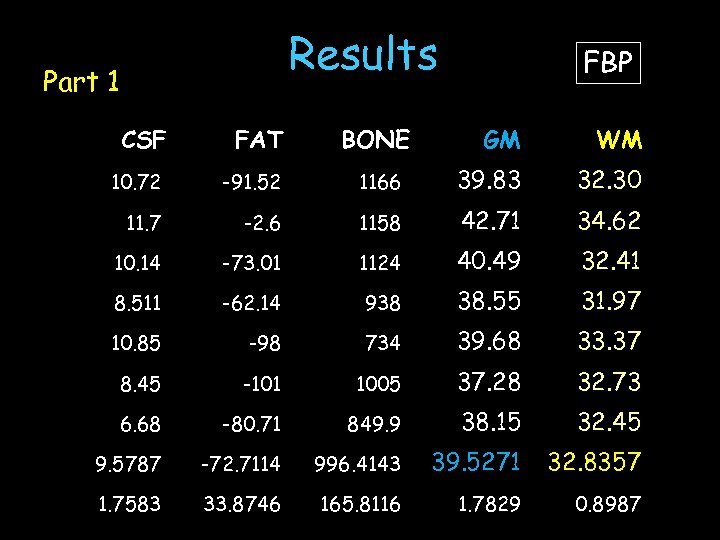
Results Part 1 CSF FAT 10. 72 -91. 52 11. 7 BONE FBP GM WM 1166 39. 83 32. 30 -2. 6 1158 42. 71 34. 62 10. 14 -73. 01 1124 40. 49 32. 41 8. 511 -62. 14 938 38. 55 31. 97 10. 85 -98 734 39. 68 33. 37 8. 45 -101 1005 37. 28 32. 73 6. 68 -80. 71 849. 9 38. 15 32. 45 9. 5787 -72. 7114 996. 4143 39. 5271 32. 8357 1. 7583 33. 8746 165. 8116 1. 7829 0. 8987
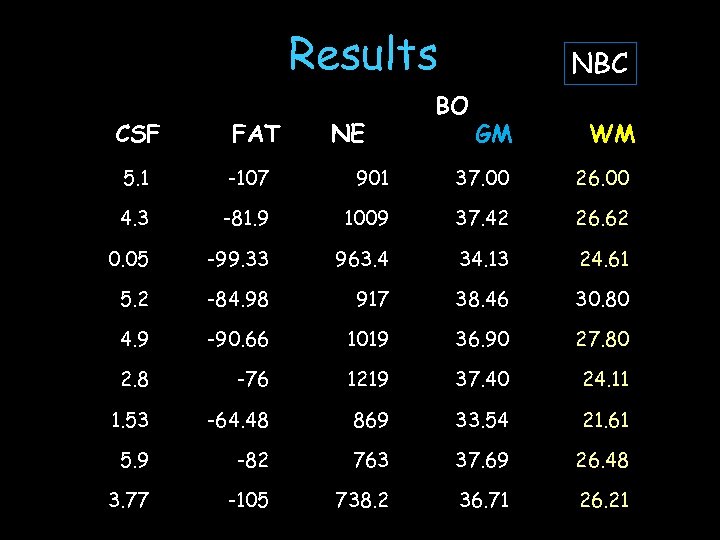
Results CSF FAT NE NBC BO GM WM 5. 1 -107 901 37. 00 26. 00 4. 3 -81. 9 1009 37. 42 26. 62 0. 05 -99. 33 963. 4 34. 13 24. 61 5. 2 -84. 98 917 38. 46 30. 80 4. 9 -90. 66 1019 36. 90 27. 80 2. 8 -76 1219 37. 40 24. 11 1. 53 -64. 48 869 33. 54 21. 61 5. 9 -82 763 37. 69 26. 48 3. 77 -105 738. 2 36. 71 26. 21
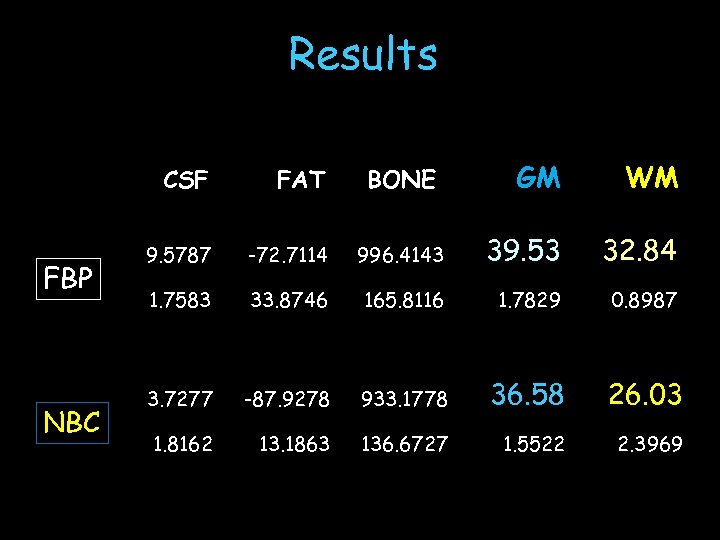
Results GM WM 996. 4143 39. 53 32. 84 33. 8746 165. 8116 1. 7829 0. 8987 3. 7277 -87. 9278 933. 1778 36. 58 26. 03 1. 8162 13. 1863 136. 6727 1. 5522 2. 3969 CSF FBP NBC FAT 9. 5787 -72. 7114 1. 7583 BONE
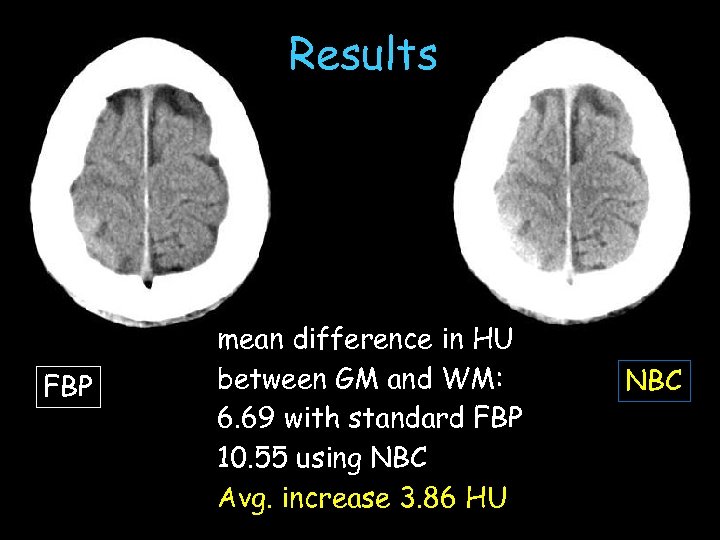
Results FBP mean difference in HU between GM and WM: 6. 69 with standard FBP 10. 55 using NBC Avg. increase 3. 86 HU NBC
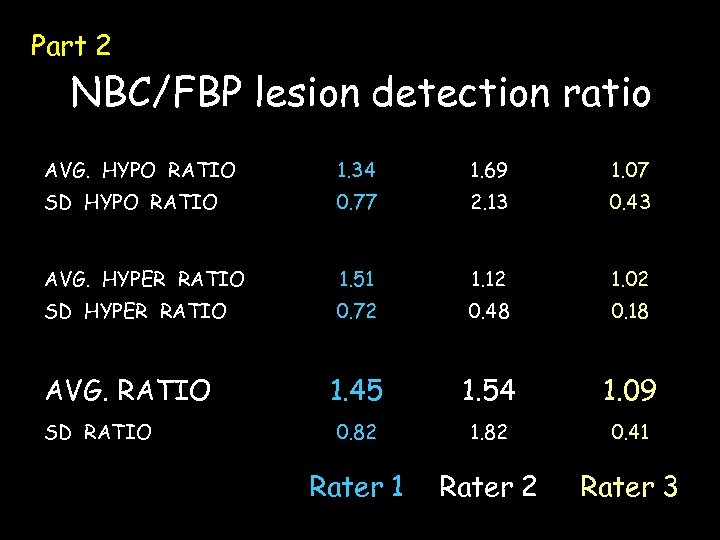
Part 2 NBC/FBP lesion detection ratio AVG. HYPO RATIO 1. 34 1. 69 1. 07 SD HYPO RATIO 0. 77 2. 13 0. 43 AVG. HYPER RATIO 1. 51 1. 12 1. 02 SD HYPER RATIO 0. 72 0. 48 0. 18 1. 45 1. 54 1. 09 0. 82 1. 82 0. 41 Rater 2 Rater 3 AVG. RATIO SD RATIO
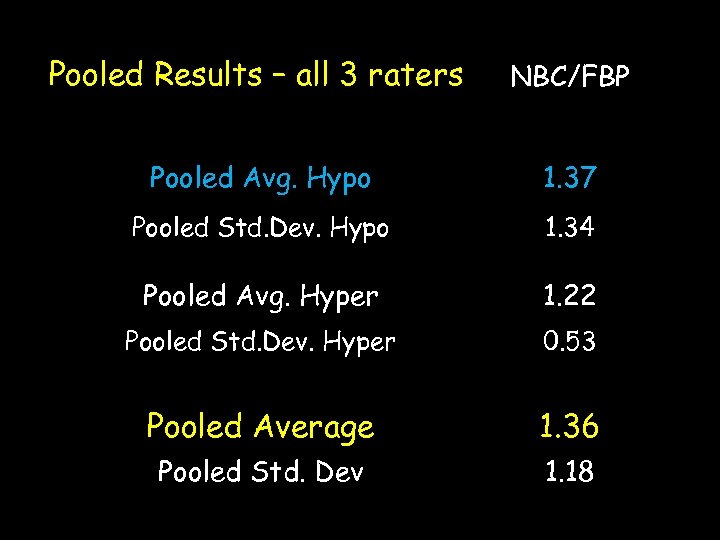
Pooled Results – all 3 raters NBC/FBP Pooled Avg. Hypo 1. 37 Pooled Std. Dev. Hypo 1. 34 Pooled Avg. Hyper 1. 22 Pooled Std. Dev. Hyper 0. 53 Pooled Average 1. 36 Pooled Std. Dev 1. 18
Conclusion NBC filter provides increased contrast between GM and WM on Head CT scans, which seems to improve lesion detection Alternatively, it may allow for a decrease in radiation dose
Скачать презентацию XIX Symposium Neuroradiologicum Evaluation of Neuro Best Contrast
54cec9b45b1e2624b84fd354eb7fe8c1.ppt