


 Скачать презентацию XIX Congress of the European Society for Pediatric
12248783f27c9c2dc4d937f4c7407c7d.ppt
- Количество слайдов: 18
 XIX Congress of the European Society for Pediatric Neurosurgery Rome, May 6 -9 th 2004 Perspectives of the Shunt Technology: i. Valve and Digi. Shunt Aschoff A, Hashemi B, Scheihing M, Unterberg A, Kremer P University of Heidelberg, Department of Neurosurgery e-mail: Alfred_Aschoff@med. uni-heidelberg. de Oral presentation on Sunday, May 9 th, 2004 Selected slides
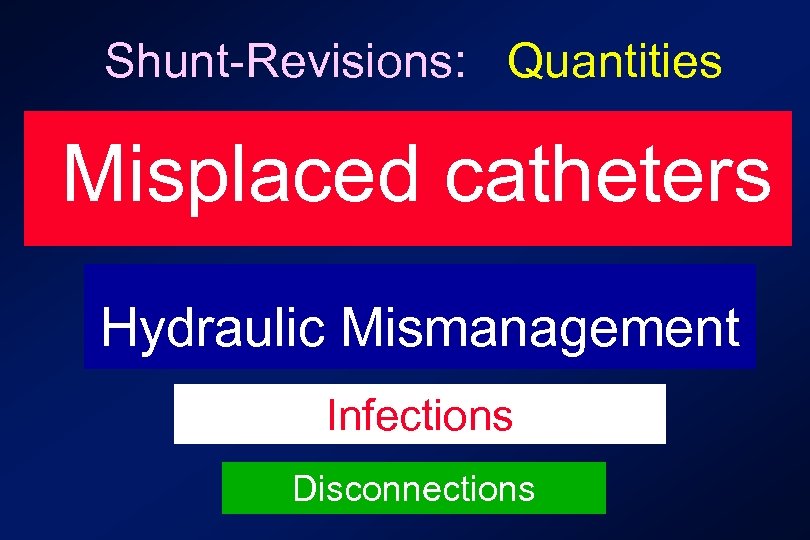 Shunt-Revisions: Quantities Misplaced catheters Hydraulic Mismanagement Infections Disconnections
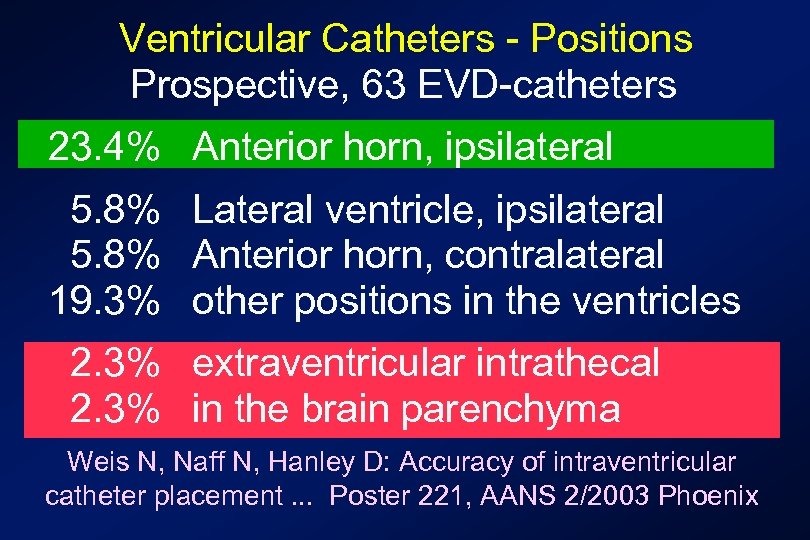 Ventricular Catheters - Positions Prospective, 63 EVD-catheters 23. 4% Anterior horn, ipsilateral 5. 8% Lateral ventricle, ipsilateral 5. 8% Anterior horn, contralateral 19. 3% other positions in the ventricles 2. 3% extraventricular intrathecal 2. 3% in the brain parenchyma Weis N, Naff N, Hanley D: Accuracy of intraventricular catheter placement. . . Poster 221, AANS 2/2003 Phoenix
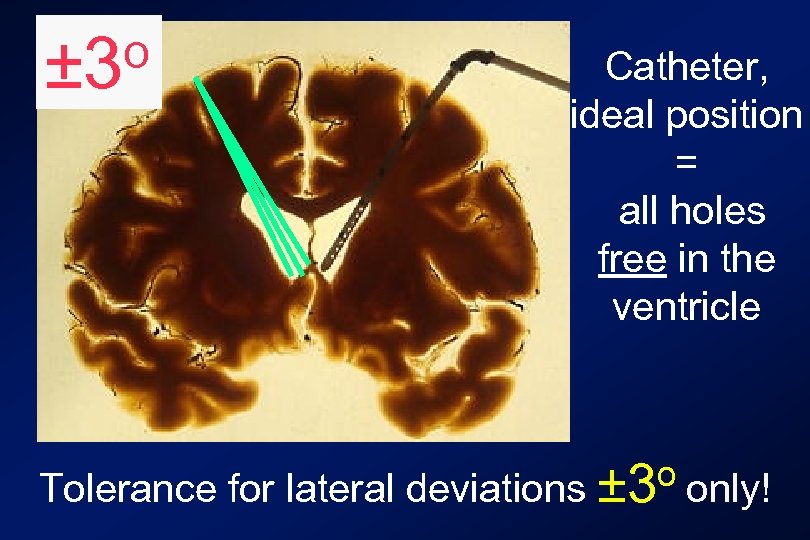 o ± 3 Catheter, ideal position = all holes free in the ventricle o only! Tolerance for lateral deviations ± 3
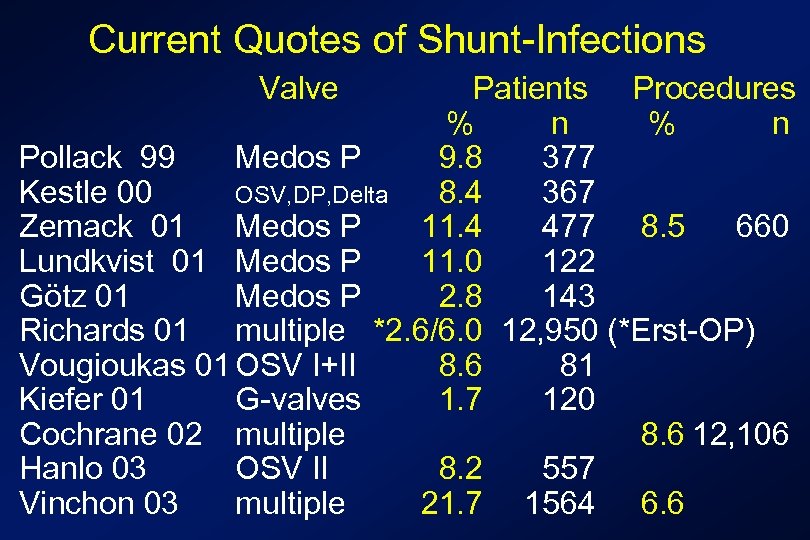 Current Quotes of Shunt-Infections Valve Patients Procedures % n Pollack 99 Medos P 9. 8 377 Kestle 00 OSV, DP, Delta 8. 4 367 Zemack 01 Medos P 11. 4 477 8. 5 660 Lundkvist 01 Medos P 11. 0 122 Götz 01 Medos P 2. 8 143 Richards 01 multiple *2. 6/6. 0 12, 950 (*Erst-OP) Vougioukas 01 OSV I+II 8. 6 81 Kiefer 01 G-valves 1. 7 120 Cochrane 02 multiple 8. 6 12, 106 Hanlo 03 OSV II 8. 2 557 Vinchon 03 multiple 21. 7 1564 6. 6
 1. Sterility in the OP-theatre 2. Antibacterial surface modification of implant 3. Systemic antibiotic prophylaxis
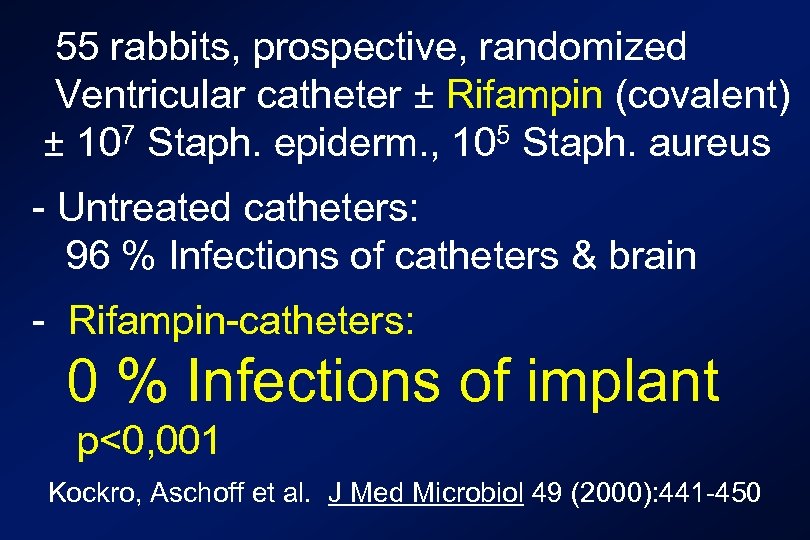 55 rabbits, prospective, randomized Ventricular catheter ± Rifampin (covalent) ± 107 Staph. epiderm. , 105 Staph. aureus - Untreated catheters: 96 % Infections of catheters & brain - Rifampin-catheters: 0 % Infections of implant p<0, 001 Kockro, Aschoff et al. J Med Microbiol 49 (2000): 441 -450
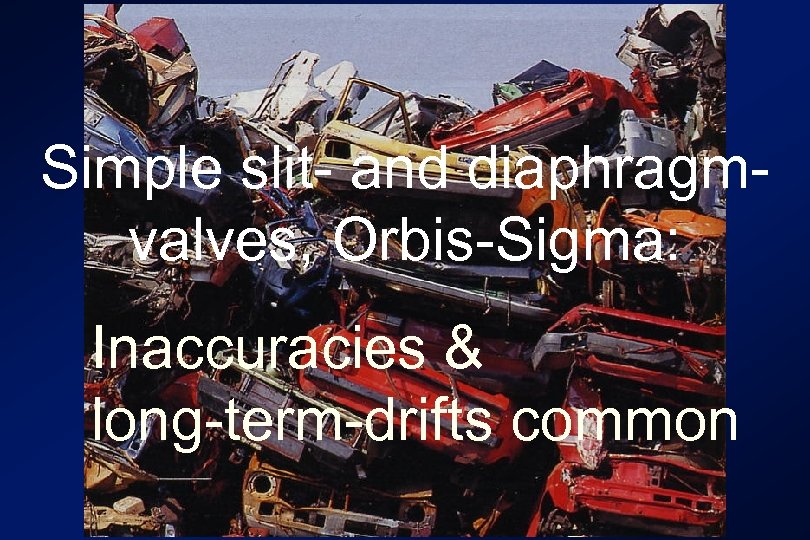 Simple slit- and diaphragmvalves, Orbis-Sigma: Inaccuracies & long-term-drifts common
 ASD, Delta, distal slit. . . : Safety deficits Instable valve bodies Reflux …
 Adjustable Valves: Change of Technological Leadership ? Codman-Medos Miethke Pro. GAV Sophysa-Polaris + gravitational valve
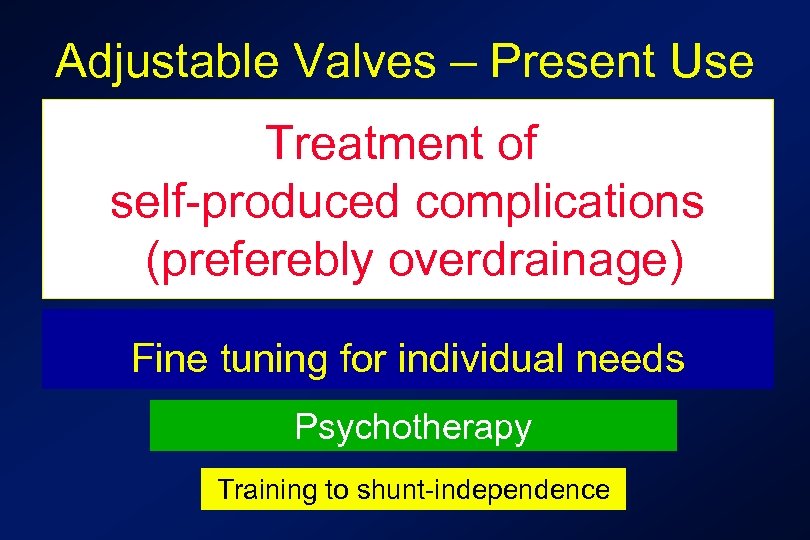 Adjustable Valves – Present Use Treatment of self-produced complications (preferebly overdrainage) Fine tuning for individual needs Psychotherapy Training to shunt-independence
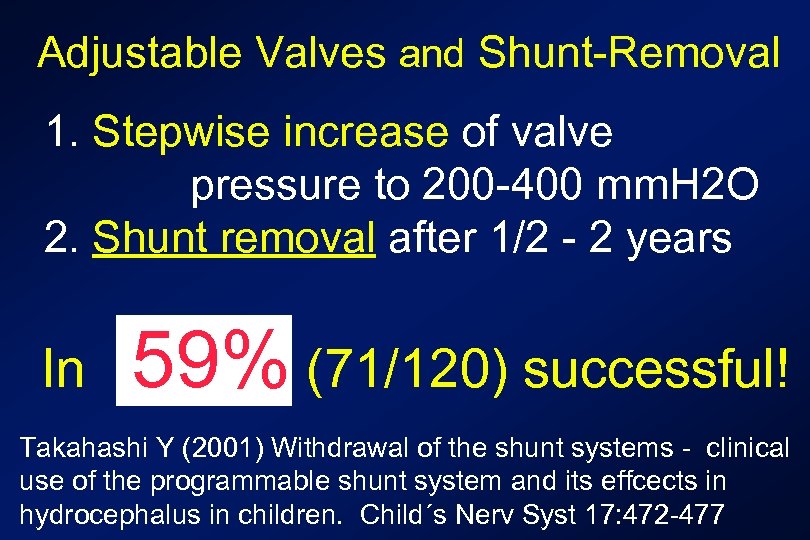 Adjustable Valves and Shunt-Removal 1. Stepwise increase of valve pressure to 200 -400 mm. H 2 O 2. Shunt removal after 1/2 - 2 years In 59% (71/120) successful! Takahashi Y (2001) Withdrawal of the shunt systems - clinical use of the programmable shunt system and its effcects in hydrocephalus in children. Child´s Nerv Syst 17: 472 -477
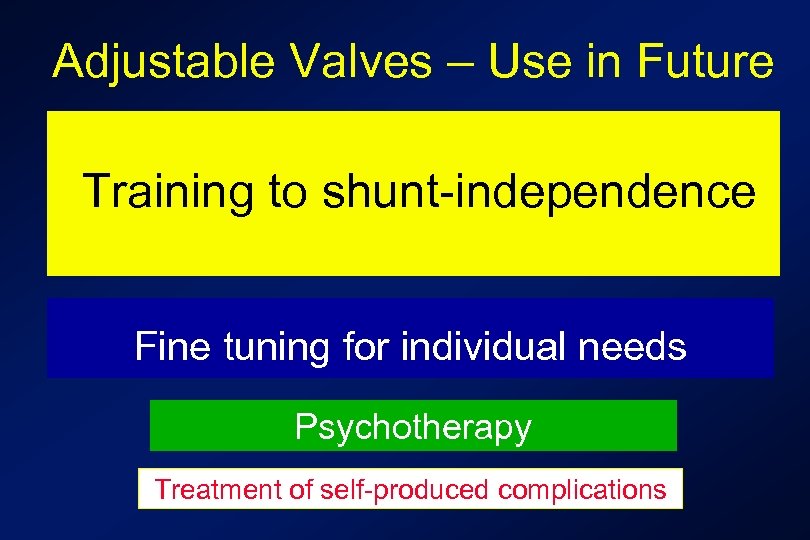 Adjustable Valves – Use in Future Training to shunt-independence Fine tuning for individual needs Psychotherapy Treatment of self-produced complications
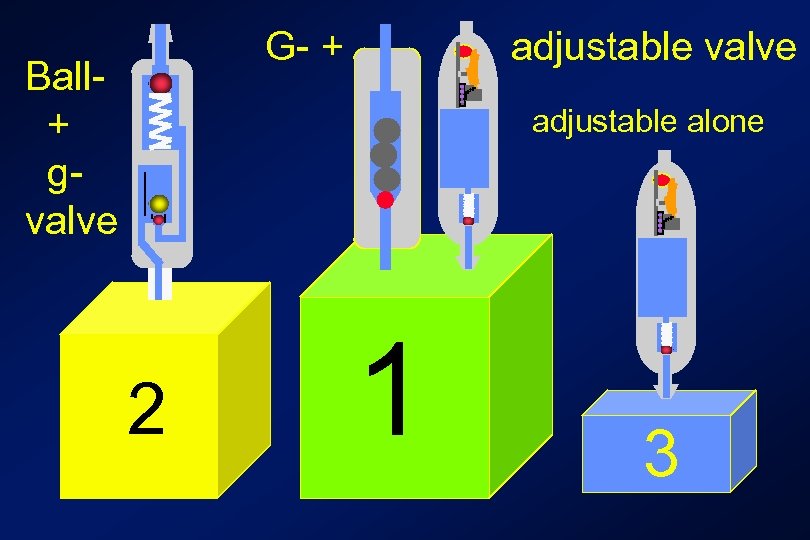 G- + Ball+ gvalve adjustable alone 2 1 3
 Gravitational Valves - Problems - Complicated stock-keeping in OR 6 supplementary devives (e. g. Shunt-Assistant) 6 complete g-valves (e. g. Paedi. GAV) - In case of growth, adipositas, pregnancy, or inadequate pressure selection is under- or (residual) overdrainage not excluded. - No individual fine-tuning
 Gravitational Valves - Perspectives Adjustable g-Valves Percutaneous variation - Number of “active“ balls - Balls with different weights - Variation of the cone-geometry
 Shunt Technology in 2005 1. Adjustable valve 50 -350 mm. H 2 O Stable in MRI, X-ray control not necessary 2. + gravitational valve, adjustable between 100 -350 mm. H 2 O, stable during jogging etc. 3. + low-flow-catheter (ID Ø 0. 8 mm) 4. ICP-telemetry (sensor intradural) 5. Incorporated antibiotics
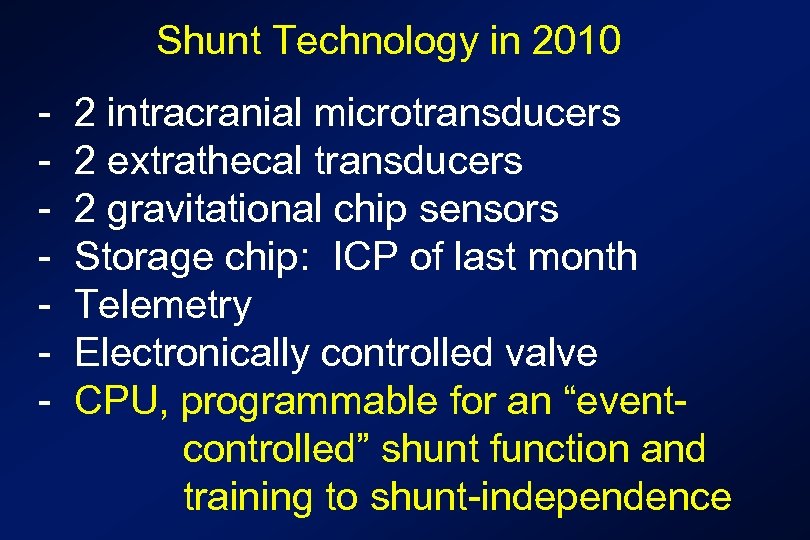 Shunt Technology in 2010 - 2 intracranial microtransducers 2 extrathecal transducers 2 gravitational chip sensors Storage chip: ICP of last month Telemetry Electronically controlled valve CPU, programmable for an “eventcontrolled” shunt function and training to shunt-independence