 Скачать презентацию X-ray States of Black Hole Binaries Possible
8d8f3d608c5659efcd23bdcc242adb78.ppt
- Количество слайдов: 24



X-ray States of Black Hole Binaries & Possible Applications for General Relativity Ron Remillard, Center for Space Research, M. I. T.
Outline Progress for Black Hole Binaries n q q Intensive Monitoring Campaigns: RXTE, radio, optical Modified Definitions of X-ray States: Physical Elements Each State : Applications for General Relativity Each State : Problems in Accretion Physics Prospects for Advancement n q q q Multi-X-ray Observations (broad-band high-resolution Spectroscopy & Timing & Imaging) Multi-Frequency Observations Engaging Theorists
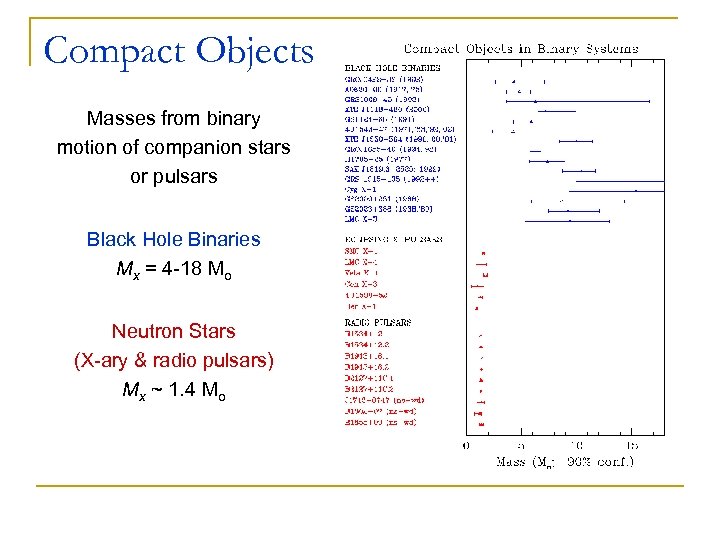
Compact Objects Masses from binary motion of companion stars or pulsars Black Hole Binaries Mx = 4 -18 Mo Neutron Stars (X-ary & radio pulsars) Mx ~ 1. 4 Mo
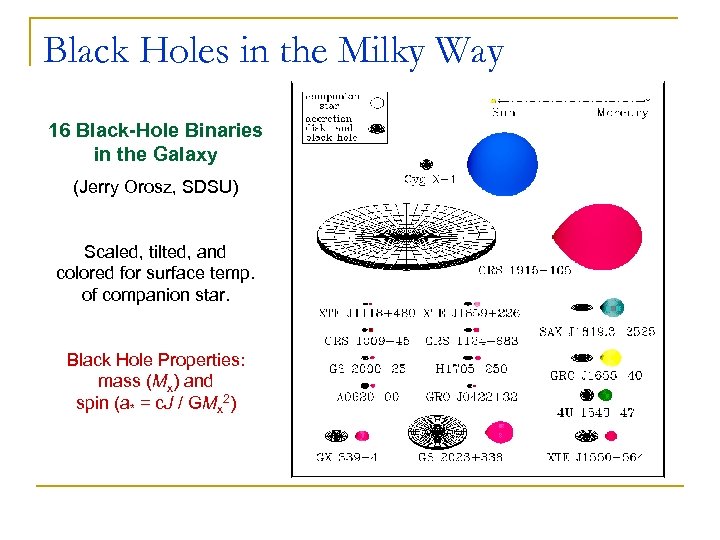
Black Holes in the Milky Way 16 Black-Hole Binaries in the Galaxy (Jerry Orosz, SDSU) Scaled, tilted, and colored for surface temp. of companion star. Black Hole Properties: mass (Mx) and spin (a* = c. J / GMx 2)
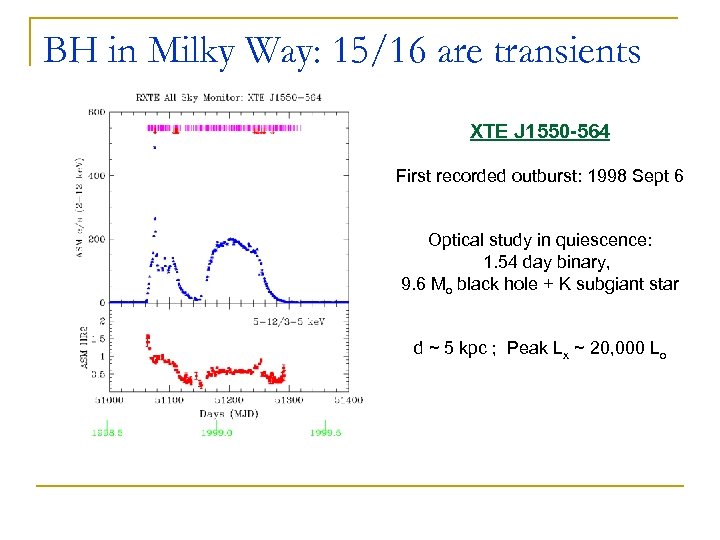
BH in Milky Way: 15/16 are transients XTE J 1550 -564 First recorded outburst: 1998 Sept 6 Optical study in quiescence: 1. 54 day binary, 9. 6 Mo black hole + K subgiant star d ~ 5 kpc ; Peak Lx ~ 20, 000 Lo
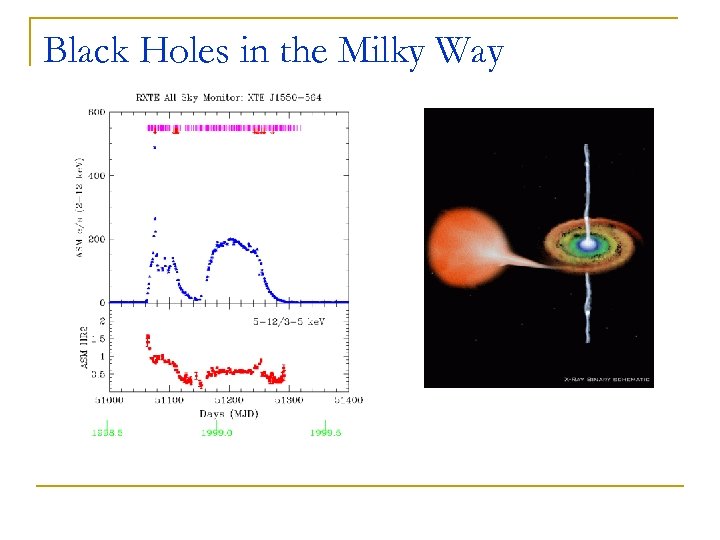
Black Holes in the Milky Way
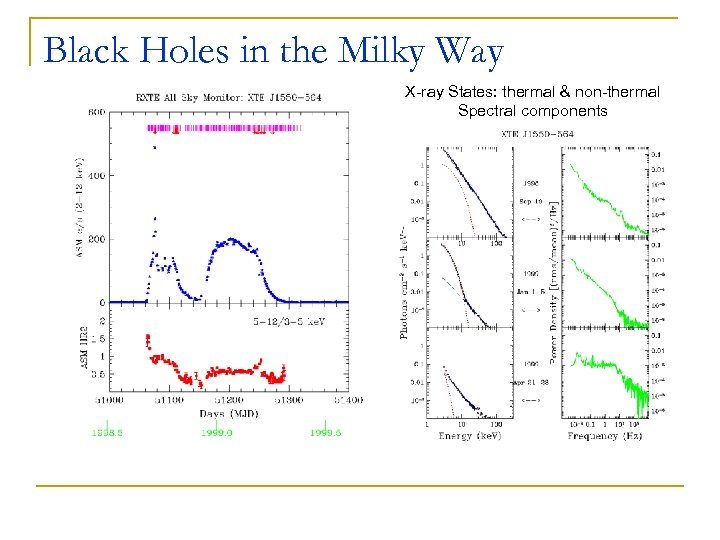
Black Holes in the Milky Way X-ray States: thermal & non-thermal Spectral components
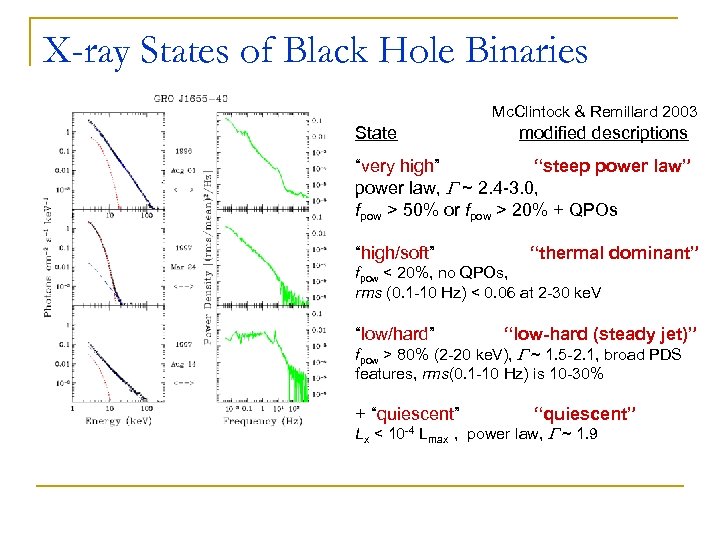
X-ray States of Black Hole Binaries Mc. Clintock & Remillard 2003 State modified descriptions “very high” “steep power law” power law, G ~ 2. 4 -3. 0, fpow > 50% or fpow > 20% + QPOs “high/soft” “thermal dominant” fpow < 20%, no QPOs, rms (0. 1 -10 Hz) < 0. 06 at 2 -30 ke. V “low/hard” “low-hard (steady jet)” fpow > 80% (2 -20 ke. V), G ~ 1. 5 -2. 1, broad PDS features, rms(0. 1 -10 Hz) is 10 -30% + “quiescent” Lx < 10 -4 Lmax , power law, G ~ 1. 9
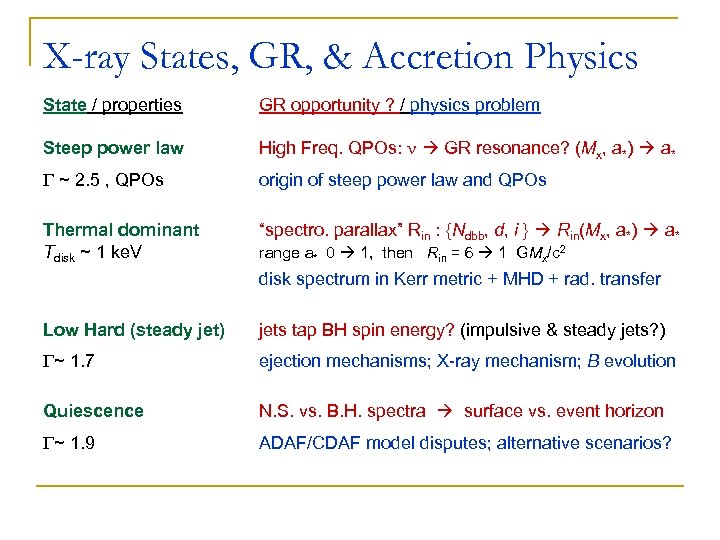
X-ray States, GR, & Accretion Physics State / properties GR opportunity ? / physics problem Steep power law High Freq. QPOs: n GR resonance? (Mx, a*) a* G ~ 2. 5 , QPOs origin of steep power law and QPOs Thermal dominant Tdisk ~ 1 ke. V “spectro. parallax” Rin : {Ndbb, d, i } Rin(Mx, a*) a* range a* 0 1, then Rin = 6 1 GMx/c 2 disk spectrum in Kerr metric + MHD + rad. transfer Low Hard (steady jet) jets tap BH spin energy? (impulsive & steady jets? ) G~ 1. 7 ejection mechanisms; X-ray mechanism; B evolution Quiescence N. S. vs. B. H. spectra surface vs. event horizon G~ 1. 9 ADAF/CDAF model disputes; alternative scenarios?
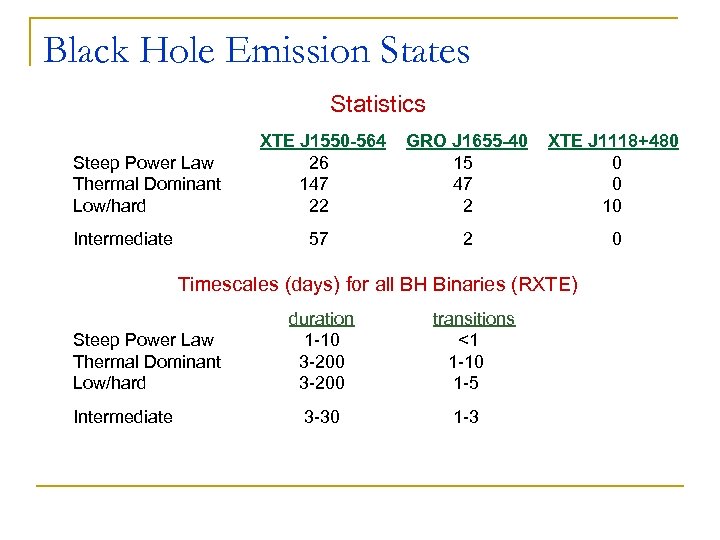
Black Hole Emission States Statistics Intermediate GRO J 1655 -40 15 47 2 XTE J 1118+480 0 0 10 57 Steep Power Law Thermal Dominant Low/hard XTE J 1550 -564 26 147 22 2 0 Timescales (days) for all BH Binaries (RXTE) Steep Power Law Thermal Dominant Low/hard Intermediate duration 1 -10 3 -200 3 -30 transitions <1 1 -10 1 -5 1 -3
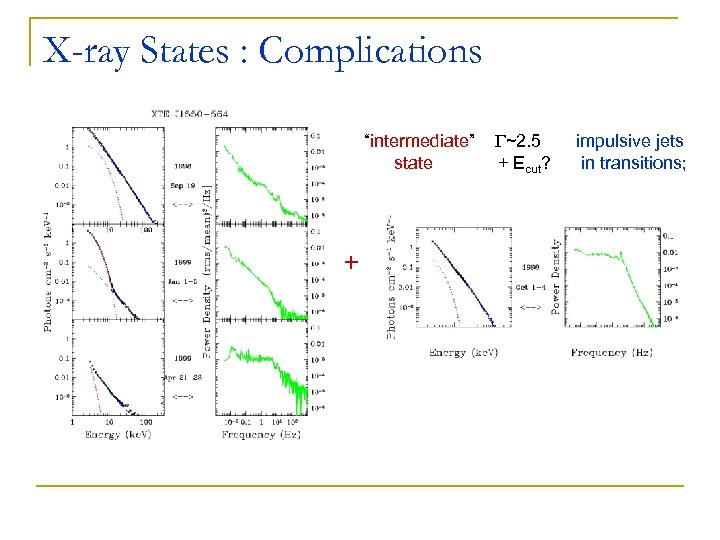
X-ray States : Complications “intermediate” state + G~2. 5 + Ecut? impulsive jets in transitions;
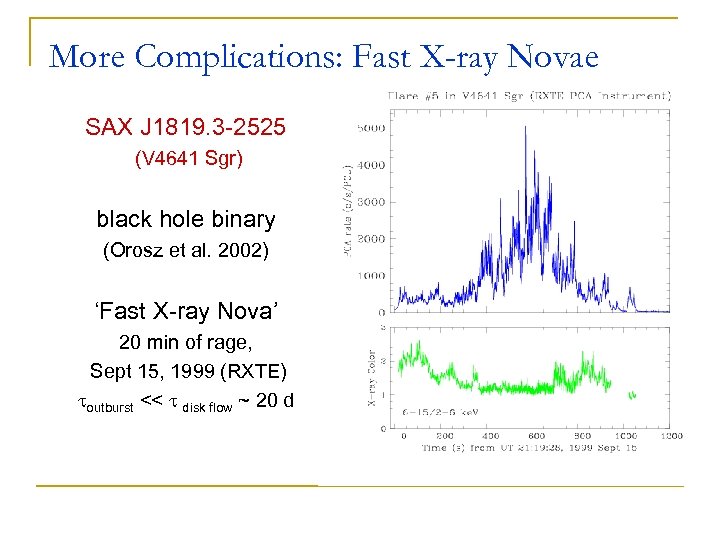
More Complications: Fast X-ray Novae SAX J 1819. 3 -2525 (V 4641 Sgr) black hole binary (Orosz et al. 2002) ‘Fast X-ray Nova’ 20 min of rage, Sept 15, 1999 (RXTE) toutburst << t disk flow ~ 20 d
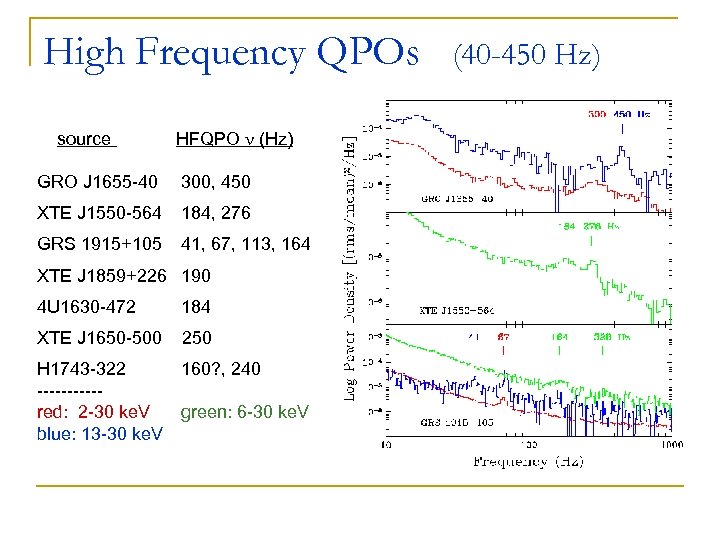
High Frequency QPOs source HFQPO n (Hz) GRO J 1655 -40 300, 450 XTE J 1550 -564 184, 276 GRS 1915+105 41, 67, 113, 164 XTE J 1859+226 190 4 U 1630 -472 184 XTE J 1650 -500 250 H 1743 -322 160? , 240 -----red: 2 -30 ke. V green: 6 -30 ke. V blue: 13 -30 ke. V (40 -450 Hz)
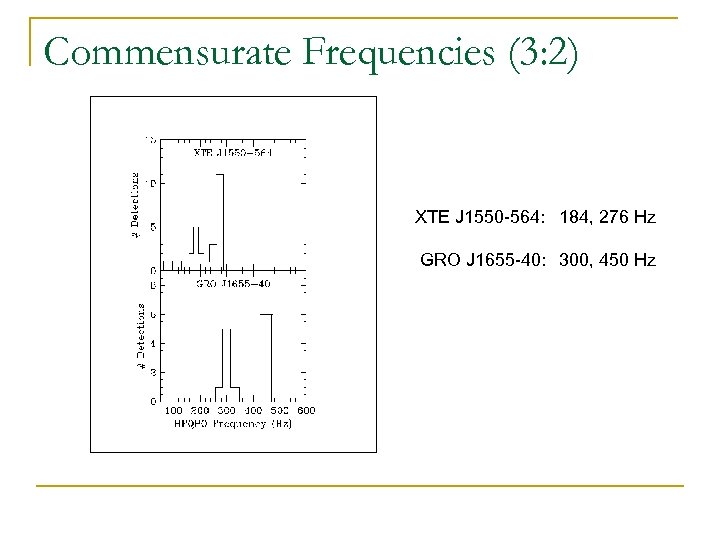
Commensurate Frequencies (3: 2) XTE J 1550 -564: 184, 276 Hz GRO J 1655 -40: 300, 450 Hz
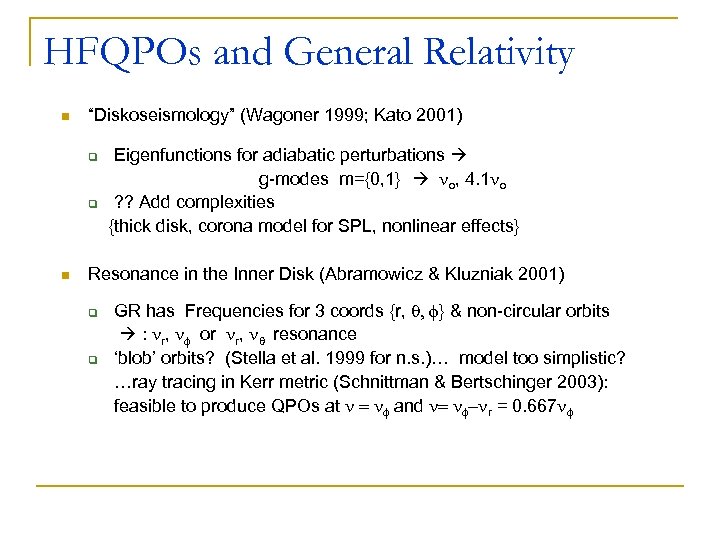
HFQPOs and General Relativity n “Diskoseismology” (Wagoner 1999; Kato 2001) q q n Eigenfunctions for adiabatic perturbations g-modes m={0, 1} no, 4. 1 no ? ? Add complexities {thick disk, corona model for SPL, nonlinear effects} Resonance in the Inner Disk (Abramowicz & Kluzniak 2001) q q GR has Frequencies for 3 coords {r, q, f} & non-circular orbits : nr, nf or nr, nq resonance ‘blob’ orbits? (Stella et al. 1999 for n. s. )… model too simplistic? …ray tracing in Kerr metric (Schnittman & Bertschinger 2003): feasible to produce QPOs at n = nf and n= nf-nr = 0. 667 nf
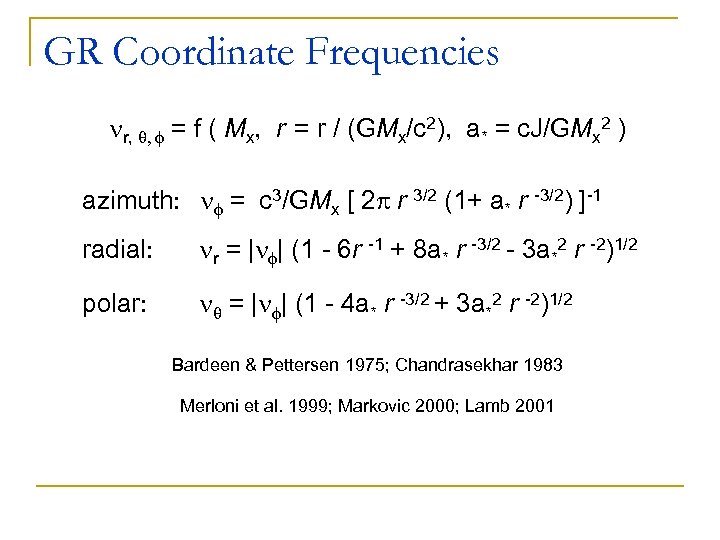
GR Coordinate Frequencies nr, q, f = f ( Mx, r = r / (GMx/c 2), a* = c. J/GMx 2 ) azimuth: nf = c 3/GMx [ 2 p r 3/2 (1+ a* r -3/2) ]-1 radial: nr = |nf| (1 - 6 r -1 + 8 a* r -3/2 - 3 a*2 r -2)1/2 polar: nq = |nf| (1 - 4 a* r -3/2 + 3 a*2 r -2)1/2 Bardeen & Pettersen 1975; Chandrasekhar 1983 Merloni et al. 1999; Markovic 2000; Lamb 2001
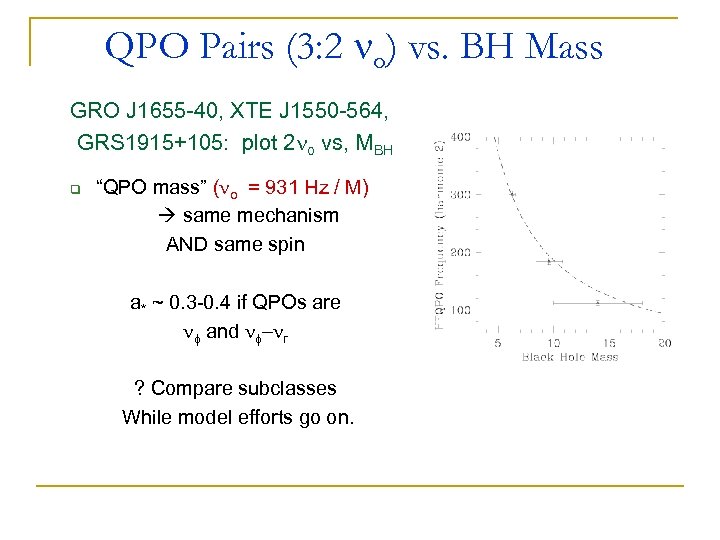
QPO Pairs (3: 2 no) vs. BH Mass GRO J 1655 -40, XTE J 1550 -564, GRS 1915+105: plot 2 no vs, MBH q “QPO mass” (no = 931 Hz / M) same mechanism AND same spin a* ~ 0. 3 -0. 4 if QPOs are nf and nf-nr ? Compare subclasses While model efforts go on.
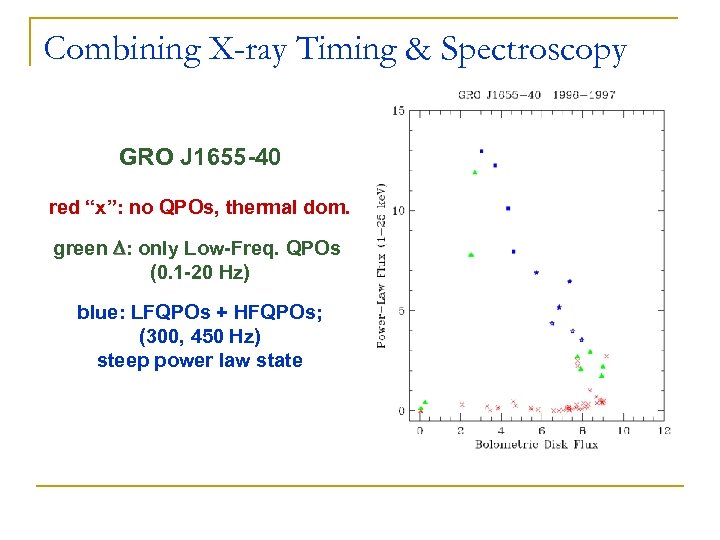
Combining X-ray Timing & Spectroscopy GRO J 1655 -40 red “x”: no QPOs, thermal dom. green D: only Low-Freq. QPOs (0. 1 -20 Hz) blue: LFQPOs + HFQPOs; (300, 450 Hz) steep power law state
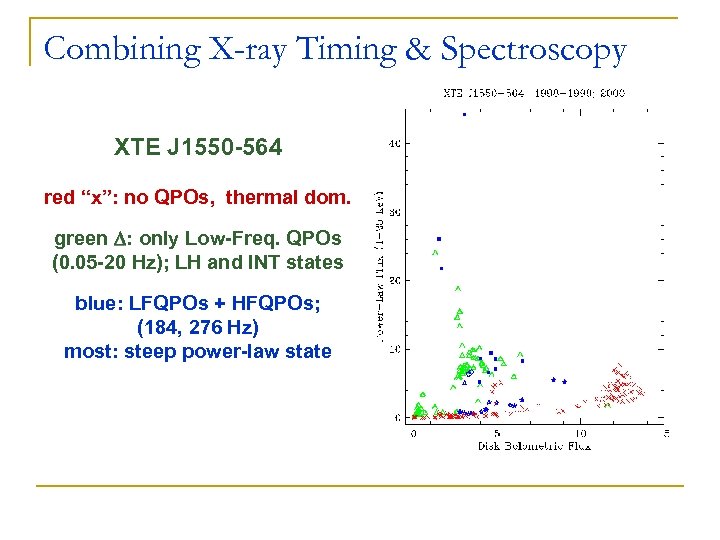
Combining X-ray Timing & Spectroscopy XTE J 1550 -564 red “x”: no QPOs, thermal dom. green D: only Low-Freq. QPOs (0. 05 -20 Hz); LH and INT states blue: LFQPOs + HFQPOs; (184, 276 Hz) most: steep power-law state
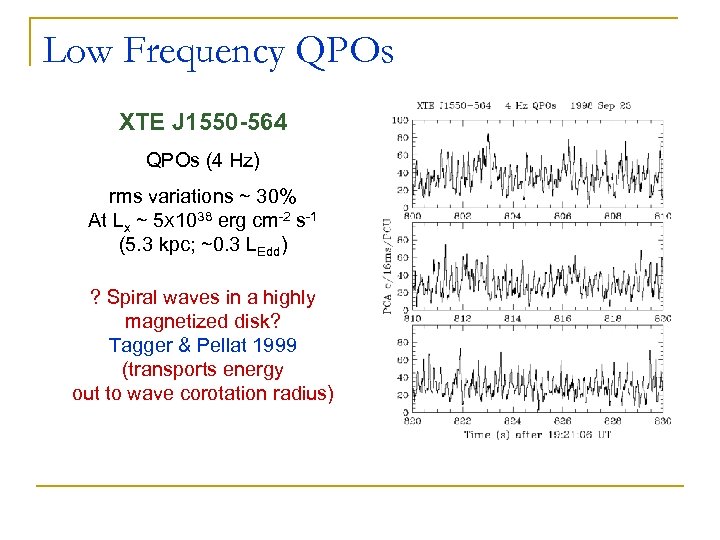
Low Frequency QPOs XTE J 1550 -564 QPOs (4 Hz) rms variations ~ 30% At Lx ~ 5 X 1038 erg cm-2 s-1 (5. 3 kpc; ~0. 3 LEdd) ? Spiral waves in a highly magnetized disk? Tagger & Pellat 1999 (transports energy out to wave corotation radius)
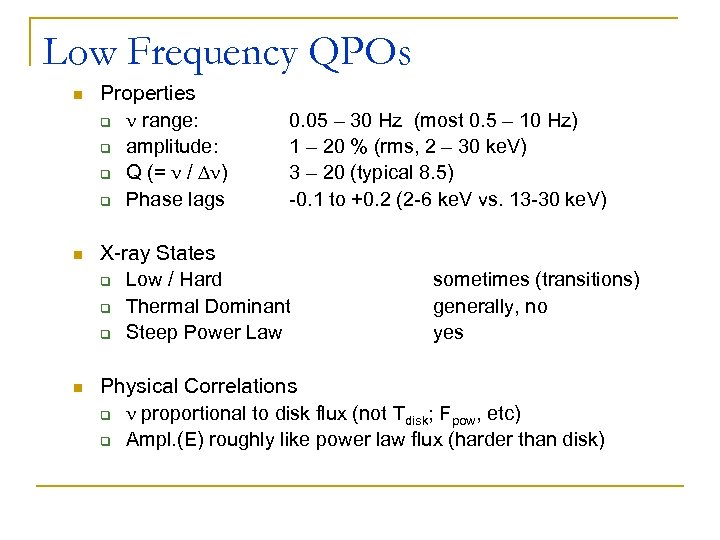
Low Frequency QPOs n n n Properties q n range: q amplitude: q Q (= n / Dn) q Phase lags 0. 05 – 30 Hz (most 0. 5 – 10 Hz) 1 – 20 % (rms, 2 – 30 ke. V) 3 – 20 (typical 8. 5) -0. 1 to +0. 2 (2 -6 ke. V vs. 13 -30 ke. V) X-ray States q Low / Hard q Thermal Dominant q Steep Power Law sometimes (transitions) generally, no yes Physical Correlations q n proportional to disk flux (not Tdisk; Fpow, etc) q Ampl. (E) roughly like power law flux (harder than disk)
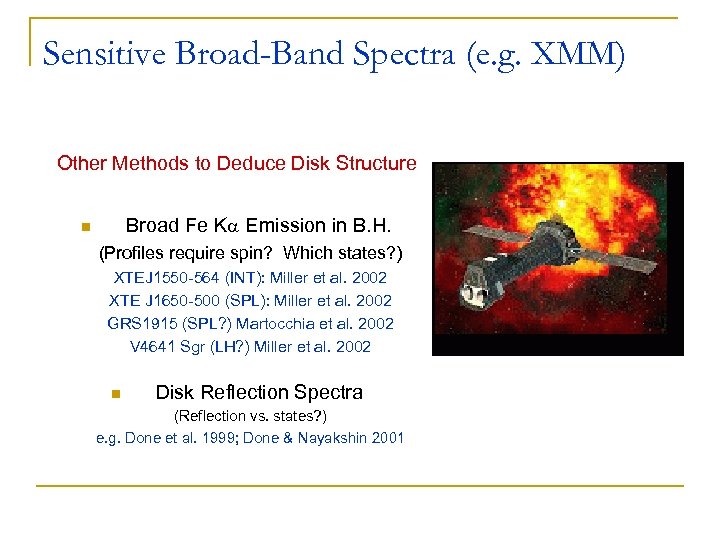
Sensitive Broad-Band Spectra (e. g. XMM) Other Methods to Deduce Disk Structure Broad Fe Ka Emission in B. H. n (Profiles require spin? Which states? ) XTEJ 1550 -564 (INT): Miller et al. 2002 XTE J 1650 -500 (SPL): Miller et al. 2002 GRS 1915 (SPL? ) Martocchia et al. 2002 V 4641 Sgr (LH? ) Miller et al. 2002 n Disk Reflection Spectra (Reflection vs. states? ) e. g. Done et al. 1999; Done & Nayakshin 2001
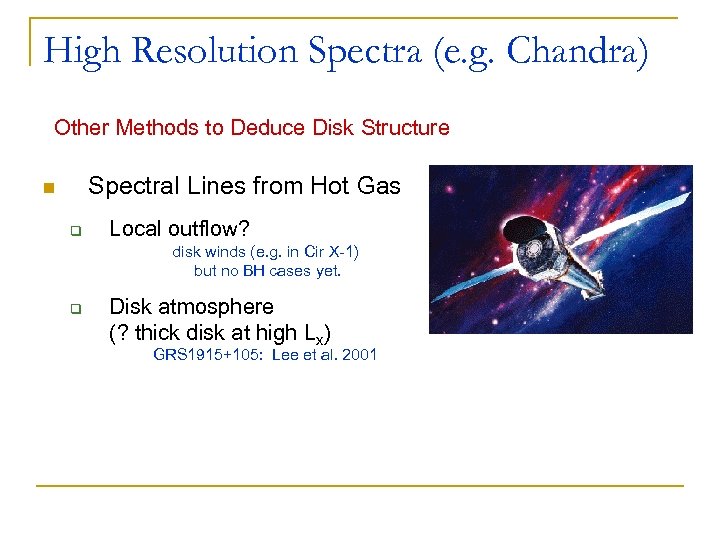
High Resolution Spectra (e. g. Chandra) Other Methods to Deduce Disk Structure Spectral Lines from Hot Gas n q Local outflow? disk winds (e. g. in Cir X-1) but no BH cases yet. q Disk atmosphere (? thick disk at high Lx) GRS 1915+105: Lee et al. 2001
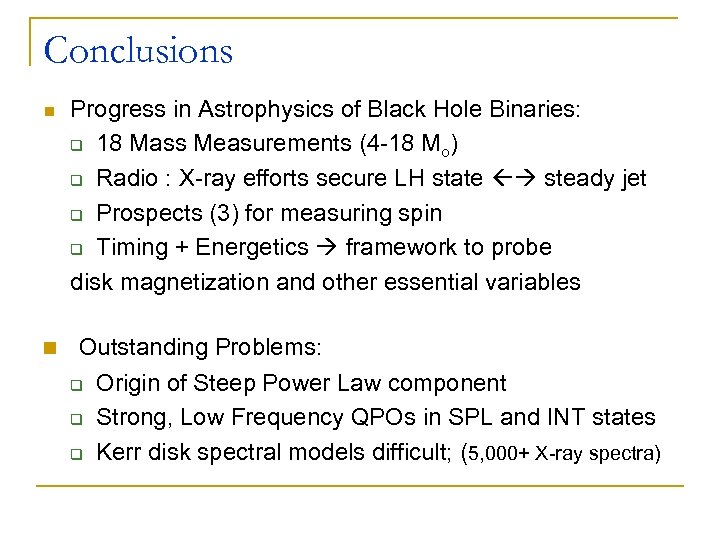
Conclusions n Progress in Astrophysics of Black Hole Binaries: q 18 Mass Measurements (4 -18 Mo) q Radio : X-ray efforts secure LH state steady jet q Prospects (3) for measuring spin q Timing + Energetics framework to probe disk magnetization and other essential variables n Outstanding Problems: q Origin of Steep Power Law component q Strong, Low Frequency QPOs in SPL and INT states q Kerr disk spectral models difficult; (5, 000+ X-ray spectra)
Скачать презентацию X-ray States of Black Hole Binaries Possible
8d8f3d608c5659efcd23bdcc242adb78.ppt