 Скачать презентацию X-ray absorption and high-velocity outflows in AGNs —
201f5ecd163d5cad3c9fe088eb416e44.ppt
- Количество слайдов: 25



X-ray absorption and high-velocity outflows in AGNs - a second look Shai Kaspi Technion – Haifa; Tel-Aviv University Israel “Physics of warm absorbers in AGN” – Warsaw, Poland – 5 October 2005
Outline - Mass outflow and identifying Outflows - Alternative interpretation for PG 1211+143 - The problematic second look; and also, PDS 456, NGC 3783 - Further directions
Mass Outflow From AGNs Does mass outflow from the AGN? • Collimated jets and/or lobs in “Radio load” quasars – 5%-10% of quasars are “Radio load”. • Broad absorption lines (BALs) – Blueshifted up to 0. 1 c - in the rest-frame UV lines of ~10% “radio quiet” quasars. Is mass loss an important component in most AGNs? “Recent” (~7 yr) UV (HST) and X-ray (Xmm & Chandra) observations detected outflowing mass in the majority of moderate luminosity Seyfert galaxies (~70%), indicating the importance of mass outflow.
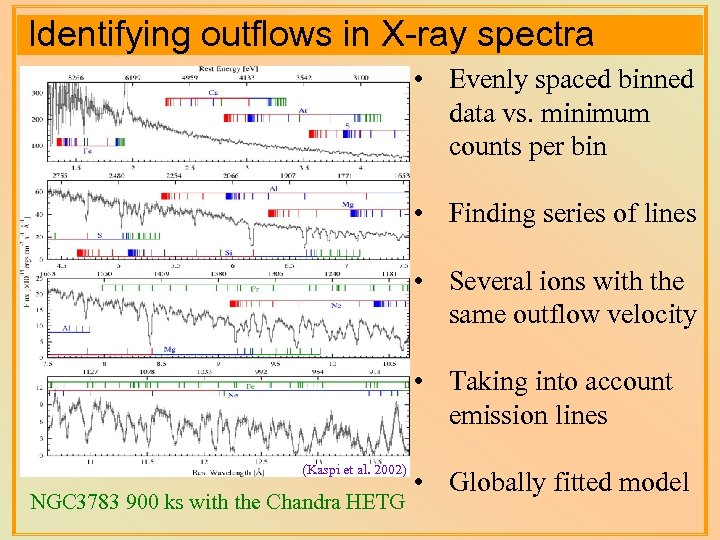
Identifying outflows in X-ray spectra • Evenly spaced binned data vs. minimum counts per bin • Finding series of lines • Several ions with the same outflow velocity • Taking into account emission lines (Kaspi et al. 2002) NGC 3783 900 ks with the Chandra HETG • Globally fitted model
![Velocities are not Straightforward NGC 3783 Ionization Potential [e. V] Kaspi et al. (2002)](https://present5.com/presentation/201f5ecd163d5cad3c9fe088eb416e44/image-5.jpg "Velocities are not Straightforward NGC 3783 Ionization Potential [e. V] Kaspi et al. (2002)")
Velocities are not Straightforward NGC 3783 Ionization Potential [e. V] Kaspi et al. (2002) Individual line measurements suffer from systematic uncertainties (emission line filling? ) Kaspi et al. (2002)
Mass outflow • How much mass is carried out of the AGN by the outflow? • How does it compared to the amount of matter being accreted? • Does the ionized outflow carry a significant fraction of the energy output of the AGN? Answers are currently model dependent
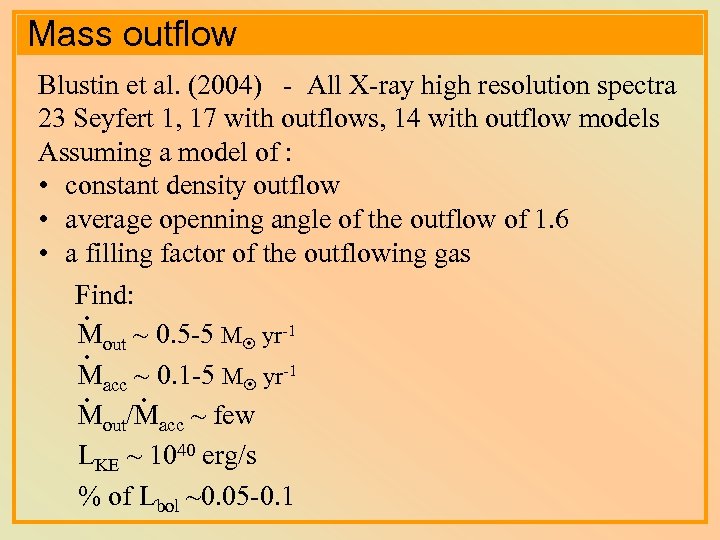
Mass outflow Blustin et al. (2004) - All X-ray high resolution spectra 23 Seyfert 1, 17 with outflows, 14 with outflow models Assuming a model of : • constant density outflow • average openning angle of the outflow of 1. 6 • a filling factor of the outflowing gas Find: . Mout ~ 0. 5 -5 M yr-1. Macc ~ 0. 1 -5 M yr-1. . Mout/Macc ~ few LKE ~ 1040 erg/s % of Lbol ~0. 05 -0. 1
![High Velocity Outflows UV BAL LEdd /L (km/s) Source Vout [c] NH [1023 cm-2]](https://present5.com/presentation/201f5ecd163d5cad3c9fe088eb416e44/image-8.jpg "High Velocity Outflows UV BAL LEdd /L (km/s) Source Vout [c] NH [1023 cm-2]")
High Velocity Outflows UV BAL LEdd /L (km/s) Source Vout [c] NH [1023 cm-2] APM 08279+5255 0. 2 , 0. 4 1 ± 0. 5 (12. 4 k)Y ~ 0. 04 c high 5 N 1. 1 0. 1 ± 0. 05, 6. 9 (? )Y 0. 7 4 N 0. 3 5 Y(? ~12 k) 1. 0 Chartas et al. (2002) PG 1211+143 0. 08 - 0. 1 Pounds et al. (2003) PG 1115+080 Chartas et al. (2003) 0. 1 , 0. 34 PG 0844+349 0. 2 - 0. 26 Pounds et al. (2003) PDS 456 0. 16 Reeves et al. (2003) Mass outflow of several M yr-1
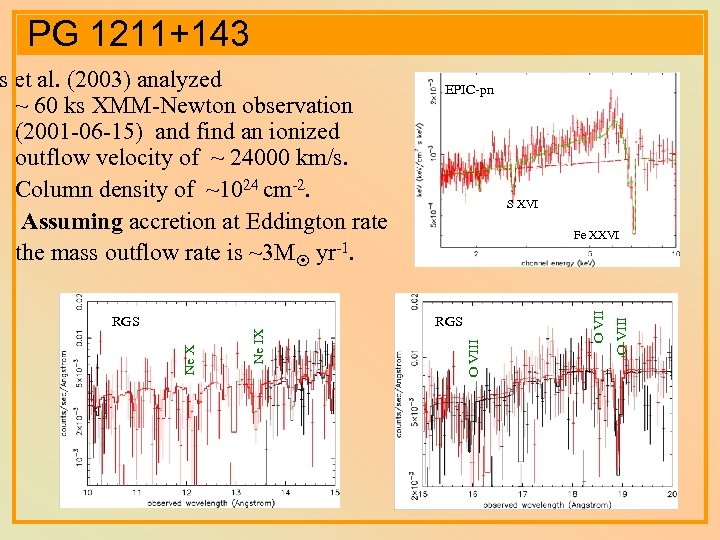
PG 1211+143 S XVI O VIII Ne IX O VIII Fe XXVI RGS Ne X RGS EPIC-pn O VII s et al. (2003) analyzed ~ 60 ks XMM-Newton observation (2001 -06 -15) and find an ionized outflow velocity of ~ 24000 km/s. Column density of ~1024 cm-2. Assuming accretion at Eddington rate the mass outflow rate is ~3 M yr-1.
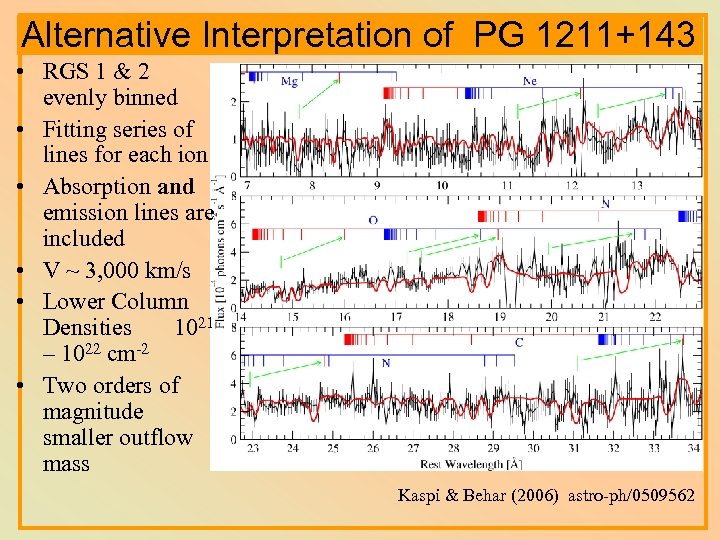
Alternative Interpretation of PG 1211+143 • RGS 1 & 2 evenly binned • Fitting series of lines for each ion • Absorption and emission lines are included • V ~ 3, 000 km/s • Lower Column Densities 1021 – 1022 cm-2 • Two orders of magnitude smaller outflow mass Kaspi & Behar (2006) astro-ph/0509562
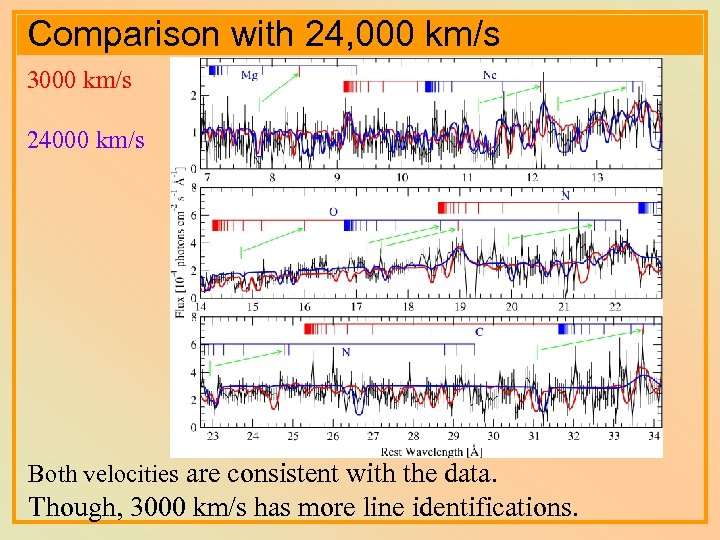
Comparison with 24, 000 km/s 3000 km/s 24000 km/s Both velocities are consistent with the data. Though, 3000 km/s has more line identifications.
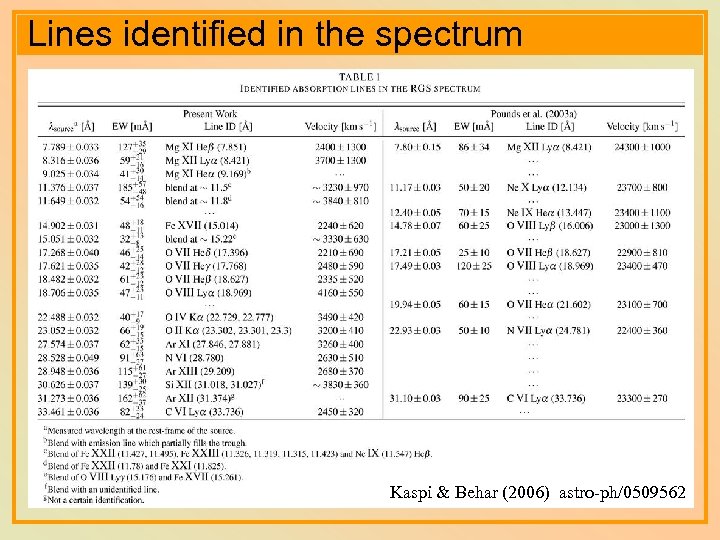
Lines identified in the spectrum Kaspi & Behar (2006) astro-ph/0509562
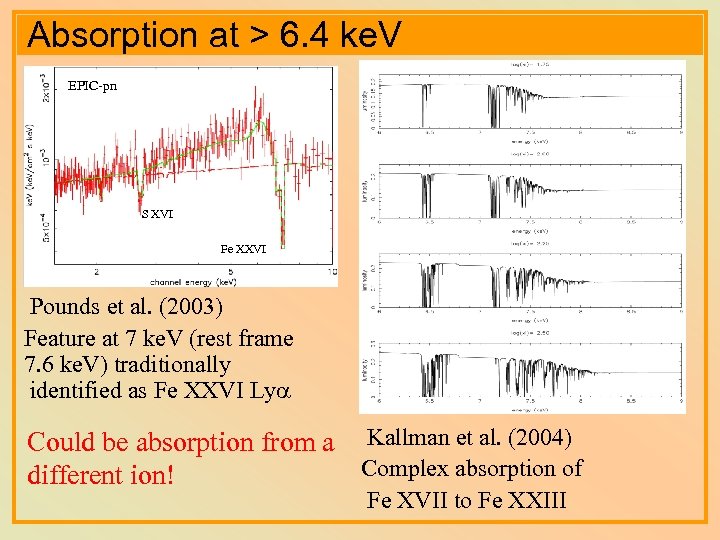
Absorption at > 6. 4 ke. V EPIC-pn S XVI Fe XXVI Pounds et al. (2003) Feature at 7 ke. V (rest frame 7. 6 ke. V) traditionally identified as Fe XXVI Lya Could be absorption from a Kallman et al. (2004) Complex absorption of different ion! Fe XVII to Fe XXIII
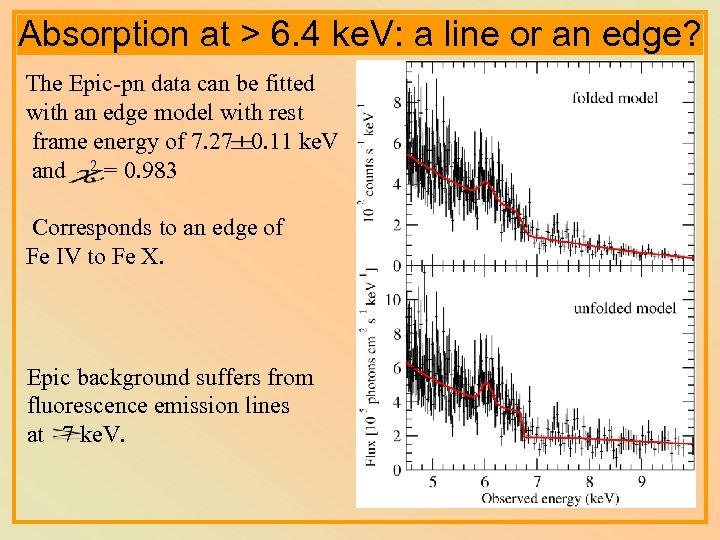
Absorption at > 6. 4 ke. V: a line or an edge? The Epic-pn data can be fitted with an edge model with rest frame energy of 7. 27 0. 11 ke. V and 2 = 0. 983 Corresponds to an edge of Fe IV to Fe X. Epic background suffers from fluorescence emission lines at 7 ke. V.
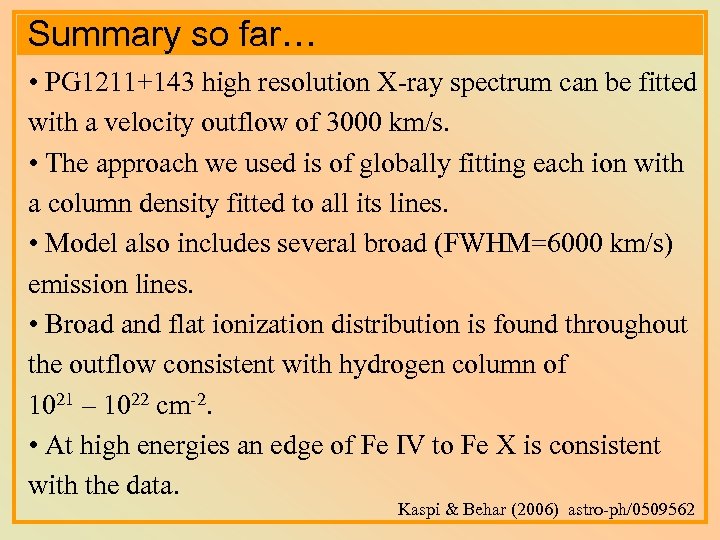
Summary so far… • PG 1211+143 high resolution X-ray spectrum can be fitted with a velocity outflow of 3000 km/s. • The approach we used is of globally fitting each ion with a column density fitted to all its lines. • Model also includes several broad (FWHM=6000 km/s) emission lines. • Broad and flat ionization distribution is found throughout the outflow consistent with hydrogen column of 1021 – 1022 cm-2. • At high energies an edge of Fe IV to Fe X is consistent with the data. Kaspi & Behar (2006) astro-ph/0509562
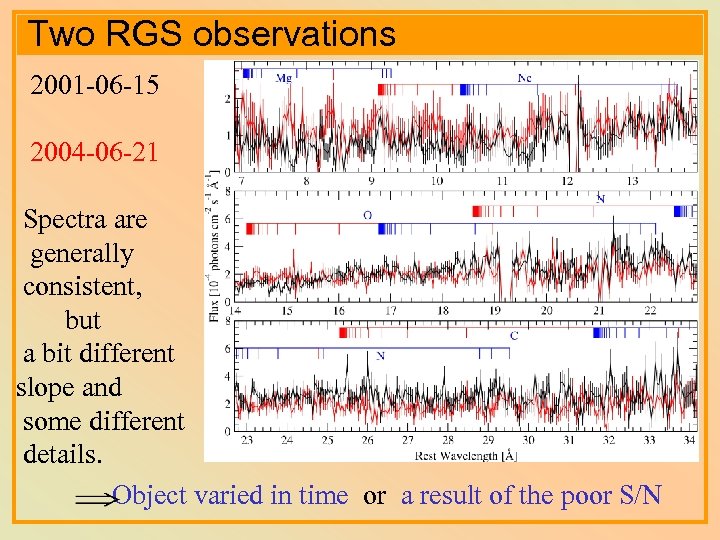
Two RGS observations 2001 -06 -15 2004 -06 -21 Spectra are generally consistent, but a bit different slope and some different details. Object varied in time or a result of the poor S/N
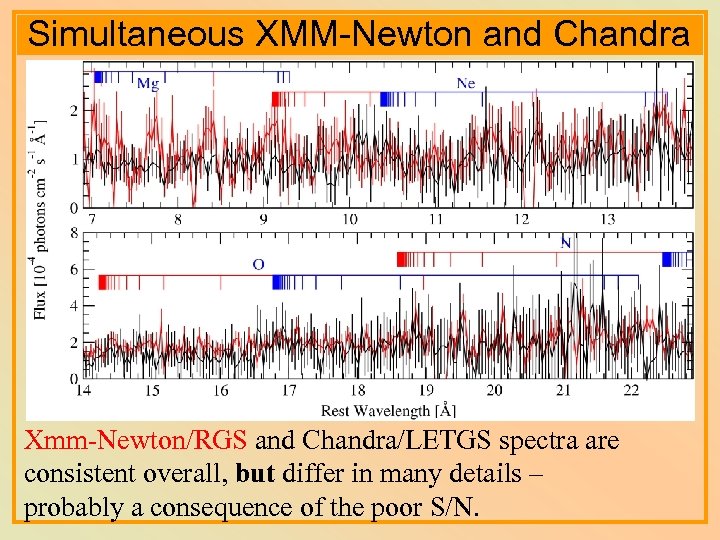
Simultaneous XMM-Newton and Chandra Xmm-Newton/RGS and Chandra/LETGS spectra are consistent overall, but differ in many details – probably a consequence of the poor S/N.
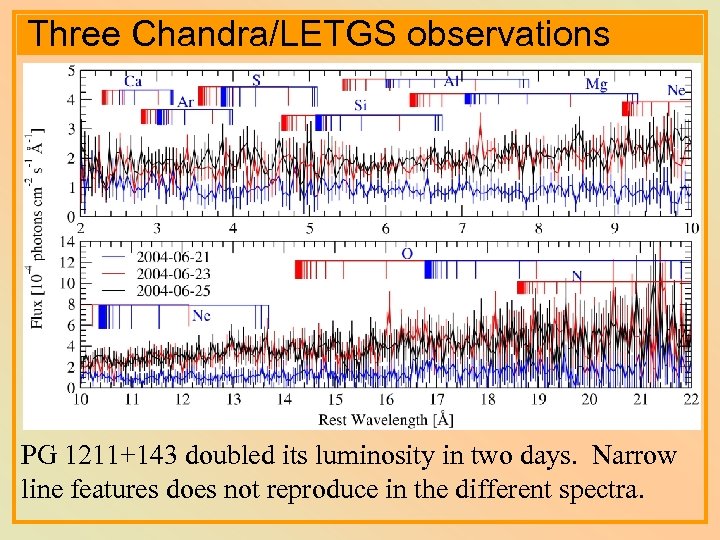
Three Chandra/LETGS observations PG 1211+143 doubled its luminosity in two days. Narrow line features does not reproduce in the different spectra.
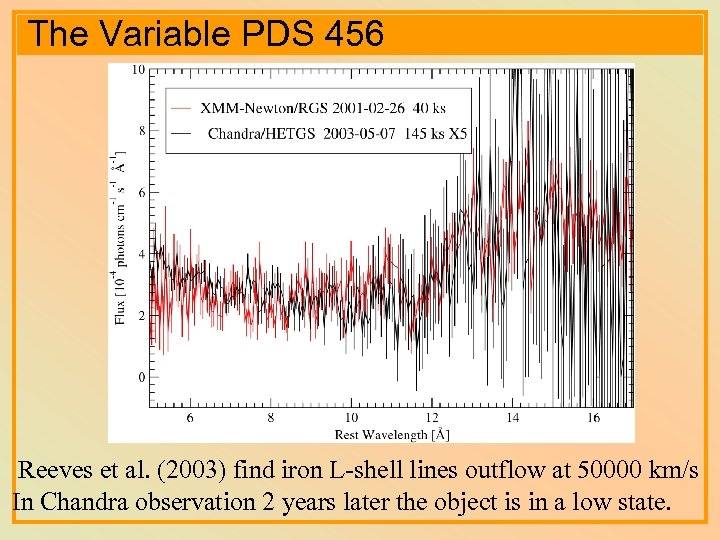
The Variable PDS 456 Reeves et al. (2003) find iron L-shell lines outflow at 50000 km/s In Chandra observation 2 years later the object is in a low state.
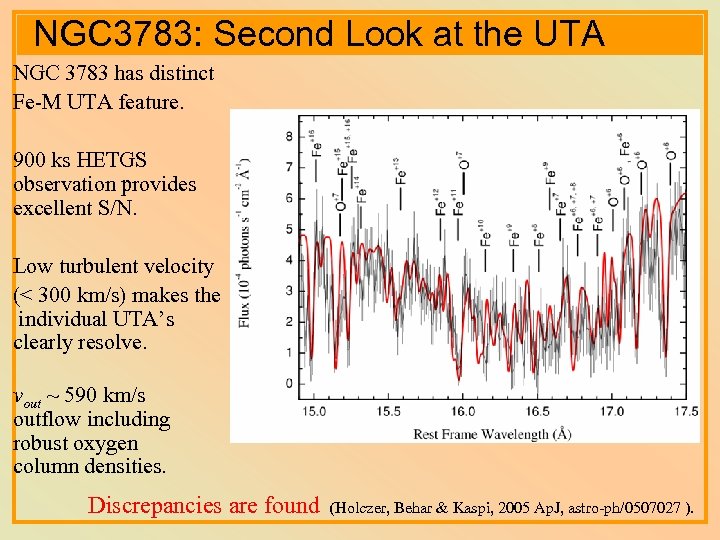
NGC 3783: Second Look at the UTA NGC 3783 has distinct Fe-M UTA feature. 900 ks HETGS observation provides excellent S/N. Low turbulent velocity (< 300 km/s) makes the individual UTA’s clearly resolve. vout ~ 590 km/s outflow including robust oxygen column densities. Discrepancies are found (Holczer, Behar & Kaspi, 2005 Ap. J, astro-ph/0507027 ).
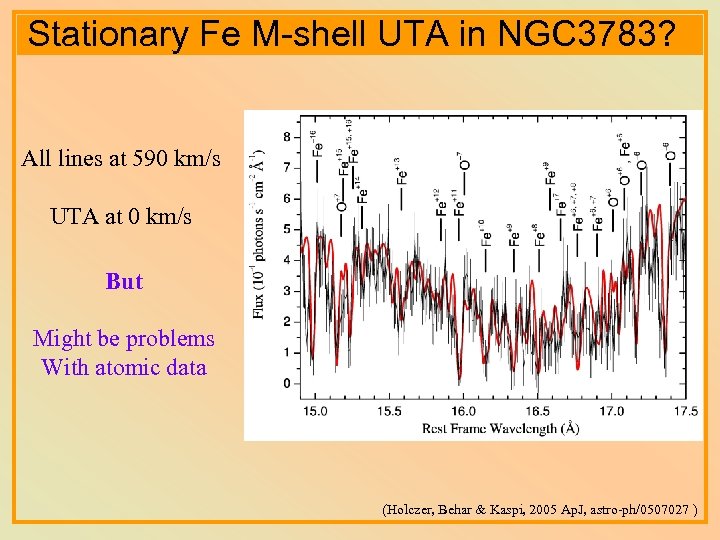
Stationary Fe M-shell UTA in NGC 3783? All lines at 590 km/s UTA at 0 km/s But Might be problems With atomic data (Holczer, Behar & Kaspi, 2005 Ap. J, astro-ph/0507027 )
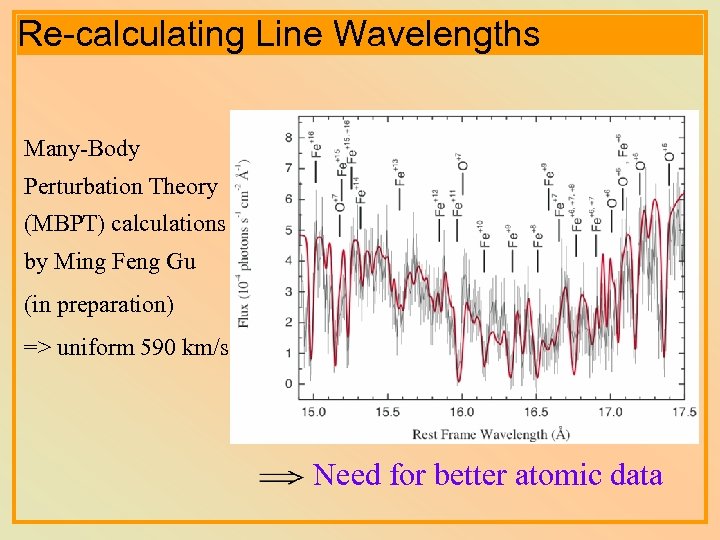
Re-calculating Line Wavelengths Many-Body Perturbation Theory (MBPT) calculations by Ming Feng Gu (in preparation) => uniform 590 km/s Need for better atomic data
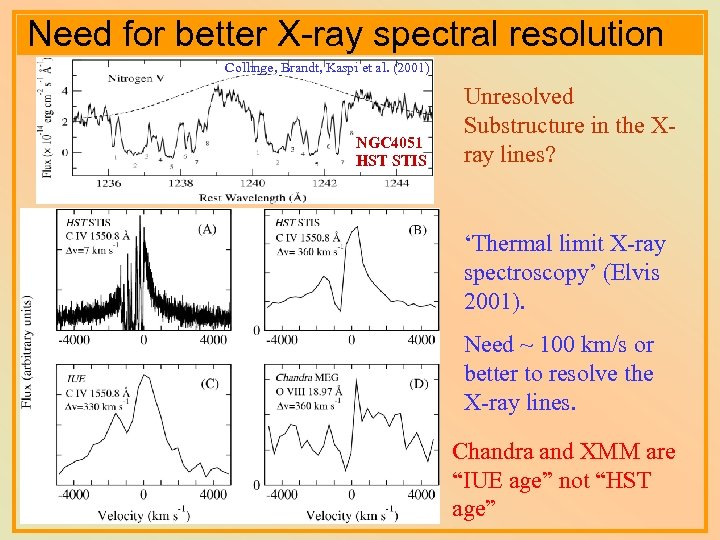
Need for better X-ray spectral resolution Collinge, Brandt, Kaspi et al. (2001) NGC 4051 HST STIS Unresolved Substructure in the Xray lines? ‘Thermal limit X-ray spectroscopy’ (Elvis 2001). Need ~ 100 km/s or better to resolve the X-ray lines. Chandra and XMM are “IUE age” not “HST age”
Summary… • Outflows in AGNs are a common phenomenon (~70% of objects) and seem to be significant in terms of mass loss rate. • Outflows provide key results about AGNs’ central regions, e. g. : Dynamics: outflows velocities of few 100 km/s in multiple components. Range of ionization parameters UOxygen ~ 0. 01 to 1 (degeneracy of location and density). Column density ~ 1021 -23 cm-2. • Normal outflows are insignificant in terms of energy. • High-velocity mass outflow are potentially energetically significant but are still in debate.
…Summary and Conclusions • To the best of our understanding, a 3, 000 km/s model fits the PG 1211+143 data better than a 24, 000 km/s model. • In all fairness, the data can tolerate more than one interpretation. • Admittedly, S/N of data is marginal. • Features that appear in one data set disappear thereafter (or even in simultaneous observations? ) and average out with integration. • Data call for extra caution and careful modeling. • If discrete features are real, they vary on short time scales. • With the loss of Astro-E 2, a very long observation of a good bright source with Chandra or XMM-Newton gratings remains as the most viable approach towards a verdict on the high velocity outflows. • Since continuum sources vary rapidly, X-ray monitoring for triggering grating observations is recommended.
Скачать презентацию X-ray absorption and high-velocity outflows in AGNs —
201f5ecd163d5cad3c9fe088eb416e44.ppt