


 Скачать презентацию X-Parameters The Power to Create a Paradigm Shift
ae416a4131f11b90cddd5de45727eab2.ppt
- Количество слайдов: 31
 X-Parameters: The Power to Create a Paradigm Shift in Nonlinear Design? Dr. Charles Baylis Baylor Engineering and Research Seminar (B. E. A. R. S. ) February 24, 2010
 Acknowledgments • Dr. Robert J. Marks II – faculty collaborator • Josh Martin, Joseph Perry, Matthew Moldovan, Hunter Miller – student collaborators • X-Parameters is a registered trademark of Agilent Technologies.
 WMCS Active Circuit Research Group
 Agenda • • • The Microwave Amplifier Design Problem Linear Network Parameters X-Parameters for Nonlinear Devices Research Goals Conclusions
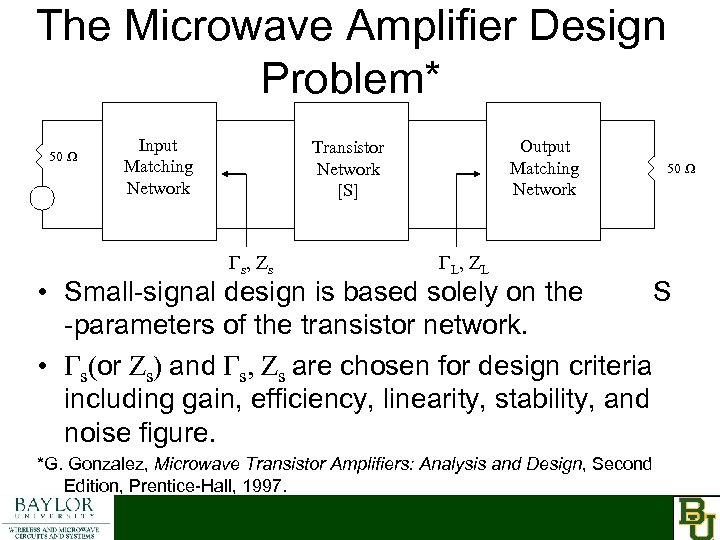 The Microwave Amplifier Design Problem* 50 Ω Input Matching Network Output Matching Network Transistor Network [S] Γs, Zs ΓL , Z L 50 Ω • Small-signal design is based solely on the S -parameters of the transistor network. • Γs(or Zs) and Γs, Zs are chosen for design criteria including gain, efficiency, linearity, stability, and noise figure. *G. Gonzalez, Microwave Transistor Amplifiers: Analysis and Design, Second Edition, Prentice-Hall, 1997.
 Small-Signal vs. Large-Signal • Small-Signal – We “bias” the device and then superimpose a very small ( 0) AC waveform. – Designs can be based on S-parameters of the active device. • Large-Signal – The AC signal on top of the DC bias cannot be considered of negligible amplitude. – Nonlinear models or measurements must be used to design.
 Small-Signal Design • Can be accomplished using linear network parameters. • The measurement is all you need! • Can calculate gain, noise figure, and stability as a function of – Device S-parameters – Source and load terminating impedances
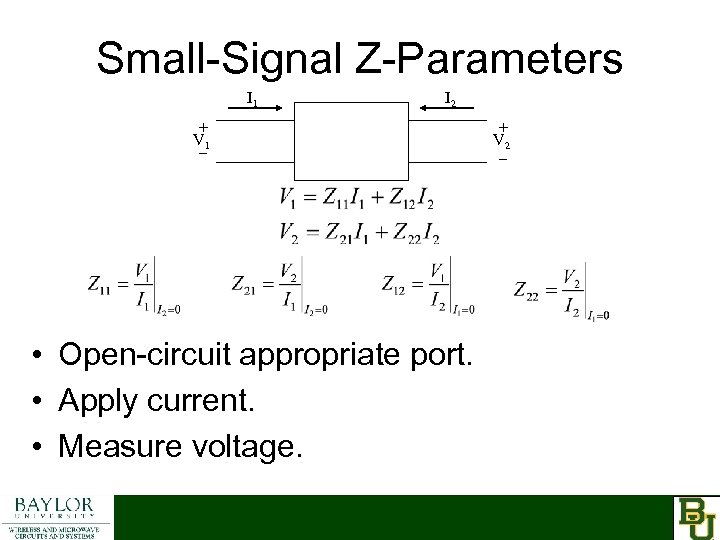 Small-Signal Z-Parameters I 1 I 2 + V 1 _ • Open-circuit appropriate port. • Apply current. • Measure voltage. + V 2 _
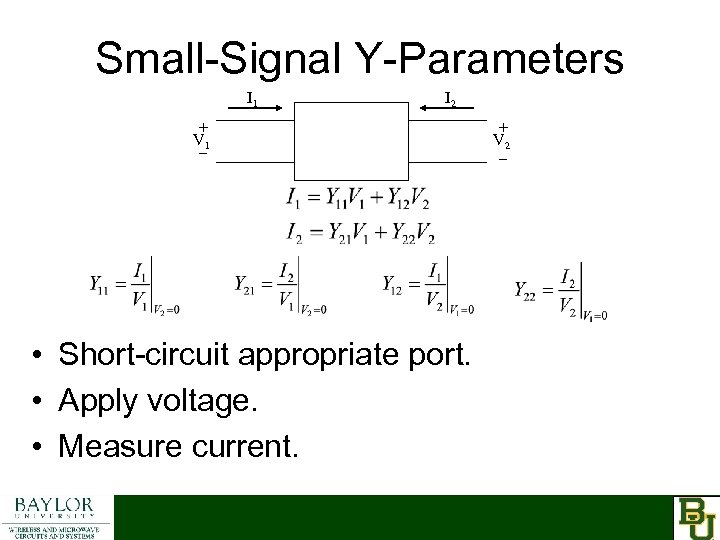 Small-Signal Y-Parameters I 1 I 2 + V 1 _ • Short-circuit appropriate port. • Apply voltage. • Measure current. + V 2 _
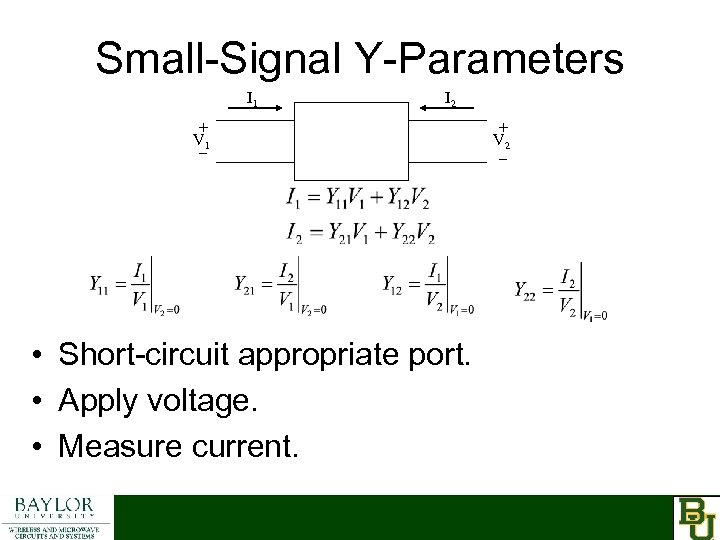 Small-Signal Y-Parameters I 1 I 2 + V 1 _ • Short-circuit appropriate port. • Apply voltage. • Measure current. + V 2 _
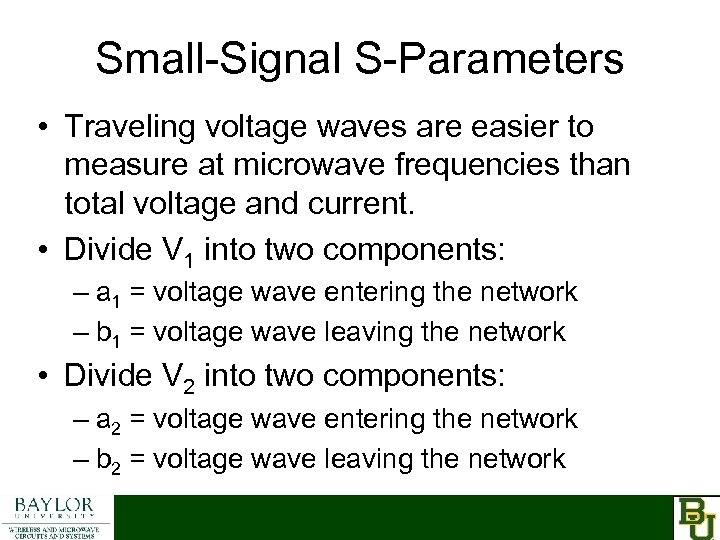 Small-Signal S-Parameters • Traveling voltage waves are easier to measure at microwave frequencies than total voltage and current. • Divide V 1 into two components: – a 1 = voltage wave entering the network – b 1 = voltage wave leaving the network • Divide V 2 into two components: – a 2 = voltage wave entering the network – b 2 = voltage wave leaving the network
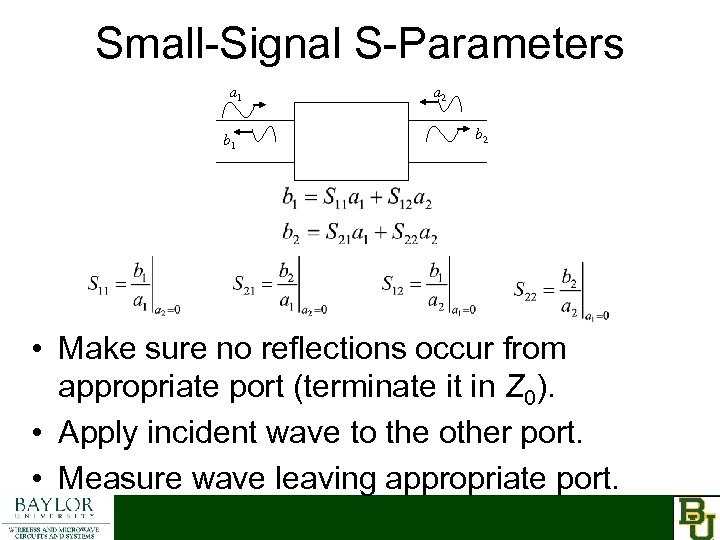 Small-Signal S-Parameters a 1 b 1 a 2 b 2 • Make sure no reflections occur from appropriate port (terminate it in Z 0). • Apply incident wave to the other port. • Measure wave leaving appropriate port.
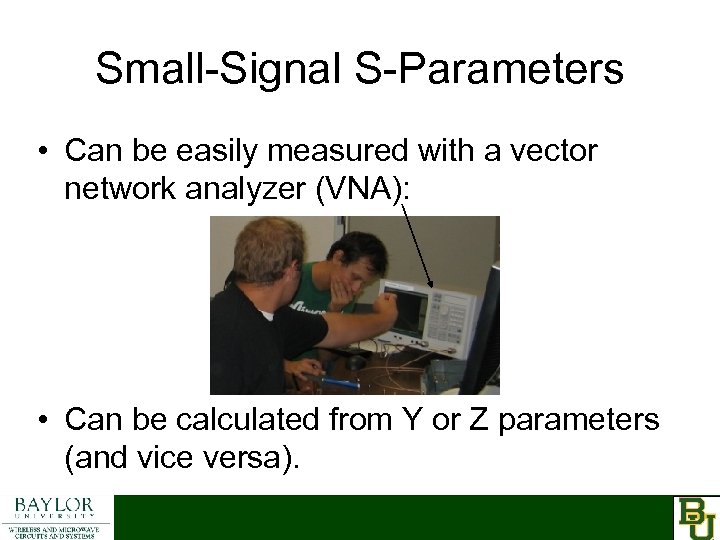 Small-Signal S-Parameters • Can be easily measured with a vector network analyzer (VNA): • Can be calculated from Y or Z parameters (and vice versa).
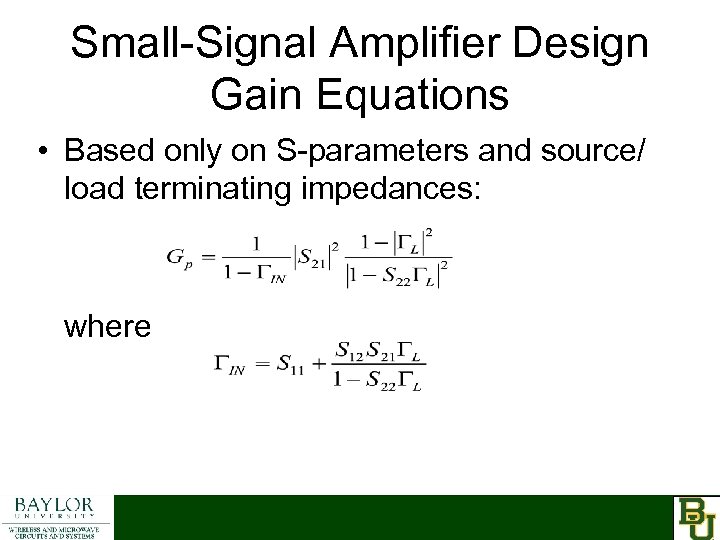 Small-Signal Amplifier Design Gain Equations • Based only on S-parameters and source/ load terminating impedances: where
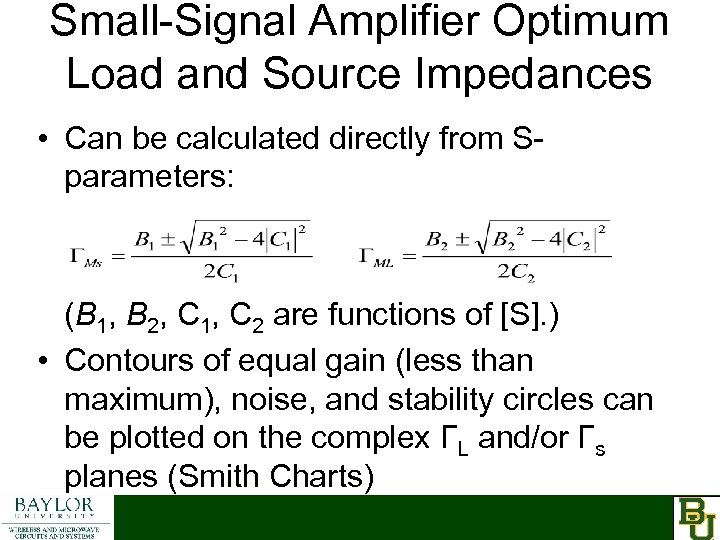 Small-Signal Amplifier Optimum Load and Source Impedances • Can be calculated directly from Sparameters: (B 1, B 2, C 1, C 2 are functions of [S]. ) • Contours of equal gain (less than maximum), noise, and stability circles can be plotted on the complex ΓL and/or Γs planes (Smith Charts)
 Large-Signal Amplifier Design • Without nonlinear network parameters, requires benchtop load pull or an accurate nonlinear transistor model. • Nonlinear transistor model extraction requires – Current-voltage measurement(s) – S-Parameters at multiple transistor bias points. – A skilled engineer to do the extraction (20 to 50 parameters!) – Load-pull measurements for validation • Is there a method analogous to the small-signal Sparameters using X-parameters that can predict largesignal gain? • TOI? ACPR? , etc.
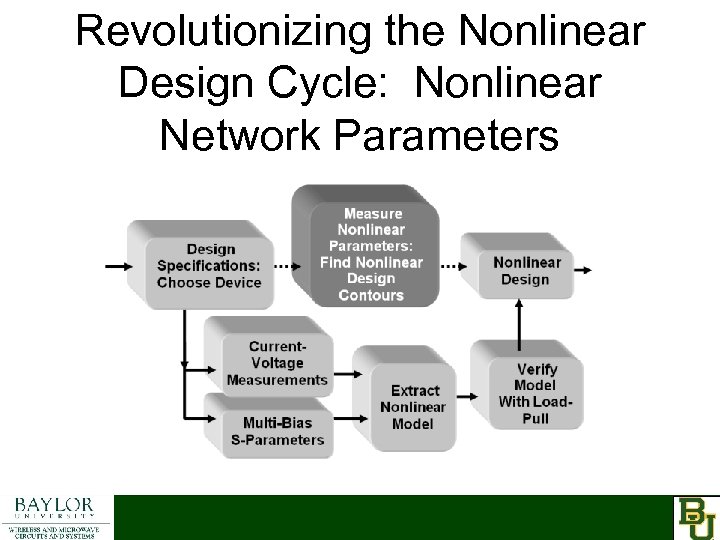 Revolutionizing the Nonlinear Design Cycle: Nonlinear Network Parameters
 Agilent X-Parameters* • Allow network characterization in a method similar to small-signal. • Measurements required: – Signal Magnitude (Input and Output) – Signal Phase (Input and Output) • Calibrations required: – Magnitude at fundamental and all harmonics – Phase at fundamental (can skip harmonics? ) *X-parameters is a registered trademark of Agilent Technologies.
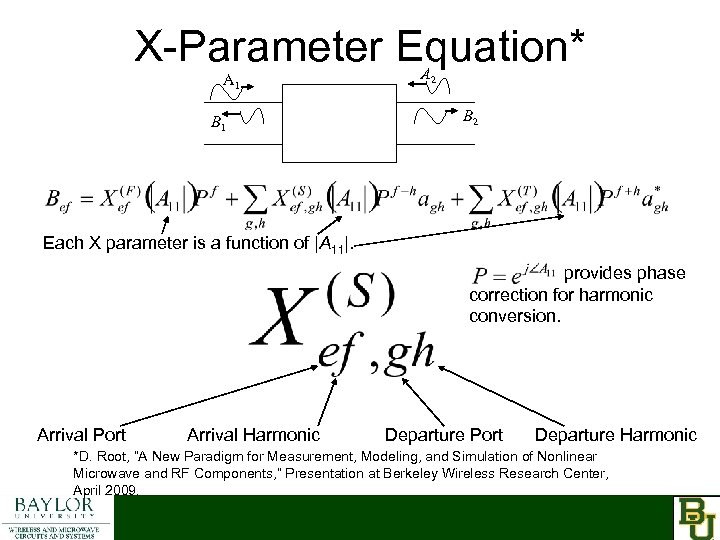 X-Parameter Equation* A 1 B 1 A 2 B 2 Each X parameter is a function of |A 11|. provides phase correction for harmonic conversion. Arrival Port Arrival Harmonic Departure Port Departure Harmonic *D. Root, “A New Paradigm for Measurement, Modeling, and Simulation of Nonlinear Microwave and RF Components, ” Presentation at Berkeley Wireless Research Center, April 2009.
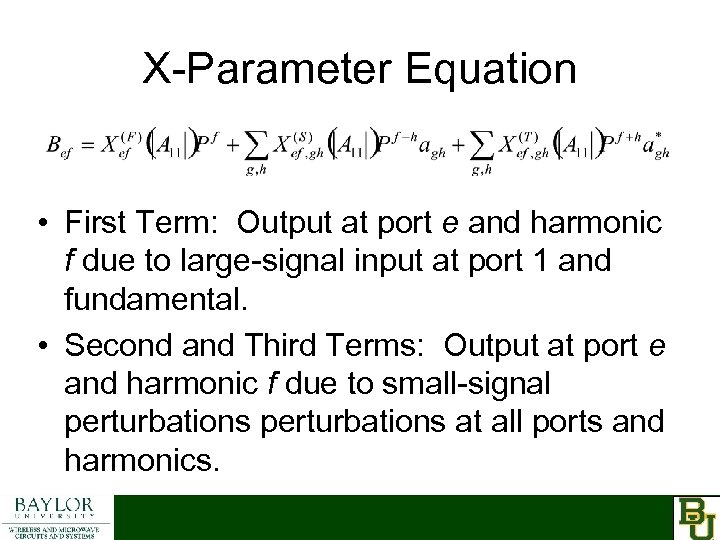 X-Parameter Equation • First Term: Output at port e and harmonic f due to large-signal input at port 1 and fundamental. • Second and Third Terms: Output at port e and harmonic f due to small-signal perturbations at all ports and harmonics.
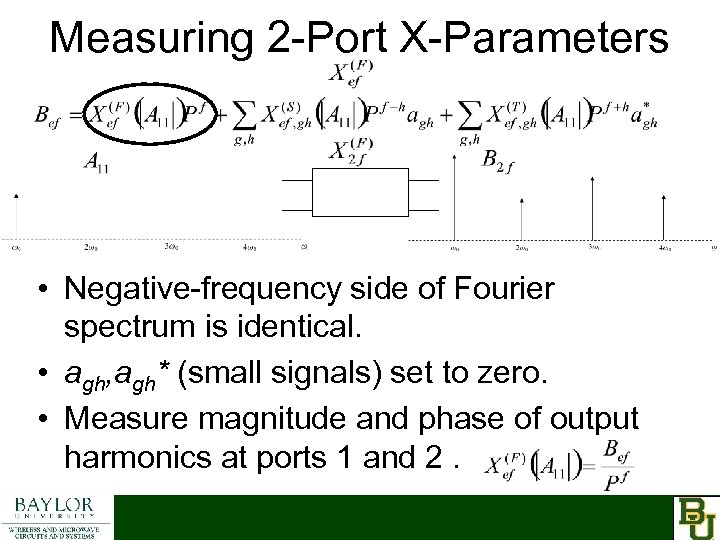 Measuring 2 -Port X-Parameters • Negative-frequency side of Fourier spectrum is identical. • agh, agh* (small signals) set to zero. • Measure magnitude and phase of output harmonics at ports 1 and 2.
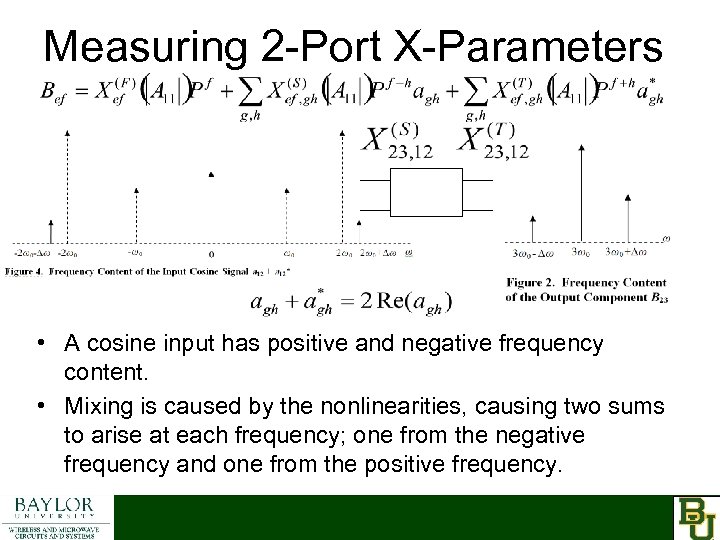 Measuring 2 -Port X-Parameters • A cosine input has positive and negative frequency content. • Mixing is caused by the nonlinearities, causing two sums to arise at each frequency; one from the negative frequency and one from the positive frequency.
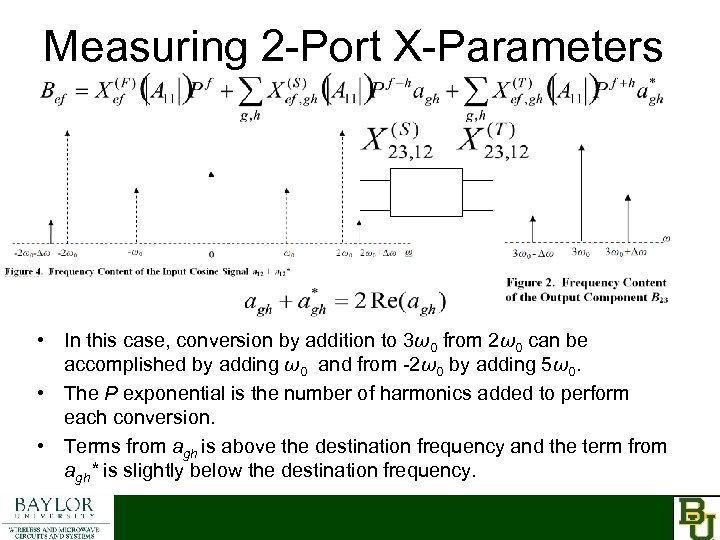 Measuring 2 -Port X-Parameters • In this case, conversion by addition to 3ω0 from 2ω0 can be accomplished by adding ω0 and from -2ω0 by adding 5ω0. • The P exponential is the number of harmonics added to perform each conversion. • Terms from agh is above the destination frequency and the term from agh* is slightly below the destination frequency.
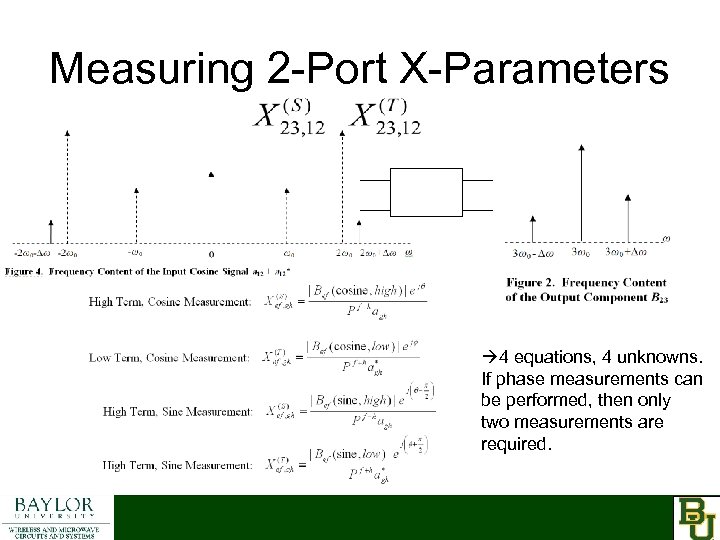 Measuring 2 -Port X-Parameters 4 equations, 4 unknowns. If phase measurements can be performed, then only two measurements are required.
 X-Parameters Research Topics • Nonlinear Amplifier Design Theory Paralleling the Linear Design Approach • Measurement • Using X-Parameters in Other Disciplines
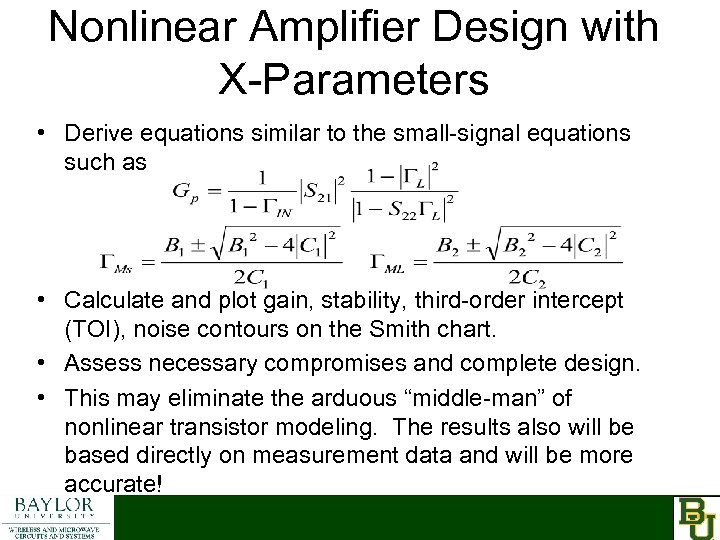 Nonlinear Amplifier Design with X-Parameters • Derive equations similar to the small-signal equations such as • Calculate and plot gain, stability, third-order intercept (TOI), noise contours on the Smith chart. • Assess necessary compromises and complete design. • This may eliminate the arduous “middle-man” of nonlinear transistor modeling. The results also will be based directly on measurement data and will be more accurate!
 Measurements • Typical measurements must be made with a nonlinear vector network analyzer (NVNA) such as the Agilent PNA -X (very expensive). • Can we measure without a NVNA? • Vector Signal Analyzer(s), Vector Signal Generator(s) needed for testing of these techniques. • Could create software routines to automate magnitude and phase calibration at fundamental and considered harmonics. • To allow a paradigm shift, measurements must be accessible.
 Using X-Parameters in Other Disciplines • Power Electronics – Total Harmonic Distortion – Characterizing unwanted nonlinearities. • “Smart” Systems for Clean Power Signals – Measure X-parameters of a system. – Apply appropriate signal predistortion or system correction to result in a clean signal. • Vibrations – Assess nonlinearities of a vibrational system. – Could this be applied to design?
 Conclusions • Nonlinear network functions may be able to revolutionize how nonlinear circuits (and possibly other types of systems) are designed. • Circuits may be designed directly from nonlinear measurement data; designs will rely less on nonlinear models. • Associated measurement techniques may save companies money, allowing the paradigm shift to occur. • Nonlinear network parameters seem to show promise of being useful in other interdisciplinary areas.
![References [1] Agilent Technologies, http: //www. home. agilent. com [2] M. S. Taci, I.](https://present5.com/presentation/ae416a4131f11b90cddd5de45727eab2/image-30.jpg "References [1] Agilent Technologies, http: //www. home. agilent. com [2] M. S. Taci, I.") References [1] Agilent Technologies, http: //www. home. agilent. com [2] M. S. Taci, I. Doseyen, and H. Gorgun, Determining the harmonic effects of nonlinear loads on parallel connected transformers in terms of power factor IEEE Power Quality '98 (IEEE), pp. 129 - 132 [3] M. S. Taci, I. Doseyen. Determining the harmonic components of nonlinear impedance loads in terms of resistances and reactances by using a current harmonic method. 9 th Mediterranean Electrotechnical Conference, 1998. MELECON 98. (IEEE), 18 -20 May 1998, Vol. 2, pp. 1000 – 1003 [4] G. Gonzalez, Microwave Transistor Amplifiers: Analysis and Design, Second Edition, Prentice-Hall, 1997. [5] Modelithics, Inc. , http: //www. modelithics. com. [6] Auriga Measurement Systems, LLC, http: //www. auriga-ms. com. [7] D. Schreurs, J. Verspecht, B. Nauwelaers, A. Van de Capelle, M. Van Rossum, “Direct Extraction of the Non-Linear Model for Two-Port Devices from Vectorial Non. Linear Network Analyzer Measurements, ” 27 th European Microwave Conference Digest, September 1997, pp. 921 -926. [8] D. Root, “A New Paradigm for Measurement, Modeling, and Simulation of Nonlinear Microwave and RF Components, ” Presentation at Berkeley Wireless Research Center, April 2009.
References [1] Agilent Technologies, http: //www. home. agilent. com [2] M. S. Taci, I. Doseyen, and H. Gorgun, Determining the harmonic effects of nonlinear loads on parallel connected transformers in terms of power factor IEEE Power Quality '98 (IEEE), pp. 129 - 132 [3] M. S. Taci, I. Doseyen. Determining the harmonic components of nonlinear impedance loads in terms of resistances and reactances by using a current harmonic method. 9 th Mediterranean Electrotechnical Conference, 1998. MELECON 98. (IEEE), 18 -20 May 1998, Vol. 2, pp. 1000 – 1003 [4] G. Gonzalez, Microwave Transistor Amplifiers: Analysis and Design, Second Edition, Prentice-Hall, 1997. [5] Modelithics, Inc. , http: //www. modelithics. com. [6] Auriga Measurement Systems, LLC, http: //www. auriga-ms. com. [7] D. Schreurs, J. Verspecht, B. Nauwelaers, A. Van de Capelle, M. Van Rossum, “Direct Extraction of the Non-Linear Model for Two-Port Devices from Vectorial Non. Linear Network Analyzer Measurements, ” 27 th European Microwave Conference Digest, September 1997, pp. 921 -926. [8] D. Root, “A New Paradigm for Measurement, Modeling, and Simulation of Nonlinear Microwave and RF Components, ” Presentation at Berkeley Wireless Research Center, April 2009.
![References (Continued) [9] J. Verspecht and D. Root, “Polyharmonic Distortion Modeling, ” IEEE Microwave](https://present5.com/presentation/ae416a4131f11b90cddd5de45727eab2/image-31.jpg "References (Continued) [9] J. Verspecht and D. Root, “Polyharmonic Distortion Modeling, ” IEEE Microwave") References (Continued) [9] J. Verspecht and D. Root, “Polyharmonic Distortion Modeling, ” IEEE Microwave Magazine, June 2006, pp. 44 -57. [10] D. Root, J. Verspecth, D. Sharrit, J. Wood, and A. Cognata, “Broad-Band Poly. Harmonic Distortion (PHD) Behavioral Models From Fast Automated Simulations and Large-Signal Vectorial Network Analyzer Measurements, ” IEEE Transactions on Microwave Theory and Techniques, Vol. 53, No. 11, pp. 3656 -3664, November 2005. [11] L. Betts, D. Gunyan, R. Pollard, C. Gillease, and D. Root, “Extension of XParameters to Include Long-Term Dynamic Memory Effects, ” 2009 International Microwave Symposium Digest, June 2009, pp. 741 -744. [12] C. Baylis, M. Moldovan, L. Wang, and J. Martin, “LINC Power Amplifiers for Reducing Out-of-Band Spectral Re-growth: A Comparative Study, ” 2010 IEEE Wireless and Microwave Technology Conference, Melbourne, Florida, April 2010. [13] J. de Graaf, H. Faust, J. Alatishe, and S. Talapatra, “Generation of Spectrally Confined Transmitted Radar Waveforms, ” Proceedings of the IEEE Conference on Radar, 2006, pp. 76 -83. [14] J. Horn, D. Gunyan, C. Betts, C. Gillease, J. Verspecht, and D. Root, “Measurement. Based Large-Signal Simulation of Active Components from Automated Nonlinear Vector Network Analyzer Data Via X-Parameters, ” 2008 IEEE International Conference on Microwaves, Communications, Antennas and Electronic Systems (COMCAS 2008), pp. 1 -6, May 2008.
References (Continued) [9] J. Verspecht and D. Root, “Polyharmonic Distortion Modeling, ” IEEE Microwave Magazine, June 2006, pp. 44 -57. [10] D. Root, J. Verspecth, D. Sharrit, J. Wood, and A. Cognata, “Broad-Band Poly. Harmonic Distortion (PHD) Behavioral Models From Fast Automated Simulations and Large-Signal Vectorial Network Analyzer Measurements, ” IEEE Transactions on Microwave Theory and Techniques, Vol. 53, No. 11, pp. 3656 -3664, November 2005. [11] L. Betts, D. Gunyan, R. Pollard, C. Gillease, and D. Root, “Extension of XParameters to Include Long-Term Dynamic Memory Effects, ” 2009 International Microwave Symposium Digest, June 2009, pp. 741 -744. [12] C. Baylis, M. Moldovan, L. Wang, and J. Martin, “LINC Power Amplifiers for Reducing Out-of-Band Spectral Re-growth: A Comparative Study, ” 2010 IEEE Wireless and Microwave Technology Conference, Melbourne, Florida, April 2010. [13] J. de Graaf, H. Faust, J. Alatishe, and S. Talapatra, “Generation of Spectrally Confined Transmitted Radar Waveforms, ” Proceedings of the IEEE Conference on Radar, 2006, pp. 76 -83. [14] J. Horn, D. Gunyan, C. Betts, C. Gillease, J. Verspecht, and D. Root, “Measurement. Based Large-Signal Simulation of Active Components from Automated Nonlinear Vector Network Analyzer Data Via X-Parameters, ” 2008 IEEE International Conference on Microwaves, Communications, Antennas and Electronic Systems (COMCAS 2008), pp. 1 -6, May 2008.