 Скачать презентацию x 86 Disassembler Internals 22 c 3 Private
93dbcc30905afdc67a23bbbf5aff6882.ppt
- Количество слайдов: 58



x 86 Disassembler Internals 22 c 3: Private Investigations December 2005 Richard Johnson | rjohnson@idefense. com
Welcome • Who am I? Richard Johnson Senior Security Engineer, i. DEFENSE Labs Other Research: nologin. org / uninformed. org • What is i. DEFENSE? • What is the purpose of this talk? – – Introduce the core components of a disassembler Refresh binary format parsing concepts Explore programmatic disassembly analysis methods Inspire the audience to take development of binary analysis tools a little further and explore the potential for automated disassembly analysis programs.
Agenda • Introduction • Disassember Core Architecture – Instruction Decoder • IA-32 – Executable Binary Format Parser • Executable and Linkable Format (ELF) • Portable Executable (PE) – Disassembly Analyzer • Basic Disassembly Analysis – Data Associations • Function Recognition • Cross-Referencing – Hinting • System Calls • Function Calls • Assembly Syntax – Demo (codis)
Agenda • Advanced Disassembly Analysis – Path Analysis • Loop Detection – Data Analysis • • Static data flow analysis Emulation Data Structure Recognition Demo (ida-x 86 emu + idastruct) • Conclusion
Introduction • Disassemblers decode machine language into human-readable mnemonics • Reverse-engineering in the software world makes use of a disassembler to understand an unknown or closed system. • Reverse-engineering has many applications – – Interoperability Copyright evasion Technology theft Software security
Introduction • The goal of reverse engineering is to gain a higher understanding of the machine readable code that is available. • The low-level disassembler is powerful, yet limited. Manual reverse-engineering is tedious. • Advanced disassemblers are capable of recognizing structures and relationships within binary code. – – Executable binary format handling Function recognition / argument detection Code and data cross-referencing Structure recognition
Disassembler Core Architecture
Disassembler Core Architecture • The core function of a disassembler is to interpret executable files and decode their instructions. • The instruction decoder translates compiled binary instructions back into mnemonics as defined by the architecture's reference manuals. • The executable file parsers are each designed to extract useful information from various executable binary formats.
IA-32 Instruction Decoding • The IA-32 processor is considered to be a CISC architecture. The instruction set includes many operands which do similar things or combine multiple operations into one instruction. • RISC architectures have far fewer opcodes and simpler opcode lookup algorithms • IA-32 has variable length opcodes and opcode extensions, which results in a larger set of tables for opcode and operand decoding.
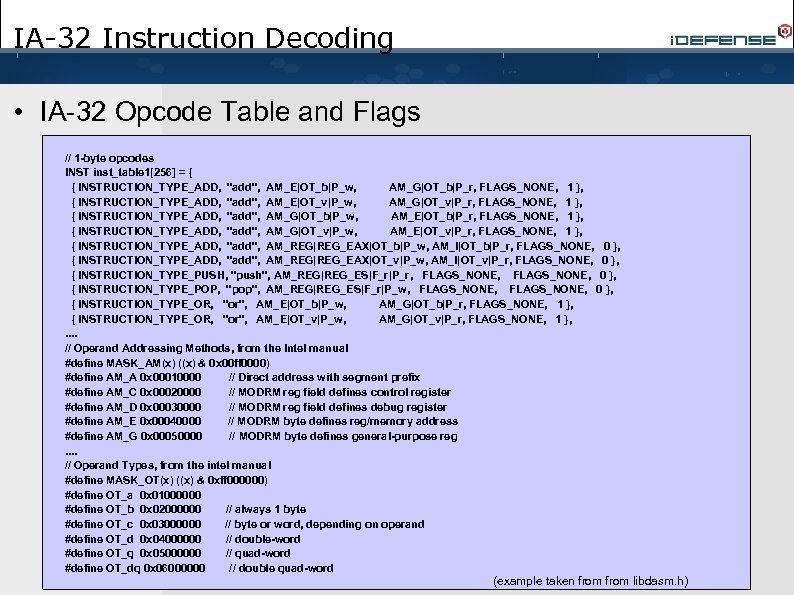
IA-32 Instruction Decoding • IA-32 Opcode Table and Flags // 1 -byte opcodes INST inst_table 1[256] = { { INSTRUCTION_TYPE_ADD, "add", AM_E|OT_b|P_w, AM_G|OT_b|P_r, FLAGS_NONE, 1 }, { INSTRUCTION_TYPE_ADD, "add", AM_E|OT_v|P_w, AM_G|OT_v|P_r, FLAGS_NONE, 1 }, { INSTRUCTION_TYPE_ADD, "add", AM_G|OT_b|P_w, AM_E|OT_b|P_r, FLAGS_NONE, 1 }, { INSTRUCTION_TYPE_ADD, "add", AM_G|OT_v|P_w, AM_E|OT_v|P_r, FLAGS_NONE, 1 }, { INSTRUCTION_TYPE_ADD, "add", AM_REG|REG_EAX|OT_b|P_w, AM_I|OT_b|P_r, FLAGS_NONE, 0 }, { INSTRUCTION_TYPE_ADD, "add", AM_REG|REG_EAX|OT_v|P_w, AM_I|OT_v|P_r, FLAGS_NONE, 0 }, { INSTRUCTION_TYPE_PUSH, "push", AM_REG|REG_ES|F_r|P_r, FLAGS_NONE, 0 }, { INSTRUCTION_TYPE_POP, "pop", AM_REG|REG_ES|F_r|P_w, FLAGS_NONE, 0 }, { INSTRUCTION_TYPE_OR, "or", AM_E|OT_b|P_w, AM_G|OT_b|P_r, FLAGS_NONE, 1 }, { INSTRUCTION_TYPE_OR, "or", AM_E|OT_v|P_w, AM_G|OT_v|P_r, FLAGS_NONE, 1 }, . . // Operand Addressing Methods, from the Intel manual #define MASK_AM(x) ((x) & 0 x 00 ff 0000) #define AM_A 0 x 00010000 // Direct address with segment prefix #define AM_C 0 x 00020000 // MODRM reg field defines control register #define AM_D 0 x 00030000 // MODRM reg field defines debug register #define AM_E 0 x 00040000 // MODRM byte defines reg/memory address #define AM_G 0 x 00050000 // MODRM byte defines general-purpose reg. . // Operand Types, from the intel manual #define MASK_OT(x) ((x) & 0 xff 000000) #define OT_a 0 x 01000000 #define OT_b 0 x 02000000 // always 1 byte #define OT_c 0 x 03000000 // byte or word, depending on operand #define OT_d 0 x 04000000 // double-word #define OT_q 0 x 05000000 // quad-word #define OT_dq 0 x 06000000 // double quad-word (example taken from libdasm. h)
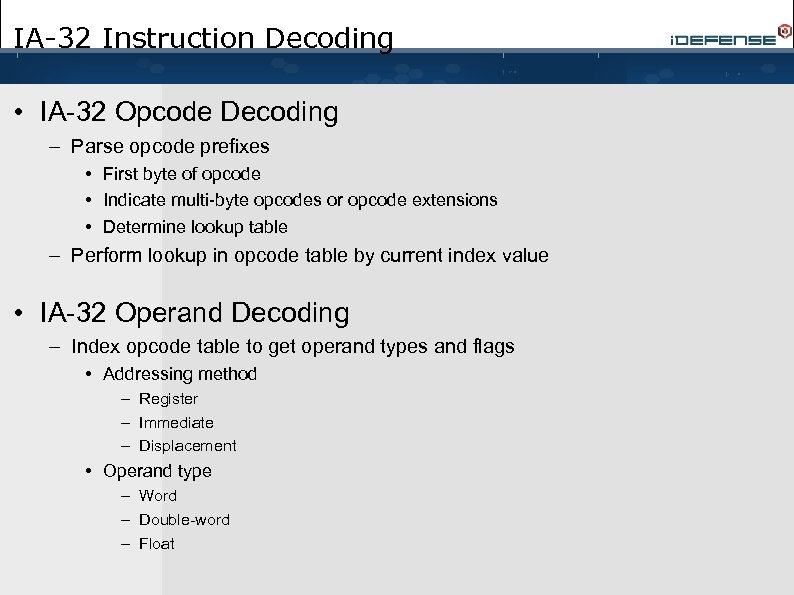
IA-32 Instruction Decoding • IA-32 Opcode Decoding – Parse opcode prefixes • First byte of opcode • Indicate multi-byte opcodes or opcode extensions • Determine lookup table – Perform lookup in opcode table by current index value • IA-32 Operand Decoding – Index opcode table to get operand types and flags • Addressing method – Register – Immediate – Displacement • Operand type – Word – Double-word – Float
Executable Binary Formats • Executable binary formats instruct an operating system how to initialize the required environment for an executable and how to place the binary in memory for execution. • The kernel is responsible for: – – Creating a new task Loading a binary into memory Loading a binary's interpreter Transferring control to the new task • The kernel understands the binary as a series of memory segments.
Executable Binary Formats • Most binaries are dynamically linked • Execution control is transferred to the linker rather than the executable's entry point. • The linker is responsible for: – Library loading – Symbol relocation – Symbol resolution • The linker interprets the binary as a series of sections with special run-time purposes.
Executable and Linkable Format (ELF) • Executable and Linkable Format – Originally introduced in UNIX SVR 4 in 1989 and is now used in Linux and most System V derivatives like Solaris, IRIX, Free. BSD and HP-UX – Official reference: ELF Portable Formats Specification, Version 1. 1 Tool Interface Standards (TIS) • Contains important information for binary analysis including section headers, symbol tables, string tables, dynamic linking information.
Executable and Linkable Format (ELF) • ELF Objects – Header info • ELF Header – Details how to access headers within the object and identifies the executable's properties • Section Header Table – Details how to access various sections in the file (linker) • Program Header Table – Details how to load the executable into memory (kernel) – Object Code – Relocation info – Symbols • . symtab – Contains information about all symbols being defined or imported (not present if binary is stripped) • . dynsym – Contains information about external symbols that need to be resolved or dynamic symbols that are exported by the binary
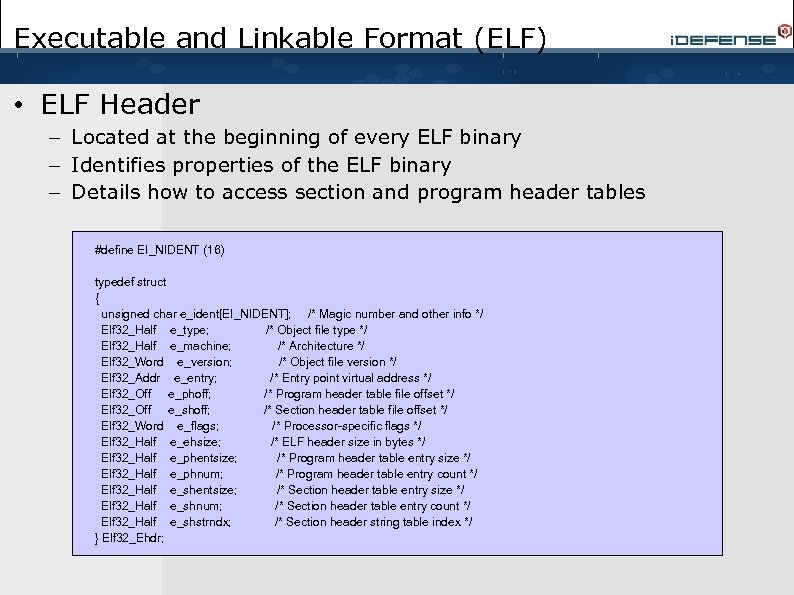
Executable and Linkable Format (ELF) • ELF Header – Located at the beginning of every ELF binary – Identifies properties of the ELF binary – Details how to access section and program header tables #define EI_NIDENT (16) typedef struct { unsigned char e_ident[EI_NIDENT]; /* Magic number and other info */ Elf 32_Half e_type; /* Object file type */ Elf 32_Half e_machine; /* Architecture */ Elf 32_Word e_version; /* Object file version */ Elf 32_Addr e_entry; /* Entry point virtual address */ Elf 32_Off e_phoff; /* Program header table file offset */ Elf 32_Off e_shoff; /* Section header table file offset */ Elf 32_Word e_flags; /* Processor-specific flags */ Elf 32_Half e_ehsize; /* ELF header size in bytes */ Elf 32_Half e_phentsize; /* Program header table entry size */ Elf 32_Half e_phnum; /* Program header table entry count */ Elf 32_Half e_shentsize; /* Section header table entry size */ Elf 32_Half e_shnum; /* Section header table entry count */ Elf 32_Half e_shstrndx; /* Section header string table index */ } Elf 32_Ehdr;
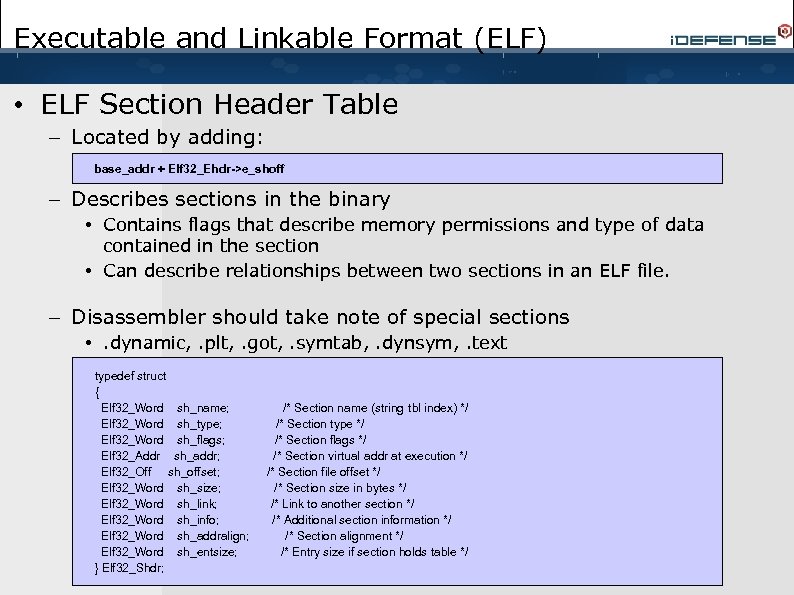
Executable and Linkable Format (ELF) • ELF Section Header Table – Located by adding: » base_addr + Elf 32_Ehdr->e_shoff – Describes sections in the binary • Contains flags that describe memory permissions and type of data contained in the section • Can describe relationships between two sections in an ELF file. – Disassembler should take note of special sections • . dynamic, . plt, . got, . symtab, . dynsym, . text typedef struct { Elf 32_Word sh_name; Elf 32_Word sh_type; Elf 32_Word sh_flags; Elf 32_Addr sh_addr; Elf 32_Off sh_offset; Elf 32_Word sh_size; Elf 32_Word sh_link; Elf 32_Word sh_info; Elf 32_Word sh_addralign; Elf 32_Word sh_entsize; } Elf 32_Shdr; /* Section name (string tbl index) */ /* Section type */ /* Section flags */ /* Section virtual addr at execution */ /* Section file offset */ /* Section size in bytes */ /* Link to another section */ /* Additional section information */ /* Section alignment */ /* Entry size if section holds table */
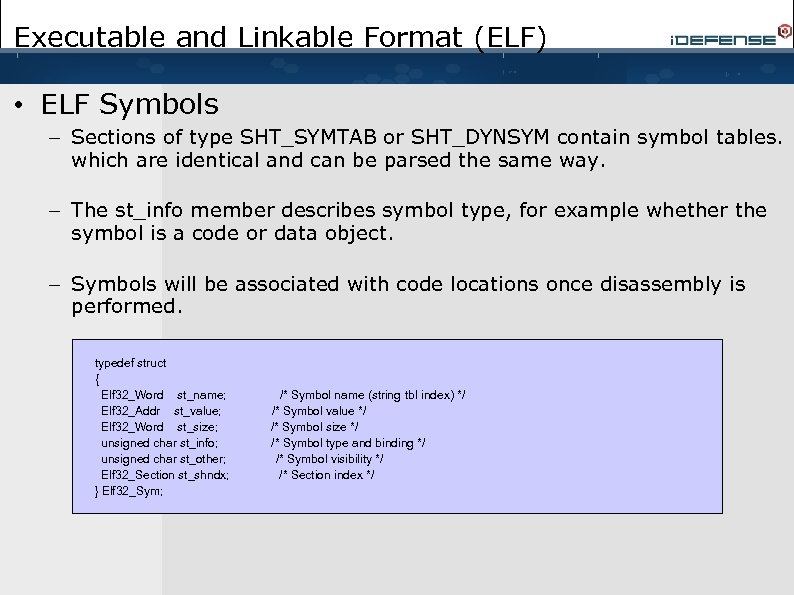
Executable and Linkable Format (ELF) • ELF Symbols – Sections of type SHT_SYMTAB or SHT_DYNSYM contain symbol tables. which are identical and can be parsed the same way. – The st_info member describes symbol type, for example whether the symbol is a code or data object. – Symbols will be associated with code locations once disassembly is performed. typedef struct { Elf 32_Word st_name; Elf 32_Addr st_value; Elf 32_Word st_size; unsigned char st_info; unsigned char st_other; Elf 32_Section st_shndx; } Elf 32_Sym; /* Symbol name (string tbl index) */ /* Symbol value */ /* Symbol size */ /* Symbol type and binding */ /* Symbol visibility */ /* Section index */
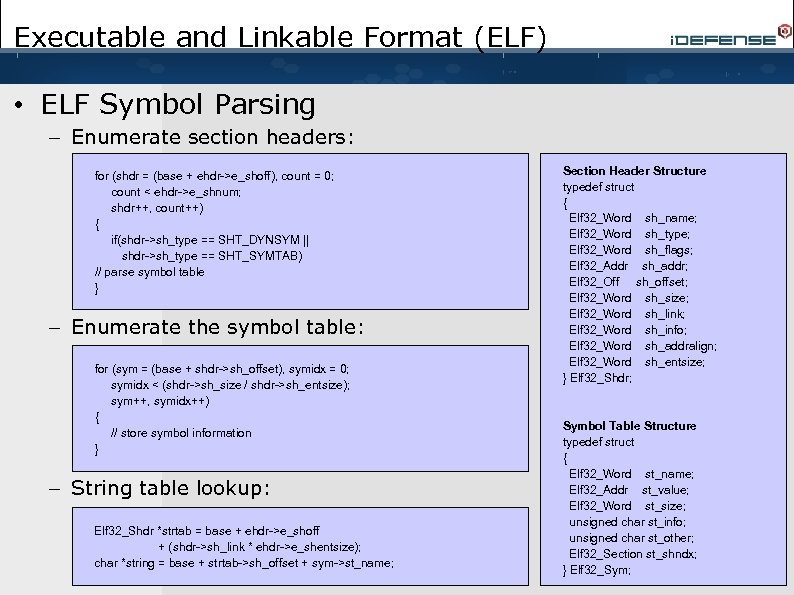
Executable and Linkable Format (ELF) • ELF Symbol Parsing – Enumerate section headers: for (shdr = (base + ehdr->e_shoff), count = 0; count < ehdr->e_shnum; shdr++, count++) { if(shdr->sh_type == SHT_DYNSYM || shdr->sh_type == SHT_SYMTAB) // parse symbol table } – Enumerate the symbol table: for (sym = (base + shdr->sh_offset), symidx = 0; symidx < (shdr->sh_size / shdr->sh_entsize); – sym++, symidx++) { // store symbol information } – String table lookup: Elf 32_Shdr *strtab = base + ehdr->e_shoff + (shdr->sh_link * ehdr->e_shentsize); char *string = base + strtab->sh_offset + sym->st_name; Section Header Structure typedef struct { Elf 32_Word sh_name; Elf 32_Word sh_type; Elf 32_Word sh_flags; Elf 32_Addr sh_addr; Elf 32_Off sh_offset; Elf 32_Word sh_size; Elf 32_Word sh_link; Elf 32_Word sh_info; Elf 32_Word sh_addralign; Elf 32_Word sh_entsize; } Elf 32_Shdr; Symbol Table Structure typedef struct { Elf 32_Word st_name; Elf 32_Addr st_value; Elf 32_Word st_size; unsigned char st_info; unsigned char st_other; Elf 32_Section st_shndx; } Elf 32_Sym;
Portable Executable Format (PE/COFF) • Portable Executable and Common Object File Format – – Originally introduced as part of the Win 32 specification Derived from DEC's Common Object File Format (COFF) Object files are generated as COFF and later linked as PE binaries Offical reference: Microsoft Portable Executable and Common Object File Format Specification Microsoft Corporation Revision 6. 0 - February 1999
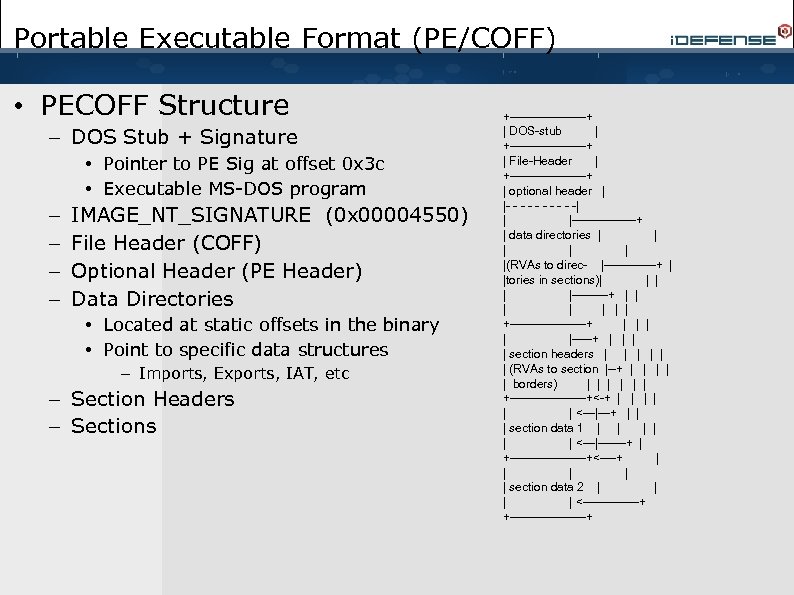
Portable Executable Format (PE/COFF) • PECOFF Structure – DOS Stub + Signature • Pointer to PE Sig at offset 0 x 3 c • Executable MS-DOS program – – IMAGE_NT_SIGNATURE (0 x 00004550) File Header (COFF) Optional Header (PE Header) Data Directories • Located at static offsets in the binary • Point to specific data structures – Imports, Exports, IAT, etc – Section Headers – Sections +----------+ | DOS-stub | +----------+ | File-Header | +----------+ | optional header | |- - -| | |--------+ | data directories | | |(RVAs to direc- |-------+ | |tories in sections)| | |-----+ | | | | +----------+ | | |-----+ | | section headers | | | (RVAs to section |--+ | | | borders) | | | +----------+<-+ | | | <---|---+ | | | section data 1 | | | <---|-------+ | +----------+<----+ | | | section data 2 | | <-------+ +----------+
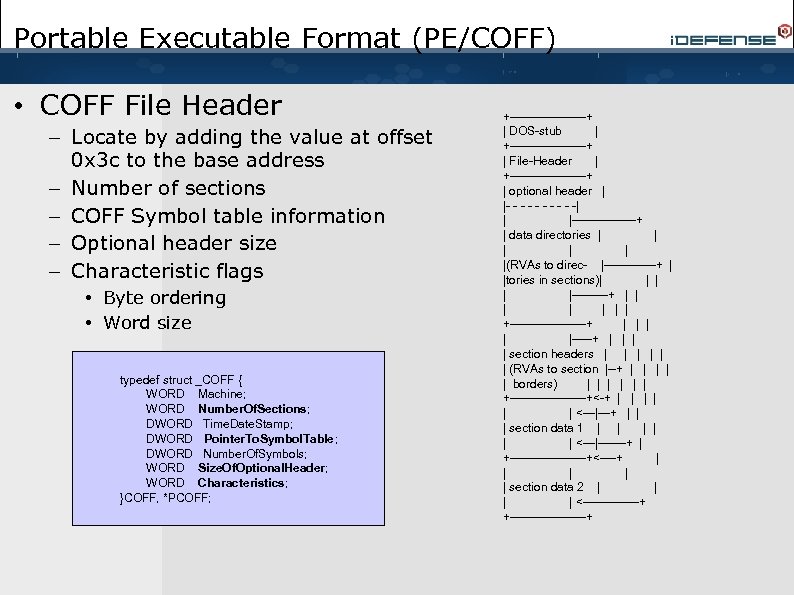
Portable Executable Format (PE/COFF) • COFF File Header – Locate by adding the value at offset 0 x 3 c to the base address – Number of sections – COFF Symbol table information – Optional header size – Characteristic flags • Byte ordering • Word size typedef struct _COFF { WORD Machine; WORD Number. Of. Sections; DWORD Time. Date. Stamp; DWORD Pointer. To. Symbol. Table; DWORD Number. Of. Symbols; WORD Size. Of. Optional. Header; WORD Characteristics; }COFF, *PCOFF; +----------+ | DOS-stub | +----------+ | File-Header | +----------+ | optional header | |- - -| | |--------+ | data directories | | |(RVAs to direc- |-------+ | |tories in sections)| | |-----+ | | | | +----------+ | | |-----+ | | section headers | | | (RVAs to section |--+ | | | borders) | | | +----------+<-+ | | | <---|---+ | | | section data 1 | | | <---|-------+ | +----------+<----+ | | | section data 2 | | <-------+ +----------+
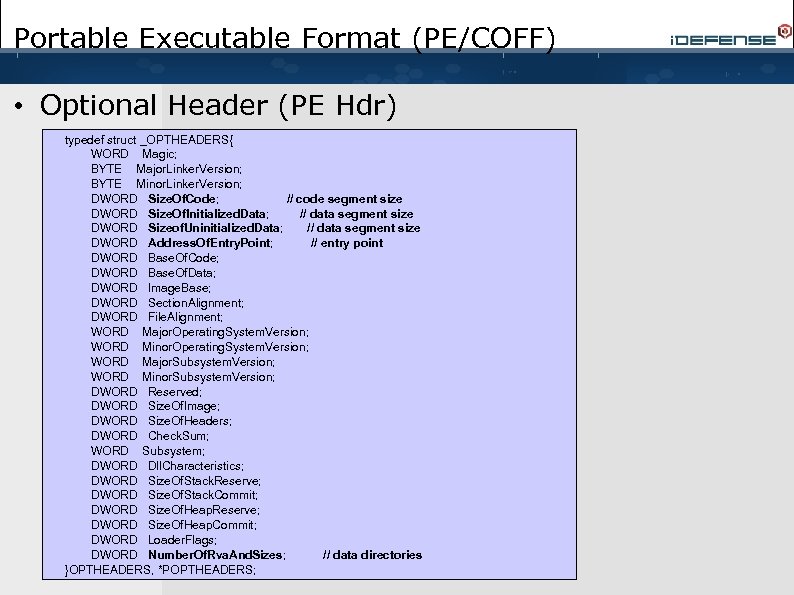
Portable Executable Format (PE/COFF) • Optional Header (PE Hdr) typedef struct _OPTHEADERS{ WORD Magic; BYTE Major. Linker. Version; BYTE Minor. Linker. Version; DWORD Size. Of. Code; // code segment size DWORD Size. Of. Initialized. Data; // data segment size DWORD Sizeof. Uninitialized. Data; // data segment size DWORD Address. Of. Entry. Point; // entry point DWORD Base. Of. Code; DWORD Base. Of. Data; DWORD Image. Base; DWORD Section. Alignment; DWORD File. Alignment; WORD Major. Operating. System. Version; WORD Minor. Operating. System. Version; WORD Major. Subsystem. Version; WORD Minor. Subsystem. Version; DWORD Reserved; DWORD Size. Of. Image; DWORD Size. Of. Headers; DWORD Check. Sum; WORD Subsystem; DWORD Dll. Characteristics; DWORD Size. Of. Stack. Reserve; DWORD Size. Of. Stack. Commit; DWORD Size. Of. Heap. Reserve; DWORD Size. Of. Heap. Commit; DWORD Loader. Flags; DWORD Number. Of. Rva. And. Sizes; // data directories }OPTHEADERS, *POPTHEADERS;
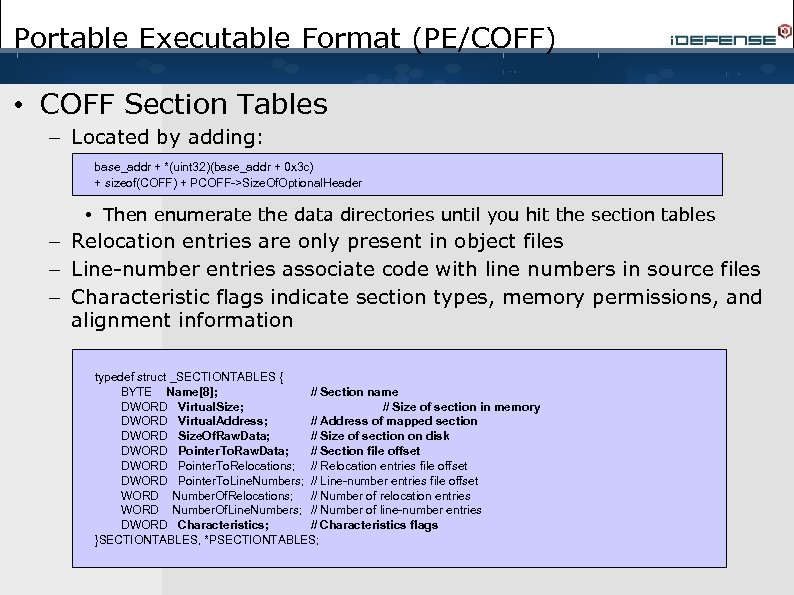
Portable Executable Format (PE/COFF) • COFF Section Tables – Located by adding: base_addr + *(uint 32)(base_addr + 0 x 3 c) + sizeof(COFF) + PCOFF->Size. Of. Optional. Header • Then enumerate the data directories until you hit the section tables – Relocation entries are only present in object files – Line-number entries associate code with line numbers in source files – Characteristic flags indicate section types, memory permissions, and alignment information typedef struct _SECTIONTABLES { BYTE Name[8]; // Section name DWORD Virtual. Size; // Size of section in memory DWORD Virtual. Address; // Address of mapped section DWORD Size. Of. Raw. Data; // Size of section on disk DWORD Pointer. To. Raw. Data; // Section file offset DWORD Pointer. To. Relocations; // Relocation entries file offset DWORD Pointer. To. Line. Numbers; // Line-number entries file offset WORD Number. Of. Relocations; // Number of relocation entries WORD Number. Of. Line. Numbers; // Number of line-number entries DWORD Characteristics; // Characteristics flags }SECTIONTABLES, *PSECTIONTABLES;
![Portable Executable Format (PE/COFF) • PECOFF Symbols – Data_Directory[1] – Import Directory • .](https://present5.com/presentation/93dbcc30905afdc67a23bbbf5aff6882/image-25.jpg "Portable Executable Format (PE/COFF) • PECOFF Symbols – Data_Directory[1] – Import Directory • .")
Portable Executable Format (PE/COFF) • PECOFF Symbols – Data_Directory[1] – Import Directory • . idata section – Import Directory entries describe DLLs • DLL Name • RVA of Import Lookup Table • RVA of Import Address Table – Image Thunk Data • Table of structures describing functions to be imported from the module typedef struct _IMAGE_IMPORT_DESCRIPTOR { union { DWORD Characteristics; PIMAGE_THUNK_DATA Original. First. Thunk; } DUMMYUNIONNAME; DWORD Time. Date. Stamp; DWORD Forwarder. Chain; DWORD Name; PIMAGE_THUNK_DATA First. Thunk; } IMAGE_IMPORT_DESCRIPTOR, *PIMAGE_IMPORT_DESCRIPTOR;
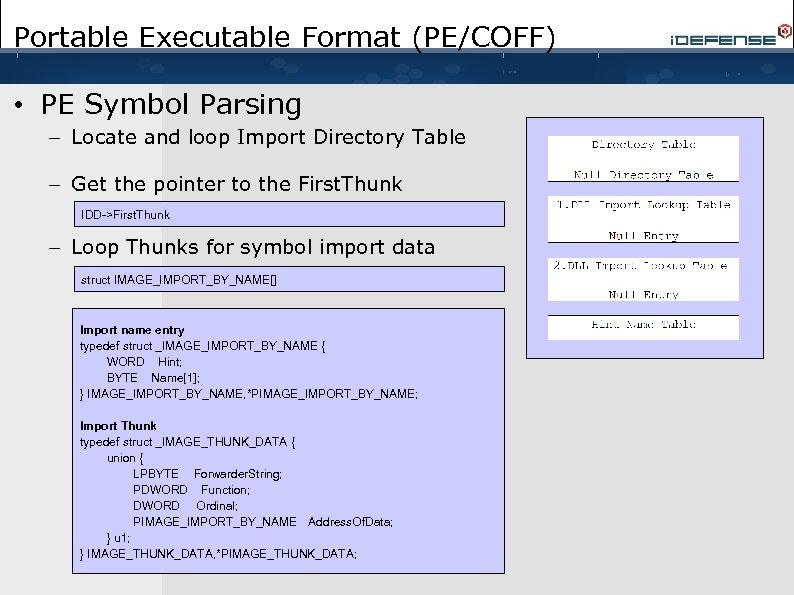
Portable Executable Format (PE/COFF) • PE Symbol Parsing – Locate and loop Import Directory Table – Get the pointer to the First. Thunk IDD->First. Thunk – Loop Thunks for symbol import data struct IMAGE_IMPORT_BY_NAME[] Import name entry typedef struct _IMAGE_IMPORT_BY_NAME { WORD Hint; BYTE Name[1]; } IMAGE_IMPORT_BY_NAME, *PIMAGE_IMPORT_BY_NAME; Import Thunk typedef struct _IMAGE_THUNK_DATA { union { LPBYTE Forwarder. String; PDWORD Function; DWORD Ordinal; PIMAGE_IMPORT_BY_NAME Address. Of. Data; } u 1; } IMAGE_THUNK_DATA, *PIMAGE_THUNK_DATA;
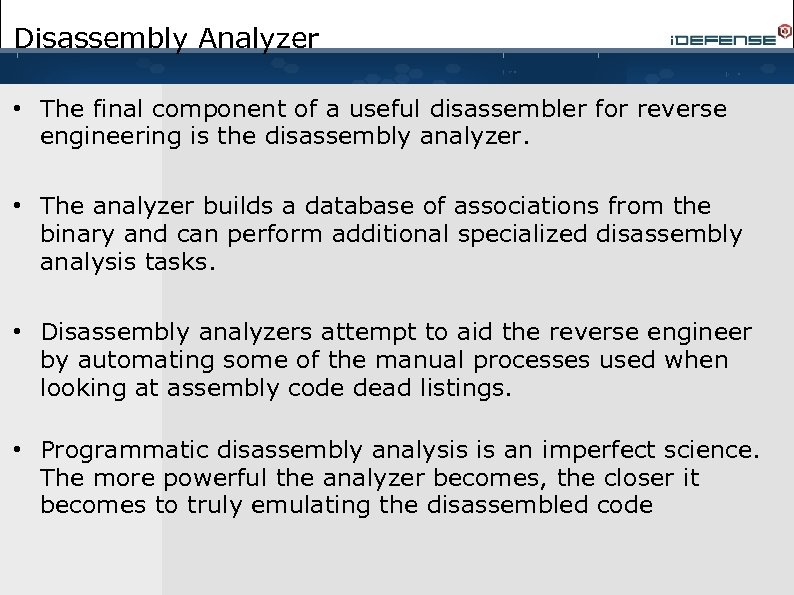
Disassembly Analyzer • The final component of a useful disassembler for reverse engineering is the disassembly analyzer. • The analyzer builds a database of associations from the binary and can perform additional specialized disassembly analysis tasks. • Disassembly analyzers attempt to aid the reverse engineer by automating some of the manual processes used when looking at assembly code dead listings. • Programmatic disassembly analysis is an imperfect science. The more powerful the analyzer becomes, the closer it becomes to truly emulating the disassembled code
Disassembly Analysis
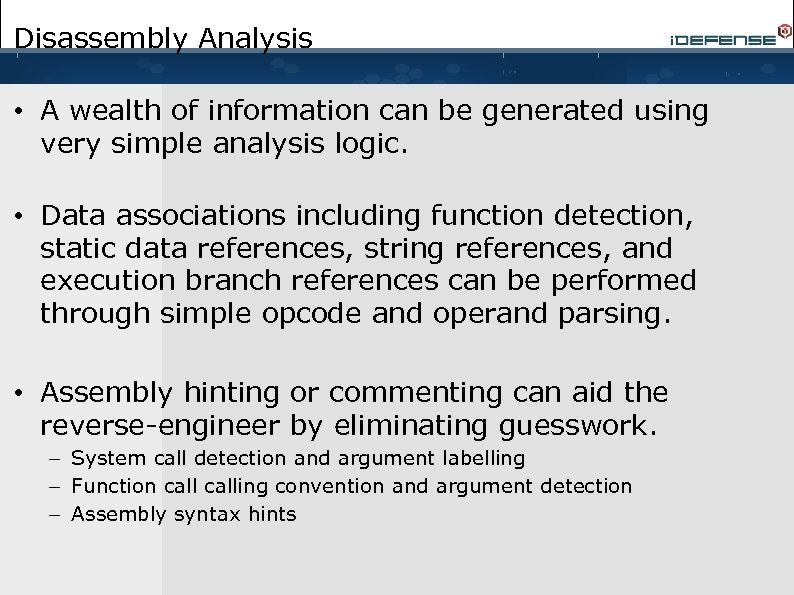
Disassembly Analysis • A wealth of information can be generated using very simple analysis logic. • Data associations including function detection, static data references, string references, and execution branch references can be performed through simple opcode and operand parsing. • Assembly hinting or commenting can aid the reverse-engineer by eliminating guesswork. – System call detection and argument labelling – Function calling convention and argument detection – Assembly syntax hints
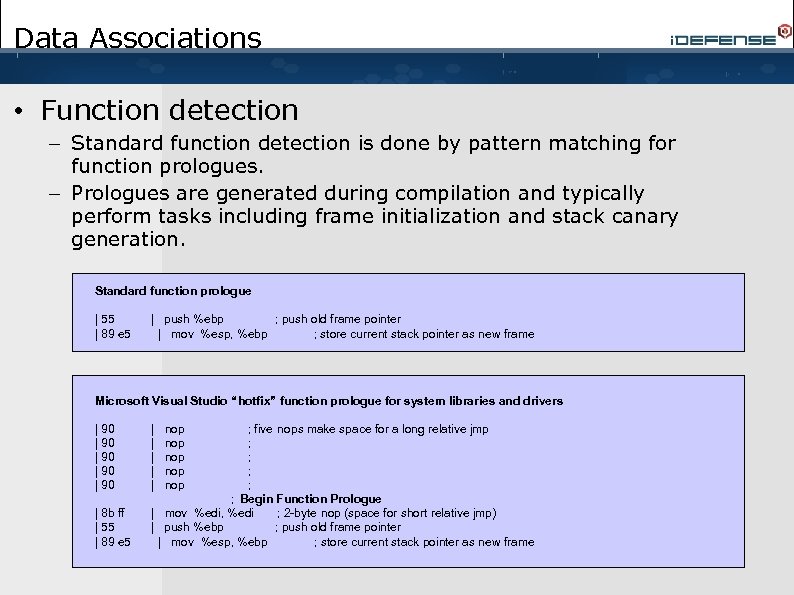
Data Associations • Function detection – Standard function detection is done by pattern matching for function prologues. – Prologues are generated during compilation and typically perform tasks including frame initialization and stack canary generation. Standard function prologue | 55 | 89 e 5 | push %ebp ; push old frame pointer | mov %esp, %ebp ; store current stack pointer as new frame Microsoft Visual Studio “hotfix” function prologue for system libraries and drivers | 90 | 90 | 8 b ff | 55 | 89 e 5 | | | nop nop nop ; five nops make space for a long relative jmp ; ; ; Begin Function Prologue | mov %edi, %edi ; 2 -byte nop (space for short relative jmp) | push %ebp ; push old frame pointer | mov %esp, %ebp ; store current stack pointer as new frame
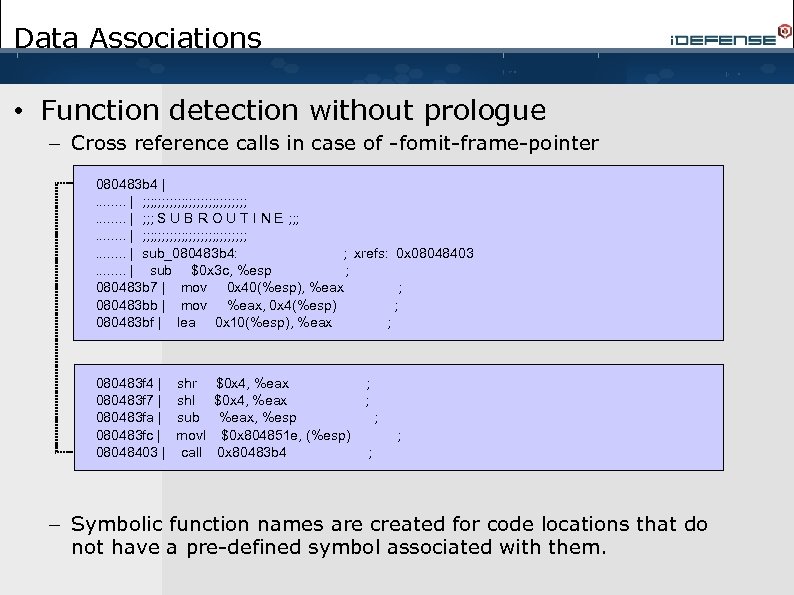
Data Associations • Function detection without prologue – Cross reference calls in case of -fomit-frame-pointer 080483 b 4 |. . . . | ; ; ; ; ; ; ; . . . . | ; ; ; S U B R O U T I N E ; ; ; . . . . | ; ; ; ; ; ; ; . . . . | sub_080483 b 4: ; xrefs: 0 x 08048403. . . . | sub $0 x 3 c, %esp ; 080483 b 7 | mov 0 x 40(%esp), %eax ; 080483 bb | mov %eax, 0 x 4(%esp) ; 080483 bf | lea 0 x 10(%esp), %eax ; 080483 f 4 | 080483 f 7 | 080483 fa | 080483 fc | 08048403 | shr shl sub movl call $0 x 4, %eax, %esp $0 x 804851 e, (%esp) 0 x 80483 b 4 ; ; ; – Symbolic function names are created for code locations that do not have a pre-defined symbol associated with them.
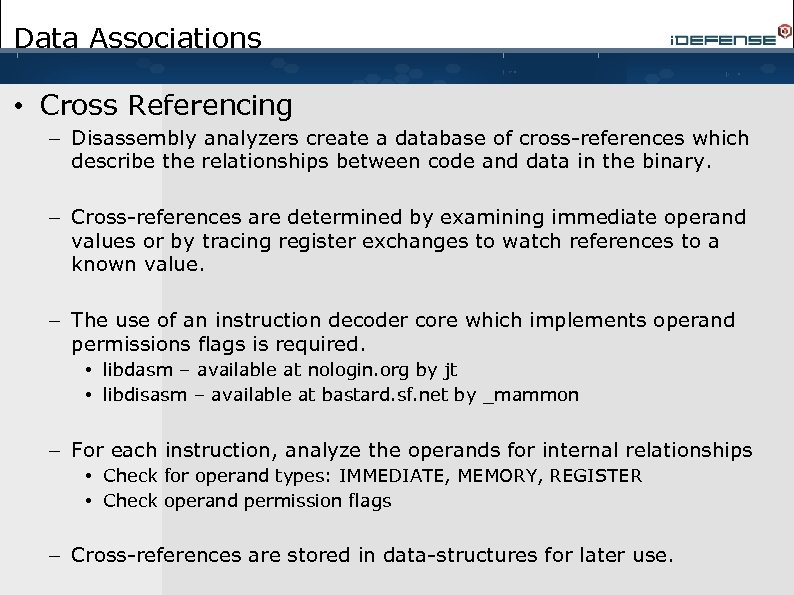
Data Associations • Cross Referencing – Disassembly analyzers create a database of cross-references which describe the relationships between code and data in the binary. – Cross-references are determined by examining immediate operand values or by tracing register exchanges to watch references to a known value. – The use of an instruction decoder core which implements operand permissions flags is required. • libdasm – available at nologin. org by jt • libdisasm – available at bastard. sf. net by _mammon – For each instruction, analyze the operands for internal relationships • Check for operand types: IMMEDIATE, MEMORY, REGISTER • Check operand permission flags – Cross-references are stored in data-structures for later use.
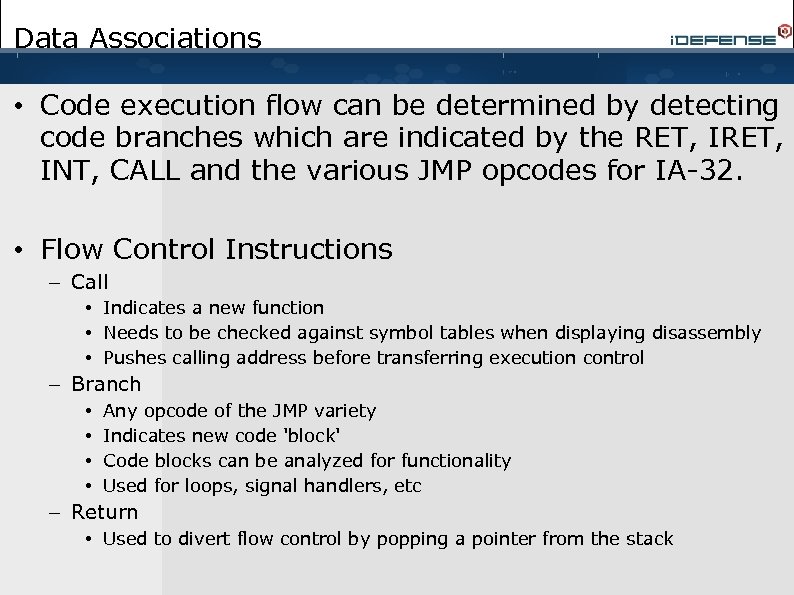
Data Associations • Code execution flow can be determined by detecting code branches which are indicated by the RET, INT, CALL and the various JMP opcodes for IA-32. • Flow Control Instructions – Call • Indicates a new function • Needs to be checked against symbol tables when displaying disassembly • Pushes calling address before transferring execution control – Branch • • Any opcode of the JMP variety Indicates new code 'block' Code blocks can be analyzed for functionality Used for loops, signal handlers, etc – Return • Used to divert flow control by popping a pointer from the stack
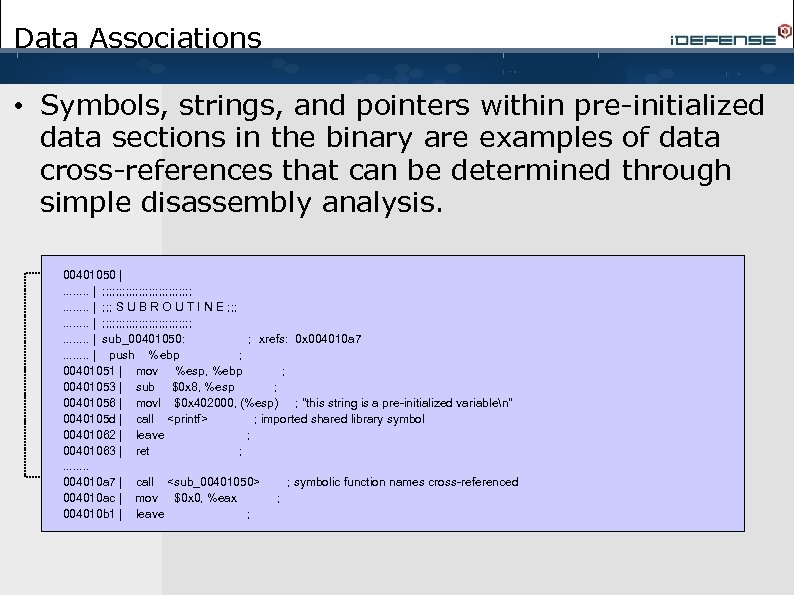
Data Associations • Symbols, strings, and pointers within pre-initialized data sections in the binary are examples of data cross-references that can be determined through simple disassembly analysis. 00401050 |. . . . | ; ; ; ; ; ; ; . . . . | ; ; ; S U B R O U T I N E ; ; ; . . . . | ; ; ; ; ; ; ; . . . . | sub_00401050: ; xrefs: 0 x 004010 a 7. . . . | push %ebp ; 00401051 | mov %esp, %ebp ; 00401053 | sub $0 x 8, %esp ; 00401056 | movl $0 x 402000, (%esp) ; "this string is a pre-initialized variablen" 0040105 d | call <printf> ; imported shared library symbol 00401062 | leave ; 00401063 | ret ; . . . . 004010 a 7 | call <sub_00401050> ; symbolic function names cross-referenced 004010 ac | mov $0 x 0, %eax ; 004010 b 1 | leave ;
Hinting • Disassemblers should use a database of information regarding system calls and standard system library calls to aid in disassembly hinting. • System Call hinting can help a reverse engineer determine what system services a function utilizes. – Syscall Numbers are stored in /usr/src/linux/include/asm/unistd. h – Arguments are typically passed in registers, so once data xrefs are applied we can tell if user-supplied data is being used in a system call. • Function argument types and high level datastructures can be parsed from header files. – Every platform has a set of default libraries and headers. – The more the disassembler knows about variable types, the better it can understand how the data is being used.
Hinting • Function call argument detection – Function prologues swap the current stack pointer into ebp to represent the base of the stack for the local function – Function arguments can be determined by internal references to offsets of ebp – In the case of code compiled without frame pointers, offsets to esp will be used. – Arguments can be determined as local variables vs passed arguments depending on their offset to ebp – Depending on calling convention, arguments to functions are typically passed via the stack • Stdcall – push args in reverse order to the stack (last to first) • Fastcall – uses registers when possible to hold args – Argument types can be determined via basic heuristics or by prototype parsing • Heuristics can determine if passed values are pointers to memory, string references or integer values
Disassembly Analysis • The features described in this section should be standard fare. • IDA Pro, HTE, the bastard, and Codis are currently the only disassemblers available which implement most of the features. • Required development time: 2 - 3 weeks Codis Demo
Advanced Disassembly Analysis
Advanced Disassembly Analysis • The flexibility offered by Data. Rescue’s IDA Pro SDK has allowed for recent advancements in disassembly analysis capabilities. • IDA Pro plug-ins have access to the program’s internal database which allows for rapid development of concept ideas. – Path Analysis • Peter Silberman’s loop detection plugin – Data Analysis • idastruct - data structure enumeration
Path Analysis • Path analyzers recursively follow execution flow to build a control flow graph. • When reverse engineering, entire code paths can be quickly grouped for functionality to speed the code recognition process. • Linear disassemblers can not determine the relationships of code blocks, and may disassemble instructions incorrectly if data is injected in-between compiled code
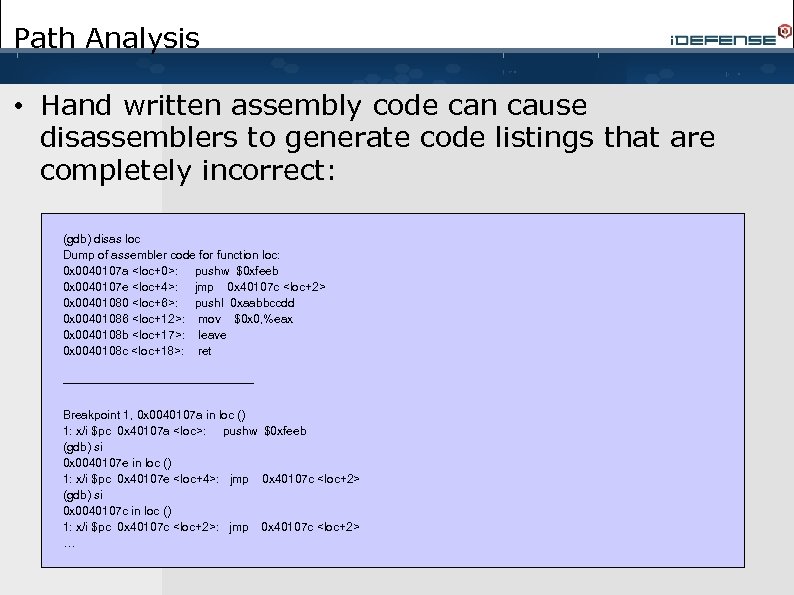
Path Analysis • Hand written assembly code can cause disassemblers to generate code listings that are completely incorrect: (gdb) disas loc Dump of assembler code for function loc: 0 x 0040107 a <loc+0>: pushw $0 xfeeb 0 x 0040107 e <loc+4>: jmp 0 x 40107 c <loc+2> 0 x 00401080 <loc+6>: pushl 0 xaabbccdd 0 x 00401086 <loc+12>: mov $0 x 0, %eax 0 x 0040108 b <loc+17>: leave 0 x 0040108 c <loc+18>: ret ------------------------Breakpoint 1, 0 x 0040107 a in loc () 1: x/i $pc 0 x 40107 a <loc>: pushw $0 xfeeb (gdb) si 0 x 0040107 e in loc () 1: x/i $pc 0 x 40107 e <loc+4>: jmp 0 x 40107 c <loc+2> (gdb) si 0 x 0040107 c in loc () 1: x/i $pc 0 x 40107 c <loc+2>: jmp 0 x 40107 c <loc+2> …
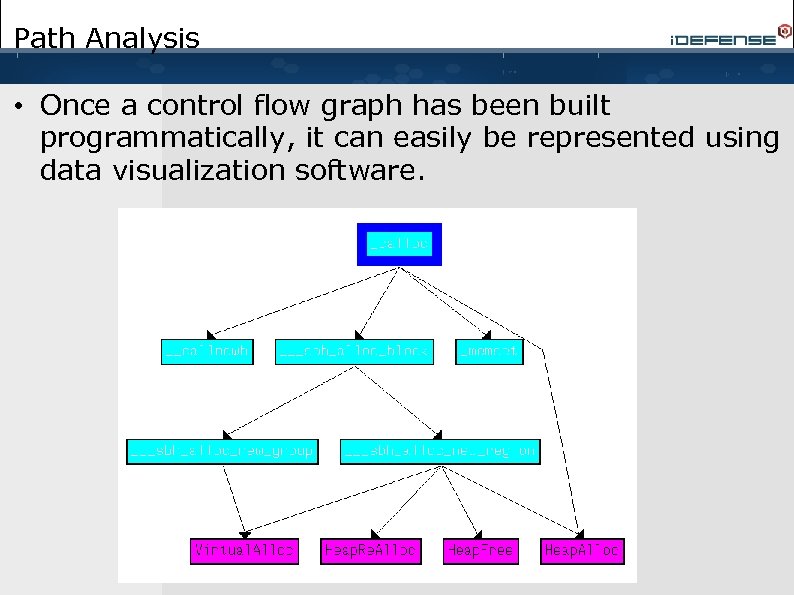
Path Analysis • Once a control flow graph has been built programmatically, it can easily be represented using data visualization software.
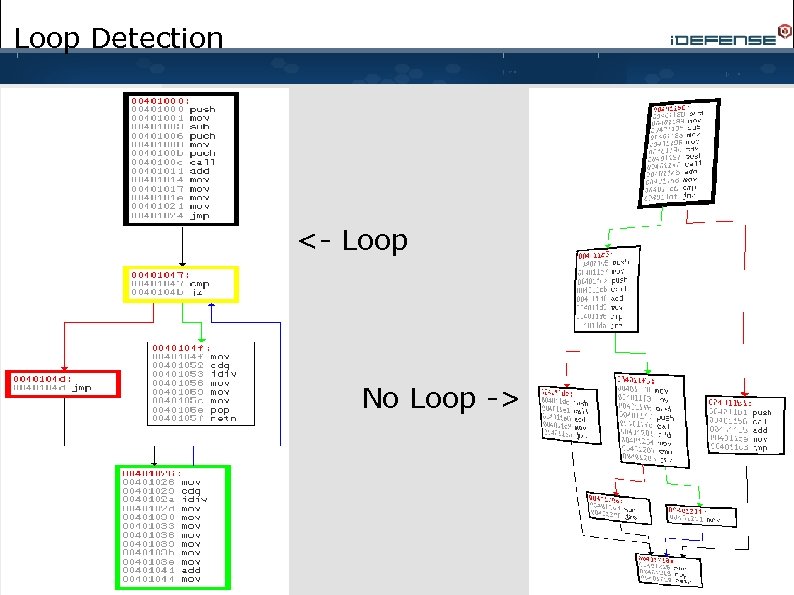
Loop Detection • Loop detection is an advanced application of control flow analysis. • Loop detection can be applied to recognize program structure as well as specific types of vulnerabilities. • Recognizing loops can aid other disassembly analysis tasks and eliminate heavy analysis of code multiple times. • Example: Peter Silberman’s Loop Detection Plugin – Designed to help reverse-engineers locate code loops that may lead to exploitable scenarios.
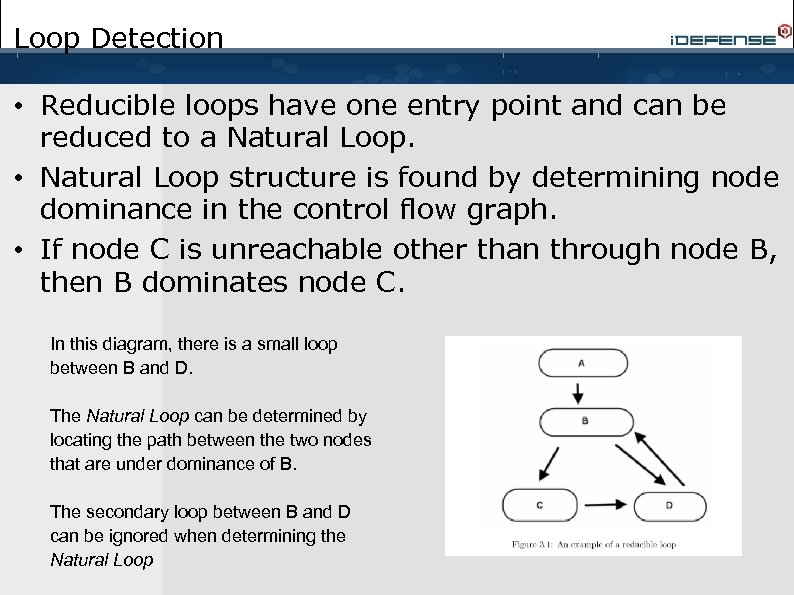
Loop Detection • Reducible loops have one entry point and can be reduced to a Natural Loop. • Natural Loop structure is found by determining node dominance in the control flow graph. • If node C is unreachable other than through node B, then B dominates node C. In this diagram, there is a small loop between B and D. The Natural Loop can be determined by locating the path between the two nodes that are under dominance of B. The secondary loop between B and D can be ignored when determining the Natural Loop
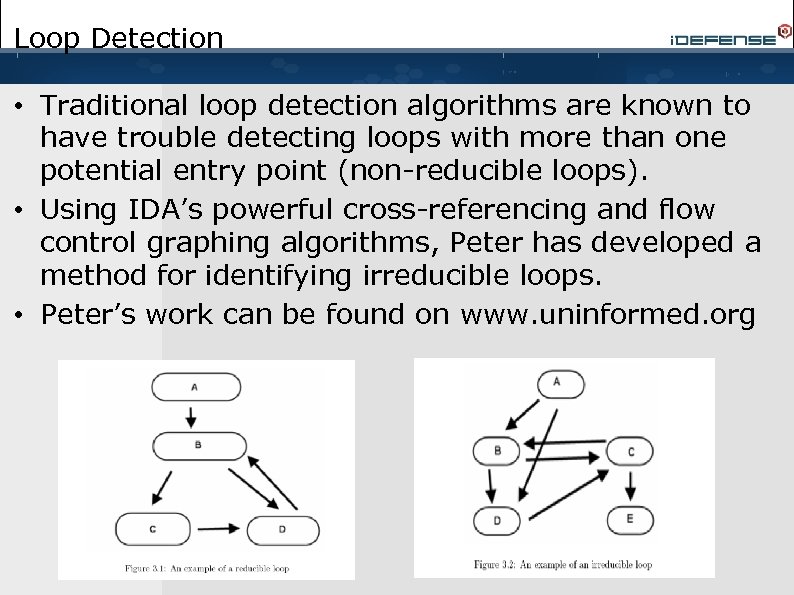
Loop Detection • Traditional loop detection algorithms are known to have trouble detecting loops with more than one potential entry point (non-reducible loops). • Using IDA’s powerful cross-referencing and flow control graphing algorithms, Peter has developed a method for identifying irreducible loops. • Peter’s work can be found on www. uninformed. org
Loop Detection <- Loop No Loop ->
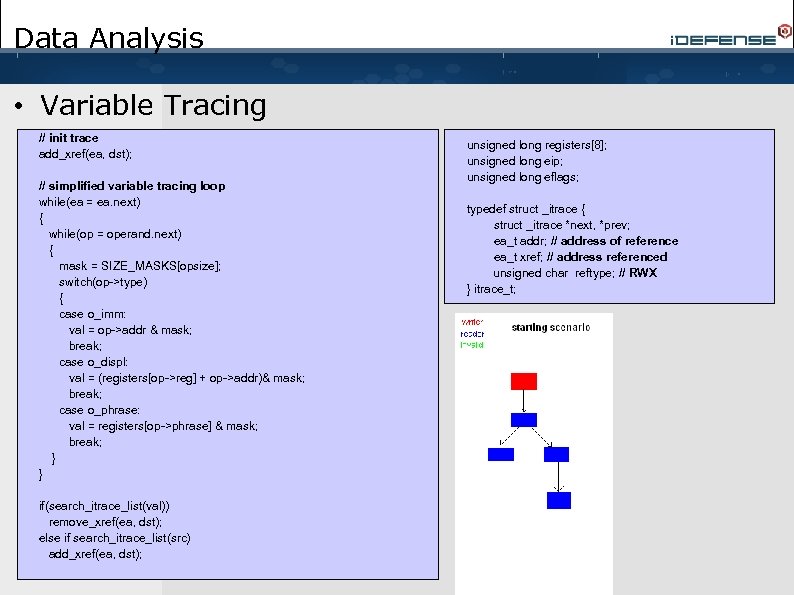
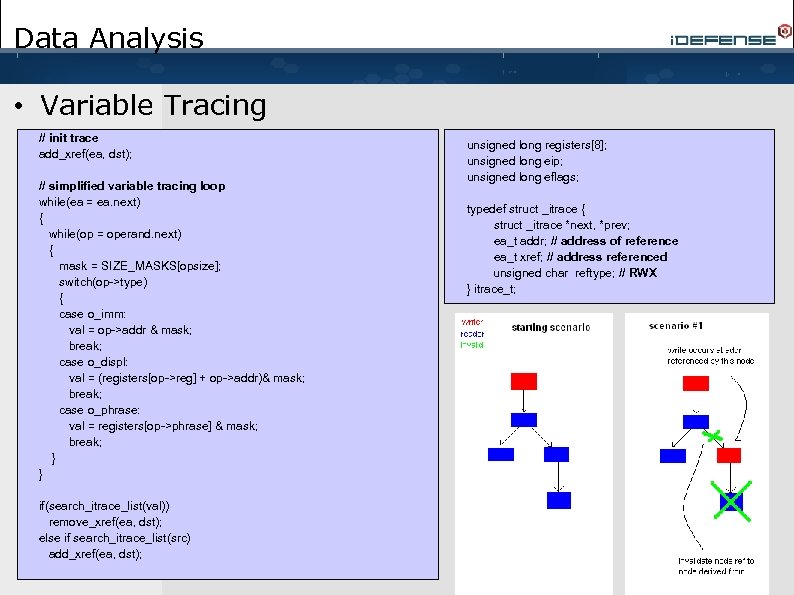
Data Analysis • Unlike code paths, analyzing data relationships is a non-trivial exercise. • Data references are occasionally supplied as immediate values, but are more often passed around in registers to perform operations. • There are numerous obstacles to overcome when tracing assembly for the purpose of data reference tracking – it has yet to be implemented successfully. • To follow data paths, a variable tracing algorithm must be developed… or does it?
Data Analysis • Variable Tracing // init trace add_xref(ea, dst); // simplified variable tracing loop while(ea = ea. next) { while(op = operand. next) { mask = SIZE_MASKS[opsize]; switch(op->type) { case o_imm: val = op->addr & mask; break; case o_displ: val = (registers[op->reg] + op->addr)& mask; break; case o_phrase: val = registers[op->phrase] & mask; break; } } if(search_itrace_list(val)) remove_xref(ea, dst); else if search_itrace_list(src) add_xref(ea, dst); unsigned long registers[8]; unsigned long eip; unsigned long eflags; typedef struct _itrace { struct _itrace *next, *prev; ea_t addr; // address of reference ea_t xref; // address referenced unsigned char reftype; // RWX } itrace_t;
Data Analysis • Variable Tracing // init trace add_xref(ea, dst); // simplified variable tracing loop while(ea = ea. next) { while(op = operand. next) { mask = SIZE_MASKS[opsize]; switch(op->type) { case o_imm: val = op->addr & mask; break; case o_displ: val = (registers[op->reg] + op->addr)& mask; break; case o_phrase: val = registers[op->phrase] & mask; break; } } if(search_itrace_list(val)) remove_xref(ea, dst); else if search_itrace_list(src) add_xref(ea, dst); unsigned long registers[8]; unsigned long eip; unsigned long eflags; typedef struct _itrace { struct _itrace *next, *prev; ea_t addr; // address of reference ea_t xref; // address referenced unsigned char reftype; // RWX } itrace_t;
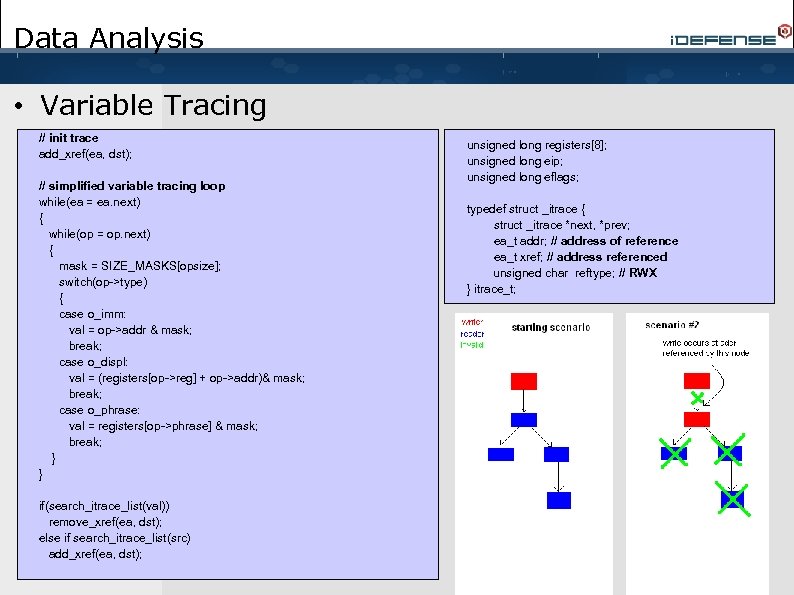
Data Analysis • Variable Tracing // init trace add_xref(ea, dst); // simplified variable tracing loop while(ea = ea. next) { while(op = op. next) { mask = SIZE_MASKS[opsize]; switch(op->type) { case o_imm: val = op->addr & mask; break; case o_displ: val = (registers[op->reg] + op->addr)& mask; break; case o_phrase: val = registers[op->phrase] & mask; break; } } if(search_itrace_list(val)) remove_xref(ea, dst); else if search_itrace_list(src) add_xref(ea, dst); unsigned long registers[8]; unsigned long eip; unsigned long eflags; typedef struct _itrace { struct _itrace *next, *prev; ea_t addr; // address of reference ea_t xref; // address referenced unsigned char reftype; // RWX } itrace_t;
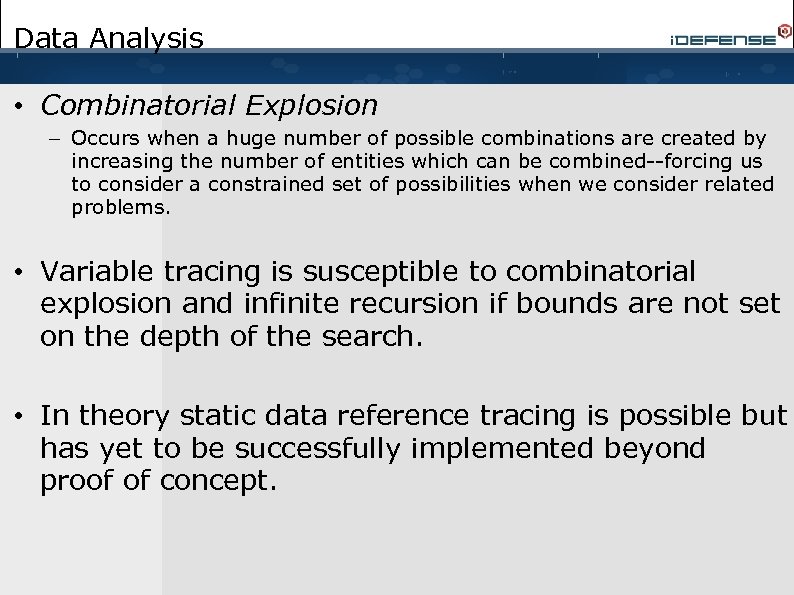
Data Analysis • Combinatorial Explosion – Occurs when a huge number of possible combinations are created by increasing the number of entities which can be combined--forcing us to consider a constrained set of possibilities when we consider related problems. • Variable tracing is susceptible to combinatorial explosion and infinite recursion if bounds are not set on the depth of the search. • In theory static data reference tracing is possible but has yet to be successfully implemented beyond proof of concept.
Emulation • CPU emulation can be used as a powerful resource when analyzing static code. • CPU Emulation involves the execution of instructions in a virtual CPU. • Virtual CPUs emulate the core components of a hardware CPU in software. – Instruction decoding/evaluation – Registers – Memory • Emulation is “safe” – depending on implementation of course
ida-x 86 emu • ida-x 86 emu is an opensource emulator written by Chris Eagle and Jeremey Cooper – – Emulator codebase can be easily hooked for special analysis purposes. Undergoing development Some features are missing but code is easily hackable Use the CVS version! • Evaluates complex instruction sequences • Emulates dynamic memory allocator functionality • Can hook PE imports and load required libraries – Sometimes has some hiccups – currently looking into this
idastruct • idastruct is data structure reference tracing code built on top of ida-x 86 emu. • Arbitrary bounds within the emulated memory space can be traced using simple logic. • As operands are evaluated for each instruction, a check is made to determine if that operand is referencing memory that is being traced. • IDA database is updated with structure information and member data as references are detected and types are applied to the reference.
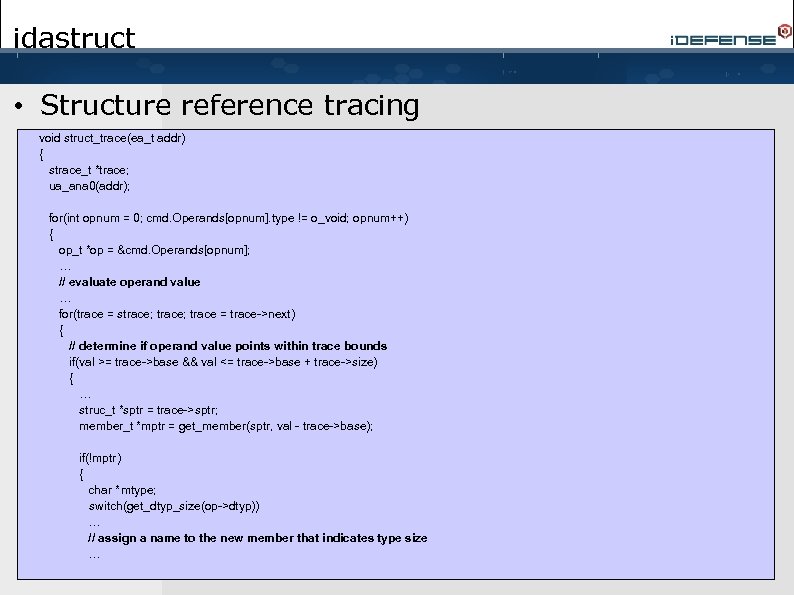
idastruct • Structure reference tracing void struct_trace(ea_t addr) { strace_t *trace; ua_ana 0(addr); for(int opnum = 0; cmd. Operands[opnum]. type != o_void; opnum++) { op_t *op = &cmd. Operands[opnum]; … // evaluate operand value … for(trace = strace; trace = trace->next) { // determine if operand value points within trace bounds if(val >= trace->base && val <= trace->base + trace->size) { … struc_t *sptr = trace->sptr; member_t *mptr = get_member(sptr, val - trace->base); if(!mptr) { char *mtype; switch(get_dtyp_size(op->dtyp)) … // assign a name to the new member that indicates type size …
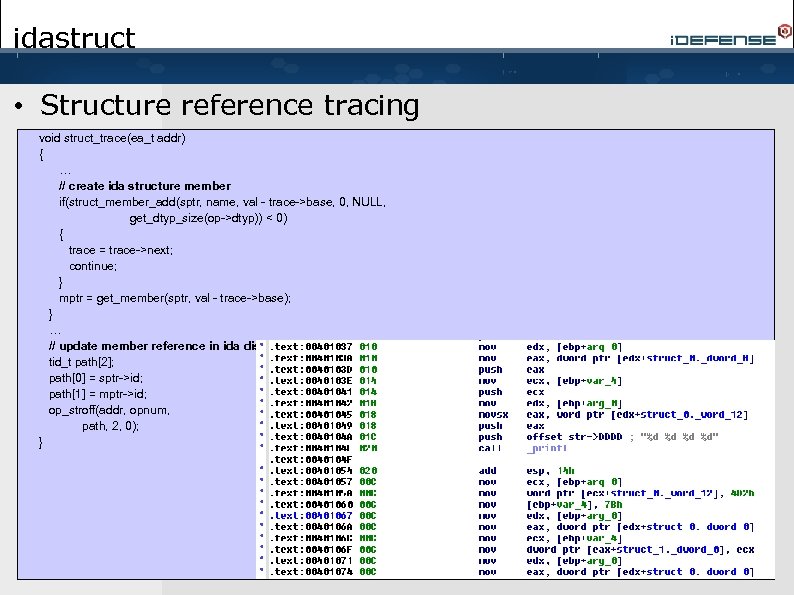
idastruct • Structure reference tracing void struct_trace(ea_t addr) { … // create ida structure member if(struct_member_add(sptr, name, val - trace->base, 0, NULL, get_dtyp_size(op->dtyp)) < 0) { trace = trace->next; continue; } mptr = get_member(sptr, val - trace->base); } … // update member reference in ida disassembly tid_t path[2]; path[0] = sptr->id; path[1] = mptr->id; op_stroff(addr, opnum, path, 2, 0); }
Conclusion • The ability to identify arbitrary structures via binary analysis should speed software reversing in all areas. • Directly applies to vulnerability discovery through automation of fuzz template generation. • Further analysis may be performed on the structure relationships within execution paths to tie complete structure hierarchies together.
Questions?
Скачать презентацию x 86 Disassembler Internals 22 c 3 Private
93dbcc30905afdc67a23bbbf5aff6882.ppt