 Скачать презентацию WXF Bio-Energy A Green Sustainable Waste to Energy
6fcdf310cbc46d04b4be106dd7bcd752.ppt
- Количество слайдов: 42



WXF Bio-Energy A Green, Sustainable Waste to Energy Process Xu Fei (Philip) Wu Chairman and Chief Scientist W&Y Environmental International Inc. Waterloo, Canada March 28, 2012; Kharkov, Ukraine 1
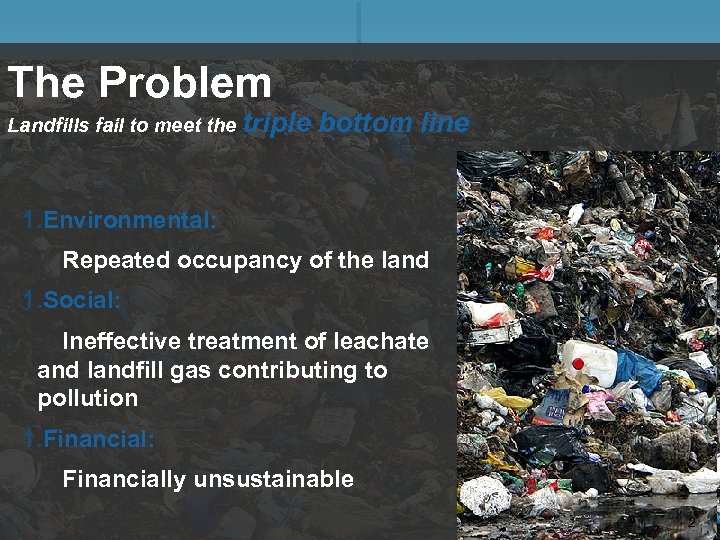
The Problem Landfills fail to meet the triple bottom line 1. Environmental: Repeated occupancy of the land 1. Social: Ineffective treatment of leachate and landfill gas contributing to pollution 1. Financial: Financially unsustainable 2
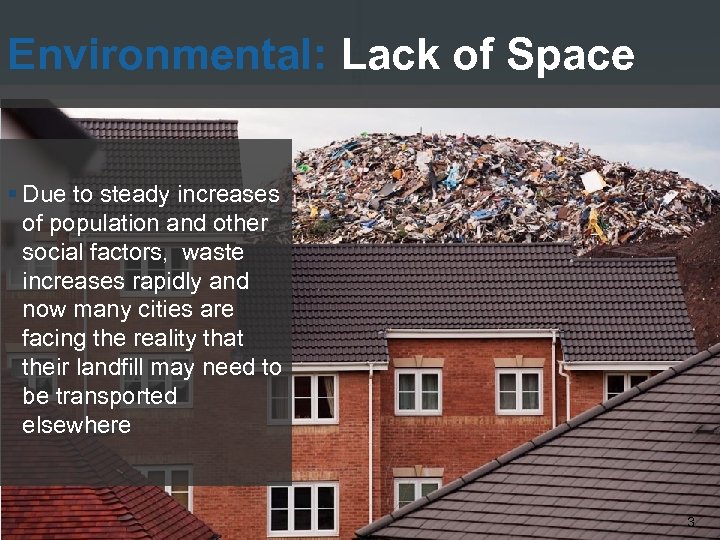
Environmental: Lack of Space § Due to steady increases of population and other social factors, waste increases rapidly and now many cities are facing the reality that their landfill may need to be transported elsewhere 3
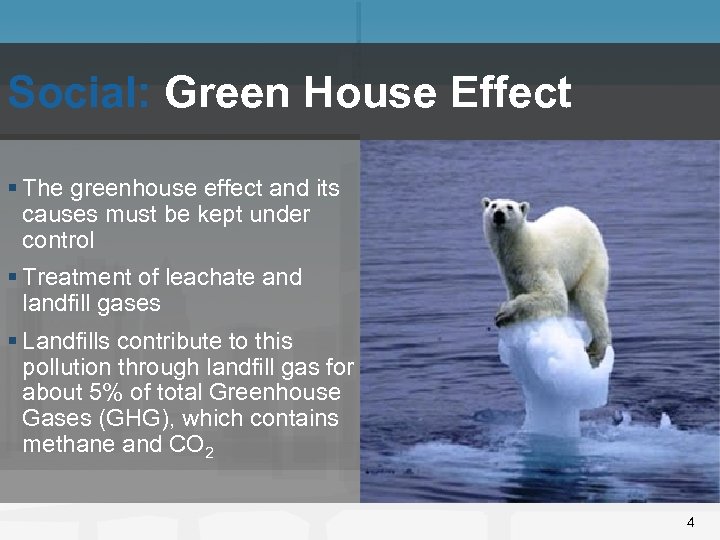
Social: Green House Effect § The greenhouse effect and its causes must be kept under control § Treatment of leachate and landfill gases § Landfills contribute to this pollution through landfill gas for about 5% of total Greenhouse Gases (GHG), which contains methane and CO 2 4
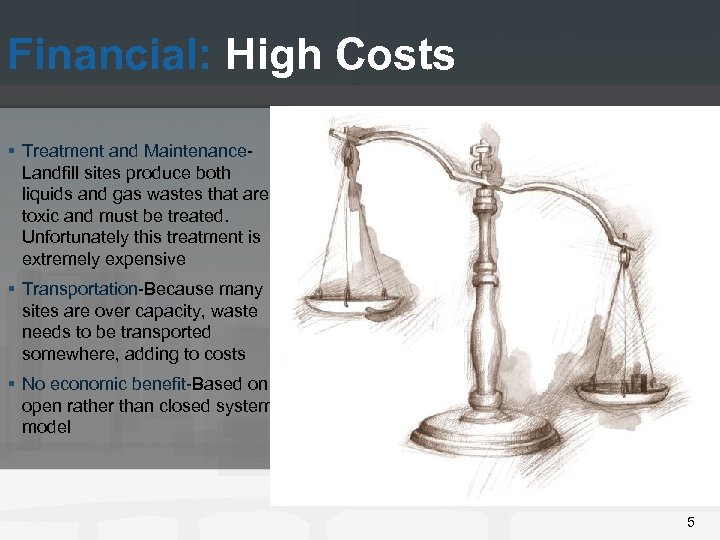
Financial: High Costs § Treatment and Maintenance. Landfill sites produce both liquids and gas wastes that are toxic and must be treated. Unfortunately this treatment is extremely expensive § Transportation-Because many sites are over capacity, waste needs to be transported somewhere, adding to costs § No economic benefit-Based on open rather than closed system model 5
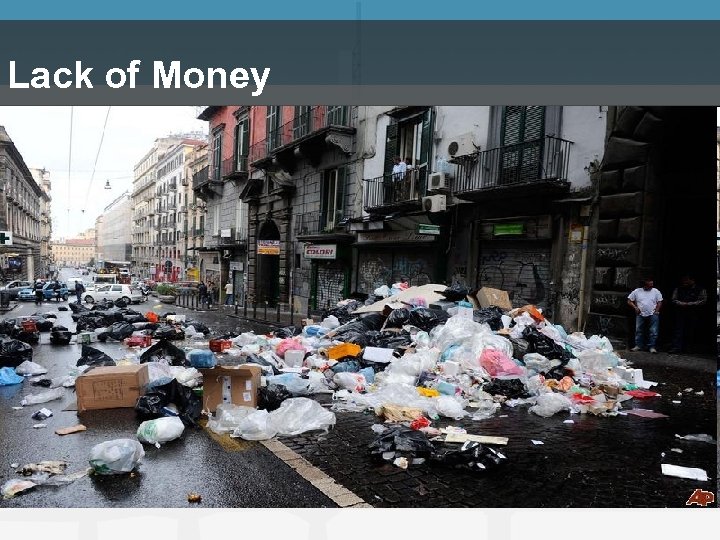
Lack of Money

What If? 7
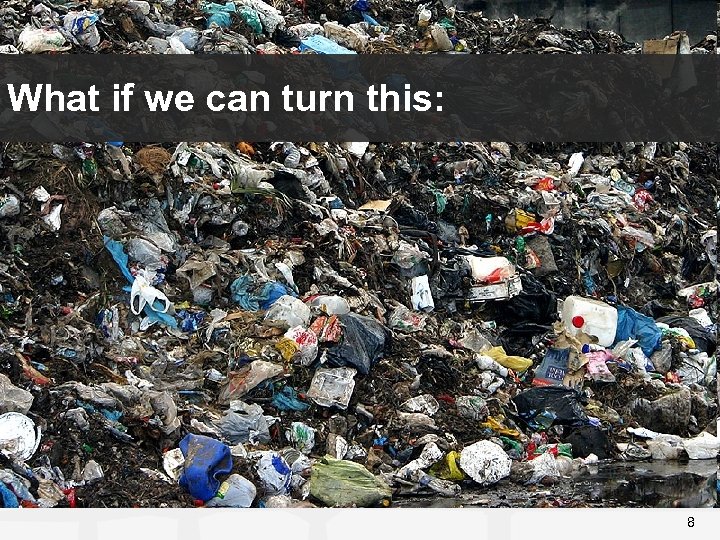
What if we can turn this: 8
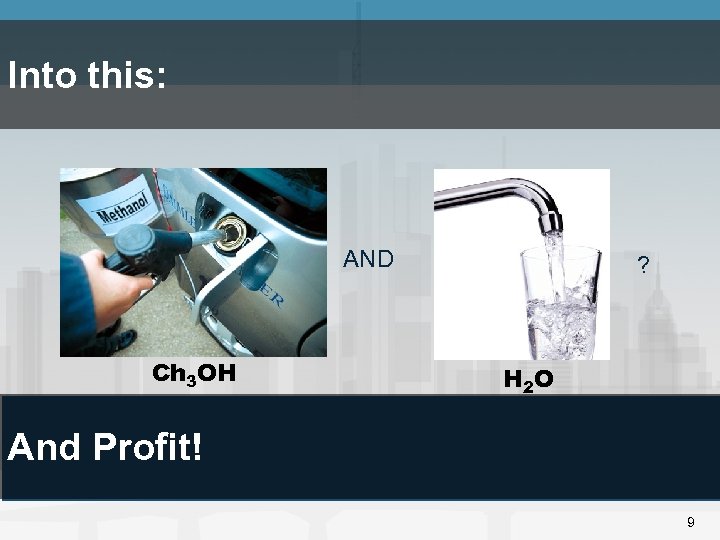
Into this: AND Ch 3 OH ? H 2 O And Profit! 9
Introducing… § W&Y Environmental International Inc. , a Canadian-owned company incorporated in Ontario in 2001. Solutions transcend the scope of any single economic sector, creating benefits and opportunities in: - Renewable Energy Generation - Innovative Waste Management - Sustainable Production of Alternative Fuels - Effective Utilization of GHG 10
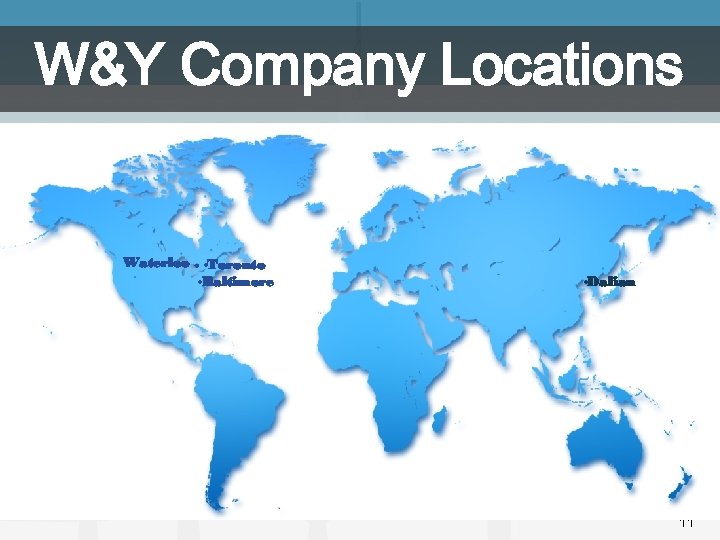
W&Y Company Locations Waterloo. • Toronto • Baltimore • Dalian 11
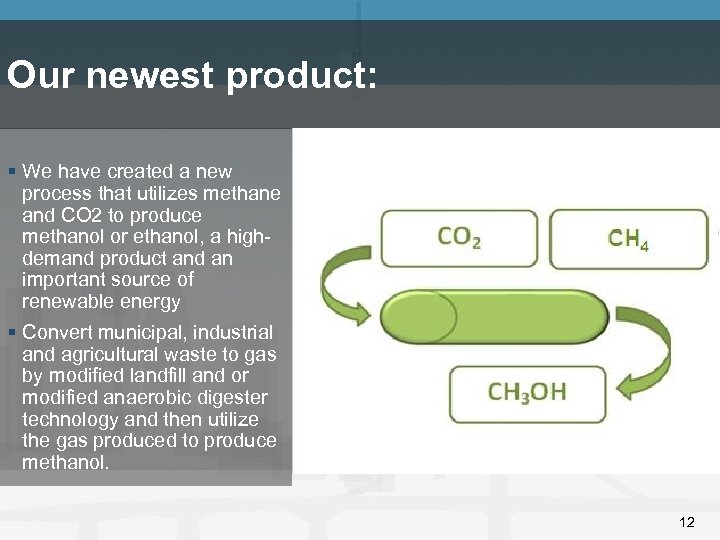
Our newest product: § We have created a new process that utilizes methane and CO 2 to produce methanol or ethanol, a highdemand product and an important source of renewable energy § Convert municipal, industrial and agricultural waste to gas by modified landfill and or modified anaerobic digester technology and then utilize the gas produced to produce methanol. 12
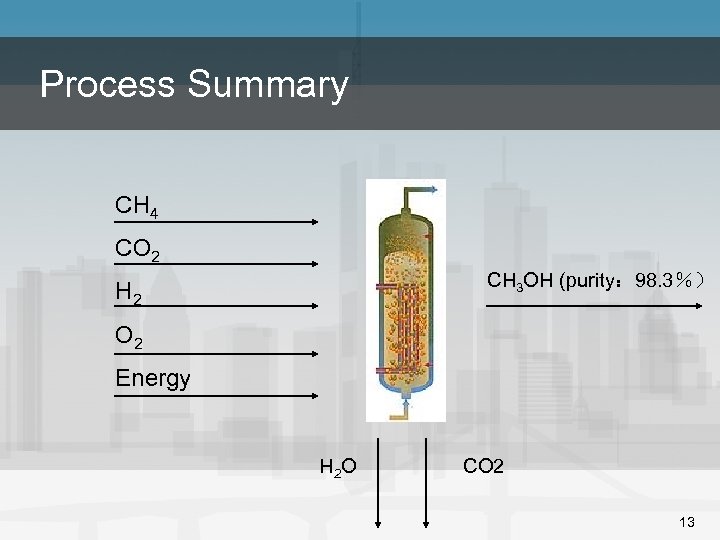
Process Summary CH 4 CO 2 CH 3 OH (purity: 98. 3%) H 2 O 2 Energy H 2 O CO 2 13
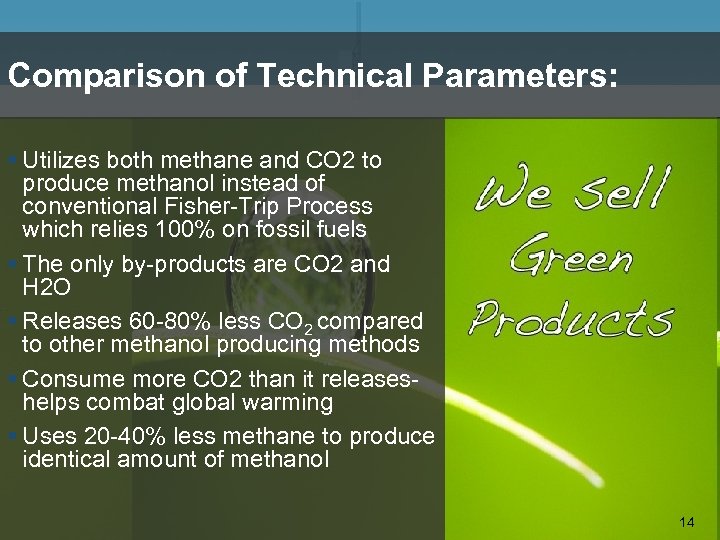
Comparison of Technical Parameters: § Utilizes both methane and CO 2 to produce methanol instead of conventional Fisher-Trip Process which relies 100% on fossil fuels § The only by-products are CO 2 and H 2 O § Releases 60 -80% less CO 2 compared to other methanol producing methods § Consume more CO 2 than it releaseshelps combat global warming § Uses 20 -40% less methane to produce identical amount of methanol 14
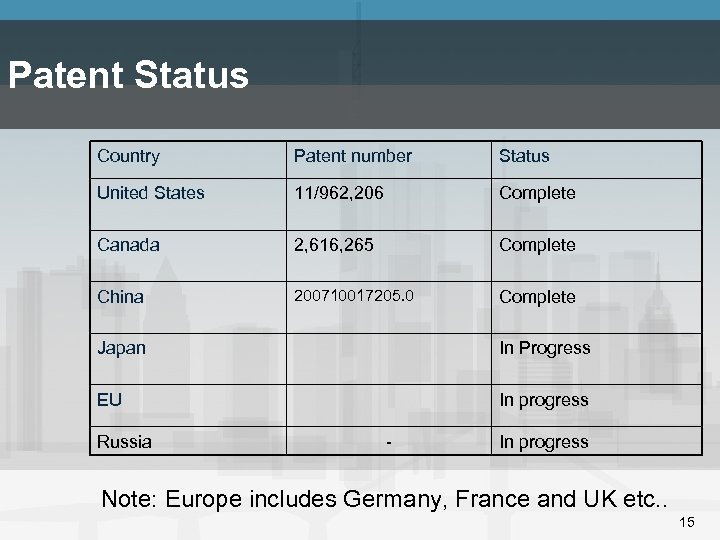
Patent Status Country Patent number Status United States 11/962, 206 Complete Canada 2, 616, 265 Complete China 200710017205. 0 Complete Japan In Progress EU In progress Russia - In progress Note: Europe includes Germany, France and UK etc. . 15
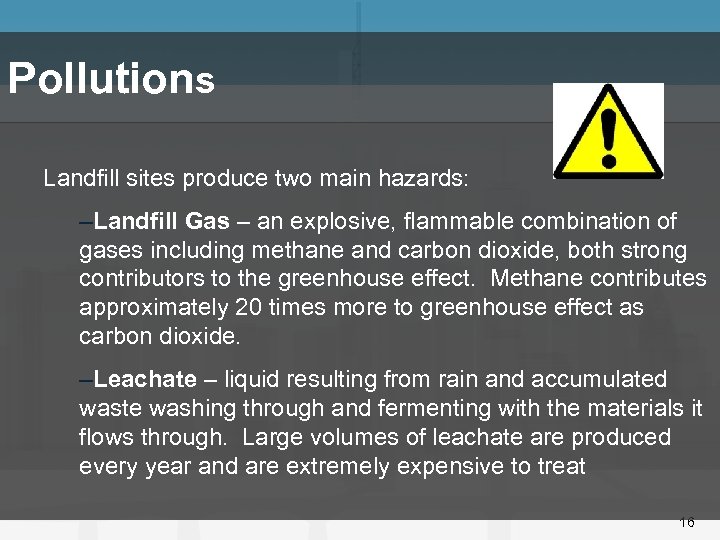
Pollutions Landfill sites produce two main hazards: –Landfill Gas – an explosive, flammable combination of gases including methane and carbon dioxide, both strong contributors to the greenhouse effect. Methane contributes approximately 20 times more to greenhouse effect as carbon dioxide. –Leachate – liquid resulting from rain and accumulated waste washing through and fermenting with the materials it flows through. Large volumes of leachate are produced every year and are extremely expensive to treat 16
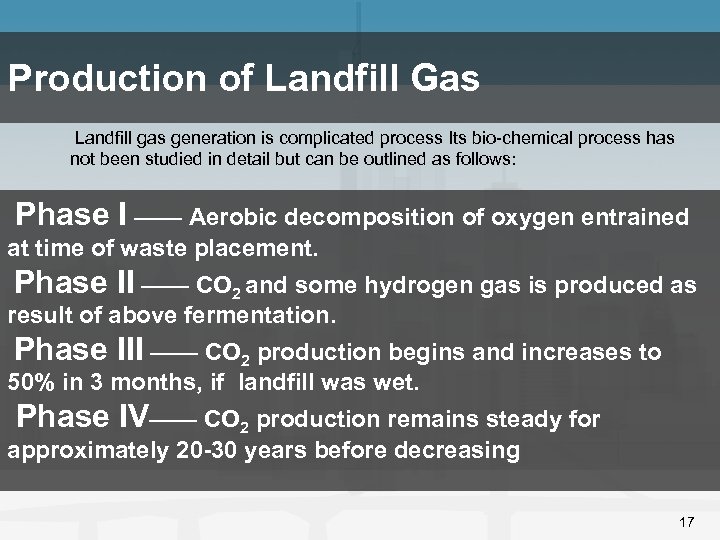
Production of Landfill Gas Landfill gas generation is complicated process Its bio-chemical process has not been studied in detail but can be outlined as follows: Phase I —— Aerobic decomposition of oxygen entrained at time of waste placement. Phase II —— CO 2 and some hydrogen gas is produced as result of above fermentation. Phase III —— CO 2 production begins and increases to 50% in 3 months, if landfill was wet. Phase IV—— CO 2 production remains steady for approximately 20 -30 years before decreasing 17
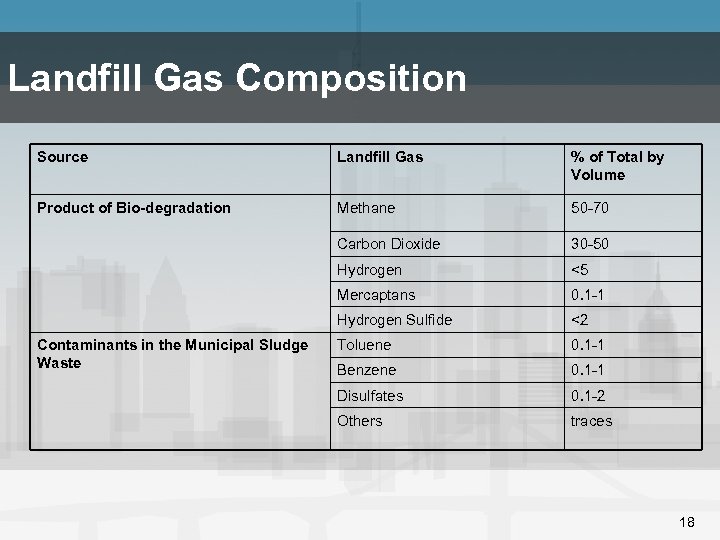
Landfill Gas Composition Source Landfill Gas % of Total by Volume Product of Bio-degradation Methane 50 -70 Carbon Dioxide 30 -50 Hydrogen <5 Mercaptans 0. 1 -1 Hydrogen Sulfide <2 Toluene 0. 1 -1 Benzene 0. 1 -1 Disulfates 0. 1 -2 Others traces Contaminants in the Municipal Sludge Waste 18
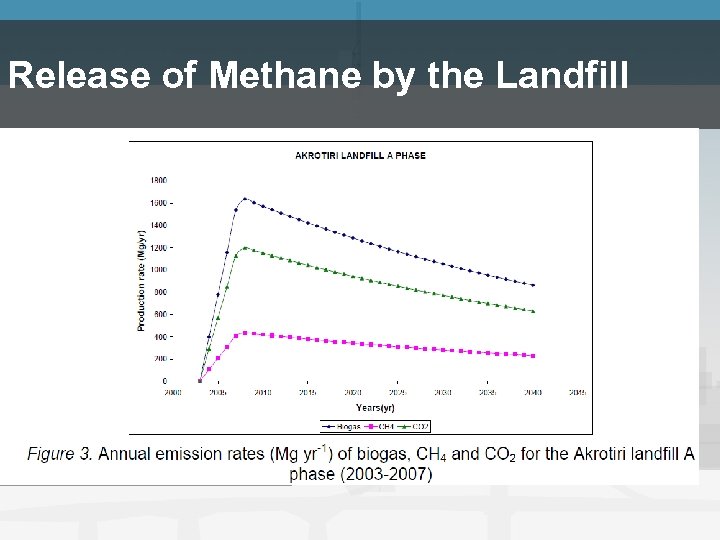
Release of Methane by the Landfill
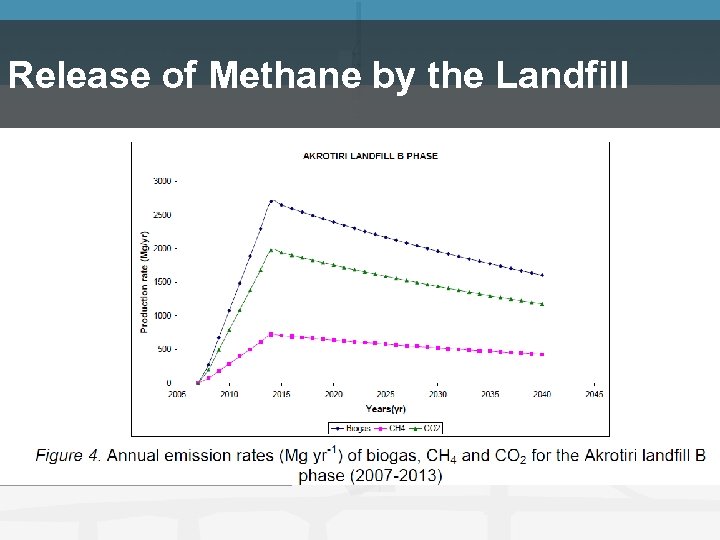
Release of Methane by the Landfill
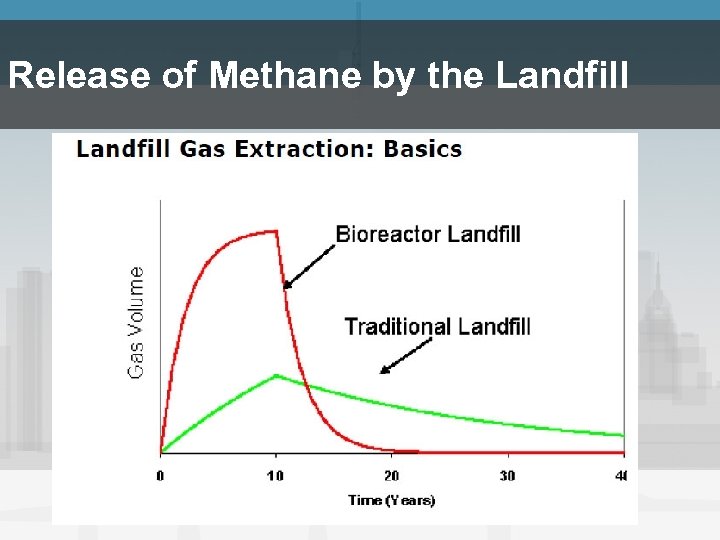
Release of Methane by the Landfill
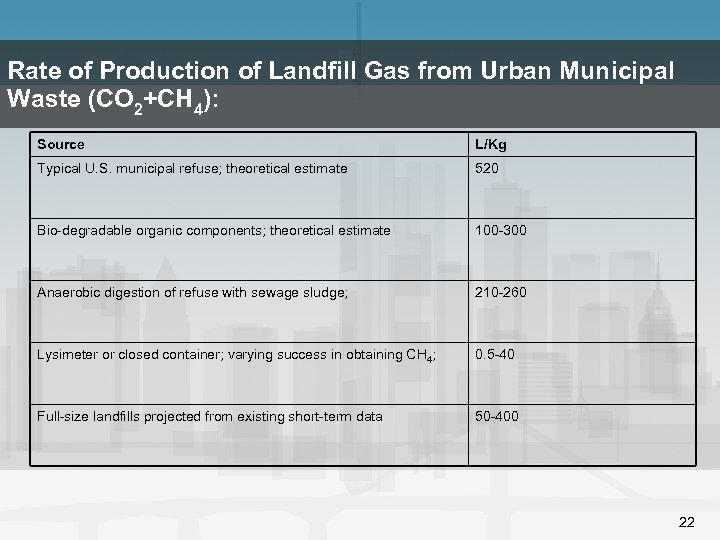
Rate of Production of Landfill Gas from Urban Municipal Waste (CO 2+CH 4): Source L/Kg Typical U. S. municipal refuse; theoretical estimate 520 Bio-degradable organic components; theoretical estimate 100 -300 Anaerobic digestion of refuse with sewage sludge; 210 -260 Lysimeter or closed container; varying success in obtaining CH 4; 0. 5 -40 Full-size landfills projected from existing short-term data 50 -400 22
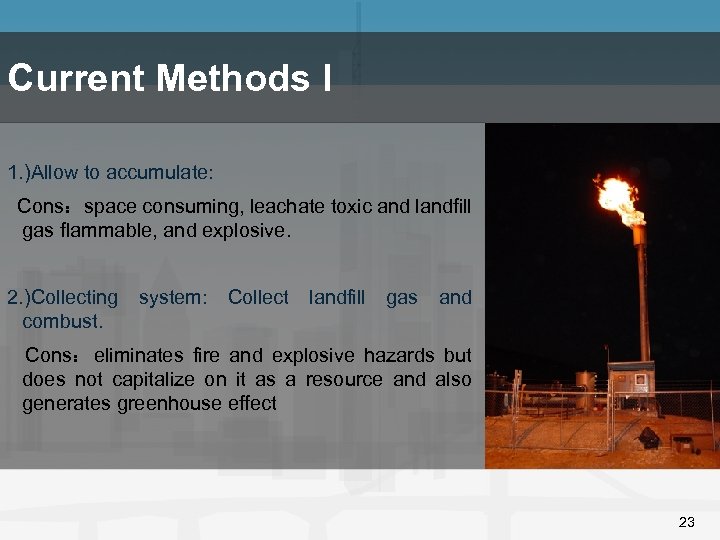
Current Methods I 1. )Allow to accumulate: Cons:space consuming, leachate toxic and landfill gas flammable, and explosive. 2. )Collecting combust. system: Collect landfill gas and Cons:eliminates fire and explosive hazards but does not capitalize on it as a resource and also generates greenhouse effect 23
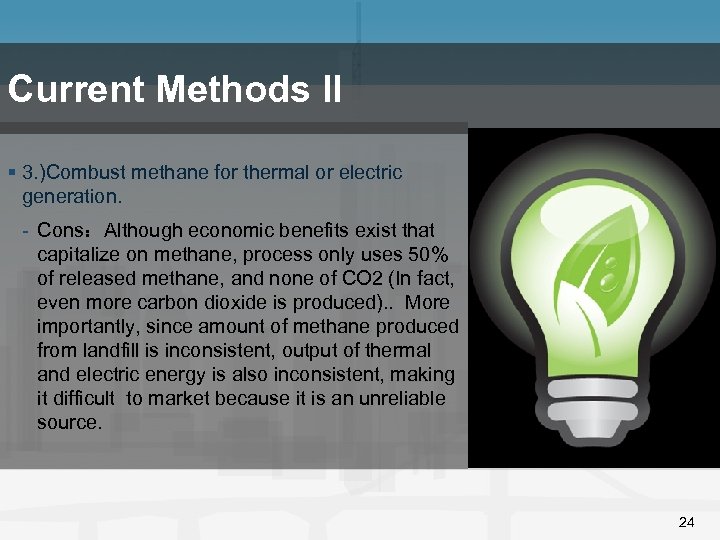
Current Methods II § 3. )Combust methane for thermal or electric generation. - Cons:Although economic benefits exist that capitalize on methane, process only uses 50% of released methane, and none of CO 2 (In fact, even more carbon dioxide is produced). . More importantly, since amount of methane produced from landfill is inconsistent, output of thermal and electric energy is also inconsistent, making it difficult to market because it is an unreliable source. 24
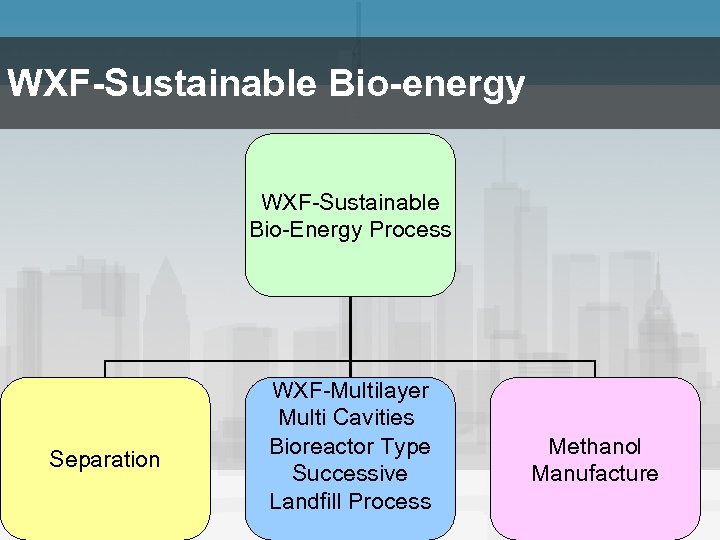
WXF-Sustainable Bio-energy WXF-Sustainable Bio-Energy Process Separation WXF-Multilayer Multi Cavities Bioreactor Type Successive Landfill Process Methanol Manufacture 25
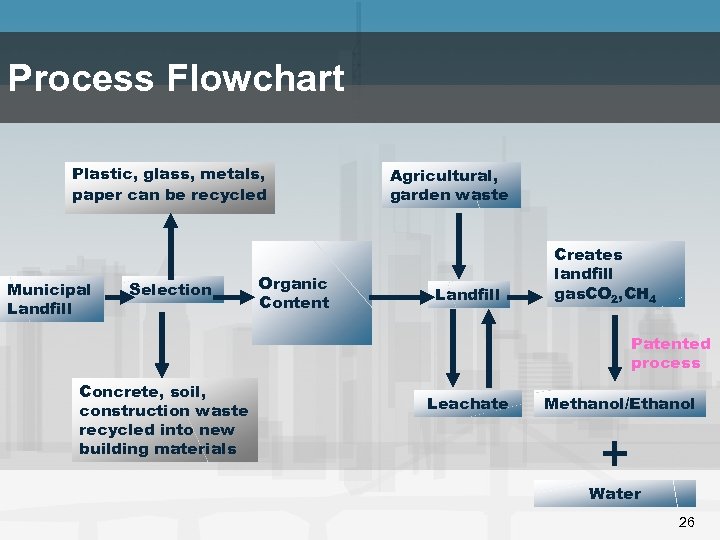
Process Flowchart Plastic, glass, metals, paper can be recycled Municipal Landfill Selection Organic Content Agricultural, garden waste Landfill Creates landfill gas. CO 2, CH 4 Patented process Concrete, soil, construction waste recycled into new building materials Leachate Methanol/Ethanol Water 26
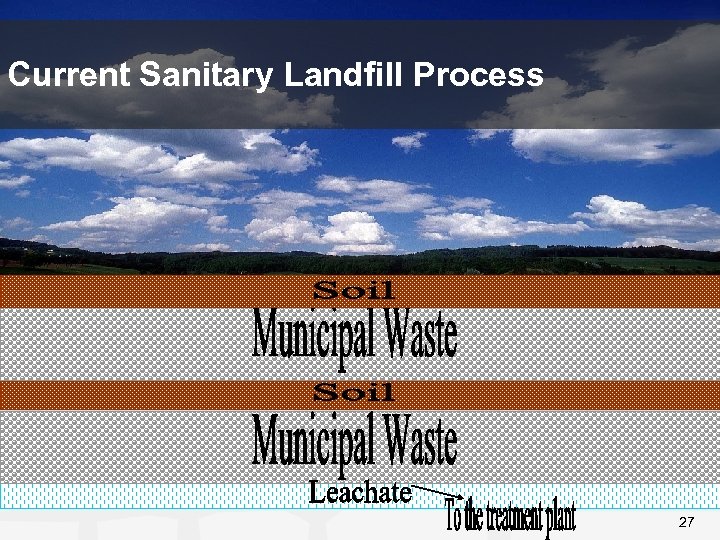
Current Sanitary Landfill Process 27
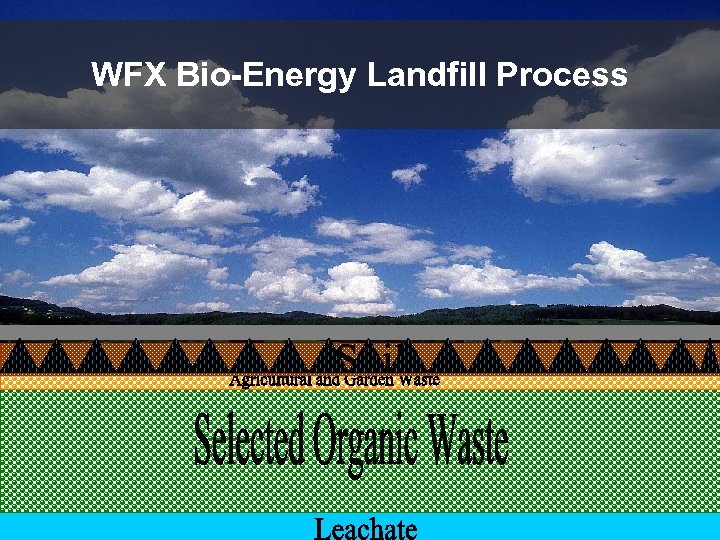
WFX Bio-Energy Landfill Process 28
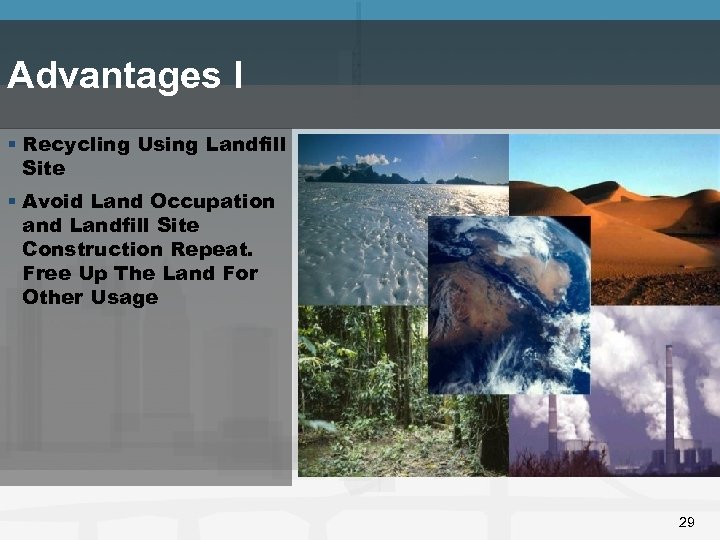
Advantages I § Recycling Using Landfill Site § Avoid Land Occupation and Landfill Site Construction Repeat. Free Up The Land For Other Usage 29
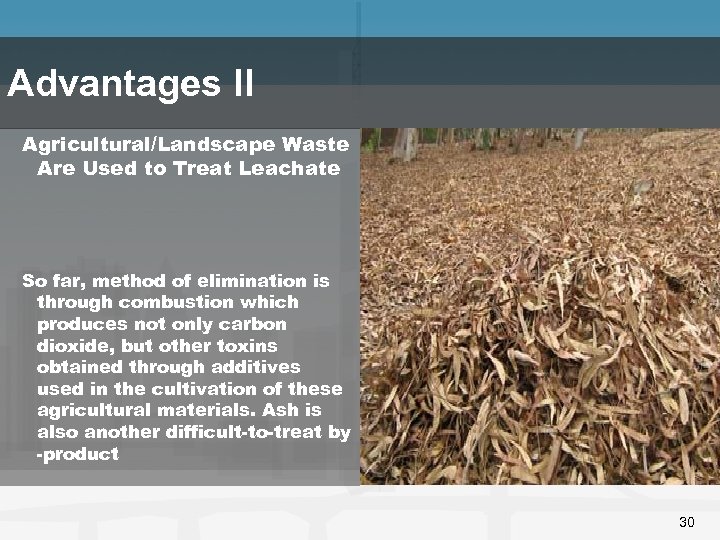
Advantages II Agricultural/Landscape Waste Are Used to Treat Leachate So far, method of elimination is through combustion which produces not only carbon dioxide, but other toxins obtained through additives used in the cultivation of these agricultural materials. Ash is also another difficult-to-treat by -product 30
Advantages III Recycling what can be recycled use what can’t. The Received Trash can be Sorted to: • • Reusable Recyclable Biodegradable Toxic and Hazardous 31
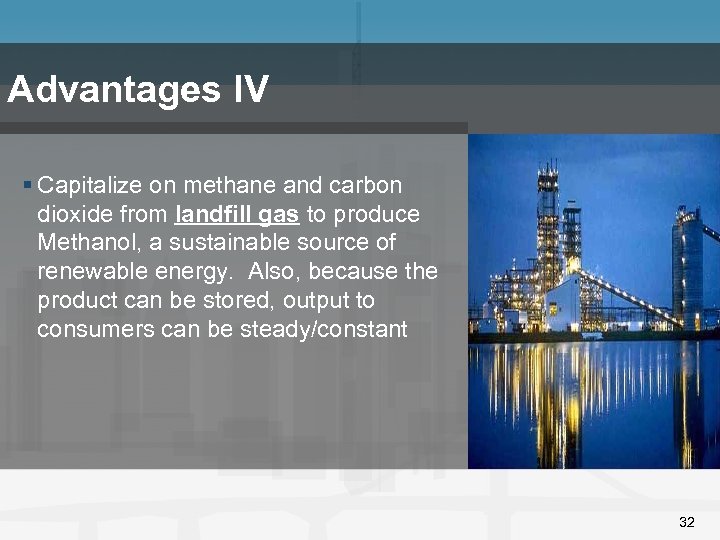
Advantages IV § Capitalize on methane and carbon dioxide from landfill gas to produce Methanol, a sustainable source of renewable energy. Also, because the product can be stored, output to consumers can be steady/constant 32
Advantages V Reduce Green House Gas Release Carbon Credit Trade 33
Advantages VI Leachate Recycling: § Recycling Leachate, Limited Expensive Treatment Process, § By Doing That has Increased Organic Content, § Increase Moisture of Landfill Bed, . § This will Speed Up Biodegradation Then Speed Up Gas Production 34
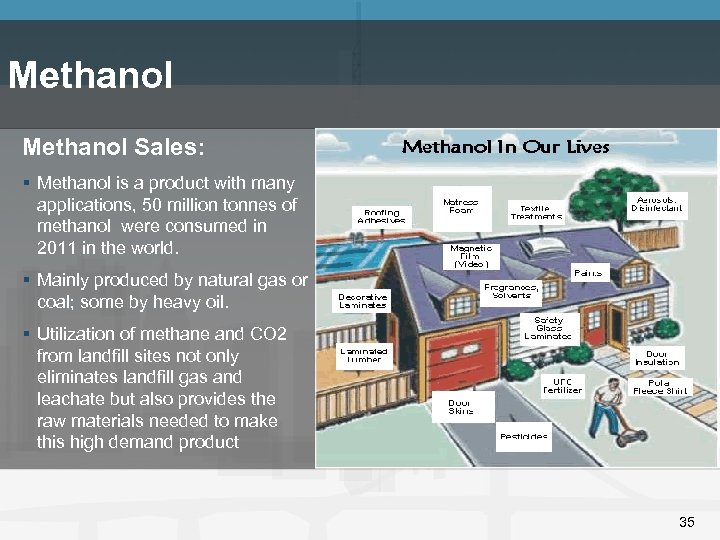
Methanol Sales: § Methanol is a product with many applications, 50 million tonnes of methanol were consumed in 2011 in the world. § Mainly produced by natural gas or coal; some by heavy oil. § Utilization of methane and CO 2 from landfill sites not only eliminates landfill gas and leachate but also provides the raw materials needed to make this high demand product 35
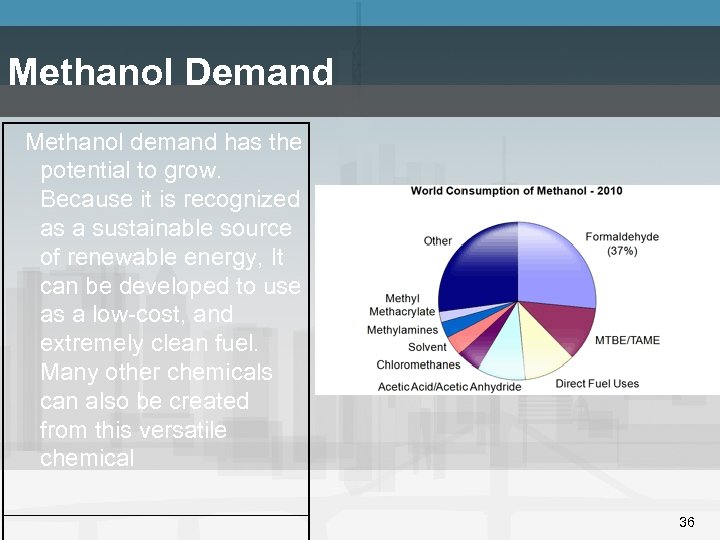
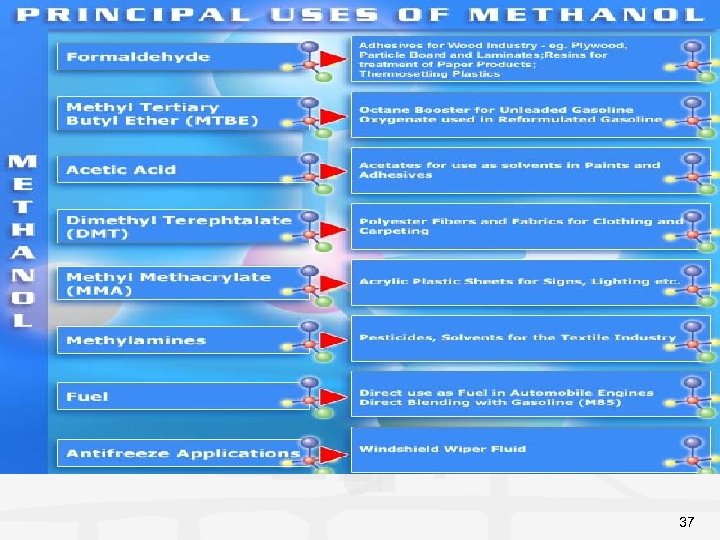
Methanol Demand Methanol demand has the potential to grow. Because it is recognized as a sustainable source of renewable energy, It can be developed to use as a low-cost, and extremely clean fuel. Many other chemicals can also be created from this versatile chemical 36
37
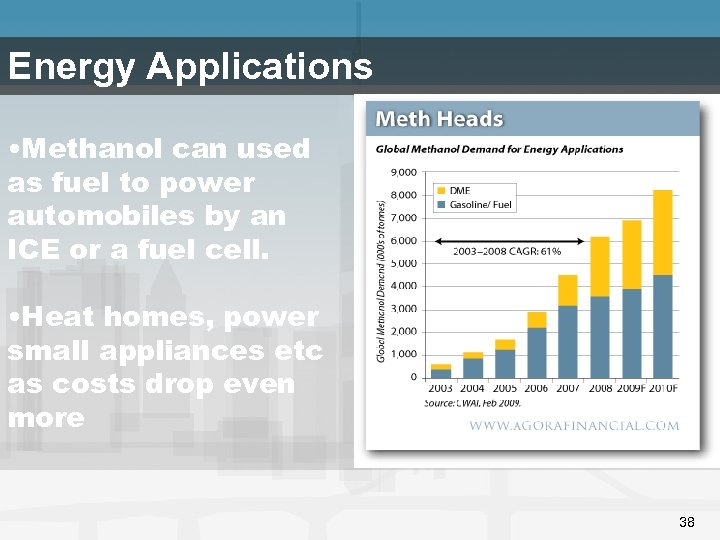
Energy Applications • Methanol can used as fuel to power automobiles by an ICE or a fuel cell. • Heat homes, power small appliances etc as costs drop even more 38
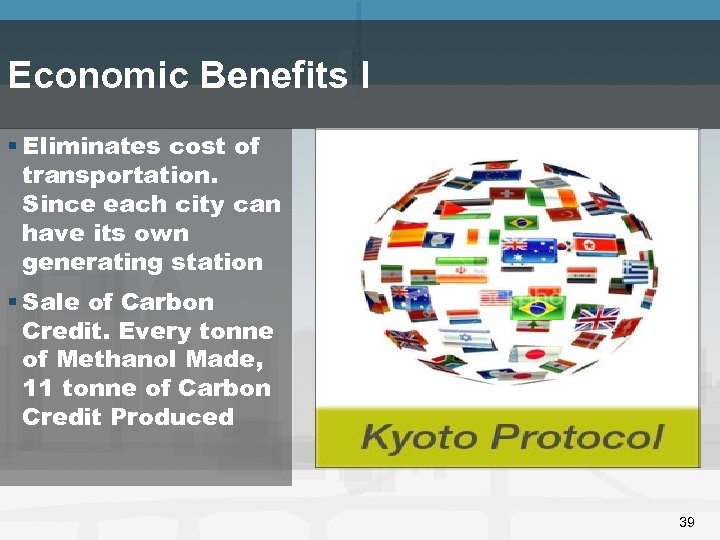
Economic Benefits I § Eliminates cost of transportation. Since each city can have its own generating station § Sale of Carbon Credit. Every tonne of Methanol Made, 11 tonne of Carbon Credit Produced 39
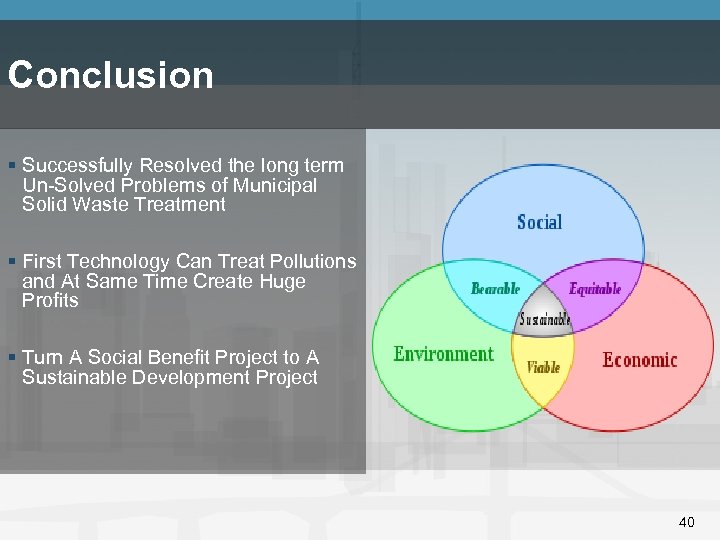
Conclusion § Successfully Resolved the long term Un-Solved Problems of Municipal Solid Waste Treatment § First Technology Can Treat Pollutions and At Same Time Create Huge Profits § Turn A Social Benefit Project to A Sustainable Development Project 40
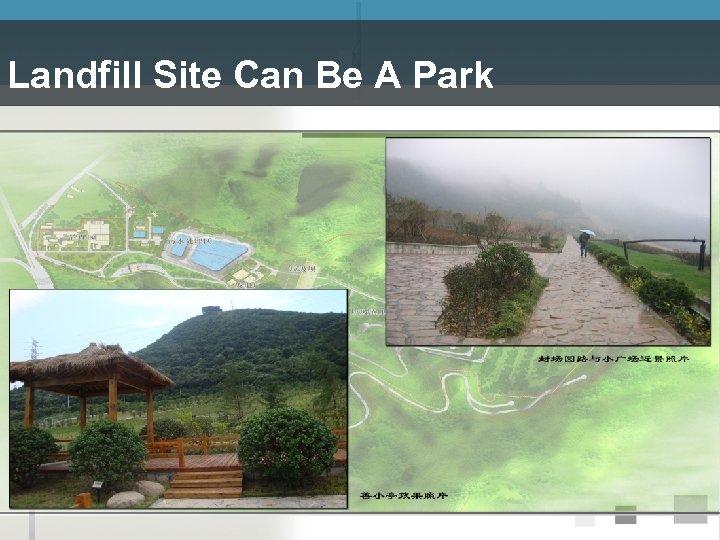
Landfill Site Can Be A Park
конец Xu Fei (Philip) Wu Skype: philip. wu +1 (519)884 -9865 philip. wu@wyenvironmental. com www. wyenvironmental. com Your time and consideration is appreciated! 42
Скачать презентацию WXF Bio-Energy A Green Sustainable Waste to Energy
6fcdf310cbc46d04b4be106dd7bcd752.ppt