


 Скачать презентацию www wlpgroup com Understanding and Developing Our Resilience
316b088e2480147b2dd329b47d3b338c.ppt
- Количество слайдов: 46
 www. wlpgroup. com Understanding and Developing Our Resilience Strategies for Strengthening Our Capacities for Surviving (and Thriving on) Organizational Change © 2005, Photograph by Jeff Russell
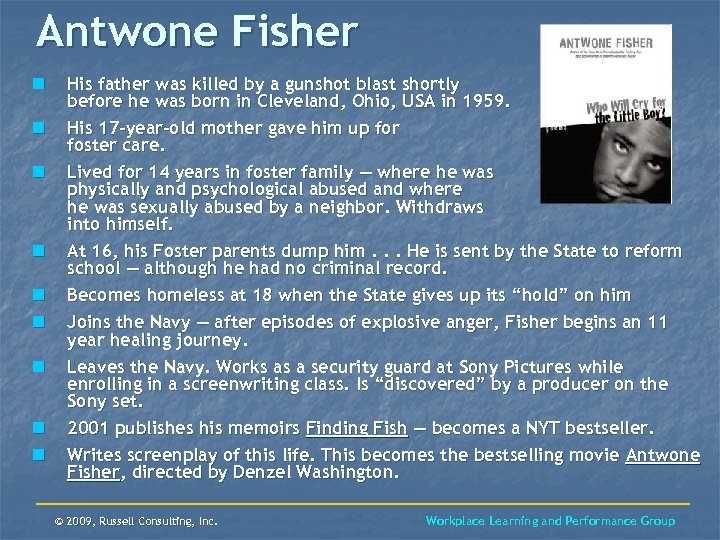 Antwone Fisher n n n n n His father was killed by a gunshot blast shortly before he was born in Cleveland, Ohio, USA in 1959. His 17 -year-old mother gave him up for foster care. Lived for 14 years in foster family — where he was physically and psychological abused and where he was sexually abused by a neighbor. Withdraws into himself. At 16, his Foster parents dump him. . . He is sent by the State to reform school — although he had no criminal record. Becomes homeless at 18 when the State gives up its “hold” on him Joins the Navy — after episodes of explosive anger, Fisher begins an 11 year healing journey. Leaves the Navy. Works as a security guard at Sony Pictures while enrolling in a screenwriting class. Is “discovered” by a producer on the Sony set. 2001 publishes his memoirs Finding Fish — becomes a NYT bestseller. Writes screenplay of this life. This becomes the bestselling movie Antwone Fisher, directed by Denzel Washington. © 2009, Russell Consulting, Inc. Workplace Learning and Performance Group
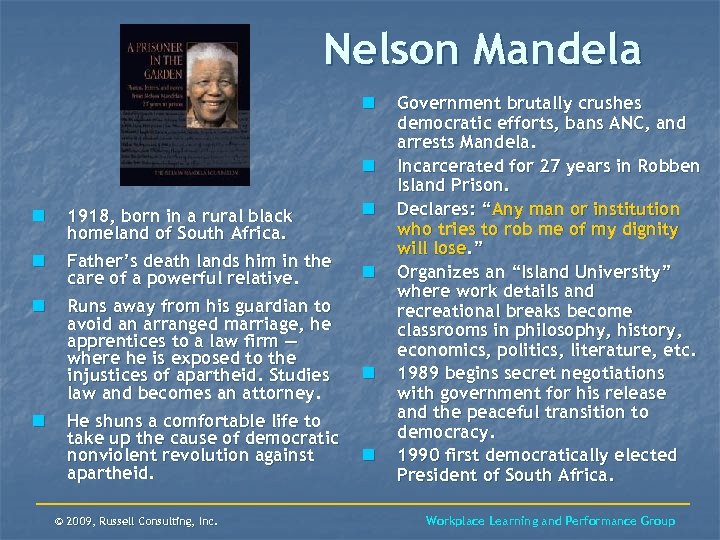 Nelson Mandela n n n 1918, born in a rural black homeland of South Africa. n Father’s death lands him in the care of a powerful relative. n Runs away from his guardian to avoid an arranged marriage, he apprentices to a law firm — where he is exposed to the injustices of apartheid. Studies law and becomes an attorney. n He shuns a comfortable life to take up the cause of democratic nonviolent revolution against apartheid. © 2009, Russell Consulting, Inc. n n Government brutally crushes democratic efforts, bans ANC, and arrests Mandela. Incarcerated for 27 years in Robben Island Prison. Declares: “Any man or institution who tries to rob me of my dignity will lose. ” Organizes an “Island University” where work details and recreational breaks become classrooms in philosophy, history, economics, politics, literature, etc. 1989 begins secret negotiations with government for his release and the peaceful transition to democracy. 1990 first democratically elected President of South Africa. Workplace Learning and Performance Group
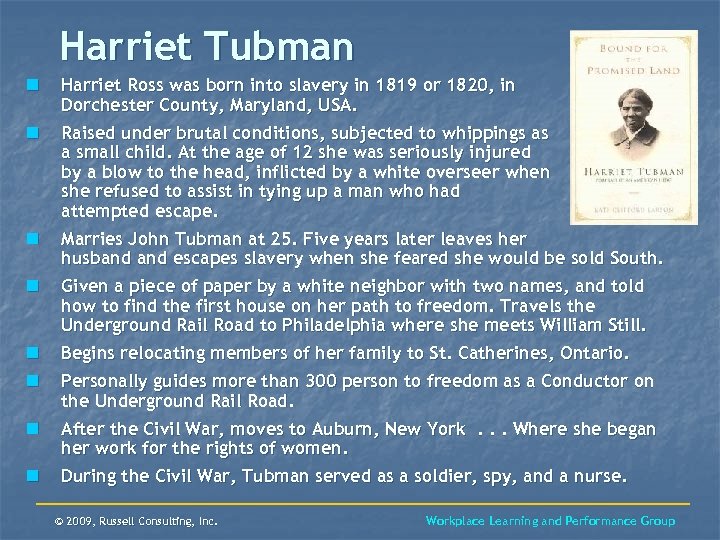 Harriet Tubman n Harriet Ross was born into slavery in 1819 or 1820, in Dorchester County, Maryland, USA. n Raised under brutal conditions, subjected to whippings as a small child. At the age of 12 she was seriously injured by a blow to the head, inflicted by a white overseer when she refused to assist in tying up a man who had attempted escape. n Marries John Tubman at 25. Five years later leaves her husband escapes slavery when she feared she would be sold South. n Given a piece of paper by a white neighbor with two names, and told how to find the first house on her path to freedom. Travels the Underground Rail Road to Philadelphia where she meets William Still. n n Begins relocating members of her family to St. Catherines, Ontario. n After the Civil War, moves to Auburn, New York. . . Where she began her work for the rights of women. n During the Civil War, Tubman served as a soldier, spy, and a nurse. Personally guides more than 300 person to freedom as a Conductor on the Underground Rail Road. © 2009, Russell Consulting, Inc. Workplace Learning and Performance Group
 Viktor Frankl — 1905 -1997 n n n Born in Vienna, Austria. At age 4 wanted to become a doctor. 1928 organizes free counseling centers for youth in Vienna. 1930 earns his doctorate in medicine. Continues training in neurology and runs psychiatric unit. 1938 Nazis invade Austria. He applies for a VISA to the U. S. — but decides to stay to care for his elderly parents. 1942 appointed director of neurological unit at the only Jewish hospital in Vienna. He begins writing The Doctor and the Soul. 1942: He marries, but soon his entire extended family is arrested and deported to the camps. His wife, parents, and brother all perish in the camps. His manuscript is destroyed upon arriving in Auschwitz. Helps organize a camp lecture series and concert performances. Succumbs to Typhoid fever. Stays alive by focusing on reconstructing his manuscript on stolen pieces of paper. 1945 Auschwitz liberated. Publishes his reconstructed book and then writes Man’s Search for Meaning in only nine days — selling over 5 million copies in U. S. alone. © 2009, Russell Consulting, Inc. Workplace Learning and Performance Group
 Our Learning Objectives n Define resilience and its importance n Describe the emotional roller-coaster of change n Identify the disruptive nature of change n Identify the characteristics that enable someone to be resilient n Assess your RQ n Develop resilience in yourself and support its development in others © 2009, Russell Consulting, Inc. Workplace Learning and Performance Group
 Resilience. . . n What does it mean to be resilient? n Why is resilience important to us as individuals? n To our organization? © 2009, Russell Consulting, Inc. Workplace Learning and Performance Group
 What Resilience Looks Like. . . Resilient people. . . n View problems and challenges as opportunities. n Learn from their mistakes/failures. n Succeed despite their hardships. n Seek out new and challenging experiences. © 2009, Russell Consulting, Inc. Workplace Learning and Performance Group
 What Resilience Looks Like. . . n Don’t let anxiety and doubts overwhelm them. n Have a sense of humor and realistic optimism under stress. n Don’t feel shame or depression in the face of failure. n Transform helplessness into power. n Move from being a victim to being a survivor. © 2009, Russell Consulting, Inc. Workplace Learning and Performance Group
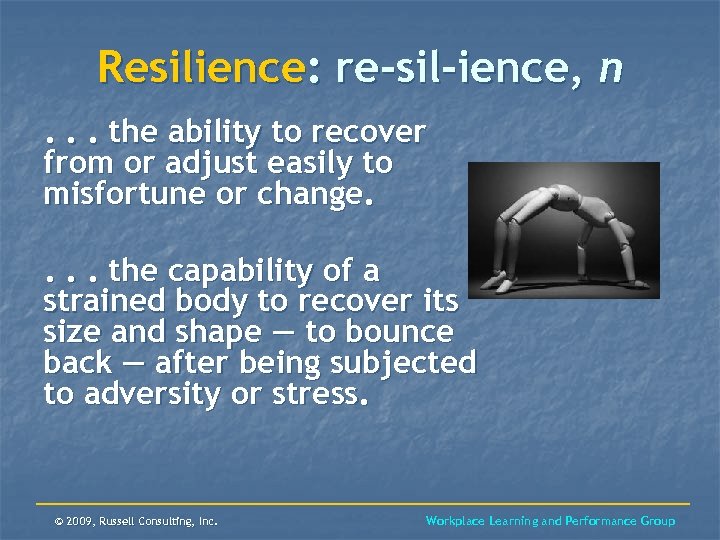 Resilience: re-sil-ience, n. . . the ability to recover from or adjust easily to misfortune or change. . the capability of a strained body to recover its size and shape — to bounce back — after being subjected to adversity or stress. © 2009, Russell Consulting, Inc. Workplace Learning and Performance Group
 Why We Need Resilience @ Work n Rapid changes in our environment. n Pressures to do more with less. n The need to play multiple roles, wear multiple hats, and satisfy multiple customers in our jobs. n Work/life balance OUT of balance. n Greater workplace diversity. n Changing job descriptions. © 2009, Russell Consulting, Inc. Workplace Learning and Performance Group
 Why We Need Resilience @ Work n Increasing pressure to achieve higher levels of performance. n Outsourcing, downsizing, and the fear of job loss. n Project overload. n Loss of control over our work. n Mergers and acquisitions — blending (and the clash) of organizational cultures. n Uncertainty about the future. . . © 2009, Russell Consulting, Inc. Workplace Learning and Performance Group
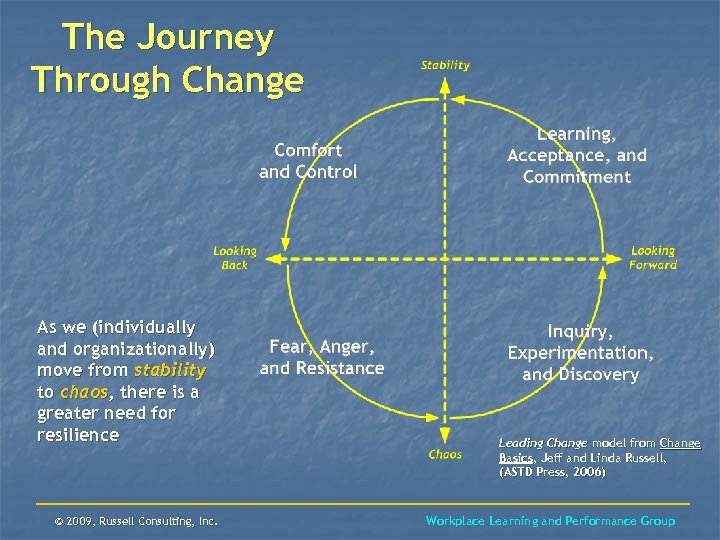 The Journey Through Change As we (individually and organizationally) move from stability to chaos, there is a greater need for resilience © 2009, Russell Consulting, Inc. Leading Change model from Change Basics, Jeff and Linda Russell, Basics, (ASTD Press, 2006) Workplace Learning and Performance Group
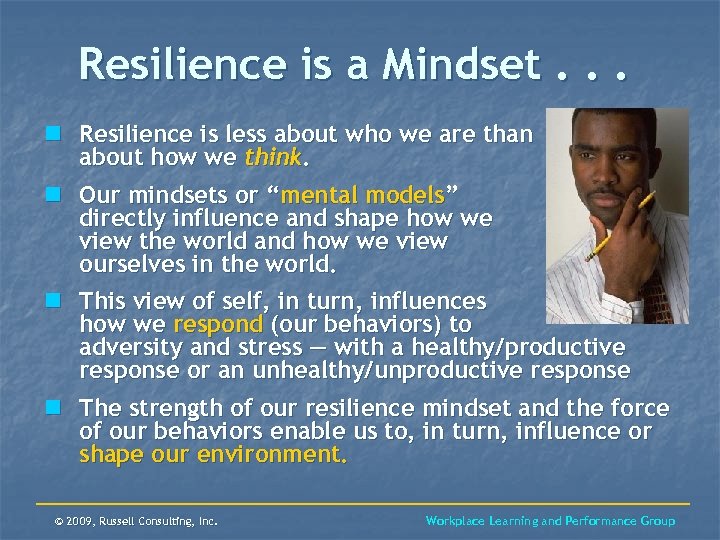 Resilience is a Mindset. . . n Resilience is less about who we are than about how we think. n Our mindsets or “mental models” directly influence and shape how we view the world and how we view ourselves in the world. n This view of self, in turn, influences how we respond (our behaviors) to adversity and stress — with a healthy/productive response or an unhealthy/unproductive response n The strength of our resilience mindset and the force of our behaviors enable us to, in turn, influence or shape our environment. © 2009, Russell Consulting, Inc. Workplace Learning and Performance Group
 Human Nature. . . 1. People want to maintain control over their lives. 2. People develop self-confidence and psychological health by building stable and effective relationships with others. 3. Our sense of control, comfort, and well-being results from the degree of certainty we have about our life. 4. Change disrupts our ability to predict what’s in store for us. 5. The more a change disrupts our ability to envision our future, the greater our confusion, fear, anxiety, and self-doubt. 6. Resilience enables us to survive, even thrive, on the challenges posed by a changing environment © 2009, Russell Consulting, Inc. Workplace Learning and Performance Group
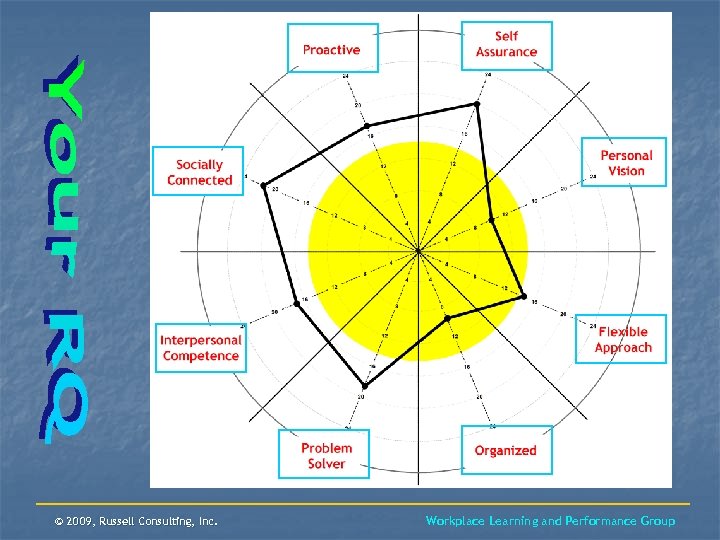
 Assessing Your Resilience n Respond to each of the 32 statements using the six-point scale n Transfer your scores to the Score Sheet (page 3, 5, or 7 [note to consultant, choose page depending upon which version of the RQ you are using]) n Calculate your RQ dimension scores and your Overall RQ score © 2009, Russell Consulting, Inc. Workplace Learning and Performance Group
 Characteristics of Resilient People n What enables someone to be resilient? n What characteristics might people develop in themselves to strengthen their resilience? © 2009, Russell Consulting, Inc. Workplace Learning and Performance Group
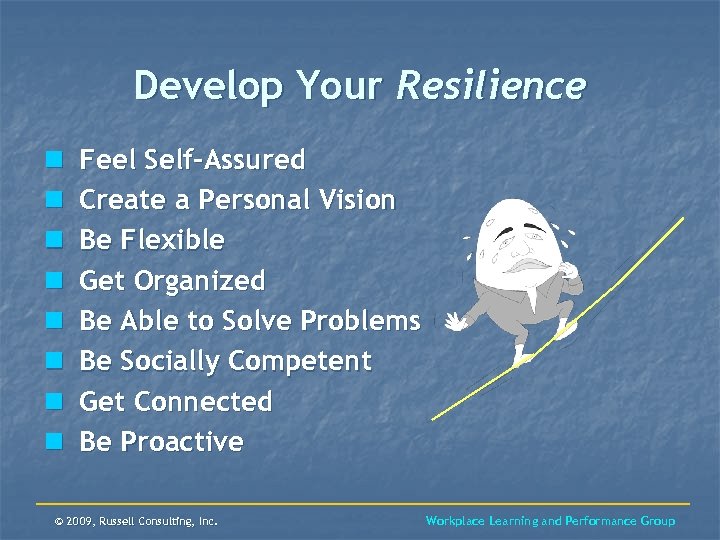 Develop Your Resilience n n n n Feel Self-Assured Create a Personal Vision Be Flexible Get Organized Be Able to Solve Problems Be Socially Competent Get Connected Be Proactive © 2009, Russell Consulting, Inc. Workplace Learning and Performance Group
 First Dimension: Self-Assurance n Viewing the world as complex and challenging. . . But filled with opportunity. n Holding a positive self-perception. n Confident in one’s ability to meet any challenge with hope and realistic optimism. © 2009, Russell Consulting, Inc. Workplace Learning and Performance Group
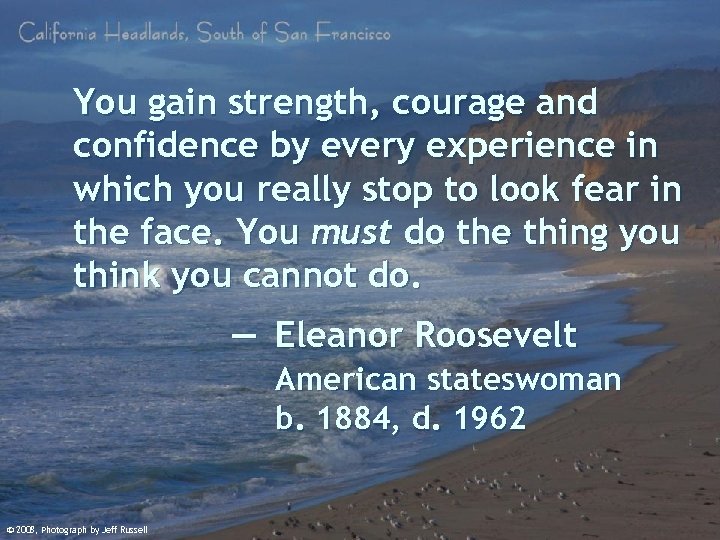 You gain strength, courage and confidence by every experience in which you really stop to look fear in the face. You must do the thing you think you cannot do. — Eleanor Roosevelt American stateswoman b. 1884, d. 1962 © 2008, Photograph by Jeff Russell
 Second Dimension: Personal Vision/Purpose n Knowing what you believe in. n Having a clear vision of what you want to accomplish/achieve. n Approaching adversity and stress with a sense of hope. n Belief and purpose carries you forward into life. © 2009, Russell Consulting, Inc. Workplace Learning and Performance Group
 Destiny is no matter of chance. It is a matter of choice: It is not a thing to be waited for, it is a thing to be achieved. — William Jennings Bryan U. S. statesman and politician b. 1860, d. 1925 © 2008, Photograph by Jeff Russell
 Third Dimension: Flexible/Adaptable n Aware of and sensitive to changes in the environment. n Able to shift gears in response to what is happening. n Remaining true to your purpose/vision while making room for other’s ideas and opportunities. . . © 2009, Russell Consulting, Inc. Workplace Learning and Performance Group
 Blessed are the flexible, for they shall not be bent out of shape. — Dr. Michael Mc. Griffy © 2000, Photograph by Jeff Russell
 It is not the strongest of the species that survive, nor the most intelligent, but the most responsive to change. — Charles Darwin British naturalist c. 1809 -1882 © 2005, Photograph by Jeff Russell
 Fourth Dimension: Organized n Creating structures and methods to bring order and stability on your own terms. n Setting realistic goals for yourself. n Managing the moments with calm and clarity of purpose. . . © 2009, Russell Consulting, Inc. Workplace Learning and Performance Group
 Fifth Dimension: Problem Solver n Thinking critically and reflectively. n Viewing impossible problems as challenges and opportunities for learning and growth. n Collaborating with others. n Anticipating setbacks and missteps. n Solving problems for the long-term. n Viewing failures as opportunities for inspiration © 2009, Russell Consulting, Inc. Workplace Learning and Performance Group
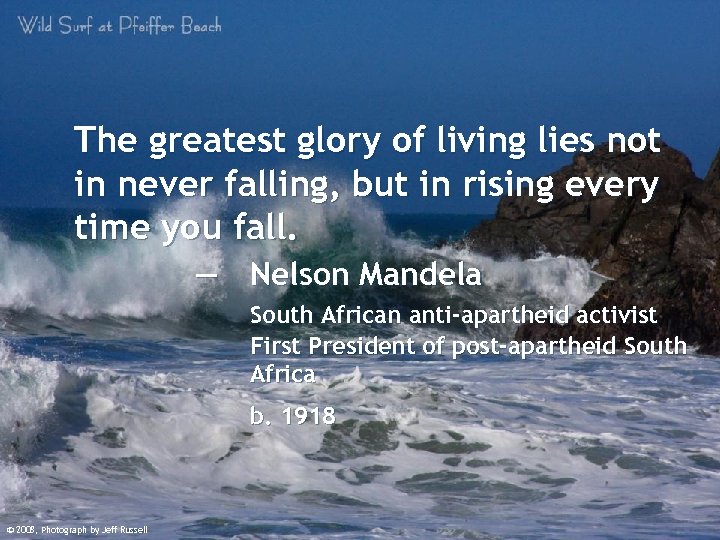 The greatest glory of living lies not in never falling, but in rising every time you fall. — Nelson Mandela South African anti-apartheid activist First President of post-apartheid South Africa b. 1918 © 2008, Photograph by Jeff Russell
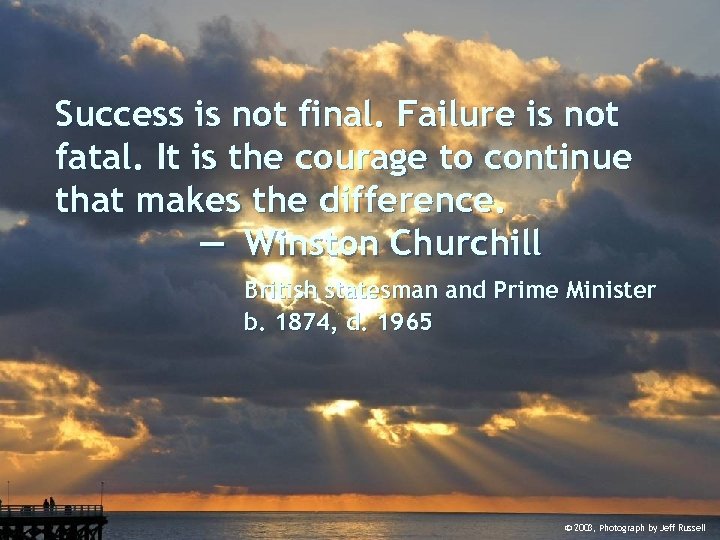 Success is not final. Failure is not fatal. It is the courage to continue that makes the difference. — Winston Churchill British statesman and Prime Minister b. 1874, d. 1965 © 2003, Photograph by Jeff Russell
 Sixth Dimension: Interpersonal Competence n Demonstrating empathy and understanding for others. n Displaying emotional intelligence — self -awareness, self-control, and social awareness. n Laughing at yourself. n Seeking out others’ perspectives. © 2009, Russell Consulting, Inc. Workplace Learning and Performance Group
 Seventh Dimension: Socially Connected n Reaching out to others. n Building bridges, sharing solutions, exploring opportunities together. n Discovering common ground. n Contributing to other’s welfare — giving of yourself. n Touching others’ hearts. . . © 2009, Russell Consulting, Inc. Workplace Learning and Performance Group
 Eighth Dimension: Proactive n Engaging change directly. n Focusing on — and expanding — your sphere of influence. n Focusing on actions that you can take vs. waiting for others to act. n Experiencing small victories. . . n Leading others through change by setting the example. . . © 2009, Russell Consulting, Inc. Workplace Learning and Performance Group
 © 2009, Russell Consulting, Inc. Workplace Learning and Performance Group
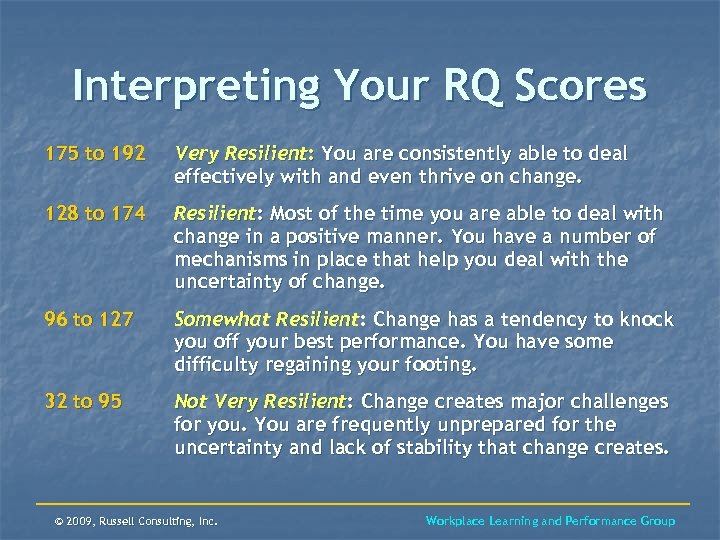 Interpreting Your RQ Scores 175 to 192 Very Resilient: You are consistently able to deal effectively with and even thrive on change. 128 to 174 Resilient: Most of the time you are able to deal with change in a positive manner. You have a number of mechanisms in place that help you deal with the uncertainty of change. 96 to 127 Somewhat Resilient: Change has a tendency to knock you off your best performance. You have some difficulty regaining your footing. 32 to 95 Not Very Resilient: Change creates major challenges for you. You are frequently unprepared for the uncertainty and lack of stability that change creates. © 2009, Russell Consulting, Inc. Workplace Learning and Performance Group
 People are always blaming their circumstances for what they are. I don't believe in circumstances. The people who get on in the world are the people who get up and look for the circumstances they want, and if they can't find them, make them. ― George Bernard Shaw Irish playwright b. 1856, d. 1950 © 2005, Photograph by Jeff Russell
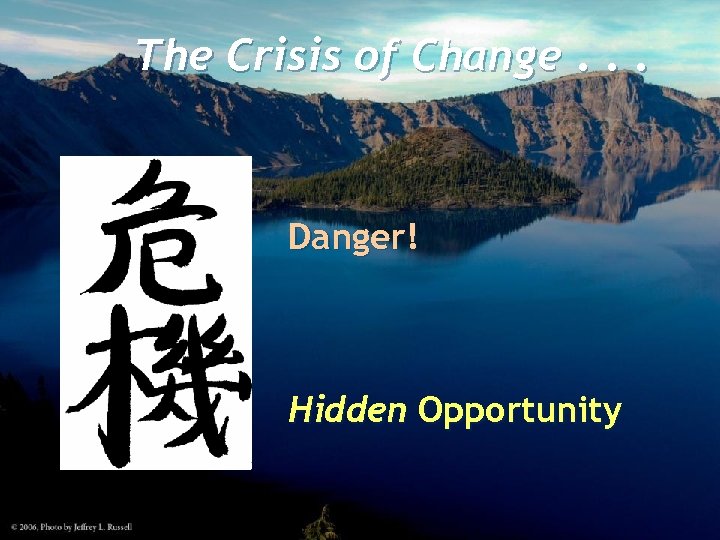 The Crisis of Change. . . Danger! Hidden Opportunity
 Developing Resilience n What actions or new ways of thinking can you take/embrace to strengthen your resilience? n What actions can you take to help strengthen resilience in others? © 2009, Russell Consulting, Inc. Workplace Learning and Performance Group
 Strengthening Your Resilience n Know what’s important to you — define your personal vision and your core values n Reframe your mental models — challenge your assumptions about yourself and others n Identify what you can change/influence and what you can’t and focus on what you can influence © 2009, Russell Consulting, Inc. Workplace Learning and Performance Group
 Strengthening Your Resilience n Assume a “can do, ” proactive attitude n Take care of yourself — mentally and physically n Reach out to others — find new connections and strengthen existing ones n Create/build a discipline that gives you the structure/stability/order you need © 2009, Russell Consulting, Inc. Workplace Learning and Performance Group
 Helping Others Strengthen Their Resilience. . . n Remind people what ISN’T changing n Increase opportunities for social connections n Increase communication about the coming changes/challenges n Shift grousing and whining toward problem solving n Listen to their anxieties and fears n Acknowledge their losses n Engage staff in developing a shared vision of a realistically optimistic future © 2009, Russell Consulting, Inc. Workplace Learning and Performance Group
 Helping Others Strengthen Their Resilience. . . n Encourage a healthy work/life balance n Hold “brown bag” seminars on health, wellness, stress management, taking care of yourself, etc. n Promote EAP (employee assistance program) services n Explain the “whys” of the change/challenges n Celebrate the little victories along the way n Keep the team together n Break problems/challenges into bite-size pieces © 2009, Russell Consulting, Inc. Workplace Learning and Performance Group
 Change is inevitable, growth is optional. . . (Resilient people are able to choose growth) © 2006, Photograph by Jeff Russell
 Sometimes I lie awake at night, and I ask, "Where have I gone wrong? “ Then a voice says to me. . . "This is going to take more than one night. ” — Charles M. Schulz Charlie Brown in "Peanuts“ American Cartoonist b. 1922, d. 2000 © 2005, Photograph by Jeff Russell
 Somebody has to do something. . . and it's just incredibly pathetic that it has to be us. — the late Jerry Garcia (of the Grateful Dead) b. 1942, d. 1995 © 2005, Photograph by Jeff Russell
 Recommended Reading n The Resilience Factor, by Karen Reivich and Andrew Shatté (New York: Broadway Books, 2002) n The Power of Resilience, by Robert Brooks and Sam Goldstein (New York: Mc. Graw-Hill Contemporary Books, 2004) © 2009, Russell Consulting, Inc. Workplace Learning and Performance Group
 Thank you for the opportunity to guide you in exploring your resilience! ww. wlpgroup. com Developed by © 2000, Photograph by Jeff Russell