


 Скачать презентацию www pumpkininc com Small Spacecraft Missions How
51283f9f15c6d5c05a3396d56d3517fa.ppt
- Количество слайдов: 44
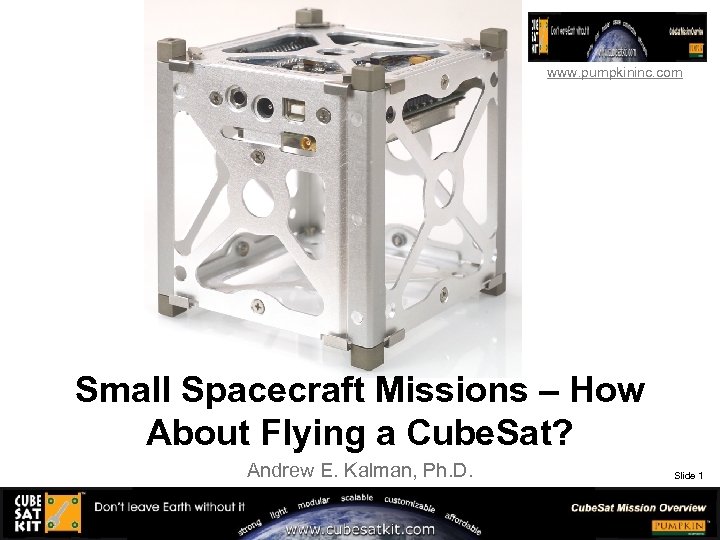 www. pumpkininc. com Small Spacecraft Missions – How About Flying a Cube. Sat? Andrew E. Kalman, Ph. D. Slide 1
 Small Spacecraft Missions www. pumpkininc. com • Starts with a goal • Followed by § § § Obtaining funding Constructing the spacecraft (SC) Integrating & launching the SC Deploying the SC into its orbit Operating the SC Analysis of the mission data Slide 2
 Mission Goal www. pumpkininc. com • Obtain government grant? • Science mission? • Commercial opportunity? • National prestige? • Educational programs / benefits? • Workforce & industry development? • A mission can be as simple as constructing a desk model, to balloon-launching a payload, to a full-fledged orbital deployment. Slide 3
 Mission Goal www. pumpkininc. com • Constraints: § § § § Time Money Launch opportunities Manpower Available technology Capabilities of selected SC platform Risk • Process (the NASA way) vs. People (the Cube. Sat way) Slide 4
 Mission Goal www. pumpkininc. com • Focus on the mission / payload • Buy as much as possible, so as to accelerate development and capitalize on the rapid pace of technology. You’ll be very busy developing all the unique things for your mission / payload anyway. Slide 5
 Cube. Sats www. pumpkininc. com • Why build your SC to the Cube. Sat standard? § § § Rapid development cycle – not “career satellites” Large, open community Simple specification Reasonable chance of success (see track record) Low per-mission costs (though high per-kg costs) LEO orbits for now, GTO etc. later w/rad-hard. w LEO orbits are a relatively benign environment, therefore COTS components are OK § Now accepted as secondary payload § Current trends in technology (low-power, miniaturization, large feature set) are ideal fit to small spacecraft § No experience required! Slide 6
 Cube. Sats www. pumpkininc. com • Cube. Sat specification proposed by Stanford Prof. Bob Twiggs, maintained & upgraded by Cal Poly • Very stable specification – few changes over time • Standardization has created a growth industry serving the Cube. Sat community’s needs § § Deployers – P-POD (Cal Poly), X-POD (SFL/UTIAS), etc. Solar panels Power systems Radios • Popular – ca. 20 10 x 10 cm (1 U) Cube. Sats launched • Launch costs have stayed at $30 -$50 k / Cube. Sat • Launch providers now showing strong interest (NASA, Space. X, Russia, India, etc. ) Slide 7
 Fundraising www. pumpkininc. com • $100 k-$150 k “hard” costs per 1 U Cube. Sat § § § § Electronics Structure Radio(s) Solar Panels Tools (software, hardware, etc. ) Ground stations (modest) Launch • “Soft” costs (I. e. labor, testing, travel, program management, etc. ) are typically 1 x to 3 x hard costs Slide 8
 Fundraising www. pumpkininc. com • 1 U Cube. Sats (1 liter volume, 1 kg mass) are relatively small – only ca. 30% of the mass and volume are available for an internal payload. Such spacecraft are constrained to one or maybe two payloads / experiments. • Therefore it’s harder to attract multiple partners to join you in the development of a 1 U Cube. Sat. • 1 U Cube. Sats are great starter spacecraft – they lay the foundation (construction, operation, technology) for later, more sophisticated missions. • Nevertheless, when designing your 1 U Cube. Sat you should strive to be as efficient as possible (space- and volume-wise) so as to be able to attract other parties to aid in funding by carrying their payload, too. Slide 9
 Fundraising www. pumpkininc. com • Having a hands-on prototype to display / show to potential funding sources is an excellent way to raise awareness. N. B. AEK’s experience at trade shows. § Buy one (e. g. Cube. Sat Kit (CSK)) § Build one in a machine shop, etc. § Build one via Rapid Prototyping (RP) machine from 3 D CAD model § Paper cut-out (inexpensive!) Slide 10
 Fundraising www. pumpkininc. com • Be realistic about what you are promoting. A 1 U Cube. Sat cannot deliver Hubble-telescope-like images. • A 1 U can grow to 1. 5 U or 2 U or 3 U if it better meets your mission requirements. • Be as public as possible. “Broadcast yourself. ”You never know when an interested party may find you and your project. N. B. AEK’s contact with Company E. Slide 11
 Fundraising www. pumpkininc. com • Opportunities § National and global advertising are expensive. Even at >$200 K, Cube. Sats are cheap at this level. With the space race now on, consider your Cube. Sat’s advertising potential. § Bob Twigs / Katy. Sat / KYSat – “multimedia Cube. Sats” with classroom involvement. § “Social conscience” investors. “Giving back to the community”, esp. by investing in space, education and global awareness. § Government funding. Chances of winning grant / funding can be small. Long approval times. Not too expensive to put togeter proposals, however – just man-hours. Competing against “proposal mills”. Fosters a disciplined approach due to required accountability. Slide 12
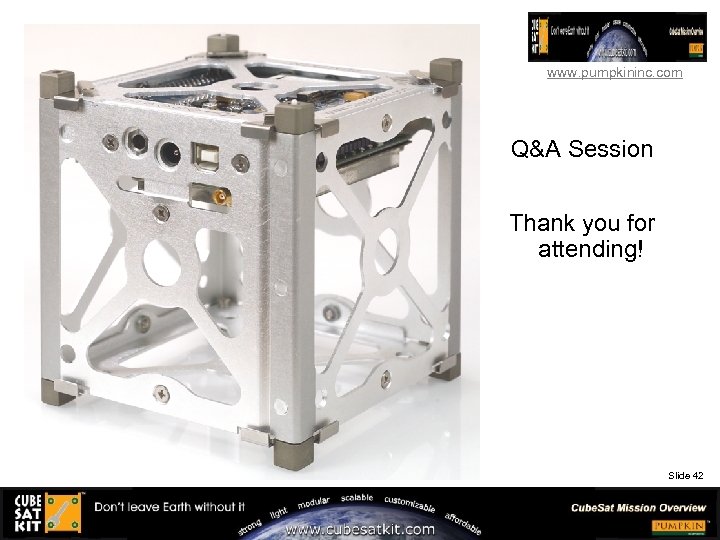
 Construction www. pumpkininc. com • Cube. Sat specification (from Cal Poly) § § § 100 mm x 100 mm cross-section 1 kg mass 113. 5 mm height (1 U), 227 mm height (2 U), 340. 5 mm height (3 U) 6. 5 mm from each face (CSK: 7 mm top & bottom) Spec allows for 113 mm diameter structure • Materials § § § Spec essentially requires aluminum (Al), esp. for contact surfaces 6061 -T 6 & 7075 -T 6 common, machinable Al 5052 -H 32 is bendable Al as used in CSK Titanium (Ti) too heavy Carbon Fiber (CF) has outgassing and consistency problems • Fasteners § Non-magnetic, Stainless-steel preferred Slide 13
 Construction www. pumpkininc. com • Understanding Cube. Sat sizes § § § § P-POD can accommodate up to three 1 U Cube. Sats To date, only 1 U & 3 U Cube. Sats have been built / launched X-POD (SFL/UTIAS version of P-POD) also 3 U P-POD might be extended to 5 U for ESPA ring use CSK available in 0. 5 U, 1. 5 U, 2 U, 3 U sizes PCBSat (concept) ca. 22 mm (0. 2 U) thick. MAST was a 3 U that separated into three Cube. Sats of different shapes and sizes Slide 14
 Construction www. pumpkininc. com • Purpose of corner foot springs (x 2) § Push neighboring Cubesats apart after ejection from P-POD • Purpose of Remove-Before-Flight (RBF) switch § Satisfy certain safety requirements of launch provider • Purpose of Launch switch § Energize / start Cube. Sat after ejection from P-POD Slide 15
 Construction www. pumpkininc. com • Faces of a Cube. Sat and some uses § § Left/right sides – often totally covered in solar cells Front – access port for RBF, PC link, antenna, etc. Rear – Often with sensor, antenna, etc. + solar cells Top/bottom – antennas, sensors, etc. Usually the fewest solar cells here • Shock / G-loads § Not a major issue, in that Cube. Sats don’t seem to have much trouble surviving shake table tests and launch. Some delicate components may pose issues (e. g. solar cells). Delfi-C 3 § Fasteners should be staked or potted. Conformal coatings on PCBs are probably a good idea, but not required. • Tin Whiskers § More and more components are Ro. HS/Pb-free. Aerospace technically exempt in most markets. Limited lifespan mitigates this problem somewhat. Slide 16
 Construction www. pumpkininc. com • Thermal issues § Lots of analysis has been done § While not immune to thermal issues, Cube. Sats don’t seem to be too sensitive to this. On-orbit data shows that most electronics is happy. § Batteries are the most thermally-sensitive component – many failures suspected due to temp (and outgassing) § On-orbit thermal data is available for several Cube. Sats. Also, Gene. Sat (active control) has bio temp data as well. Slide 17
 Construction www. pumpkininc. com • Attitude determination and control (ADAC) § Passive AC via magnets quite popular § Torque coils sandwiched in Solar Panel PCBs also popular § Active ADAC via momentum wheels and torque coils, with sensors (e. g. IMI-100) § All active AC requires power – may exceed 1 U Cube. Sat’s power budget • Delta-V possible, but not much room for existing thrusters Slide 18
 Construction www. pumpkininc. com • Electronics Layout § Horizontal stacking – “most obvious / common” § Vertical stacking – has benefits for > 1 U sizes (e. g. long PCBs in a 2 U) § Perimeter arrangement – lots of room centrally, more difficult to rigidize PCBs (they flex relative to one another), no ability to stack connectors • Connectors vs. Wires § Wires are more likely to fail simply because they are more complex – endpoints, crimps, chafing, etc. § May be best solution for certain applications (e. g. high-current runs, solar panel connections) • Point-to-point wiring is theoretically optimal in terms of minimizing mass, but practically speaking it’s a big problem, esp. in assembly / disassembly Slide 19
 Construction www. pumpkininc. com • Tradeoffs of connector types § Board-to-board: pin current ratings are just what you need (+), more flexible inter-PCB spacing (+), pin out only those signals that you use (+), totally custom boards (-), only one assembly sequence / layout (-), rigid / no wiping (-) § Board stacking: typically large inter-board spacing (+/-), all pins (even unused ones) carried through (-), more general, more standard (+), pins all high-current (excess capacity) (-), arbitrary assembly sequence (+), wiping action (+) • Boards can be interconnected via § Unique point-to-point / board-to-board topology (e. g. CP series) § “Backplane” topology (e. g. Gene. Sat – dedicated slots) § Stacking approach (e. g. Cube. Sat Kit) Slide 20
 Construction www. pumpkininc. com • Payloads § Internal payloads – common to most 1 U Cube. Sats. Constrained by internal volumes, walls, connector pinouts. § Semi-internal payloads – e. g. Gene. Sat, Pharma. Sat where the payload is an integral but separable part of the overall Cube. Sat structure. May have more internal volume available, usually employ a custom electrical interface, are tied to the structural design of the Cube. Sat structure § External payloads – “bolt-on”, like 4 th-generation CSK. Have the potential to be highly modular, since tied primarily to Cube. Sat specification for dimensional issues, not to Cube. Sat itself. Slide 21
 Construction www. pumpkininc. com • Electrical Power System (EPS) § Simple EPS – batteries (or solar) only § Standard EPS – solar cell interface, PPT, batteries • Li-Ion & Li-Poly rapidly becoming battery of choice. We probably won’t see Ni. Cd & Ni. Mh on future Cube. Sats • Lithium cell voltage is nom. +3. 7 V – this impacts power systems directly, as combining them in series introduces many concerns, primarily safety. • Batteries are there for peak power consumption. • Quake. Sat – 15 W – dead batteries – reset out of eclipse. Slide 22
 Construction www. pumpkininc. com • EPS features § § § Status / telemetry should be available at all times (ground, flight) Should be chargeable on the ground (e. g. USB or external source) PPT is useful, but not absolutely required Overcurrent trip protection / fault detection and resolution a must EPS can be analog or digital control Battery temp range should be EPS’ first priority – e. g. heat to above 0 C for Li-Poly, disconnect in overtemp conditions Slide 23
 Construction www. pumpkininc. com • Operating voltages § Transceivers run at +5 V due to power considerations. Typical efficiency is < 25%. • u. C’s run at +5 V, +3. 3 V, …, +1. 8 V. • Various peripherals have narrower ranges. E. g. SD card: +3. 3 V (low-voltage cards do exist) • Most flash memory (e. g. in the u. C) cannot reprogram itself at very low voltage. Charge pumps (big power consumer) are required. • Many +3. 3 V parts are +5 V I/O tolerant. • Recommend +5 V and/or +3. 3 V EPS outputs, I/O at +3. 3 V • Level-shifting can consume a lot of power, esp. if charge pumps are used. Slide 24
 Construction www. pumpkininc. com • Solar cells § 85 mm (? ) width across face of Cube. Sat for solar cells § Some USA cells are ITAR-controlled, similar available outside USA § Cover glass (protects against micrometeorites) is likely unnecessary (saves mass), but cover glass adhesive is required to protect cells against atomic oxygen § Cells in series should not be too high (> 28 V) nor too low (< 5 -8 V). Efficiencies favor buck (I. e. down) converters. Redundant strings of cells a must. § Pumpkin’s idea of low-cost TASC cells treated as surface-mount components being tested successfully on Ky. Sat project § 0. 062” (1. 5 mm) PCBs form a nice, strong but heavy substrate for solar cells. CF might be a lighter and better option. § SC with distributed power may want to route solar cell output voltage to all corners of SC Slide 25
 Construction www. pumpkininc. com • Radios § Many different ones, some COTS, some home-made § Existing radios have been small and simple § They’ve also been slow (e. g. Libertad-1 at 300 bps with AX-25) or power-hungry (MHX series receive idle current @ 115 m. A) § This is an unfinished / unresolved area of concern for the Cube. Sat community. • Bands / Frequencies § Primarily amateur due to licensing restrictions: 144 MHz, 433 MHz, 920 MHz, 2. 4 GHz • Antennas § Patch (Gene. Sat), x 4 (Delfi-C 3), stubby (MAST), tape measure (CPn), genetic algorithms (NASA ARC) § Omni required if no attitude control. With ADAC, can improve antenna gain Slide 26
 Construction www. pumpkininc. com • Command & Data Handling (C&DH) § Processors used: 8051, AVR, PIC, MP 430, x 86/Pentium, etc. (all COTS parts, industrial temp range – 40 C to +85 C § Programming & debugging environment is perhaps more important than the choice of processor, though some choices will be based on u. C’s peripherals § The more data you need to process, the better the architecture needs to be § C&DH may be done on a dedicated processor or on the SC’s sole processor • Watchdogs § Internal (sw) watchdog – simple and window-style § External (hw) watchdog – independent operation § DTMF decoder system reset via GS (e. g. Quake. Sat) Slide 27
 Construction www. pumpkininc. com • Software § The best software is the software you and your team understand best § As complexity increases, an RTOS or other structured framework will help you in managing the complexity to achieve reliable operation § RTOS-enabled products are all around you (e. g. MHX-920 A, MHX -2420) § Complex monolithic software is hard to understand even harder to maintain / grow. Strive for modular software. Build, test & verify incrementally. Don’t forget to backup. Slide 28
 Construction www. pumpkininc. com • Tools § Dedicated Lab • Team areas / assignments § § § § Software Electronics Structures / Mechanics / Thermal Communications & GS Power Documentation / Web Project Management • Clear documents (e. g. pin allocations on bus) are a requirement • Team-based approach, with regular oversight and mentors’ meetings Slide 29
 Construction www. pumpkininc. com • Current state-of-the-art low-power x 86/Pentium-class SBCs consume ca. 5 W for “Windows useable” processor speeds. That is too high to run 24 x 7 in a 1 U Cube. Sat. May be OK for a larger Cube. Sat. Alternatively, may need to be controlled (sleep, run, sleep) to maximize utility while minimizing power consumption Slide 30
 Integration & Launch www. pumpkininc. com • Luckily for the Cube. Sat builder, this stage of the mission is beyond your control! • You: § § Ensure your Cube. Sat meets the Cube. Sat specifications Send it to your integrator (e. g. Cal Poly) Wait for launch If possible, send team to launch site in order to observe & learn • Launches are often delayed. You should be prepared for this, with procedures to (re-)charge batteries while in storage, verify functionality, even update software fix bugs. • Launch is risky! Rocket may explode! E. g. Russia 2006. Slide 31
 Integration & Launch www. pumpkininc. com • Traditionally, Cube. Sats were considered low-priority and risky, and so were ejected last from the rocket as a safety precaution. This severely limited the orbits available to Cube. Sats. However, the thinking vis-à-vis Cube. Sats is now changing, as rockets are now willing to “drop off” Cube. Sats at low orbits before the primary payload is released. Why? Because carrying just 3 P-POD deployers (9 1 U Cube. Sats) is worth $0. 5 M to the launch company. It’s good business for them. • Also, the fully enclosed P-POD has proven itself to isolate the primary payload(s) from any bad behavior (early turnon, parts falling off) of the low-cost, low-priority Cube. Sats inside. Slide 32
 Integration & Launch www. pumpkininc. com • The Test & Integration (T&I) stage may be the first time your Cube. Sat is verified by a third party against the specification. The integrator takes a “hands-off” view of your SC during T&I. Decision is simply Pass/Fail. • Traditionally, 1 U Cube. Sats must conform strictly. • 3 U Cube. Sats (10 x 30 cm) have more leeway, as they are alone in the P-POD. Some P-POD customizations have been done, e. g. Delfi-C 3 w/X-POD. Slide 33
 Deployment www. pumpkininc. com • Deployments is also beyond our control. • P-POD has an excellent deployment record. • An independent (VHF/UHF) beacon is extremely important for getting an initial fix on your Cube. Sat. TLEs, etc. may be incorrect / swapped via-a-vis another Cube. Sat. Beacons should transmit at least once per minute to allow multiple detections per pass per ground station. Libertad-1 experience (10 minute interval, QSL cards for initial fix). • Beacon data should be simple, unencoded, with health & status info (e. g. time, battery status, etc. ) • Companies (e. g. 1 Earth Research) can do initial acquisition for a fee. Slide 34
 Deployment www. pumpkininc. com • Orbits are based on the requirements of the primary payload. Must choose what’s available. • With no delta-V, constellations are dependent strictly on drift and staggered deployments. Slide 35
 Operating the SC www. pumpkininc. com • Cube. Sat-class SC comms are highly directional – low BW uplink (command control), high BW downlink (data). • Receiver(s) must be as low-power as possible to be able to operate 24 x 7. • Tx must be high-power (esp. with omni antennas) to close the loop and maintain a decent link margin. Slide 36
 Operating the SC www. pumpkininc. com • The challenge is to balance the opportunities to download data from the SC against the on-board power required to process and compress the data. Storage capacities (e. g. SD cards) greatly exceed the daily download capacity of a typical Cube. Sat Kit to a single Ground Station (GS). Therefore you need either multiple GS’s to maximize downlink contact, or you need to process and compress data on board for the relatively rare GS contact. A 1 U Cube. Sat does not have much power on board to spend all its time crunching large amounts of data … especially if a Pentium-class processor is required for this task. Slide 37
 Operating the SC www. pumpkininc. com • Jamie Cutler’s Mercury Ground Station software provides a scalable foundation upon which to add a variety of GScentric software packages (e. g. GSEOS). Runs on Virtual Machines (VM), which has multiple advantages, not the least of which is resistance to being hacked (just reboot VM from image). Isolated testing, etc. • Very important to be able to script the SC’s operation as Quake. Sat did via Linux scripting – fully unattended operation, with daily script uploads from the Mercury GS to the SC, and daily data sent via email to operations team. Slide 38
 Operating the SC www. pumpkininc. com • GS “hardware creep”. Many of the “higher performance” GS setups (e. g. using MHX) have dedicated comm hardware on both ends. Such pairings make the GS incompatible with other SCs. • Currently, the small SC community is faced with the problem of “We have a 1000 W, 2 m^3 mobile GS. Won’t you please install this at your GS site? No! • So, working towards a common radio that satisfies the community requirements and can (in a GS) communicate simultaneously with multiple SCs would be a big step forward. Slide 39
 Operating the SC www. pumpkininc. com • In the future, a software-defined (SD) radio with a simple but powerful transmitter and complex receiver software in the GS will allow the GS to listen to multiple SC, reconfigure on-the-fly, and permit utilization of new encoding schemes. • GPS: Space GPS is now available, at $15 -40 K. Hasn’t flown in a Cube. Sat yet. Slide 40
 Analysis www. pumpkininc. com • Analysis on § Mission (payload) data § SC (operational) data • Satellite may live much longer than you anticipate (e. g. Quake. Sat) or primary mission may be short-lived (e. g. Gene. Sat). If operation is autonomous / scriptable, you may get a lot more data than you bargained for. • Uploadable or alternate stored code enables multiple, different missions to be performed after the primary mission is over (e. g. Gene. Sat and injecting faults to see if GS software can detect them heuristically) Slide 41
 www. pumpkininc. com Q&A Session Thank you for attending! Slide 42
 Notice www. pumpkininc. com This presentation is available online in Microsoft Power. Point and Adobe Acrobat formats at: ® ® www. pumpkininc. com/content/doc/press/Pumpkin_CSMO 2007. ppt and: www. pumpkininc. com/content/doc/press/Pumpkin_CSMO 2007. pdf Slide 43
 Appendix www. pumpkininc. com • Speaker information § Dr. Kalman is Pumpkin's president and chief technology architect. He entered the embedded programming world in the mid-1980's. After co-founding Euphonix, Inc – the pioneering Silicon Valley high-tech pro-audio company – he founded Pumpkin, Inc. to explore the feasibility of applying high-level programming paradigms to severely memory-constrained embedded architectures. He is the creator of the Salvo RTOS and the Cube. Sat Kit. He holds two United States patents and is a consulting professor in the Aero & Astro department at Stanford University. Contact Dr. Kalman at aek@pumpkininc. com. • Acknowledgements § Stanford Professors Bob Twiggs' and Jamie Cutler’s continued support for the Cube. Sat Kit, and their inputs on enhancements and suggestions for future Cube. Sat Kit products, are greatly appreciated. § Pumpkin’s Salvo and Cube. Sat Kit customers, whose real-world experience with our products helps us improve and innovate. • Salvo, Cube. Sat Kit and Cube. Sat information § More information on Pumpkin’s Salvo RTOS and Pumpkin’s Cube. Sat Kit can be found at http: //www. pumpkininc. com/ and http: //www. cubesatkit. com/, respectively. • Copyright notice © 2000 -2007 Pumpkin, Inc. All rights reserved. Pumpkin and the Pumpkin logo, Salvo and the Salvo logo, The RTOS that runs in tiny places, Cube. Sat Kit Bus and the Cube. Sat Kit logo are all trademarks of Pumpkin, Inc. Don’t leave Earth without it is a service mark of Pumpkin, Inc. All other trademarks and logos are the property of their respective owners. No endorsements of or by third parties listed are implied. All specifications subject to change without notice. Slide 44