


 Скачать презентацию www oasis-open org Partner Selection in End to
61a192a174eab1807ff0c1e64b56563f.ppt
- Количество слайдов: 37
 www. oasis-open. org Partner Selection in End to End Resource Planning: An SOA and Data Mining Based Approach MIN NI, PHD Post-doctor research scientist Digital China Post-doctor station
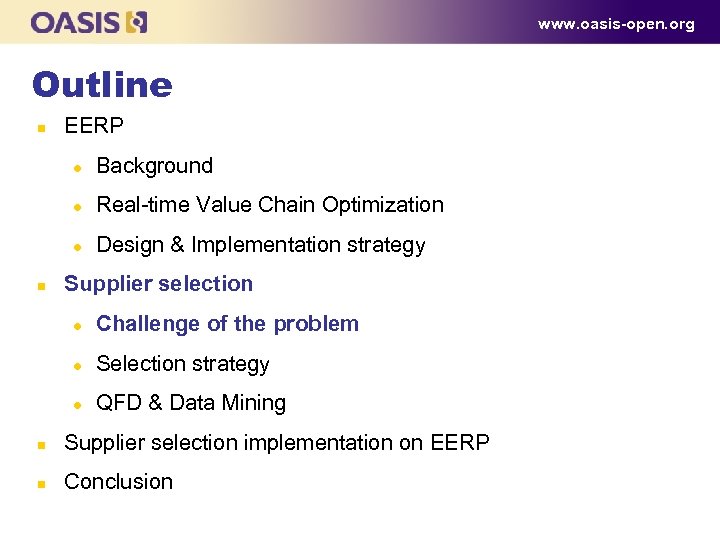
 www. oasis-open. org Outline n EERP l l Real-time Value Chain Optimization l n Background Design & Implementation strategy Supplier selection l Challenge of the problem l Selection strategy l QFD & Data Mining n Supplier selection implementation on EERP n Conclusion
 www. oasis-open. org Outline n EERP l l Real-time Value Chain Optimization l n Background Design & Implementation strategy Supplier selection l Challenge of the problem l Selection strategy l QFD & Data Mining n Supplier selection implementation on EERP n Conclusion
 Changing of business environment Business environment is tougher l l Rapid changing of market landscape Globalization Companies want to: maximize their business results l l l Revenues up profits up costs down Sustaining profit growth becomes critical
 State of the enterprise Crisis of Complexity l No “green-field” development l New applications must integrate with existing heterogeneous “legacy” systems IT Must Deliver Business Agility l Support new business opportunities l Leverage new technologies
 Changes in IT Architecture… n Business management pushes for better IT utilization and greater ROI l n Merger and acquisition have become a fact of life l n Integration of historically separate systems across enterprise borders New systems must be developed with (current or future) heterogeneity in mind l n Re-Use of IT assets, integration of B 2 X and ERP. Results driven. Internet everywhere has created a set of new business models l Integration anywhere and anytime is possible.
 Interoperability via SOA n n n Data, logic and infrastructure accessed by routing XML-based messages (Web Service) throughout Internet Location is meaningless Multiples Services suppliers Ubiquitous computing Preserves and connects existing systems Using the Right Software Architecture brings exponential productivity gains
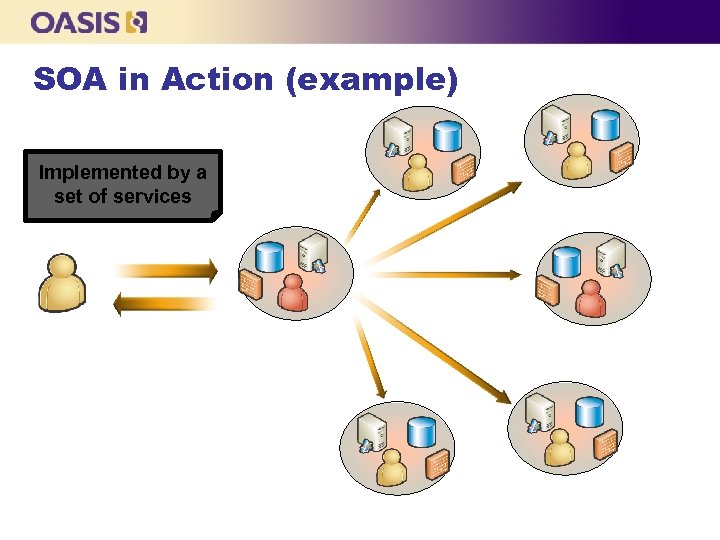 SOA in Action (example) Implementedaby a Triggers business process set of services
 www. oasis-open. org Outline n EERP l l Real-time Value Chain Optimization l n Background Design & Implementation strategy Supplier selection l Challenge of the problem l Selection strategy l QFD & Data Mining n Supplier selection implementation on EERP n Conclusion
 SOA has proven n Data level: l n Lower cost, and more efficient way to integrate application across the enterprises. Application level l Development with Lower entry barrier, easier way to collaborate, and faster development cycle.
 Next step of SOA n Business level: l l How to coordinate different services in business context and achieve the best business model? How to generate the most efficient business process automatically and intelligently? The answer is EERP: End to End Resource Planning
 EERP concept: resource planning With SOA and open standard, we can now help enterprises to improve their profits and sustain the profits, we introduce EERP: n End to end resource planning, optimize the resources along an specified value chain.
 What does EERP do? What is it? n A new way to look at enterprise IT application l n Integration inside and outside of a enterprise border. A new software architecture and platform l l a collection of Web Services that perform various enterprise functions, data exchange, process integration, collaboration and other relevant work. A self-healing, intelligent, and reliable service choreograph platform (Soft. Grid)
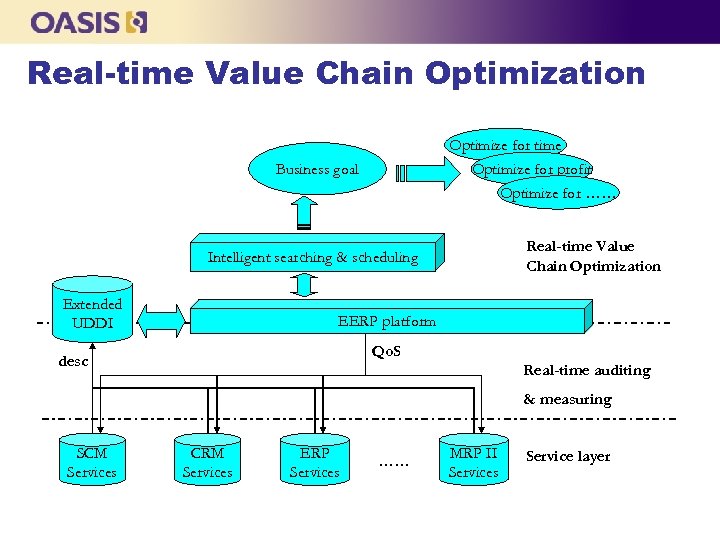 Real-time Value Chain Optimization Optimize for time Optimize for profit Optimize for …… Business goal Real-time Value Chain Optimization Intelligent searching & scheduling Extended UDDI EERP platform Qo. S desc Real-time auditing & measuring SCM Services CRM Services ERP Services …… MRP II Services Service layer
 www. oasis-open. org Outline n EERP l l Real-time Value Chain Optimization l n Background Design & Implementation strategy Supplier selection l Challenge of the problem l Selection strategy l QFD & Data Mining n Supplier selection implementation on EERP n Conclusion
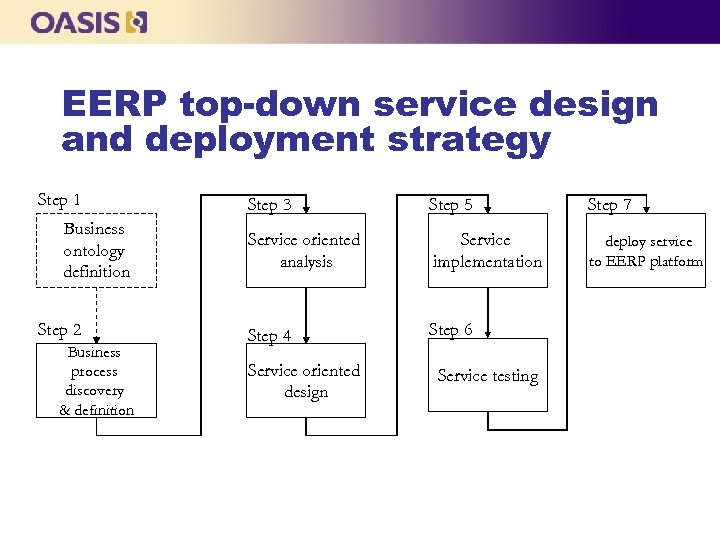 EERP top-down service design and deployment strategy Step 1 Business ontology definition Step 2 Business process discovery & definition Step 3 Step 5 Step 7 Service oriented analysis Service implementation deploy service to EERP platform Step 4 Step 6 Service oriented design Service testing
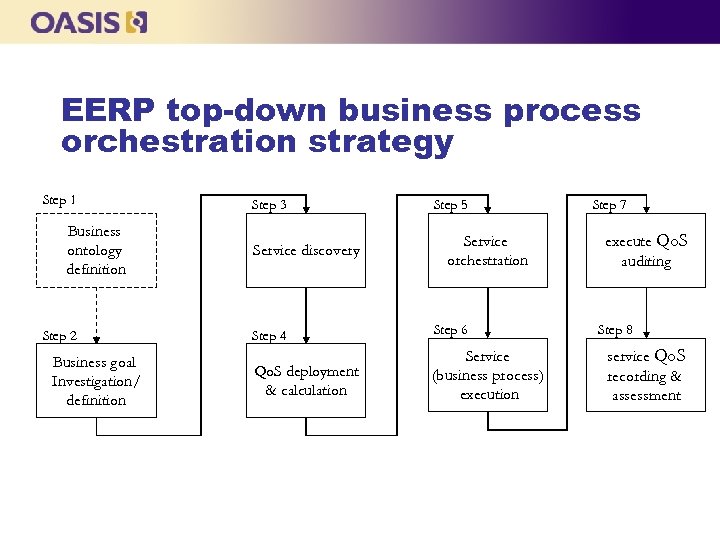 EERP top-down business process orchestration strategy Step 1 Business ontology definition Step 2 Business goal Investigation/ definition Step 3 Service discovery Step 5 Service orchestration Step 4 Step 6 Qo. S deployment & calculation Service (business process) execution Step 7 execute Qo. S auditing Step 8 service Qo. S recording & assessment
 www. oasis-open. org Outline n EERP l l Real-time Value Chain Optimization l n Background Design & Implementation strategy Supplier selection l Challenge of the problem l Selection strategy l QFD & Data Mining n Supplier selection implementation on EERP n Conclusion
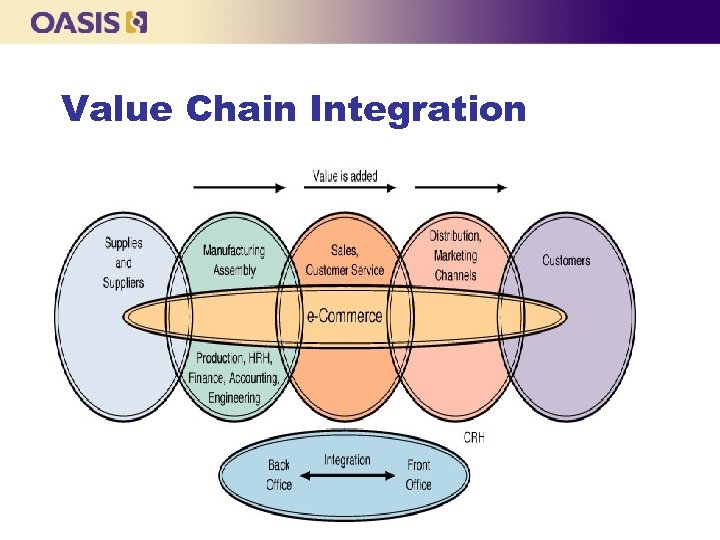 Value Chain Integration
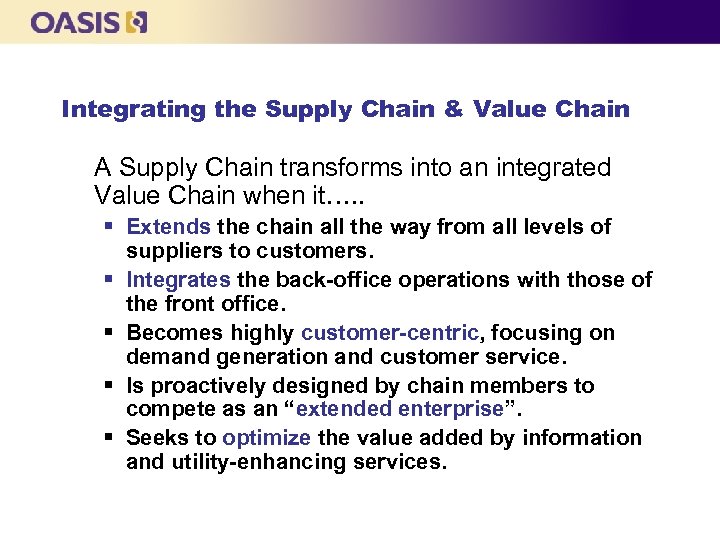 Integrating the Supply Chain & Value Chain A Supply Chain transforms into an integrated Value Chain when it…. . § Extends the chain all the way from all levels of suppliers to customers. § Integrates the back-office operations with those of the front office. § Becomes highly customer-centric, focusing on demand generation and customer service. § Is proactively designed by chain members to compete as an “extended enterprise”. § Seeks to optimize the value added by information and utility-enhancing services.
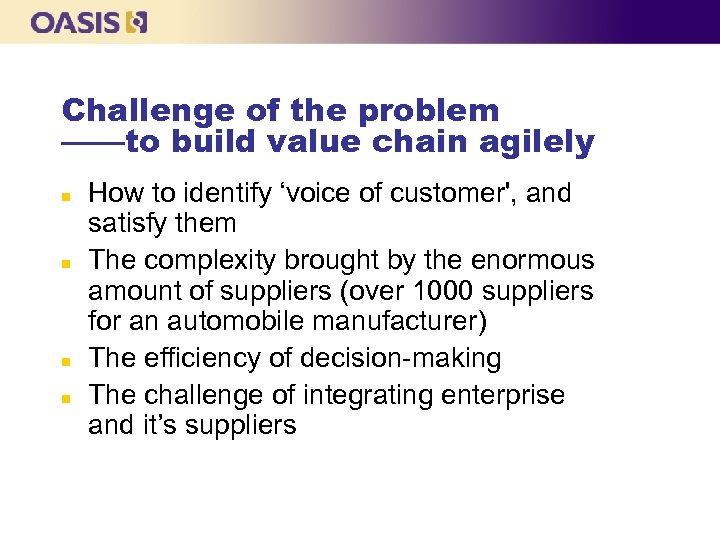 Challenge of the problem ——to build value chain agilely n n How to identify ‘voice of customer', and satisfy them The complexity brought by the enormous amount of suppliers (over 1000 suppliers for an automobile manufacturer) The efficiency of decision-making The challenge of integrating enterprise and it’s suppliers
 www. oasis-open. org Outline n EERP l l Real-time Value Chain Optimization l n Background Design & Implementation strategy Supplier selection l Challenge of the problem l Selection strategy l QFD & Data Mining n Supplier selection implementation on EERP n Conclusion
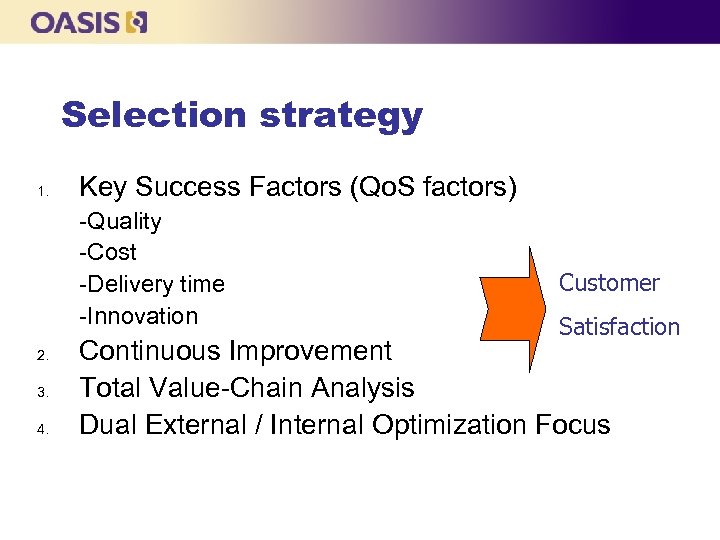 Selection strategy 1. Key Success Factors (Qo. S factors) -Quality -Cost -Delivery time -Innovation 2. 3. 4. Customer Satisfaction Continuous Improvement Total Value-Chain Analysis Dual External / Internal Optimization Focus
 www. oasis-open. org Outline n EERP l l Real-time Value Chain Optimization l n Background Design & Implementation strategy Supplier selection l Challenge of the problem l Selection strategy l QFD & Data Mining n Supplier selection implementation on EERP n Conclusion
 (QFD) Quality Function Deployment Process How to capture customers’ requirements: QFD (aka “House of Quality”) was first implemented by Yoji Akao integrate the “voice of the customer” into the design and delivery of products.
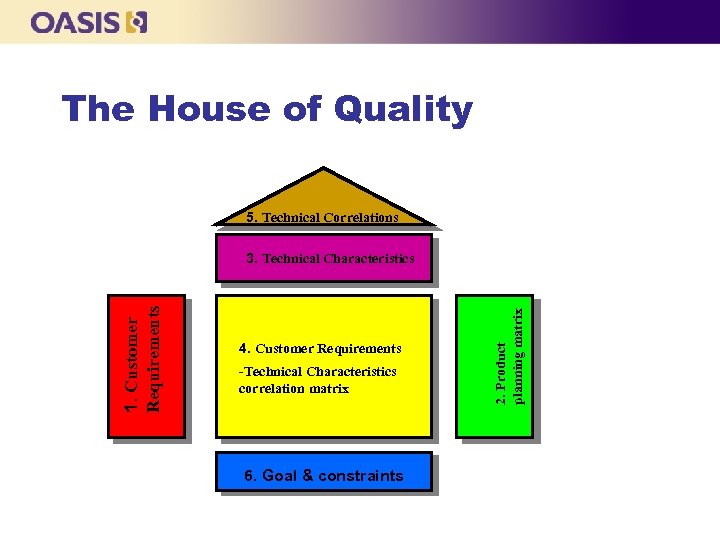 The House of Quality • 5. Roof 5. Technical Correlations 3. Technical • 3. Characteristics 4. Customer Requirements • 4. Inter • -Technical Characteristics • relationships correlation matrix 6. Goal &6. Targets • constraints 2. Product planning matrix 1. Customer Requirements • Requirements
 QFD & Suppliers Selection 1. 2. 3. 4. Draft a list of supplier requirements that contribute to the fulfillment of customers needs. Formulate evaluation criteria for suppliers. Determine the importance (weight) of the criteria. Rank your suppliers, and make appropriate selection that will accommodate customer needs.
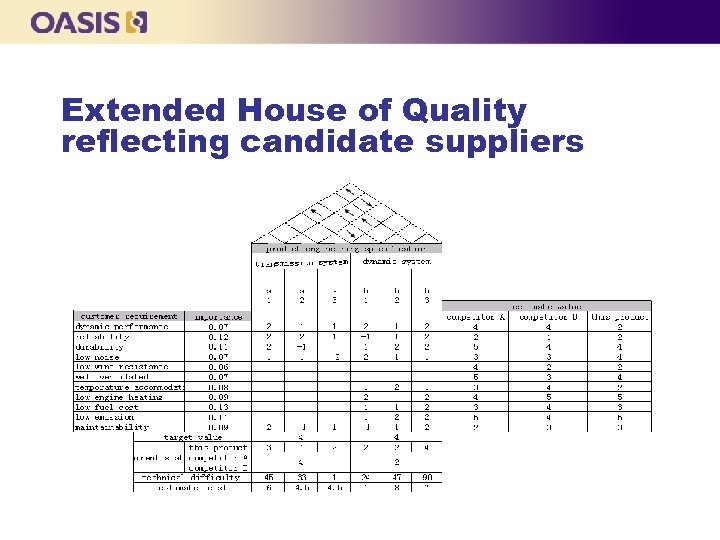 Extended House of Quality reflecting candidate suppliers
 Data Mining in supplier selection n By data mining, frequent fault patterns under different environments and different use patterns, critical requirements can be found; As mining result, frequent fault patterns can be used to build a components correlation matrix; Manufacturers can perform competitive product analysis based on information from customer profiles and the market in order to determine competitive products that greatly affect the concerned product.
 www. oasis-open. org Outline n EERP l l Real-time Value Chain Optimization l n Background Design & Implementation strategy Supplier selection l Challenge of the problem l Selection strategy l QFD & Data Mining n Supplier selection implementation on EERP n Conclusion
 An SOA-based System for supplier selection Why use SOA? Data/Services are distributed/heterogeneous; Why choose EERP? To build real-time value chain and perform optimization;
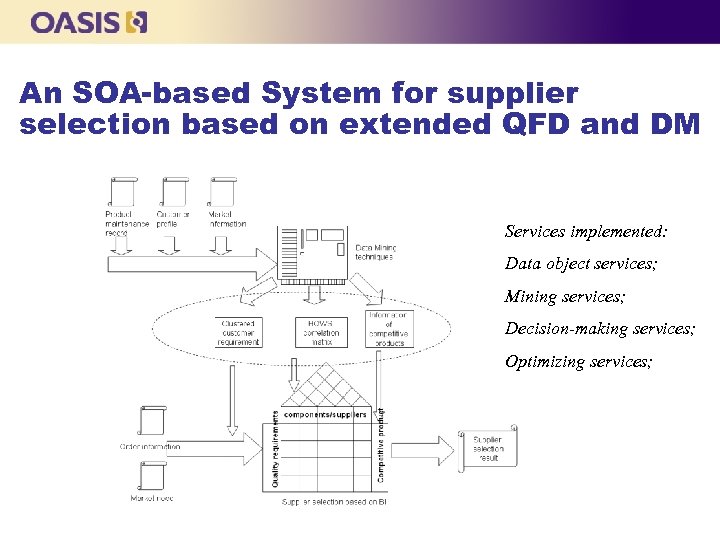 An SOA-based System for supplier selection based on extended QFD and DM Services implemented: Data object services; Mining services; Decision-making services; Optimizing services;
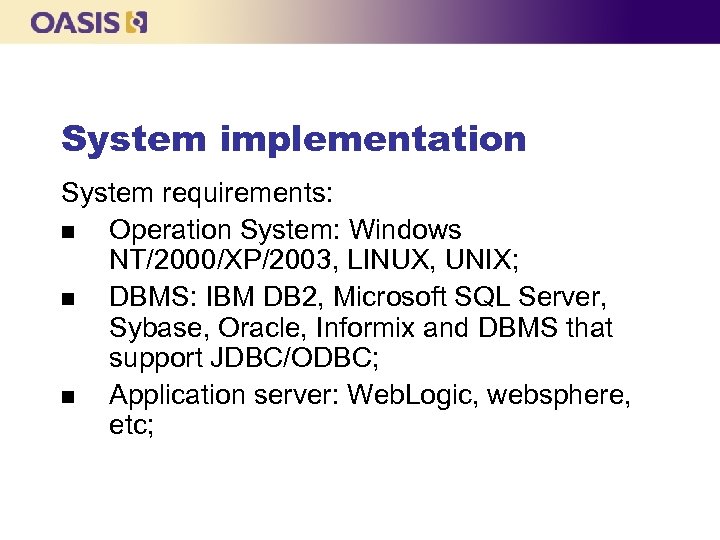 System implementation System requirements: n Operation System: Windows NT/2000/XP/2003, LINUX, UNIX; n DBMS: IBM DB 2, Microsoft SQL Server, Sybase, Oracle, Informix and DBMS that support JDBC/ODBC; n Application server: Web. Logic, websphere, etc;
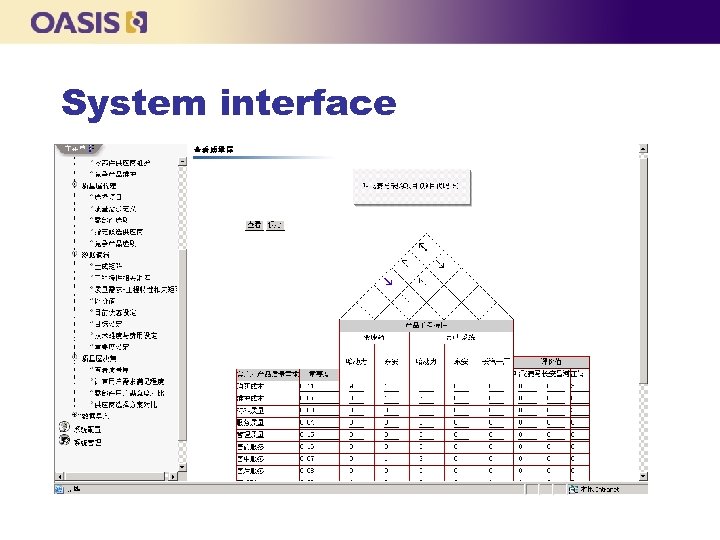 System interface
 www. oasis-open. org Outline n EERP l l Real-time Value Chain Optimization l n Background Design & Implementation strategy Supplier selection l Challenge of the problem l Selection strategy l QFD & Data Mining n Supplier selection implementation on EERP n Conclusion
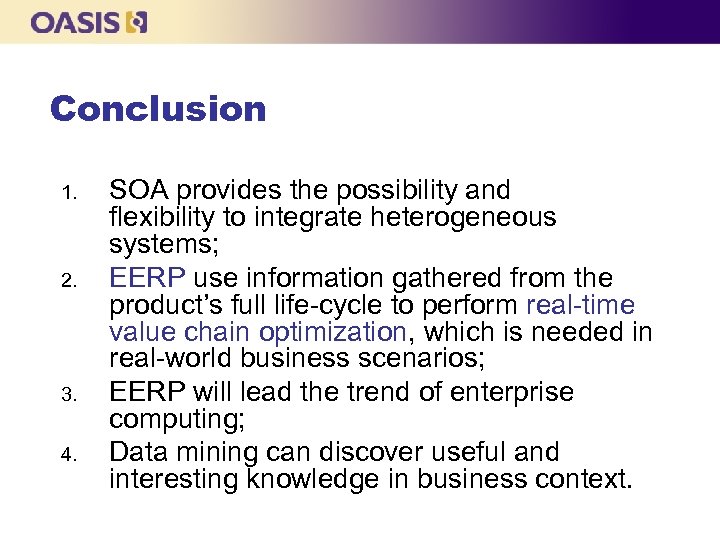 Conclusion 1. 2. 3. 4. SOA provides the possibility and flexibility to integrate heterogeneous systems; EERP use information gathered from the product’s full life-cycle to perform real-time value chain optimization, which is needed in real-world business scenarios; EERP will lead the trend of enterprise computing; Data mining can discover useful and interesting knowledge in business context.
 Thanks!