


 Скачать презентацию www halton gov uk Supporting pupils at
c7f8a66e225965229a352732c9bc6c8b.ppt
- Количество слайдов: 71
 www. halton. gov. uk
 Supporting pupils at school with medical conditions Ann Mc. Intyre Operational Director Children’s Organisation and Provision
 This morning we aim to: • Summarise the requirements of the Children and Families Act 2014 • Clarify roles and responsibilities • Provide advice that will enable you to administer basic medication; and • Identify where further support and training can be obtained
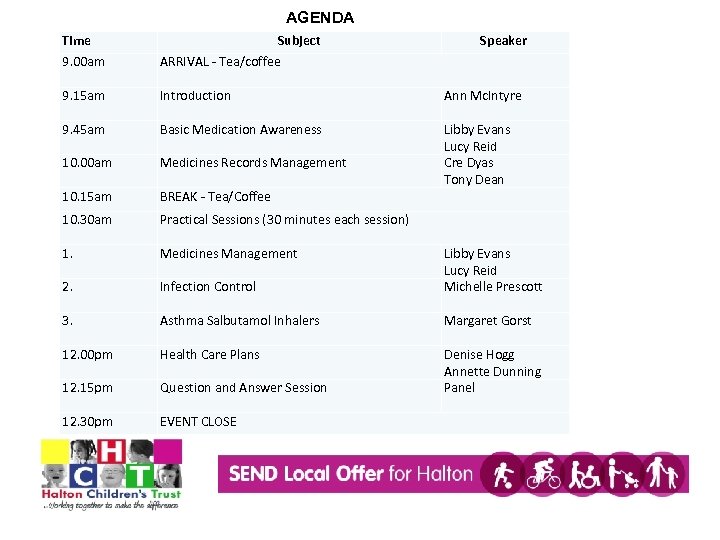 AGENDA Time 9. 00 am 9. 15 am 9. 45 am 10. 00 am 10. 15 am 10. 30 am 1. 2. 3. 12. 00 pm 12. 15 pm 12. 30 pm Subject ARRIVAL - Tea/coffee Introduction Basic Medication Awareness Medicines Records Management BREAK - Tea/Coffee Practical Sessions (30 minutes each session) Medicines Management Infection Control Asthma Salbutamol Inhalers Health Care Plans Question and Answer Session EVENT CLOSE Speaker Ann Mc. Intyre Libby Evans Lucy Reid Cre Dyas Tony Dean Libby Evans Lucy Reid Michelle Prescott Margaret Gorst Denise Hogg Annette Dunning Panel
 Supporting pupils at school with medical conditions • • From 1 st September 2014, governing bodies will have a new statutory duty - under the Children and Families Act 2014 - to ensure schools make arrangements to support pupils with medical conditions. A medical conditions policy will be required, ensuring pupils with medical conditions have full access to education, including physical education and school trips. • Children and young people with medical conditions are entitled to a full education and have the same rights of admission to school as other children. This means that no child with a medical condition should be denied admission or prevented from taking up a place in school because arrangements for their medical condition have not been made. • Statutory duty applies to schools, academies and Pupil Referral Units
 What has stayed the same? • Children and young people with medical conditions are entitled to a full education and have the same rights of admission to school as other children. This means that no child with a medical condition should be denied admission or prevented from taking up a place in school because arrangements for their medical condition have not been made. • Medicines should only be administered at school when it would be detrimental to a child’s health or school attendance not to do so. Where clinically possible, medicines should be prescribed in dose frequencies which enable them to be taken outside school hours
 What has stayed the same? • Any member of school staff may be asked to provide support to pupils with medical conditions, including the administering of medicines, although they cannot be required to do so. Although administering medicines is not part of teachers’ professional duties, they should take into account the needs of pupils with medical conditions that they teach. • Head teachers should make sure that school staff are appropriately insured and are aware that they are insured to support pupils in this way. • Schools should only accept prescribed medicines that are in-date, labelled, provided in the original container as dispensed by a pharmacist and include instructions for administration, dosage and storage
 What has stayed the same? • Children should know where their medicines are at all times and be able to access them immediately. Where relevant, they should know who holds the key to the storage facility. • Medicines and devices such as asthma inhalers, blood glucose testing meters and adrenaline pens should be always readily available to children and not locked away. • A child who has been prescribed a controlled drug may legally have it in their possession if they are competent to do so, but passing it to another child for use is an offence. Monitoring arrangements may be necessary. Schools should otherwise keep controlled drugs that have been prescribed for a pupil securely stored in a non-portable container and only named staff should have access. Controlled drugs should be easily accessible in an emergency. A record should be kept of any doses used and the amount of the controlled drug held in school
 What has stayed the same? • Governing bodies should ensure that written records are kept of all medicines administered to children. • School Nurses - every school has access to school nursing services. They are responsible for notifying the school when a child has been identified as having a medical condition which will require support in school. They may support staff on implementing a child’s individual healthcare plan and provide advice and liaison, for example on training.
 Key Changes • Governing bodies should ensure that their school develop a policy for supporting pupils with medical conditions that is reviewed regularly and is readily accessible to parents and school staff. • A medical conditions policy and arrangements must be in place, so that pupils with medical conditions have full access to education, including school trips and physical education • Governing bodies should ensure that school leaders consult health and social care professionals, pupils and parents to ensure that the needs of children with medical conditions are effectively supported.
 Key Changes • Governing bodies should ensure that the arrangements they set up include details on how the school’s policy will be implemented effectively, including a named person who has overall responsibility for policy implementation. • School staff should receive sufficient and suitable training and achieve the necessary level of competency before they take on responsibility to support children with medical conditions. Head teachers should ensure that sufficient trained numbers of staff are available to implement the policy and deliver against all individual healthcare plans, including in contingency and emergency situations. This may involve recruiting a member of staff for this purpose. • Governing bodies should ensure that sufficient staff have received suitable training and are competent before they take on responsibility to support children with medical conditions.
 Supporting pupils at school with medical conditions In order to support schools to fulfil their statutory duties, a range of resources and support has been developed in conjunction with: • Consultant, Public Health • Health Co-ordinator for Children of School Age • Clinical Manager School Health, Bridgewater • Lead Pharmacist - Halton Locality Medicines Management Team • Commissioning Manager Health, Public Health • Acting Divisional Manager, Inclusion 0 -25 • Principal Health and Safety Advisor • Operational Director, children’s Organisation and Provision • Principal Policy Officer
 Supporting pupils at school with medical conditions These resources will include: • A revised ‘Supporting pupils at school with medical conditions’ policy, which schools can adopt if they wish to do so; • Where to go for training and further guidance; • Information bulletins will be circulated to schools advising them of the changes through the schools e-bulletin, Chairs of Governors Briefings etc. • Information will be made available through Halton’s Local offer and the Children’s Trust websites.
 The role of Governing Bodies The governing body: • must ensure that arrangements are in place to support pupils with medical conditions. • should ensure that the focus is on the needs of each individual child and how their medical condition impacts on their school life. • should ensure that their arrangements give parents and pupils confidence in the school’s ability to provide effective support for medical conditions in school. • must ensure that the arrangements they put in place are sufficient to meet their statutory responsibilities and should ensure that policies, plans, procedures and systems are properly and effectively implemented.
 The role of Governing Bodies The governing body should ensure that: • all schools develop a policy for supporting pupils with medical conditions that is reviewed regularly and is readily accessible to parents and school staff. • the arrangements they set up include details on how the school’s policy will be implemented effectively, including a named person who has overall responsibility for policy implementation. • the school’s policy sets out the procedures to be followed whenever a school is notified that a pupil has a medical condition. • the school’s policy covers the role of individual healthcare plans, and who is responsible for their development, in supporting pupils at school with medical conditions.
 The role of Governing Bodies Governing bodies should ensure that: • written records are kept of all medicines administered to children. • the school’s policy sets out what should happen in an emergency situation. • the appropriate level of insurance is in place and appropriately reflects the level of risk. • the school’s policy sets out how complaints may be made and will be handled concerning the support provided to pupils with medical conditions.
 Staff Training • Governing bodies should ensure that sufficient staff have received suitable training and are competent before they take on responsibility to support children with medical conditions. • Staff must not give prescription medicines or undertake health care procedures without appropriate training (updated to reflect any individual healthcare plans). A first-aid certificate does not constitute appropriate training in supporting children with medical conditions. • Governing bodies should ensure that the school’s policy covers arrangements for children who are competent to manage their own health needs and medicines.
 The role of Headteachers are responsible for implementing this policy and the developing individual healthcare plans and are to ensure that relevant staff have sufficient resources, including training and personal protective equipment, to support pupils with medical conditions. In order to do so they should identify a named person who has overall responsibility for: • ensuring that sufficient staff are suitably trained; • that all relevant staff will be made aware of the child’s condition including any requirement for the child to participate in outside the classroom activities where appropriate; • cover arrangements are in place at all times in case of staff absence or staff turnover to ensure someone is always available
 The role of Headteachers • supply teachers are briefed; • risk assessments have been carried out for school visits, holidays, and other school activities outside of the normal timetable; • procedures are in place to cover any transitional arrangements between schools for any medical issues; • for children starting at the school, necessary arrangements are in place in time for the start of the relevant school term so that they start at the same time as their peers; • Individual Healthcare plans are monitored including identifying pupils who are competent to take their own medication.
 The role of Headteachers • The management of accepting, storing and administering any medication. Note: if the school chooses to hold an emergency Salbutamol Inhaler it should be cross referenced in the Asthma policy; • That appropriate protective equipment is made available to staff supporting pupils at school with medical conditions. • Ensure that there is effective coordination and communications with relevant partners, professionals, parents and the pupils.
 The role of Headteachers should ensure that: - • written records are kept of all medicines administered to children. • the school’s policy sets out what should happen in an emergency situation. • the appropriate level of insurance is in place and appropriately reflects the level of risk. • the school’s policy sets out how complaints may be made and will be handled concerning the support provided to pupils with medical conditions.
 The role of the named person The named person has overall responsibility for policy implementation, including responsibility: • for ensuring that sufficient staff are suitably trained, • to ensure that all relevant staff are made aware of the child’s condition, • to put in place cover arrangements in case of staff absence or staff turnover to ensure someone is always available, • briefing for supply teachers, • to undertake risk assessments for school visits, holidays, and other school activities outside of the normal timetable, and • for monitoring of individual healthcare plans.
 The role of school staff • Any member of school staff may be asked to provide support to pupils with medical conditions, including the administering of medicines, although they cannot be required to do so. • Although administering medicines is not part of teachers’ professional duties, they should take into account the needs of pupils with medical conditions that they teach. • School staff should receive sufficient and suitable training and achieve the necessary level of competency before they take on responsibility to support children with medical conditions. • Any member of school staff should know what to do and respond accordingly when they become aware that a pupil with a medical condition needs help.
 The role of parents Parents should: • provide the school with sufficient and up-to-date information about their child’s medical needs. • be involved in the development and review of their child’s individual healthcare plan, and may be involved in its drafting. • carry out any action they have agreed to as part of their child’s individual healthcare plan implementation, eg provide medicines and equipment and ensure they or another nominated adult are contactable at all times.
 The role of local authorities Local authorities: • are commissioners of school nurses for maintained schools and academies. • have a duty to promote co-operation between relevant partners such as governing bodies of maintained schools, proprietors of academies, clinical commissioning groups and NHS England, • provide support, advice and guidance, including suitable training for school staff, to ensure that the support specified within individual healthcare plans can be delivered effectively. • should work with schools to support pupils with medical conditions to attend full time. Where pupils would not receive a suitable education in a mainstream school because of their health needs, the local authority has a duty to make other arrangements.
 Practice not acceptable • Prevent children from easily accessing their inhalers and medication and administering their medication when and where necessary • Send children with medical conditions home frequently or prevent them from staying for normal school activities, including lunch, unless this is specified in their individual healthcare plans; • If the child becomes ill, send them to the school office or medical room unaccompanied or with someone unsuitable; • Require parents, or otherwise make them feel obliged, to attend school to administer medication or provide medical support to their child, including with toileting issues. • Prevent children from participating, or create unnecessary barriers to children participating in any aspect of school life, including school trips, eg by requiring parents to accompany the child.
 Flu vaccinations • HBC employees can present to the ASDA Pharmacy in Runcorn or Widnes and show their ID badge to get a free flu vaccination. • This runs till November 30 th. Staff are advised to call the store first just to make sure the pharmacist is in. But these are drop in sessions. • Everyone who goes will be asked to fill a consent forms so that we know they have had the vaccination and we can arrange payments to ASDA • Additionally anyone who has a long term condition, is a carer or pregnant can also go to the pharmacy to get a free vaccination ASDA Runcorn number 01928 703210 ASDA Widnes number 0151 422 5912
 Basic Medication Awareness 17 th October 2014 Libby Evans - School Health Nursing Service Lucy Reid - Locality Lead Pharmacist
 Do you have any specific questions or issues you’d like to be covered?
 Aims • Scope of this awareness session • Responsibilities • Why might medication need to be administered within the school setting? • Safe storage and disposal (including controlled drugs) • Safe administration of medicines • Record Keeping
 Scope of the Session What will be covered What’s not covered • Basic awareness • Overview • Reassurance • Specialist techniques • Specific therapeutic areas • Emergency medication
 Why medication might need to be administered within the school setting? • Children with medical needs have the same rights of admission to school. • Most children will at some time have short term medical needs. • Some children however have longer term medical needs and may require medicines on a long term basis to help them keep well. • The administration of medication at school will minimise the time pupils will need to be absent • Some children require emergency medication e. g. adrenaline auto-injector
 Responsibilities General • Medication must be given at home where possible • The health and welfare of the pupil is paramount in all decisions regarding the administration of medication. Therefore if school staff have any concerns regarding medication or dosage for a pupil then advice MUST be sought before any medicine is given.
 Responsibilities • • • Parent/Carers MUST provide all relevant information to the school and any changes MUST be in writing Routinely all medicines MUST be handed to a responsible adult – exception self-management Prescribed medicines MUST always be provided in the original container dispensed by a pharmacist. Non-prescribed medication MUST only be administered in line with the policy and MUST have full written instructions provided by the parent/carer MUST sign the appropriate consent form.
 Responsibilities • • • Staff Never accept medicines out of their original container. Always follow instructions on pharmacy label and/or parental consent form. Record all medicines given in the appropriate manner Adhere to policy and procedures at all times Report any incidents or errors immediately in line with policy and procedures
 Safe Storage • Always store medicines in a secure place with restricted access. • Some medicines need to be stored in a fridge according to manufacturers instructions. These can be stored alongside food but must be kept in an air tight container and clearly labelled. • Large volumes of medicines should not be stored. • Medicines that may be required in an emergency must always be readily available e. g. Inhalers, adrenaline auto-injector • Controlled drugs must be stored securely within a locked cupboard (fixed to a wall)
 Safe Disposal • The medication is the property of the patient • Do not dispose of any medication in general waste or down the drain • Medication no longer required or out of date must be handed back to the parent/carer for disposal via a community pharmacy • Only medication in use and in date should be stored – follow policy regarding end of term procedures • Ensure records are kept of any medication returned to a parent/carer even if it is no longer needed or out of date.
 Safe Administration of Medication Always follow the five ‘Rights’ • Right Patient • Right Medicine • Right Dose • Right Route • Right Time ALWAYS check against the label AND consent form If there any discrepancies DO NOT proceed without further advice Always check the medicine is in date
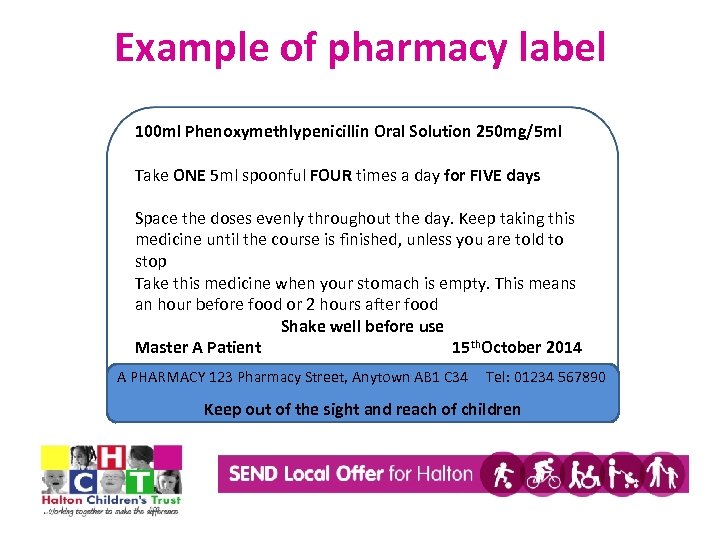 Example of pharmacy label 100 ml Phenoxymethlypenicillin Oral Solution 250 mg/5 ml Take ONE 5 ml spoonful FOUR times a day for FIVE days Space the doses evenly throughout the day. Keep taking this medicine until the course is finished, unless you are told to stop Take this medicine when your stomach is empty. This means an hour before food or 2 hours after food Shake well before use Master A Patient 15 th. October 2014 A PHARMACY 123 Pharmacy Street, Anytown AB 1 C 34 Tel: 01234 567890 Keep out of the sight and reach of children
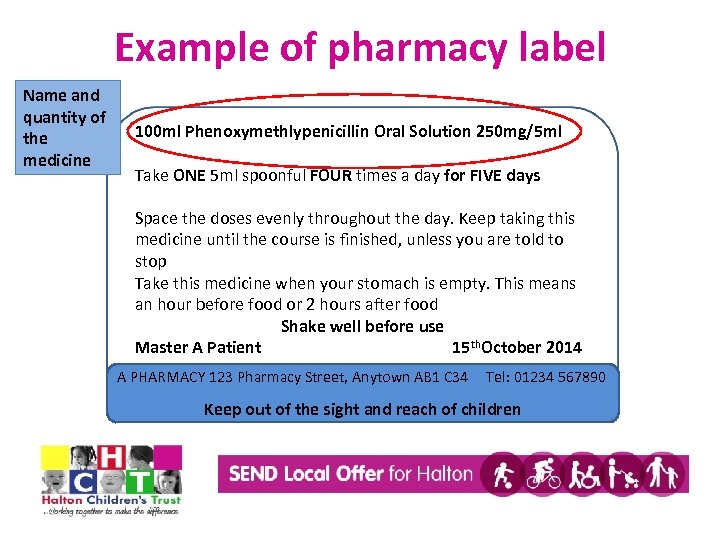 Example of pharmacy label Name and quantity of the medicine 100 ml Phenoxymethlypenicillin Oral Solution 250 mg/5 ml Take ONE 5 ml spoonful FOUR times a day for FIVE days Space the doses evenly throughout the day. Keep taking this medicine until the course is finished, unless you are told to stop Take this medicine when your stomach is empty. This means an hour before food or 2 hours after food Shake well before use Master A Patient 15 th. October 2014 A PHARMACY 123 Pharmacy Street, Anytown AB 1 C 34 Tel: 01234 567890 Keep out of the sight and reach of children
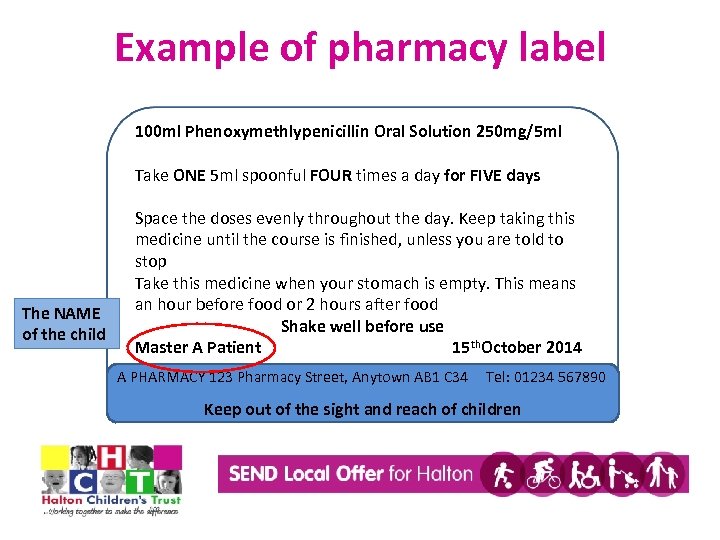 Example of pharmacy label 100 ml Phenoxymethlypenicillin Oral Solution 250 mg/5 ml Take ONE 5 ml spoonful FOUR times a day for FIVE days The NAME of the child Space the doses evenly throughout the day. Keep taking this medicine until the course is finished, unless you are told to stop Take this medicine when your stomach is empty. This means an hour before food or 2 hours after food Shake well before use Master A Patient 15 th. October 2014 A PHARMACY 123 Pharmacy Street, Anytown AB 1 C 34 Tel: 01234 567890 Keep out of the sight and reach of children
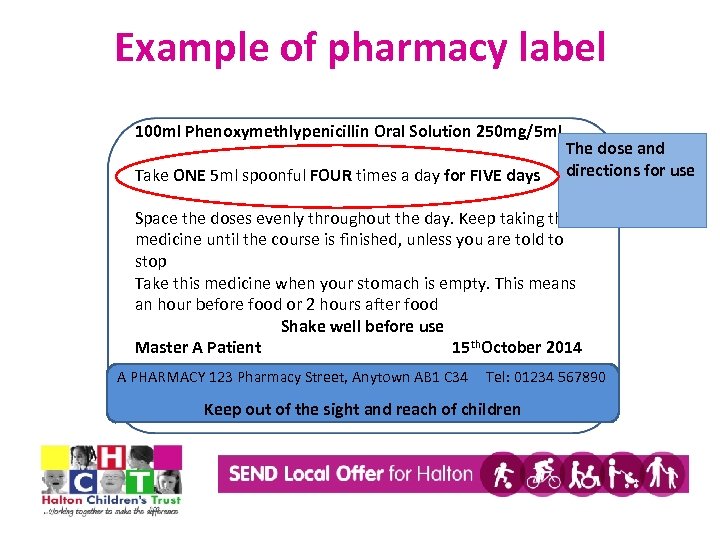 Example of pharmacy label 100 ml Phenoxymethlypenicillin Oral Solution 250 mg/5 ml Take ONE 5 ml spoonful FOUR times a day for FIVE days The dose and directions for use Space the doses evenly throughout the day. Keep taking this medicine until the course is finished, unless you are told to stop Take this medicine when your stomach is empty. This means an hour before food or 2 hours after food Shake well before use Master A Patient 15 th. October 2014 A PHARMACY 123 Pharmacy Street, Anytown AB 1 C 34 Tel: 01234 567890 Keep out of the sight and reach of children
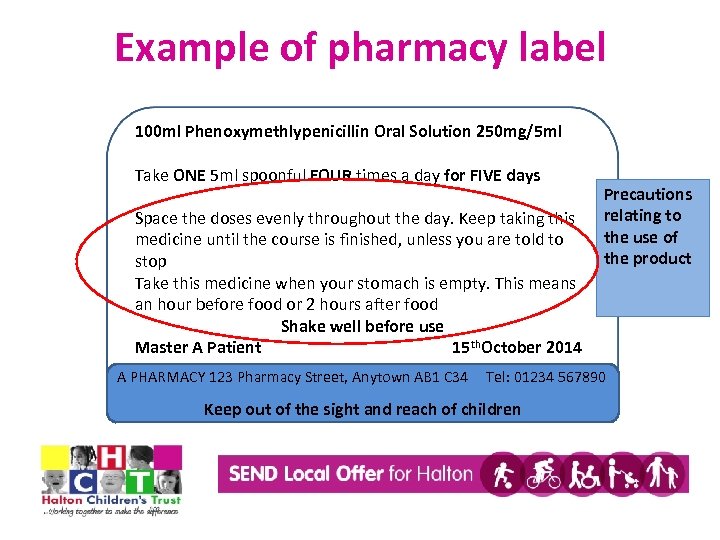 Example of pharmacy label 100 ml Phenoxymethlypenicillin Oral Solution 250 mg/5 ml Take ONE 5 ml spoonful FOUR times a day for FIVE days Space the doses evenly throughout the day. Keep taking this medicine until the course is finished, unless you are told to stop Take this medicine when your stomach is empty. This means an hour before food or 2 hours after food Shake well before use Master A Patient 15 th. October 2014 Precautions relating to the use of the product A PHARMACY 123 Pharmacy Street, Anytown AB 1 C 34 Tel: 01234 567890 Keep out of the sight and reach of children
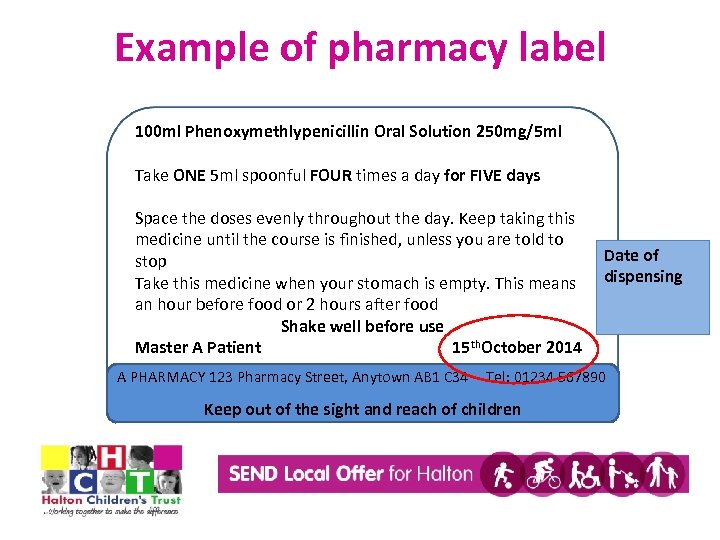 Example of pharmacy label 100 ml Phenoxymethlypenicillin Oral Solution 250 mg/5 ml Take ONE 5 ml spoonful FOUR times a day for FIVE days Space the doses evenly throughout the day. Keep taking this medicine until the course is finished, unless you are told to stop Take this medicine when your stomach is empty. This means an hour before food or 2 hours after food Shake well before use Master A Patient 15 th. October 2014 Date of dispensing A PHARMACY 123 Pharmacy Street, Anytown AB 1 C 34 Tel: 01234 567890 Keep out of the sight and reach of children
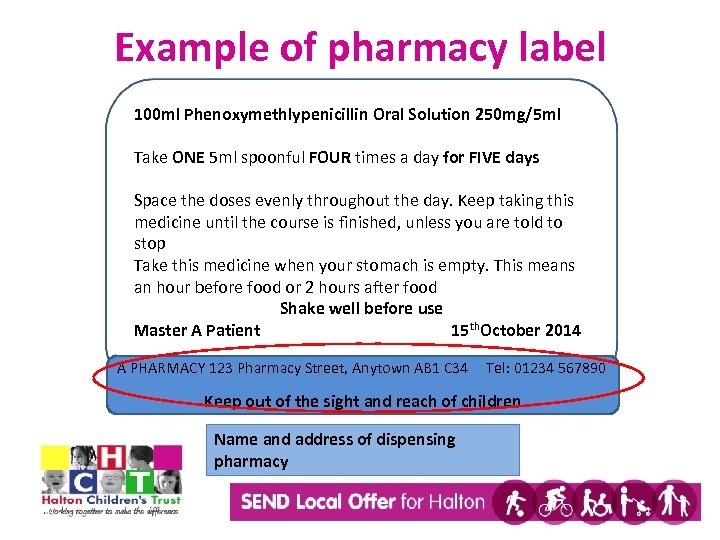 Example of pharmacy label 100 ml Phenoxymethlypenicillin Oral Solution 250 mg/5 ml Take ONE 5 ml spoonful FOUR times a day for FIVE days Space the doses evenly throughout the day. Keep taking this medicine until the course is finished, unless you are told to stop Take this medicine when your stomach is empty. This means an hour before food or 2 hours after food Shake well before use Master A Patient 15 th. October 2014 A PHARMACY 123 Pharmacy Street, Anytown AB 1 C 34 Tel: 01234 567890 Keep out of the sight and reach of children Name and address of dispensing pharmacy
 Self-Management • Where a pupil is competent to do so they should take responsibility to manage their own medicines – discussion between school and parents/carers should take place to agree this decision and this should be documented. • There is still the need to ensure the medicine is kept safe and is not accessible to other pupils. • Need to consider actions if child encounters any problems and what they do
 Non Prescribed Medication • Only after parental advice should schools administer paracetamol or other pain relief – this must be in writing with full instructions • Parental consent must be obtained before administration and on every occasion • Schools must not keep it’s own stock of medication; it should be provided by parents for use solely by their child. • Before administering staff should check that the medication has been given in the past without adverse effect – schools need a record of this. • Record any medicines given. • Must be in original manufacturers packaging
 Record Keeping • Parental consent forms • Health Care Plan where appropriate – not in all cases • Recording sheets should cover: – Supply – Administration – Disposal • Details of any medication given should be recorded and signed for by the person administering it.
 Hygiene • Always wash hands before and after administering any medication. • Do not touch medicine with hands
 Issues that may occur • Record if medicine is refused, late, or missed – inform parent/carer and senior staff member • If an error occurs inform senior staff member and parent/carer immediately • Written information maintained by the school or school staff regarding a pupil including information about medical needs is confidential
 Days Trips and Residential • Children who have medical needs cannot be excluded • It is recommended medication is stored in a locked box when off school premises and held by a designated member of staff • Consider how their needs including medication are dealt with in these circumstances • Extra training maybe required • Medication should be in original containers • Full written information required • Record keeping
 ANY QUESTIONS
 Medicine Records Management Tony Dean Cre Dyas
 When should schools use medicine records? EVERYTIME a child/young person needs to take medication
 Medicine Records Parental Agreement for School to Administer Medicine Head Teacher Agreement to Administer Medicine Request for Child to Carry his/her Medicine Record of Medicine Administered to Individual Child Staff Training Record- Administration of Medicines Use of Emergency Salbutamol Inhaler Specimen letter to Inform Parents of emergency Salbutamol Inhaler use • Authorisation for the administration of rectal diazepam • •
 Maladministration of Medication • What is maladministration of medication? • What to do in the case of maladministration? ü Call First Aider ü Call ambulance if appropriate/ retain container ü Inform Parents ü Report incident on Accident Reporting System
 Insurance • Schools should ensure they have suitable insurance in place to ensure that staff supporting pupils with medical conditions are indemnified • Schools not buying into the council’s insurance scheme should contact to their insurers to ensure appropriate level of cover
 Where to Find the Information? School Medicine Management Policy www. halton. gov. uk/localoffer Accident reporting system http: //hbc/teams/HANDS/Pages/Health-and. Safety-and-Risk-Management-Portal. aspx
 Tea/Coffee BREAK
 Practical Sessions 1. Medicines Management Libby Evans Lucy Reid 2. Infection Control Michelle Prescott 3. Asthma Salbutamol Inhalers Margaret Gorst
 Individual Health Care Plans (HCP) Denise Hogg - Service Lead Children’s Community Nursing Annette Dunning - Specialist Practitioner in Children’s Community Nursing
 Why do we need an individual healthcare plan ? ‘’ The aim is to ensure that all children with medical conditions, in terms of both physical and mental health, are properly supported in school so that they can play a full and active role in school life, remain healthy and achieve their academic potential. ’’[Df. E, 2014]
 Developing a health care plan • Medical need or healthcare issue identified that could impact on pupil’s wellbeing or safety. • IHCP’s can be initiated by a member of the school staff or a healthcare professional involved in providing care to the child. • The plan will be drawn up in partnership with pupil, family, school and health. • Partners agree who will take the lead writing the plan.
 Who should be involved in the process? • • Key school staff Child or young person Parent or legal guardian Relevant healthcare professional e. g School Nurse; Children’s Community Nurse; Specialist Nurse; Allied Healthcare professional; Hospital Consultant; GP.
 What information needs to be in a plan? • The medical condition. • The pupil’s needs. • Specific support for the pupil’s educational, social and emotional needs. • The level of support needed. • Who will provide this support. • What to do in an emergency. View Assessment Form
 Example of a completed plan. • Child A is a young person in main stream secondary school with a diagnosis of Juvenile Arthritis. Suppressed immunity. • Contact Details. • Description of medical needs and symptoms. • Daily care requirements. • Description of what constitutes an emergency. • Follow up care for child A. • Who is responsible in an emergency? • Agreement and sign off by pupil, parents author of the plan. View School plan for child A
 Implementation and review of the IHCP • Responsibility for ensuring the plan is finalised and implemented rests with the school. [Df. E 2014] • IHCP should be reviewed annually or when condition changes.
 Need assistance? Who to contact? • Follow your local policy for guidelines on supporting pupils at school with medical conditions. [HBC, 2014] • Contact your school nurse. • Is the child under a specialist nurse? Contact them directly. • Is there a consultant involved? Contact their secretary. • Is the pupil known to Statutory services? Contact Social care. • Children’s Community Nurse Team? Tel 0151 495 5400.
 References : • Supporting pupils at school with medical conditions. Statutory guidance for governing bodies of maintained schools and proprietors of academies in England. April 2014. Df. E. • Supporting pupils at school with medical conditions policy. August 2014. Halton Borough Council.
 Q & A Session Over to you!
 Event close • Please complete evaluation forms. • Any remaining questions please add to sticky wall, along with your email address and we will get back to you. Many thanks