 Скачать презентацию www gvf org The 20 Billion Question Can
5ecef6ab88348d4b53fa09b6e0beb3b6.ppt
- Количество слайдов: 19



www. gvf. org The $20 Billion Question: Can Satellite and Terrestrial Wireless Co-Exist in C-band? David Hartshorn Secretary General GVF
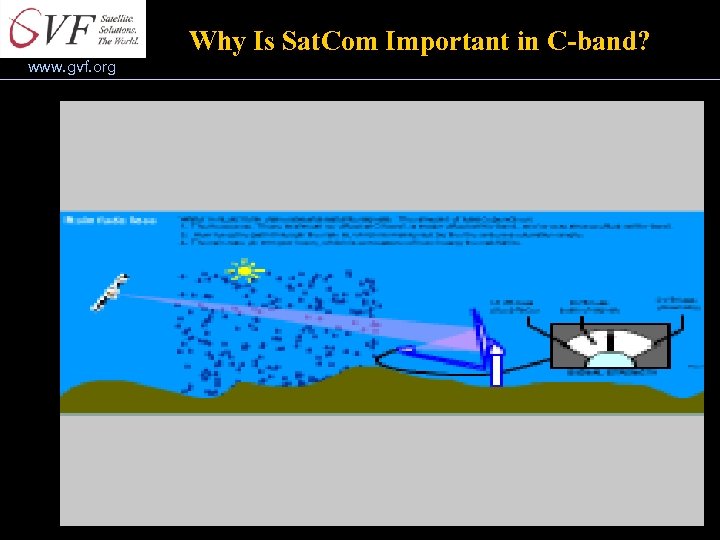
Why Is Sat. Com Important in C-band? www. gvf. org
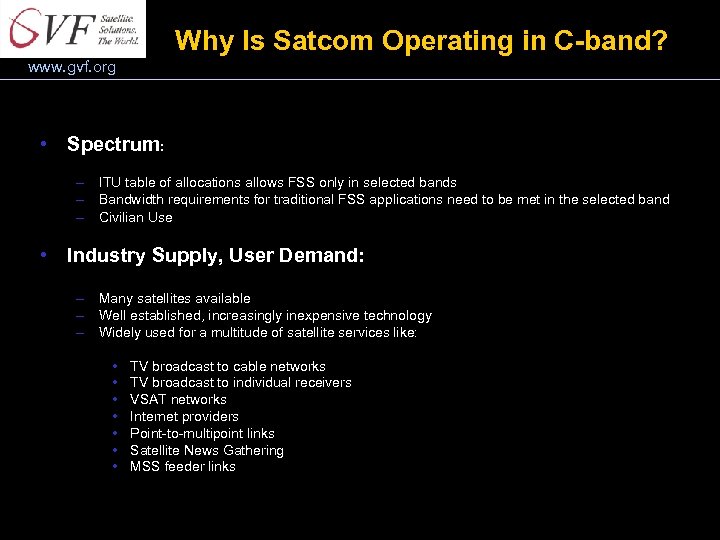
Why Is Satcom Operating in C-band? www. gvf. org • Spectrum: – ITU table of allocations allows FSS only in selected bands – Bandwidth requirements for traditional FSS applications need to be met in the selected band – Civilian Use • Industry Supply, User Demand: – Many satellites available – Well established, increasingly inexpensive technology – Widely used for a multitude of satellite services like: • • TV broadcast to cable networks TV broadcast to individual receivers VSAT networks Internet providers Point-to-multipoint links Satellite News Gathering MSS feeder links
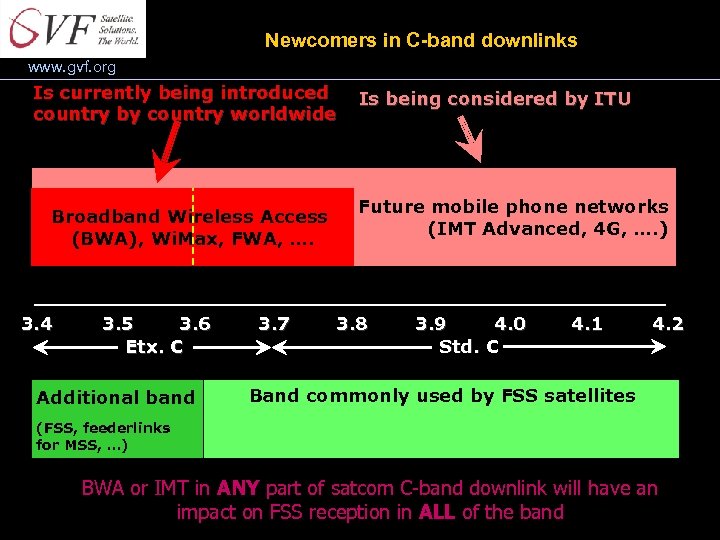
Newcomers in C-band downlinks www. gvf. org Is currently being introduced country by country worldwide Broadband Wireless Access (BWA), Wi. Max, FWA, …. 3. 4 3. 5 3. 6 Etx. C Additional band 3. 7 Is being considered by ITU Future mobile phone networks (IMT Advanced, 4 G, …. ) 3. 8 3. 9 4. 0 Std. C 4. 1 4. 2 Band commonly used by FSS satellites (FSS, feederlinks for MSS, …) BWA or IMT in ANY part of satcom C-band downlink will have an impact on FSS reception in ALL of the band
Impact on FSS Reception www. gvf. org • In-band interference • Interference from unwanted emissions (outside the signal bandwidth) • Overdrive of LNB’s Þ Exclusion zones around earth stations are required if these terrestrial wireless services are to operate in the band
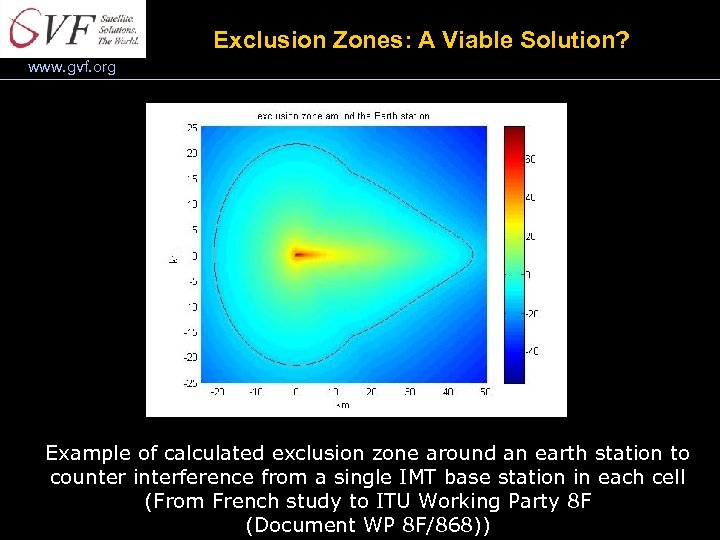
Exclusion Zones: A Viable Solution? www. gvf. org Example of calculated exclusion zone around an earth station to counter interference from a single IMT base station in each cell (From French study to ITU Working Party 8 F (Document WP 8 F/868))
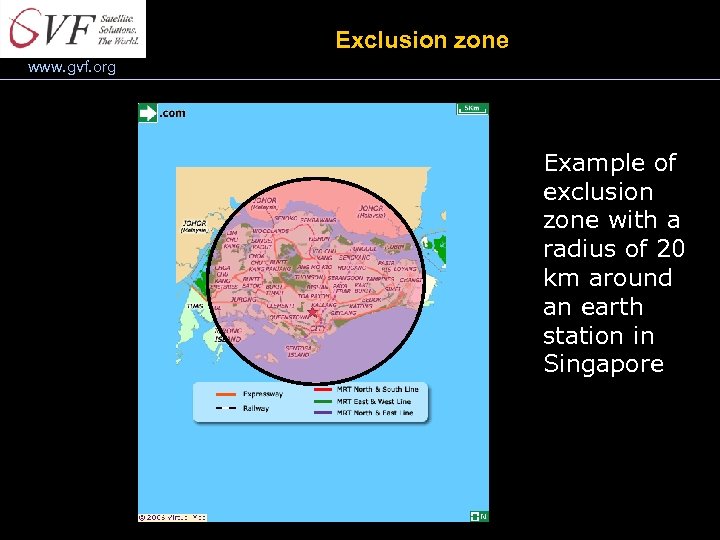
Exclusion zone www. gvf. org Example of exclusion zone with a radius of 20 km around an earth station in Singapore
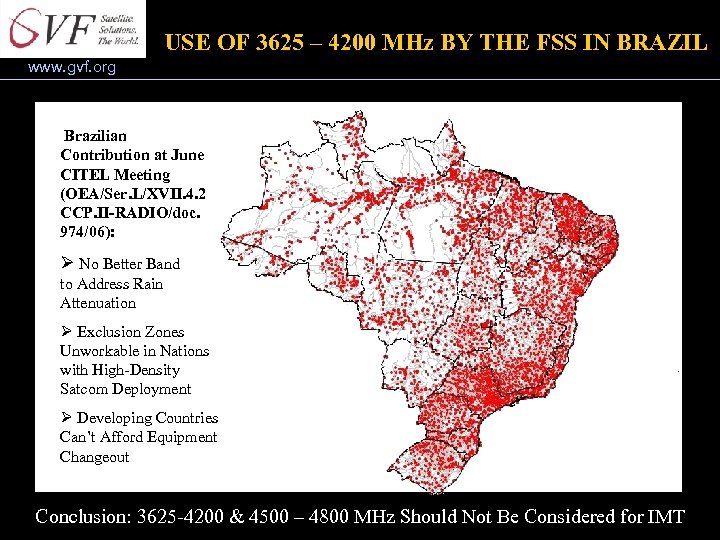
USE OF 3625 – 4200 MHz BY THE FSS IN BRAZIL www. gvf. org Brazilian Contribution at June CITEL Meeting (OEA/Ser. L/XVII. 4. 2 CCP. II-RADIO/doc. 974/06): Ø No Better Band to Address Rain Attenuation Ø Exclusion Zones Unworkable in Nations with High-Density Satcom Deployment Ø Developing Countries Can’t Afford Equipment Changeout Conclusion: 3625 -4200 & 4500 – 4800 MHz Should Not Be Considered for IMT
Exclusion zones www. gvf. org • May be enforced for base stations with respect to specific earth stations • Cannot be applied with respect to user terminals • Will require user terminals which do not emit any signals when they are not in contact with a base station • Cannot be applied with respect to unlicensed earth stations or earth stations at unknown locations • Exclusion zones around earth stations may block large areas for BWA or IMT and prohibit effective and economically viable operation
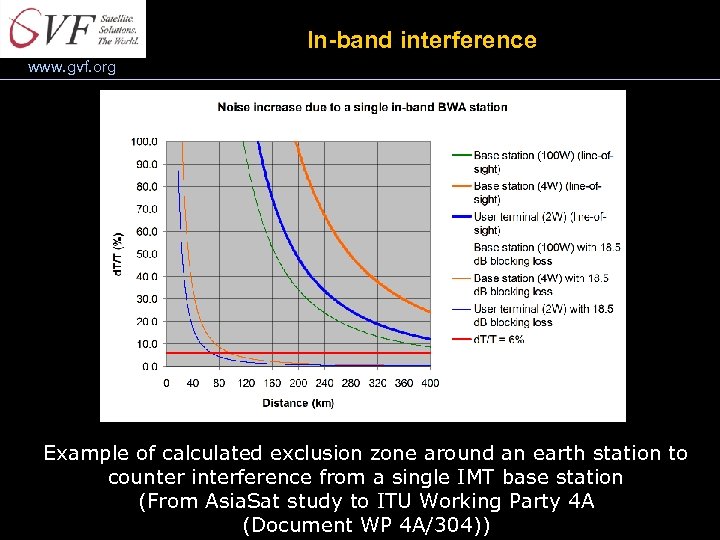
In-band interference www. gvf. org Example of calculated exclusion zone around an earth station to counter interference from a single IMT base station (From Asia. Sat study to ITU Working Party 4 A (Document WP 4 A/304))
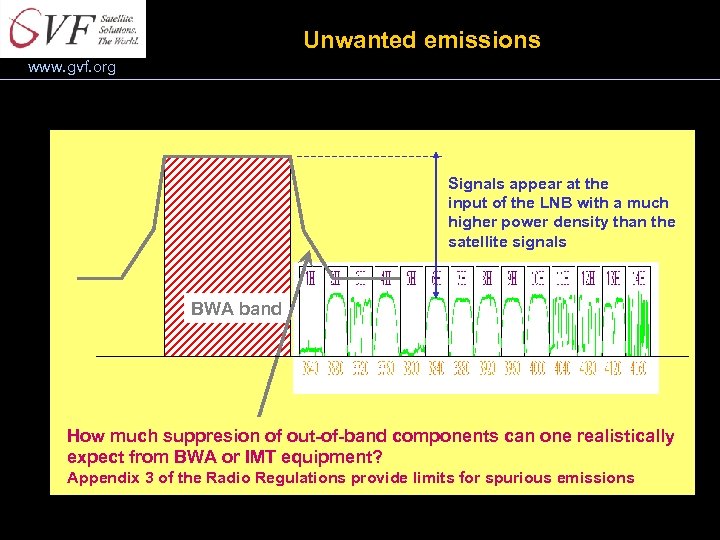
Unwanted emissions www. gvf. org Signals appear at the input of the LNB with a much higher power density than the satellite signals BWA band How much suppresion of out-of-band components can one realistically expect from BWA or IMT equipment? Appendix 3 of the Radio Regulations provide limits for spurious emissions
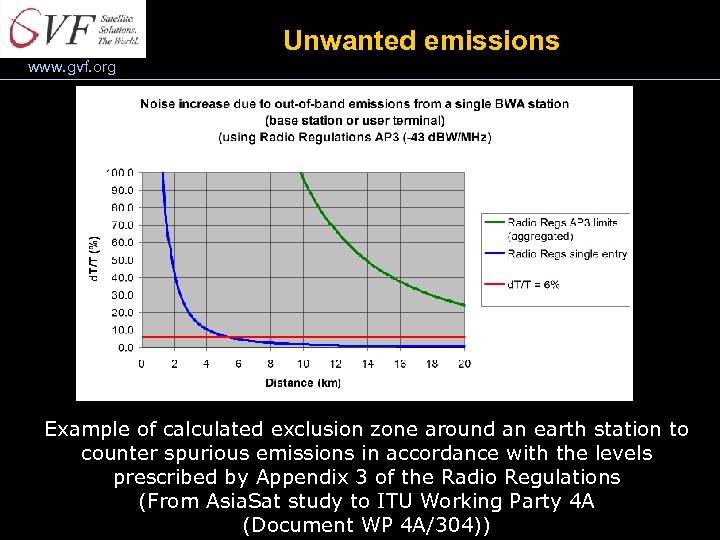
Unwanted emissions www. gvf. org Example of calculated exclusion zone around an earth station to counter spurious emissions in accordance with the levels prescribed by Appendix 3 of the Radio Regulations (From Asia. Sat study to ITU Working Party 4 A (Document WP 4 A/304))
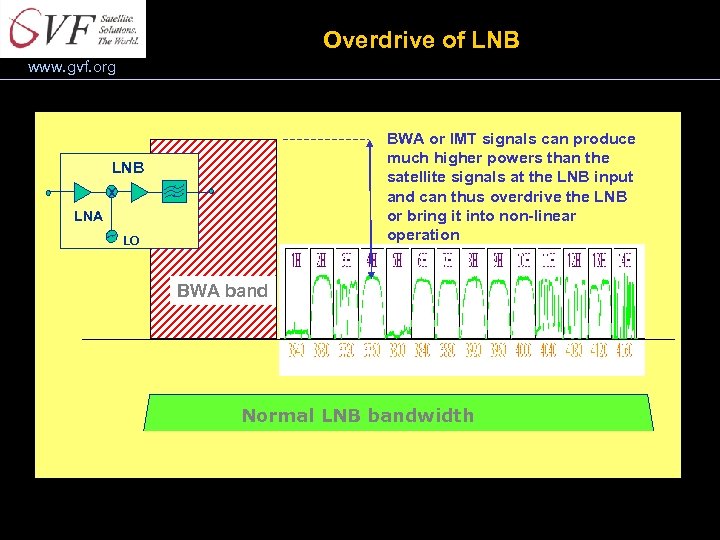
Overdrive of LNB www. gvf. org BWA or IMT signals can produce much higher powers than the satellite signals at the LNB input and can thus overdrive the LNB or bring it into non-linear operation LNB X LNA LO BWA band Normal LNB bandwidth
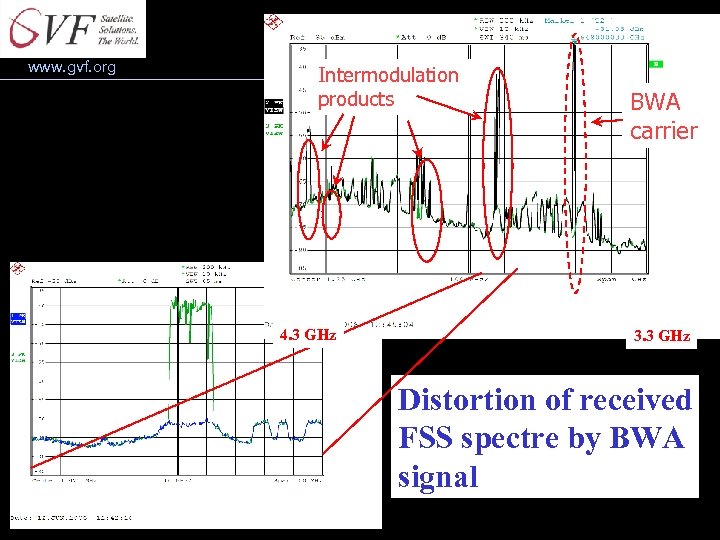
Overdrive of LNB www. gvf. org Intermodulation products 4. 3 GHz BWA carrier 3. 3 GHz Distortion of received FSS spectre by BWA signal
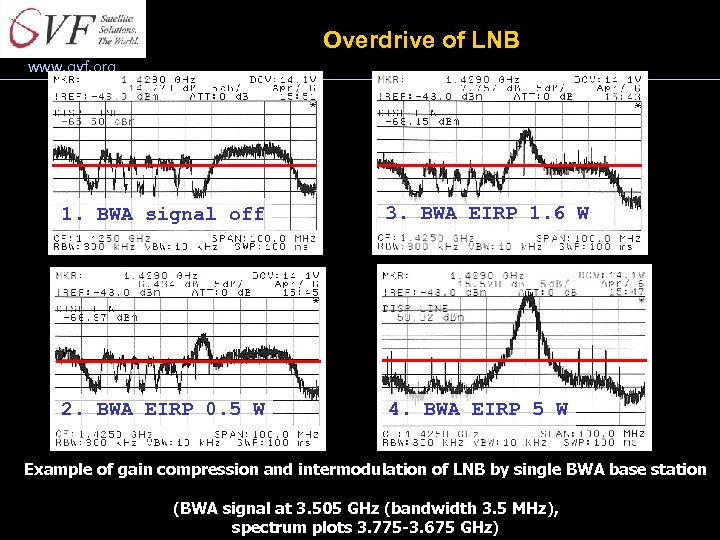
Overdrive of LNB www. gvf. org 1. BWA signal off 3. BWA EIRP 1. 6 W 2. BWA EIRP 0. 5 W 4. BWA EIRP 5 W Example of gain compression and intermodulation of LNB by single BWA base station (BWA signal at 3. 505 GHz (bandwidth 3. 5 MHz), spectrum plots 3. 775 -3. 675 GHz)
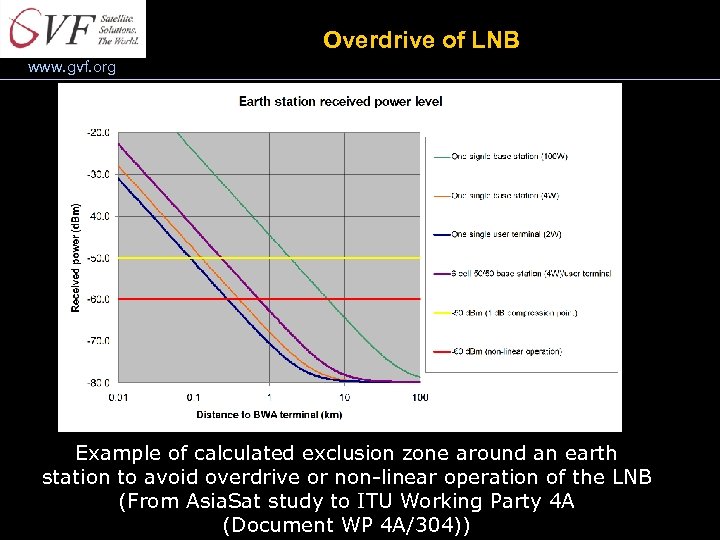
Overdrive of LNB www. gvf. org Example of calculated exclusion zone around an earth station to avoid overdrive or non-linear operation of the LNB (From Asia. Sat study to ITU Working Party 4 A (Document WP 4 A/304))
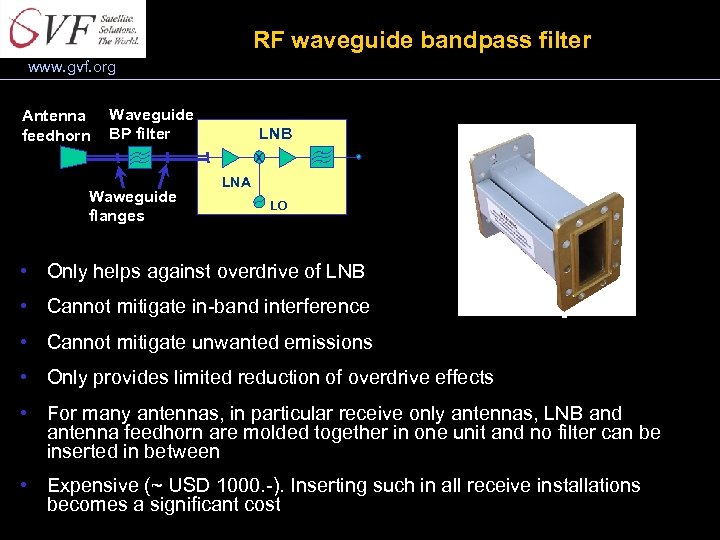
RF waveguide bandpass filter www. gvf. org Antenna feedhorn Waveguide BP filter LNB X Waweguide flanges LNA LO • Only helps against overdrive of LNB • Cannot mitigate in-band interference • Cannot mitigate unwanted emissions • Only provides limited reduction of overdrive effects • For many antennas, in particular receive only antennas, LNB and antenna feedhorn are molded together in one unit and no filter can be inserted in between • Expensive (~ USD 1000. -). Inserting such in all receive installations becomes a significant cost
Conclusions www. gvf. org • BWA or IMT in a part or all of the FSS C-band downlink will be incompatible with general FSS reception in any part of C-band in the same geographical area • BWA or IMT in a part of C-band may be compatible with FSS reception by a small number of earth stations if: – Appropriate exclusion zones around each of the earth stations are established – User terminals are designed not to emit any signals when not in contact with a base station • Introduction of BWA or IMT by one country can block FSS reception in another country
Alternative frequency bands www. gvf. org • S-band (e. g. 2. 29 – 2. 4835 GHz) • 7 GHz band • Spectrum refarming • FSS uplink bands (frequencies > 6. 425 GHz less used)
Скачать презентацию www gvf org The 20 Billion Question Can
5ecef6ab88348d4b53fa09b6e0beb3b6.ppt