 Скачать презентацию www fibl org How Organic Agriculture Contributes to
1b93be89028bea302a6676160d99af14.ppt
- Количество слайдов: 20



www. fibl. org How Organic Agriculture Contributes to Food Availability Lukas Kilcher and Christine Zundel Conference on Organic Agriculture and Food Security, 3 – 5 May 2007 FAO, Rome Archived at http: //orgprints. org/10753/ Rome, May 3, 2007
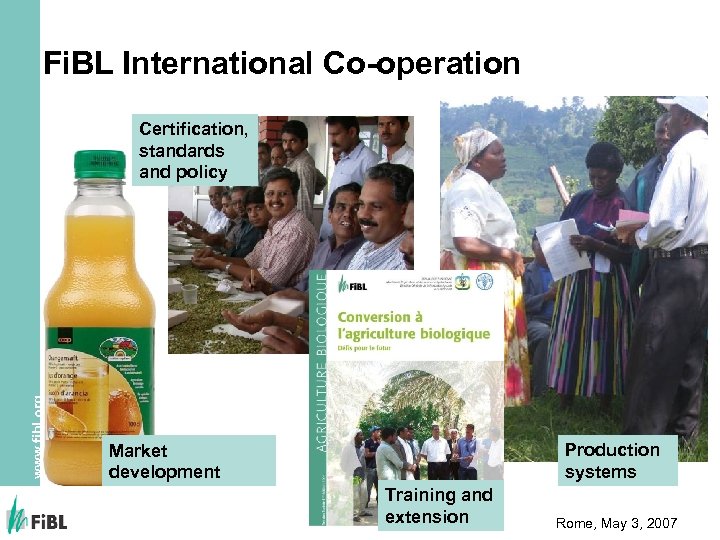
Fi. BL International Co-operation www. fibl. org Certification, standards and policy Production systems Market development Training and extension Rome, May 3, 2007
Food Availability Definition Food availability, access, stability and utilization = part of the multi-dimensional nature of food security “Availability” of sufficient quantities of food of appropriate quality, supplied through domestic production or inputs www. fibl. org Methods Literature review Case studies Rome, May 3, 2007
Dimensions of Food Availability 1. Productivity: The ultimate benchmark when comparing the performance of agricultural systems!? 2. Efficiency: Does organic agriculture use resources efficiently? 3. Adapted technologies: Make organic agriculture successful www. fibl. org 4. Peri-urban agriculture: Supplying food to millions, while minimizing transportation 5. Markets: How OA makes diverse food available at household, community, national and international levels Rome, May 3, 2007
Productivity: Questions OA = unique combination of low external input technology, environmental conservation and input/output efficiency www. fibl. org Farmers are increasingly adopting OA as a method of improving productivity and sustainability. Are diverse OA systems more productive compared to simplified conventional systems? Can OA meet the world’s growing food needs? Rome, May 3, 2007
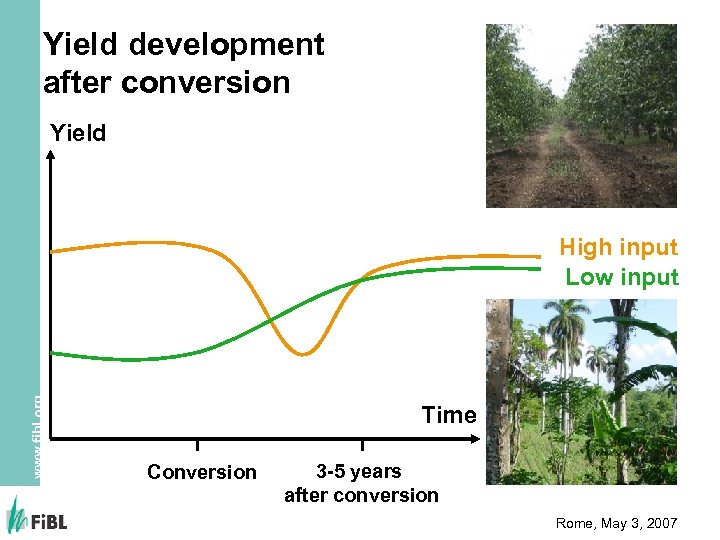
Yield development after conversion Yield www. fibl. org High input Low input Time Conversion 3 -5 years after conversion Rome, May 3, 2007
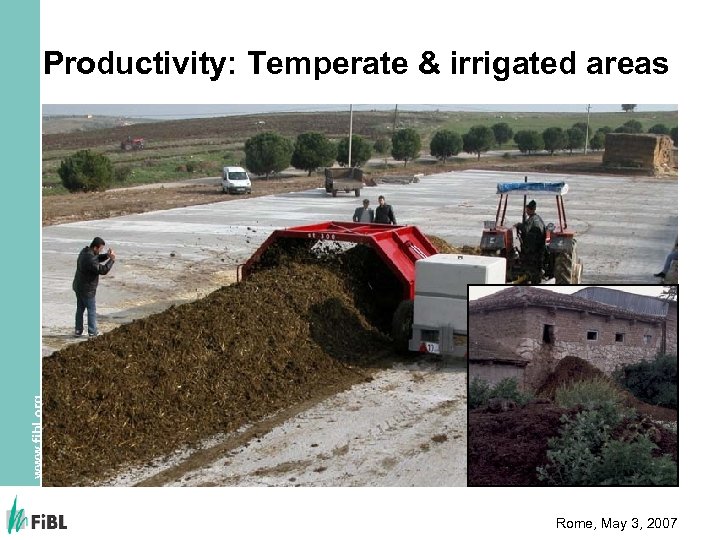
www. fibl. org Productivity: Temperate & irrigated areas Rome, May 3, 2007
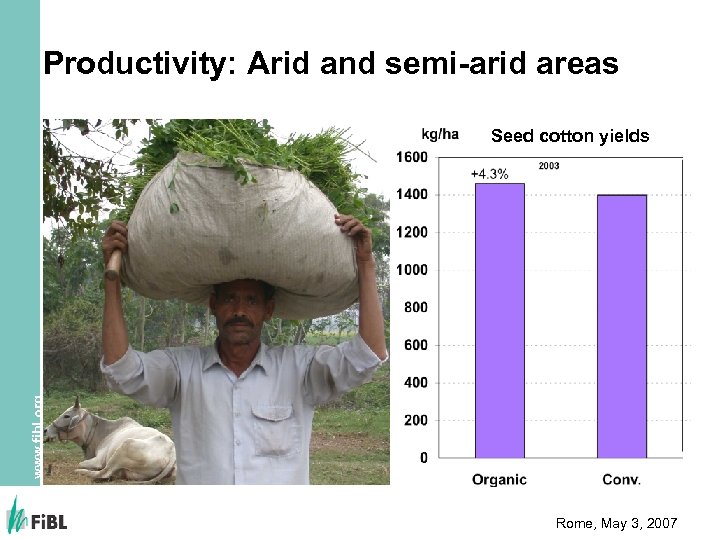
Productivity: Arid and semi-arid areas www. fibl. org Seed cotton yields Rome, May 3, 2007
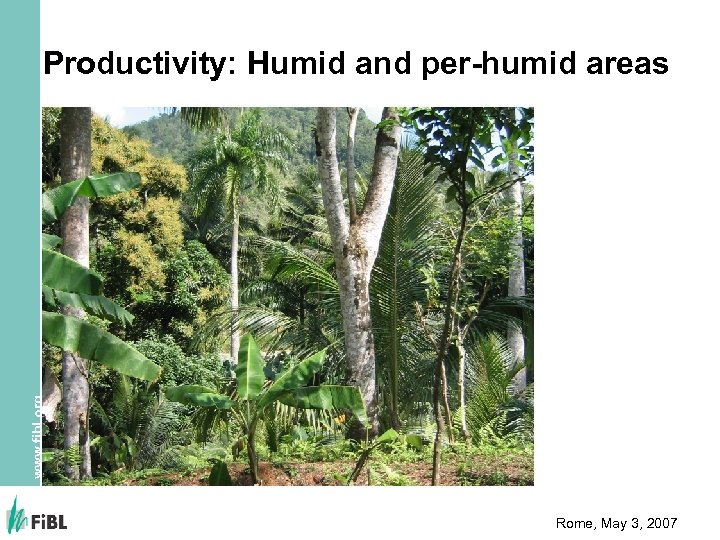
www. fibl. org Productivity: Humid and per-humid areas Rome, May 3, 2007
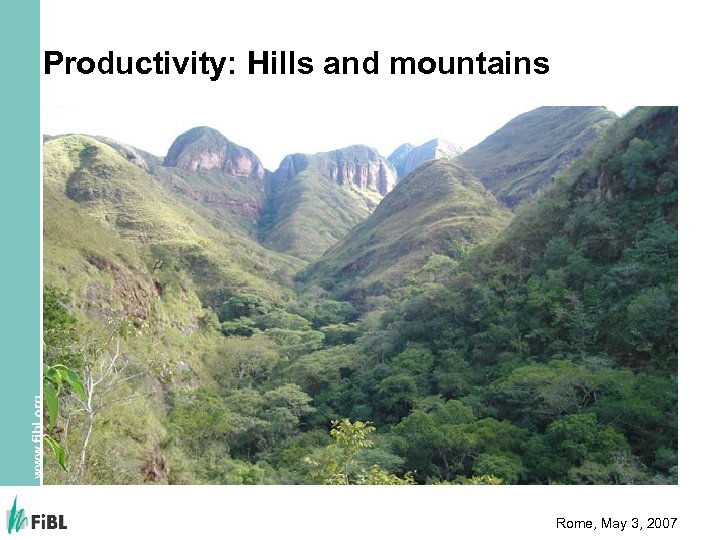
www. fibl. org Productivity: Hills and mountains Rome, May 3, 2007
Efficiency: Questions Productivity is only one aspect Resources are always limited consider the capability to produce high output per unit of resources used Types of efficiency: natural resource efficiency (input-output relations) economic efficiency (cost-benefit relation) www. fibl. org Does organic agriculture use resources efficiently? Does organic agriculture provide the expected benefits for the consumers? Rome, May 3, 2007
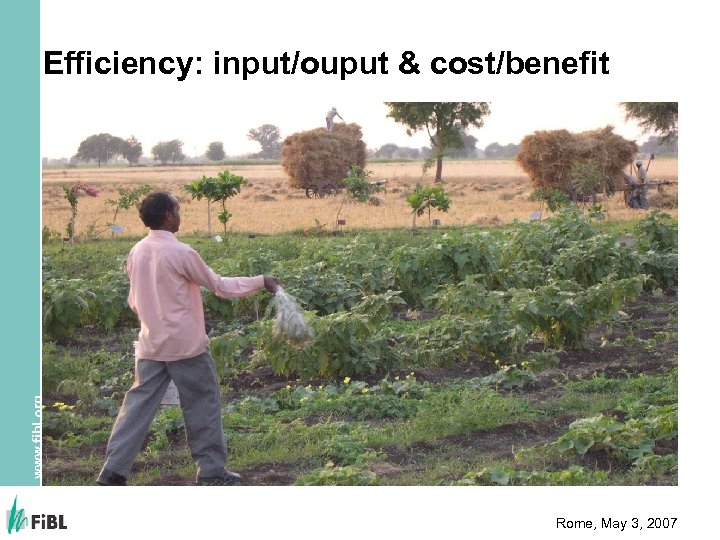
www. fibl. org Efficiency: input/ouput & cost/benefit Rome, May 3, 2007
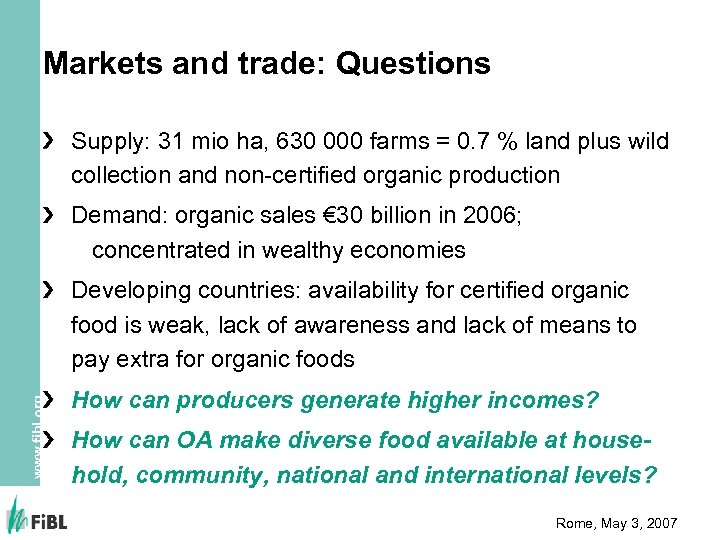
Markets and trade: Questions Supply: 31 mio ha, 630 000 farms = 0. 7 % land plus wild collection and non-certified organic production Demand: organic sales € 30 billion in 2006; concentrated in wealthy economies www. fibl. org Developing countries: availability for certified organic food is weak, lack of awareness and lack of means to pay extra for organic foods How can producers generate higher incomes? How can OA make diverse food available at household, community, national and international levels? Rome, May 3, 2007
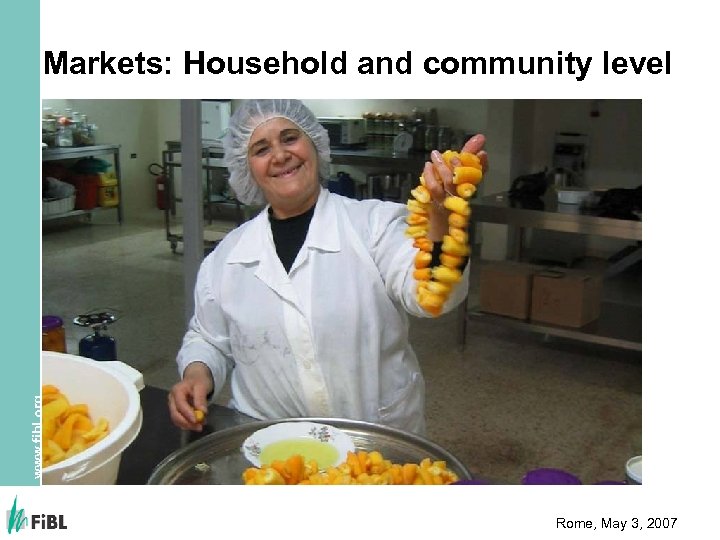
www. fibl. org Markets: Household and community level Rome, May 3, 2007
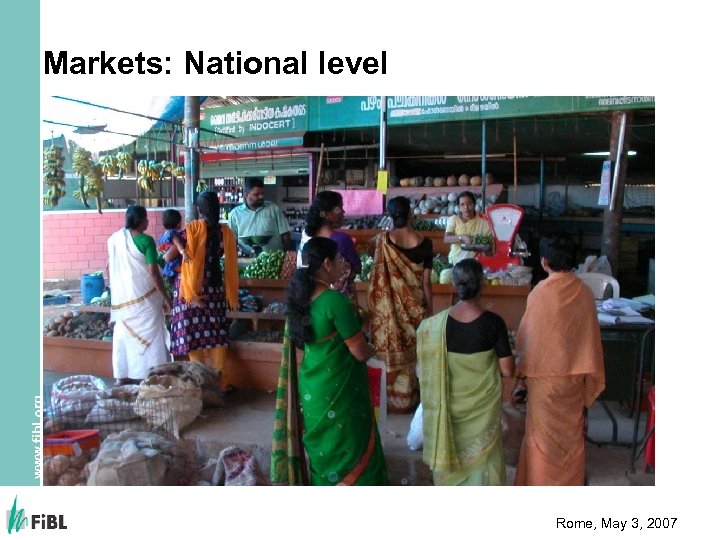
www. fibl. org Markets: National level Rome, May 3, 2007
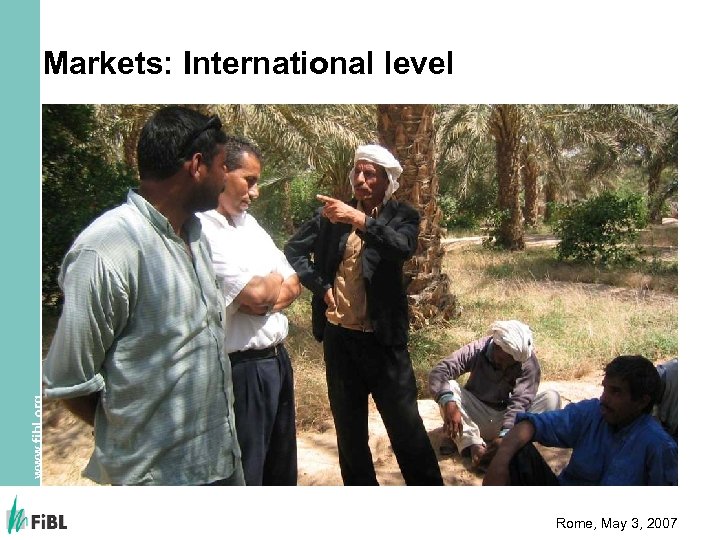
www. fibl. org Markets: International level Rome, May 3, 2007
Conclusions 1. Real beneficiaries of OA: farmers and ecosystem 2. Intelligent management needs fewer inputs 3. Developing countries: OA offers employment opportunities and production costs are lower 4. Market opportunities benefit farmers financially and socially from OA www. fibl. org 5. OA contributes to self-reliance of local food systems and thus to food availability 6. OA improves viability of rural economies, increases food self-sufficiency and national food supply Rome, May 3, 2007
Challenges and recommendations 1. OA-impact on food availability is still limited 2. Production: build-up of organic matter in the soil 3. Difficult access to information about OA practices for farmers in developing countries 4. Domestic markets develop slowly in developing countries www. fibl. org 5. Multiply OA impact on food availability through public and private sector investments on all levels: research & development training & extension markets, certification and & policy Rome, May 3, 2007
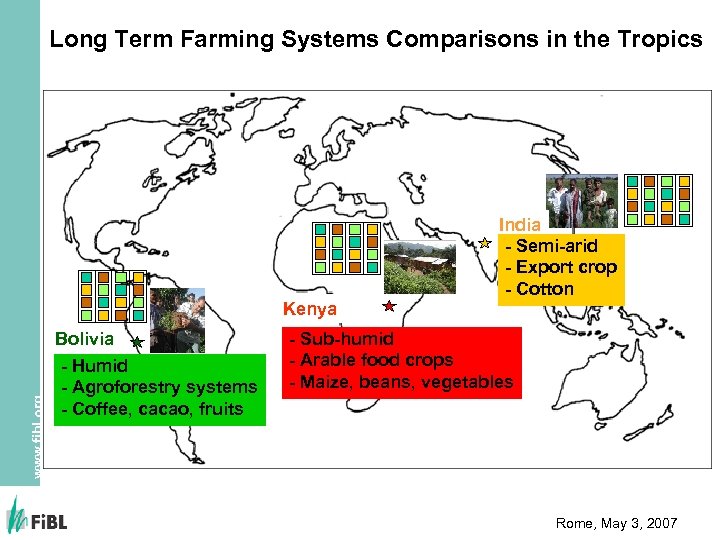
Long Term Farming Systems Comparisons in the Tropics India - Semi-arid - Export crop - Cotton www. fibl. org Kenya Bolivia - Humid - Agroforestry systems - Coffee, cacao, fruits - Sub-humid - Arable food crops - Maize, beans, vegetables Rome, May 3, 2007
Thank you for your attention Lukas Kilcher Head of the International Co-operation Division Research Institute of Organic Agriculture (Fi. BL) www. fibl. org Ackerstrasse CH-5070 Frick 0041 62 865 72 72 lukas. kilcher@fibl. org Rome, May 3, 2007
Скачать презентацию www fibl org How Organic Agriculture Contributes to
1b93be89028bea302a6676160d99af14.ppt