


 Скачать презентацию www ehsstrategies com REACH Protecting Your Supply Chain
2a02f46a5182c34ef3968de394962950.ppt
- Количество слайдов: 30
 www. ehsstrategies. com REACH: Protecting Your Supply Chain Georjean L. Adams EHS Strategies, Inc. November 17, 2011
 Overview • REACH supply chain impacts • What your European customer wants & worries about • Ways to meet customer needs – Registration scenarios • How do you decide? – Costs and considerations © 2011 EHS Strategies, Inc. 2
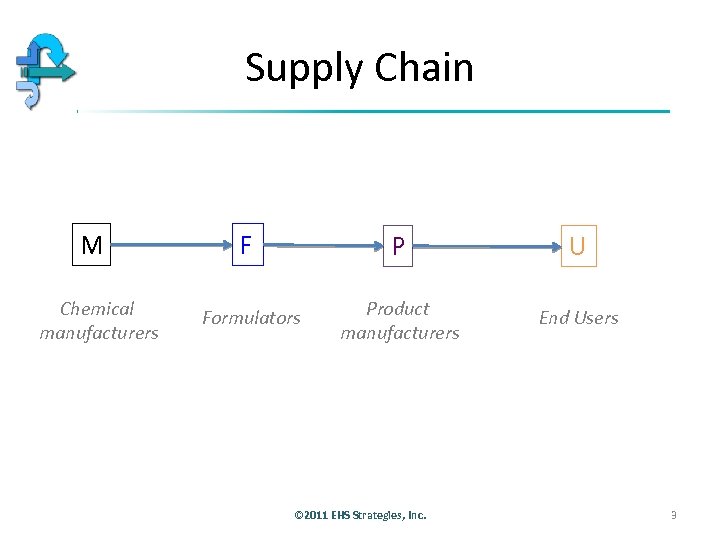 Supply Chain M Chemical manufacturers F P U Formulators Product manufacturers End Users © 2011 EHS Strategies, Inc. 3
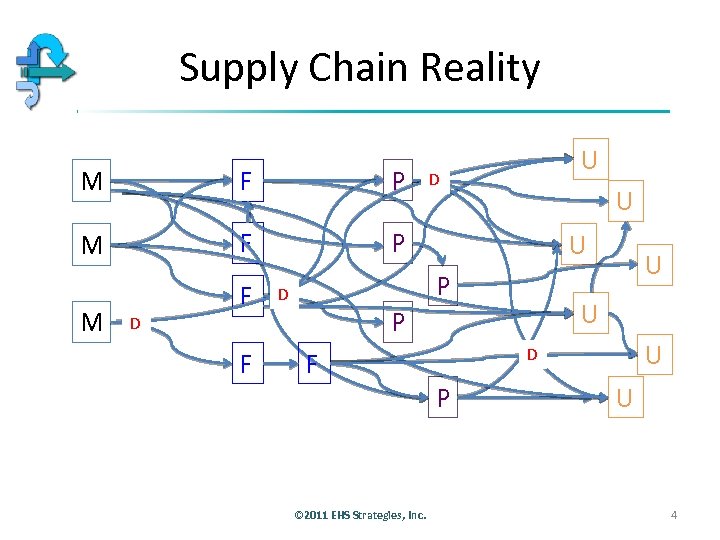 Supply Chain Reality M F P M F U P M D F F D U U P D U P U D F P © 2011 EHS Strategies, Inc. U U 4
 REACH Responsibilities 1. Someone in the supply chain has to register – Chemical components and uses of your product 2. Safety Data Sheets (SDS) – Necessary safety precautions for exposure scenarios 3. Substances of Very High Concern (SVHC) – – Communicate presence Follow any restrictions for authorized SVHC © 2011 EHS Strategies, Inc. 5
 REACH Responsibilities 1. Someone in the supply chain has to register – Chemical components of your product – Supply chain uses – Has to be EU legal entity 2. Safety Data Sheets (SDS) 3. Substances of Very High Concern (SVHC) © 2011 EHS Strategies, Inc. 6
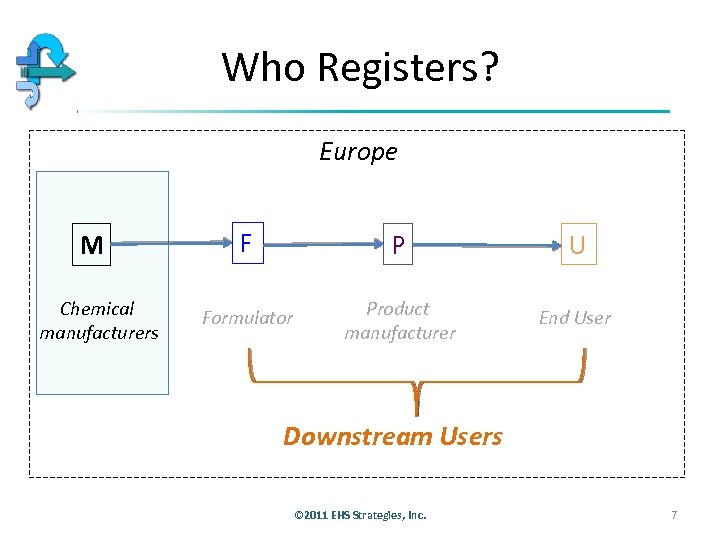 Who Registers? Europe M Chemical manufacturers F P U Formulator Product manufacturer End User Downstream Users © 2011 EHS Strategies, Inc. 7
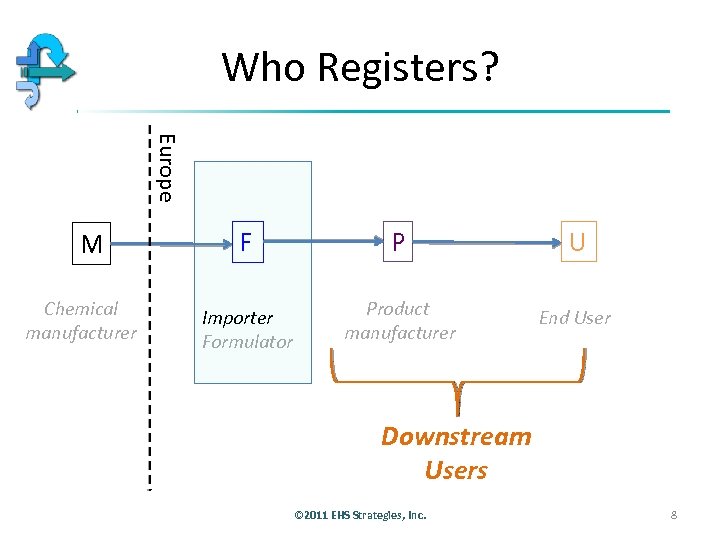 Who Registers? Europe M Chemical manufacturer F P U Importer Formulator Product manufacturer End User Downstream Users © 2011 EHS Strategies, Inc. 8
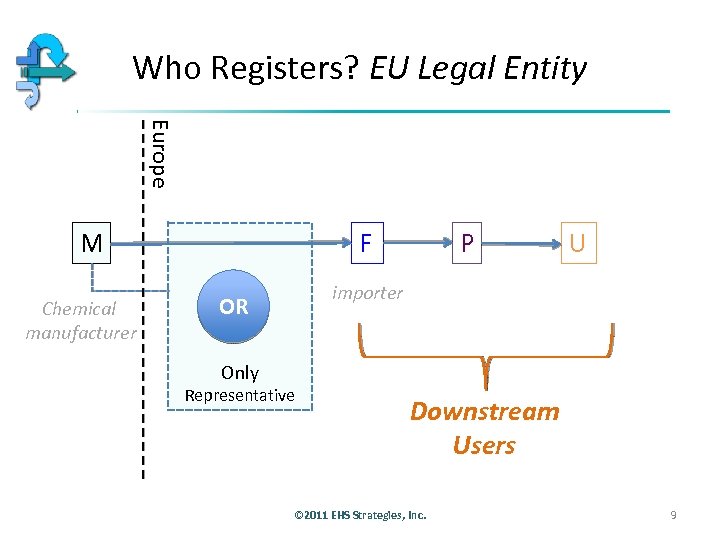 Who Registers? EU Legal Entity Europe M Chemical manufacturer P F U importer OR Only Representative Downstream Users © 2011 EHS Strategies, Inc. 9
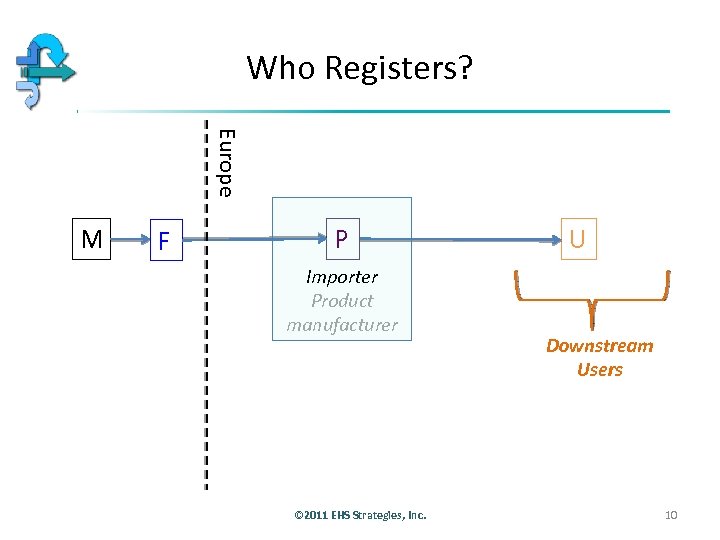 Who Registers? Europe M F P Importer Product manufacturer © 2011 EHS Strategies, Inc. U Downstream Users 10
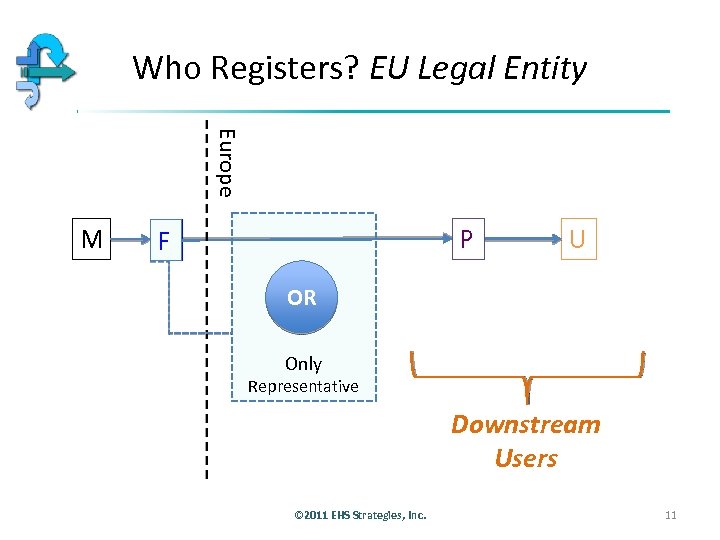 Who Registers? EU Legal Entity Europe M P F U OR Only Representative Downstream Users © 2011 EHS Strategies, Inc. 11
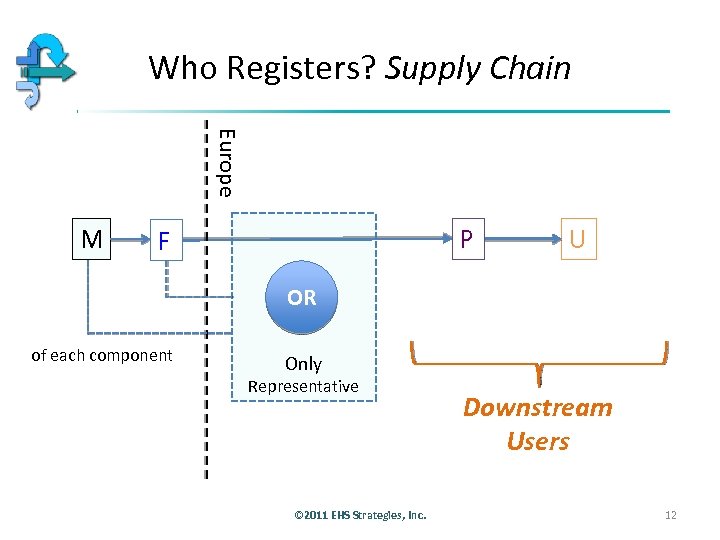 Who Registers? Supply Chain Europe M P F U OR of each component Only Representative © 2011 EHS Strategies, Inc. Downstream Users 12
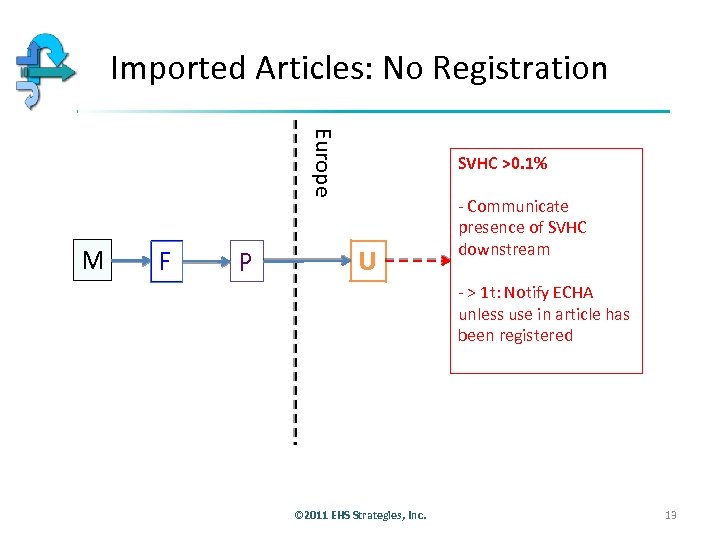 Imported Articles: No Registration Europe M F P SVHC >0. 1% U - Communicate presence of SVHC downstream - > 1 t: Notify ECHA unless use in article has been registered © 2011 EHS Strategies, Inc. 13
 REACH Responsibilities: Downstream Users 1. Know chemicals are registered by supply chain 2. Safety Data Sheets (SDS) – – Communicate uses to suppliers Follow safety provisions in supplier SDS – Pass necessary safety precautions downstream 3. Substances of Very High Concern (SVHC) – Communicate presence of SVHC – Notify ECHA if use not registered – Follow any restrictions for authorized SVHC © 2011 EHS Strategies, Inc. 14
 What Your Customer Wants 1. To be a REACH Downstream User – Components are pre-registered or registered (or will be) by his supply chain for his uses 2. Compliant SDS for his site’s use and to build his product’s SDS – Registration numbers – Safety info and exposure scenario (>10 t) – CLP 3. Preferably no SVHC >0. 1%, no restrictions – If yes, supply chain gets use authorized © 2011 EHS Strategies, Inc. 15
 Customer Worry #1: Registration • Will supply chain register components? – Will he see a price increase? – Will he have to provide confidential use information? • Will supply chain decline to register? – Will he have to register and can he afford it? – Can he find another supplier who has/will? – Does he have to stop using it? © 2011 EHS Strategies, Inc. 16
 Registration: What You Should Do • Ensure someone in your supply chain – Filed Pre-registration already • Did your customer, your OR or someone else in supply chain preregister all chemical components? – Filed or Will File Registration • • Previous new chemical notice (PMN) Nov 2010 if >1000 t or CMR by May 31, 2013 if 100 t – 1000 t by May 31, 2018 if 1 t – 100 t – Exempt: <1 t per importer • If none of the above: don’t market Registration Scenarios and options © 2011 EHS Strategies, Inc. 17
 Registration Scenario #1: Selling Registered Product Now ü Your chemical suppliers have registered ü Your product volumes and uses are covered by their dossiers ü Exposure scenarios in SDS ü You have established mechanism to get SDS to your customers ü You have established upstream and downstream communication on new volumes and uses ü Confidentiality agreements in place ü No SVHC and tracking new SVHC and Restrictions Congratulations! © 2011 EHS Strategies, Inc. 18
 Registration Scenario #2: Pre-registered, Will be Registered ü Verified pre-registration by your supply chain – each chemical component and each supplier • For polymers, was monomer pre-registered • Suppliers are committed to registering ü upstream communication on volumes and uses ü Distributing compliant SDS and SVHC info ü providing pre-registration numbers © 2011 EHS Strategies, Inc. 19
 Registration Scenario #3: Pre-registrant Not Sure will Register • Register the chemical yourself through your OR – Submit “inquiry” > join/form SIEF > register • Help your supplier register • Help your customer (importer) register • Buy time: stay under 100 t/yr until 2018 • Substitute chemical to one that is/will be registered • Withdraw product from market © 2011 EHS Strategies, Inc. 20
 Registration Scenario #4: Registered, but Not by Your Supply Chain • Change supply chain to a registered chemical – Same chemical, new manufacturer – Substitute another, registered chemical • Become Co-registrant via your OR – Do registration inquiry – Join consortium or purchase a Letter of Access from existing SIEF – complete the business-specific info, refer to tox data in existing dossier, do risk assessment for your product © 2011 EHS Strategies, Inc. 21
 Registration Scenario #5: Begin Marketing in Future • If no one in your supply chain has registered yet: – Help supply chain register – Switch to supplier (or substitute chemical) who has – Set up your own OR to late pre-register > SIEF > file registration dossier when volume is triggered • Establish supply chain communication networks as soon as possible – Uses, volumes, tox data – SDS preparation and distribution system – SVHC and restrictions communication, if needed © 2011 EHS Strategies, Inc. 22
 Costs of Registration • Establishing and participating in a SIEF – Consortium & data exist? Letter of Access? – New testing needed? – Confidentiality concerns? • Consultant and internal costs of dossier preparation – Chemical Safety Report, e. SDS, submission • Registration & Update Fees • Ongoing communication & documentation – OR - SIEF - Supply Chain - Agency • Manage changes in volumes, uses, suppliers, customers, ORs, consultants, regulatory requirements © 2011 EHS Strategies, Inc. 23
 Customer Worry #2: SDS • Can he comply with SDS safety conditions? • Will his customers accept safety conditions? • If SDS doesn’t cover his exposure scenario, he must: – – – Change practices to meet Tell use info upstream so supplier will cover Do his own chemical safety assessment Find another supplier who has his exposure scenario Quit buying product © 2011 EHS Strategies, Inc. 24
 SDS: What Should You Do? • Know your customers’ uses – Deal with confidentiality concerns • Make sure registering party covers your customers’ exposure scenarios – Otherwise customer has to notify ECHA and do assessment • Communicate supplier SDS to customers • Help customer comply with precautions © 2011 EHS Strategies, Inc. 25
 Customer Worry #3: SVHC >0. 1%? • Keeping up with new SVHC listings & presence in product – 53 Candidate SVHC now – Informing his customers • Imported Article: Does he have to notify ECHA? – Exempt if <1 t or someone has already registered use • Will SVHC go on Authorization list? – Will his use be authorized? – Can he and his customers meet restrictions? © 2011 EHS Strategies, Inc. 26
 SVHC: What Should You Do? • Must communicate SVHC >0. 1% up front to industrial customers – Any volume – Chemicals listed > 6 months – Track new SVHC listings – Article 0. 1% wt/wt controversy • Watch for authorization/restrictions • Consider substitution © 2011 EHS Strategies, Inc. 27
 Information Exchange Challenges • Information management – Timeliness and completeness, updates – Documents (REACH-IT) – Records of communications • Confidentiality – Formulation composition, Customers, Uses, Volumes • How much control do you want to have? – Contracts with OR, technical service providers for SIEF and dossier, document management provider © 2011 EHS Strategies, Inc. 28
 Deciding What to Do • Understand your supply chain thoroughly – Who and what they have done, plan to do, can do • Understand compliance options costs & ROI – Do you need to change your product or suppliers? – Can you manage information and risks? • volumes, uses, suppliers, customers, SDS distribution, communications, deadlines • Track regulatory changes in interpretations, listings and restrictions • Clarify roles and responsibilities © 2011 EHS Strategies, Inc. 29
 References ECHA Guidance http: //echa. europa. eu/home_en. asp – Navigator (be sure to answer as the EU importer) http: //guidance. echa. europa. eu/ – Registration 2013 http: //echa. europa. eu/2013_en. asp – Downstream Users http: //echa. europa. eu/reach/du_en. asp – Articles http: //echa. europa. eu/reach/sia_en. asp – Preregistrations (verify with your suppliers) http: //apps. echa. europa. eu/preregistered/pre-registered-sub. aspx – Registered Chemicals (verify with your suppliers) http: //apps. echa. europa. eu/registered-sub. aspx – Candidate SVHC http: //echa. europa. eu/chem_data/authorisation_process/candidate_list_tabl e_en. asp CEFIC http: //www. cefic. org/Industry-support/Implementing-reach/Guidances-and-Tools 1/ EHS Strategies, Inc. gla@ehsstrategies. com © 2011 EHS Strategies, Inc. 30