


 Скачать презентацию www economicsnetwork ac uk Improving Student Motivation and
6de141e9fc597d673991e191826c6f49.ppt
- Количество слайдов: 19
 www. economicsnetwork. ac. uk Improving Student Motivation and Learning through Classroom Experiments and Games John Sloman
 www. economicsnetwork. ac. uk Tell me and I will forget Show me and I will remember Involve me and I will understand Step back and I will act (Chinese proverb)
 www. economicsnetwork. ac. uk Games, experiments and role playing in PBL • Strengths – motivation, involvement, empathy, fun! – encourages active and deep learning – illustration and contextualisation • Potential weaknesses – over-simplification – not taken seriously
 www. economicsnetwork. ac. uk Games, experiments and role playing in PBL • Overcoming the drawbacks – clear guidelines – feedback and reflection – drawing on concepts in later classes – linked to seminar activities
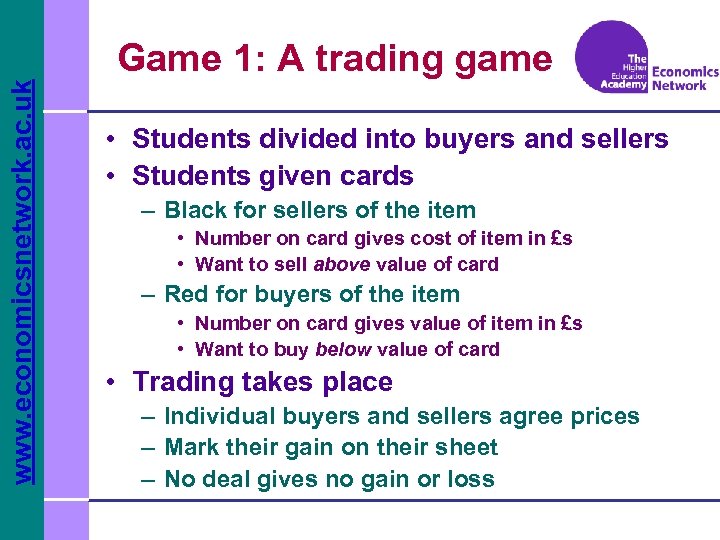 www. economicsnetwork. ac. uk Game 1: A trading game • Students divided into buyers and sellers • Students given cards – Black for sellers of the item • Number on card gives cost of item in £s • Want to sell above value of card – Red for buyers of the item • Number on card gives value of item in £s • Want to buy below value of card • Trading takes place – Individual buyers and sellers agree prices – Mark their gain on their sheet – No deal gives no gain or loss
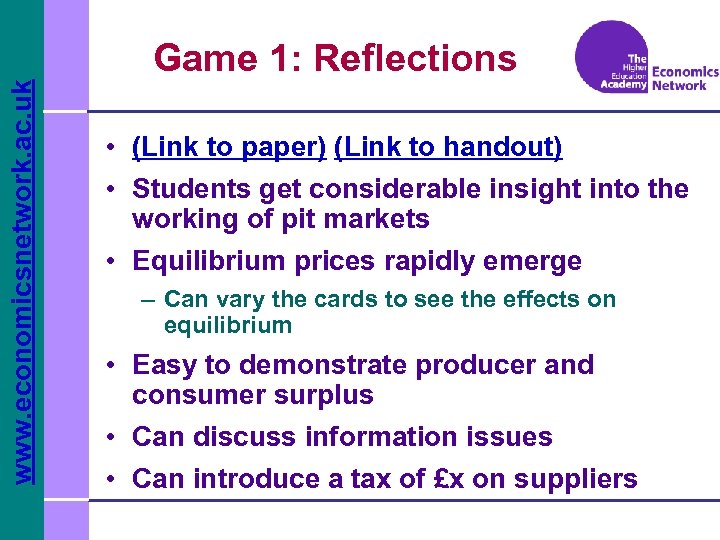 www. economicsnetwork. ac. uk Game 1: Reflections • (Link to paper) (Link to handout) • Students get considerable insight into the working of pit markets • Equilibrium prices rapidly emerge – Can vary the cards to see the effects on equilibrium • Easy to demonstrate producer and consumer surplus • Can discuss information issues • Can introduce a tax of £x on suppliers
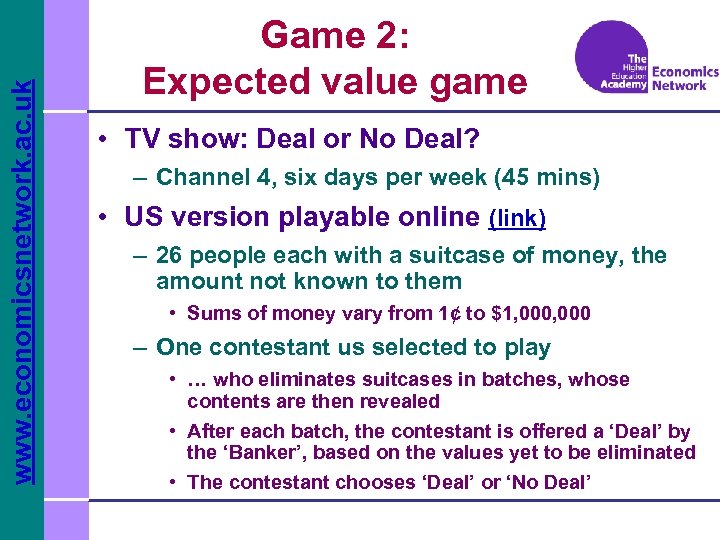 www. economicsnetwork. ac. uk Game 2: Expected value game • TV show: Deal or No Deal? – Channel 4, six days per week (45 mins) • US version playable online (link) – 26 people each with a suitcase of money, the amount not known to them • Sums of money vary from 1¢ to $1, 000 – One contestant us selected to play • … who eliminates suitcases in batches, whose contents are then revealed • After each batch, the contestant is offered a ‘Deal’ by the ‘Banker’, based on the values yet to be eliminated • The contestant chooses ‘Deal’ or ‘No Deal’
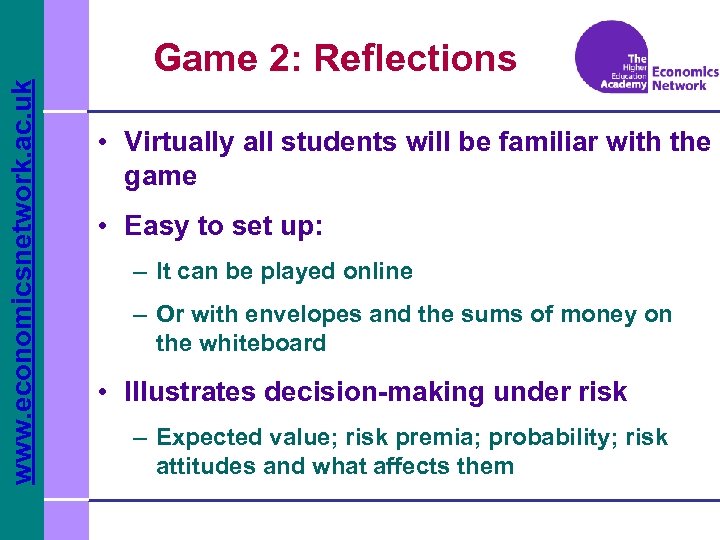 www. economicsnetwork. ac. uk Game 2: Reflections • Virtually all students will be familiar with the game • Easy to set up: – It can be played online – Or with envelopes and the sums of money on the whiteboard • Illustrates decision-making under risk – Expected value; risk premia; probability; risk attitudes and what affects them
 www. economicsnetwork. ac. uk Game 3: Production function game • Activity – Production runs (2) in a factory, involving moving balls from one place to another – Extra workers are added one at a time • Equipment: – About 30 balls (e. g. tennis balls) – 4 buckets (or baskets or cardboard boxes) • Students divided into two teams – Object to get as many balls from one end to the other in 30 seconds
 www. economicsnetwork. ac. uk Game 3: Reflections • (Link to paper) (Link to handout) • Easy to set up and fun to play – Can bring alive a potentially dry subject area – Flexible: can be played with 1, 2 or more teams • Can demonstrate – – Diminishing returns TP, AP and MP Can derive TC, AC, MC, TR, AR, MR and Profit Shifts and movements along product and cost curves from technological change – Effects of changing fixed and variable costs
 www. economicsnetwork. ac. uk Game 4: Public goods game • Aim – Aim is to make as much money as possible, irrespective of what others make • Activity – Each person (or pair) is given four cards of the same value (e. g. four threes or four queens) – Each person plays two cards each round • Scoring – Black cards have no value – Red cards are worth £ 1 for everyone if played and £ 4 just to the individual if not played.
 www. economicsnetwork. ac. uk Game 4: Reflections • (Link to paper) (Link to handout) • Very easy to set up and fun to play – Can easily be played in a seminar – Flexible: can be played with up to 13 individuals or pairs • Can demonstrate – Public goods and external benefits – Prisoners’ dilemma and Nash equilibrium – Collusion versus competition – Motivation and altruism
 www. economicsnetwork. ac. uk Game 5: Auctioning a pound coin • Activity – This is a simple auction of a pound coin – The only difference is that both the winner and the next highest bidder have to pay • At the end – The money earned can be returned to students (but don’t tell them this at the start). – A discussion can then take place about the issues raised
 www. economicsnetwork. ac. uk Game 5: Reflections • (Link to paper) (Link to handout) • Simple and flexible – Simple equipment: a pile of pound coins and a sheet for recording results – Can be played in a seminar group • Can demonstrate – Sunk costs and marginal costs – Risk attitudes – Collusive bidding – Concepts of equity
 www. economicsnetwork. ac. uk Game 6: A ‘Keynesian Beauty Contest’ • A game about investor expectations – predicting share prices based on what you think other people will do • Simple to play – No equipment required other than: • a calculator for the tutor • a whiteboard/flipchart for recording results • The game (each round) – Students have to select a number from 0 to 100 – A prize is given in each round to the student who selects a number closest to 2/3 of the mean
 www. economicsnetwork. ac. uk Game 6: Reflections • Link 1 Link 2 • At the end – Students can be asked to explain their decisions • Can demonstrate: – Expectations formation – Iterative thinking / progression – Movement to Nash equilibrium
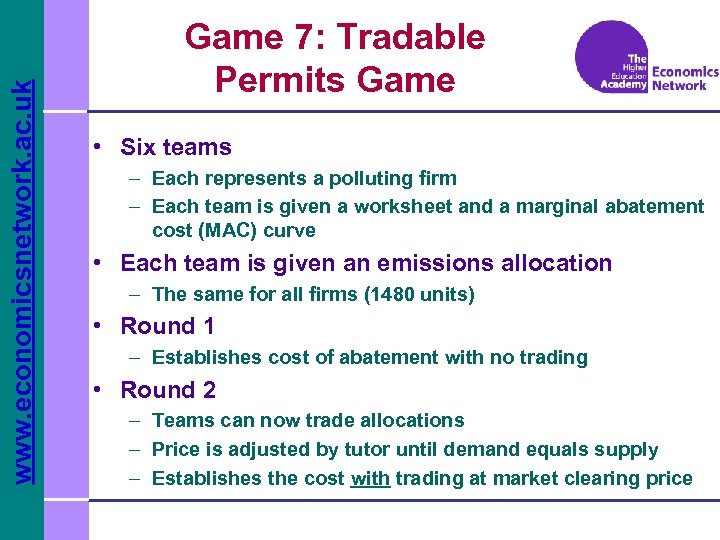 www. economicsnetwork. ac. uk Game 7: Tradable Permits Game • Six teams – Each represents a polluting firm – Each team is given a worksheet and a marginal abatement cost (MAC) curve • Each team is given an emissions allocation – The same for all firms (1480 units) • Round 1 – Establishes cost of abatement with no trading • Round 2 – Teams can now trade allocations – Price is adjusted by tutor until demand equals supply – Establishes the cost with trading at market clearing price
 www. economicsnetwork. ac. uk Game 7: Reflections • (Link to handouts and worksheets) • Uses MC = MR analysis in a different context • Demonstrates how emissions trading can achieve any given pollution reduction at minimum cost • Flexible: no. of permits can be varied to demonstrate – Effect on equilibrium price – Abatement costs • Seminar can analyses worksheets of all teams after the game
 www. economicsnetwork. ac. uk References • Classroom Expernomics – http: //www. marietta. edu/%7 Edelemeeg/games • Charlie Holt’s Games papers – http: //www. people. virginia. edu/~cah 2 k/papers. html • Charlie Holt’s Veconlab – http: //veconlab. econ. virginia. edu/admin. htm • Charles A. Holt, Markets, Games and Strategic Behaviour, Pearson/Addison Wesley, 2006 • Bringing Economic Experiments into the Classroom (FDTL 5 project: Univ. of Exeter) – http: //www. economicsnetwork. ac. uk/projects/fdtl 5/experimen ts. htm