


 Скачать презентацию www ecologic eu Climate change and water conflicts
5b6e34c056bc3e34a2ae86943ea85785.ppt
- Количество слайдов: 25
 www. ecologic. eu Climate change and water conflicts - insights from a research project on „Climate change, water conflicts and human security“ (CLICO) Christiane Gerstetter Ecologic Institute
 www. ecologic. eu Ban Ki-Moon, UN Secretary General in an address to the UN Security Council, 2011: “Climate change is real and accelerating in a dangerous manner, it not only exacerbates threats to international peace and security; it is a threat to international peace and security. ” Assumption: Climate change leads to scarcity of resources and as a consequence to conflicts and security risks 19. 03. 2018 Workshop at Kubiz/Solar 2
 www. ecologic. eu Research question: What are the relationships between climate change, water conflicts and human security? Area studied: Mediterranean, Middle East, Sahel Area characterised by: history of conflicts, neighbour region of EU, significant impacts of climate change expected (warming, water scarcity, droughts, floods, raise in sea level etc. ) 19. 03. 2018 Workshop at Kubiz/Solar 3
 www. ecologic. eu The research project: Climate Change, Hydro Conflicts and Human Security (CLICO) Funding: European Commission, DG Research and Innovation Duration: January 2010 – December 2012 Budget: ca. 2, 9 Mio € Partners: 15 universities and Think Tanks in UK, Germany, Norway, Israel, Switzerland, Cyprus, UK, Palestine, Spain, Ethiopia, Egypt Primarily social science 19. 03. 2018 Workshop at Kubiz/Solar 4
 www. ecologic. eu Definitions Human security “safety from chronic threats such as hunger, disease and repression” “protection from sudden and hurtful disruptions in the patterns of daily life - whether in homes, in jobs or in communities” Dimensions: economic security, food security, health security, environmental security, personal security, community security and political security (UNDP 1994) Conflict Broad definition, not only including violent conflict, also local conflicts etc. 19. 03. 2018 Workshop at Kubiz/Solar 5
 www. ecologic. eu Research components 19. 03. 2018 Workshop at Kubiz/Solar 6
 www. ecologic. eu Statistical analysis of newspapers Analysis of more than 70. 000 newspaper articles with a view to whether they mention intra-state/local water-related events – conflict or cooperation - and correlation with climate or socio -economic data Covering 35 countries, time period: 1997– 2009 Altogether more cooperation than conflicts found, more intrastate/local conflicts than international conflicts Climate-related factors hardly trigger water-related conflicts; institutional and economic factors are more relevant In autocractic regimes there are fewer, but more violent conflicts 19. 03. 2018 Workshop at Kubiz/Solar 7
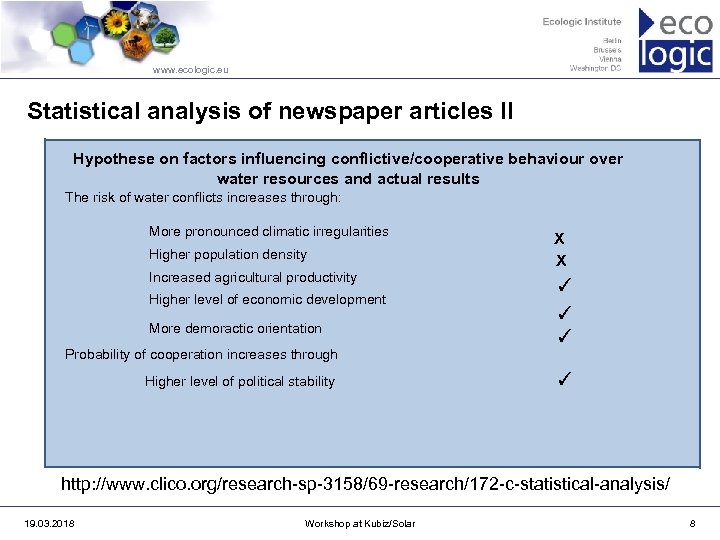 www. ecologic. eu Statistical analysis of newspaper articles II Hypothese on factors influencing conflictive/cooperative behaviour over water resources and actual results The risk of water conflicts increases through: More pronounced climatic irregularities Higher population density Increased agricultural productivity Higher level of economic development More demoractic orientation X X ✓ ✓ ✓ Probability of cooperation increases through Higher level of political stability ✓ http: //www. clico. org/research-sp-3158/69 -research/172 -c-statistical-analysis/ 19. 03. 2018 Workshop at Kubiz/Solar 8
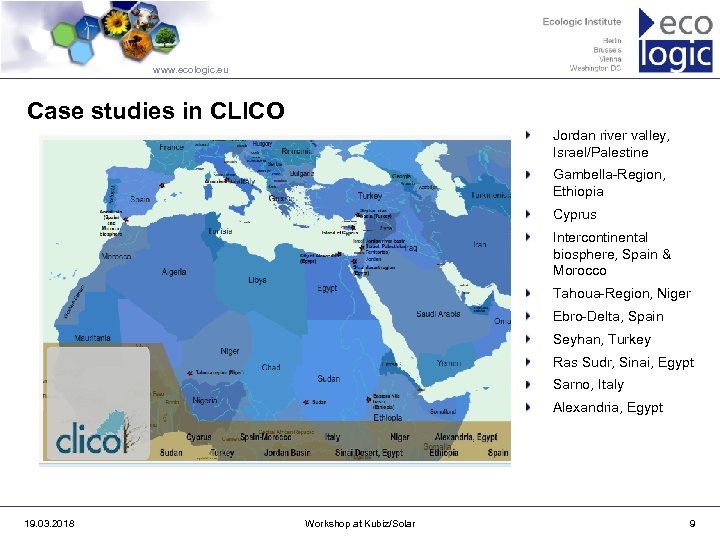 www. ecologic. eu Case studies in CLICO Jordan river valley, Israel/Palestine Gambella-Region, Ethiopia Cyprus Intercontinental biosphere, Spain & Morocco Tahoua-Region, Niger Ebro-Delta, Spain Seyhan, Turkey Ras Sudr, Sinai, Egypt Sarno, Italy Alexandria, Egypt 19. 03. 2018 Workshop at Kubiz/Solar 9
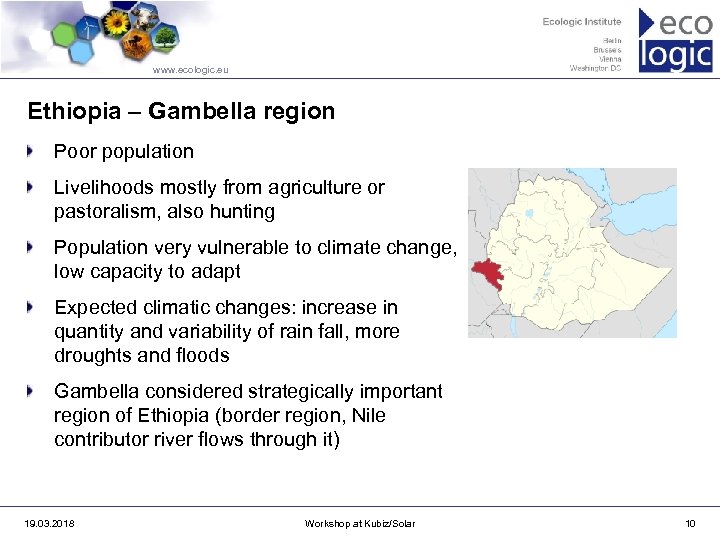 www. ecologic. eu Ethiopia – Gambella region Poor population Livelihoods mostly from agriculture or pastoralism, also hunting Population very vulnerable to climate change, low capacity to adapt Expected climatic changes: increase in quantity and variability of rain fall, more droughts and floods Gambella considered strategically important region of Ethiopia (border region, Nile contributor river flows through it) 19. 03. 2018 Workshop at Kubiz/Solar 10
 www. ecologic. eu Ethiopia – Gambella region Existing often violent conflicts: Between different ethnic communities (indigenous – settler) Often over land, water etc. Cattle raids from groups from Sudan 19. 03. 2018 Workshop at Kubiz/Solar 11
 www. ecologic. eu Policies and their consequences No specific adaptation policies, idea that “modernization” or development can foster adaptation Major policies: Villagisation: relocation of 45 000 households into larger and fixed communities; each household to be assigned farm land + agricultural input (e. g. seed) + food for transition period; official rationale (among others): flood protection, socio-economic development, more secure living environment Agricultural Development-Led Industrialisation: fostering private sector investment in agriculture for large-scale farming through cheap leases and tax reductions; rationale: job creation, improve food security 19. 03. 2018 Workshop at Kubiz/Solar 12
 www. ecologic. eu Results People have been moved away from water sources – less risk of flooding, but less access to water, problematic with higher variability of rain fall; interviewees: “people do not have enough water” “we are brought here to die” People may need to adapt to new environment in new villages, may first be worse-off Settlement program is seen by some parts of population as attempt of government to control them Raise in conflicts in region (2012) If water/land conflicts increase in region, climate change is unlikely to be primary driver 19. 03. 2018 Workshop at Kubiz/Solar 13
 www. ecologic. eu Climate change and availability of water in the region IPCC (4 AR) expect increase in annual average temperature, and reduction of annual precipitation by 25% by 2070 -2100 Altered pattern of precipitation Less ground water recharge, higher rate of evapotranspiration, raise in seal -level Reduced amount of water in rivers But already now water scarcity 19. 03. 2018 Workshop at Kubiz/Solar 14
 www. ecologic. eu Political situation Both sides depend on the same water resources 1993/1994 peace agreements contain rules on allocation of water Creation of Joint Water Committee – both sides consider it insufficient Palestinians needs for larger water-related projects in most areas permit of the Israeli side (wells, sewage treatment Water availability very different on both sides, according to UN Israel: 300 l per day available for consumption Palestinian territories: 70 l per available for consumption 19. 03. 2018 Workshop at Kubiz/Solar 15
 www. ecologic. eu Israeli perspective on water, conflict, climate change No huge dependence on natural water resources through waste water re-use and desalination plants, „water has always been scarce“ Climate change would reduce availabilty of water, but this is unlikely to lead to conflicts; population growth seen as larger problem than climate change Predominant perspective is that water is a commodity and water scarcity can be solved through technical means Lack of water on Palestinian side is caused by Palestinians 19. 03. 2018 Workshop at Kubiz/Solar 16
 www. ecologic. eu Palestinian perspective on water, conflict, climate change Israel uses most of joint water resources Not climate change, but Israeli occupation is cause of water scarcity and conflicts Water distribution is seen as issue of (national) rights, access and distribution 19. 03. 2018 Workshop at Kubiz/Solar 17
 www. ecologic. eu Results Climate change unlikely to be important factor in exacerbating Israeli/Palestinian conflict In a situation of existing political conflict, the cauality is not from ecological scarcity to conflict, but from conflict to environmental stress and vulnerability Conflict prevents certain reasonable actions to address situation 19. 03. 2018 Workshop at Kubiz/Solar 18
 www. ecologic. eu Overall results 19. 03. 2018 Workshop at Kubiz/Solar 19
 www. ecologic. eu Overall results Climate-related, hydrological, socio-economic, institutional and political factors may all have an impact on human security, but their relative importance depends on the context Political, economic and social factors so far appear to be more important drivers of water conflicts than for example resource scarcity Political: e. g. governance and dispute resolution mechanisms Socio-economic: marginalisation of certain sectors of the population Government driven strategies of adaptation can play an important role in safeguarding human security, but they can have positive or negative consequences 19. 03. 2018 Workshop at Kubiz/Solar 20
 www. ecologic. eu Policy conclusions and recommendations I State-led and funded adaptation measures are indispensable, as only states have certain resources at their disposal; yet not all state-led adaptation measures are good. When adaptation measures are used for a certain agenda, they may provoke antagonism and increase, rather than resolve or provent conflicts; participatory decision-making is important Social security systems are essential for reducing vulnerability to climate change and safeguarding human security Terms like „water wars“ should not be used in the context of climate change – such causal relations do not stand up to empirical scrutiny Institutions and mechanisms for conflict resolution should be strengthened Existing good political programmes and approaches should be implemented 19. 03. 2018 Workshop at Kubiz/Solar 21
 www. ecologic. eu Links Project: http: //www. clico. org/ Final report: http: //www. clico. org/final-report Database of environmental conflicts: http: //ejatlas. org/ Databse of historic water conflicts: http: //www 2. worldwater. org/conflict/map/ 19. 03. 2018 Workshop at Kubiz/Solar 22
 www. ecologic. eu Lessons for educational work on climate change 19. 03. 2018 Workshop at Kubiz/Solar 23
 www. ecologic. eu Simple claims about causalities (“climate change will cause conflicts”) are not necessarily correct, even if intuitively plausible >> teach people to think critically and doubt, rather than believing in simple thruths If you frame the discourse about climate change in a certain way, this also favors certain political solutions, e. g. if intensive agricultural contributes to water conflicts, rethinking the agricultural model might be the appropriate response if climate change produces conflicts and risks to security, responses involving a military component might be chosen Assume that political statements about climate change are made with certain intentions behind them 19. 03. 2018 Workshop at Kubiz/Solar 24
 www. ecologic. eu Thank you for your attention Christiane Gerstetter Ecologic Institute, Pfalzburger Str. 43 -44, D-10717 Berlin Tel. +49 (30) 86880 -0, Fax +49 (30) 86880 -100 christiane. gerstetter@ecologic. eu www. ecologic. eu 19. 03. 2018 Workshop at Kubiz/Solar 25