


 Скачать презентацию Something new is on the horizon for individuals
dd2ce7ee7f3d210ee1a3dcf4b7d789c8.ppt
- Количество слайдов: 27
 Something new is on the horizon… …for individuals receiving waiver services.
 Budget Florida The Waive(r) of the Future
 Phase 1 Implementation of IBudget Florida Area 2 B Initial locations: • Franklin, Gadsden, Jefferson, Leon, Liberty, Madison, Taylor, and Wakulla counties
 Phase 1 Implementation of IBudget Florida • Area 2 A will follow in about six months – Bay, Calhoun, Gulf, Holmes, Jackson, and Washington counties • Wider phase-in begins late 2011 or 2012
 Why i. Budgets? • Other options raise concerns – Managed care – Greater institutionalization – Continued deficits, growing waiting list, awkward legislative cost-control measures • Legislature told us to develop a plan by February 2010—then passed a law requiring APD to implement it
 How did APD make the i. Budget Florida plan? • Did a lot of research – Other states have similar systems - Georgia, Minnesota, Connecticut • Got a lot of stakeholder input – 16 dedicated self-advocates, family members, WSCs, providers, state agency representatives, and advocates on Stakeholder Group • Got help from consultants • Listened to consumers, families, and providers in public meetings and via our Web site
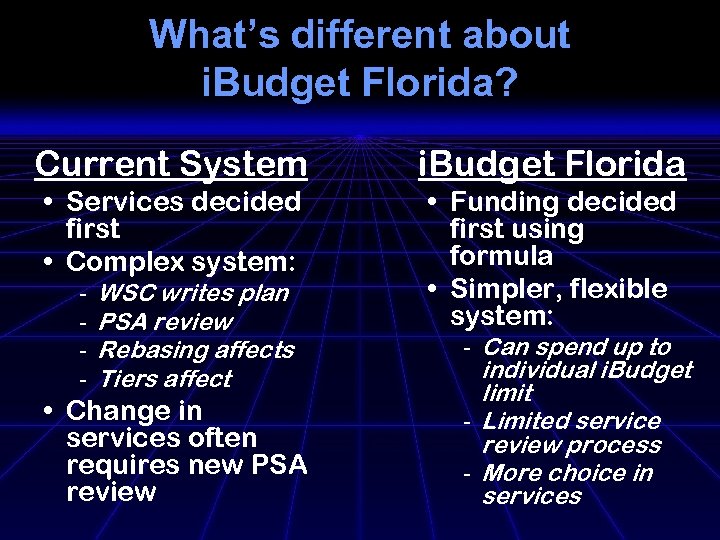 What’s different about i. Budget Florida? Current System i. Budget Florida • Services decided first • Complex system: • Funding decided first using formula • Simpler, flexible system: - WSC writes plan PSA review Rebasing affects Tiers affect • Change in services often requires new PSA review - Can spend up to individual i. Budget limit - Limited service review process - More choice in services
 Features of i. Budget Florida • More control over services—can get priority services faster and make changes easier – Budgets for services are determined up front to allow for planning – Wider array of services available to all – Prior service authorization ended as we know it • Greater support – WSCs will have less paperwork to do – Training and tools to self-direct are available if requested
 Features of i. Budget Florida • Stronger quality assurance and quality improvement – APD and QA contractor will review for health and safety, provider manipulation, and fraud • More stable system – Would phase-in gradually
 Algorithm Used to Determine Individual Budgets • Uses a statistically validated formula or algorithm – Considers consumer age, living setting, QSI subsection sum of scores, some QSI questions – People with similar needs receive similar funding – People with greater needs receive greater funding • Total of i. Budgets + funds for exceptional/ changed/one-time needs = total APD waiver funding
 What This Means to Consumers and Area Staff • Can scale back PSA process—gives more control • PSA process reduction and electronic records reduce WSC workload • Computer systems help monitor budgets, services, and quality • A chance for more consumer selfdirection
 What else is important? • Initially, some budgets would increase, others decrease, and some stay about the same – Will phase-in gradually—over a few years – Exceptional need process if critical health and safety needs are unmet with budget – Expect more system stability after initial phase-in • Consumers may need to prioritize use of APD funding – Waiver is intended to work with other resources – WSCs freed to help get more community resources
 Service Review The process as we know it would go away— minimized or eliminated as much as possible while meeting federal requirements • Streamlined paperwork • More flexibility • Review spread among areas, Central Office, and contracted experts • More review for unusual situations, less (or no) review for routine decisions
 Services Design of service array • Services grouped in 8 service families - Can switch among services within service family usually with minimal or no outside service review - Easier to meet changing needs over time • Broader services - Personal support and day activities - One worker can do a broader set of tasks - Allow to meet changing needs day-to-day
 Waiver Support Coordination • Waiver Support Coordinator’s role will shift to more of a facilitator and guide • Will be seeking to reduce paperwork • Allow more customized level of service – Most will have more flexibility to choose support coordination level (limited, full, or enhanced) – More meaningful distinction between levels (for example: more limited support in limited WSC service)
 Consumer and Family Control • Training would be provided to consumers and families on i. Budget Florida policies and choice-making • Unless in CDC+, must use Medicaid-enrolled providers • Could negotiate some rates up to maximum
 Online Budgeting Tool • Online budget tool to create budgets and track spending if consumers and families want to do so - Waiver Support Coordinator will handle if they don’t
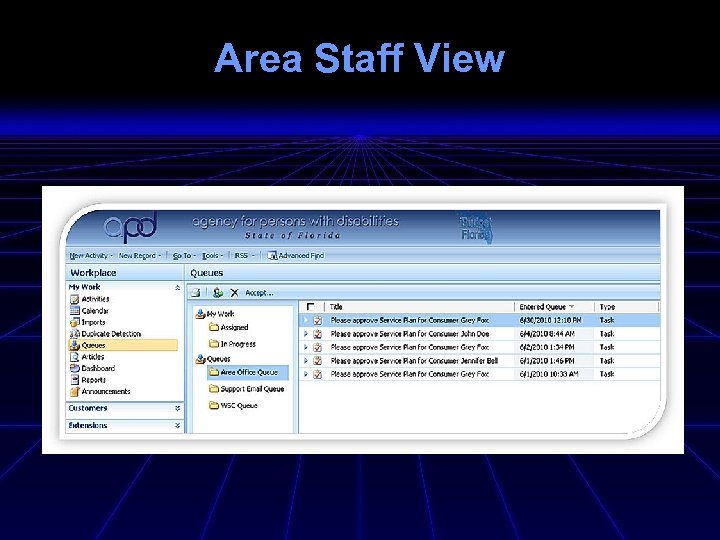 Area Staff View
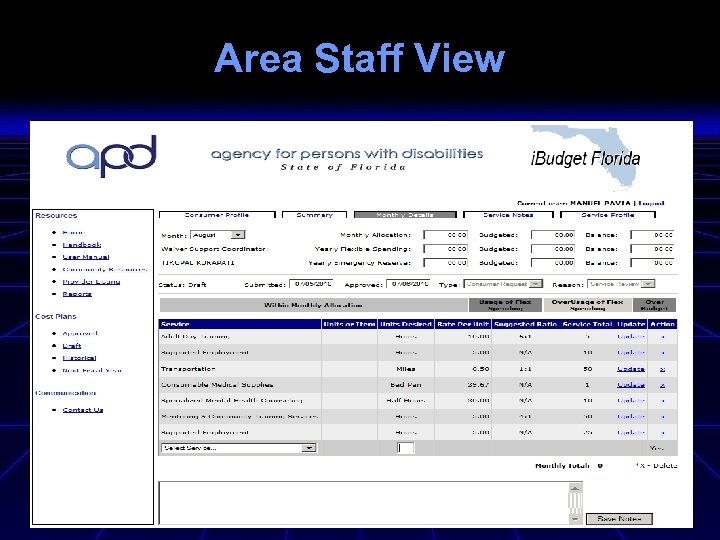 Area Staff View
 CDC+ and i. Budget Florida • CDC+ option will continue • CDC+ participants will have funding determined through their i. Budgets • CDC+ participants will “spend” i. Budgets according to CDC+ policies
 What if a personal i. Budget can’t meet an individual’s needs? • Extraordinary need funding is available if critical health and safety risk • Temporary or permanent increase for significantly changed needs that current i. Budget can’t accommodate • One-time funding is available—durable medical, environmental modifications, nonroutine dental • Thorough review of requests for more funding
 How will this affect Area staff? • PSA process changes – Area staff will have greater role in service review and approval (though online system will automatically process many requests) • Help answer questions from consumers, families, WSCs, and providers • Support QA process • Encourage and support self-direction while ensuring health and safety within budget
 Overview of Proposed System • Electronic/automated as much as possible – New online tool for creating budgets and tracking funding • Phase-in over a reasonable time period – e. g. , number of consumers (say, by geography) and budget amounts
 Overview of Proposed System • Consumer and family training and tools for managing budgets • Policies for limiting risk of overspending and options for corrective action plans • Reviews for health and safety, provider manipulation, and fraud • Process for determining budgets for consumers with extraordinary needs
 i. Budget Florida Public Meetings • Monday, August 30, 2010 – Tallahassee Community College • Tuesday, August 31, 2010 – Madison Public Library • Wednesday, September 1, 2010 – Carrabelle City Commission Chambers
 Budget Florida …has arrived! Get the latest info and provide input via APD’s Web site apdcares. org
 Questions? Jim De. Beaugrine Director Charlie Crist Governor