


 Скачать презентацию www Can-The-Internet Help-Our-Inpatients com THE ROLE OF THE
0fe6899a8c4ece650ad23bbc50b5f405.ppt
- Количество слайдов: 27
 www. Can-The-Internet. Help-Our-Inpatients. com THE ROLE OF THE INTERNET IN FACILITATING COMMUNICATION IN THE DYING PHASE Abby Parish FP 1 Doctor in Palliative Medicine, YBN, Bridgend
 Communication difficulties for patients. . . n Multiple medical and psychological causes n Also being physically removed from society when an inpatient
 The Problem
 Case: Patient D n 57 y old male with locally advanced rectal cancer n Acute admission in final weeks of life n Bed bound (pain, open tumour) n Discharge not possible n Business man - main concern was being able to tie up his business so he could provide for his family
 Patient Management ü Pain control ü Wound management ü Supportive treatment s How to help him tie up his business affairs…. .
 Background
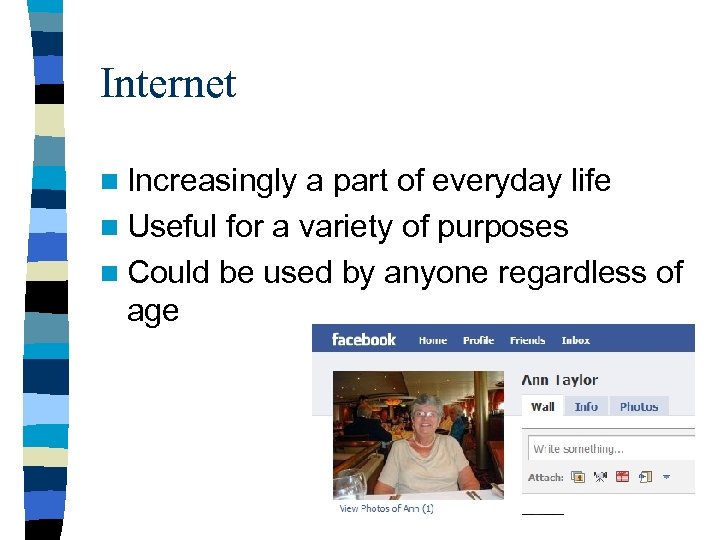 Internet n Increasingly a part of everyday life n Useful for a variety of purposes n Could be used by anyone regardless of age
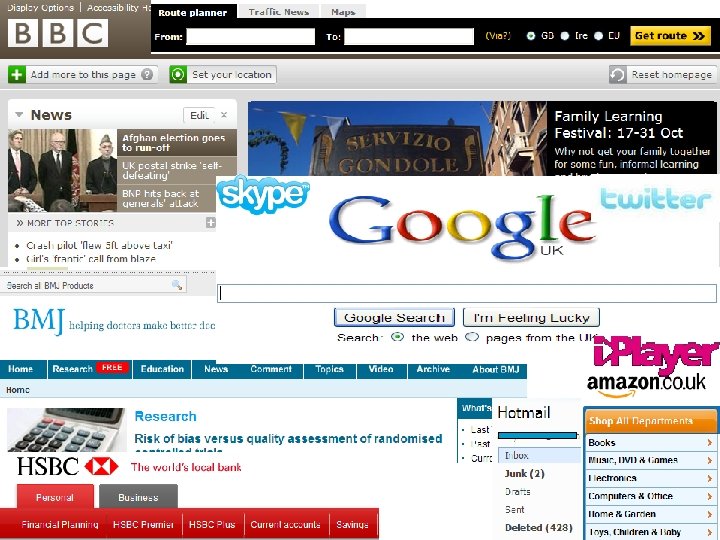 Internet usage
 Patients use of the internet n Information gathering n Support n Socialisation/blogging n Purchasing aids n Therapeutic outlet
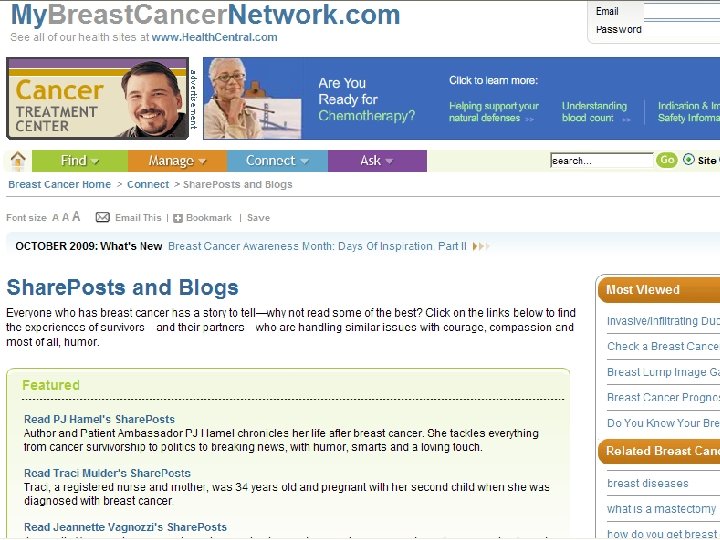
 Palliative Care Inpatients n Some will never leave hospital n Others have relatives around the world n They may seek information n Others seek solace in strangers n Some want to tie up business affairs n Some may just want to buy a CD or a pair of shoes
 Survey
 Aims n To look at the provision and use of the internet for palliative care inpatients in specialist palliative care units in Wales n Ultimately to find a solution for patient D
 Method n Telephone survey of 17 Welsh inpatient units – Both adult & paediatric – Both NHS and funded by charity
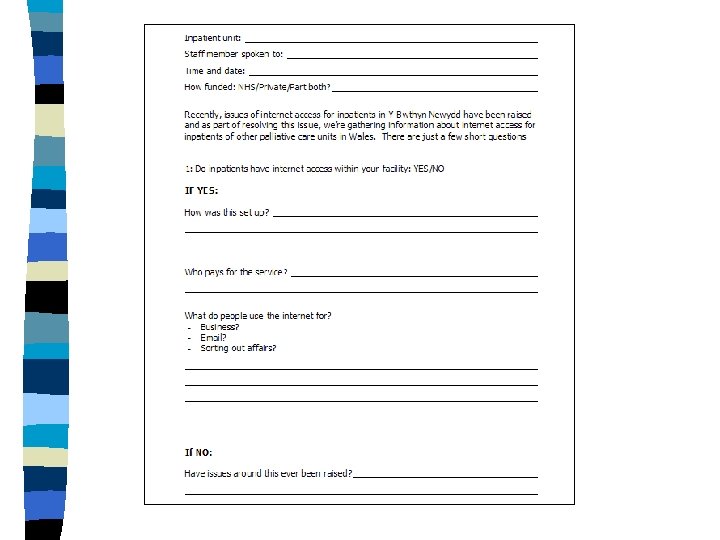
 Results n 5 units provide internet access – All funded by charitable contributions n 12 units had no internet provision – In 3 units patients did access the internet via mobile broadband was self-funded
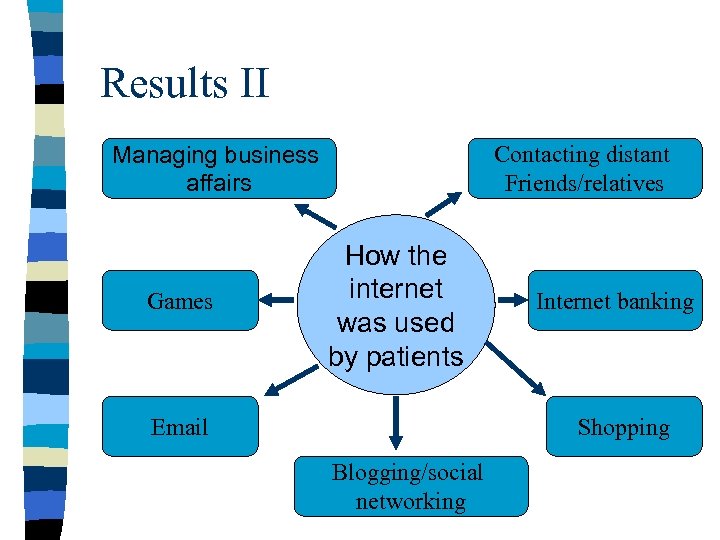 Results II Managing business affairs Games Contacting distant Friends/relatives How the internet was used by patients Email Internet banking Shopping Blogging/social networking
 The Solution
 Patient D n After information gathering across Wales, we advised D to bring in his laptop and use mobile internet n His business affairs were completed via the internet plus telephone n In his final weeks of life, he enjoyed peace of mind and quality time with his family
 Summary
 Benefits n Allows patient to socialise on their own terms n Information gathering n Facilitates process of tying up affairs n Allows communication with friends and families who are away n Promotes patient well-being
 Disadvantages n Not everyone can use the internet n Not all patients will be well enough to use the internet n Confidentiality (e. g. communal laptops) n Accessing inaccurate information online n Mobile broadband may not be available in all areas
 Suggestions n Internet access is easy to provide – Broadband & wireless router (<£ 20/month) – Patients own laptop & mobile internet (£ 0 to hospice) – IT security may be an issue within a trust
 Suggestions II n What to do with this information – Bring it up at a national conference for discussion! n Next step… – Qualitative study
 Finally…. n Internet is an increasingly important form of communication in everyday life n Handy way for patients to communicate with loved ones and tie up outstanding affairs n Allows us to ‘offers a support system to help patients live as actively as possible until death’ (WHO)
 References n n n n Bach, L. A. Blogging during terminal care: Communication, color schemes and creating a community, Journal of Clinical Oncology, 2008: 26, p. 4504 -4506 Farmer A. D. , Bruckner Holt, C. E. M. , Cook, M. J. , & Hearing, S. D. Social networking sites: a novel portal for communication, Postgraduate Medical Journal, 2009: 85; p. 455 -459 Mc. Kay, B. Internet resources for hospice and bereavement, Journal of Pain & Palliative Care Pharmacotherapy, 2009: 23; p. 141 -144 Tan, L. Psychotherapy 2. 0: My. Space blogging as self-therapy, American Journal of Psychotherapy, 2008: 62; p. 143 -163 Weiss, J. B. & Lorenzi, N. M. Online communication and Support for Cancer patients: A Relationship-centric Design Framework, AMIA annual symposium of procedures, 2005: 799 -803 Weiss, J. B. & Lorenzi, N. M. Challenges of social networking technologies for cancer care and social support, AMIA annual symposium of procedures, 2007: 1151 Willis, L. , Demiris, G. , & Oliver, D. P. Internet use by hospice families and providers: a review, Journal of medical systems: 31; p. 97 -101
 Thank you n Any questions or discussion points?