 Скачать презентацию WW II Invading German troops approach Bydgoszcz
d70e21e2865461e06ea501f218c37386.ppt
- Количество слайдов: 32



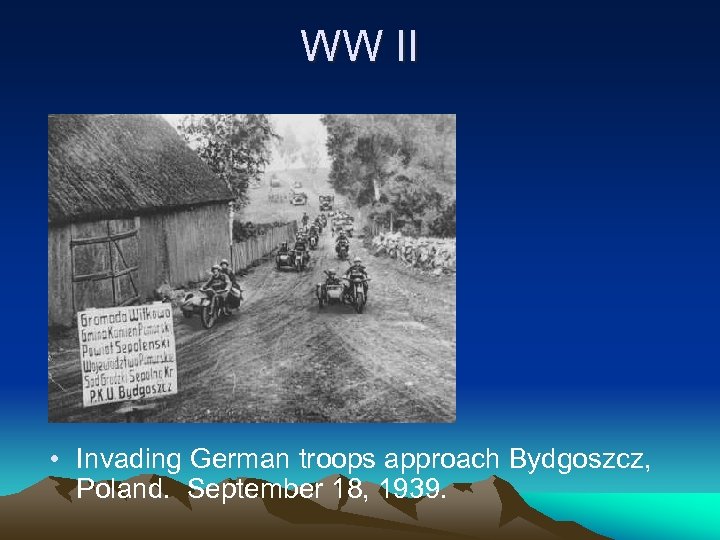
WW II • Invading German troops approach Bydgoszcz, Poland. September 18, 1939.
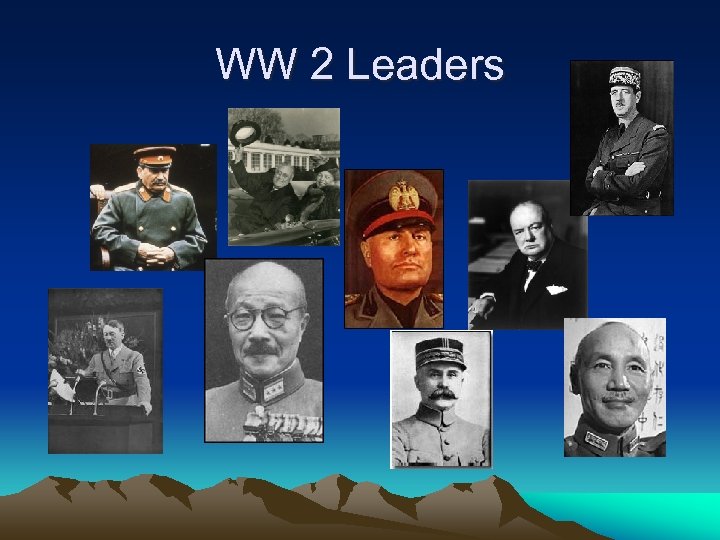
WW 2 Leaders
WW 2 Leaders The “Big Four”… • Great Britain… Winston Churchill; PM 1940 -1945 • USA… FDR • USSR… Josif Stalin • China… Chiang Kai-shek Additionally… • France… Charles De Gaulle; leader of the Free French forces in London Henri Petain; leader in Vichy France
WW 2 Leaders Axis leaders… • Germany… Adolph Hitler • Italy… Benito Mussolini • Japan… Hideki Tojo; foreign minister 1941 then prime minister 1941 -1944 Other Axis countries… • Hungary • Romania • Bulgaria
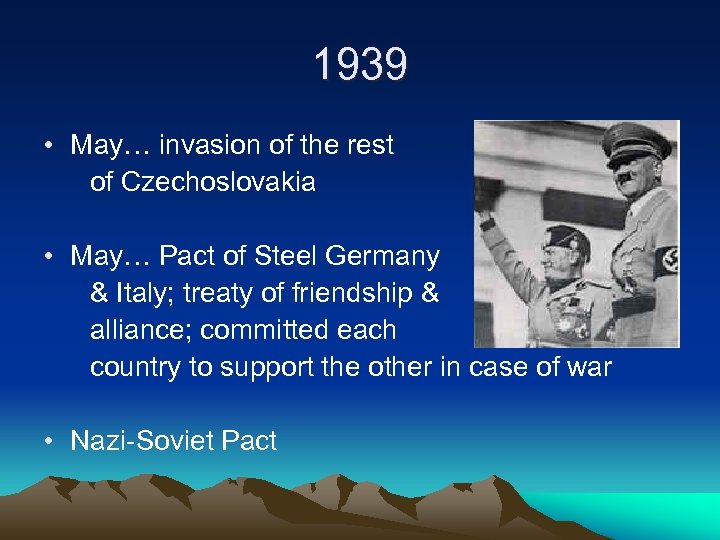
1939 • May… invasion of the rest of Czechoslovakia • May… Pact of Steel Germany & Italy; treaty of friendship & alliance; committed each country to support the other in case of war • Nazi-Soviet Pact
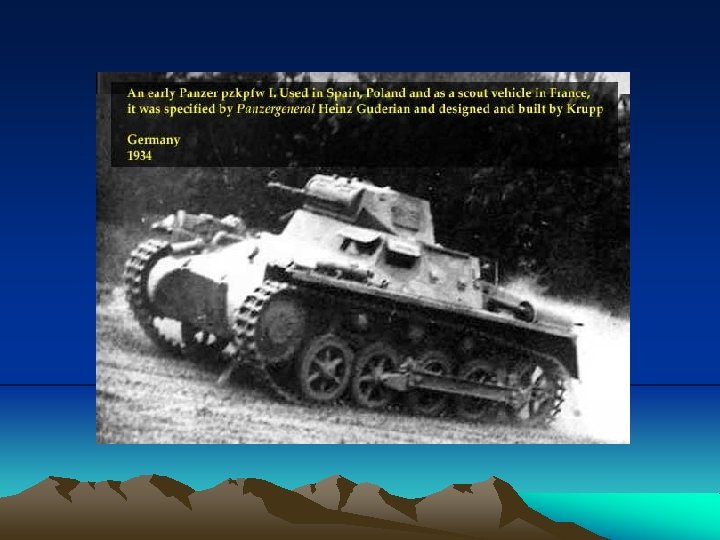
1939 Sept. 1… German invasion of Poland Sept. 3… France & Britain declared war on Germany Sept. 17… USSR attacked Poland Blitzkreig… rapid advances in enemy territory; use of radio to connect commanders, tanks, aircraft Nov…USSR attacked Finland Winter 1939 -1940 Dubbed “sitzkreig” by the British press War in the Atlantic already in full swing
1940 April 9… Germany attacked Denmark & Norway May 10… attacked France, going through Belgium, Netherlands & Luxembourg Between the two wars, France had built the Maginot Line between Luxembourg & Switzerland to defend France’s border with Germany went around the Maginot Line through the Ardennes Forest to defeat France
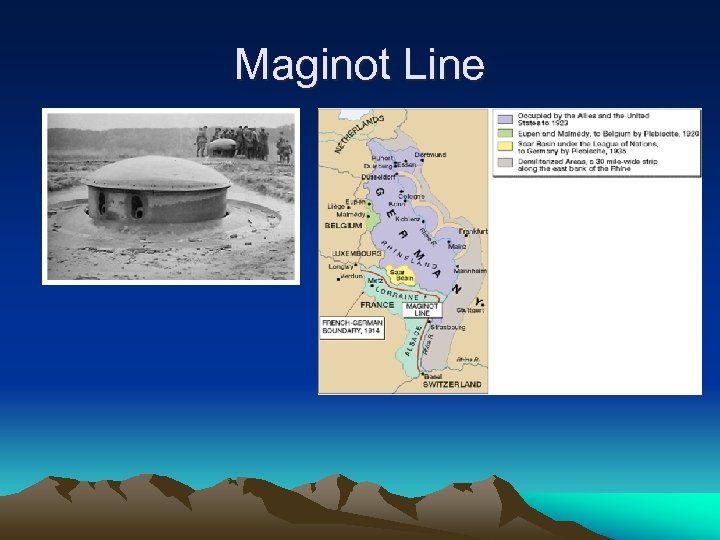
Maginot Line
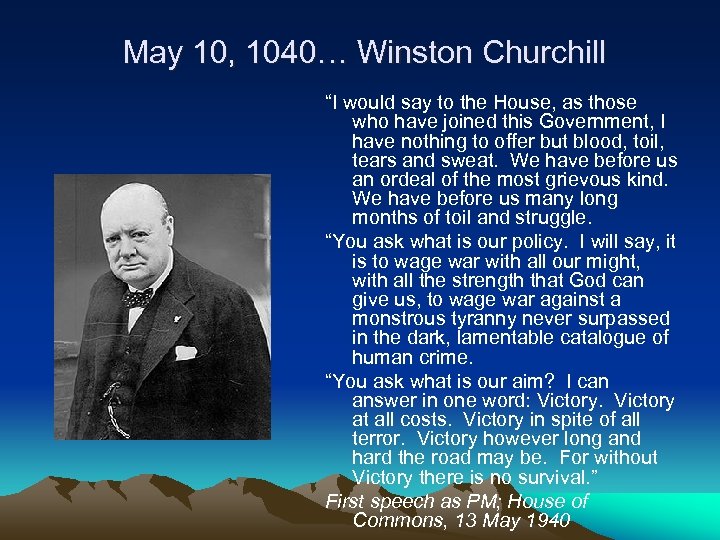
May 10, 1040… Winston Churchill “I would say to the House, as those who have joined this Government, I have nothing to offer but blood, toil, tears and sweat. We have before us an ordeal of the most grievous kind. We have before us many long months of toil and struggle. “You ask what is our policy. I will say, it is to wage war with all our might, with all the strength that God can give us, to wage war against a monstrous tyranny never surpassed in the dark, lamentable catalogue of human crime. “You ask what is our aim? I can answer in one word: Victory at all costs. Victory in spite of all terror. Victory however long and hard the road may be. For without Victory there is no survival. ” First speech as PM; House of Commons, 13 May 1940
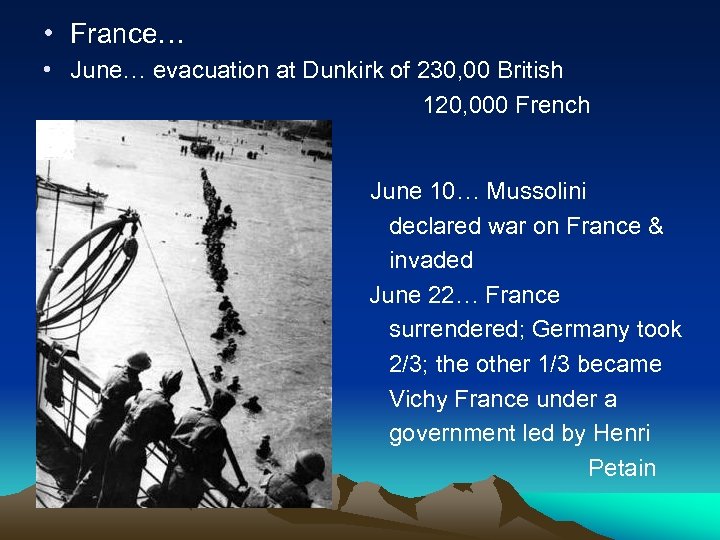
• France… • June… evacuation at Dunkirk of 230, 00 British 120, 000 French • June 10… Mussolini • • declared war on France & invaded June 22… France surrendered; Germany took 2/3; the other 1/3 became Vichy France under a government led by Henri Petain •
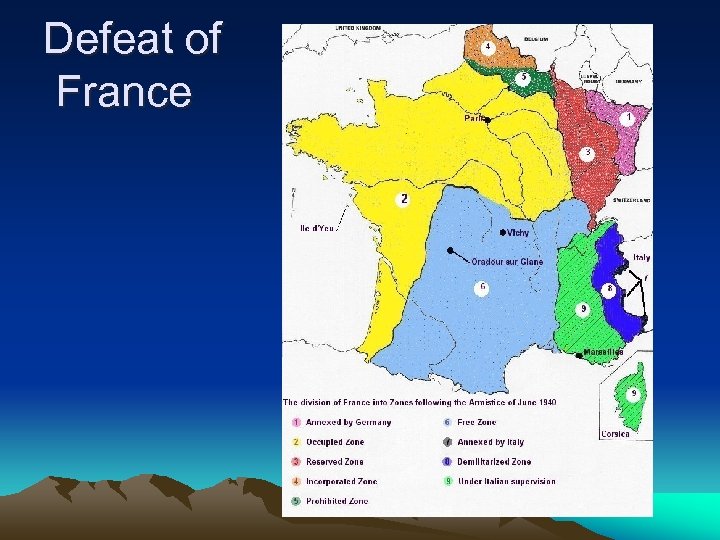
Defeat of France
And in the Atlantic Ocean… • Admiral Karl Donitz commanded all German U-boats at the beginning of the war • Britain put their ships into convoys to try to protect them • By October 1939, Germans had sunk 41 merchant ships • In 1939 more ships were sunk than could be built • Surrender of France gave the Germans more ports • Donitz developed the wolf pack system for attacking the British & American convoys • After the US entered the war, German submarines operated off the US East Coast; by June 1942, German U-boats had sunk 505 ships
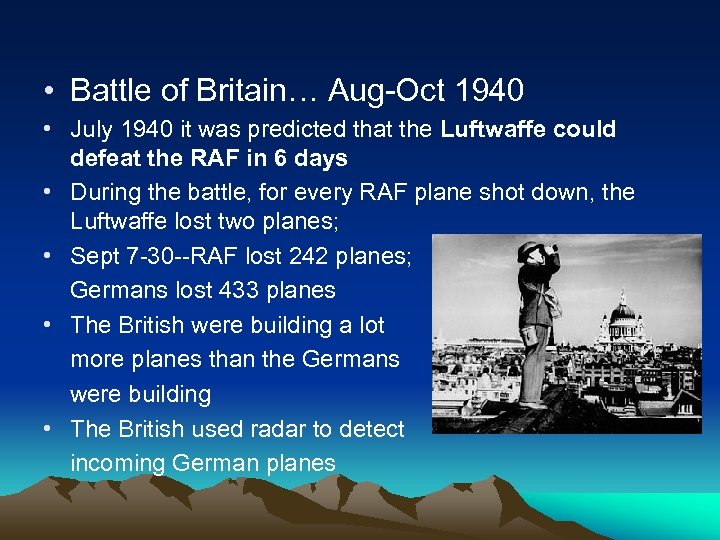
• Battle of Britain… Aug-Oct 1940 • July 1940 it was predicted that the Luftwaffe could defeat the RAF in 6 days • During the battle, for every RAF plane shot down, the Luftwaffe lost two planes; • Sept 7 -30 --RAF lost 242 planes; Germans lost 433 planes • The British were building a lot more planes than the Germans were building • The British used radar to detect incoming German planes
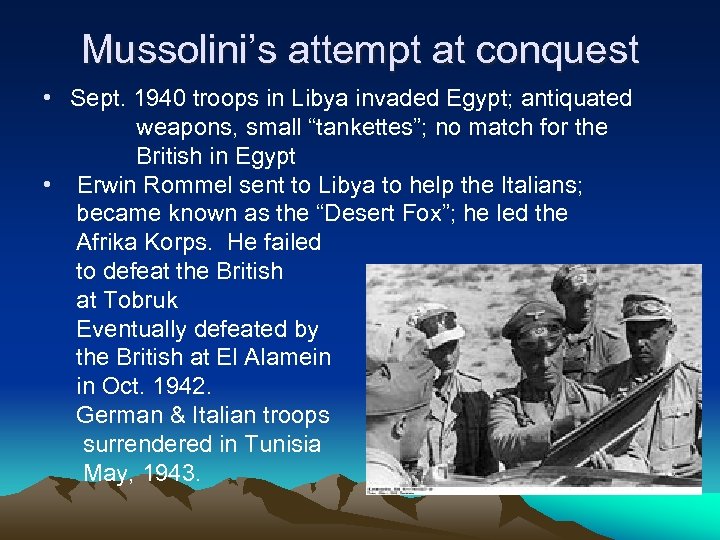
Mussolini’s attempt at conquest • Sept. 1940 troops in Libya invaded Egypt; antiquated weapons, small “tankettes”; no match for the British in Egypt • Erwin Rommel sent to Libya to help the Italians; became known as the “Desert Fox”; he led the Afrika Korps. He failed to defeat the British at Tobruk Eventually defeated by the British at El Alamein in Oct. 1942. German & Italian troops surrendered in Tunisia May, 1943.
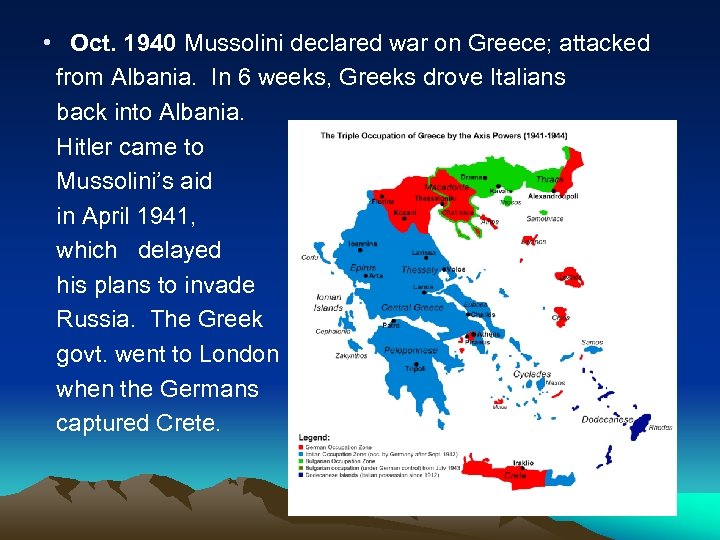
• Oct. 1940 Mussolini declared war on Greece; attacked from Albania. In 6 weeks, Greeks drove Italians back into Albania. Hitler came to Mussolini’s aid in April 1941, which delayed his plans to invade Russia. The Greek govt. went to London when the Germans captured Crete.
• Operation Barbarossa… the invasion of the USSR June 22, 1941 • Siege of Leningrad Nov. 1941 to end of 1943 • German troops reached the outskirts of Moscow • Battle of Stalingrad winter 1942 -1943 ** one of the turning points of WW II ** Russian army led by General Zhukov; German army led by General Paulus ** German army was headed for the oil fields in the Caucasus. Stalingrad was attacked both for its name and because it would have left a Russian city in the German rear ** Was a HUGH defeat for the Germans; Paulus, 24 other generals and army of 300, 000 Germans were lost ** First defeat for a German army; German retreat from the Eastern Front began Feb. 1943
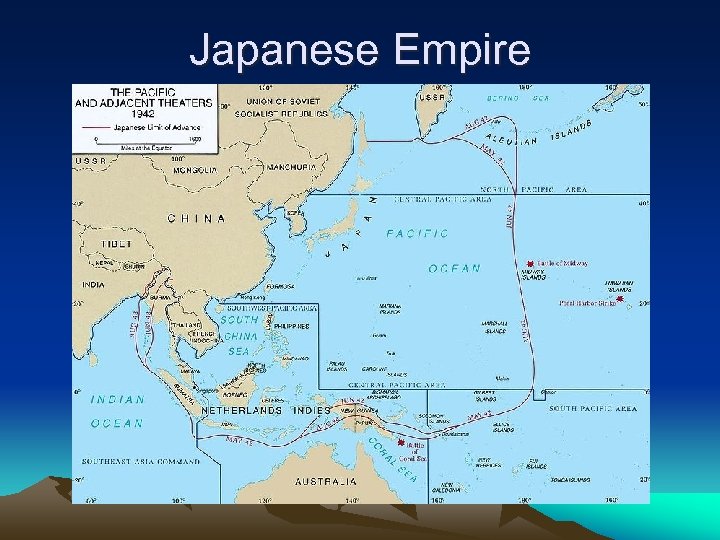
Japanese Empire
• Battle of Midway Island June 4 -6, 1942 • April, 1942… Doolittle Raid on Tokyo • Midway was another turning point battle, along with the Battle of Coral Sea in May, 1942 • US broke the Japanese code • Japanese wanted to sink the aircraft carriers they missed at Pearl Harbor. • The two navies never saw each other; battle was air battle. • All four Japanese aircraft carriers were sunk due to US attacks during the battle and after the battle; established US naval superiority in the Pacific.
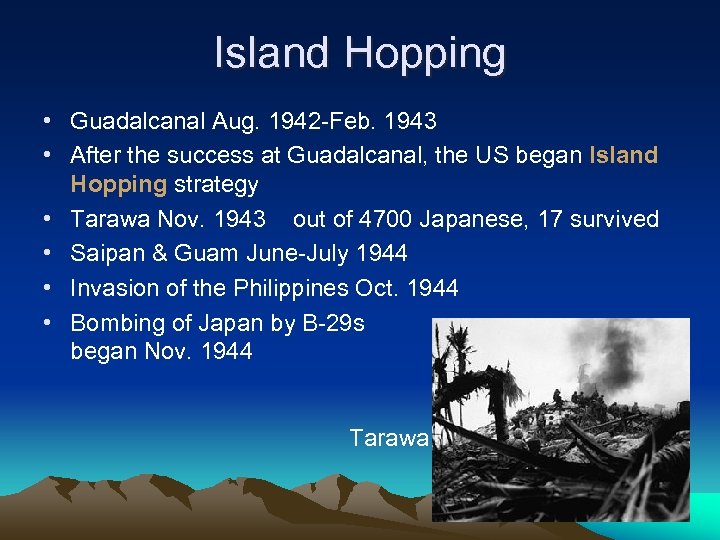
Island Hopping • Guadalcanal Aug. 1942 -Feb. 1943 • After the success at Guadalcanal, the US began Island Hopping strategy • Tarawa Nov. 1943 out of 4700 Japanese, 17 survived • Saipan & Guam June-July 1944 • Invasion of the Philippines Oct. 1944 • Bombing of Japan by B-29 s began Nov. 1944 Tarawa
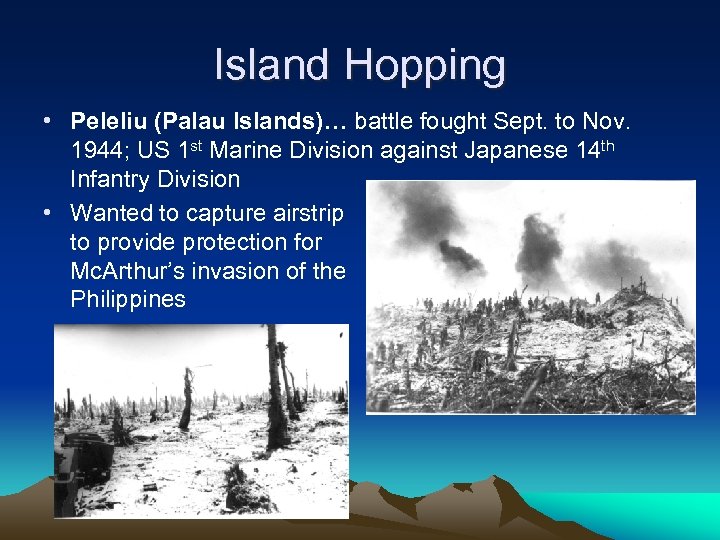
Island Hopping • Peleliu (Palau Islands)… battle fought Sept. to Nov. 1944; US 1 st Marine Division against Japanese 14 th Infantry Division • Wanted to capture airstrip to provide protection for Mc. Arthur’s invasion of the Philippines
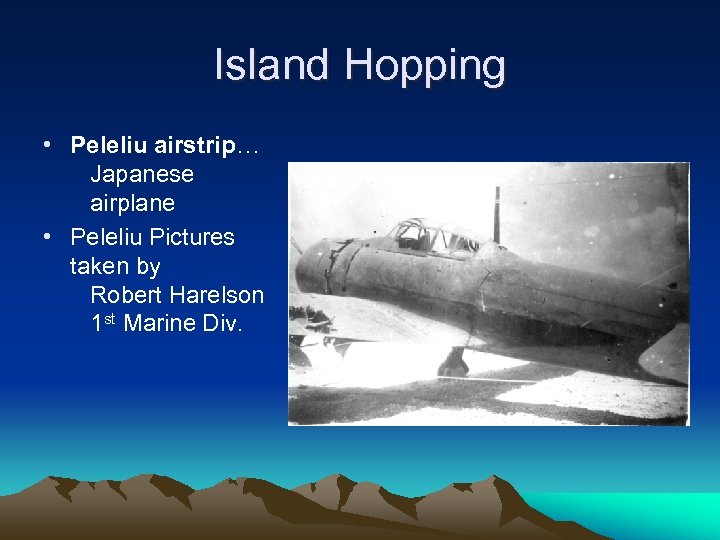
Island Hopping • Peleliu airstrip… Japanese airplane • Peleliu Pictures taken by Robert Harelson 1 st Marine Div.
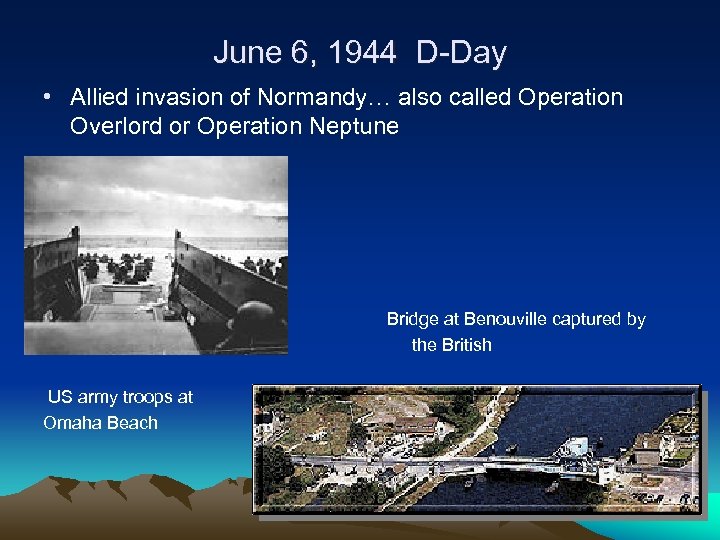
June 6, 1944 D-Day • Allied invasion of Normandy… also called Operation Overlord or Operation Neptune Bridge at Benouville captured by the British US army troops at Omaha Beach
Progress towards the end of WW II • http: //www. archive. org/details/1944 -1102_3 rd_Army_blasts_Nazi_Strongholds • Newsreel report on US military progress in both Europe and the Pacific • Battle of the Bulge… December-January 1944 • Hitler’s attempt to split the allies (France, Britain, USA) and stop their advance • One reason for German failure… lack of fuel for tanks and other vehicles
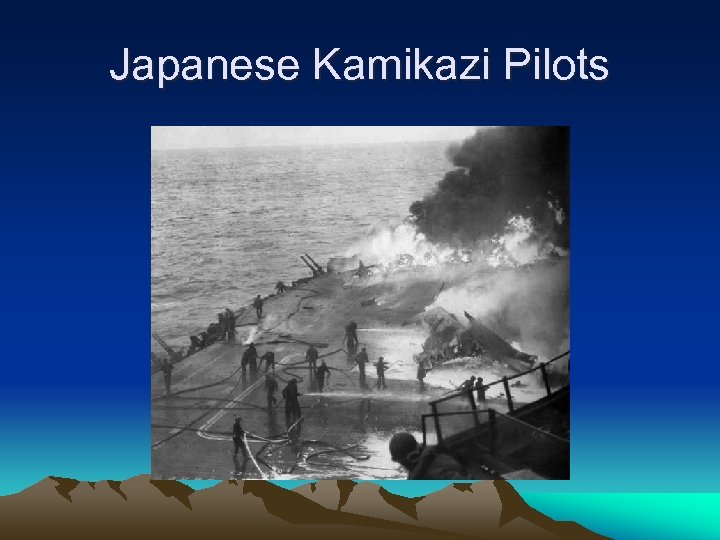
Japanese Kamikazi Pilots • First use of kamikazi pilots at Battle of Leyte Gulf Oct. 1944 • At the battle on Okinawa, over 300 kamikazi airplanes dove at US ships • By the end of the war, kamikazi planes sunk or damaged more than 300 US ships • The use of kamikazi pilots was one reason for the use of the atomic bomb.
Japanese Kamikazi Pilots
Conferences • Oct. 1943—Moscow Conference USA, UK, USSR, China Declaration to continue carrying out the war until Germany, Italy & Japan surrender unconditionally, then to maintain international peace • Nov. 1943—Tehran Conference USA, UK, USSR Plans for the final destruction of the German army Discussed invasion of France— 2 nd front in Europe Agreed to partition Germany at the end of the war, but specific boundaries were not set
• Feb. 1945—Yalta Conference Set policy of unconditional surrender Germany to be divided into four occupation zones Discussed reparations Russia agreed to enter the war in the Pacific First UN meeting set for April, 1945 in San Francisco • July 1945—Potsdam Conference Attended by Truman, Attlee & Stalin Confirmed agreement at Yalta Set up boundaries and commission to run Germany Decided on amount of reparations to be paid by Germany and other Axis countries Surrender terms for Japan
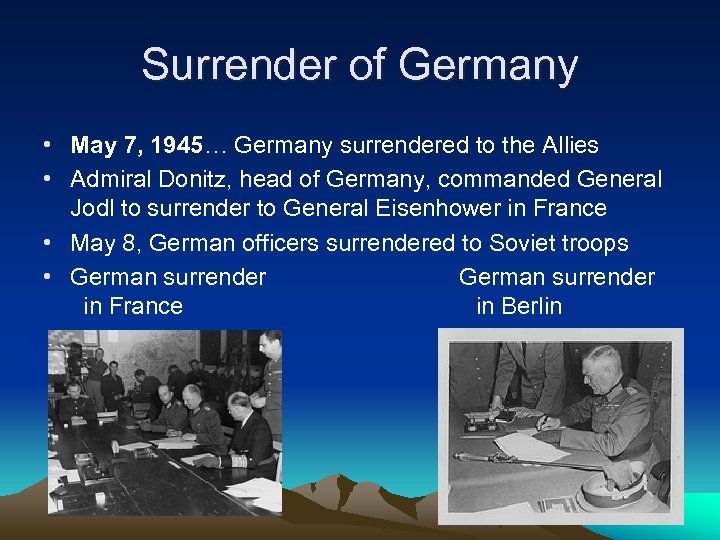
Surrender of Germany • May 7, 1945… Germany surrendered to the Allies • Admiral Donitz, head of Germany, commanded General Jodl to surrender to General Eisenhower in France • May 8, German officers surrendered to Soviet troops • German surrender German surrender in France in Berlin
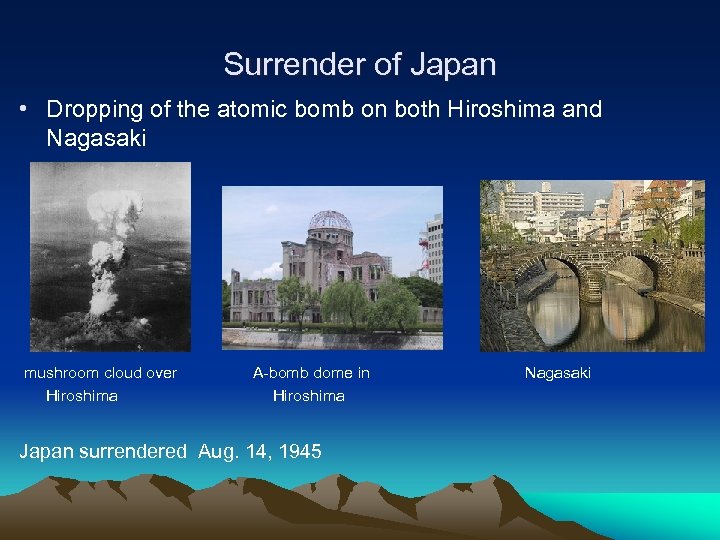
Surrender of Japan • Dropping of the atomic bomb on both Hiroshima and Nagasaki mushroom cloud over A-bomb dome in Nagasaki Hiroshima Hiroshima Japan surrendered Aug. 14, 1945
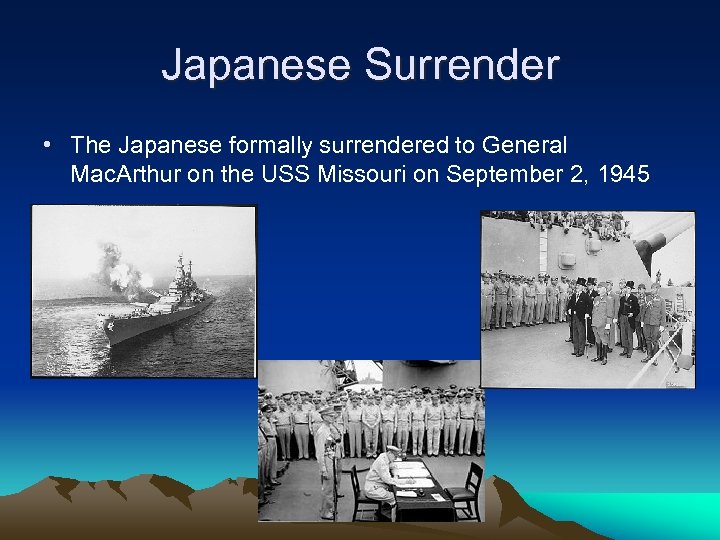
Japanese Surrender • The Japanese formally surrendered to General Mac. Arthur on the USS Missouri on September 2, 1945
• Pictures • • • Bibliography http: //www. worldwar 2 database. com/cgi-bin/slideviewer. cgi? list=poland. slides&dir= &config=&refresh=&direction=forward&scale=0&cycle=off&slide=3&design=default&total=18 http: //en. wikipedia. org/wiki/File: DUNKIRK 1940. jpg http: //en. wikipedia. org/wiki/Erwin_Rommel http: //en. wikipedia. org/wiki/Winston_Churchill http: //en. wikipedia. org/wiki/Battle_of_Britain http: //en. wikipedia. org/wiki/D-Day http: //www. pcf. city. hiroshima. jp/frame/Virtual_e/tour_e/guide 2_4. html http: //en. wikipedia. org/wiki/Nagasaki, _Nagasaki http: //www. ushmm. org/wlc/article. php? Module. Id=10005070 http: //en. wikipedia. org/wiki/Gilbert_and_Marshall_Islands_campaign http: //www. firstworldwar. com/bio/petain. htm http: //www. dogpile. com/info. dogpl/search/images? q=maginot%20 line&fcoid=408&fcop=topnav&fpid=2 • Text • • • • http: //www. mikekemble. com/ww 2/uboat. html http: //www. ahistoryofgreece. com/worldwar. II. htm http: //www. winstonchurchill. org http: //www. historylearningsite. co. uk/battle_of_stalingrad. htm http: //www. 2 worldwar 2. com/blitzkrieg. htm http: //www. worldwar 2 history. info/Pacific/ http: //www. ibiblio. org/pha/policy/1943/431000 a. html http: //news. bbc. co. uk/onthisday/hi/dates/stories/december/1/newsid_3535000/3535949. stm http: //www. army. mil/botb/overview. html http: //www. britannica. com/EBchecked/topic/453539/Philippe-Petain http: //www. oradour. info/appendix/francez 1. htm http: //www. militaryhistoryonline. com/wwii/articles/maginotline. aspx http: //www. pbs. org/perilousfight/psychology/the_kamikaze_threat/
Скачать презентацию WW II Invading German troops approach Bydgoszcz
d70e21e2865461e06ea501f218c37386.ppt