


Würzburg Airport Bringing benefits to the city
Current business model: aviational segment.
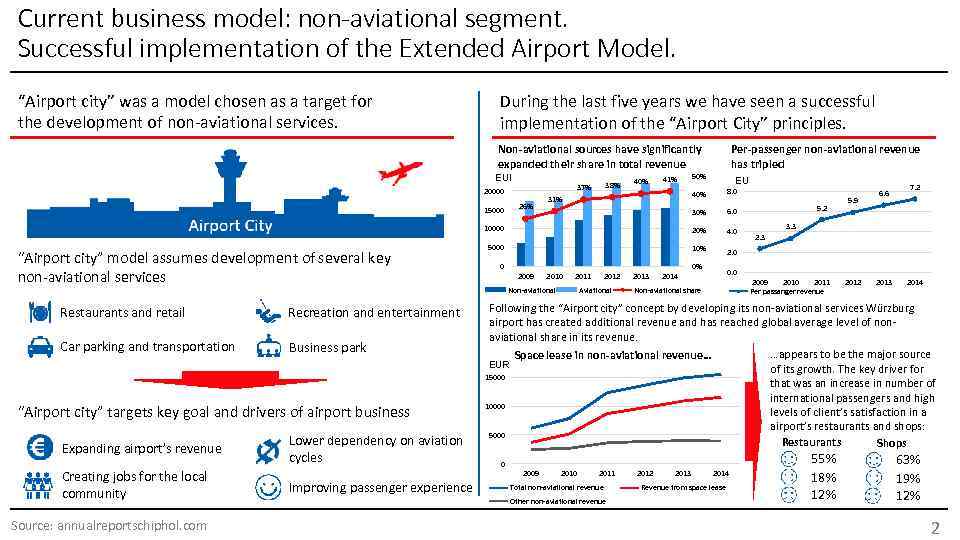
Current business model: non-aviational segment. Successful implementation of the Extended Airport Model. “Airport city” was a model chosen as a target for the development of non-aviational services. During the last five years we have seen a successful implementation of the “Airport City” principles. Non-aviational sources have significantly expanded their share in total revenue EUR 38% 37% 20000 40% 41% Per-passenger non-aviational revenue has tripled 50% EUR 40% 8. 0 30% 6. 0 10000 20% 4. 0 5000 10% “Airport city” model assumes development of several key non-aviational services Restaurants and retail Recreation and entertainment Car parking and transportation Business park “Airport city” targets key goal and drivers of airport business Expanding airport’s revenue Creating jobs for the local community Source: annualreportschiphol. com Lower dependency on aviation cycles Improving passenger experience 7. 2 2. 0 15000 26% 31% 0 0% 2009 2010 2011 Non-aviational 2012 Aviational 2013 5. 2 5. 9 6. 6 3. 3 2. 3 0. 0 2014 2009 2010 2011 Per passanger revenue Non-aviational share 2012 2013 2014 Following the “Airport city” concept by developing its non-aviational services Würzburg airport has created additional revenue and has reached global average level of nonaviational share in its revenue. …appears to be the major source Space lease in non-aviational revenue… EUR of its growth. The key driver for 15000 that was an increase in number of international passengers and high 10000 levels of client’s satisfaction in a airport’s restaurants and shops: 5000 Restaurants Shops 0 2009 2010 2011 Total non-aviational revenue Other non-aviational revenue 2012 2013 2014 Revenue from space lease 55% 18% 12% 63% 19% 12% 2

Development objectives
Target segments and airlines
Aviational services and products
Non-aviational services and products
Operating model
Effect on the city

ANOVA team

Appendix
