 Скачать презентацию WTO Public Symposium Fulfilling the Doha Development Agenda
a20093eafc9ef3dabc600e6214a77a36.ppt
- Количество слайдов: 18



WTO Public Symposium Fulfilling the Doha Development Agenda: Key Issues for developing countries 18 June 2003 1
FULFILLING THE DOHA DEVELOPMENT AGENDA: WHY IT MATTERS • Global trading system failing to bring benefits it could to developing countries and to poor people. • Africa’s share of world trade halved between 1980 and 1999. • Share of 49 poorest countries fell from 0. 8% to 0. 4% over same period. 2
WHY THE DDA MATTERS • DDA sets out bold agenda, putting development at centre of multilateral trade negotiations. • First step toward creating a fairer set of rules to govern international trade. • Includes commitments to: • Reduce agricultural trade barriers • Improve non-agricultural market access • Make S&DT provisions more effective • Improve rules on TRIPS/ public health and antidumping 3
WHY THE DDA MATTERS • World Bank estimates eliminating all barriers to trade in goods would generate extra US$ 250 bn – 620 bn in global income. Up to half to developing countries. This could lift 300 million out of poverty by 2015. • But trade and trade liberalisation alone not enough. Need pro-poor policies, investment in health and education, greater access by poor to productive assets, stronger institutions, infrastructure and CB to develop supply side. 4
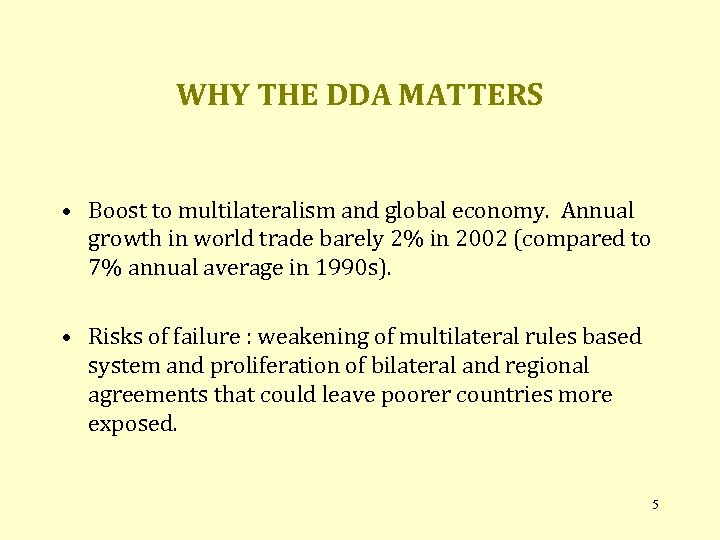
WHY THE DDA MATTERS • Boost to multilateralism and global economy. Annual growth in world trade barely 2% in 2002 (compared to 7% annual average in 1990 s). • Risks of failure : weakening of multilateral rules based system and proliferation of bilateral and regional agreements that could leave poorer countries more exposed. 5
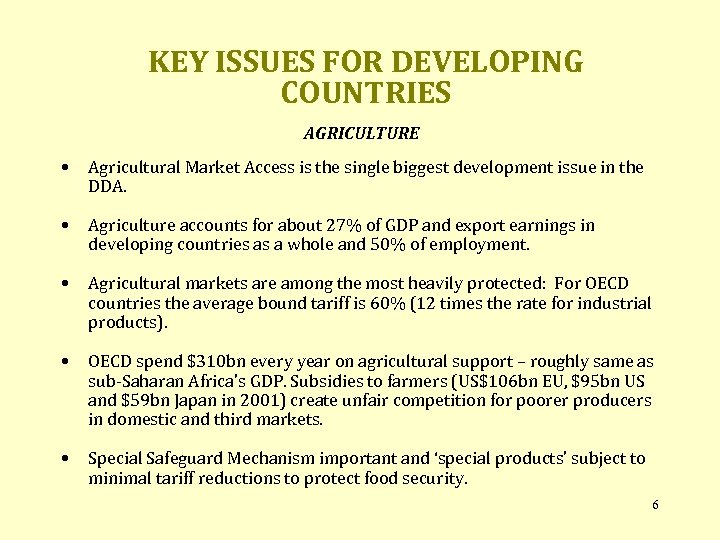
KEY ISSUES FOR DEVELOPING COUNTRIES • • • AGRICULTURE Agricultural Market Access is the single biggest development issue in the DDA. Agriculture accounts for about 27% of GDP and export earnings in developing countries as a whole and 50% of employment. Agricultural markets are among the most heavily protected: For OECD countries the average bound tariff is 60% (12 times the rate for industrial products). OECD spend $310 bn every year on agricultural support – roughly same as sub-Saharan Africa’s GDP. Subsidies to farmers (US$106 bn EU, $95 bn US and $59 bn Japan in 2001) create unfair competition for poorer producers in domestic and third markets. Special Safeguard Mechanism important and ‘special products’ subject to minimal tariff reductions to protect food security. 6
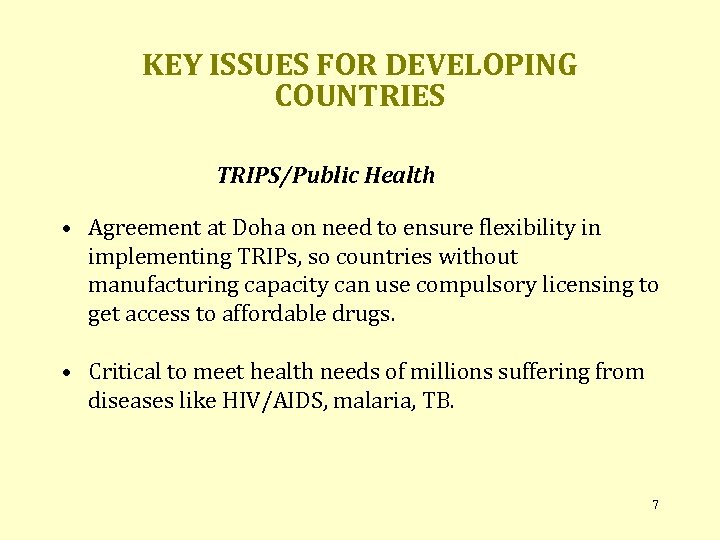
KEY ISSUES FOR DEVELOPING COUNTRIES TRIPS/Public Health • Agreement at Doha on need to ensure flexibility in implementing TRIPs, so countries without manufacturing capacity can use compulsory licensing to get access to affordable drugs. • Critical to meet health needs of millions suffering from diseases like HIV/AIDS, malaria, TB. 7
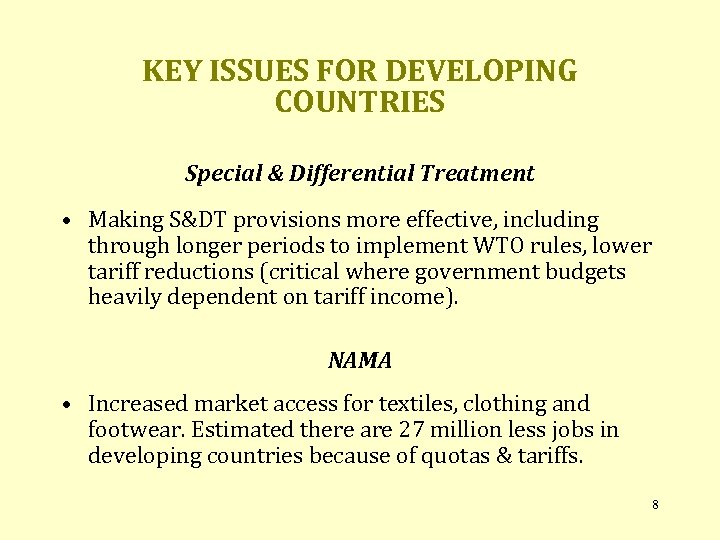
KEY ISSUES FOR DEVELOPING COUNTRIES Special & Differential Treatment • Making S&DT provisions more effective, including through longer periods to implement WTO rules, lower tariff reductions (critical where government budgets heavily dependent on tariff income). NAMA • Increased market access for textiles, clothing and footwear. Estimated there are 27 million less jobs in developing countries because of quotas & tariffs. 8
KEY ISSUES FOR DEVELOPING COUNTRIES Services • Significant interest in Mode 4 (temporary movement of workers). • Estimated that an increase in developed country quotas for skilled and unskilled temporary labour equivalent to just 3% of their labour forces would create increase in global economic welfare 1. 5 times greater than gains from liberalisation of all remaining trade restrictions. Trade Related Capacity Building • Delivery on commitments. 9
PROGRESS SO FAR Least progress on the issues that matter most to developing countries: • Agriculture: Missed deadlines on modalities for new Agriculture agreement. Awaiting EU CAP reform. • TRIPS/public health: Every member except US able to sign up in December to compromise text. No agreement yet. • S&DT: Need agreement on substantial package of measures. • NAMA: another missed deadline. 10
OBSTACLES • Political will to take on powerful domestic interest groups in OECD (agricultural reform; TRIPS/public health; and in developing countries that stand to gain from increased South -South trade too. • More WTO members; more significant players with divergent interests (e. g. Cairns Group versus those defending ACP preferences). • Polarised positions on extent of liberalisation (agriculture and NAMA). • Lack of progress on key issues (e. g. reduction of trade distorting OECD agricultural subsidies) slowing down progress on other issues (NAMA, Services, Singapore issues). 11
OBSTACLES • Breadth of the round ambitious timetable. • Serious capacity constraints especially of poorer countries to participate meaningfully in the negotiations. Lack of analysis and input from capitals (e. g. on Service sectors). • Political events (e. g. US 2004 elections) could complicate achievement of DDA deadline. 12
WHAT NEEDS TO HAPPEN – BEFORE CANCUN • Cancun less than 100 days away. • Political leadership: difficult decisions to give new momentum to the DDA. • EU member states need to reach agreement on CAP reform (Fischler proposals on decoupling agricultural support from production). • Secure US support for TRIPS/public health December 16 text. Possibly with reassurances to pharmaceutical industry on recourse to DSU in clear cases of abuse; and by developing country manufacturers. 13
WHAT NEEDS TO HAPPEN – BEFORE CANCUN • S&DT: Willingness of advanced developing countries to prioritise needs of poorest WTO members. Progress reached on substantial package of measures. • World leaders and opinion leaders need to champion the DDA. • Engagement with business and civil society. • More vocal NGO support on issues of most importance to developing countries. Ministers won’t take tough political decisions if only hear critical voices. • Mini-ministerial/s help move negotiations forward. 14
SUCCESS AT CANCUN • • • Members to recommit to ambition of DDA. Shared ownership to make it work. Realistic expectations – important step. Learn from what worked at Doha and didn’t at Seattle. EU/US leadership that made difference at Doha. Greater convergence on key issues. • Preparation for Cancun – so ministers have a manageable set of issues. • Reach some agreements to create new momentum. 15
WORKING FOR A SUCCESSFUL DEVELOPMENT ROUND BEYOND CANCUN • Chairs of negotiations put forward proposals to seed process and build consensus. • Address concerns of potential losers from loss of preferential market access (ACP); research extent of problem; IFIs, multilateral and bilateral donors give support to ease transition/diversification. • Analytical and technical assistance to developing countries e. g. on Services negotiations; commitments in individual agricultural schedules. 16
WORKING FOR A SUCCESSFUL DEVELOPMENT ROUND BEYOND CANCUN • Design of proposed framework agreements on “new issues” to address needs of developing countries (cost/benefit e. g. on trade facilitation). • New approach to S&DT more tailored to helping individual countries at different stages of development adjust to specific rules and agreements. • Coordinated approach to Technical Assistance and Trade-related capacity building by donors through Integrated Framework. 17
WORKING FOR A SUCCESSFUL DEVELOPMENT ROUND BEYOND CANCUN • Address disconnect between Geneva-based trade negotiations and national economic development policies (PRSPs etc). Integration of trade and development needed to identify new opportunities, careful sequencing of reforms. • Complementary pro-poor policies so trade contributes to Millennium Development Goals. • Democracies need to ratify agreements reached. Greater involvement of civil society and private sector in dialogue on trade and development. 18
Скачать презентацию WTO Public Symposium Fulfilling the Doha Development Agenda
a20093eafc9ef3dabc600e6214a77a36.ppt